What the Brokers Say – Issue 83

WHAT THE BROKERS SAY: Interesting news and views from across the Resource Analyst universe.

Alligator Energy (ASX: AGE)

Alligator Energy (ASX: AGE) is a cashed-up, aggressive uranium exploration company with a large strategic acreage position in one of the world’s best uranium provinces, the Northern Territory’s Alligator Rivers region.

Alligator has conducted extensive drill programs over its project area, with a total of 10,991 metres of drilling completed during 2012.

Results to date justify a more systematic drill out of the Caramal deposit area during 2013, which will likely lead to a revised and upgraded Resource estimate.

Through the purchase of the Tin Camp Creek Project from Cameco and exploration licence applications covering favorable geology and structure, Alligator has secured a prospective land holding in the region and a pipeline of quality projects.

The company holds 283 square kilometres under three granted tenements and 1,025sqkm under 15 tenement applications.

With $4.8 million cash on hand, the company is able to aggressively explore its acreage.

During April 2012 the company’s aggressive exploration program paid off, with the announcement of a maiden JORC-compliant resource estimate for its primary Caramal deposit comprising 944,000 tonnes at 0.31 per cent uranium for 6.5 million pounds uranium (at a 0.1 per cent uranium cut-off), located within its Tin Camp project area.

The results from drilling during late 2012 at Caramal point to a likely sizeable upgrade in the resource base.

Alongside the Athabasca Basin in Canada, the Alligator Rivers province ranks as one of the world’s premier uranium addresses in terms of hosting large, high-grade deposits.

In fact the province hosts nearly 1 billion pounds of high-grade uranium resources and past production, including the operating Ranger mine and the nearby Jabiluka deposit.

The Alligator River region however has had significantly less exploration attention than the geologically-similar Athabasca Basin, which continues to produce new discoveries.

Therefore the prospect of further significant discoveries within the ARUP should be considered extremely good.

Alligator purchased its flagship Tin Camp Creek tenements from established uranium producer, Cameco Australia, a subsidiary of Canada’s Cameco.

The project contained advanced drilling targets, both to extend and validate known zones of uranium mineralisation, as well to allow systematic exploration of prospects that have untested radiometric anomalies and/or limited previous drilling.

High-grade uranium mineralisation had previously been intersected at numerous prospects on Alligator’s granted tenements, including the historic Caramal deposit. Some of the best high-grade intersections included 21m at 0.5 per cent uranium and 22.7m at 0.38 per cent uranium at Caramal, 15m at 0.47 per cent uranium at South Horn and 15m at 0.19 per cent uranium at Gorrunghar.

Apart from its geological prospectivity and strong mining history, the other key factor that makes the Northern Territory the place to be from a uranium perspective is the fact that the Northern Territory Government actively encourages uranium exploration and project development.

Recommendation: Speculative BUY

 

Manas Resources (ASX: MSR)

We like Manas Resources (ASX: MSR) because it’s a near-term, potentially very low cost gold producer that could bank plus US$100 million over 5 years, even at US$1100 per ounce gold from 2016.

We expect some of this short, sharp injection of cash to find its way into exploration of MSR’s large and highly prospective tenement package in south-western Kyrgyzstan.

Price catalysts for 2013 could include final permitting, funding and start of construction at Shambesai.

Further exploration success is a good possibility.

Manas Resources is an Australian‐based company focused on exploring and developing its 100 per cent‐owned gold projects in south-western Kyrgyzstan.

The company has a Mineral Resource base of 1.25 million ounces of gold at the Shambesai and Obdilla prospects.

A feasibility study has been completed for Shambesai.

MSR received a Mining and Development Licence for the project in late 2012. Gold production (245koz Au over 4.5 years) is expected to commence in 2014.

We consider MSR to be a very attractive if Speculative investment for several reasons:

Low cost, near term gold production: Shambesai could produce at least 245,000 ounces of gold (Probable Reserve) at an average C1 cash cost of $411 per ounce via open cut mining and vat/heap leaching

This would make MSR a lowest-cost-quartile producer. CAPEX to first gold is a very modest US$32.6 million.

Strong cash flow: we estimate that net cash flow from the project over 4.5 years (late 2014 to early 2019), including taxes and capital cost repayment, will be US$107 million (gold) US$1100 per ounce LT; this increases to US$151 million at US$1600 per ounce.

At NPV, the IRR is 80 per cent. MSR’s market cap is currently less than $30 million so the potential value-add is considerable.

High exploration potential: MSR’s 100 per cent-owned South West Kyrgyz gold project covers 3,500sqkm of the Tien Shan gold belt, which hosts the 17 million ounce Kumtor in Kyrgyzstan and the plus 100 million ounce gold Muruntau in Kazakhstan.

There approx. 54 prospects divided among nine projects, most of which have barely been tested.

The prospectivity of this ground is hard to overstate. Discovery costs to date have been $16 per ounce.

Experienced operators:
we are comfortable with Management’s ability to deliver Shambesai and grow MSR’s resource base.

The Board includes representatives of parent company and mid-cap gold miner Perseus Mining (ASX: PRU).

The recent appointment to non-exec of Papillion Resources (ASX: PIR) managing director Mark Connelly (ex Adamus/Endeavour) is a very encouraging sign.

Valuation
Our 12-month share price target for MSR is $0.25/sh, with a recommendation of BUY (Speculative).

This is based on a DCF analysis of the Shambesai Gold Mine (245,000 ounces), an EV/resource valuation of gold not included in the Shambesai feasibility study (1 million ounces) and a nominal amount for further exploration (10 per cent).

Azure Minerals – Mexico’s favourite Aussies

THE INSIDE STORY: It’s encouraging when an exploration company exemplifies the definition of the term explorer, which according to my dictionary: ‘travels into undiscovered or un-investigated territory’.

In 2005, while contemporaries wrestled over projects in Australia or headed to less-politically friendly climates in Africa, Azure Minerals (ASX: AZS) journeyed to Mexico.

“We were looking for projects, but what was available in Australia was too expensive and most of the good projects had been well picked over,” Azure Minerals managing director Tony Rovira told The Resources Roadhouse.

“We looked in Central and South America, Africa and Indonesia, but Mexico stood out with better projects, not just technically, they were located in an ideal mining environment.”

Azure was by no means the first mining company to recognise Mexico’s potential.

Today over 350 mining and exploration companies with a healthy representation from North America, particularly Canada, operate in the country.

Azure was, however the first Australian company to stake its Mexican claim.

What is not celebrated outside of the America’s, is Mexico’s reputation as a mining friendly jurisdiction and mining history dating back over 500 years.

“The government and the general population understand the benefits mining brings so they want to help you and to attract more investment,” Rovira said.

“Its mining history combined with the current exploration and mining activity means there is a substantial support industry in place.

“There are dozens of drilling companies and assay laboratories, all the infrastructure you need is there.”

Azure’s introduction to Mexico was an earn-in Joint Venture with a Canadian junior company.

Once established, Azure staked properties in its own right.

Azure Minerals project locations in Mexico. Source: Company

The project to emerge as the company’s flagship is the Promontorio copper-silver-gold project, located in Chihuahua State.

Promontorio possesses high-grade copper sulphide mineralisation containing significant grades of gold and silver.

In the four years it has held the project, Azure has completed three large-scale diamond drilling programs totalling some 87 holes for around 13,000 metres.

From this drilling it has calculated an initial JORC-complaint total mineral resource of 502,000 tonnes at 4.7 per cent copper, 2.1 grams per tonne gold, 99 grams per tonne silver for 23,400 tonnes of copper, 34,000 ounces of gold and 1.6 million ounces of silver.

“It is a high-grade copper-gold-silver project that is modest in terms of tonnes at this stage, but we consider it to hold a great deal of potential for expansion,” Rovira explained.

“The most recent drilling at Promontorio was completed in January this year and the results have been very encouraging.

“We have completed a Scoping Study and a Pre-Feasibility Study as well as economic evaluation and mine planning, which have provided very positive results.

“We anticipate the increase in the resource will be enough to get this project up and running for a mine life of around eight to nine years.”

Azure recently drilled two holes outside of the Promontorio deposit to test two areas where historical shallow drilling, by previous owners, identified gold and silver mineralisation.

The first of these areas was Cascada, situated 200m northwest from Promontorio.

From 40m Azure intersected 70m of copper sulphide mineralisation grading 2.7 per cent copper equivalent.

That 70m interval included 36m of material running at 4.7 per cent copper equivalent, including a 13m intercept at 11 per cent copper equivalent.

Rovira acknowledges the result stemmed from one single drill hole, but in any language, a 70m intercept draws attention and could possibly indicate a deposit with significant size potential.

“The Promontorio deposit consists of veins varying two metres to five metres wide, whereas we think Cascada has potential to be a large volume deposit, with potential high grades as well,” Rovira said.

“Cascada definitely demands more attention and we intend conducting some serious work there involving a significant amount of diamond drilling.”


Targets surrounding Promontorio. Source: Company announcement

Testing of the other target near Promontorio called Risco Dorado, or Golden Cliff, also raised eyebrows by intersecting an 11m wide interval of silicified volcanic rocks containing disseminated and semi-massive pyrite and copper sulphides.

“It just shows the Promontorio project is not just the Promontorio deposit but includes numerous additional opportunities along strike, which require further work,” Rovira said.

“We see potential to develop a large mining operation. We’re very excited by what we have discovered so far and we will be back in there drilling as soon as we can.”

When the Global Financial Crisis brought tough economic times Azure was approached by Japanese Government organisation JOGMEC (Japan Oil, Gas and Minerals National Corporation), which also recognised Mexico’s potential for big mineral deposits, to form a Joint Venture to explore for copper deposits in Mexico.

Having similar arrangements in Australia JOGMEC was pleased to JV with a company in Mexico boasting Australian exploration expertise.

Azure’s two Joint Ventures with JOGMEC cover the El Tecolote and La Tortuga projects where the search is on for porphyry copper and skarn copper-zinc deposits.

Azure is free carried and operator of both projects.

JOGMEC can earn 70 per cent interest of the El Tecolote project by sole funding US$13 million of exploration expenditure. To date about US$3M has been spent.

So far El Tecolote has undergone several geophysical surveys, including aeromagnetics, VTEM and IP, as well as geological mapping and sampling, and 30 diamond drill holes.

Some very encouraging copper and zinc intercepts have been made, and further drilling is being planned to define the mineralised zones.

At the La Tortuga project, JOGMEC can earn 51 per cent interest by sole funding US$3 million of exploration expenditure and to date about US$2.5M has been spent.

“La Tortuga, or The Tortoise, is actually an apt name because we have been exploring this project in Joint Venture with JOGMEC for five years,” Rovira said.

“It has been progressing slowly, but with encouraging results, and we are confident slow and steady is going to help us win this particular race.”

Geophysical work at La Tortuga resulted in the identification of a large, deeply-buried porphyry copper target, into two deep diamond core holes of over 600m were drilled.

“We know the target starts around 600 metres below surface, but the strongest part of the anomaly is at a depth of about 1,000 metres,” Rovira said.

“One hole reached 660 metres and the other 605 metres. Both holes drilled into the top of the body and intersected promising looking porphyry rocks containing indications of precious metal and base metal mineralisation.

“We plan to drill another hole very soon; this time with a target depth of 1000 metres, which will take us into the middle of the anomaly.”

The next six months will be a very busy time for Azure Minerals as it works to complete the resource update for Promontorio, which is anticipated in April.

There will also be follow up drilling at Cascada and Risco Dorado plus regional mapping and sampling to identify more drilling targets within the project area.

“We also have a gravity survey at La Tortuga to assess and we expect to commence drilling the deep diamond hole very soon,” Rovira said.

“We don’t know what we will find down there, but what we’ve seen so far has been very encouraging.

“Our model is a big porphyry copper or IOCG-style of deposit, and if we’re successful then that will kick-off an entire new ball game for the company.”

Azure Minerals Limited (ASX: AZS)
…The Short Story

HEAD OFFICE
Level 1, 30 Richardson Street
West Perth, WA 6005

Phone: +61 8 9481 2555

Fax: +61 8 9485 1290

Email: admin@azureminerals.com.au

DIRECTORS and MANAGEMENT
Peter Ingram, Anthony Rovira, Wolf Martinick

MAJOR SHAREHOLDERS
Yandal Investments Pty Ltd    5.2%
Drake Private Investmenst LLC    5.1%
Stadjoy Pty Ltd            2.5%

SHARES ON ISSUE
566 million

MARKET CAPITALISATION
$44 million (at 25/02/13)

Ric Dawson – AMMG

ONE OFF THE WOOD: Ric Dawson, managing director of Australia Minerals and Mining Group stopped in this week to give us the low down on his company’s exciting new process for converting kaolin to alumina.


Ric, Australia Minerals and Mining Group (ASX: AKA) recently announced a new technology that is capable of producing 3N high-purity alumina (HPA), what does that mean?

It is a bit of industry jargon – 3N means three nines, therefore we are able to produce alumina of 99.9 per cent purity. People within the industry refer to products being 3N, 4N or 5N.

Basically the more nines, the higher the purity of the alumina product, and therefore the higher the price customers will pay for it.

When you start to enter the 4 nine, or 4N, territory, you begin to see a very significant increase in the price – around $300 to $400 a kilogram, or $300,000 to $400,000 per tonne.

That’s an impressively priced commodity.

The reason the price for the high-purity alumina is so high is because it is used in many different forms these days.

It is in high demand for modern-day technology, being used in LED screens, LCD lights, motherboards and high-tech ceramics, whereas the standard less-pure alumina, basically is a feedstock for the aluminium industry.

The unique element of your process though is the feedstock you are using to produce the alumina. Could you enlighten us as to what that is?

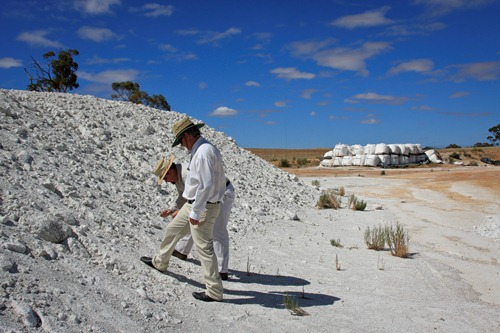
The feedstock being used is aluminous clay, which is probably better known as kaolin.

The samples for the testing were sourced from all four of our South West high purity alumina (HPA) projects in Western Australia, and the material has performed well demonstrating it has the properties to be the ideal clean source of aluminous clay for producing high-purity alumina using our process.

Our consulting processing chemists have verified the purity of product at greater than 99.9 per cent – or greater than 3N.

We expect that once we have made further refinements to the process we will be able to produce a product of 99.99 per cent purity, in other words 4N.

What is kaolin and how is it currently used?

Kaolin is white porcelain clay that has historically been used in ceramics and, to a greater degree but probably less known, in the paper industry providing the sheen across the glossy pages of magazines.


What does your process offer the alumina industry?

What we have accomplished is to identify an adjunct to creating alumina, rather than using bauxite via the Bayer process.

We’re now saying we think we have a new technology, which means we can use aluminous clay – or kaolin – as a feedstock to create alumina.

The Bayer technology is an old technology.

It is a one hundred year old technology. We are aiming to provide an advanced new technology that is a viable alternative.

Are you able to give us an idea of how the process works at this stage?

We are just about to lodge our patents for the process within the next few weeks so if I did tell you I would then have to kill you.

However, what I can tell you is that the kaolin is attacked by an acid-based process and that is completely different to the Bayer process, where they come from the other end of the PH scale using caustic soda to attack the bauxite.

So this is the first time anybody has used kaolin to produce alumina?

There is a Canadian company, called Orbite, using a similar acid-based approach; however they are starting with iron-enriched clay, which means they have to first extract the iron before they can reach our starting point.

They’re probably about 12 months ahead of us at this stage but their share price has gone from 10 cents to five dollars, which demonstrates this type of technological advancement can be rewarded by the stock market.

The kaolin to alumina process, we believe, is going to have a much lower capital cost, it will have a much lower energy cost as it uses lower temperatures and pressures, which all adds up to a much lower operating cost.

The technology produces minimal waste and the key reagents are recyclable, therefore, the efficiencies are high.

You said the Kaolin is being sourced from your South West high purity alumina project. Where is the project located, and what are you doing there?

We own 100 per cent interest of the South West HPA project, which is located in the south west of Western Australia in the Yilgarn mineral belt, through our wholly-owned subsidiary company Kaolin Resources.

The Yilgarn Craton is one of the oldest weathered cratons on earth. The weathered granites have left the residual kaolin so that the deposits are ‘primary’ or ‘in situ’ in nature, as opposed to others that may be ‘secondary’ or transported in nature.

The ancient weathering process has left us with a whitish coloured kaolin that possesses extremely low levels of impurities, such as iron and titanium, and extends from surface to a depth of 42 metres.


The project is made up of one granted exploration licence and nine applications.

We are anticipating being able to source aluminous clay, or kaolin, from our projects at Meckering, Kerrigan, Kellerberrin and Bobalong.

We have already delineated two separate JORC-complaint resources at Meckering and Kerrigan aluminous clay projects.

These two projects already hold a total resource of 150 million tonnes with screened grades of up to 38 per cent alumina, with an exploration target ranging from 485 million tonnes to 830 million tonnes.

We are conducting trial mining in a test pit at Meckering where we have defined a JORC Resource of 65 million tonnes – 16.77 million tonnes indicated and 48.28 million tonnes inferred.

The Inferred Resource at Kerrigan currently stands at 85 million tonnes.

You have indicated your next phase of exploration is being planned to increase this resource. What will this involve and when will it start?

We anticipate this will involve additional aircore and some diamond drilling with geochemical analysis to increase our confidence and size of the Meckering aluminous clay resource, in approximately the middle of this year.

In addition, some planning will go into determining the optimised location for a potential pilot plant to process the aluminous clay to HPA.

We have had significant interest from overseas investors wanting to get a better understanding of our new process, size of the projects and how they can get involved with AMMG.

The illogicality of markets presently – gold must eventually trade higher

GAVIN WENDT: I’ll never cease to be amazed by the logic (or the apparent lack of it) with respect to financial markets.

Over the past few weeks so-called ‘experts’ have been telling us that gold’s un is over – and that the price is suffering due to renewed optimism with respect to the US economy, based on improving data over there and the resolution of the fiscal cliff issue.

Well, last Friday gold fell once again (a sizeable 1.8 per cent fall) that extended a week-long trend, but US economic data released simultaneously was not exactly encouraging – in fact, far from it.

And the fiscal cliff issue again reared its ugly head.

The data showed that US industrial production was weak and accompanied by a sizeable 2.2 per cent drop in sales by Wal-Mart Stores.

The performance of Wal-Mart is a much better and more accurate ‘real-life’ example of actual customer-related confidence than consumer confidence surveys themselves.

According to internal emails, Wal-Mart had its worst start to a month for sales in seven years, with a Wal-Mart VP calling February MTD sales “a total disaster” (Bloomberg).

Wal-Mart’s executives had actually expected the opposite – a strong start in February because of the Super Bowl, milder weather and wage cycles.

But the fragility of US economic recovery is still very much apparent.

Meanwhile, the US fiscal cliff debate is far from being resolved.

With the 1 March deadline looming, Senate Democrats have proposed a deal to delay the scheduled budget cuts to 2 Jan 2014 and replace them with US$55 billion in new revenue and US$55 billion in spending cuts.

While earnings, economics and talk of a currency war have taken centre stage recently, with the 1 March deadline nearing, the fiscal cliff debate will return to the fore during the coming weeks.

Returning to the gold price itself, the price stabilised around US$1,600 per ounce after retreating to US$1,598 per ounce – its lowest level since August 2012.

There doesn’t seem to be much logic in gold prices retreating firstly due to recent positive economic news – then again on weaker news.

But that’s the market!

Gold price support remains at around US$1,600 per ounce.

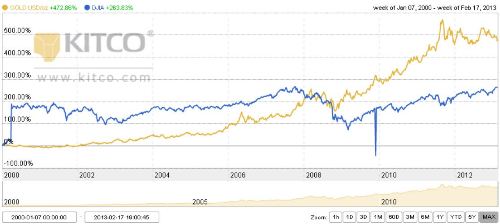
The chart below clearly underscores the extent to which gold (the gold line) has outperformed the Dow Jones Industrial Average since the year 2000.

Whilst gold has endured comparative headwinds over the past few years in terms of its price performance, these are in reality no different to any other period in gold’s more-than-a-decade-long price run that began back in 1999/2000.


As always, you have to take a step back in time and examine the bigger picture.

The important thing about the fluctuating price of gold since 2008 is that it’s typically fulfilled its role as an insurance policy and tore of value – and has from time-to-time been sold to fund losses on declining assets elsewhere in investors’ portfolios – typically equities and property.

This means that gold has, to some degree, been exposed to forced selling.

At the end of the day however, gold remains the ultimate insurance policy for investors.

Despite its price volatility, gold has managed to stabilise around its long-term trend-line of US$1,600 per ounce.

Central Banks gold buying at its highest level since 1964

The actions of central banks worldwide continue to fly in the face of the hordes of financial experts that point to an improving economic picture and growing confidence.

Instead, the World Gold Council’s latest report released this past week highlights the fact that investors and central banks continue to seek safety in gold.

The report highlights that gold demand during 2012 reached yet another record high of $236.4 billion – which included a six per cent increase in value terms during Q4 2012 alone to $66.2 billion (the highest fourth quarter on record0.

In fact, gold demand during Q4 2012 rose by four per cent to 1,195.9 tonnes.

Just as significantly, central bank gold buying reached its highest level since 1964, with purchases for 2012 rising by 17 per cent to 534.6 tonnes, with 145 tonnes purchased during Q4 2012 – up nine per cent from the same period a year ago and the eighth consecutive quarter in which central banks were net purchasers of gold.

From our perspective what this situation clearly demonstrates is a clear lack of confidence on the part of emerging economies in the traditional and established world reserve currencies – like the dollar, the euro and he pound.

And who could blame them, given the trillions of dollars that have been printed and fed into the financial system for little net effect?

Not surprisingly, the WGC anticipates that central bank buying will continue this year, driven by emerging market economies and central banks.

Importantly too, the figures quoted by the WGC report do not include any gold purchases made by China, but there is ongoing speculation that China has been buying gold but not yet revealing it – which it has done many times in the past.

China had been widely expected to surpass India last year in terms of demand, but WGC figures show that it lagged India by 88 tonnes.

Apparent Chinese demand was flat year-on-year, reflecting the impact of economic slowdown, however during Q4 20112 demand rose by one per cent to 202.5 tonnes.

The WGC postulates that the economic slowdown in China appears to have been shorter than expected, auguring well for future demand.

“Notwithstanding the predicted economic slowdown in China, investment demand was up 24 per cent in Q4 on the previous quarter and jewellery consumption held steady at 137 tonnes,” according to WGC managing director Marcus Grubb.

“Despite the turbulent macroeconomic climate throughout the year, as well as the regional uncertainties affecting India and China, the two largest gold markets, annual demand was 30 per cent higher than the average for the past decade,” he added.

Russian central bank amongst world’s biggest gold buyers – lacks confidence in the US$

As Bloomberg recently reported, “when Russian PM Vladimir Putin says the US is endangering the global economy by abusing its dollar monopoly, he’s not just talking – he’s betting on it.”

Not only has Putin transformed Russia into the world’s largest producer of oil, he’s also made it the world’s biggest buyer of gold, with his central bank purchasing 570 metric tons over the past decade.

This is in fact 25 per cent more that the world’s second-largest buyer, China.

Sentiment is best expressed by the recent quote by one of Putin’s fellow party members Evgeny Fedorov, who told Bloomberg, “The more gold a country has, the more sovereignty it will have if there’s a cataclysm with the dollar, the euro, the pound or any other reserve currency.”

It’s a lack of confidence in the US dollar, as well as a perception that the US is abusing its position as the holder of the world’s reserve currency, that’s driven Russia’s thinking on gold.

And who can blame them?

As we’ve previously highlighted, other world leaders haven’t been as lucky with gold.

In particular Bloomberg highlights the fateful decision of Gordon Brown as the UK’s finance minister, who sold almost 400 tons of gold during a 30-month period up to March 2002 when prices were at two-decade lows.

London tabloids have famously referred to this period as Brown’s Bottom!

Gavin Wendt is the founder of MineLife, publisher of the MineLife Weekly Resource Report

What the Brokers say – Issue 81

WHAT THE BROKERS SAY: Interesting news and views from across the Resource Analyst universe.


Consolidated Tin Mines (ASX: CSD)

The acquisition of the Kagara processing facilities by Consolidated Tin’s major shareholder is of major strategic importance, providing the company with a clear pathway to production.

A 50/50 JV agreement will soon be signed with first tin production scheduled for 2014.

Consolidated Tin Mines (ASX: CSD) has taken a major step forward in its ambition to become the next Australian tin producer.

Snow Peak International (SPI), CSD’s major shareholder, recently agreed terms to acquire the Kagara Central Region processing plant (and surrounding mining operations) for a total consideration of $40 million.

The acquisition now creates a clear path to production for Consolidated Tin’s nearby Mt Garnet tin project with the flagship Gillian deposit located just 9 kilometres (by sealed highway) from the Kagara plant.

Terms of a JV between Snow Peak and CSD are currently being formalised (subject to CSD shareholder approval) however, both parties envisage a 50/50 JV with CSD providing the Mt Garnet tin project and Snow Peak providing the processing plant.

Some modifications will be required to the plant which will be funded on a 50/50 basis.

In the short term, CSD will manage the plant and continue to process ore from copper and polymetallic mines (included in the acquisition) for a 10 per cent free carry in any profit made.

The earlier signing of a $3 million funding package with Snow Peak has been used to advance exploration at Mt Garnet and complete a pre-feasibility study (PFS).

The results of the PFS are expected shortly after an understandable delay (due to the acquisition) while the recently completed 10,000 metres drill campaign is likely to lead to the company soon announcing a resource upgrade (targeting a further 2 million tonnes Mt for a total of 8 million tonnes to 10 million tonnes of tin mineralisation, averaging 0.5 per cent tin).

Recommendation: Speculative BUY

Corazon Mining Limited (ASX: CZN)

Top Up Rise – high risk, massive potential

Corazon Mining Limited (ASX: CZN) recently secured an option to acquire 75 per cent of the Top Up Rise project (TUR project) located in the Gibson Desert of Western Australia.

The TUR project is a highly speculative ‘greenfield’ play that could have significant upside.

The next Olympic Dam…?

The project area covers an area of 1,380 square kilometres on the eastern margin of the Gibson Desert.

The target at the TUR project is a very large, very dense rock mass, first identified in gravity in surveys carried out by the GSWA.

Corazon believes that the anomaly has the potential to be a large Iron Oxide Copper Gold (IOCG) system.

Olympic Dam, one of the most significant mineral deposits in Australia is an IOCG deposit.

Due to the remote location and sand cover very little exploration has been carried out in the area.

In the late ‘90’s BHP explored an area to the south of TUR, following up a large gravity anomaly defined in a broad spaced regional survey that missed the anomaly at TUR.

BHP completed more geophysical surveys and defined a 3 kilometre by 6 kilometre gravity anomaly at a modelled depth of approx. 300 metres.

A combination of approval delays, logistical difficulties and a change in corporate exploration strategy meant the target was never drill tested.

Work completed by Toro Energy (ASX: TOE) on an Exploration Licence approx. 30km east of TUR discovered further encouraging indications of IOCG mineralisation.

Border Exploration, the vendor of the TUR project, completed an airborne magnetics survey over the TUR gravity anomaly and, after interpreting these results with the GSWA data, defined an 8km by 4km residual gravity high of greater than 7 milliGals above background; of similar size and more intense than the anomaly at Olympic Dam.

Corazon plans to follow-up with ground based geophysics and drill testing.

An access agreement was recently signed with the Traditional Owners and exploration work should commence in the coming months.

Option terms and capital raising

Corazon’s option on the TUR project was recently approved by shareholders.

Terms of the option are staged, with Corazon progressively earning up to 75 per cent of Border on the satisfaction of various milestones and payments.

Corazon recently announced a share placement and SPP to raise up to $3 million to fund exploration at TUR and the company’s Canadian projects.

Oil & gas style risk/reward

With a fully diluted market capitalisation of just $9.7 million and a post-raise Enterprise Value of $7 million Corazon is, in our view, an exceptionally cheap option on potentially massive upside.

We believe the downside is limited by this cheap entry and the company’s Canadian exploration assets, which we believe are attractive in their own right.

Consequently we rate Corazon as a:

Speculative Buy.

Disclaimer: The above is intended as a guide only. The Roadhouse accepts no responsibility for investments made from this advice.

Junior companies – To get capital in, get your story out

Accessing capital is one of the critical issues facing the industry today.

The mining project development funding pie is not as large as it has been in previous years and accessing a healthy enough slice is becoming increasingly difficult for the junior end of town.

A quick scan of the boards of the Australian Securities Exchange tells us there are currently around 670 mining companies listed with a total market capitalisation of approximately $435 billion.

Closer examination tells us about 60 per cent of these companies have a market cap of less than $20 million.

Probably more sobering to note is that the top ten resources companies dominate in terms of market cap accounting for around 90 per cent of the total value for the sector

The Initial Public Offering market has taken a beating with some $200 million raised through new IPOs last year.

That seems a nice big number, yet in reality that figure is down almost 70 per cent, from the year before.

What these statistics tell us is that the resources industry is suffering, particularly junior companies, so it is not surprising they are turning more and more towards alternative sources of funding away from traditional bank debt and equity markets to fund their projects.


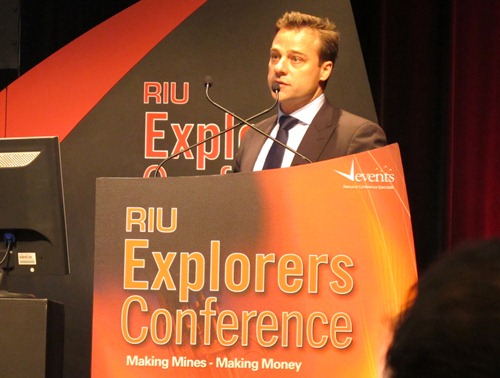
“Without the ability to raise equity and have equity market support going forward is making it challenging,” Westpac Institutional Bank director of Natural Resources Todd Ross told the recent RIU Explorers Conference.

“In saying that, debt is available, certainly for high-quality projects and low risk projects, and in that space the market is incredibly competitive.

“We are seeing offshore banks and other non-bank lenders coming into the market with margins lowering and structures looser in some instances.

“The bank market in general – certainly the Australian banks are facing a lot of challenges in terms of their cost of capital.”

According to Ross there is a key theme emerging the moment, which is that having a clear funding strategy is vital for a company when it comes to being able to get the financial support it needs to take a project forward.

The current state of play results in a run up of the equity price of a company when it makes a discovery the market considers being of some significance, such as we have witnessed in recent times with Sirius Resources (ASX: SIR) and its Nova deposit discovery.

Ross said the honeymoon tended to last as long as reaching the Bankable Feasibility Study (BFS) and construction, after which share prices fall back as the initial excitement dies down.

Once companies hit the commissioning and then first production stages, there tends to be a rerating of the company.

“In the last few BFS results that have come out, we have seen that trigger point happening a lot more aggressively,” Ross said.

“With the release of the BFS we have seen a fall of some 30 to 40 per cent in equity market values at that point as the market takes a negative view about the company’s ability to fund debt for their project.

“This has certainly been the case for a lot of the base metal companies in the past 12 months.”

In terms of the structure of ASX-listed companies – approximately 15 per cent are actually in production at the moment, which Ross said indicates therefore only 15 per cent are generating some form of cash flow.

Five per cent are in the development stage with funding already arranged, 30 per cent are at some stage of Feasibility Study with the view that within the next 18 to 24 months they’ll be coming to the market in order to raise funding for their projects.

The remaining 42 per cent are exploration focused with the final eight per cent in Scoping Study stage.

“All of them are burning through cash pretty rapidly and will be looking for access to funds fairly soon,” Ross said.

Ross encouraged these companies to be more proactive in generating some positive news flow to the market.

“It’s difficult to do that and it is also difficult to have the successes on discoveries,” he said.

“That continual news flow and the ability to tap the market when necessary by partnering early with funding providers is essential.

“The investor community is certainly more focused at the moment on maintaining capital and putting direct investments into things like exchange traded funds or direct commodity investments rather than directly into equities.

“The multiply effect they used to enjoy isn’t there anymore and the equity markets are certainly not providing any support.”

KalNorth Gold Mines commences mining operations

OUT AND ABOUT: KalNorth Gold Mines recently commenced mining activities at the Lindsay’s gold mine, which is part of the company’s KalNorth Gold Field located 65 kilometres form the historic gold mining town of Kalgoorlie in Western Australia.

The mine is the first of four, including Kurnalpi, Kalpinin and Mt Jewell for a combined resource of 1.2 million ounces of gold; KalNorth intends to bring on over the next few years.

The 1,235 square kilometres of KalNorth Gold Field tenements are all 100 per cent-owned by the company.

The company’s strategy for mining its tenements could be viewed as either one of impatience or impudence, however either way it is proving effective.

Instead of putting itself through the usual protracted approach of constructing its own processing plant favoured by many of its contemporaries, KalNorth has decided it is best to just start mining.

That decision has its merits considering the mine’s proximity to the Carosue Dam processing facility of Saracen Resources.

KalNorth started mining the Parrot Feathers open put at Lindsay’s, which it anticipates to operate for 18 months delivering 440,000 tonnes of ore for 40,000 ounces of gold.

The company is to sell the mined ore at the mine gate to its neighbour Saracen, which will then process the material at the Carosue facility.


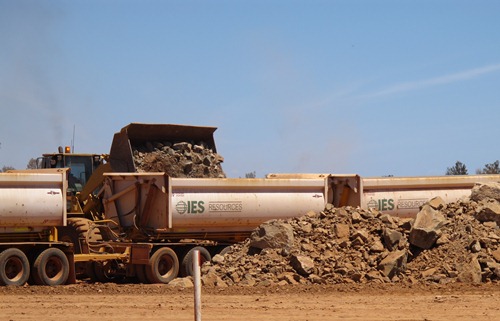
Loading the first truckload of ore bound for Carosue Dam

KalNorth has also contracted the mining and transport aspects of the operation, which it says leaves it with a predictable and fixed cost base for the entire operation while outlaying limited capital expenditure and without incurring any debt.

The seemingly rapid start-up of the Lindsay’s gold mine has been at least eight years’ in the making when the company was operating under its former name of Carrick Gold.

The company had conducted a great deal of drilling over, what is now known as, the KalNorth Gold Field during that time.

Just over two and half years ago company chairman Laurence Freedman joined the board, bringing with him a determination to get things moving.

“We decided the first thing to do was to reassess every hole that had been drilled,” Freedman told The Resources Roadhouse.

“We appointed John McKinstry as managing director and he set about that massive task.”

The reassessment of the historic drilling left the company in no doubt it had one gold mine, which quickly grew to three mines.

KalNorth then acquired the Mt Jewell project, which it considers to be a future large low-grade mining operation.

KalNorth had now identified four potential mines and had reached the point of how it was going to bring them into operation.

Freedman said he approached Mckinstry with the idea of deciding on a mine and then doing everything possible to bring it on stream.

“He said we’re going to have to raise $60 million for the mill and other infrastructure,” Freedman explained.

“I didn’t want to be calling on shareholders every six months to raise money to keep us going.

“Then it came to me that there is a better way to do it in our circumstances, and that was effectively, to rent everything.

“So we have now contracted the mining and contracted a separate group for the transport and then Saracen for the milling.”

Having the big toys in such a situation means the company processing the ore, in this case Saracen Mineral Holdings, gets to enjoy a healthy slice of the royalty pie.

However, Freedman said his company was still able to bring home a healthy wedge.

“[With the gold price] at $1600 an ounce we are making around $400 an ounce, Freedman said.

“We will, within 18 months mine and produce 40,000 ounces of gold from the Lindsay’s open pit.

“If the gold price goes to $1650…we make an extra $4 million in that 18 months.”

Freedman indicated the company was in good shape financially with around $5 million in the bank.

He said what he expects the company to do this year is to be aggressive in increasing both resources and reserves at on the KalNorth Field.

Freedman intimated the company was also close to naming which of its other three mines would be the next to be developed.

“The deal with Saracen Minerals is to process ore from Kurnalpi, Kalpini and Lindsay’s, so it will be either Kurnalpi or Kalpini.”

Disclaimer: the Roadhouse travelled to Kalgoorlie as a guest of KalNorth Gold Mines.

Breakaway Resources receives Sandfire JV drill results

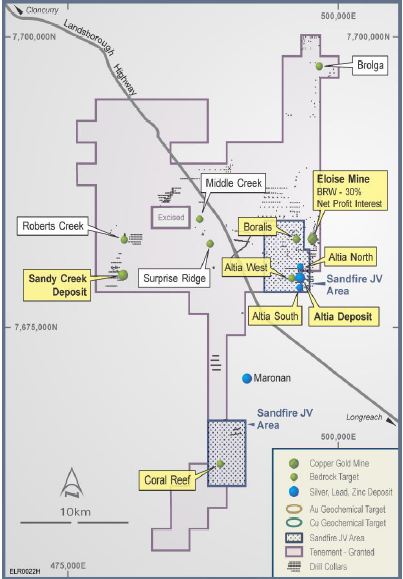
THE DRILL SERGEANT: Breakaway Resources (ASX: BRW) has received results of a drilling program conducted by its Joint Venture partner Sandfire Resources (ASX: SFR) at the Broader Altia project, located south-east of Cloncurry in north-west Queensland.


Breakaway / Sandfire JV area (in blue). Source: Company announcement


Sandfire completed a maiden reconnaissance diamond drilling program at the Broader Altia project before Christmas, which comprised five diamond drill holes.

Three holes were completed at the Altia deposit and two at the Boralis prospect.

The Altia deposit has an Inferred Resource of 5.8 million tonnes at 4 per cent lead, 40 grams per tonne silver and 0.5 per cent zinc for 229,000 tonnes of contained lead, 7.5 million ounces of silver and 29,000 tonnes of contained zinc.

Breakaway explained the objective of this maiden drilling was to scope out the project’s potential for large-scale Broken Hill Type lead-zinc-silver discoveries within the joint venture area similar to the nearby Cannington deposit.

Assay results have been received for all holes, with intersections including:

–    1 metre at 4.1 per cent lead and 2.4 per cent zinc from 304.3 metres and 0.6 metres at 1.2 per cent lead and 0.5 per cent zinc from 307.8 metres; and

–    0.5m at 1.6 per cent lead from 700.4m.

Down-hole EM surveys were conducted on all holes drilled, however full interpretation of the EM data has yet to be completed.

Breakaway indicated the findings from the DHEM’s will be used for a subsequent drilling program, which is planned in the second Quarter of 2013.

“The reconnaissance drilling program has demonstrated that mineralisation extends both north and south of the existing Altia resource, with preliminary results of follow-up down-hole EM highlighting several potential off-hole conductors,” Breakaway Resources managing director Victor Rajasooriar said in the company’s announcement to the Australian Securities Exchange.

“We are pleased that Sandfire was able to carry out a maiden drilling program at Altia so quickly after executing the joint venture late last year.”

Under the Joint Venture agreement Sandfire can earn an initial 60 per cent interest in the Broader Altia project by spending $4 million on exploration over a three-year period, and can then elect to increase its stake to 80 per cent by spending a further $4 million over the subsequent three years.

Sandfire can withdraw after spending a minimum of $1 million within the first year of the Joint Venture.

Drilling conducted prior to the Sandfire JV by Breakaway during 2010 and 2011 demonstrated that the Altia deposit lies within a broad mineralised system with silver-lead-zinc mineralisation drill-defined over a strike length of 1.2 kilometres and to a vertical depth of 800 metres.

Silver Lake and the Integra integration

It is morning. Day one: 2012 Diggers and Dealers conference in Kalgoorlie. Delegates are either enjoying an early breakfast or nursing a ‘gone out too hard too early’ hangover.

Silver Lake Resources (ASX: SLR) managing director Les Davis fits neither category. He literally bounds toward the Kalgoorlie Arts Centre eager to spread his news.

“Have you seen our announcement this morning, Wally,” Les asks as he passes me on the street.

“We took over Integra last night.”

For the rest of that day, pretty much the rest of the conference, the proposed merger between the two neighbours was the key subject of discussion.

That it was achieved and announced so suddenly came as a surprise, however most of the delegates at the conference concluded it was an obvious outcome with many commenting they were surprised it hadn’t happened earlier.

Once the numbers of the merged entity are crunched the more Silver Lake’s reasoning for the takeover become obvious.

Each company had operating mines, Maxwells (Integra), Daisy Milano, Haoma, Daisy East, Wombola, and Rosemary (Silver Lake) in close proximity to each other, processing ore through two processing facilities with a combined milling tonnage of 2.2 million ounces; Integra’s at Randalls and the Lakewood facility of Silver Lake.

Six months on and Silver Lake says the integration of Integra’s operation into the Mount Monger operations has gone smoothly with production at both mills having hit around the 98,000 ounces of gold mark by the end of December.

“Both mills are going at full steam, as they were before the takeover,” Silver Lake Resources director of exploration and geology Chris Banasik told The Resources Roadhouse.

“From an Integra perspective we are still mining the Maxwells deposit and we are still drawing down on that large ore stockpile that Integra had.

“That’s going to be the modus operandi. That plan is going to remain in place until June – July when we have finished our complete optimisation of the Mount Monger area.

“From that perspective Lakewood hasn’t changed eithers, so ore that was being fed into Lakewood from Daisy Milano and our stockpiled Wombola pit material is still happening.”

In gold producing company terms Silver Lake now has a compelling, somewhat envious project pipeline.


Silver Lake’s land position in Western Australia now covers 5,000 square kilometres of highly- prospective, under-explored tenements containing gold, silver, copper and zinc.

The company currently has JORC Resources and JORC Ore Reserves containing:

–    6.6 million ounces of gold inclusive of 1.8 million ounces of reserve;

–    10.4 million ounces of silver; and

–    140,000 tonnes of copper.

As envious as the portfolio may be the task ahead of the company now is not as easy as it appears, which is to methodically work its way through the process of optimising the combined Mount Monger projects to extract maximum production and value from the operations.

At this stage the company is considering a range of options including:

–    The treatment of high and low grade ore sources through the Lakewood and Randalls mills;

–    Expanding the Randalls mill, this could then be fed from multiple open pit and underground ore sources;

–    Sharing mains power allotments;

–    Realising operational efficiencies through shared technical services providers and consolidating corporate activities; and

–    Optimising overall exploration expenditure through a more targeted program across the company’s expanded tenement package.

“We will be looking at such things like what ore bodies to we bring on first and when will be the optimum time to do so,” Banasik said.

“When do we bring on projects like the Majestic deposit?

“What do we do with the Magic deposit, what do we do with the other Wombolas, which of the Integra underground operations – Cock-Eyed Bob or Santa do we bring in?”

The conundrum surrounding the Majestic deposit is an example of the logistic puzzle the integration of the Integra projects has presented Silver Lake.

Integra had announced its intentions to have brought the Majestic deposit on March this year.

Banasik indicated Silver Lake’s intentions regarding Majestic are somewhat different.

“We’re not going to bring Majestic on as soon as that because we are still in the process of deciding where the development of Majestic fits in within the structure of what is now a much larger company,” he said.

“That even comes down to which of our two milling facilities is the best place to process the Majestic ore, Lakewood or the Randalls plant, which would have been the only option for Integra.”

Banasik explained Silver Lake’s exploration outlook doesn’t stop at Mt Monger with the company now considering its exploration options from a whole-of-company perspective by including its Murchison, and Ravensthorpe projects.

In the grand scheme of things these have now all been bundled under the one blanket, from which Silver Lake is basing its priorities to ensure it is spending its valuable exploration dollars at the best projects, irrespective of where they are located.

“We wanted to be able to be flexible and we wanted to have options, so we are now in the process of properly evaluating those options so we end up making the best and smartest decision,” Banasik said.

“Because we are now approaching exploration from a whole-company perspective we are commencing by spending a couple of months looking at some of the copper prospects in the Murchison, then some of the crew will be sent to Mt Monger and others to Ravensthorpe.

“Later on in the year the Ravensthorpe crew will be brought back to Mt Monger and we intend ending the year back in the Murchison.”


Since the announcement of the takeover at Diggers and Dealers speculation has been rife from within and without the industry as to which company would be the next to be rolled by the Silver Lake Tsunami.

It is a fair assumption to make; given the region is a proven area for high-grade gold mining littered with smaller companies conducting a good deal of exploration work.

“We are always looking,” Banasik said dryly.

“If we said we were stopping, industry watchers would be less than enthusiastic about our business acumen.

“You always have to be on the lookout for the next thing.”

The reality facing Silver Lake, and its contemporaries, is that everything the industry does is finite.

Gold mines eventually run out of gold and if a company isn’t smart enough to be looking over the horizon for the next opportunity then – by definition – it will perish.

“We have always comfortably filled Lakewood so it is not as if we are going to be picking up neighbouring projects just to feed the mills,” Banasik said.

“We will acquire projects eventually but we consider our own projects at present are good enough to last us for quite a while.

“Any company out there that may consider itself as a possible Silver Lake target because it has ounces just for the sake of ounces had best reconsider.

“That doesn’t make a target as we have plenty of ounces ourselves – it’s whether they have a project that is of a strategic benefit or whether we consider it to be underdone and we may be able to get more out of it.

“I consider the most important thing we have achieved since announcing the takeover is that we have maintained the status quo from a production perspective.

“Over the next six months that status quo will be going through an intensive re-optimisation program”

Silver Lake Resources (ASX: SLR)
…The Short Story


HEAD OFFICE

Suite 4, Level 3
South Shore Centre
85 South Perth Esplanade
South Perth  WA   6151

Ph:    +61 8 6313 3800
Fax:    +61 8 6313 3888

Email: contact@silverlakeresources.com.au
Web: www.silverlakeresources.com.au

DIRECTORS and MANAGEMENT
Paul Chapman, Les Davis, Chris Banasik, Peter Johnston, Brian Kennedy, David Griffiths

MAJOR SHAREHOLDERS

Directors                6.8%
Dynamic Funds             5.8%
Sprott Asset Management    3.5%
Blackrock                3.5%

SHARES ON ISSUE

379 million

MARKET CAPITALISATION

959 million (at 14/02/13)

MRRT farce continues – Andrew Forrest must be laughing

GAVIN WENDT: News that the Minerals Resource Rent Tax (MRRT) had raised a meager $126 million in its first two quarters underlined the farcical nature of the prognostications surrounding the tax on behalf of Treasury and the Federal Government.

Not only was it a drop in the ocean compared to the predicted $2 billion windfall the government was counting on to balance its budget, but it highlighted the government’s folly in terms of solving its economic problems by saddling the one industry that’s working through ill-conceived taxation.

Given the enormous trashing of Australia’s international investment reputation over the past two years as a result of the mining tax issue and the direct damage caused to the mining sector in terms of added risk and uncertainty, the measly return generated by the tax is hardly a worthy return.

The longer-term damage to our industry reputation should be measured in the billions (or even tens of billions).

The current tax system is entirely adequate in terms of capturing additional earnings generated by the mining industry.

Every additional tonne of profitable product generated by the iron ore heavyweights BHP Billiton (ASX: BHP) and Rio Tinto (ASX: RIO) can be taxed via the existing company tax system.

If the Federal government was serious about increased receipts, it wouldn’t have let BHP, Rio and Xstrata negotiate the tax for them.

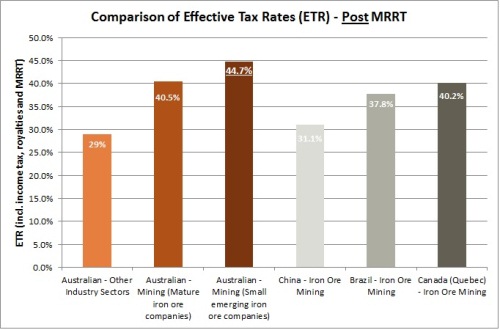
The MRRT is the derivative of the original Resources Super Profits Tax (RSPT), which would have levied a 40 per cent tax across all extractive industry, including base and precious metals, coal, uranium and mineral sands.

The MRRT is designed to impose a 30 per cent levy on coal and iron-ore companies that report profits of more than $75 million.

It was initially aimed at companies earning profits around $50 million, but this was subsequently revised.

The biggest failing of the MRRT is that it benefits the big miners – after all they helped design the tax!

The MRRT provides recognition of past investments via a credit that recognises the market value of the investment, recorded over a period of up to 25 years, while also providing a full credit for state royalties paid.

New investments are given an immediate write-off rather than depreciated over a number of years, and a project is not liable for MRRT until it has made enough profit to pay off its up-front investment.

But the biggest impact of the tax is on confidence.

Looking back, Western Australia’s Pilbara iron ore operations and the Eastern States coal industries of the Hunter Valley and the Bowen Basin, were conceived and developed by companies with long-term vision, many decades years ago.

Investment decisions weren’t made lightly – they reflected a strong level of confidence in the stability of the overall financial picture.


But what about the future?

The Federal Government’s ham-fisted approach to resource industry taxation means both domestic and international investors should be increasingly concerned about what happens next?

Will the government inevitably look to plug its funding shortfall through higher rates of taxation on the iron ore and coal industries, or will it look to broaden the tax to other sectors – precious metals, base metals and uranium?

Inevitably, the impacts of greater economic imposts on our minerals industry will be felt – particularly over the medium to longer-term.

Whilst mineral deposits are not transportable, investment dollars most certainly are.

Uncertainty now impacts exploration spending, which provides the resource discoveries a decade or two down the track.

As we’ve previously emphasized, what this all means is that there’s a growing likelihood that the next generation of major discoveries – the Pilbaras, Olympic Dams, Bowen Basins, Cadia – Ridgeways, De Grussas and Novas – won’t be made here in Australia.

Rather, they’re more likely to be unearthed in Africa, Asia or South America – which is where the exploration dollars are increasingly headed.


Gavin Wendt is the founder of MineLife, publisher of the MineLife Weekly Resource Report