Potash West firms up Dandaragan Trough project

A recent Scoping Study by Potash West has determined the Dandaragan trough project has strong economic fundamentals.

Potash West (ASX: PWN) announced the results of its initial Scoping Study into the production of potassium sulphate and other products from its Dandaragan Trough project in January.

The study considered a start-up rate of 2.4 million tonnes per annum (Mtpa), which was identified by the study to be suited to the immediate market demand in the local region.

The results of the study have validated the faith Potash West has shown in the Dandaragan Trough project since the company listed in 2011.

Its intentions back then were clear; to establish a flowsheet and complete a financial analysis for the process of extracting the potash from the glauconite on the Dandaragan Trough.

“To support that financial study we needed a JORC Resource so we had to do that as well,” Potash West managing director Pat McManus told The Resources Roadhouse.

“The budgeted cost to complete those activities was $6 million and we hoped back then to have them completed by the end of 2012.

“We achieved those milestones – the JORC-compliant Resource of 244 million tonnes at 3 per cent potassium oxide with a higher-grade core of 122 million tonnes at 4.6 per cent potassium oxide was announced for the Dinner Hill prospect in October 2012.
 

“The results of the Scoping Study based on treating that resource were released in January.”

The Capital and Operating costs estimates, and the Marketing and Revenue estimates were carried out by independent experts, Tenova Bateman and CRU respectively.  CRU studies of the market led to a scale of 2.4Mtpa mining rate being chosen as the base case.

At this scale the marketing study determined most of the production would be placed onto the market without much discount.

“We will produce not just sulphate of potash, which is the premium of potash products, but also what will be a high-magnesium sulphate of potash that should find a ready market in the palm oil industry of South East Asia,” McManus said.

“We will also produce aluminium sulphate, which has a reasonable market world-wide in water treatment and super phosphate, as well as a high-quality 70 per cent iron, iron-oxide product.”

At 2.4Mtpa the project has a mine life of more than 60 year mine.

Operating costs per year are $365 million and capital costs are $650 million.

“We believe we have quite a strong project, based on the Dinner Hill resource,” McManus said.

“The very important thing for me to take out of the Scoping Study is the very strong revenue to cash flow, nearly 3 to 1, which indicates a strong operating cash flow.

“Equally important is that the study is based on what is just a very small part of the potential ultimate resource we believe we will be able to establish across our total tenement package.”

The study emerged with three key points concerning the company’s Dandaragan trough project.

The first is that the Dandaragan deposit is positioned to become a very, very big resource.

The company plus-60 years at 2.4Mtpa, currently sitting in the nine square kilometres of the Dinner Hill prospect, which is just one of several mineralised areas Potash West has identified within its nearly 3,000 square kilometre tenement package.

The second point is the company will let the scale of the project be driven by market demand for the products it will produce, a fact Potash West considers to be of great importance as it believes entering the market too early on too large a scale would result in an over-supply and cause soft prices.

The third point is the company will be able to commence production from Dinner Hill at a relatively small scale on a robust project with a calculated Internal Rate of Return of more than 20 per cent and grow that as the markets develop.

Another important element to the Potash West formula has been the development of the company’s glauconite to fertiliser processing technology called the K-Max process.
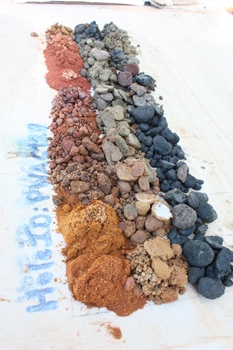
 

“K-Max is a process that has been developed by Potash West and our partners Strategic Metallurgy,” McManus explained.

“The process unlocks the value in the very large glauconite deposits that are present in the Dandaragan Trough basically by leaching and controlled precipitation.

“We have lodged a patent for the K-Max process as we feel that is the best way the company can ensure the value of the intellectual property in that process.”

The products produced from glauconite by the K-Max process are:

–    Commodity grade sulphate of potash, used as a fertiliser;

–    A high-Magnesium sulphate of potash, dubbed KMS, used as a fertiliser;

–    High-grade Iron oxide powder/granules, with potential for iron ore sales;

–    Aluminium sulphate, used in water treatment; and

–    An iron-calcium phosphate, used as fertiliser.

“The K-Max process is very much a key component to the strong economics of the project,” McManus said.

“The process we have developed is one that will allow multiple products to be produced from the glauconite and that is the key revenue element in the viability of the project.”

Perhaps the only frustrating part of the Potash West story is how to get the investment community to look beyond its blinkered view of the Australian junior exploration sector and be excited by a project with a large resource, long mine life and robust economics.

Far too many investors look at a map of Australia and see iron ore on the left and coal on the right.

“Potash is not, at this stage of the game, fully understood, or appreciated, by the Australian investment community,” McManus lamented.

In fairness, Potash is reasonably new to the Australian scene, with only a handful of ASX-listed companies working mainly on this commodity.

Potash West, however, is one of even fewer companies working up a project on home soil.

The products to be produced by Potash West from its Dandargan Trough project will emerge into an established domestic agricultural market and into an export market in Asia eagerly looking for a nearby source.

Presently it seems, in terms of the physical market and of the fertiliser business, people just don’t seem to be concerned about where potash comes from.

It is astounding to think all the potash presently consumed in Western Australia, for instance, comes from Saskatchewan in Canada when a substantial resource of the product is situated within that state’s boundaries.

A final piece of food for thought; the potash market is a world-wide market and is currently worth around US$27 billion per year.

Potash West (ASX: PWN)
…The Short Story

HEAD OFFICE
Suite 3
23 Belgravia Street
Belmont WA 6104

Ph:     +61 8 9479 5386
Fax:    +61 8 9475 0847

Web:    www.potashwest.com.au
Email:    info@potashwest.com.au

DIRECTORS
Adrian Griffin, Patrick McManus, George Sakalidis, Gary Johnson

MAJOR SHAREHOLDERS
Barclay Wells Ltd                  17.9%
Elsinore Energy Pty Ltd        14.9%
HSBC Custody Nominees        7.0%

SHARES ON ISSUE
52 million

MARKET CAPITALISATION
$12.5 million (at 6/3/13)
Laconia adds high-grade copper to Rasuhuilca sample bag

A fruitful review of historical exploration data of the Rasuhuilca project in Peru has developed Laconia Resources’ appreciation of narrow vein, high-grade copper-gold-silver deposits.

When Laconia Resources (ASX: LCR) first informed the market of its intention to acquire the Rasuhuilca high-grade gold-silver project in the Southern Andes of Peru, the company’s managing director Ian Stuart told The Resources Roadhouse the acquisition made, “extremely good sense for a company of our size.”

Twelve months later and Stuart’s enthusiasm for the project has grown in direct proportion to the exploration success the company has enjoyed.

The acquisition of Rasuhuilca was settled in June 2012. Since then Laconia has demonstrated a determination to bring an underground mine at the project into production as quickly as it is able.

The project currently has an Inferred Resource estimate of 360,000 tonnes at 1.97 grams per tonne gold and 179 grams per tonne silver (at a 2.5 g/t gold-equivalent cut-off).

Laconia has compiled and reviewed extensive historical data sets it inherited as part of the acquisition, which had been accumulated by companies that had previously owned and conducted exploration work on the project.

Particular attention was paid to available data of high-quality exploration conducted by Cominco from 1984 to 1987 and by Buenaventura between 1997 and 1999.

This work consisted prospect-scale mapping, channel sampling at surface and in underground adits, from which Laconia has developed a series of detailed targets to guide its 2013 exploration programs.

The new Exploration Targets have been identified over five areas of exposed and previously sampled – at surface and/or underground – high-grade epithermal gold and silver veins across the company’s 100 per cent-owned project licences.

Target 1 – Condor Zone (target: 60,000 tonnes to 167,000 tonnes at 1.1g/t to 1.45g/t gold, 184.5g/t to 244.8g/t silver): a zone of high-grade silver with sub-ordinate gold at the western end of the current Rasuhuilca Resource.

Target 2 – Hyallatas Prospect (target: 94,000t to 200,000t at 2.3g/t to 2.4 g/t gold, 37.7g/t to 78.2g/t silver): a series of gold-silver mineralised lodes in silicification alteration assemblages on the western extension of the vein system that hosts the Rasuhuilca Resource.

Target Area 3 – Olga Prospect (target: 42,500t to 50,000t at 2.4g/t to 2.55g/t gold, 81.1g/t to 90.5g/t silver): a vein, 1.5 kilometres to the northwest of the Rasuhuilca Resource that has surface sampling and underground development and sampling.

Target 4 – Española 1 Prospect (target: 54,000t to 154,000t at 3.75g/t to 3.9g/t gold, 57.7g/t to 79.2g/t silver): has surface sampling and sampling of underground development. It consists of two intersecting vein sets that host gold and silver mineralisation. This will be expanded in light of confirmation of copper assays at this prospect.

Target 5 – Marcelita Prospect (target: 114,500t to 220,000t at 2.48g/t to 4.4g/t gold, 71.9g/t to 127g/t silver): located 4.5km to the South East of the Rasuhuilca vein system. It consists of three parallel north-south trending veins, and one breccia pipe, that is the Elsa Breccia.

“We are extremely happy with the progress we have achieved so far with the ongoing review of the historical data,” Stuart told The Roadhouse recently.

“It has enabled us to identify five very good targets, which will be the subject of some detailed systematic exploration activities with the aim of adding to the project’s existing JORC Resource.”


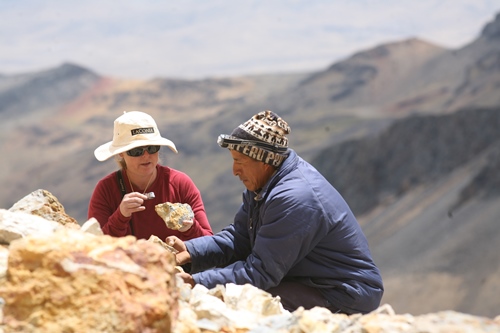
Laconia’s senior exploration geologist at the Española 1 Prospect.

Work was undertaken in February this year by Laconia’s senior exploration geologist at the Española 1 Prospect.

This verified copper mineralisation at the entrance of a 4810m level adit and on surface where veins and breccia outcrop.

The presence of copper mineralisation came as no surprise to Laconia, however the company does consider the confirmation to be highly significant as it corroborates the project’s earlier-owners’ published knowledge of the geology, mineralisation and alteration.

“We have been reviewing all the historical data and what we are finding is that data is in a lot better shape than what we could have hoped for,” Stuart explained.

The historic underground drive sampling results included:

–    A composite sample over a total sample length of 23.05 metres of drive back samples for a mineralised length of 24.9 metres at 3.88 per cent copper, 2.98g/t gold and 66.63g/t silver; and

–    This includes a composite sample over a total sample length of 13m of drive back samples for a mineralised length of 15.5m at 6.54 per cent copper, 4.77g/t gold and 103.86g/t silver.

Significant individual underground samples include:

–    2.1m at 8.4 per cent copper, 6.13g/t gold and 111.7g/t silver (entire width of drive);

–    2.2m at 6.8 per cent copper, 6.47 g/t gold and 141.8g/t silver (entire width of drive); and

–    1.1m at 9.7 per cent copper, 8.7g/t gold and 152.8g/t silver.

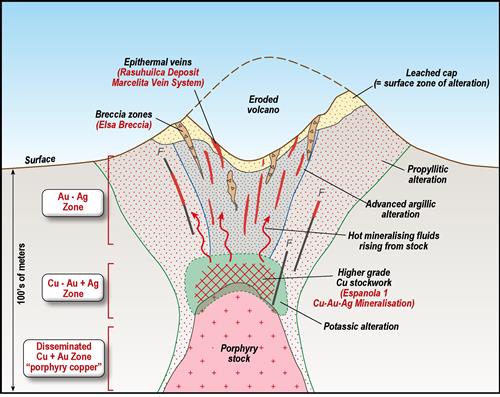
The recent work also expands the exploration model of Rasuhuilca to an ‘El-Indio style’ gold, silver and copper porphyry system.

Previous explorers were aware of the potential scale and size of the Rasuhuilca volcanic system and its porphyry copper-gold potential.

They identified geological similarities to the historic El-Indio deposit in Peru, which contained some 23.2 million tonnes at 6.6g/t gold, 50g/t silver and 4 per cent copper, including a bonanza gold zone of 200,000 tonnes at 209g/t gold.


Schematic diagram of the Rasuhuilca porphyry exploration model

Laconia has now expanded its compilation of historical data to include any available copper sampling undertaken across the project licences with the view the project could contain a buried and fully intact epithermal/porphyry system.

Stuart said the presence of significant copper mineralisation in conjunction with the gold and silver epithermal veins already identified adds significantly to the potential of the entire Rasuhuilca project.

“The initial reason we went to Peru was in order to find blue sky exploration properties with real substance,” he said.

“When I first looked at the deposit I thought there was clearly a porphyry deposit there it was just a matter of where it was.

“What we are seeing now is that – the indications we are getting from this copper – is that we may be a lot closer to it than what we had hoped.”

Laconia is now preparing an aggressive exploration campaign for Rasuhuilca and is making solid progress in regards to the necessary permitting and approvals it needs in place to commence exploration drilling.

These permits involve community agreements utilising the Declaración de Impacto Ambiental process of the Peruvian regulatory system.

The company has a preliminary 2,000m diamond drilling program planned to upgrade the existing Rasuhuilca JORC resource.

This is now under review in light of the recent copper results and will likely be expanded to include drilling in these areas.

The program will also be used to test the gold and copper targets the company has identified via its previous exploration activities.

Besides the proposed diamond drilling, Laconia is also planning further exploration programs for gold-silver and copper zones comprising surface and underground channel sampling and drill testing, which will be undertaken during 2013 and into the first half of 2014.

“What this copper result tells us is that we have an entirely intact high-sulphidation, porphyry system,” Stuart said.

“We have high-grade epithermal gold and silver veins and breccia pipes and now we’re looking at high-percentage-grade copper, which has changed our thinking quite a bit.

“We want to be a self-funded explorer – to that end we are very keen to get the Rasuhuilca mine up and running to get some cash flow.

“However, these latest copper results have made us think we had better have a good look at locating this larger system first.”

Laconia Resources Limited (ASX: LCR)
…The Short Story

HEAD OFFICE
Level 1, 41 – 43 Ord Street
West Perth WA 6005

Ph: +61 8 9486 1599
Fax: +61 8 9486 7899

Email: info@laconia.com.au
Web: www.laconia.com.au

DIRECTORS
Matthew Howison
Ian Stuart
Vincent Algar
Dr Saliba Sassine

MAJOR SHAREHOLDERS
Gold Mines of Peru Ltd        9.65%
Josephine Patoir            4.04%
Ian Stuart                3.74%

SHARES ON ISSUE
248.3 million

MARKET CAPITALISATION
$9.5 million (at 6/3/13)

What the Brokers Say

WHAT THE BROKERS SAY: Interesting news and views from across the Resource Analyst universe.

Luiri Gold Limited (ASX: LGM)

The current management team gained control of the Luiri Hill gold project in early 2011, following the Zambian Government cancelling the previous operator’s licence due to non-performance.

In order to satisfy the Government, Luiri Gold has warranted that it will achieve three key milestones by November 2013.

These are completion of a development plan, arranging project finance and commencing site works.

Against a backdrop of challenging markets for project finance, Luiri Gold is implementing a low risk strategy of commencing gold production at a small scale of 10,000 to 13,000 ounces per annum.

This should limit the initial capital cost to a relatively modest US$20 million.

Luiri Gold Limited (ASX: LGM) is focused on gold exploration in Central South Zambia where the company holds two Mining Licenses, 8074-HQ-LML and 14948-HQ-LML, that together cover 277 square kilometres.

The historical Dunrobin and Matala mine workings are within 8074-HQ LML that covers 31.6sqkm.

The company has a strong management team, supported by Coffey Mining for mining studies and resource estimation.

They are implementing a staged growth strategy, with low cost development of a modest sized operation at Dunrobin followed by incremental expansions supported from operational cashflow.

Infill and step-out drilling is expected to add to existing resources at Matala and Dunrobin of 568,000 ounces and 193, 000 ounces respectively.

A resource inventory of 10.53 million tonnes at average grade of 2.2 grams per tonne gold is a respectable start and provides a solid platform on which to build.

Luiri Gold has a Market Capitalisation of around $5.9 millio.

It has no debt and over $2 million cash, giving Luiri Gold an EV of around $4 million.

This appears very cheap given the company’s exploration success and proposed near term transition to producer status.

Recommendation: Speculative Buy


Rox Resources (ASX: RXL)  

Assay results from the first diamond hole at Camelwood delivered 11.4 metres at 2.93 per cent nickel from 282.6m, which included 6.4m at 3.8 per cent nickel including 2.9m at 4.66 per cent nickel.

The assay results compare favourably to the preliminary indications, which were 3.1m of massive to semi-massive sulphides from 282.8m followed by 2.9m of strongly disseminated sulphides.

The next four diamond holes have assay results pending.

Preliminary indications are promising, although the widths of semi-massive sulphides are relatively thin.

The best indication is in the most recent hole (MFED005) which intersected 1.7m of massive sulphides and 2m of disseminated sulphides from 384.6m.

Assay results from RC drilling were also reported with 1m at 2.48 per cent nickel from 126m and 3m at 1.82 per cent nickel from 118m.

RC drilling has been suspended for a week due to a rig breakdown whilst diamond drilling is ongoing but hampered by not being able to step out to the east because of an ungranted exploration license application, which should be sorted out within the next few weeks.

The assay results from the first diamond hole have exceeded expectations and displayed a nickel grade at the high-end of what we anticipated whilst the width of mineralisation is broader than initially indicated (11.4m versus visual indications of 6m).

Whilst follow-up diamond drilling has encountered lesser widths of semi-massive to massive sulphides, there is sufficient encouragement to suggest that Camelwood is a significant discovery.

We believe that the granting of the exploration license application to the east will facilitate the drilling of deeper and more targeted diamond holes.

This should also result in an additional diamond drill rig being deployed.

We retain our speculative buy rating with further assay results due in the next 2 to 3 weeks.

Recommendation:       Speculative Buy


Disclaimer: The above is intended as a guide only. The Roadhouse accepts no responsibility for investments made from this advice, successful or otherwise.

Mine development suffered in 2012 slowdown

INTIERRA-RMG: The 3,486 companies that make up the global mining industry had a combined market capitalisation of US$2,543 billion at the end of last year, for an average corporate valuation of some US$730 million.

This rather bland statistic hides, however, a huge variation in the structure of the industry.

On the final trading day of 2012 there were just 681 mining companies (20 per cent of the total) with individual market capitalisations of over US$100 million.

These companies were valued by the market at a combined US$2,501 billion (for an average market capitalisation of US$3.67 billion).

At the other extreme of the market, there were 1,756 companies (half of the total) that were each valued at less than US$10 million.

At the end of 2012 there were a further 817 companies valued at US$10 million to 49 million and 232 at US$50 million to 100 million (the latter companies had an average market capitalisation of US$71 million).

PROJECT PIPELINE

Last year saw a slow-down in the hitherto fast pace of mine development.

Investment in mining projects* grew 9 per cent in 2012 to US$735 billion, after the growth of 20 per cent in 2011.

However, the total number of projects in the pipeline fell 3 per cent to under 1,300 (similar to the level of 2010).

*Note: The requirement for inclusion in IntierraRMG’s Raw Materials Database (RMD) are that a project must have either an estimated mineral resource or an estimate of capital expenditure.

Several large projects have been put on hold, including BHP Billiton’s US$8 billion Olympic Dam expansion in Australia, and the Prioskolskoye iron-ore and Sukhoi Log gold projects in Russia.

A number of uranium and nickel projects have also been postponed.

Figures from RMD show that the average project has become more expensive.

This is attributed, especially, to an increase in the geological complexity of orebodies and to falling ore grades, making them more difficult to mine and beneficiate.

There has also been an increase in the construction of supporting infrastructure, and greater costs associated with securing environmental and community agreements.

The later project stages, for both greenfield and brownfield developments, have seen the greatest investment growth.

This is the result of mining companies pushing for early production to benefit from the still relatively high metals prices.

The early stage exploration projects have lost out, which might create pipeline problems in the future.

METALS CHOICE

RMD shows that the investment market last year continued to be dominated by three metals: iron ore, copper and gold.

Together these metals accounted for 77 per cent of the total project investment, amounting to US$570 billion.

Iron-ore prices have risen recently after a decline caused by concern over the Chinese economy, and the metal remained the most important investment target in 2012.

Annual spending increased 14 per cent to US$245 billion, leaving iron ore accounting for 33 per cent of the industry’s total metals investments.

However, the growth rate has fallen sharply compared with the 33 per cent jump in annual iron-ore investment in 2011.

The average investment on the almost 1,300 projects in 2012 (slightly down on the total number in 2011) rose 13 per cent (on a year-on-year basis) to US$1.2 billion.

Investment in copper projects grew 12 per cent last year (16 per cent in 2011), reaching US$200 billion.

The number of copper projects in the pipeline (which is similar to those recorded in 2011) was higher than for iron ore.

Stable production growth is forecast for the next two years.

Gold prices have remained robust during the recession but investment in gold projects is relatively low.

However, the physical number of projects remains very high at 410, representing one-third of the total number of mining projects recorded on RMD.

The number of nickel projects fell slightly in 2012, as did the total investment.

Nevertheless, production of the metal remained high despite the difficult market conditions.

This is attributed to the complication, and cost, of suspending advanced-stage nickel projects.

REDUCED NUMBER OF DEALS

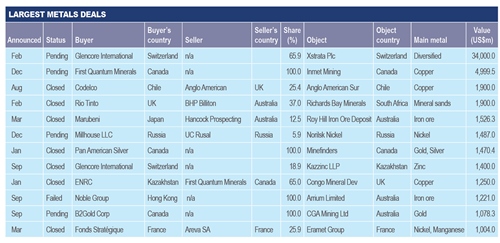
Last year saw a sharp year-on-year drop in deal-making activity, with the total being down almost 20 per cent in value terms compared with 2011.

This decline was despite inclusion of the proposed merger between Glencore and Xstrata.

Although the number of announced deals was on a par with the previous year, the scarcity of ‘mega-deals’ (defined as being those valued at over US$1 billion) made for a significantly lower average deal value (the notable exception is, of course, the Glencore-Xstrata tie-up, which is still pending).

Copper, gold and iron ore were the most sought after metals, with the trio representing fully 76 per cent of the total deal evaluation in 2012 (excluding Glencore‑Xstrata).

Australia and Canada dominated deal-making last year, and, in terms of the number of deals that were announced, they accounted for almost half of the total.

China trailed behind, in third place.

While numerous, the Australian deals were smaller in value terms in 2012, compared with the previous year.

Switzerland ranked first due almost entirely to Glencore’s imminent acquisition of Xstrata, although there were also independent deals by both Glencore and Xstrata.

Indeed, Switzerland, Canada and China accounted for two thirds of the total deal-making activity last year (by value), and the top five countries together accounted for three quarters of the total activity.

Notable last year was China’s 60 per cent drop year-on-year in overseas deal-making.

While copper, gold and iron ore continued to be the focus of Chinese activity, both the number and value of these deals declined.


Avalon Minerals strikes further Swedish copper

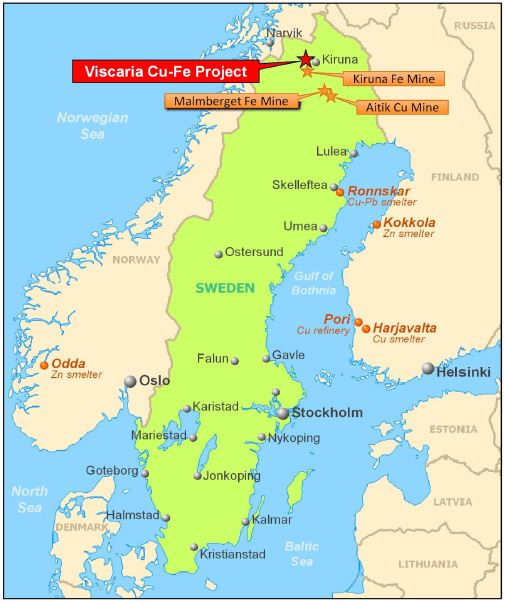
THE DRILL SERGEANT: Avalon Minerals (ASX: AVI) has released assay results for seven drill holes from the current drill program being conducted on the D Zone prospect at the company’s Viscaria copper project in northern Sweden.


Project location. Source: Company announcement


Intersections from the assays include:

–    34.8 metres at 1.2 per cent copper equivalent (CuEq), including 11.2 metres at 1.6 per cent CuEq;

–    38m at 1 per cent CuEq, including 4.3m at 1.7 per cent CuEq and 8m at 1.5 per cent CuEq;

–    28.25m at 1 per cent CuEq, including 4m at 2 per cent CuEq;

–    15.42m at 1 per cent CuEq, including 3.42m at 2.1 per cent CuEq; and

–    10m at 1.5 per cent CuEq, including 3.6m at 2.3 per cent CuEq.

Avalon said the ongoing drill program will comprise approximately 25,000m of drilling, with the objective of extending the known Mineral Resources at the A and D Zone prospects.

It is also aimed at delivering on the potential increases to the project’s Net Present Value (NPV), which was outlined in a Scoping Study that was completed at Viscaria in October 2012.

“These latest results have extended the known mineralisation at D Zone and are consistent with previous drilling results, which defined two thick, high-grade copper-iron mineralisation zones,” Avalon Minerals managing director Jeremy Read said in the company’s announcement to the Australian Securities Exchange.

“It is a very positive outcome that these thickened higher grade zones are continuing at depth with no sign of diminishing.

“This suggests there is excellent potential for the D Zone Mineral Resource to be significantly extended at depth.

“This would enhance the economics of the D Zone Mineral Resource and deliver the Development Cases A and C, which would result in a $78 million increase to the NPV of D Zone, to $126 million.”

Castle Minerals claims bedrock gold discovery at Bundi

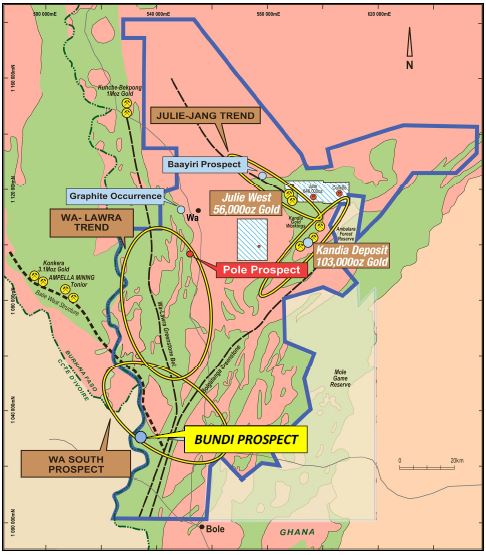
THE DRILL SERGEANT: Castle Minerals (ASX: CDT) has claimed discovery of an open ended zone of bedrock gold mineralisation over one kilometre long while conducting RAB drilling at the Bundi prospect, situated within the company’s Wa project in north-west Ghana.


Wa project geology and prospect locations in north-west Ghana. Source: Company announcement


Castle claim the new gold mineralised zone to be 20 metres to 60 metres wide and remains completely open to the north and south.

The company indicated it would soon commence extensional drilling to outline the full extent of the zone.

Castle considers Bundi to be one of the strongest bedrock gold targets it has generated to date with the gold mineralisation discovered beneath a shallow veneer of alluvial cover.

“Bundi is a compelling target for RC drilling that we will complete as soon as we define the full extent of this open ended zone,” Castle Minerals managing director Mike Ivey said in the company’s announcement to the Australian Securities Exchange.

“These results reaffirm the very strong prospectivity of this unexplored area that will now be part of an enhanced exploration effort by Castle.”

The drilling was conducted by Castle using the company’s own RAB drill rig.

Results from the drilling included:

4 metres at 0.70 grams per tonne gold from 5 metres;

5m at 0.35g/t gold from surface;

8m at 0.30g/t gold from surface;

7m at 0.15g/t gold from surface;

2m at 0.25g/t gold from 10m;

4m at 0.28g/t gold from 10m;

5m at 0.97g/t gold from surface;

10m at 0.17g/t gold from surface;

13m at 0.33g/t gold from 5m;

19m at 0.26g/t gold from 5m; and

10m at 0.74g/t gold from 5m, including 5m at 1.23g/t gold from 5m.

Juniors hoping recent rally lasts

PETER HAYES: Given the exciting start that equities have had in 2013, many small companies will be hoping that it lasts.

April 2011 was the last time both indices were trading above the mystical 5000 point mark and, despite recent glitches, we seem to be holding and extending gains in equities, backed by some better than expected corporate results.

Both CBA and Wesfarmers reported better than expected results, and definitely better than expected dividends.

This new found optimism in the market will hopefully trickle down to the midcaps, and then some of the penny dreadfuls.

Many small company executives will be hoping so, as their lifeblood is equity capital raisings, and as such, so is their salaries.

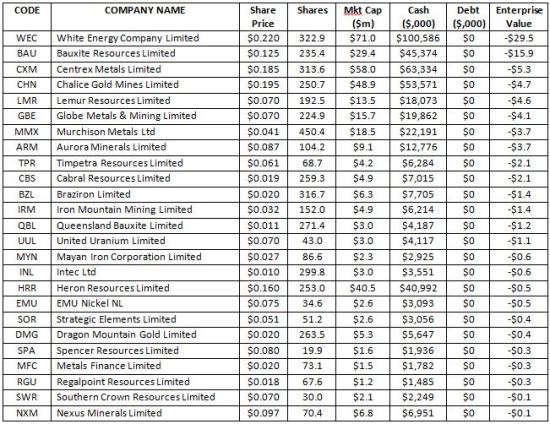
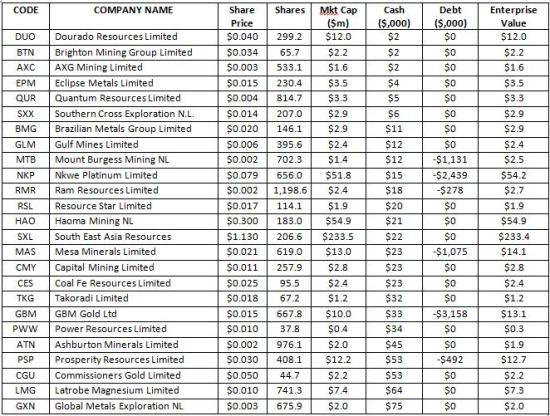
A report compiled by Alto Capital analyst Carey Smith recently isolates the parlous stage some small speculative stocks have found themselves in.

The tables below show both the cheapest resources stocks as at early February, 2013 and the lowest cash balances.

They also demonstrate Cash, Debt and Shares Outstanding info as of Dec 31, Share price as of the 5th February.

These were tabulated manually so there may be some small mistakes.

25 Cheapest Resource Companies (Enterprise Value)


25 Resource Companies with the Lowest Cash Balance (as of 31st Dec)


Peter Hayes
Investment Manager

Chrysalis Resources confirms copper in Zambia

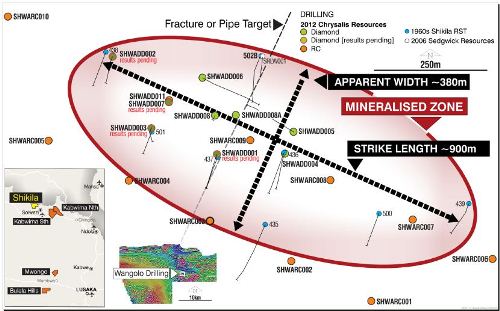
THE DRILL SEREGEANT: Chrysalis Resources (ASX: CYS) has received results from four diamond drill holes recently completed at the Wangolo prospect, which is part of the company’s Shikila copper project, in Zambia.

The company has received results for four of the eight diamond drilling holes it has completed to date.

Results include:

–    59 metres at 0.62 per cent copper, including 3 metres of 1.21 per cent copper, 3 metres of 1.10 per cent copper and 3 metres of 0.92 per cent copper;

–     39m at 0.62 per cent copper and 3m at 0.93 per cent copper; and

–    2m at 1.52 per cent copper and 11m at 0.71 per cent copper.


Drillhole locations and copper intersections for the RC and diamond
drilling at The Wangolo prospect. Source: Company announcement


According to Chrysalis the drilling has confirmed the presence of a copper mineralised system at the Wangolo prospect close to surface extending approximately 900m along strike and over 350m down dip.

The mineralisation remains open along strike and down dip and has demonstrated to appear in two styles:

–    A 3-metre-thick contact zone at the contact with the overlying schist; and

–    A plus-50-metre-thick mineralised unit in the host stratum.

Chrysalis has also completed 11 reverse circulation holes, which along with the 4 diamond hole results were used to define the approximately 900 metres of strike length mineralisation.

The company anticipates the results from the remaining four diamond holes will be available by the end of March and will be used to develop a resource model.

After hours energy use – a great place to start your efficiency campaign

Greensense is a global leader in cloud-based sustainability performance monitoring and occupant engagement software. 

GUEST CONTRIBUTOR: Greensense director Peter Tickler looks at how businesses can develop a better understanding of the buildings they occupy and how they can improve the sustainability performance of those buildings.

One of the biggest challenges of any resource efficiency program is deciding where to start.

This can be tough even if you only have one property, but for managers of large portfolios it can be particularly tricky.

Whilst buildings generally share some similarities in their infrastructure – walls, roof, HVAC, lighting, plugs and people – there are often significant differences related to size, occupancy, hours of operation, age and function.

Of course, it’s these differences that can make it hard to come up with a portfolio wide approach to energy efficiency.

If analysed and presented correctly, data can be hugely powerful, both in terms of helping identify where you might begin on your efficiency quest, as well as providing the means to track and quantify performance improvements over time.

So what does all this data tell us when it comes to figuring out where to begin your efficiency efforts?

One thing: Out-of-hours energy use; and here’s why.

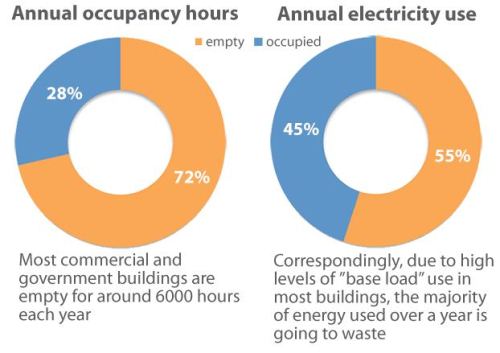
To begin with, as the graphic below shows, most buildings are empty for the majority (approx. 70 per cent) of the time over the course of a year.

As obvious as this sounds, it’s a very important consideration when you’re looking at improving efficiency.


Source: Greensense


From a sustainability perspective, in the same way that a busy and productive building will inevitably use energy, there’s nothing wrong with having an empty building, just so long as you’re not consuming any resources while it’s sitting idle.

Unfortunately, that is never the case, far from it in fact.

Most buildings have relatively high levels of “base load”, meaning they continue to consume significant amounts of power even when they’re empty.

We typically see over 50 per cent of the total electricity used over a year going into empty buildings.

That’s from our own dataset of over 1000 commercial buildings.

As always in discussions around building (in)efficiency, when it comes to costs we need to consider both the environmental and the financial implications.

The environmental cost is pretty easy to work out.

In Australia, each kilowatt-hour of electricity poured into an empty building generates around 0.9 kilograms** of greenhouse gas emissions.

Of course you might be subsidising your wasted electricity through some onsite renewables, most likely solar, but remember that the majority of this out-of-hours consumption is going to occur at night when your PV can’t help.

The financial cost is a little trickier to calculate, as it will depend on the tariff for each building.

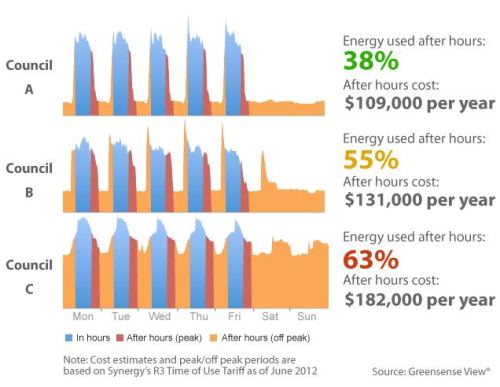
In order to explore the cost question a little further, and at the same time to illustrate the value in understanding your building’s energy profile, we’ve put together a graphic to illustrate how significant out-of-hours consumption can be to the financial bottom line.

As an aside, it also demonstrates the value of benchmarking and comparison as tools to help you put the performance of your buildings in context.

In the graphic below we compare the average weekly energy consumption for three local government administration buildings.

The buildings are located within a few kilometres of each other in a major Australian city, are of very similar size, have very similar operating hours and perform the same function.

In many ways they are typical examples of commercial office buildings.


Source: Greensense

Despite the similarities, the amount of energy going into these buildings during out-of-hours periods varies hugely, with correspondingly significant implications in terms of operating costs.

Even the ‘best’ performing building here is spending over $100,000 a year powering an empty building!

What the graphic also shows clearly is that, while the benchmarking is useful in putting the after-hours performance of each building in context, the 7-day profile is also crucial in understanding when that energy is being used.

So where is all that energy going?

Exactly where all that out-of-hours electricity is going will vary a bit from building to building but, even without sub-metering data, it’s easy enough to make some informed guesses.

In a typical office building there are three main energy sinks: HVAC (50 per cent), lighting (25 per cent) and plug loads (25 per cent) ***.

HVAC is normally pretty well centralised in most larger offices, although you might still have a few split-system units around the place, and lighting control is increasingly centralised too.

So, while they may be playing a part in the story, it will most likely be plug loads that are the real culprit and must inevitably form the focus of any out-of-hours performance improvements.

It just makes sense

Sometimes it’s important to be pragmatic when you’re looking to roll out environmental programs, and energy efficiency is no different.

There will likely be a number of (often competing) project options, whether it’s covering the building in solar panels or turning up the set point on the A/C.

While many of these projects will have merit, a number will present significant obstacles such as upfront cost (solar panels) or push back from building occupants (A/C tweaks).

By starting your energy saving quest by focusing on out-of-hours use though, you remove most of these barriers.

First and foremost, nobody can deny that pouring energy into an empty building is a dumb and wasteful thing to do.

Secondly, the steps taken to reduce this waste are often relatively uncomplicated.

Why? Because the building is empty for a start.

It’s much easier to affect change in an empty building, as you don’t have to worry about upsetting the occupants.

Coupled with that, the savings you’ll find are often from simple, operational tweaks such as shutting down printers and PCs at night.

For those aspiring to improve the energy efficiency of their buildings, getting to grips with out-of-hours consumption is an obvious, and often rewarding, place to start.

By focusing on one particular element of building performance, it helps bring direction and clarity to your efficiency program.

All you need to get going is some decent quality interval data and the ability to analyse it in a way that helps you determine how much of your precious and increasingly expensive energy is going into empty buildings.

I promise, the results will be startling and should provide all the incentive you need to start tracking down those savings.

Of course, if you’d like some help in your quest then you can always contact the team at Greensense.

*A 365 day year is composed of 8760 hours. Of those 365 days, only around 250, or 2500 hours (assuming a 10 hour operating day), are working days. The rest are weekends and public holiday. This means that the majority of commercial buildings are actually only operating for about 28 per cent of the year. For the other 72 per cent of the time they’re sat empty.

** Based on the 2012 NGA factors
http://www.climatechange.gov.au/~/media/publications/nga/NGA-Factors-20120829-PDF.pdf

*** 2006 review of LEED-NC v2 energy modelling

IPO Watch

UPCOMING FLOATS: Who’s due to list on the boards of the Australian Securities Exchange and what they’re all about.

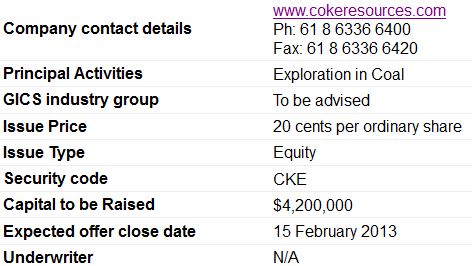
Coke Resources Limited
Proposed ASX code: CKE
Proposed listing date: 28 February 2013

Coke Resources was incorporated in 2011 and claims its primary purpose is to investigate investment in or acquisition of opportunities in the Indonesian resources sector.

The company describes itself as a, “speculative exploration company”, to which point it has indicated that upon admission to the ASX it will exercise its optin to acquire an indirect 97.03 per cent interest in coal exploration company, PT Cristian Eka Pratama (PT CEP).

PT CEP holds an Izin Usaha Pertambangan Eksplorasi (Indonesion Exploration Mining Business Licence), which contains the Cristian thermal coal project in East Kalimantan.

The Cristian project covers consists of 5,273 hectares and is located in a recognised Indonesian coal province.

Coke has also entered into a conditional sale and purchase agreement to acquire a majority stake in the Taliwang gold project in Sumbawa.

This acquisition is set to occur via the company’s purchase of 100 per cent of Indotan Sumbawa pte Ltd.

Once it is listed, Coke Resources said it intends conducting investigations into and due diligence on other Indonesian-based resources projects with the aim to quickly expand its asset portfolio in the region.

Company non-executive chairman James Carter claims 17 years’ experience in the mining industry in Indonesia, Singapore and Australia.

Carter was previously CFO of ASX-listed Straits Resources and CFO and Company Secretary of Singapore-listed Straits Asia Resources.

Executive director Claude Strnadica has been a corporate banker Perth for the past 12 years. In recent years has worked with ASX-listed mining companies with operations in Australia, Africa and most particularly Indonesia.

Non-executive director Les Pereira has been involved in mining projects over the past 12 years, most recently in coal mining in Indonesia.

Non-executive director Rafael Nitiyudo is Indonesian-based and has been involved in coal mining projects in Indonesia over the past six years. He has worked on the Pakar coal project in Kalimantan, Indonesia.


Source: ASX

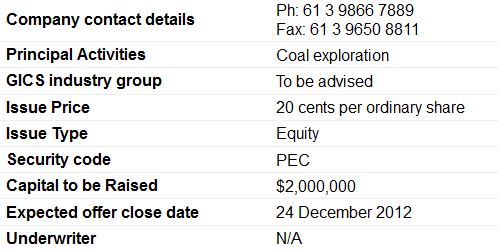
Perpetual Resources Limited
Proposed ASX code: PEC
Proposed listing date: 28 February 2013

Perpetual Resources Limited is seeking to list on the Australian Securities Exchange with its primary focus being the exploration and development of the Atoz coal project located 60 kilometres south of Padang in the central west of West Sumatra.

The project covers 192.08 hectares and has an approved production license (Production IUP, which is valid until 2017.

Perpetual claims the potential of the Atoz project could be significant indicating the geological setting at the pits is identical indicating one coherent target zone.

The development of high-grade coal has been confirmed at various sites within the tenement while the interpretation of satellite imagery indicates other seams could be present in the area.
The harbour at Padang is being expanded and deepened.

Perpetual says once this development has been completed it will be possible to export coal in bulk carriers direct to clients instead of the smaller parcel handling method that is currently in use.

A reconnaissance trip was undertaken in late 2011 by an independent geologist to assess the potential of the area established coal occurs as dipping seams that strike from northeast to southwest.

It was interpreted that the seam in the main pit area extends for at least 400m along strike with a potential strike-length of 1.0km and possible multiple seams within the tenement.

Perpetual considers the success of other local producers, and the encouraging coal outcrops in the area, provide potential to identify a sizeable resource within the project area.

The company intends to undertake a drilling campaign immediately after listing with the aim of moving the project to production as quickly as possible.

Source: ASX


Disclaimer:  The above information is not investment advice. The Roadhouse accepts no responsibility for investments made from this information.