


MRRT farce continues – Andrew Forrest must be laughing
GAVIN WENDT: News that the Minerals Resource Rent Tax (MRRT) had raised a meager $126 million in its first two quarters underlined the farcical nature of the prognostications surrounding the tax on behalf of Treasury and the Federal Government.
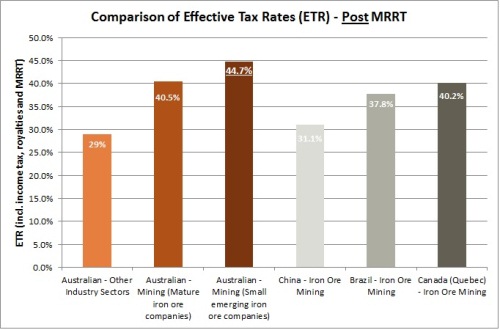
Not only was it a drop in the ocean compared to the predicted $2 billion windfall the government was counting on to balance its budget, but it highlighted the government’s folly in terms of solving its economic problems by saddling the one industry that’s working through ill-conceived taxation.
Given the enormous trashing of Australia’s international investment reputation over the past two years as a result of the mining tax issue and the direct damage caused to the mining sector in terms of added risk and uncertainty, the measly return generated by the tax is hardly a worthy return.
The longer-term damage to our industry reputation should be measured in the billions (or even tens of billions).
The current tax system is entirely adequate in terms of capturing additional earnings generated by the mining industry.
Every additional tonne of profitable product generated by the iron ore heavyweights BHP Billiton (ASX: BHP) and Rio Tinto (ASX: RIO) can be taxed via the existing company tax system.
If the Federal government was serious about increased receipts, it wouldn’t have let BHP, Rio and Xstrata negotiate the tax for them.
The MRRT is the derivative of the original Resources Super Profits Tax (RSPT), which would have levied a 40 per cent tax across all extractive industry, including base and precious metals, coal, uranium and mineral sands.
The MRRT is designed to impose a 30 per cent levy on coal and iron-ore companies that report profits of more than $75 million.
It was initially aimed at companies earning profits around $50 million, but this was subsequently revised.
The biggest failing of the MRRT is that it benefits the big miners – after all they helped design the tax!
The MRRT provides recognition of past investments via a credit that recognises the market value of the investment, recorded over a period of up to 25 years, while also providing a full credit for state royalties paid.
New investments are given an immediate write-off rather than depreciated over a number of years, and a project is not liable for MRRT until it has made enough profit to pay off its up-front investment.
But the biggest impact of the tax is on confidence.
Looking back, Western Australia’s Pilbara iron ore operations and the Eastern States coal industries of the Hunter Valley and the Bowen Basin, were conceived and developed by companies with long-term vision, many decades years ago.
Investment decisions weren’t made lightly – they reflected a strong level of confidence in the stability of the overall financial picture.
But what about the future?
The Federal Government’s ham-fisted approach to resource industry taxation means both domestic and international investors should be increasingly concerned about what happens next?
Will the government inevitably look to plug its funding shortfall through higher rates of taxation on the iron ore and coal industries, or will it look to broaden the tax to other sectors – precious metals, base metals and uranium?
Inevitably, the impacts of greater economic imposts on our minerals industry will be felt – particularly over the medium to longer-term.
Whilst mineral deposits are not transportable, investment dollars most certainly are.
Uncertainty now impacts exploration spending, which provides the resource discoveries a decade or two down the track.
As we’ve previously emphasized, what this all means is that there’s a growing likelihood that the next generation of major discoveries – the Pilbaras, Olympic Dams, Bowen Basins, Cadia – Ridgeways, De Grussas and Novas – won’t be made here in Australia.
Rather, they’re more likely to be unearthed in Africa, Asia or South America – which is where the exploration dollars are increasingly headed.
Gavin Wendt is the founder of MineLife, publisher of the MineLife Weekly Resource Report
