Ian Gordon – Ramelius Resources

ONE OFF THE WOOD: Ramelius Resources (ASX: RMS) CEO Ian Gordon dropped by to explain that although the company’s logo features a horse it is definitely far from being a one trick pony.

 

Ian, Ramelius Resources is both a gold producer and explorer, however it seems your attention is currently more focused on production at this point in time?

Most definitely, our major focus at the moment is moving our Mt Magnet operation to the point where it starts producing some cash flow for us.

We expect that to start happening in the June quarter this year.



That’s good timing for it to come on stream, just as you’re winding things down at Wattle Dam.

It certainly is. We will be milling the last ore from Wattle Dam over the next four months, which we anticipate will produce some valuable cash flow for us.

There is still around 5,000 ounces of gold to come out of Wattle Dam at an operating cost of around $400 an ounce.

What happens with Wattle Dam once that final ore has been processed?

Wattle Dam has already been completely rehabilitated. That was completed as at 31 December last year and we are waiting for sign off by DMP.

As the mill isn’t actually located at the rehabilitated Wattle Dam mine site, what plans do you have for it now?

It will continue to mill the remnant Wattle Dam ore and then we have another project, called Coogee, which we are currently moving through the approvals process.

We hope to commence mining at Coogee by the middle of June this year with the anticipated delivery of ore to the Wattle Dam mill by around September – October.

You obviously don’t want to have that asset sitting around idle for too long?

We are hoping to carry out a few months of third party milling there around the July – August period, and we are already in discussions towards that goal.

It won’t be for any significant period of time, just to enable us to cover costs of holding the mill during the period between Wattle Dam ending and Coogee coming on stream.

Besides Coogee coming on line, are you looking at any other prospects in the area?

Absolutely; we’re talking with a number of parties at the moment with projects that appear attractive to us, which we hope to get involved in.

Hopefully by the second half of this year we will have completed at least one of those deals and we hope we will be able to keep the mill operating on that basis.

What we are trying to do is provide capital to get some small projects going, which will enable us to participate in the profits.

So is that the Ramelius business model, to keep an eye out for smaller, viable projects, then getting involved in and maintaining them as a possible future supply chain for the Wattle Dam mill?

That’s what we are trying to achieve, yes. At the moment, with Coogee, we have enough mill feed to take us out to around August 2014, so that allows us a good bit of time to stitch up a couple of those deals.

We’re pretty confident of being able to achieve that. As long as these deals make sense and we continue to make money we’ll continue to do it.
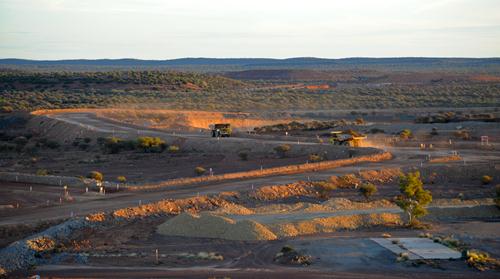


With all that happening you have Mt Magnet just waiting in the wings ready to come on and take centre stage?

We commenced production at Mt Magnet last year, but it has taken us a bit longer than what we anticipated to ramp the operation up to where we want it to be.

During the last quarter we did processed some 15,000 ounces through the mill and we hope to take that figure up to around 17,000 ounces this quarter, then up to 19,000 in the June quarter.

We have also just started development of a separate satellite pit near Mt Magnet, called Western Queen.

That project will provide additional high-grade mill feed to Mt Magnet from August this year and we expect to have the Mt Magnet production up to around the 100,000 ounces per annum mark in the Financial Year 2014.

You have had more good news from Mt Magnet in regards to more recent discoveries.

Most of our exploration money, at present, is being spent at Mt Magnet and we have discovered a small high-grade deposit there called Water Tank Hill.

We are just finalising the drilling on that at the moment and we anticipate releasing a Resource there during the next quarter.

We are hopeful of Water Tank Hill becoming an underground feed source for Mt Magnet from 2014.

It’s the type of deposit we consider could be around 100,000 ounces, but it is just a nice add on to the project, with potential to produce around 30,000 a year at around eight grams per tonne gold.

Most companies would be pleased to have that much going on, but you also have a lot more background activity.

We recently agreed to acquire the Vivien project from Gold Fields, which is another small high-grade deposit, similar to Wattle Dam.

We hope to have that acquisition completed by the end of this quarter as it has taken a bit longer than we anticipated.

It is costing us $10 million and we consider that to be a good buy as it comes with an existing Indicated Resource of 579,000 tonnes at 8.3 grams per tonne gold for 154,000 ounces of gold.

Our focus for that project, once we have completed settlement of the acquisition, is to get in and do some more drilling in order to extend that resource before we start mining.

At this stage we consider there could be up to 120,000 ounces there that is mineable and we anticipate increasing that before mining commences.

Gold mining is an industry that doesn’t allow companies to rest on their laurels, there’s always more gold to be found.

One of the main issues the gold industry faces is the continual search to replace production.

That search means you are going to be outlaying capital every three to four years and, unfortunately, during any period you’re outlaying capital you’re not making as much return as you, or your shareholders, would like.

That’s a fact of gold mining life and you have to deal with it. The secret is to ensure you are holding enough capital to see you through those periods.

Would it be fair to say your timing – as a producing company, which is able to fund new exploration – in these tight economic times enables you to look at new projects, whereas other companies are struggling to maintain just one?

Definitely; one of the things we have worked hard at is always maintaining a strong capital position.

It’s no secret that projects can end up costing more than when companies approve them. You just have to take that into account in regard to your capital position.

That’s where most small mining companies can go wrong, by not having enough capital to cover when things may not go according to plan.

We are in a pretty healthy capital position right now and expect to see strong cash flows coming in from Mt Magnet come July.

From that point on we will introduce the production from Coogee, so our cash flow position for the year ahead looks pretty good.
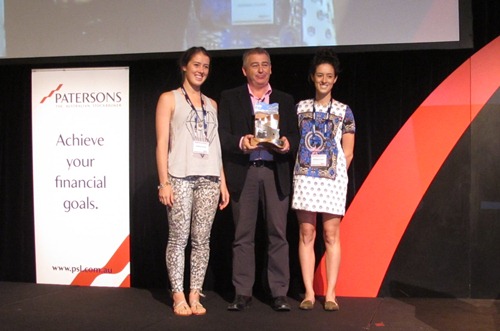
The 2013 Craig Oliver Award

THE CONFERENCE CALLER: Winner of this year’s Craig Oliver Award was hardly a surprise.

The Craig Oliver Award for 2013 was presented at the RIU Explorers Conference to Sirius Resources.

Siruis ran home from a select field including: Doray Minerals, Northern Star Resources, Papillion Resources, Phoenix Gold, Regis Resources, and Sandfire Resources.

The award was created in memory of Craig Oliver, former non-executive director of Sundance Resources, who passed away in 2010 when a plane carrying the entire Sundance Resources board crashed in the Congo, killing all on board.

It is presented at the Explorers Conference each year to a small to mid-cap Australian mining company which has excelled in several areas of performance, including exploration, mining, community engagement and environmental performance.

This year’s award was present by Oliver’s two eldest daughters Hannah and Georgia.


“We are privileged, honoured and humbled by this,” Sirius Resources managing director Mark Bennet said on receiving the award.

“We’ve come a long way in a short time and the nice thing about this award is that it remembers Craig and his colleagues and his community.

“He met an unfortunate situation doing what he loved doing, what we all love doing, and we are a big family.

“Thanks very much, we hope to do the award justice with what we do.”

Every day, we’re getting better and better

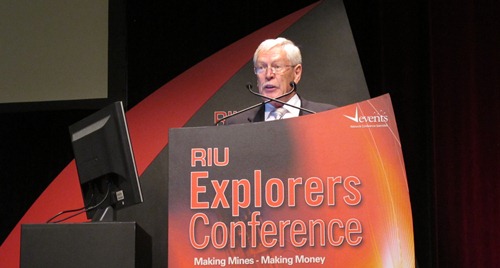
THE CONFERENCE CALLER: On day one of the RIU Explorers Conference Patersons Securities director of corporate finance Alex Passmore saw a good deal of light shining through from the far end of the tunnel.

Passmore told the audience that the past 12 months had provided a number of indications that although resources have under-performed on the market they are starting to rebound.

Passmore presented a number of reasons as to why resources equities are not performing as well as they could be.

“One of the main themes we’ve been seeing over the past year is the ongoing cost escalation and productivity issues across the sector,” Passmore said.
 
“The average cost of gold production in the Australian sector from March 2010 to June 2012 rose from $500 per ounce to over $700 per ounce.

“Some major projects in Australia have been delayed such as Olympic Dam and the Port Hedland Outer Harbour.”

Those of us that manage to take overseas holidays at the moment are enjoying spending their high Australian dollars, however the currency’s sustained strength continues to make offshore projects appear a lot more attractive relative to domestic projects.

Be that as it may there has been a few companies in smaller end of town that have provided some much-needed spark to the small end of the market.

“We’ve had the Nova discovery by Sirius Resources and around five to ten companies near Sirius in the Fraser Range that have benefited from the nearology factor,” Passmore said.

“The Nova discovery has been a great boost to the sector and has shown people that you can still make money by investing in resources.
 
“More recently Rox Resources has had some interesting hits up near Wiluna, which has also created a bit of excitement.”

Passmore indicated market liquidity continues to be one of the major issues facing many junior company share price ambitions.

He said feedback he had received from potential investors was that they were holding back from entering the smaller end of the market until liquidity improves.

This has made things a bit difficult for the Initial Public Offering (IPO) market with only 36 IPOs listing in the past 12 months: of these 23 have been gold companies, seven coal companies and six copper plays.

The previous year there were 106 IPOs.

“Investors have been very selective by backing companies and Boards with track records and looking for liquidity,” Passmore explained.

“Placements have been the instrument of choice for mid-cap companies.

“There was $6.3 billion raised in the mining sector in 2012, while that sounds like a lot it was actually down quite significantly from just a couple of years ago.

“There is, in fact, a significant amount of money sitting on the sidelines looking for decent investment opportunities, but it is about getting market appeal and differentiating yourself from the pack.

“Some JV deals have also provided interesting funding and companies are starting to be pragmatic in how they fund their projects.”

Norman Moore prepares for well earned retirement

THE CONFERENCE CALLER: Due to retire at the upcoming state election, Norman Moore stopped by the RIU Explorers Conference to say farewell.

Since he regained his job as Western Australian Minister for Mines and Petroleum following the election of the Barnett Government four years ago, Norman Moore has been a familiar, and much welcomed face at all mining industry events.

Moore took over the portfolio at a difficult time with the Global Financial Crisis just letting the world know it had arrived.

It was a time that saw a great deal of turmoil across the resources sector with much pain being felt mostly in the exploration sector, the sector that normally feels the most pain in such economic circumstances.


“Clearly, the State government at the time couldn’t do anything to change the global economic outlook, but what we could do was reduce the risk associated with exploration by streamlining the processes of getting approvals in the system,” Moore told the audience at the RIU Explorers Conference in Fremantle.

Moore’s brief was to encourage the long term growth of the Western Australian resources sector and to help it maintain its standing as, what he described as being, “the backbone of the Nation’s economy”.

Moore rolled out a number of impressive statistics that demonstrated how affective his recent Ministership has been.

2011-2012 financial year statistics show Western Australian resources recorded sales of $106 billion.

Iron ore remained the state’s most valuable sector accounting for $61.1 billion with petroleum contributing around $23.8 billion

Exploration expenditure during 2011-2012 increased to an all-time record of $2.1 billion, which represented a 32 per cent increase on 2010-2011.

Exploration expenditure for iron ore was the largest figure accounting for 46 per cent spending $1.2 billion representing a 75 per cent increase from 2010-2011.

Overall Western Australia accounted for 53 per cent of all the mineral exploration in Australia, almost doubling its closest rival Queensland.

“These are pretty impressive figures and I think there are a testament to the prospectively of Western Australia and the confidence the industry has in the Western Australian economy and our resources industry,” Moore said.

“I think it’s fair to say that I’m not inflating expectations when I say Western Australia is the place to come when you want to invest, explore, or indeed, to mine.

“It is a very desirable destination.”

Moore put the responsibility for the results on the implementation of a number of new initiatives by the WA government and the state’s mining industry.

When the government was elected the first thing it did was to re-establish the Department responsible for mining and petroleum as a standalone agency creating the Department for Mining and Petroleum (DMP).

A second initiative was the introduction of the Exploration Incentive Scheme (EIS).

There are six programs in the exploration incentive scheme with the best known of these being the co-funded exploration drilling program, which refunds up to 50 per cent of successful candidates’ drilling costs.

Since the program began in 2009, more than $30 million has been offered to some 315 projects across the six funding rounds in the state. Round seven of the co-funded drilling round will open next week.

The EIS also provides additional geological support to the industry, and has flown more than 2.7 million line kilometres of airborne magnetic and radiometric data in the past four years, completing the coverage of the entire state at 400 metres, or less, line spacing.

“This program is the biggest geophysics data campaign exercise ever undertaken in Australia,” Moore boasted.

If a good example of the success of the EIS is needed then you don’t really have to look much further than Sirius Resources, which successfully used three aspects of the scheme to find the Nova deposit.

The company utilised regional geochemical sampling together with airborne magnetics to identify and area of interest around a geological anomaly.

Sirius then obtained co-funding for a deep hole and subsequent drilling discovered the much talked about Nova deposit.

Probably the most important initiative Moore has been able to introduce is the improvement to the approvals process in Western Australia.

“It simply was taking too long to get approvals,” he said.

“As a result of some hard work and good initiatives the average mine approval process in Western Australia now has been reduced to around 28 months – still too long, but when I first got here it was taking up to three year in many cases.

“In 2012 the Department finalised 82 per cent of its 7,048 mining, petroleum and geothermal applications within the targeted time frames.”

Moore also talked up the potential importance of the recently-ratified Reforming Environmental Regulations Strategy (RER).

“One particular area of the RER that is important to me has been the development of the new Mining Rehabilitation Fund,” he said.

“This fund is set to require most operators to start paying a levee by July next year and this will ensure tax payers are not footing the bill for abandoned mine site rehabilitation work.

“However, it also means companies will no longer be required to take out environmental bonds.”

In closing Moore reiterated the importance of exploration to the continued vitality of the mining industry.

“You have to find the mines of tomorrow today otherwise the industry has no future,” he said.

“So it is absolutely vital that we get exploration continuing in Western Australia and that new ore bodies are found on a regular basis.

“It’s been a pleasure to have worked with you over the years and I wish you all great exploration success in the years to come.”

Fly In Fly Out – It’s a matter of choice

GUEST COMMENTARY: The Chamber of Minerals and Energy of Western Australia (CME) has told both Federal and State  Government’s they need to be careful about implementing recommendations from the Regional Australia Committee report into Fly In-Fly Out (FIFO), warning any changes could have unintended detrimental consequences to industry and communities in Australia.

CME chief executive Reg Howard-Smith said his body supports recommendations which call for further evidence-based research and allow for a greater understanding of the unique work practice.


“With more than $175 billion worth of resource projects either under consideration or being constructed, access to a skilled workforce, along with the high cost of doing business in Western Australia are major challenges for the sector,” Howard-Smith said.

“FIFO is about providing choice for workers and in a competitive labour market, employee choice is paramount.

“Choice of what job they do, who they work for and importantly of where they choose to live.

“FIFO and residential employment are complementary, not supplementary approaches in a total workforce management package.”

FIFO has been a n established work practice in the WA resource sector for so long it is considered by many to be as normal a way of getting to work as catching a bus from the corner from your street.

The system is expected to grow in the years ahead with many employees opting for FIFO rosters over relocating to regional WA.

CME through its recent State Growth Outlook found the sector’s workforce in WA is almost 120,000 with approximately 55 per cent or 66,000 employed on FIFO rosters.

Howard-Smith said recommendations which added to the cost of doing business should be discarded.

“Unfortunately we are becoming a less attractive place to develop resources projects when compared with global resource rich nations and investment may be driven to other, lower cost, regions because of additional layers of taxation and charges which are continuing to drive up cost for doing business,” he said.

“Attraction and retention of employees would be severely impacted if companies attempted to force residential employment on their employees.

“Further, if FIFO was highly restricted or residential employment mandated, local communities and government would experience severe pressures on infrastructure and services.

“While at the same time valuable resource projects would not find a skilled local workforce and may not even proceed.”

TNG prepares Mount Peake numbers for resource upgrade

TNG Limited (ASX: TNG) has received results of recent resource drilling undertaken at the company’s Mount Peake vanadium-titanium-iron project in the Northern Territory.

The drilling encountered consistent mineralised intercepts both within and around the existing resource area.

TNG completed a program of Reverse Circulation (RC) drilling during the December 2012 Quarter, which was designed to infill and step out around the edges of the existing resource at Mount Peake.

The drilling was aimed at upgrading the current Inferred and Indicated resource for the Mount Peake project of 160 million tonnes at 0.3 per cent vanadium, 5 per cent titanium and 23 per cent iron to Indicated and Measured status.

TNG indicated it expects to commence work on a revised JORC estimation later this Quarter when all results are available.

The best intercept was in hole 12MPRC096, which encountered high-grade mineralisation from the base of the thin transported cover sand unit at surface to the end of the hole, providing a total intersection of:

–    147 metres at 0.48 per cent vanadium, 8.8 per cent titanium and 31.9 per cent iron.

TNG said other holes drilled during the program demonstrated continuity of grade and thickness within the resource area.

These holes returned mineralised intervals of up to 141 metres width, with consistent grades of up to 0.37 per cent vanadium, 6.88 per cent titanium and 28.0 per cent iron.

In addition to the RC program, TNG also completed a diamond drilling program during the December 2012 Quarter designed to provide metallurgical samples for pilot plant testwork.


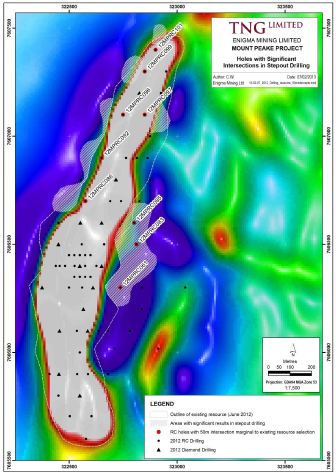
Locations of diamond and RC drill holes completed during the
December Quarter 2012. Step out holes and areas with significant
mineralisation are also shown. Source: Company announcement


Results have now been received for approximately one-third of this program, with the remaining results expected to be available before the end of February.

“Mineralised diamond drill core is being composited to form the material used in process plant testwork now underway as part of the Mount Peake Definitive Feasibility Study and samples are also being used to obtain engineering and specific gravity information over the deposit,” TNG Limited explained in its ASX announcement.

“All holes fall within the existing resource outline to provide a representative sampling over the whole deposit.

“Once all assays from the diamond drilling have been received, an updated JORC estimate for the Mount Peake resource will be carried out by Snowdon Mining Consultants, expected to be completed during March.

“It is expected that the revised resource model will upgrade a significant portion of the resource from Indicated to Measured status, strengthening and de-risking the project as it proceeds into Feasibility Study.”

Radar Iron to acquire Mt Ruby magnetite deposit

THE BOURSE WHISPERER: Radar Iron (ASX: RAD) has reached  an agreement to acquire 51 per cent of the Mount Ruby magnetite deposit in the Innisfail district of Far North Queensland from private company, Developed Iron Ore.


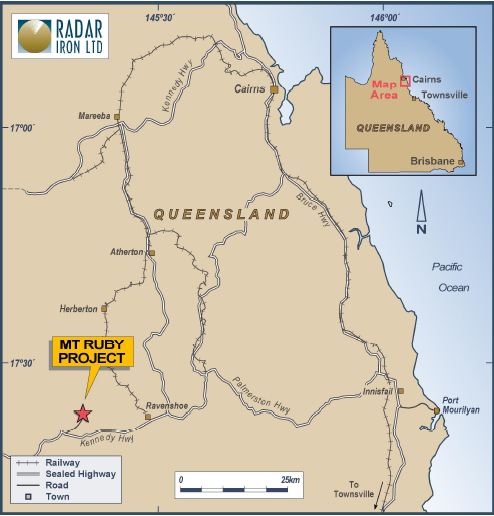
Project location. Source: Company announcement


An exploration target for the high grade magnetite mineralisation at Mt Ruby of 8 million tonnes to 27 million tonnes at 57 to 68 per cent iron has been estimated.

The acquisition is contingent on Radar completing due diligence including initial confirmatory drilling on the project by April 30, 2013.

Following satisfactory due diligence, Radar will make a cash payment and spend funds on project development to secure a 51 per cent interest in the project.

The company said it has expectations of mining high-grade direct shipping magnetite ore by the second half of 2013 with approvals to do so already in place or pending.

According to the company Developed Iron Ore has already completed project evaluation and mining studies on the project and agreements are in place to enable transport including highway trucking and export through the port of Mourilyan.

Other approvals already in place or pending allow an initial mining rate of 600,000 tonnes per annum.

“This project offers the potential for a near term and substantial cash flow for Radar to benefit our shareholders and provide funds to progress our Central Yilgarn project,” Radar Iron managing director Jonathan Lea said in the company’s announcement to the Australian Securities Exchange.

“The Board is very excited at the opportunities this presents to the company and we will provide further updates as the due diligence progresses.”

The Pick 7 Feb 2013

For the latest releases from The Pick please click the links below.

Venturex Resources (ASX: VXR)
Non-Executive Director Appointment… Read more

IMX Resources (ASX: IXR)
IMX Appoints Azure Capital as Corporate Advisor… Read more

International Goldfields (ASX: IGS)
Copper Values Increase in Extension Drilling of Gold-Copper Mineralisation, Latin Gold Project, Brazil… Read more

Latin Resources (ASX: LRS)
Latin Prepares to Drill New I.P. Anomaly at Ilo Norte… Read more

AusAmerican Mining (ASX: AIW)
Capital Raising Completed… Read more

Elemental Minerals (ASX: ELM)
Elemental Minerals Commences Phase 3A Drilling at Kola to Test Extension of the High-Grade Sylvinite… Read more

Avalon Minerals (ASX: AVI)
Avalon to Commence Drill Program on Two Most Prospective Copper-Gold Targets at Viscaria Project… Read more

Australian renewable energy cheaper than fossil fuels

A recently conducted study by research firm Bloomberg New Energy Finance (BNEF) has produced some interesting data on the power bill discussion providing endless talk-back fodder across the nation.

Listen to any politician of any persuasion and they’re all ready to tell you that paying for electricity is becoming harder for the average ‘battling’ of ‘modern’ family.

According to the BNEF research, unsubsidised renewable energy is now cheaper than electricity generated from new-build coal and gas-fired power stations in Australia.

BNEF’s Sydney analysis team carried out a comprehensive study that modelled the cost of generating electricity in Australia from different sources.

The study concluded that electricity can be supplied from a new wind farm at a cost of $80 per Megawatt Hour (MWh) (US$83), compared to $143 per MWh from a new coal plant or $116 per MWh from a new baseload gas plant.

These figures are inclusive of the cost of emissions under the Gillard government’s carbon pricing scheme.

However, BNEF found that even without a carbon price, which it identified as the most efficient way to reduce economy-wide emissions, wind energy is 14 per cent cheaper than new coal and 18 per cent cheaper than new gas.


“The perception that fossil fuels are cheap and renewables are expensive is now out of date”, Bloomberg New Energy Finance chief executive Michael Liebreich said.

“The fact that wind power is now cheaper than coal and gas in a country with some of the world’s best fossil fuel resources shows that clean energy is a game changer which promises to turn the economics of power systems on its head.”

Bloomberg New Energy Finance claimed its research on Australia shows that since 2011, the cost of wind generation has fallen by 10 per cent and the cost of solar photovoltaics (PV) by 29 per cent.

This is in stark contrast to the cost of energy from new fossil-fuelled plants, which the firm said is high and on the rise.

The study identified high financing costs to be a major contributing factor in the expense of new coal projects.

The study surveyed Australia’s four largest banks and found lenders are unlikely to finance new coal without a substantial risk premium due to the reputational damage of emissions-intensive investments – if they are to finance coal at all.

It also demonstrated new gas-fired generation to be expensive; blaming the expansion of Australia’s liquefied natural gas (LNG) export market for forcing up local prices.

The carbon price adds further costs to new coal- and gas-fired plant and is forecast to increase substantially over the lifetime of a new facility.

Another conclusion to emerge from the BNEF study is that by 2020, large-scale solar photovoltaics will be cheaper than coal and gas, once carbon prices are factored in.

By 2030, dispatchable renewable generating technologies such as biomass and solar thermal could also be cost-competitive.

BNEF said the results suggest the Australian economy is likely to be powered extensively by renewable energy in future and that investment in new fossil-fuel power generation may be limited, unless there is a sharp, and sustained, fall in Asia-Pacific natural gas prices.

“It is very unlikely that new coal-fired power stations will be built in Australia. They are just too expensive now, compared to renewables”, Bloomberg New Energy Finance in Australia head of clean energy research Kobad Bhavnagri said.

“Even baseload gas may struggle to compete with renewables.

“Australia is unlikely to require new baseload capacity until after 2020, and by this time wind and large-scale PV should be significantly cheaper than burning expensive, export-priced gas.

“By 2020-30 we will be finding new and innovative ways to deal with the intermittency of wind and solar, so it is quite conceivable that we could leapfrog straight from coal to renewables to reduce emissions as carbon prices rise.”

Before that time, BNEf claimed, clean energy investment will be driven up, and power sector emissions down, only with the support of Australia’s Large-scale Renewable Energy Target.

The research said a compelling economic case for new-build renewables existed in Australia now, however, the country’s fleet of aging coal-fired power stations, which were built by state governments in the 1970s and 1980s are still more than capable of producing power at lower cost than renewables, mainly because their original construction cost has now been depreciated.

“New wind is cheaper than building new coal and gas, but cannot compete with old assets that have already been paid off,” Bhavnagri said.

“For that reason policy support is still needed to put megawatts in the ground today and build up the skills and experience to de-carbonise the energy system in the long-term.”

What the Brokers say

WHAT THE BROKERS SAY: Interesting news and views from across the Resource Analyst universe.


Altona Mining Ltd (ASX: AOH)

Outokumpu performing well, Roseby development-ready but requires finance

Outokumpu copper project (Finland):

– Record quarter of production, exceeding feasibility design.

– Plant throughput of approx. 144,000 tonnes (FSBe 138kt) represents 104 per cent of nameplate (550kt per annum).

– Copper recovery was 91 per cent (FSBe 91 per cent) with concentrate grade of 21 per cent (FSBe 21 per cent). Milled copper grade was 1.6 per cent versus our estimate of 1.25 per cent copper.

– Production for the quarter totalled 2kt tonnes of copper (FSBe 1.6kt), 2.3koz goldu (FSBe 2koz) and 444t zinc (FSBe 400kt).

– Copper production increased almost 30 per cent on the September quarter and was 25 per cent above our estimates, which was predominantly a function of grade (1.6 per cent v 1.3 per cent) and throughput.

– Cash costs of US$1.61 per pound for the quarter were in line with FSBe of US$1.60 per pound.

– Outokumpu is now operating at an annualised run rate of approx. 8ktpa copper, approx. 9.2kozpa gold and 1.8ktpa zinc. Management have provided updated guidance for FY13 of 6.5 to 7.0kt copper and 6.5 to 7.0koz gold at cash costs of US$1.40 per pound to US$1.60 per pound.
 
Roseby copper project (Queensland):

– Xstrata notified Altona that it will not exercise its option to acquire a 51 per cent interest in the majority of the tenements which comprise the Roseby copper project.

– The project is now fully permitted following the granting of three mining licences during the quarter.

Altona’s position is $19 million and the Credit Suisse debt facility of US$20 million has been fully drawn down.

Outokumpu exceeding expectations: We are impressed by management’s performance and delivery at Outokumpu to date, having steadily increased output since commissioning the Luikonlahti mill in early 2012 to now be producing at an annualised rate of approx. 8ktpa copper.

FY13 guidance has been lifted to 6.5 to 7.50 tonnes copper (FSBe 7.0kt copper) and, at forecast cash costs of approx. US$1.60 per pound, the operation should be generating approx. $30 million EBITDA per annum moving forward.

Management have also commenced studies to investigate the potential to expand output by 30 to 50 per cent, with results expected mid-2013.

Xstrata overhang now removed, JV or ‘go it alone’ scenario most likely development pathway for Roseby: Following Xstrata’s advice to Altona that it will not be exercising the option on Roseby, the company is now in a position to actively pursue a development pathway for the asset.

A number of development scenarios are being considered including a JV/asset sale with another corporate/strategic or a ‘go it alone’ scenario potentially based on a smaller scale or staged operation (and in turn refined/manageable capex).

With the copper price remaining strong and financing expected to be more readily available for projects of decent scale in 2013, we believe it is may be feasible for Altona to seek to raise finance (debt/offtake/equity) and retain majority exposure to the project.

A DFS was completed for Roseby in 2012 and highlighted a NPV of approx. $250 million based upon an approx. 39ktpa copper and approx. 17kozpa gold operation with capex of approx. $320 million and cash costs of US$1.73 per pound.

RECOMMENDATION: We retain our BUY recommendation and price target of 45 cents per share.

Image Resources (ASX: IMA)

Image Resources (ASX: IMA) is now advancing towards development of its high-grade mineral sand assets delineated within the North Perth Basin in Western Australia.

A resource upgrade at the key Boonanarring deposit (due in Feb 2013) is likely to further enhance the already robust economics outlined in the scoping study.

Image has now embarked on a ‘bankable’ feasibility study with first production targeted for late 2014.

After five years of exploration, Image Resources has now created a significant portfolio of high grade mineral sands projects within the North Perth Basin.

Following the successful outcomes of a scoping study completed in 2011, the company is now implementing a clear strategy to develop these assets with first production from the Boonanarring deposit possible by early 2015.

The recent $6.7 million capital raising (subject to shareholder approval) will be more than adequate to complete the necessary technical studies (as part of a broader feasibility study), the planned resource expansion drilling campaigns at Boonanarring and all company operating costs through to July 2013.

Initially, Image envisage construction of a 3.3 million tonnes per annum single mine and wet plant operation at Boonanarring.

This initial, relatively low capital cost project should then provide the operating platform and cash flow for the staged development of parallel mining operations at Atlas and the other projects, together with the construction of a more capital intensive Dry Mill, capable of producing finished products.

This strategy is not only attractive in terms of project economics, but will provide a quicker path to production at lower risk, with a significantly lower up-front capital requirement than would be the case if a Dry Mill is constructed initially.

North Perth Basin project

Image has a major land holding in the North Perth Basin (NPB) which comprises of a total JORC resource of 289 million tonnes at 2.9 per cent heavy minerals (HM) (for approx. 8.4 million tonnes of valuable Heavy Minerals).

Within this resource, the company has identified a ‘high-grade’ resource made up from seven nearby deposits which host a total of 52.9 million tonnes at 6.6 per cent HM for approx. 3.5 million tonnes of Heavy Minerals with over 90 per cent of the resource in the Measured and Indicated categories.

The seven North Perth Basin projects are:

Boonanarring (existing ML on part of the prospect) – First to be mined;

Atlas and Atlas South (MLA on part of prospect) – Second to be mined;

Hyperion;

Helene;

Red Gully (existing ML);

Gingin North (existing ML); and

Gingin South (existing ML on part of the prospect).

Recommendation: Speculative BUY


Disclaimer: The above is intended as a guide only. The Roadhouse accepts no responsibility for investments made from this advice.