


The illogicality of markets presently – gold must eventually trade higher
GAVIN WENDT: I’ll never cease to be amazed by the logic (or the apparent lack of it) with respect to financial markets.
Over the past few weeks so-called ‘experts’ have been telling us that gold’s un is over – and that the price is suffering due to renewed optimism with respect to the US economy, based on improving data over there and the resolution of the fiscal cliff issue.
Well, last Friday gold fell once again (a sizeable 1.8 per cent fall) that extended a week-long trend, but US economic data released simultaneously was not exactly encouraging – in fact, far from it.
And the fiscal cliff issue again reared its ugly head.
The data showed that US industrial production was weak and accompanied by a sizeable 2.2 per cent drop in sales by Wal-Mart Stores.
The performance of Wal-Mart is a much better and more accurate ‘real-life’ example of actual customer-related confidence than consumer confidence surveys themselves.
According to internal emails, Wal-Mart had its worst start to a month for sales in seven years, with a Wal-Mart VP calling February MTD sales “a total disaster” (Bloomberg).
Wal-Mart’s executives had actually expected the opposite – a strong start in February because of the Super Bowl, milder weather and wage cycles.
But the fragility of US economic recovery is still very much apparent.
Meanwhile, the US fiscal cliff debate is far from being resolved.
With the 1 March deadline looming, Senate Democrats have proposed a deal to delay the scheduled budget cuts to 2 Jan 2014 and replace them with US$55 billion in new revenue and US$55 billion in spending cuts.
While earnings, economics and talk of a currency war have taken centre stage recently, with the 1 March deadline nearing, the fiscal cliff debate will return to the fore during the coming weeks.
Returning to the gold price itself, the price stabilised around US$1,600 per ounce after retreating to US$1,598 per ounce – its lowest level since August 2012.
There doesn’t seem to be much logic in gold prices retreating firstly due to recent positive economic news – then again on weaker news.
But that’s the market!
Gold price support remains at around US$1,600 per ounce.
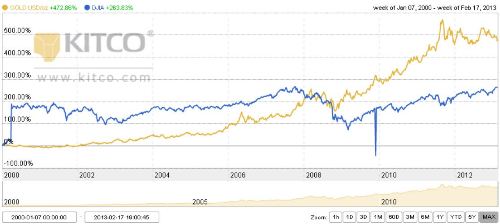
The chart below clearly underscores the extent to which gold (the gold line) has outperformed the Dow Jones Industrial Average since the year 2000.
Whilst gold has endured comparative headwinds over the past few years in terms of its price performance, these are in reality no different to any other period in gold’s more-than-a-decade-long price run that began back in 1999/2000.
As always, you have to take a step back in time and examine the bigger picture.
The important thing about the fluctuating price of gold since 2008 is that it’s typically fulfilled its role as an insurance policy and tore of value – and has from time-to-time been sold to fund losses on declining assets elsewhere in investors’ portfolios – typically equities and property.
This means that gold has, to some degree, been exposed to forced selling.
At the end of the day however, gold remains the ultimate insurance policy for investors.
Despite its price volatility, gold has managed to stabilise around its long-term trend-line of US$1,600 per ounce.
Central Banks gold buying at its highest level since 1964
The actions of central banks worldwide continue to fly in the face of the hordes of financial experts that point to an improving economic picture and growing confidence.
Instead, the World Gold Council’s latest report released this past week highlights the fact that investors and central banks continue to seek safety in gold.
The report highlights that gold demand during 2012 reached yet another record high of $236.4 billion – which included a six per cent increase in value terms during Q4 2012 alone to $66.2 billion (the highest fourth quarter on record0.
In fact, gold demand during Q4 2012 rose by four per cent to 1,195.9 tonnes.
Just as significantly, central bank gold buying reached its highest level since 1964, with purchases for 2012 rising by 17 per cent to 534.6 tonnes, with 145 tonnes purchased during Q4 2012 – up nine per cent from the same period a year ago and the eighth consecutive quarter in which central banks were net purchasers of gold.
From our perspective what this situation clearly demonstrates is a clear lack of confidence on the part of emerging economies in the traditional and established world reserve currencies – like the dollar, the euro and he pound.
And who could blame them, given the trillions of dollars that have been printed and fed into the financial system for little net effect?
Not surprisingly, the WGC anticipates that central bank buying will continue this year, driven by emerging market economies and central banks.
Importantly too, the figures quoted by the WGC report do not include any gold purchases made by China, but there is ongoing speculation that China has been buying gold but not yet revealing it – which it has done many times in the past.
China had been widely expected to surpass India last year in terms of demand, but WGC figures show that it lagged India by 88 tonnes.
Apparent Chinese demand was flat year-on-year, reflecting the impact of economic slowdown, however during Q4 20112 demand rose by one per cent to 202.5 tonnes.
The WGC postulates that the economic slowdown in China appears to have been shorter than expected, auguring well for future demand.
“Notwithstanding the predicted economic slowdown in China, investment demand was up 24 per cent in Q4 on the previous quarter and jewellery consumption held steady at 137 tonnes,” according to WGC managing director Marcus Grubb.
“Despite the turbulent macroeconomic climate throughout the year, as well as the regional uncertainties affecting India and China, the two largest gold markets, annual demand was 30 per cent higher than the average for the past decade,” he added.
Russian central bank amongst world’s biggest gold buyers – lacks confidence in the US$
As Bloomberg recently reported, “when Russian PM Vladimir Putin says the US is endangering the global economy by abusing its dollar monopoly, he’s not just talking – he’s betting on it.”
Not only has Putin transformed Russia into the world’s largest producer of oil, he’s also made it the world’s biggest buyer of gold, with his central bank purchasing 570 metric tons over the past decade.
This is in fact 25 per cent more that the world’s second-largest buyer, China.
Sentiment is best expressed by the recent quote by one of Putin’s fellow party members Evgeny Fedorov, who told Bloomberg, “The more gold a country has, the more sovereignty it will have if there’s a cataclysm with the dollar, the euro, the pound or any other reserve currency.”
It’s a lack of confidence in the US dollar, as well as a perception that the US is abusing its position as the holder of the world’s reserve currency, that’s driven Russia’s thinking on gold.
And who can blame them?
As we’ve previously highlighted, other world leaders haven’t been as lucky with gold.
In particular Bloomberg highlights the fateful decision of Gordon Brown as the UK’s finance minister, who sold almost 400 tons of gold during a 30-month period up to March 2002 when prices were at two-decade lows.
London tabloids have famously referred to this period as Brown’s Bottom!
Gavin Wendt is the founder of MineLife, publisher of the MineLife Weekly Resource Report
