


Junior companies – To get capital in, get your story out
Accessing capital is one of the critical issues facing the industry today.
The mining project development funding pie is not as large as it has been in previous years and accessing a healthy enough slice is becoming increasingly difficult for the junior end of town.
A quick scan of the boards of the Australian Securities Exchange tells us there are currently around 670 mining companies listed with a total market capitalisation of approximately $435 billion.
Closer examination tells us about 60 per cent of these companies have a market cap of less than $20 million.
Probably more sobering to note is that the top ten resources companies dominate in terms of market cap accounting for around 90 per cent of the total value for the sector
The Initial Public Offering market has taken a beating with some $200 million raised through new IPOs last year.
That seems a nice big number, yet in reality that figure is down almost 70 per cent, from the year before.
What these statistics tell us is that the resources industry is suffering, particularly junior companies, so it is not surprising they are turning more and more towards alternative sources of funding away from traditional bank debt and equity markets to fund their projects.
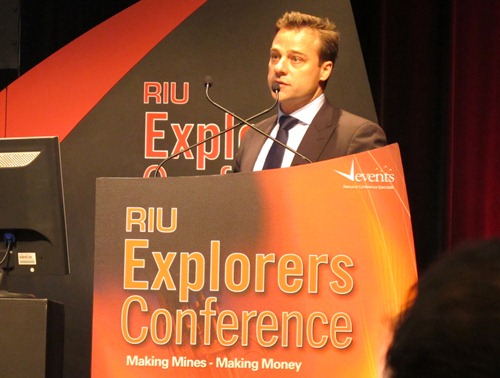
“Without the ability to raise equity and have equity market support going forward is making it challenging,” Westpac Institutional Bank director of Natural Resources Todd Ross told the recent RIU Explorers Conference.
“In saying that, debt is available, certainly for high-quality projects and low risk projects, and in that space the market is incredibly competitive.
“We are seeing offshore banks and other non-bank lenders coming into the market with margins lowering and structures looser in some instances.
“The bank market in general – certainly the Australian banks are facing a lot of challenges in terms of their cost of capital.”
According to Ross there is a key theme emerging the moment, which is that having a clear funding strategy is vital for a company when it comes to being able to get the financial support it needs to take a project forward.
The current state of play results in a run up of the equity price of a company when it makes a discovery the market considers being of some significance, such as we have witnessed in recent times with Sirius Resources (ASX: SIR) and its Nova deposit discovery.
Ross said the honeymoon tended to last as long as reaching the Bankable Feasibility Study (BFS) and construction, after which share prices fall back as the initial excitement dies down.
Once companies hit the commissioning and then first production stages, there tends to be a rerating of the company.
“In the last few BFS results that have come out, we have seen that trigger point happening a lot more aggressively,” Ross said.
“With the release of the BFS we have seen a fall of some 30 to 40 per cent in equity market values at that point as the market takes a negative view about the company’s ability to fund debt for their project.
“This has certainly been the case for a lot of the base metal companies in the past 12 months.”
In terms of the structure of ASX-listed companies – approximately 15 per cent are actually in production at the moment, which Ross said indicates therefore only 15 per cent are generating some form of cash flow.
Five per cent are in the development stage with funding already arranged, 30 per cent are at some stage of Feasibility Study with the view that within the next 18 to 24 months they’ll be coming to the market in order to raise funding for their projects.
The remaining 42 per cent are exploration focused with the final eight per cent in Scoping Study stage.
“All of them are burning through cash pretty rapidly and will be looking for access to funds fairly soon,” Ross said.
Ross encouraged these companies to be more proactive in generating some positive news flow to the market.
“It’s difficult to do that and it is also difficult to have the successes on discoveries,” he said.
“That continual news flow and the ability to tap the market when necessary by partnering early with funding providers is essential.
“The investor community is certainly more focused at the moment on maintaining capital and putting direct investments into things like exchange traded funds or direct commodity investments rather than directly into equities.
“The multiply effect they used to enjoy isn’t there anymore and the equity markets are certainly not providing any support.”