Queensland revs up for uranium mining

The Queensland Government has indicated it will restart uranium mining in the state following the release of a Cabinet a report on the subject.

After being elected in March 2012, the Campbell Newman-led, Queensland Government wasted little time in announcing its support for the recommencement of uranium mining in the state.
Implementation Committee,” AMEC regional manager Eastern States Bernie Hogan said.

“AMEC supports the Queensland Government’s thorough review. It is important to recognise the Newman Government aims to establish world’s best practice environmental and health and safety standards in the uranium industry.

“AMEC looks forward to continuing to work with the government in further developing the uranium exploration and mining sector in Queensland in order to provide jobs and significant revenue streams that can be used for regional community services.”
 
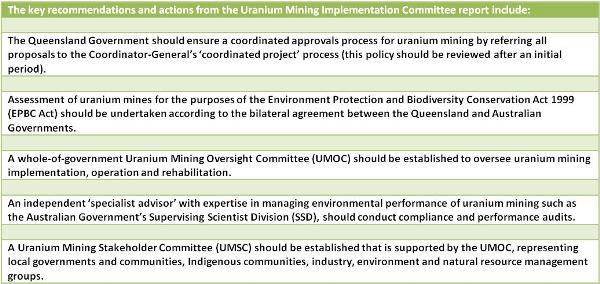
In its report the committee has concluded that, “With certain adaptations, Queensland’s existing system for regulating mining and radiation safety is appropriate for uranium mining and therefore a new legislative framework is not needed to regulate a Queensland uranium mining industry.”

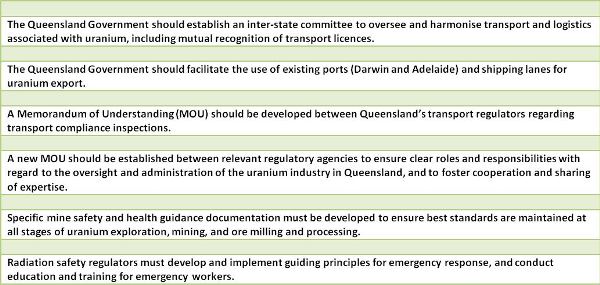
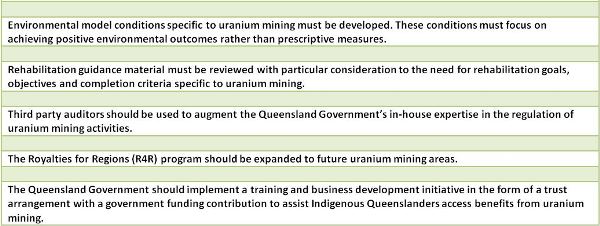
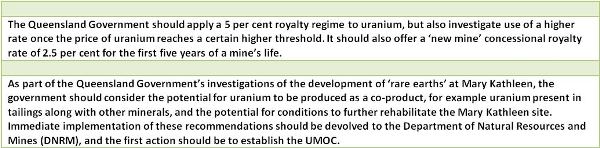
Despite there being no need for legislation the committee has recommended the existing framework can be adapted to ensure uranium mining can recommence in Queensland within a best practice framework.

The recommendations relate to new institutional arrange
In October the government established the Uranium Mining Implementation Committee and charged it with the responsibility of designing a best practice policy framework for the development and operation of the uranium industry in Queensland.

The committee heard more than 70 submissions from local, national and international sources as well as travelling to Northern Territory, South Australia, and Western Australia.

Particular focus was paid to the Mt Isa and Townsville regions, where the committee met with government, industry, uranium mining operators, transport and port authorities, Traditional Owners, and community organisations.

The report was greeted with a thumbs up from the Association of Mining and Exploration Companies (AMEC).

“AMEC welcomes the report released today from the State appointed Uranium Mining ments to be put in place the committee considers will improve coordination of assessment and approvals for uranium mines.

These include ensuring cooperation between regulatory agencies; improving engagement with stakeholders.

The recommendations also include an initiative to assist Indigenous people to access the benefits from uranium mining and the resources industry.

Queensland Natural Resources and Mines Minister Andrew Cripps announced an inter-departmental committee will be established to consider the report’s findings.

“This group will submit a draft report to the Resources Cabinet Committee outlining an implementation strategy for the recommendations, including identification of any budget implications and necessary legislative changes,” The ABC reported him as saying.

“We will also establish a Uranium Mining Stakeholder Committee comprising representatives from local governments, Indigenous groups, industry, environment and natural resource management groups in accordance with the report’s recommendations.”

Norman Moore leaves a big pair of steel capped boots to fill

Since the electoral bell was rung in favour of Western Australia Premier, Colin Barnett returning for a second term there has been much anticipation as to who he would choose to replace industry-favourite Norman Moore as Minister for Mines and Petroleum.

Moore’s latest stint in the portfolio saw a number of popular and successful policies introduced including streamlining of the approvals processes and the introduction of the WA government’s co-funded exploration drilling Exploration Incentive Scheme.

Barnett put the pollsters of West Perth out of their misery, of sorts, by announcing he had moved Bill Marmion from the Environment and Water portfolios to become the new Minister for the Mines and Petroleum

Marmion’s arrival to the portfolio was greeted warmly by industry groups.

“With his previous role as Minister for Environment and Water, Minister Marmion is well prepared for this portfolio,” Association of Mining and Exploration Companies chief executive officer Simon Bennison said.

“Leading up to the State election the Liberals released their Mines and Petroleum Policy which recognised numerous recommendations from the AMEC WA Policy Platform.

“Key commitments included allocating additional funds to expand the existing approvals tracking system and the continuation of the existing Exploration Incentive Scheme.”

Although Bennison said AMEC is looking forward to working with the new government, he also took the opportunity to express AMEC’s disappointment by a recent announcement from WA Treasurer, Troy Buswell to increase the payroll tax threshold from $750,000 to $850,000 – to come into effect by 2016-2017.

“The change follows calls from AMEC and other associations to increase the threshold to $1.5 million and reduce the rate to five per cent,” Bennison said.

“This change does not go far enough and is not in line with average wage increases.

“AMEC urges the Treasurer to readdress this issue.”

Encouraging Barnett’s new cabinet to stay true to its commitments was a theme echoed by Chamber of Minerals and Energy of Western Australia (CME) chief executive Reg Howard-Smith.

Howard-Smith indicated the rising cost of doing business was becoming something of an albatross around the neck of the Western Australian resource sector.

“Our attractiveness as a place to develop resources projects is under threat due to additional layers of taxation and charges which are driving up business costs,” Howard-Smith said.

“Policy initiatives that focus on reducing costs, duplication and red tape will deliver ongoing economic benefits to all Western Australians.”

The CME presented a list of commitments made by the Barnett government it said were of particular interest to the Western Australian resources sector, such as:

The expansion of the Department of Mines and Petroleum’s approvals tracking scheme into the Department of Water, The Department of Environment Regulation and the Environmental Protection Authority;

The development of a publically available online biodiversity, water and cultural heritage database and virtual library; and

The creation of a separate dedicated environmental regulatory department to look over all environmental approvals, associated enforcement and waste management functions.

“Premier Barnett’s strong statement opposing additional levies and taxes on the resource sector – such as the training levy proposed by the WA Nationals, showed a clear understanding of the challenges faced by the sector,” Howard-Smith said.

“CME is looking forward to working with the new Minister for Mines and Petroleum, Bill Marmion.

“As the Minister for the Environment, Minister Marmion was focused on reducing duplication and ensuring timely approvals processes.

“This common-sense approach was welcomed by the Western Australian resource sector.”


What the Brokers say

WHAT THE BROKERS SAY: Interesting news and views from across the Resource Analyst universe

Aus-American Mining Ltd (ASX: AIW)

New project and new direction

AIW has been given a new lease of life through an option to purchase a highly prospective volcanogenic massive sulphide (VMS) copper-gold-silver project in Arizona, USA.

New managing director Richard Holmes was instrumental in bringing the project into the company and will drive the company forward on this flagship asset whilst simultaneously divesting non-core assets to streamline the company.

AIW are currently undertaking their maiden drilling program on the project and so far have a very high success rate in intersecting both low grade halo and high grade massive sulphide core with grades up to 11 per cent copper, providing support for the exploration thesis.

We believe this is the start of a major change in the company and expect to see positive results from the maiden program leading to a maiden resource estimate later in the year.

Key Points
AIW are clearing the decks with respect to their diverse project portfolio, which until this point, has been dominated by USA based uranium assets augmented by an eclectic mix of Rare Earth Elements, speciality metals and gold. A new Managing Director and a new acquisition of a brown-fields, (mined on the early 1900 s) VMS style copper-gold-silver project sets the stage for a new direction.

In August 2012, AIW entered into an option to purchase agreement on two VMS (volcanogenic massive sulphide) copper-gold-silver projects in Yavapai County, Arizona. The option agreement was finalised in September 2012 and consists of a low up-front option entry payment with $2 million in payments over 3 years to get 100 per cent of the project.

AIW acquired an extensive data package on the two projects in October 2012. The package consisted of 83 drill holes (75 underground, 8 regional), geochemical, geophysical and geological data. The data package also included the original underground mine plans, underground sampling information and operational reports. This data has been used to help plan drilling and gain an early understanding of the geology and mineralisation.

AIW has set an exploration target at between 15 million and 20 million tonnes at a copper grade of between 0.6 per cent and 0.8 per cent and gold and silver credits of between 0.2 grams per tonne to 0.4 grams per tonne, and 15 to 30g/t respectively. This is based on the concept of lower grade open pittable resources. The higher grade massive sulphide lenses are seen as an upside case on the model.

So far seven holes from a 5,000m, 30-hole RC drilling program have had results returned, six of which have hit mineralised intervals, the best so far being 17m at 4.5 per cent copper equivalent in a down-dip, massive sulphide lens. The exploration model appears to be robust on the results published at this stage.

We believe there will be several catalysts in 2013, which will drive share price appreciation.

We will see the completion of the maiden program by April 2013 with follow up drilling leading to a maiden resource estimate. New anomalous areas have already been discovered leading to further potential and open ground pegged now gives AIW a 5 kilometre strike of prospective geology. AIW has a current market capitalisation of just $7.3 million.

Recommendation: Speculative Buy

Bannerman Resources Limited (ASX: BMN)

Ready, set, go! (just waiting for uranium prices to rise)

Bannerman Resource Ltd has a large (500 million tonnes) uranium deposit in Namibia called Etango.

The deposit is low grade (approx. 200 parts per million (ppm)) but has been extensively drilled and last year BMN completed a robust Definitive Feasibility Study (DFS) (reserve 280 million tonnes at 194ppm for 119 million pounds).

The management team is solid; with both the managing director and general manager qualified engineers and each with involvement at the nearby Rio Tinto Rossing uranium mine.

The DFS determined a 20 million tonnes per annum heap leach operation (recoveries approx. 87 per cent) and a sixteen year mine life.

Cash costs were estimated in the DFS to be US$45.70 per pound (closer to $40/lb in the early years).

Our model assumes LOM total cash costs of approx. $53/lb. However, capex is large. The DFS estimated capex of US$870 million (including owner operated mining fleet).

Time to production could fill market supply gaps

The uranium procurement procedures for nuclear utilities have long time horizons. Although there is a spot market, most traded uranium is via off-take because of product specifications, lead time to convert U308 into fuel, risks around securing supply (geopolitical and environmental) and costs if supply is disrupted.

This means utilities ensure they have multiple years of inventory visibility. Because of the immense forward planning, if a shortage of uranium eventuates, it is unlikely to be in the spot market. But, there is a very strong desire to secure outer year supply.

As an indication of this dynamic, Paladin Energy (ASX: PDN) recently needed to raise cash to repay convertible notes. PDN negotiated a $200 million pre-payment from EdF (a French utility) for delivery of approx. 14Mlb between 2019-2024 (with a cap & floor prices).

The fact that EdF pre-paid a significant proportion of the current implied contract value (approx. $650 million) six years ahead of delivery, to a partially distressed seller, indicates the importance utilities place on securing outer year supply.

The Etango project is well advanced with most of the work required to enter construction already complete. The lead time from decision-to-mine (which in theory could be made soon) to production is around 2.5 years and significantly ahead of other listed developers. This means that BMN could easily deliver uranium into the supply window that utilities focus on (3-5 years into the future) and hence is strategically attractive (the estimated lead time for typical mines is greater than 6 years).

Bannerman trades on an EV/resource lb of 12cents, diluted for capex it is approx. $4.70/lb.

Early to production + low grade + long mine life = U308 leverage

The DFS (24 May 2012) estimated a pre-tax NPV8 of $238 million and post-tax of $68.7 million (based on $75/lb U3O8).

We use a higher discount rate and therefore have a lower valuation.

The real upside for shareholders of BMN is based on rising U3O8 prices, particularly as the advanced stage of Etango means it can enter construction quickly. Using a long run price of $85/lb, we have a BMN valuation of approx. 100 cents per share.

Bannerman’s all-time high share price was $4.14 in 2007. Despite dilution since then, under very aggressive (but plausible) long term price assumptions (approx. $130/lb), a recovery to those levels is possible.

We initiate with a $0.18 price target with the speculative aspect emphasising U3O8 price risk.

Recommendation: Speculative Buy

Disclaimer: The above
is intended as a guide only. The Roadhouse accepts no responsibility for
investments made from this advice, successful or otherwise.

What the Brokers Say

WHAT THE BROKERS SAY: Interesting news and views from across the Resource Analyst universe.


Lamboo Resources (ASX: LMB)

Lamboo Resources has a quality portfolio of graphite projects with significant exploration potential.

Newly acquired South Korean projects host existing JORC Resources, a ‘Mining Right’ and established infrastructure while at the company’s Australian based McIntosh project, a maiden JORC Resource is expected imminently, with substantial upgrades likely in due course.

The South Korean projects cover three different project areas, each of which were historically mined by open cut operations.

The three deposits have a combined JORC Resource estimate of 0.57 million tonnes at 7.5 per cent TGC (Total Graphite Content) and offer significant exploration potential.

Processing of the graphite ore is relatively straight forward as demonstrated by the historical operators who employed a simple flotation processing route to produce a large flake carbon-graphite concentrate on site.

A ‘Mining Right’ was recently granted over the Samcheock project paving the way for further exploration and potential early start-up of mining operations.

The McIntosh project (WA) has been assessed by over 12,200 metres of drilling and is set to imminently deliver a maiden JORC Resource estimate (targeting a 5 to 6 million tonnes at 5 to 6 per cent TGC) at just one of the five targets identified.

At ‘Target 1’, Lamboo has identified a 3.7 kilometre electromagnetic (EM) anomaly which has a strong correlation to the known areas of mineralisation.

Encouragingly, Lamboo has only drill tested approximately 10 per cent of this anomaly, highlighting the potential for substantial increases with further drilling.

Additional nearby targets demonstrate similar mineralisation characteristics and contribute to a combined 10km of prospective strike.

The outlook for graphite remains robust, buoyed by the growth in electric vehicle fuel cells and lithium ion batteries.

Demand from these sectors will likely keep graphite prices on an upward trend for the foreseeable future.

 Recommendation: Speculative BUY


 Wolf Minerals (ASX: WLF)

Wolf Minerals is in the final stages of securing finance to advance the Hemerdon Ball tungsten and tin project into production.

This is a major achievement and is testament to sound management and a quality project.

The EPC contract has now been awarded to GR Engineering with the expected time of construction and commissioning scheduled for 24 months.

Wolf Minerals is an ASX-listed (ASX: WLF) and AIM-listed (AIM: WLFE) emerging tungsten producer focused on the development of the world class Hemerdon Ball tungsten and tin project, located in Devon, SW England.

Hemerdon currently hosts a JORC resource of 401 million tonnes at 0.13 per cent tungsten trioxide (WO3) and 0.02 per cent tin, placing it as the third largest (known) tungsten deposit in the world.

A Definitive Feasibility Study (DFS), completed in May 2011, indicated robust economics based on a 3 million tonnes per annum operation over a 9.25 year life of mine.

Production is estimated at approximately 350,000 metric tonne units (mtu) per annum of a 65 per cent tungsten concentrate and a further approx. 450 tonne per annum of tin in concentrate at C1 costs of US$105 per mtu (after tin credits) versus the 2012 average APT price of US$387 per mtu.

The current mining reserves of 26.7 million tonnes at 0.19 per cent WO3 and 0.03 per cent tin are bound only by the constraints of the open pit limits as per the parameters of the granted ‘Planning Permission’.

Significant opportunity therefore exists to extend the mine life should approval for a larger open pit be sought in due course.

Based on the outcomes of the DFS, Breakaway estimates the total required CAPEX is approx. £130 million ($200M).

Wolf is completing documentation and conditions president for approx. $212M (raised through debt and equity) which should be sufficient to commission the mine.

Wolf will however be required to repay a US$75 million ‘bridging facility’ within 12 months of first draw down.

This would likely be accomplished via an equity placement with the top 2 shareholders already indicating support.

 Recommendation: Speculative BUY

Disclaimer: The above is intended as a guide only. The Roadhouse accepts no responsibility for investments made from this advice, successful or otherwise.

IPO Watch

IPO WATCH: Recent ASX listings and those companies scheduled to list soon.

RECENT LISTINGS

Strata-X Energy Ltd
ASX code: SXA
Listing Date: 12/3/13
Opening Price: 33 cents
Closing Price: 35 cents

Toronto Venture Exchange-listed Strata-X Energy Ltd. (TSX.V: SXE) listed on the Australian Securities Exchange this week.

The company describes itself as an independent oil and gas exploration company.

Based in Golden, Colorado in the United State of America, Strata-X Energy has a portfolio of petroleum projects covering over 225,000 net acres of leases across the country.

The company’s self-proclaimed mission is to create substantial growth for its shareholders by finding and developing high reward opportunities with relatively low entry costs, then acquiring acreage positions in those opportunities thereby owning a working interest.

Current projects in the USA are in the states of Colorado, California, North Dakota, Illinois and Texas.
The company also holds a 100 per cent equity position in a large area of the Canning Basin in Western Australia.

Strata-X Energy says it has a drilling program planned for 2013 to evaluate the high resource potential of its WA leasehold.


UPCOMING FLOATS

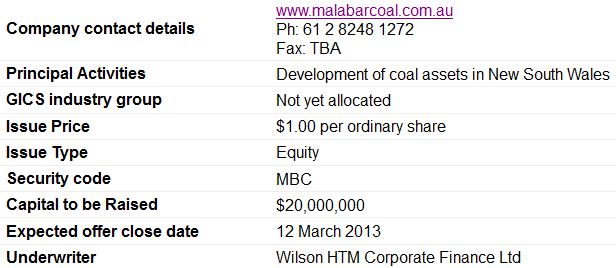
Malabar Coal Limited
Proposed ASX code: MBC
Proposed listing date: 21 March 2013

Malabar Coal has a 27.7 per cent interest in the Spur Hill underground coal project located in the coal fields of the Upper Hunter Valley in New South Wales.

The company has the right to increase its interest up to 80 per cent.

The Spur Hill project includes a 586 million tonnes JORC Mineral Resources comprising 117 million tonnes Indicated Mineral Resources and 469 million tonnes Inferred Mineral Resources.

The company says the project hosts high-quality, well-known coal seams, from which it expects to produce products such as ultra-low ash soft coking coal and semi-soft coking coal.

The project is situated in close proximity to infrastructure being adjacent to established coal mines and less than five kilometres from the Hunter Valley Rail Network.

The company is offering a total of 20 million shares at a price of $1.00 per share.

Funds raised will be used to fund continued development of the Spur Hill project including drilling, environmental studies and monitoring, engineering studies, development approvals and strategic land acquisitions.

The proceeds will also provide general working capital and fund the expenses of the IPO and costs associated with listing the company on the ASX.


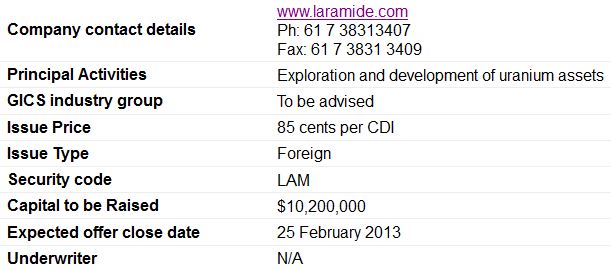
Laramide Resources Ltd
Proposed ASX code: LAM
Proposed listing date: 22 March 2013

Laramide Resources is listed on the Toronto Stock Exchange (TSX: LAM).

The company is conducting exploration and development of uranium assets based in Australia and the United States.

These include Westmoreland in Australia and two development stage assets, La Sal and La Jara Mesa, in the US.

Within the Laramide portfolio are also joint ventures, strategic equity positions and royalty participation in uranium development and exploration companies that provide additional diversification.

The company claims the Westmoreland project in Queensland to be one of the largest uranium deposits not controlled by a senior producer or utility.

The latest NI 43-101 resource estimate for Westmoreland reported an Indicated Mineral Resource totalling 36.0 million pounds of uranium contained in 18.7 million tonnes at an average grade of 0.089 per cent uranium, and an additional Inferred mineral resource totalling 15.9 million pounds of uranium contained in 9 million tonnes at an average grade of 0.083 per cent uranium.

In addition to the Westmoreland deposit in Queensland, the Company has in the Northern Territory, three contiguous joint ventures, the NuPower-Lagoon Creek Joint Venture, the Gulf Mines Joint Venture, and the Rio Tinto – Murphy Farm-in and Joint Venture.


Disclaimer:  The above information is not investment advice. The Roadhouse accepts no responsibility for investments made from this information.

Gold once again in the spotlight

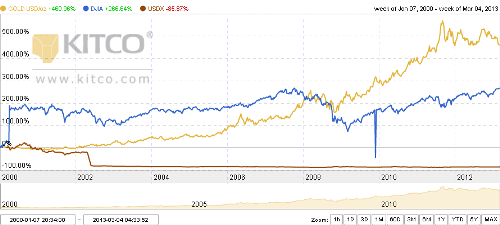
GAVIN WENDT: Over the past fortnight or so, the price of gold has declined to levels around its $1,600 long-term trend-line, which we’ve previously spoken about.

What’s most bemused me about gold’s recent decline (and all previous sell-offs during its 12-year bull run), has been the economic rhetoric accompanying it.

Quite simply, it seems to have boiled down to economic complacency. It is argued that share markets are recovering (well some of them superficially anyhow), growth is reappearing (in some sporadic circumstances) and investors are feeling more comfortable about their economic outlook (in some instances). Therefore the argument goes, there’s no logical reason to own gold.

Nothing could be further from the truth. Sharemarkets are rising (notably in the US) because of the trillions of dollars that have been pumped into the market since the GFC, through various forms of quantitative easing (QE) and money-printing.

Naturally, if you keep pumping enough air into a balloon, the balloon must eventually swell in size.

The problem with the US economic balloon is that it’s also full of holes.

Cheap credit (via record low interest rates) has provided the mechanism with which the US economic balloon has been inflated – not just since the GFC – but for the past 20 years or more since sound economic management went out the window.

Cheap interest rates led of course to both a consumer and property boom unparalleled in US history, allowing average Americans an over-inflated sense of their own economic wellbeing.

The debt binge would eventually end – and it did so with the implosion of the US economic balloon during the GFC in 2008.

Now the US is applying exactly the same economic remedy that caused the mess in the first place – more easy credit and low interest rates (and this time around a devalued currency) in order to get Americans to spend once more. But it’s inevitable it will fail.

The scary part is that the average American’s lot has not improved despite the trillions poured into the monetary system – in fact, by virtually all measures (net income, purchasing power and investment returns) – they’ve going backwards.

According to US statistical group, TrimTabs, their tracking of real-time wages and salaries shows that the US has in fact entered into a recession this year.

This of course contradicts official Government statistics, but what the data shows is that after-tax wages and salaries net of inflation have been shrinking since the second week in January.

What has been growing dramatically in real time this year is income and employment tax payments. Before inflation, after-tax wages and salaries have grown by just 0.3 per cent.

The average American is actually buying more gold, which demonstrates that the economic outlook as far as they are concerned is clouded to say the least. Figures from the US mint show that gold coin demand for February was up more almost 300 per cent on the same period in 2012. Gold coins are the ultimate form or insurance for ordinary investors.

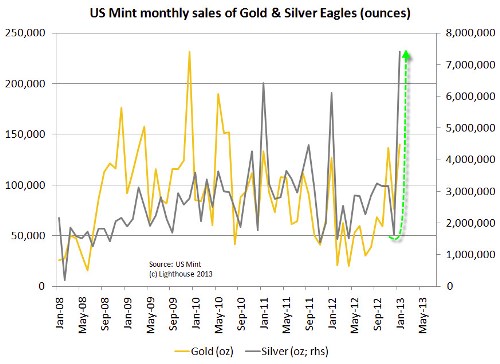
Sales of American Eagle gold coins totaled 80,500 ounces during February, a rise of 283.3 per cent from the same month last year, while sales of the same line of silver coins more than doubled from a year earlier to nearly 3.4 million ounces.


Excluding figures for January, February 2013 saw the second-highest monthly gold coins sales by the US Mint since September 2011, the month that saw gold set an all-time high above $1900 an ounce.

Since then, only November last year has seen more American Eagle gold coins sold by the US Mint, when 136,500 ounces were sold.

And it’s the same story with respect to silver coins. After smashing their all-time monthly sales record during January with 7.5 million Silver Eagles sold (even with production halted for half the month), silver eagle sales have continued at a record-setting pace.

The Mint’s February sales statistics indicate record sales of 3.37 million silver eagles for the month, eclipsing February 2011′s previous February record of 3.24 million ounces sold.

In contrast with gold coin sales, gold exchange traded funds (ETFs) saw their biggest combined monthly bullion outflow on record. What this indicates is that whilst the big boys are chasing higher speculative returns elsewhere, ordinary investors are increasingly demanding the security and peace of mind that only gold can deliver.

And it’s not just the mums-and-dads that are buying gold in record volumes – so too are central banks.

In fact, the actions of central banks worldwide continue to fly in the face of the hordes of financial experts that point to an improving economic picture and renewed confidence.

During 2012 central bank gold buying reached its highest level since 1964, rising by 17 per cent to 534.6 tonnes, with 145 tonnes purchased during Q4 2012 – up 9 per cent from the same period a year ago and the eighth consecutive quarter in which central banks were net purchasers of gold.

What this situation clearly demonstrates is a clear lack of confidence on the part of emerging economies in the traditional and established world reserve currencies – like the dollar, the euro and the pound.

And who could blame them, given the trillions of dollars that have been printed and fed into the financial system for little net effect?

As experienced precious metals commentator David Levenstein best described it this past week, “There is a huge dislocation between the physical market of gold and the paper market for gold. But, unfortunately, at the moment, it seems that speculative trades are determining the trend, much like the tail wagging the dog.”

Whilst the price of gold has fallen in the short-term, I share his view that the decline does not reflect the very real fundamentals that include a European, US and Japanese debt crisis, global currency wars and the real risk of recessions. And as we’ve previously highlighted, when sustained economic recovery does eventually take place, surging interest rates and inflation will be the result.

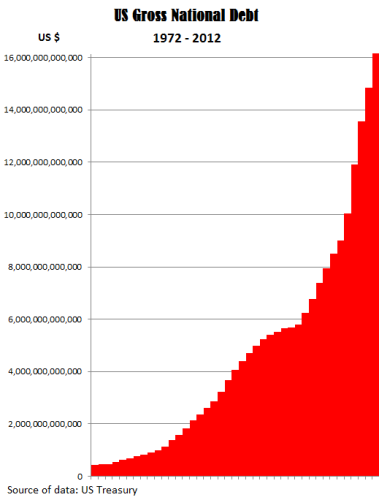
As Levenstein highlighted last week, since 2008 the official net public debt of the US federal government has increased by $5.5 trillion – which is more than double the size of the total net public debt of the US in 2007 when it was $5 trillion.

The total net debt of the US government has exploded to more than $11 trillion, or roughly 80 per cent of GDP.

Over the same period, the US Federal Reserve has more than tripled the size of its balance sheet to around $3 trillion through a series of bond buying programs.

Despite the trillions in bail-outs and stimulus spending, the US economy is in most respects stagnant and the unemployment rate remains close to 8 per cent.

And the situation in Europe is dire and getting worse – contrary to the opinion of many commentators.

In fact the Eurozone economy is likely to shrink for the second consecutive year, with countries like France and Spain missing fiscal targets.

Olli Rehn, the European commissioner for economic and monetary affairs, forecast growth across the 27 nation European Union of just 0.1 per cent this year and a contraction of 0.3 per cent among the 17 countries in the euro zone.

Levenstein says it best: “While the mainstream media is reporting an economic turnaround, I am not convinced. And, as Federal Reserve Chairman Ben Bernanke is trying to create the illusion of wealth by pumping money into the system, the average US citizen is having a tougher and tougher time as the cost of living is higher relative to their salaries. Furthermore, the economy is not growing and unemployment remains elevated.”

As noted gold-watcher Barry Stuppler opined this past week, “Many of the financial commentators on CNBC and CNN expressed their opinion that the twelve year track record of gains for the gold price was over”, for the following reasons:

Investors are switching out of gold into stocks for growth and income;

There is no inflation, and investors have no reason for owning gold;

The US economy is recovering, easing pressure for more monetary stimulus;

Investors like George Soros are reducing their core holdings of gold; and

World demand for physical gold dropped 4 per cent in 2012.

The same arguments against gold have been made many times over the past 12 years – most notably during 2006 and 2008.

The experts of course proved to be wrong, with gold quickly recovering and hitting fresh highs. And I have no doubt that the current situation isn’t any different.


It’s been reported within China that central bankers there have a three-phase, 10-year route map to make the yuan a full reserve currency and gold will be a central part of their strategy.

This contrasts with most Western central banks over the past three decades, which have effectively tried to get rid of gold from the international monetary system.

What we witness now are the dollar, euro and yen in crisis.

The sensible investor understands that gold’s recent price drop does not alter the long-term picture. I remain bullish on gold and believe that after a period of consolidation around its long-term support line at US$1,600, it will inevitably push higher.

Gavin Wendt is the founder of MineLife, publisher of the MineLife Weekly Resource Report


Mining, Football and Foxtel

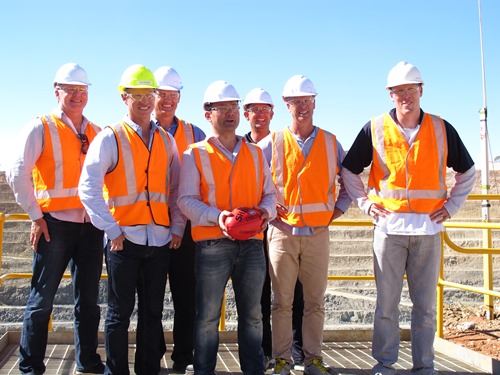
OUT AND ABOUT: The Roadhouse recently travelled to the Edna May gold mine of Evolution Mining with a number of former West Coast Eagle and Fremantle champions.

A 12 seater light aircraft can appear diminutive at the best time but when shared with the likes of Glen Jakovich and former West Coast Eagles team mates Dean Kemp, Brett Heady, Ashley McIntosh and Michael Brennan plus former Fremantle Dockers players Peter Bell and Shaun McManus, they can feel claustrophobic.

The Roadhouse’s footballing exploits may not have reached the same plateau as our peripatetic companions, however after a quick tour of the Edna May mine we became part of a travelling football clinic that had been organised by Foxtel for Business.


The Edna May gold mine of Evolution Mining (ASX: EVN) recently signed a deal with Foxtel for Business for the provision of a Foxtel Platinum service.

Nothing too much out of the ordinary there, however Evolution has made its subscription unique in that it is installing a Foxtel iQ box in every employee’s room.

“We have got FOXTEL on a lot of mine sites, in a lot of dongers all around Australia, but this is the first place in the entire country to deliver the full Foxtel iQ Platinum service into the dongers for the crew,” Foxtel for Business national sales manager Daniel Gardener told the people of Westonia gathered in the local hall.

“When workers have access to all of the channels they can record, pause and rewind as they like, it makes a huge difference to not just how they are entertained, but how they stay connected.

“You can watch the same programs your family is watching at home whilst you’re away at work.”


According to Foxtel entertainment has been demonstrated to be an important tool for mining companies in regards to employee retention.

The company said the Edna May gold mine was breaking new ground for the industry by delivering its employees with an at-home entertainment experience, which offers all the functionality and channels they’re used to, even while on site.

“We know that isolation is a big issue for these remote communities and these mine sites,” Gardener said.

“Evolution has partnered with us to something pretty special and when we fly 150-odd IQ boxes and set them up for the crew, I’m sure it will make a huge difference and make work feel a little bit more like home.”

Discslaimer: The Roadhouse travelled to Westonia as a guest of Foxtel for Business

Octagonal Resources shoots to Producer status

THE INSIDE STORY: Sometimes putting the cart before the horse can be a smart way of operating, especially when your cart is the only suitable operating gold processing facility in the area.

Octagonal Resources (ASX: ORS) has achieved a rare feat by attaining the status of gold producer before commencing mining activities at any of its numerous projects.

Octagonal has been producing gold from its 100 per cent-owned 150,000 tonne per annum carbon-in-leach gold processing plant located near Maldon.


Maldon sits on a rich goldfield, historically producing over 1.7 million ounces of reef-hosted gold at an average grade of 28 grams per tonne, in Central Victoria.

The area rates third behind Victoria’s more famous gold rush regions, Bendigo and Ballarat.

The Maldon processing plant was recently refurbished and is fully permitted and operation ready to process competent underground ore and lower grade open pit ore.

“This means we can process lower grade and oxidised gold other operations are unable to efficiently recover,” Octagonal Resources managing director Anthony Gray told The Resources Roadhouse.

“This gives us exposure to third party ore by toll treating arrangements.”

In the past 12 months Octagonal has established two ore processing arrangements providing a revenue stream to enable it to develop its own ore sources.

In February 2012, Octagonal struck an agreement with A1 Consolidated Gold to treat up to 150,000 tonnes of ore over a three year period from its A1 gold mine at Woods Point.

In August it agreed to reprocess tailings from the Kangaroo Flat gold mine of Unity Mining near Bendigo.

“In consideration for the removal of tailings, transport, processing and refining, and paying 50 per cent of the costs- we receive 50 per cent of the gold,” Gray explained.

“We commenced regular gold production from these tailings in November.

“During the December quarter we processed 6,430 tonnes of tailings to recover almost 1,400 ounces of gold at an average recovery grade of 6.5 grams per tonne gold.

“We are producing gold on a weekly basis at grades beyond our expectations and expect to be producing gold from this material until the middle of this year.

“For processing the A1 ore, we receive a processing fee and 10 per cent of the gold produced.” 

Being a regular gold producer, Octagonal can now self-fund its exploration, mining and future growth, without diluting existing shareholders’ interests.

Octagonal’s primary focus is its Victorian operations where it is targeting 30,000 ounces per annum of low-cost gold production.

“In this area we own 17 exploration and mining licences overlying 900 square kilometres and seven historic goldfields,” Gray said.

“Our Victorian mining strategy is to develop a sustainable, low-risk gold operation by focussing on grade and profit, not tonnes and ounces.”

This is a reasonable objective; besides its gold processing plant, Octagonal also boasts 245,000 ounces of underground and open pit ore sources, an established decline towards said underground resources, and advanced exploration plays it is confident can sustain operations.


The 1.9 kilometre-long Union Hill decline accesses the Alliance South gold deposit and the southern half of the Maldon goldfield and is within 100m of the Alliance South shoot, which has an inferred Resource of 182,000 ounces of gold.

Octagonal is currently extending the Union Hill decline 180m to the south and developing two levels to determine the grades of the ore shoot, assess ground conditions, and determine the most appropriate mining technique for an ongoing operation.

Development of the Alliance South shoot will be the first step towards establishing an ongoing underground mining operation at Maldon.

The Alliance South shoot is hosted by the Eaglehawk Reef: one of five reefs in the central Maldon shear zone to have produced almost 1.5 million ounces of gold.

The others are the Nuggetty Reef to the north, and the Beehive, German and Derby Reefs to the south.

“We have five priority exploration targets on these reefs, which we intend to drill test once the Union Hill decline is developed sufficiently to the south,” Gray said.

“Each target has potential to host between 50,000 and 100,000 ounces of high-grade gold mineralisation and could contribute to ongoing underground mining operations.”

To supplement its underground mining at Maldon, Octagonal is currently developing three open pits.

The first to come into production will be the Black Reef on the Wehla goldfield, 60km from Maldon.

Octagonal intends operating a trial open pit at Black Reef to 30m depth in an area where a costean returned 14m at 4.5g/t gold and drilling intersected 5m at 15, and 5m at 35g/t gold.

“Our expectation is that by improving our understanding on the distribution of gold at Black Reef this will help us to interpret drilling results and help justify a larger open pit mining operation at Wehla,” Gray said.

A second, and significantly larger, open pit will be at the Pearl Croydon deposit, which is located 40km from Maldon and hosts an inferred resource totalling 53,000 ounces of gold.

The Pearl Croydon deposit consists of a 1.6km long reef system and is located on a granted mining licence.

A recent open pit optimisation study indicated Pearl Croydon has potential to produce between 15,000 and 32,000 ounces of gold.

Octagonal is developing a mine plan for this deposit, which once finalised will allow it to seek regulatory approval to commence mining.

The company’s third open pit mine will be the Specimen Reef located 30km from Maldon near Donnelly, which consists of a greater than 1km long line of reef.

Octagonal discovered this deposit in July last year and has since drilled 47 RC holes to define an initial inferred resource containing 10,000 ounces of gold.

“This mineralisation extends over 440 metres strike length and is not constrained by drilling to the north, south, or down dip,” Gray said.

“In June last year we applied for a mining licence to exploit this deposit and we will recommence drilling this deposit later in the year to upgrade the resource and start to define its size.”

In conjunction to its Victorian operations Octagonal intends to grow its Western Australian assets, where it holds a significant landholding located 70km southeast of Kalgoorlie, surrounded by the 12 million ounce St Ives goldfield, 800,000 ounce Daisy Milano mine and 400,000 ounce Salt Creek mine.

The main focus here is the Burns prospect, where 272 aircore holes were drilled in 2011 to define a one square kilometre area of gold anomalism.

Subsequent drilling in 2012 discovered potentially economic gold, copper, and silver, which led the company to have all samples from the 2011 aircore programs re-analysed for copper.

Octagonal has now identified thick zones of copper anomalism, where the latest drilling has defined a 2km long anomaly between 80m and 350m wide, not constrained by drilling, along its southeast margin.

A second anomaly was also identified over 700m not constrained by drilling to the northwest.

“We are excited by the potential of the Burns prospect to develop into a significant multi-commodity deposit,” Gray said.

“In December 2012 the Western Australia government awarded us a $150,000 co-funded drilling grant as part of its exploration incentive scheme for our first four hole diamond drilling program at the deposit, which we expect to complete later in the year.”

Octagonal Resources Limited (ASX: ORS)
…The Short Story

HEAD OFFICE
Suite 3
51 – 55 City Road
Southbank VIC 3006

Telephone: +61 3 9697 9088
Facsimile: +61 3 9697 9089

Email: info@octagonalresources.com.au
Website: www.octagonalresources.com.au

DIRECTORS and MANAGEMENT
Ian Gandel, Anthony Gray, Robert Tolliday, Jason Mills

MAJOR SHAREHOLDERS
Alliance Resources    20.8%
Ian Gandel        18.7%
JP Morgan Nominees    8.9%

SHARES ON ISSUE
106.05 million

MARKET CAPITALISATION

$12.2 million (at 13/3/13)


Investigator identifies new silver targets at Peterlumbo

THE DRILL SEARGEANT: Investigator Resources (ASX: IVR) has identified new silver targets in the eastern part of the Peterlumbo Joint Venture tenement (75 per cent IVR).

The targets are situated at distances of 15 kilometres to 30 kilometres east of the Paris silver deposit.

Investigator said it had defined the new targets via first-pass soil sampling that had previously discovered the Paris deposit, which is situated about 400km northwest of Adelaide on South Australia’s Eyre Peninsula.

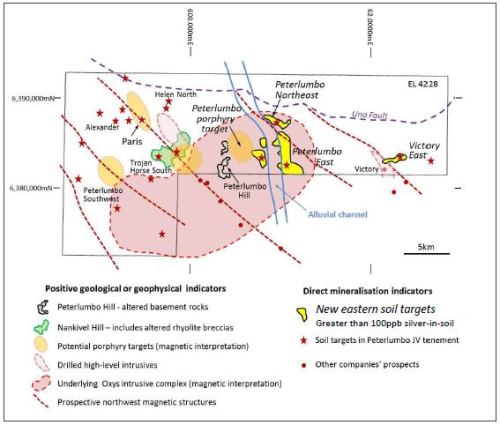
The company has recently received analyses, which it claims shows high silver-in-soil results for first-pass soil sampling of the eastern part of the Peterlumbo tenement.

These outlined new targets in covered areas, namely; Peterlumbo East, Peterlumbo Northeast and Victory East.


Peterlumbo interpretive target plan showing new silver-in-soil targets in yellow. Source: Company announcement


According to Investigator the new targets have strike lengths of 2km to 5km and anomalous silver-in-soil values up to 415 parts per billion silver.

The company indicated the new targets to be larger in area with similar or higher silver values than what the Paris target signature held at the same stage of its exploration.

“The exciting new silver targets are another very positive result for the Joint Venture’s breakthrough exploration program at Peterlumbo,” Investigator Resources managing director John Anderson said in the company’s announcement to the Australian Securities Exchange.

“The new targets not only show substantial size and silver-in-soil values compared with the initial signature of the Paris discovery, they are also well-located within the geology of the Peterlumbo field to be genuine targets for additional bedrock silver deposits.

“The targets are an excellent addition to the satellite targets already identified and being progressed to drilling nearer to Paris.

“The calibre and proximity to Paris make these new targets a high priority for immediate follow up with infill soil sampling.

“We expect to be able to start drill testing these exceptional targets around the middle of the year after the usual access and regulatory requirements are achieved.”

Australian mineral exploration took a dive late last year

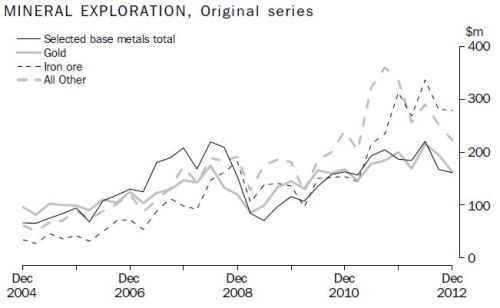
The Australian Bureau of Statistics has released figures showing a decline in mineral exploration expenditure toward the end of 2012.

The Bureau’s MINERAL AND PETROLEUM EXPLORATION report for the DECEMBER QUARTER 2012 paints a sobering picture for the sector, which has so far enjoyed a, relatively, buoyant beginning to 2013.

“The recent release by the Australian Bureau of Statistics of the December quarter exploration statistics has further highlighted what AMEC has been warning policy makers for some time. Australian exploration activity is in decline,” Association of Mining and Exploration Companies chief executive officer Simon Bennison said.

The ABS determined the trend estimate for total mineral exploration expenditure fell in the fourth quarter of last year by 10.2 per cent or $89.3 million in monetary terms to $790.2m.

The state that emerged as the largest contributor to the fall in the trend was Western Australia, which dropped 11.2 per cent ($55.3m).

The 2012 final quarter estimate came in at 21.2 per cent lower than the December quarter 2011 estimate.

Australia’s other big mining state Queensland was not to be left out, featuring as the largest contributor to the drop in the seasonally adjusted estimate for mineral exploration expenditure, which fell 8.9 per cent ($17.5m).

Overall the country dropped 6.7 per cent ($56.5m) to $788.4m for the quarter.

Source: ABS

Exploration on areas of new deposits fell 13.1 per cent ($39.6m) while expenditure on areas of existing deposits fell 5.3 per cent ($31.1m).

According to the report the largest fall in mineral exploration came from expenditure on gold exploration, which surprisingly, was down 16.3 per cent ($31.7m).

The next largest fall came from expenditure on coal exploration, which dropped 12.5 per cent (21.4m).

“Of most concern, is the decrease in greenfield exploration,” Bennison said.

“For the first time since the financial crisis the trend for exploration activity in Australia is going down.”

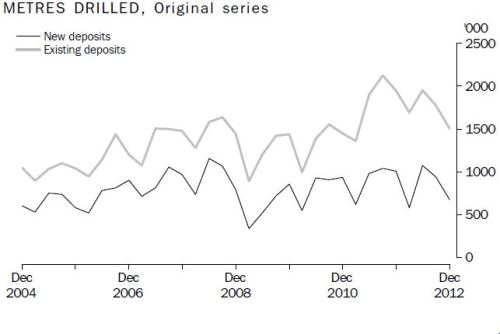
Although it seems the miners are suffering, spare a thought for the drilling companies with the trend estimate for metres drilled during the December 2012 quarter falling 9.9 per cent.

This was 23.7 per cent lower than the December quarter 2011 estimate.

“In original terms, metres drilled fell 19.7 per cent,” The ABS report said.

“Drilling in areas of new deposits fell 28.2 per cent and drilling in areas of existing deposits fell 15.2 per cent.”

Source: ABS

“These statistics further highlight the lack of investor confidence in exploration companies that has made access to equity finance almost impossible,” Bennison continued.

“This decrease in greenfield exploration has serious consequences for future Governments given greenfields exploration is responsible for finding the mines of tomorrow.

“It is estimated that in the absence of new significant discoveries, based on current reserve and resources, about half of Australia`s non-bulk commodities mines would be exhausted between 7 and 18 years.

“Considering it takes between 7-10 years from applying for an exploration license to get to a stage of extracting and selling a mineral, it is imperative we increase greenfield exploration now to ensure the mines of tomorrow.”

Bennison highlighted a policy framework AMEC has assembled, which the body believes will correct the situation if it can obtain federal government support.

One suggested strategy in the framework is the introduction of a Minerals Exploration Tax Credit model.

He said a similar strategy was introduced in Canada in 2000, which resulted in an upswing in exploration rates.

“AMEC looks forward to working closely with all governments in the drive to reverse the decline in the share of greenfields mineral exploration that has been occurring over the last decade,” Bennison said.

“If this decline is allowed to continue it will threaten the future revenue streams of the Australian economy.”