After hours energy use – a great place to start your efficiency campaign
Greensense is a global leader in cloud-based sustainability performance monitoring and occupant engagement software.
GUEST CONTRIBUTOR: Greensense director Peter Tickler looks at how businesses can develop a better understanding of the buildings they occupy and how they can improve the sustainability performance of those buildings.
One of the biggest challenges of any resource efficiency program is deciding where to start.
This can be tough even if you only have one property, but for managers of large portfolios it can be particularly tricky.
Whilst buildings generally share some similarities in their infrastructure – walls, roof, HVAC, lighting, plugs and people – there are often significant differences related to size, occupancy, hours of operation, age and function.
Of course, it’s these differences that can make it hard to come up with a portfolio wide approach to energy efficiency.
If analysed and presented correctly, data can be hugely powerful, both in terms of helping identify where you might begin on your efficiency quest, as well as providing the means to track and quantify performance improvements over time.
So what does all this data tell us when it comes to figuring out where to begin your efficiency efforts?
One thing: Out-of-hours energy use; and here’s why.
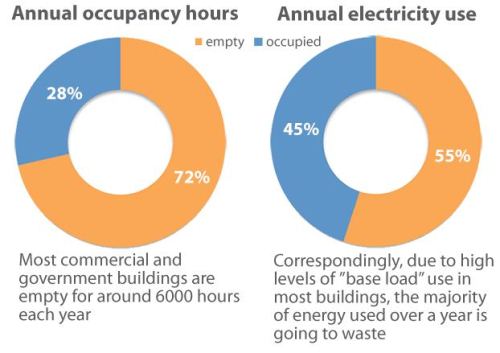
To begin with, as the graphic below shows, most buildings are empty for the majority (approx. 70 per cent) of the time over the course of a year.
As obvious as this sounds, it’s a very important consideration when you’re looking at improving efficiency.
Source: Greensense
From a sustainability perspective, in the same way that a busy and productive building will inevitably use energy, there’s nothing wrong with having an empty building, just so long as you’re not consuming any resources while it’s sitting idle.
Unfortunately, that is never the case, far from it in fact.
Most buildings have relatively high levels of “base load”, meaning they continue to consume significant amounts of power even when they’re empty.
We typically see over 50 per cent of the total electricity used over a year going into empty buildings.
That’s from our own dataset of over 1000 commercial buildings.
As always in discussions around building (in)efficiency, when it comes to costs we need to consider both the environmental and the financial implications.
The environmental cost is pretty easy to work out.
In Australia, each kilowatt-hour of electricity poured into an empty building generates around 0.9 kilograms** of greenhouse gas emissions.
Of course you might be subsidising your wasted electricity through some onsite renewables, most likely solar, but remember that the majority of this out-of-hours consumption is going to occur at night when your PV can’t help.
The financial cost is a little trickier to calculate, as it will depend on the tariff for each building.
In order to explore the cost question a little further, and at the same time to illustrate the value in understanding your building’s energy profile, we’ve put together a graphic to illustrate how significant out-of-hours consumption can be to the financial bottom line.
As an aside, it also demonstrates the value of benchmarking and comparison as tools to help you put the performance of your buildings in context.
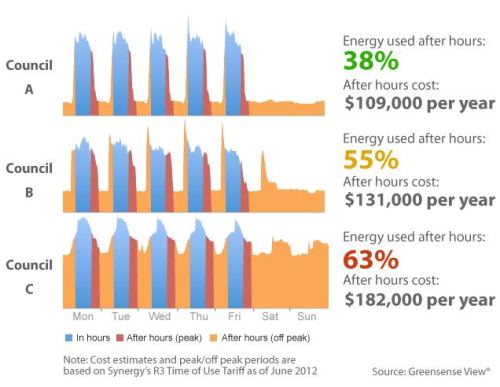
In the graphic below we compare the average weekly energy consumption for three local government administration buildings.
The buildings are located within a few kilometres of each other in a major Australian city, are of very similar size, have very similar operating hours and perform the same function.
In many ways they are typical examples of commercial office buildings.
Source: Greensense
Despite the similarities, the amount of energy going into these buildings during out-of-hours periods varies hugely, with correspondingly significant implications in terms of operating costs.
Even the ‘best’ performing building here is spending over $100,000 a year powering an empty building!
What the graphic also shows clearly is that, while the benchmarking is useful in putting the after-hours performance of each building in context, the 7-day profile is also crucial in understanding when that energy is being used.
So where is all that energy going?
Exactly where all that out-of-hours electricity is going will vary a bit from building to building but, even without sub-metering data, it’s easy enough to make some informed guesses.
In a typical office building there are three main energy sinks: HVAC (50 per cent), lighting (25 per cent) and plug loads (25 per cent) ***.
HVAC is normally pretty well centralised in most larger offices, although you might still have a few split-system units around the place, and lighting control is increasingly centralised too.
So, while they may be playing a part in the story, it will most likely be plug loads that are the real culprit and must inevitably form the focus of any out-of-hours performance improvements.
It just makes sense
Sometimes it’s important to be pragmatic when you’re looking to roll out environmental programs, and energy efficiency is no different.
There will likely be a number of (often competing) project options, whether it’s covering the building in solar panels or turning up the set point on the A/C.
While many of these projects will have merit, a number will present significant obstacles such as upfront cost (solar panels) or push back from building occupants (A/C tweaks).
By starting your energy saving quest by focusing on out-of-hours use though, you remove most of these barriers.
First and foremost, nobody can deny that pouring energy into an empty building is a dumb and wasteful thing to do.
Secondly, the steps taken to reduce this waste are often relatively uncomplicated.
Why? Because the building is empty for a start.
It’s much easier to affect change in an empty building, as you don’t have to worry about upsetting the occupants.
Coupled with that, the savings you’ll find are often from simple, operational tweaks such as shutting down printers and PCs at night.
For those aspiring to improve the energy efficiency of their buildings, getting to grips with out-of-hours consumption is an obvious, and often rewarding, place to start.
By focusing on one particular element of building performance, it helps bring direction and clarity to your efficiency program.
All you need to get going is some decent quality interval data and the ability to analyse it in a way that helps you determine how much of your precious and increasingly expensive energy is going into empty buildings.
I promise, the results will be startling and should provide all the incentive you need to start tracking down those savings.
Of course, if you’d like some help in your quest then you can always contact the team at Greensense.
*A 365 day year is composed of 8760 hours. Of those 365 days, only around 250, or 2500 hours (assuming a 10 hour operating day), are working days. The rest are weekends and public holiday. This means that the majority of commercial buildings are actually only operating for about 28 per cent of the year. For the other 72 per cent of the time they’re sat empty.
** Based on the 2012 NGA factors
http://www.climatechange.gov.au/~/media/publications/nga/NGA-Factors-20120829-PDF.pdf
*** 2006 review of LEED-NC v2 energy modelling