Rox Resources drilling news continues good run at Camelwood

Rox Resources (ASX: RXL) has received further good news from drilling being carried out at the company’s Camelwood nickel sulphide prospect at Fisher East, located north of Kalgoorlie in Western Australia.
 
Diamond drilling at Camelwood has returned results including:

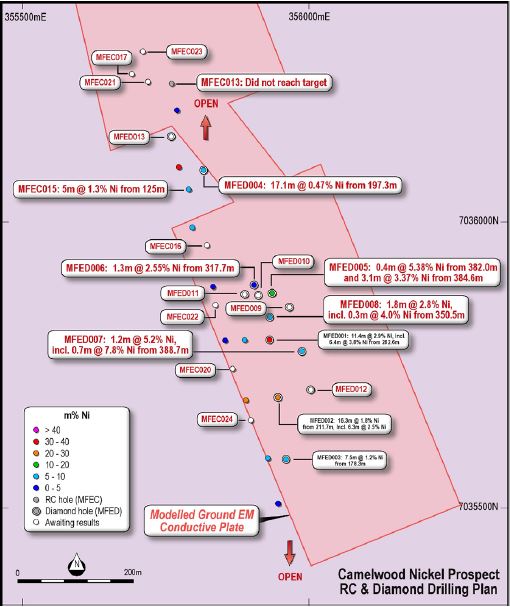
–    1.2 metres at 5.2 per cent nickel of massive sulphide, including 0.7 metres at 7.8 per cent nickel from 388.7 metres;

–     1.8m at 2.8 per cent nickel of massive and semi-massive sulphide, including 0.3m at 4 per cent nickel from 350.5m of massive sulphide;

–    0.4m at 5.4 per cent nickel from 382m of massive sulphide, and 3.1m at 3.4 per cent nickel from 384.6m of massive and semi-massive sulphide;

–    1.3m at 2.6 per cent nickel of massive and semi-massive sulphide, including 0.6m at 3.8 per cent nickel from 317.7m of massive sulphide; and

–    17.1m at 0.47 per cent nickel from 197.3m of disseminated sulphides.
 
“The results we are receiving are demonstrating excellent prospects for economic grades and thicknesses at Camelwood,” Rox resources managing director Ian Mulholland sadi in the company’s announcement to the Australian Securities Exchange.

“The massive sulphide portions of the system are consistently showing grades in the 4.5 to 5.5 per cent nickel range, with 7.8 per cent nickel the highest grade reported to date, while the strongly disseminated and semi-massive zones are showing grades between 2.5 and 3.5 per cent nickel.

“A much better picture of the distribution of nickel sulphide mineralisation is starting to emerge as we continue to drill more holes.”


Camelwood prospect drill hole plan. Source: Company announcement


Rox explained it is continuing with its diamond drilling program in order to test down dip extensions of the nickel sulphide mineralisation intersected by nearer surface drilling.

Testing of the deeper Camelwood North EM conductor located approximately 500m north of Camelwood is planned within the next three weeks.

Rox said it considers this conductor to be a down faulted offset from the main Camelwood EM conductor.

RC drilling is also ongoing, drilling a number of shallow 50m infill sections as well as continuing to define extensions to the north along the now 800m strike extent of Camelwood.

What the Brokers Say

WHAT THE BROKERS SAY: Interesting news and views from across the Resource Analyst universe.

Troy Resources Ltd (ASX: TRY)

Troy’s friendly scrip-bid for Azimuth Resources (ASX: AZH) shows a degree of pragmatism that should hopefully be increasingly replicated in the small resources sector in our view.

Whilst prima facie the implied offer (approx. $188 million upon announcement) appears substantial, the market should recognise Troy’s track-record of value creation through frugal development of acquisitions.

Further, and in the context of the exploration upside potential offered by Azimuth’s tenure, it is reasonable to expect that this deal can realise substantial upside in time.

Troy brings a development skill set, cash and cashflow to realise development of Azimuth’s existing 1.6 million ounce at 3 grams per tonne West Omai resource.

We acknowledge that prima facie, the offer implied seems substantial; we believe that – particularly in the context of weak gold sentiment – Troy faces a “hard sell” to its existing shareholders.

However, we believe that this deal should ultimately be recognised for what it can realise for the company: It materially extends Troy’s group production profile and provides significant long term exploration potential.

In addition, we feel that the market should acknowledge Troy’s management has an excellent track record of realising substantial value from frugal capital developments.

We cite US$20 million paid for Casposo that should generate A$30 million in AT operating cash flow this FY, increasing to circa A$80 million next FY with the advancement of the underground development.

Similarly, Troy’s Brazilian operations – Sertao and Andorinhas – have both been profitable operations that have contributed to free cash flow that has maintained an annual dividend stream for the past 11yrs.

In addition, in-fill drilling in the short term should realise a maiden reserve (we anticipate circa 500koz) at West Omai.

As the Pre-feasibility Study unfolds, the market will have clearer optics on the economic parameters of a potential development of West Omai.

Noting Troy’s track record of low cost development execution, coupled with good exploration potential, we would expect upside value to the current share price to impute over the course of the year.

In assessing the valuation impact of the Azimuth acquisition, we have assumed staged development of West Omai, commencing from FY’15 at 1mtpa increasing to 1.5 million tonnes per annum from FY’17.

We assume staged capital expenditure of US$160 million on that basis, producing one million ounces over seven years at an average of 130,000 ounces per annum at US$720 per ounce.

It is reasonable to anticipate that Troy can achieve lower realised capex and may yet pursue a smaller initial stage 1 development (say 750ktpa) at a commensurately lower headline capex number.

On our numbers – depending upon timing – Troy has the capacity to self-fund development of West Omai.

Thus any requirement for additional debt or equity finance should be relatively small.

Our pro forma valuation of $2.75 (prev. $3.60) does not include any nominal exploration value for the remaining Azimuth exploration tenure.

Note that we have lowered our Casposo asset valuation by $30 million as a function of anticipated longer negative impacts of the prevailing in-country inflation.

Continued share price weakness represents a good medium to long term investment opportunity in a soundly run, profitable, dividend paying gold producer.

Recommendation: Buy
Price Target: $2.75/sh

Forge Group Ltd (ASX: FGE)

The recent sale of Clough’s shares in Forge has seen the latter’s share price fall by 10 per cent.

We believe it has presented an attractive buying opportunity into Forge.

The company reported one of the better mining service results last month, with an ensuing strong rally despite general nervousness concerning the markets and mining exposed stocks.

The market may think Clough’s decision means that it believes the best is over for Forge, and/or that any takeover premium that may have existed has now evaporated upon its exit from the register.

However, valuation and the balance sheet remain attractive.

Even assuming flat growth in FY14 vs FY13, the company is trading at 7.3 times PE.

 We think given the significant net cash position of $162 million (end December 2012) bodes well for Forge to undertake astute capital management.

Only about 25 per cent of the order book is exposed to iron ore, with two-thirds predominantly power sector work.

We believe a PE of 8 times on forward earnings is more appropriate which yields a valuation of $6.57, on which we base our price target.

Recommendation: BUY

Price Target $6.57

Goldminex Resources (ASX: GMX)

Goldminex Resources has a large and highly prospective portfolio of copper-gold exploration projects located in Papua New Guinea (PNG).

Exploration completed to date continues to highlight the potential for numerous targets to host large scale mineral deposits.

Goldminex Resources’ exploration portfolio has approximately 9,000 square kilometres of exploration tenure principally focused on the Owen Stanley Ranges in the south east of Papua New Guinea.

In July 2011, Goldminex signed a farm-in agreement with Vale, a wholly owned subsidiary of the second largest global mining company in the world, Vale S.A.

Under the Farm-in Agreement, Vale may earn a 51 per cent interest in copper and gold rights of six selected tenements within the Owen Stanley Range by sole funding US$20 million of project expenditure over a four year period.

The flagship project is Liamu which hosts 12 high priority prospects within an extensive intrusive complex and has significant potential to host large porphyry copper-gold deposits.

Geological and geochemical exploration to date has outlined an area in excess of 15sqkm shedding anomalous gold and copper in drainage samples.

A recent 3,292m (6 hole) diamond drill program intersected broad widths of low grade copper mineralisation.

While the grades intercepted are sub-economic, they do however indicate the system is mineralised and extensive.

The Kiki prospect (within the Liamu project area) is a high priority target which has been broadly defined by an airborne magnetic anomaly, geological mapping, alteration and elevated copper-gold geochemistry.

An IP survey was recently carried out over the Kiki prospect (results still pending) which will be used to define drill targets ahead of a likely drill program later in the year.

PNG is situated on the Pacific Rim and hosts numerous world class gold and copper projects including OK Tedi, Porgera, Lihir, Wafi and Hidden Valley as well as hosting some of the world’s largest mining companies such as Barrick, Harmony and Newcrest.

The Owen Stanley region is considered to be highly prospective and although exploration is at a relatively early stage, Goldminex has multiple prospects with large scale potential.

With an EV of just $0.9 million, Goldminex is significantly leveraged to exploration success.

Recommendation: Speculative BUY

Disclaimer: The above is intended as a guide only. The Roadhouse accepts no responsibility for investments made from this advice, successful or otherwise.

IPO Watch

IPO WATCH: Companies scheduled to list soon on the boards of the Australian Securities Exchange.


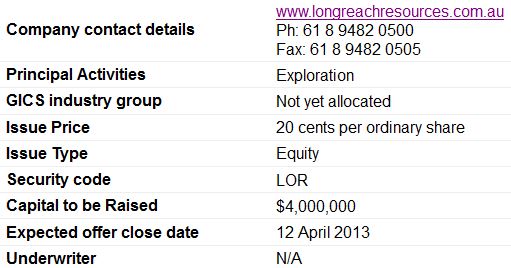
Longreach Resources Limited
Proposed ASX code: LOR
Proposed listing date: 22 April 2013

Longreach Resources is seeking to raise up to $3.5 million through the issue of 17.5 million shares at an issue price of 20 cents each.

The aim of the raising is to enable the company to complete the acquisition of a 75 per cent interest in the Mt Olympus gold project.

The Mt Olympus project is located approximately 35 kilometres south-east of Paraburdoo in the Peak Hill mineral region of Western Australia.

The project is comprised of two tenements covering approximately 66 square kilometres, which the company considers to be prospective for Carlin-style gold mineralisation and base metals.

Longreach has an exploration program planned to go for the project once it has achieved its listing and upon completion of necessary permitting.

In addition to commencing exploration activities on the Mt Olympus project, Longreach has also indicated it intends to pursue new projects in the resources sector, both in Australia and overseas, by way of acquisition or investment.


Source: ASX

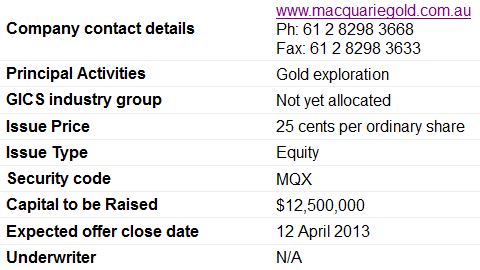
Macquarie Gold Limited
Proposed ASX code: MQX
Proposed listing date: 24 April 2013

Macquarie Gold acquired a 100 per cent interest in Challenger Mines in January 2011.

Challenger holds ML 1435, EL 5728 and 16 MCLs across the Adelong Gold Field in southern New South Wales.

Macquarie is offering 50 million shares at 25 cents each to raise $12.5 million.

After listing, and subject to obtaining the necessary approvals, the company has indicated it intends to construct a facility capable of handling 200,000 tonnes of ore per annum and capable of producing gold at a rate of 13,000 ounces to 15,000 ounces per year from an existing JORC defined resource in the Challenger and Currajong deposits.

The Challenger deposit has a resource of 930,000 tonnes grading 2.74 grams per tonne for 82,000 ounces of gold while the Currajong deposit measures 338,000 tonnes at 3.48g/t for 37,800 ounces of gold.

Macquarie Gold management believes there to be significant upside potential in gold resource extensions.
It claims the Challenger ore body deposit extends both along strike and at depth and considers it is likely the mine will continue to grow once the known resources have been mined.

The company is also confident gold resource potential exists in the Currajong deposit and within other known reefs within its tenements.

These additional potential resources will be the focus of the company’s exploration program and will be evaluated by drilling which is planned to take place soon after listing.

Macquarie Gold said it also believes its proposed gold production plan will generate cash flows that will fund ongoing exploration programs.


Source: ASX

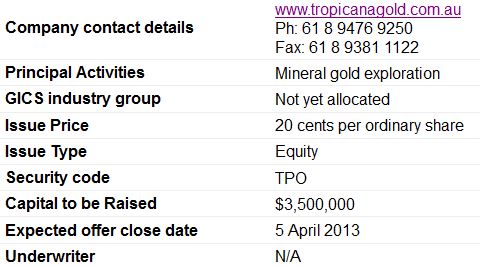
Tropicana Gold Limited
Proposed ASX code: TPO
Proposed listing date: 19 April 2013

Tropicana Gold is a Western Australia-based gold exploration company, which has entered into a Heads of Agreement to acquire 100 per cent interest of Sulphide Resources.

Sulphide Resources owns 100 per cent of the Tropicana gold project, Kat Gap project and the Lake Johnston project – all located in Western Australia.

Upon listing Tropicana Gold intends advancing the eponymous gold project, which is located 50 kilometres from the Tropicana gold mine Joint Venture between AngloGold Ashanti and Independence group.

The project is also situated between the Hercules and Pleides projects of Beadell Resources.

The Kat Gap project is made up of seven tenements in Forrestania and is considered by the company to be an ‘advanced exploration’ play.

It appears little work has been conducted at Lake Johnston at his stage, however Tropicana Gold said it did have indications of potential gold mineralisation that had been identified from historical exploration work.


Source: ASX

Disclaimer:  The above information is not investment advice. The Roadhouse accepts no responsibility for investments made from this information.

Trafford Resources welcomes ‘Year of the Octopus’

Perth-headquartered Trafford Resources (ASX: TRF) is eyeing 2013 as the year the company comes of age, seven years after listing on the Australian stock market. By Rebecca Lawson

This is the year one of the company’s many investments, the Wilcherry Hill iron ore mine, will come into production, while the Twin Peaks and Moorarie projects begin to take shape as exploration gathers pace.
 

The fruition of the game changer projects stems from Trafford’s diversification strategy, or as managing director Ian Finch calls it – “the insurance policy”- which was born out of the global financial crisis (GFC) as a way to counter economic downturns.

Finch equates the company’s strategy to an octopus.

Each tentacle represents one of Trafford’s investments, which range from base and precious metals to bulk commodity iron ore, international exposure and the company’s own exploration projects.

“We have developed over time a series of insurances for the company – for the shareholders – while conducting effective exploration,” Finch told The Resources Roadhouse.

“We’ve had to because we’ve been through a GFC and we’ve been through the Greek tragedy play.

“So we’ve grown the company in a different way.”

Trafford’s strategy centres on taking substantial shareholdings in other exploration companies, which have a high prospect of returning value to shareholders and to the company.

This was proven when Trafford invested $2.24 million in Indonesia-focused exploration play Robust Resources (ASX: ROL) in 2008, taking a major shareholding in the company.

A year later, Trafford started turning that investment into a liquid asset that has generated about $17 million, part of which was returned to shareholders as dividends and has helped to fund the company’s own exploration program.

“That’s $17 million we didn’t have to go to shareholders for, that’s 17 million worth of shares we didn’t have to put out, that’s how we keep our market cap tight,” Finch said.

It’s a strategy Trafford is aiming to replicate with its recent investment in Perth-based Orinoco Gold (ASX: OGX), which is progressing its flagship asset, the Curral De Pedra gold project in Brazil.

Trafford has been keen to get into the area for more than two years, with Finch saying Orinoco provided the company with the “perfect opportunity” to get into the lucrative South American market.

Curral De Pedra sits in a high-grade gold area, with the two nearest operating mines owned by Anglo and Yemana, having multi-million ounce gold reserves.

Exploration is at an early stage, with bulk sampling at the Cascavel target returning an average grade of 22 grams per tonne, while first round drilling has yielded gold grades of up to 101g/t.

“It’s a positive investment for shareholders in Trafford and it’s our introduction to South America,” Finch said.

Trafford’s main investment, however, lies in IronClad Mining (ASX: IFE), a company it spun out and floated in 2007 to focus on developing the iron ore assets within the Wilcherry Hill project in South Australia’s northern Eyre Peninsula area.

Trafford has a 20:80 joint venture with IronClad over the project.

Six years on and IronClad is about to become Trafford’s first mining arm, with stage one to involve the production of one million tonnes of Direct Shipping Ore per annum, and exports to start before the end of the calendar year.

The second stage aims to produce between three and five million tonnes per annum with the addition of dry magnetite and gravity separation concentrates.

Wilcherry has a current JORC-compliant iron ore resource of 263 million tonnes and exploration potential of more than 1.5 billion tonnes.

Trafford retains a 27.6 per cent interest in IronClad.

“The strategy is that the arms of the Trafford octopus feed cash back to the head so that we can do more and more effective exploration and find more mines, and ultimately find more arms of the octopus,” Finch explained.

“Chinese astrologists may think this is the year of the snake, but it’s not.

“It’s the year of the octopus and the year that Trafford comes of age.”

Towards that end Trafford is advancing its latest projects, the Twin Peaks and Moorarie projects, which have been touted as potential game changers for the company.
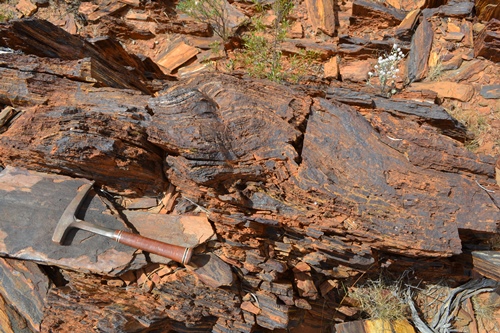
 

The Twin Peaks project, is located 200 kilometres northeast of Geraldton in the Mid-West region

It is a joint venture with Independence Group, whereby Trafford can earn 80 per cent equity in the project’s iron ore rights by spending $5 million over five years.

Earlier this year, Trafford began a 5000 metre drilling program where a total of 15 iron ore prospects have been delineated along a 20 kilometre strike length covering a Banded Iron Formation belt.

Results from the first four holes have been received and include:

–    31 metres at 63.5 per cent iron, including 5 metres at 68.1 per cent; and

–    17m at 64.3 per cent iron, including 6m at 67.7 per cent.

All results have so far shown low impurities.

Drilling has also shown the outcrop extends to a minimum depth of 80m and remains open.

“This is going to be a big winner for Trafford,” Finch said

“There’s no doubt about this if you look at the way at which we could truck the Direct Shipping Ore to the coast – or many of the options that we can deal with this – and the high margins currently available.”

Another exploration area Trafford will actively pursue is its Western Gawler Craton gold joint venture with Kingsgate Consolidated.

The agreement, struck in August last year, saw Trafford buy Southern Gold’s 51 per cent share in the JV, with the tenements next door to Kingsgate’s Challenger gold mine.

The JV landholding, covering 2,841 square kilometres, includes advanced exploration targets, brownfields exploration and a number of high quality greenfields prospects.

Combined with Trafford’s existing tenements in the area – some of which it swooped on soon after the federal and state governments opened the Woomera Prohibited Area – the company now holds more than 8,300sqkm in the greater Gawler Craton region.

This includes Trafford’s other land holdings within the Wilcherry Hill project, which Finch describes as “Aladdin’s cave” due to its rich mineralisation.

The initial attraction for Trafford when it acquired Wilcherry in 2006 was its gold prospects at Weednanna, which after being deflected by China’s insatiable demand for iron ore in 2006/07, is now being aggressively explored.

In 2012, a total of 1,566m of drilling was completed at Weednanna with a number of broad gold zones intersected, including:

–     174m at 0.40g/t gold; and

–    93m at 1.59g/t gold containing 22m at 5.25g/t.

The company considers these results indicate potential for a large scale, near-surface gold zone on the western end of the project.

Trafford will also follow up its Paris silver-gold discovery within the Wilcherry tenements later this year following successful first pass qualitative drilling, which showed the potential of a high-grade silver deposit.

That discovery prompted Trafford to conduct an internal review of its silver prospects within Wilcherry, widening the scope of the precious metal to outside of the only previously identified silver target at the Telephone Dam project.

Finch said Telephone Dam’s scope has now been broadened to include lead and zinc, however this would not be aggressively explored until Trafford’s investments come good.

Trafford Resources Ltd (ASX: TRF)
…The Short Story

HEAD OFFICE
Level 2, 679 Murray Street
West Perth, WA, 6005

PH: +61 8 9485 1040
Fax: +61 8 0485 1050

Web: www.traffordresources.com

DIRECTORS
Ian Finch
Mark Le Grange
Neil McKay
Allan Trench

SHARES ON ISSUE
94.15 million

MARKET CAPITALISATION
$13.65 million (as at 28/03/2013)

Elvis has left the building

THE BOURSE WHISPERER: The regular game of musical chairs continues within the boardrooms across the resources industry.


PMI appoints chairman / non-executive director

PMI Gold Corporation (ASX:PVM) has appointed James (Jim) Askew as chairman and non-executive director.

Askew is a mining engineer with international experience as a chairman, chief executive officer and director for international mining, resource investment, contracting, software and mining service companies.

He has had continuous involvement with the Ghanaian gold industry since 1985.

“Mr. Askew is a standout appointment, well respected in Australian and North American capital markets,” PMI Gold Corporation interim chair and non-executive director Ross Ashton said in the company’s ASX announcement.

“He has been directly involved in multiple corporate successes which have required strong strategic leadership and resulted in enormous value creation.”

PMI also indicated its intention to nominate two new directors for election at the upcoming Annual General Meeting scheduled for 15 May 2013.

The first of these is Peter Bradford, a metallurgist with some thirty years of project management experience in Africa (including eight years as president and CEO of Ghana gold producer Golden Star Resources).

Second is Michael Anderson, a twenty year mining industry professional and director of Taurus Funds Management with broad Australian (ex-managing director of Exco Resources) and African mineral resource experience (non-executive director Ampella Mining).


Challenger Energy appoints new managing director

Challenger Energy (ASX: CEL) has appointed Robert A. Willes to the position of managing director., effective on 8 April 2013.

Willes has over 25 years of extensive international experience in the oil and gas and energy industries – primarily with BP (formerly British Petroleum).

Willes’ early career with BP involved several positions in petroleum product supply, trading, and marketing, and as a lead negotiator for numerous gas transactions in Europe.

Subsequently, he became project manager of Group Mergers and Acquisitions, where he led the divestments of Burmah Castrol’s Chemicals Division and Great Yarmouth Power Ltd, and advised the Corporation on a number of acquisition opportunities.

More recently, Willes was chief executive officer of Eureka Energy Limited, and was instrumental in managing the recommended A$107 million On-Market Takeover by Aurora Oil and Gas Limited.

New Rawsons Resources MD

Rawson Resources (ASX: RAW) has announced the appointment of Scott Brownlaw as managing director.

Brownlaw initially joined the company’s Board in December 2012, since when he has been involved with Rawson’s recent transition.

Brownlaw’s background is in oil and gas exploration, having previously held senior technical positions as New Ventures manager and chief geologist in several exploration companies.

His experience comes mainly from exploration in South East Asia and Australia, with a focus on Indonesia, Brunei Darussalam, Philippines, and the Bonaparte Basin, Western Australia.

Rawson said the appointment of Brownlaw met the company’s parameters of a managing director with proven technical and commercial abilities, to support the new Board’s strategy of a more commercially focussed exploration company.


Erin Resources appointment of new managing director and other Board changes

Erin Resources (ASX: ERI) has appointed Nick Poll as managing director, forming a new Board of Directors with Brett Mitchell as chairman and Grant Davey as non-executive director effective immediately.

This change follows the completion of a strategic review and recent changes to the company’s project team in Senegal.

“I’m delighted to join the team at Erin Resources,” Poll said.

“We have a great team in-country and the current status of gold exploration in Senegal, and West Africa in general, seems analogous to Western Australia in the 1980’s.

“Many of the WA discoveries since then have been semi-concealed, due to laterite and we see strong laterite formation in Senegal, so I think there is tremendous possibility for discoveries in Senegal and nearby countries.”

Poll is an experienced exploration geologist, having been integral in the largest nickel sulphide deposit discovery in over a decade and previously holding various senior roles in gold exploration with WMC Resources Limited.

“We are delighted that Nick is able to join Erin Resources as managing director, to drive the company’s operations and corporate activities moving forward,” new chairman Brett Mitchell said.

“He brings extensive technical experience and corporate skills to the company, particularly in the areas of gold exploration, resource discovery and country management, developed through a long career in gold exploration with WMC Resources and as managing director of Mirabela Nickel with its discovery of Santa Rita.”

Grant Davey steps down from the position of managing director as a result of this appointment and remains on the board as a non-executive director.

The new appointments follow James Malone and Robert Besley both stepping down as chairman and non-executive director respectively.


IMX Resources claims new Axehead and Tomahawk North discoveries at Mt Woods

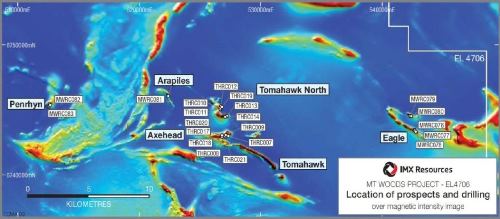
THE DRIL SERGEANT: IMX Resources (ASX: IXR) has claimed discovery of new iron-rich magnetite formations at the Axehead and Tomahawk North prospects, situated within the company’s Mt Woods magnetite project in South Australia.

The company drilled six prospects in total, resulting in an increase to the Mt Woods project exploration target tonnage by 168 million tonnes to 214 million tonnes.

IMX has combined the numbers from the existing Inferred Mineral Resource at the Snaefell magnetite deposit and a review of regional magnetics data and historical exploration drilling and come up with a global exploration target tonnage, which now totals 1.5 to 1.8 billion tonnes.


IMX Resources magnetite prospects and October-November 2012 drilling. Source: Company announcement


“These latest results have boosted our global exploration target for Mt Woods beyond one billion tonnes and confirm that the Mt Woods project has significant resource upside, as we have only scratched the surface from an exploration perspective,” IMX Resources managing director Neil Meadows said in the company’s announcement to the Australian Securities Exchange.

“IMX believes this project has excellent development potential, with the ability to produce high-grade, very coarse-grained magnetite concentrates that are in strong demand globally and are attracting premium prices from steel producers.

“IMX is working hard to find a development partner to realise this potential for shareholders.”

The company completed twenty-five reverse circulation (RC) holes during October and November 2012, all of which returned magnetite iron intersections from five prospects near the Tomahawk prospect, located 25 kilometres south-east of its Cairn Hill mine in Coober Pedy, and Fitzgerald Dam which is located west of Cairn Hill.

IMX said its RC drilling at the Tomahawk group of prospects has shown higher average iron grades, minimal oxidation of magnetite and shallower overburden when compared to the Snaefell deposit.

The company indicated it now plans a program of Davis Tube Recovery analysis to indicate the iron content of magnetically separated concentrates generated from these samples primarily as it considers these smaller, potentially higher yielding targets could represent opportunities in terms of resources to exploit on a smaller scale start-up project.

Ferrowest acquires new iron ore project

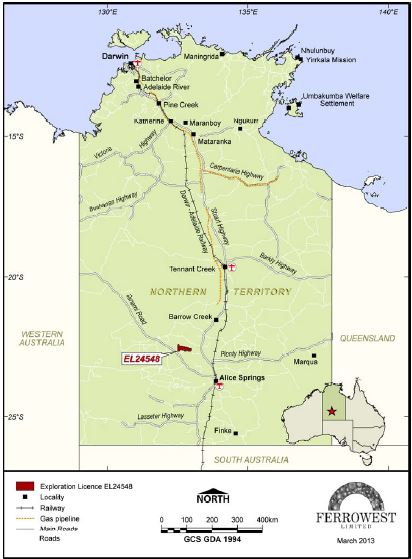
THE BOURSE WHISPERER: Ferrowest (ASX: FWL) has executed a Sale and Purchase Agreement with Ngalia Resources to acquire up to 60 per cent of the Yalyirimbi iron ore project in the Northern Territory.


Project location. Source: Company announcement


The earn‐in requires the expenditure of $2 million on exploration and the establishment of an Indicated Resource estimation.

Ngalia has already spent around $1.4 million of the earn‐in.

Ferrowest said it is of the opinion the current Inferred Resource will only require selected diamond drilling and project related works to attain an Indicated Resource status.

The remaining 40 per cent of the project will remain held by Arafura Resources (ASX: ARU).

The project will be developed under an incorporated joint venture, subject to the completion of a bankable feasibility study, to be managed by Ferrowest as it completes the 60 per cent earn‐in.

“Yalyirimbi delivers on a number of key fronts for Ferrowest,” Ferrowest chairman Bryan Hughes said in the company’s announcement to the Australian Securities Exchange.

“We can apply the excellent experience and talent we have in the iron space to a project that can be advanced quickly.

“It has quite a low capital requirement and it can generate solid returns for the company as we start to develop our larger projects.”

The Yalyirimbi project has an existing Inferred Resource of 14.1 million tonnes of haematite at 27.1 per cent iron classified and reported in accordance with the JORC Code.

Ferrowest currently estimates the Exploration Target at the project to be 50 to 70 million tonnes at between 25 per cent and 29 per cent iron.

The company explained the current Resource is located in two zones totalling 1.5 kilometres in length, out of a 30km to 40km long formation that is yet to be explored.

Early stage test work Ferrowest has carried out at Yalyirimbi demonstrated that, with a crush to 1mm and gravity upgrading, a haematite fines concentrate of 63.5 per cent iron with 7.1 per cent silicon dioxide, 0.84 per cent aluminium oxide and negligible phosphorus can be produced.

Ngalia has completed an in‐house scoping study, which it claims suggests the project is robust and profitable at an assumed long term average iron ore price for 62 per cent iron fines of $120 per tonne.

When governments are stealing your savings, gold is the only option

GAVIN WENDT: Over the past few weeks we’ve focused our commentary exclusively on gold. The reason is simple – no other commodity is currently exposed to the same level of misrepresentation or misunderstanding as the price of gold bullion. We’ve seen all sorts of traders and experts talking down gold’s prospects, based on recovering sharemarkets and supposed economic growth.

As we’ve discussed over recent weeks, most of this can be dismissed. The US economic strategy (which ironically is the same methodology that caused the mess in the first place) is to pursue easy credit, obscenely low interest rates and a race to the bottom as far as their currency is concerned.

Ironically, Japan is also following suit – despite the fact that the same failed economic policies have left it an economic basket case since the 1990s. And ironically too it is the USA, which has been one of China’s toughest critics in terms of its supposed ‘currency manipulation’, which is now manipulating its own currency for short-term political ends.

The scary part is that the average US citizen’s lot has not improved despite the tens of trillions of dollars poured into the nations’ monetary system since 2008 – in fact, by virtually all measures (net income, purchasing power and investment returns) – they’ve gone backwards. So the health of world sharemarkets in no way reflects the strength of the underlying world economy.

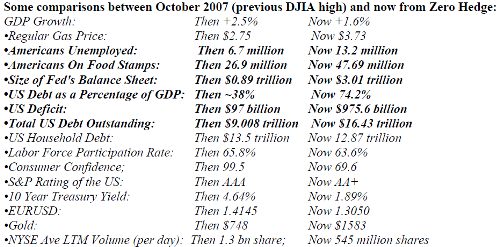
Americans, on average are making less money, are less wealthy and are not nearly as monetarily comfortable as they were five years ago. The only other explanation for the recent increase has to be overall economic growth, but it isn’t. The US economy has grown since late 2007, but at an extremely weak rate. Inflation-adjusted (or real) GDP is about 2.5 per cent higher than it was in October 2007, but when annualized it represents an extremely modest growth rate of just 0.5 per cent.

This represents a rate of growth which is lower than the population growth rate over the same timeframe. And since 2007 the US national debt has risen by 83 per cent within a period of just 5 years. So the argument that the US is doing well is a difficult one to swallow.

The situation is best illustrated by the stark statistics supplied by Zero Hedge:


This brings us back to gold. The arguments against the precious metal in the current context are flimsy, but we’ve seen them made several times (notably during 2006 and 2008) during the latter half of gold’s 12-year bull-run since the year 2000. The so-called experts of course proved to be wrong on each occasion, with gold quickly recovering and reaching new highs.

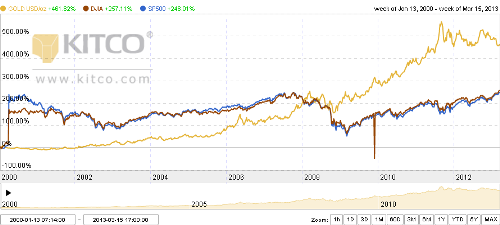
And I’ve no doubt that the current situation isn’t any different. I stated months ago that despite the bad press gold was getting and its declining price, I would be surprised if gold didn’t rebound to its long-term support level around US$1,600 – which is almost exactly what’s it’s managed to achieve over the past fortnight. And over the past decade gold is still shown to be outperforming the Dow Jones and the S&P 500 Indices.


So despite all the money that the US Federal Reserve has printed and pumped into the system, over the last five-and-a-half years the Dow Jones has not provided investors with a return. Think about it – the Dow has just gotten back to where it was back in October 2007 and many investors are still struggling to make up their losses following the GFC that wiped out $37 trillion from global equity values. By contrast (and despite prices falling over the past two years), over the last five years gold has provided a return of approximately 120 per cent.

The reasons for gold’s recent recovery are all related to big question marks over the supposed ‘economic recovery’ that’s taking place within both the European and US economies. Gold has just capped its longest rally in six months on the back of indications of slowing growth in Europe, which in turn could lead to central banks further expanding stimulus measures.

Data has shown that UK industrial production unexpectedly fell during January compared to the previous months, whilst a US government report showed that unemployment continues to remain above the target set by the Federal Reserve, signalling the central bank will continue stimulus measures. The US jobless rate dropped to 7.7 per cent, but is still well above Fed Chairman Ben Bernanke’s target of 6.5 per cent.

And in probably the best example (or worst, depending on your perspective) of how Europe’s economic and political turmoil is far from over (in fact it could be about to get a whole lot worse), European officials in Brussels recently announced that they will require that part of a new 10 billion euro bail-out to Cyprus be paid for directly from the bank accounts of ordinary citizens. Ordinary people were to be forced to have 10 per cent of their bank savings seized – in a program that can best be described as thievery by the state.

As The New York Times reported, “In a move that could set off new fears of contagion across the euro zone, anxious depositors drained cash from automated teller machines in Cyprus on Saturday, hours after European officials in Brussels required that part of a new 10 billion euro bailout be paid for directly from the bank accounts of ordinary savers.”

And little wonder. The terms of the deal, which imposed a charge of up to 10 per cent on savings accounts, breaks a previous taboo of protecting depositors. The move has raised questions about whether bank runs could be set off elsewhere within the euro zone.

Under an emergency deal reached in Brussels, a one-time tax of 9.9 per cent is to be levied on Cypriot bank deposits of more than 100,000 euros effective from Tuesday, hitting wealthy depositors – mostly Russians – who have put vast sums into Cyprus’s banks in recent years. But even deposits under that amount are to be taxed at 6.75 per cent, meaning that Cyprus’ creditors will be confiscating money directly from pensioners, workers and regular depositors to pay off the bailout tab.

Not surprisingly, people around the country have reacted with disbelief and anger. “This is a clear-cut robbery,” said Andreas Moyseos, a former electrician who is now a pensioner in Nicosia, the capital. Iliana Andreadakis, a book critic, added: “This issue doesn’t only affect the people’s deposits, but also the prospect of the Cyprus economy. The E.U. has diminished its credibility,” he told CNBC.

Sharon Bowles, a British member of the European Parliament who is the head of the body’s influential Economic and Monetary Affairs Committee, said the accord amounted to a “grabbing of ordinary depositors’ money,” billed as a tax. “What the deal reflects is that being an unsecured or even secured depositor in euro-area banks is not as safe as it used to be,” said Jacob Kirkegaard, an economist and European specialist at the Peterson Institute for International Economics in Washington. “We are in a new world,” she told CNBC.

And let’s not forget Italy. Recent elections have left Italy facing its worst recession since World War II. Fitch Ratings has lowered Italy’s sovereign rating to BBB+ from A- with a negative outlook. Across the Euro zone, youth unemployment increased to 24.2 per cent during January, up from 21.9 per cent during the same period a year earlier. In the EU, under 25-year old unemployment rose to 23.6 per cent from 22.4 per cent, whilst in Greece the youth unemployment rate was around 59.4 per cent, with Spain at 55.5 per cent and Italy 38.7 per cent.

Unemployment numbers in France rose also by 43,000 during January to 3.16 million, an increase of 10.7 per cent from last year. The figure is at its highest since January 1997, when it reached 3.19 million.

As we’ve commented previously, the sensible investor understands that gold’s recent price drop does not alter the long-term picture. I remain bullish on gold and believe that after a period of consolidation around its long-term support line at US$1,600, it will inevitably push higher.

As noted gold industry expert David Levenstein said last week: “Despite the negative sentiment and downward pressure on gold, I remain extremely bullish. While I am fully aware recent trading has been particularly turbulent and incongruous as the price of gold continues to trade mostly lower, I simply see no reason to panic and sell one single ounce. And, I firmly believe that the upside for the yellow metal is far greater than the downside. And, even though most of the dire outcomes predicted for paper money have not materialized, central banks around the world are diversifying some of their paper currencies into gold.”

“One of the main reasons people invest in gold is not to speculate, but to protect one’s wealth against what may happen in the future. By buying gold you have something of intrinsic value instead of a paper currency which could become totally worthless.  Owning physical gold is like taking insurance against your government and the financial system. And, right now, no matter what the main stream media may tell you about an economic recovery, gold is something you should buy because you cannot trust your government or central bankers.”

So whilst gold has recently been at an eight-month low, and as most of the major investment banks have turned bearish on gold, the precious metal has staged yet another recovery. The reason for my positive outlook on gold relates to the fact that the fundamental drivers for investing in gold have not altered, and as the people of Cyprus are finding out, we are silly to put our trust in any government. Instead, the better option is to invest in gold.


Gavin Wendt is the founder of MineLife, publisher of the MineLife Weekly Resource Report


Australian Mines scores positive gold assays

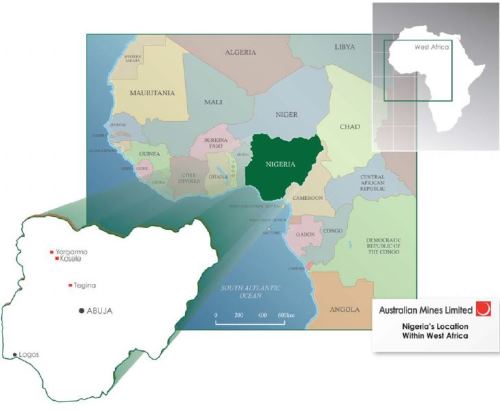
THE DRILL SERGEANT: Australian Mines (ASX: AUZ) has received initial assay results from five of eight drill holes that have been completed at the company’s 100 per cent-owned Yargarma project in Nigeria.


Source: Company announcement


The Yargarma drilling program involves eight diamond core holes, which have been designed to test a series of conceptual targets identified through Australian Mines’ recently completed airborne geophysical and surface geochemical sampling surveys.

Assay results received from the first five holes include:

– 1 metre at 4.45 grams per tonne gold from 34 metres; and

– 1m at 5.92g/t gold from 76m and 2m at 1.19g/t gold from 85m.

Australian Mines said the latest results have confirmed the presence of primary gold mineralisation within second-order geological structures across the Yargarma project area.

The company also said it considers these initial assays validate the current exploration model and demonstrates the project’s potential to host structurally-controlled gold.

“We are very pleased that the first batch of assay results received from our maiden drilling program confirms the presence of primary gold mineralisation within our Yargarma project,” Australian Mines managing director Benjamin Bell said in the company’s announcement to the Australian Securities Exchange.

“These latest results have significantly improved the company’s understanding of the regional geology and will play a crucial role in guiding our future exploration program.

“In addition, Australian Mines is very appreciative of the on-going support the company is receiving from the Nigerian Federal Government, Zamfara State Government and local communities.”

Australian Mines indicated it is currently waiting on assay results from the remaining three drill holes at Yargarma as well as from four diamond core holes drilled within the Kasele prospect.

These pending assays include the samples of two drill holes that tested the depth extension of gold mineralisation presently being extracted by local artisanal miners.

The company is also waiting to receive assay results from the multi-element (base metal) analysis of the Yargarma and Kasele diamond core.

Avalon Minerals improves Swedish copper grades

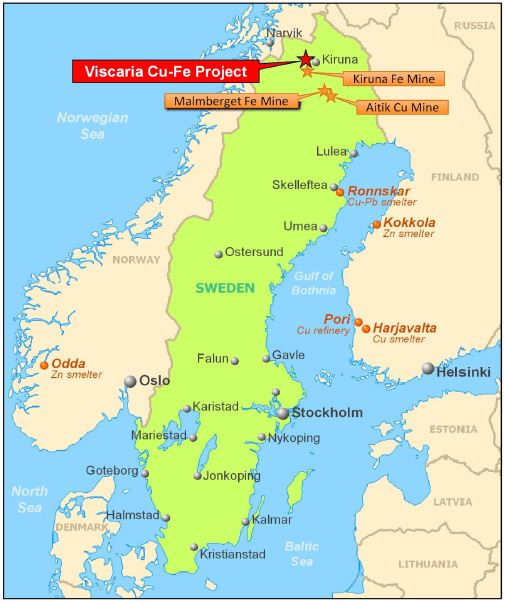
THE DRILL SERGEANT: Avalon Minerals (ASX: AVI) has received assay results for the latest five completed drill holes, part of an ongoing drill program being undertaken on the D Zone prospect on the company’s Viscaria project, in northern Sweden.


Project location. Source: Company announcement


Avalon reported four of the drill holes intersected thick, high-grade copper and iron mineralisation.

All five drill holes have extended the area of known mineralisation by up to 150 metres down dip and 150 metres along strike.

Best intersections from the drilling include:

–    8 metres at 2.7 per cent copper equivalent (CuEq), within a larger mineralisation zone of 12 metres at 2.1 per cent CuEq;

–    10.7m at 2.4 per cent CuEq, within a larger mineralisation zone of 19.1m at 1.6 per cent CuEq;

–    8m at 2.2 per cent CuEq, within a larger mineralisation zone of 31m at 1.2 per cent CuEq; and

–    7m at 1.8 per cent CuEq, within a larger mineralisation zone of 26m at 0.9 per cent CuEq.

“The latest assay results from D Zone show the high-grade plunging copper-iron zones are getting better grade with depth, with grades from this batch of drill holes consistently in excess of 2 per cent copper equivalent, over 8 to 10 metre widths,” Avalon Minerals managing director Jeremy Read said in the company’s announcement to the Australian Securities Exchange.

“In addition to the zones grading greater than 2 per cent CuEq, the overall mineralisation package is still up to 30 metres thick, which is very encouraging.

“The continued success of the D Zone resource extension drill program indicates that there is excellent potential for the D Zone Mineral Resource to be significantly extended at depth.

“This should then enhance the economics of the D Zone Mineral Resource and deliver Development Cases A and C, which would result in a $78 million increase to the Net Present Value of D Zone, to $126 million.”

Avalon’s current drilling program has the aim of completing approximately 25,000m of drilling, of which approximately half has been drilled.

The company said its objective is to extend the known Mineral Resources at the A and D Zone prospects and deliver on the potential increases to the project Net Present Value outlined in a Scoping Study that was completed in 2012.