


Australian mineral exploration took a dive late last year
The Australian Bureau of Statistics has released figures showing a decline in mineral exploration expenditure toward the end of 2012.
The Bureau’s MINERAL AND PETROLEUM EXPLORATION report for the DECEMBER QUARTER 2012 paints a sobering picture for the sector, which has so far enjoyed a, relatively, buoyant beginning to 2013.
“The recent release by the Australian Bureau of Statistics of the December quarter exploration statistics has further highlighted what AMEC has been warning policy makers for some time. Australian exploration activity is in decline,” Association of Mining and Exploration Companies chief executive officer Simon Bennison said.
The ABS determined the trend estimate for total mineral exploration expenditure fell in the fourth quarter of last year by 10.2 per cent or $89.3 million in monetary terms to $790.2m.
The state that emerged as the largest contributor to the fall in the trend was Western Australia, which dropped 11.2 per cent ($55.3m).
The 2012 final quarter estimate came in at 21.2 per cent lower than the December quarter 2011 estimate.
Australia’s other big mining state Queensland was not to be left out, featuring as the largest contributor to the drop in the seasonally adjusted estimate for mineral exploration expenditure, which fell 8.9 per cent ($17.5m).
Overall the country dropped 6.7 per cent ($56.5m) to $788.4m for the quarter.
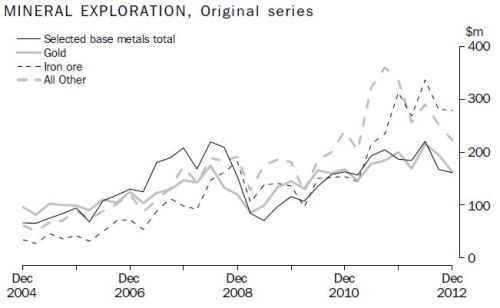
Source: ABS
Exploration on areas of new deposits fell 13.1 per cent ($39.6m) while expenditure on areas of existing deposits fell 5.3 per cent ($31.1m).
According to the report the largest fall in mineral exploration came from expenditure on gold exploration, which surprisingly, was down 16.3 per cent ($31.7m).
The next largest fall came from expenditure on coal exploration, which dropped 12.5 per cent (21.4m).
“Of most concern, is the decrease in greenfield exploration,” Bennison said.
“For the first time since the financial crisis the trend for exploration activity in Australia is going down.”
Although it seems the miners are suffering, spare a thought for the drilling companies with the trend estimate for metres drilled during the December 2012 quarter falling 9.9 per cent.
This was 23.7 per cent lower than the December quarter 2011 estimate.
“In original terms, metres drilled fell 19.7 per cent,” The ABS report said.
“Drilling in areas of new deposits fell 28.2 per cent and drilling in areas of existing deposits fell 15.2 per cent.”
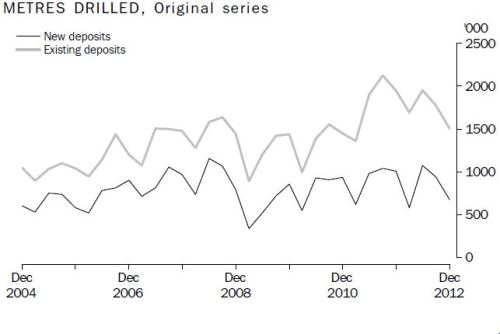
Source: ABS
“These statistics further highlight the lack of investor confidence in exploration companies that has made access to equity finance almost impossible,” Bennison continued.
“This decrease in greenfield exploration has serious consequences for future Governments given greenfields exploration is responsible for finding the mines of tomorrow.
“It is estimated that in the absence of new significant discoveries, based on current reserve and resources, about half of Australia`s non-bulk commodities mines would be exhausted between 7 and 18 years.
“Considering it takes between 7-10 years from applying for an exploration license to get to a stage of extracting and selling a mineral, it is imperative we increase greenfield exploration now to ensure the mines of tomorrow.”
Bennison highlighted a policy framework AMEC has assembled, which the body believes will correct the situation if it can obtain federal government support.
One suggested strategy in the framework is the introduction of a Minerals Exploration Tax Credit model.
He said a similar strategy was introduced in Canada in 2000, which resulted in an upswing in exploration rates.
“AMEC looks forward to working closely with all governments in the drive to reverse the decline in the share of greenfields mineral exploration that has been occurring over the last decade,” Bennison said.
“If this decline is allowed to continue it will threaten the future revenue streams of the Australian economy.”