What the Brokers Say – Issue 89

WHAT THE BROKERS SAY: Interesting news and views from across the Resource Analyst universe.

Forge Group Ltd (ASX: FGE) ($5.89, Mkt Cap $507 million)

We recently caught up with Forge management and were impressed with managing director David Simpson who gave a measured and articulate presentation.

We posited the key concerns of project curtailment and deferrals in the resources sector, as well as the focus on reduction of costs.

The company stated that in the mining sector Roy Hill was now the only major project in the near term looking likely to go ahead.

Instead, there is a greater focus for incremental brownfields expansion vs greenfields.

Although bidding for Roy Hill work, Forge has not factored in any numbers in its order book regarding the project.

In response to how the miners were reining in costs, Forge replied that they were seeking to liaise more directly with subcontractors, bypassing the larger manager contractor – essentially eliminating a costly intermediary.

Also there is the trend to owner-operate, which is negative for the mining contractors.

Forge does not compete in either of these areas.

The company has net cash of ca. $162 million.

It is prepared to be patient to find the right acquisition, giving itself a timeline of 12 to 18 months.

It will not be case of growth for growth’s sake, and Forge is prepared to return to capital to shareholders if no satisfactory acquisitions are identified.

Power station work remains a big focus, with the company undertaking only gas-fired work, while the company is looking to increase its contract and maintenance work, viewing it as an attractive annuity stream.

At current shareprice FGE still looks attractive relative to peers.

Recommendation: TRADING BUY Price Target $6.57

 

Gold Road Resources (ASX: GOR)

Gold Road Resources has released an updated mineral resource estimate for the combined Central Bore project, incorporating the Imperial Shoot, the Senate and Justinian. The upgraded estimate will be incorporated into the pre-feasibility study (PFS) work currently underway and due for completion by the end of June 2013.


A 32 per cent increase in total Central Bore project resource

In its second upgrade since establishing a maiden resource in 2011 at the Central Bore project, Gold Road reported a combined JORC-compliant resource of 813,900 tonnes at 7.7grams per tonne for 201,100 ounces contained gold, an increase of 32 per cent.

Central Bore includes the Imperial Shoot deposit which accounts for 112,200 ounces of the contained gold, an increase of 10 per cent since the previous published estimate in February 2012, at a notably higher average grade of 22.7g/t compared with 19.2g/t.

On an uncut resource basis, Imperial Shoot contributes an additional 40 per cent or 42,300 ounces to gold contained.

Importantly, of 220 RAB-drill holes used in the revised estimate, one in 10 included intercept readings of over 100g/t, which bodes well for enhancing near-term cash flows from mining higher grade portions of the ore body.

Pre-feasibility study due the end of June 2013

Gold Road continues to target production by end-2014 and has completed the necessary hydrological, geotechnical, environmental and preliminary metallurgical test work required for the currently ongoing PFS.

We expect completion of the PFS by the end of June 2013 and continue to anticipate a small scale underground mining operation at Central Bore as the most likely production scenario.
 
Valuation: Shares at 70 per cent discount

Our 33c per share sum-of-the-parts valuation remains broadly unchanged and comprises 8.4c per share from an NPV calculation, whereby small-scale production commences at the Central Bore by end-CY14.

We have added 24.6c per share for the now slightly higher remaining resources, derived by benchmarking forecast residual levels against global average EV/in-situ values for measured, indicated and inferred ounces for the Australian market, which is then discounted back into current money terms.

The market is applying a 71 per cent discount to Gold Road’s EV compared to global average benchmarks, which when applied to the remaining resource generates a valuation of 7.2c per share for the remaining resource and a sum-of-parts-valuation of 15.6c per share.


Decmil Group Limited (ASX: DCG)

Incorporating Browse LNG delay into our estimates Decmil Group’s Western Australian construction business is likely to be affected by the Woodside decision to delay the development of the Browse LNG project.

Additionally, the potential DCG build-own-operate village near Broome appears unlikely (we never included the village in our valuation or model, but did highlight it as significant upside risk).
To reflect the potential downside risk, we have reduced our WA construction revenue estimate from $436 million to $300 million (current FY14 order book is approx. $100 million excluding the Roy Hill village).

We still expect EDE to contribute $140 million of revenue for combined contracting revenue of $440 million.

We have increased our margin assumptions for WA construction. While this could sound counter intuitive to some, there is sound reasoning. Our gross margins assumptions are unchanged, but we have lowered our divisional overhead expense considerably.

The divisional overhead has been steadily increasing as a result of skills shortages (ie carrying the expense of a latent pool of project managers) and the rising tendering costs (cost inflation, the number of tenders and the complexity/size of tenders).

With the lower industry pipeline of projects, we expect the divisional overhead to fall significantly and, in the short term, Decmil should be able to retain this margin improvement.

As a result, our group EBITDA estimate has been more modestly reduced than our revenue estimate.

We expect FY14 EBITDA of $77.4 million (from $84.3 million) and our NPAT estimate has been reduced to $48.5 million (from $53.9 million).

Maintain Buy recommendation

We value the Queensland village at approx. $1.20 to $1.60 per share (depending on one’s EBIT multiple assumptions and the depreciation in the village).

We value the combined construction and EDE contracting business at $1.58 (based on approx. $440 million of perpetual revenue and a 6x EBIT multiple).

Combined with annual estimated overheads of approx. $11 million per annum and the cash on the balance sheet, we value Decmil at approx. $2.89 on a multiple basis.

We see an additional approx. $0.50 of upside from better than expected contracting and another approx. $0.80 if the company secured another owned and operated 1,000 man village at cost (for example the final stage of the Gladstone village).

We have a twelve month price target of $3.03 and maintain our Buy.


Disclaimer: The above is intended as a guide only. The Roadhouse accepts no responsibility for investments made from this advice, successful or otherwise.

Production up, costs down as Paladin cuts bite

MINING BUSINESS MEDIA: The cost cutting/optimisation regime imposed by Paladin throughout its African uranium operations seems to be paying off. Mark Mentiplay of Mining Business Media reports

Record nine month production and lower costs at its two African uranium operations keep Australian miner Paladin Energy on track for 8 million pounds to 8.5 million pounds of uranium in the 2013 financial year.

Year to date (YTD) (9 months) production for FY2013 was 26 per cent up on the previous FY2012 period to 6.112 million pounds (2,773 tonnes), 96 per cent of combined nameplate production.

The results came despite a nine per cent production fall in the March quarter to 1.992 million pounds, 95 per cent of nameplate, providing $US106 million from the sale of 1.92 million pounds at an average $55.22 per pound.

A major cost cutting/optimisation regime imposed throughout Paladin’s operations to realise savings of $60 million to $80 million in FY2013 and 2014, appears to be paying off with C1 production costs at Kayelekera in Malawi down 8.5 per cent from the December quarter’s $43.50 per pound, but Langer Heinrich in Namibia remained steady around the previous quarter’s $29.60 per pound.

In the September 2012 quarter, Langer Heinrich costs fell to $31.8 per pound from $32.2 per pound the previous quarter, with Kayelekera costs down from $52.2 per pound to $49 per pound in the same period.

Langer Heinrich’s March quarter production was down nine per cent to of 1.230 million pounds, 96 per cent of nameplate for the quarter, with ore feed through the plant down 12.8 per cent to 797,696 tonnes, hurt by temporary water constraints and some operational issues now being resolved via improved water conservation measures and the introduction of desalinated water in May.

YTD production (9 months) for FY2013 was slightly above nameplate, with recovery of 86.7 per cent above 85 per cent design and feed grades of 810 parts per million (ppm), above design of 800ppm.

Kayelekera production was down slightly on the previous quarter to 761,992 pounds (346t), but material mined during the March quarter plunged from 467,462 tonnes to 35,288 tonnes due to poor equipment availability and wet ramps.

The grade also fell from 521ppm to 471ppm, but both are expected to revert to normal in the coming dry season.

Despite this production was 94 per cent of nameplate, with record recovery of 87.1 per cent on feed grades of 1,094ppm heading for designed 1,100ppm.

Volta Mining encouraged by Gabon rock chipping results

THE DRILL SEREGANT: Volta Mining (ASX: VTM) has reported surface rock chip results grading up to 51 per cent iron from the company’s Mbombo iron ore project in Gabon, West Africa.

The company said the rock chip results support its previously released Exploration Target for the project of 385 to 640 million tonnes at 30 to 42 per cent iron, which was announced in March.

Volta has received surface rock chip sampling results from three of nine high-priority aeromagnetic anomalies, which have returned an average grade of 40 per cent iron with a best grade of 51 per cent iron.

Volta Mining is now conducting exploration including mapping trenching, pitting and the collection of rock chips with a view to commencing a maiden drill program at Mbombo.

“The rock chip results are very encouraging and their average grade of 40 per cent iron is at the higher end of our Exploration Target grade of between 30 to 42 per cent iron,” Volta Mining managing director David Sumich said in the company’s announcement to the Australian Securities Exchange.

“The results not only strengthen our belief in the potential of the Mbombo iron ore project but suggest that our current Exploration Target grade and tonnage are conservative given that only half of our high priority targets have been included in the estimate.

“We are hopeful that further work in the coming months will increase the size of the Exploration Target.”

The recent results stem from field mapping conducted over five of the company’s nine aeromagnetic anomalies, which had been identified by Core Geophysics.


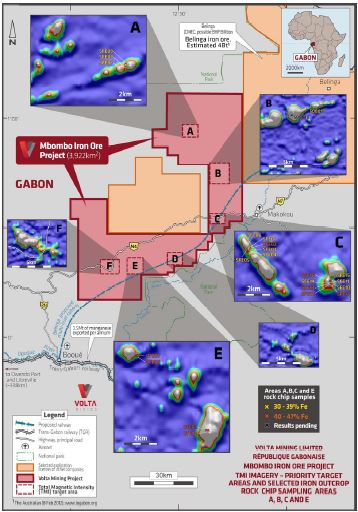
Volta Mining’s Mbombo iron ore project, Gabon – TMI analytic signal
imagery of priority target areas Source: Company announcement


To assist Core, Volta has been conducting a number of ground surveys of anomalies in Areas A, B, C and E.

In all five sites visited to date Volta claims its geologists discovered discontinuous outcrops of iron mineralisation – both magnetite and hematite.

Volta indicated a number of additional geophysical targets remain that have not been included in the estimation of the Exploration Target but which are considered prospective for iron mineralisation.

Volta intends to conduct further reconnaissance over these sites in the coming months.

Subject to rig availability Volta anticipates commencing a diamond drill program in mid-2013.

The irrationality of gold’s recent price performance

GAVIN WENDT: In a further demonstration of the irrationality of financial markets at present, the price of gold fell sharply over the past week, despite a host of supporting factors that under normal circumstances would result in a stampede towards the precious metal.

Recently, we’ve witnessed a ratcheting-up of the rhetoric from the rogue state of North Korea, more poor economic news emanating out of the United States of America, and a host of deteriorating economic indicators out of Europe – all of this hot on the heels of the Cyprus bail-out.

As we’ve discussed over recent months, I’ve long since given up trying to make sense of the current international economic picture.

What I am increasingly confident about however with every passing day is the importance and relevance of gold in both the current and future financial landscape, despite the complacency and overconfident nature of the rhetoric that seems to accompany the current economic landscape.

I have little confidence in the supposed economic recovery in the USA. It’s in reality a ‘modest’ recovery at best, which in no way bears any relation to the booming US sharemarket – which is essentially a market that’s been pumped up to the max on Fed-administered financial steroids.

If you pump trillions of dollars into a financial system then of course you’ll generate growth – but there are serious consequences.

The problem is that the US has mortgaged its future by bringing forward future consumption in a desperate attempt to try and stave off a deep and prolonged recession.

Worryingly, this might still happen, as the US sharemarket in no way reflects the enormous underlying problems inherent within the economy.

More US citizens are living on food stamps, the labour participation rate is falling, home affordability is declining, living standards are deteriorating, the divide between rich and poor has never been greater, and peoples’ savings are being wiped out by ultra-low interest rates.

In an attempt to drive its stuttering economy forward, the US Government is once again venturing down the same dangerous path of providing cheap funding, whilst at the same time devoting little attention to the credit worthiness of the borrower.

According to most mainstream financial media and market experts, risk is being reduced and the US is leading a global economic recovery.

As a result, gold is being viewed by many as an unnecessary insurance policy, thus falling to a 10-month low of $1,540 per ounce.

A total of $9.7 billion has been sold from exchange-traded products since the record high reached on 20 December 2012, whilst hedge funds have reduced their bets on higher gold prices by 70 per cent since October 2012.

We’ve also had a host of banks and brokerages this week calling an end to gold’s 12-year run.

What’s interesting though is that whilst brokers, bankers, traders and speculators might be abandoning gold, true investors aren’t.

Central banks added 534.6 tons of gold to their reserves last year, the biggest surge in gold buying since 1964, whilst gold coin sales in the US remain robust.

Why gold should benefit from rising interest rates

What’s interesting is that over the past five years, a lot of popular theories relating to the demise of gold have been proven false.

A popular theory during 2009 was that a ‘green shoots’ recovery (remember that term?) would cause gold prices to collapse. Well they didn’t.

Then there was the popular ‘contrarian’ argument that the real threat was deflation, and that gold would sell off as a result.

Gold once again rose, instead of falling. Now it’s the notion that rising interest rates will kill off gold.

One of the major reasons cited by commentators and financial experts for gold’s recent sell-off has been a prevailing view that interest rates will rise as economic growth begins to build.

There is a view held in many quarters that a rising interest rate environment is bad for gold.

Whilst I firstly have a major question mark over the whole concept of sustained economic recovery, let’s assume for the moment that they’re right and that interest rates will rise in accordance with economic growth.

Why shouldn’t gold benefit from a rising interest rate environment, just as it has done in a low interest rate environment since 2008? Let’s examine the evidence of recent history.

Significantly, gold rose with interest rates during the 1970′s and this is sufficient to prove that gold doesn’t always fall with rising interest rates.

For a good modern day example that pertains closely to the current economic situation, let’s examine Greece.

The nation is experiencing massive unemployment, wage deflation and rising interest rates, yet gold is hitting new highs as Greeks have flocked to gold.

Accordingly, a few myths have been destroyed: firstly that gold rises with inflation; and secondly that gold falls with rising interest rates.

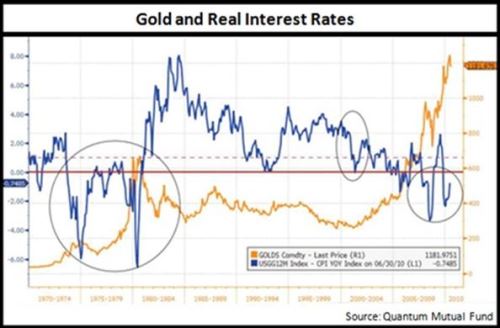
The real driver of gold prices is negative real interest rates (defined by nominal interest rates minus inflation).

Central bank policies of inducing negative real rates to ‘incentivize’ borrowing, expanding the money supply, and devaluing currencies – have forced investors (especially mums and dads) into real assets like gold and silver.

Debt is inherently inflationary if you have the ability to print your own currency.

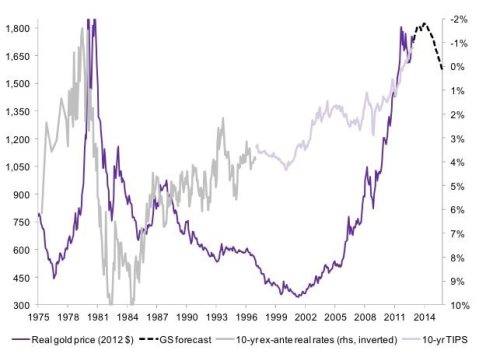
As the chart below highlights, it’s happened before.


In a gold bull market that has been fueled by negative real rates, conventional thinking would suggest rate increases would, at the very least, halt the rise of gold as the negative real rates get closer to turning positive.

History however actually says the exact opposite is true.

The gold bull market of the 1970s was dominated by inflation. Interest rates rose steadily to keep up with it, but real interest rates were mostly negative the entire time.

Peaks in gold prices since 1975 have usually been associated with rising real interest rates.

Times when real interest rates fell in tandem with gold prices include 1987-1990 and 1996-2001.

Even though real rates are have risen slightly, they remain below their historical average and levels below 2 per cent have still been supportive of rising gold prices.

As the chart below from Goldman Sachs demonstrates, gold prices languished from 1980 to 2000 and had declining correlations with debt levels, because GDP growth was sufficient to mute fears about budget and deficit issues.


The current economic recovery has been too weak to support a sustained rise in real rates above the 2 per cent level that has acted an inflection point for gold prices.

With energy and food inflation deepening and soon to affect consumer price indices, interest rates may have to rise significantly in order to restore real interest rates above 2 per cent.

This is exactly what ex Federal Reserve Chairman Volcker did during the late 1970′s, when he increased interest rates above 15 per cent in order to protect the dollar and aggressively tackle inflation.

It is unlikely that similar ‘hawkish’ monetary policy would be implemented by the Bernanke Fed today.

It is unlikely that they would and even doubtful if they could – given the appalling fiscal situation and levels of debt in the US and global economy.

As a result, I retain every confidence that we will ultimately see higher gold prices.

I believe that the US$1,600 per ounce mark is still a strong near-term support level and that prices will rebound even if we see further near-term price weakness.

Private investors and central banks are buying gold in strong volumes, as they rightly have little confidence in the world’s major currencies.

Economic circumstances in Europe and the US are set to deteriorate and gold will be the biggest beneficiary.

Gavin Wendt is the founder of MineLife, publisher of the MineLife Weekly Resource Report

What the Brokers Say

WHAT THE BROKERS SAY: Interesting news and views from across the Resource Analyst universe.


Tungsten Mining (ASX: TGN)

Tungsten Mining (ASX: TGN) is advancing assessment of its flagship Kilba project (100 per cent) in the Gascoyne region of Western Australia, with the aim of making a rapid transition to production.

To that end, the company expects to define a JORC compliant resource during the June quarter 2013 and has already commenced feasibility studies that will continue through to Sept quarter 2013.

TGN expects to be in the position to make a final investment decision (FID) in first quarter of 2014, which could result in first tungsten concentrate production as soon Sept quarter 2013.

The Kilba project represents a high-grade, near-surface exploration target of 1.2-1.4 million tonnes (Mt) at 0.6-0.8 per cent tungsten, based on historic exploration conducted in the 1980s.

After listing in December 2012, raising $5.1 million in the process, TGN commenced Phase 1 of its reverse circulation (RC) and diamond drilling program.

Phase 1 returned some promising high-grade, wide intercepts at shallow (open-pit) depths, including 14.5 metres at 0.80 per cent tungsten (from 42.5m).

These results replicated the historic drilling results across the same cross sections. With the completion of the Phase 2 and 3 drilling programs, TGN is aiming to define a JORC-compliant resource by April 2013.

The company plans to undertake feasibility studies over the next four to six months, with the aim of defining an operation capable of producing up to 100,000 million metric tonne units (MTU) tungsten per annum for a low capital expenditure (CAPEX) in the order of approx. US$30 million.

Such an operation could generate $28 million per annum in revenue at the current tungsten concentrate price.

Kilba is one of the few high-grade undeveloped open-pit tungsten deposits outside of China, the world’s largest producer (approx. 87 per cent global output in 2010).

Historic drilling has outlined a shallow, high-grade target that could potentially be developed into a mine before the end of next year.

Given the strong outlook for tungsten and the lack of supply security for tungsten end-users, TGN should be well positioned to secure finance.

Furthermore, with the managing director’s track record of bringing tungsten projects to production, we believe TGN has the unique combination of high-quality assets in a buoyant market, and an ability to deliver on ambitious targets.

Recommendation: Speculative BUY

Exterra Resources Limited (ASX: EXC)

Gold explorer Exterra Resources Limited (ASX: EXC) listed in May 2011 with a focus on achieving first production in 2013 from its brownfield high grade Second Fortune gold project in Western Australia.

Following a positive Scoping Study, the company believes it can leverage the positive cash flow from the 20,000 to 30,000 ounces per year operation to further explore and develop resources at its other key projects – Zelica, Eucalyptus, Egerton and Malcolm, all of which have established JORC resources and exploration upside.

The five gold projects in Western Australia now have a combined gold resource of 309,000 ounces, with orebodies open at depth and along strike.

The company is in a good space in having a brownfield project with current mining leases and some existing infrastructure, in close proximity to existing milling operations.

The potential for a very low capex entry into mining relies upon gaining a toll treatment contract, and the company is expected to announce a deal shortly.

Solid margins are indicated with the gold price around US$1580 per ounce and with a broad consensus that the price may go much higher in the short term with continuing headwinds from Europe.

Key Points

Total gold Resource of 309,000 ounces in five projects.

Second Fortune (Linden) project (131,900oz) has existing Mining Leases and some infrastructure in place from prior operations supporting an initial underground operation producing greater than 20,000 ounces per year from 2013.

Second Fortune Scoping Study indicates a low capex (less than $5m), low opex $700 per ounce operation using off-site toll treatment of ore.

Strong margins are indicated with a gold price at US$1580 per ounce.

Drilling is planned for improved resource definition and extension – Exterra have exploration expenditure of $1 million per year.

Near-mine area is lightly explored and indicating high potential for resource extension.

We recommend the company as a SPECULATIVE BUY, offering potentially low capex access to near term gold production, access to existing infrastructure, strong exploration upside and focussed management.

Vital Metals (ASX: VML)

Vital Metals (ASX: VML) has historically been a tungsten-focused company, with 100 per cent ownership of one of the world’s most advanced, undeveloped tungsten deposits – the Watershed project in far north Queensland.

Watershed is being fully funded through Definitive Feasibility Study (DFS) at a cost of $5.4 million by Japan’s JOGMEC group.

The company has actively diversified its exploration focus by farming-into an exploration project in southern Burkina Faso, West Africa, where gold is the primary target.

Drilling has so far returned highly encouraging results, with the company returning for an aggressive follow-up campaign in 2013.

The Watershed project is amongst the top-ten undeveloped tungsten resources outside of China and is well positioned as a potential new ore supply as demand for the metal continues to grow.

The Watershed deposit was originally identified and explored by Utah Development Company Limited during the early 1980s, with some additional work conducted by Peko-Wallsend during the mid-1980s.

Vital acquired the project in 2005 and has since been actively appraising it.

The Watershed project hosts an undiluted, JORC-Compliant Indicated Resource of 20.66 million tonnes grading 0.25 per cent tungsten for 50.7kt contained metal at a cut-off of 0.1 per cent.

The resource comprises 997 mineralised intercepts, including 304 intercepts exceeding 5 metres at 0.5 per cent tungsten (of which 160 exceed 5m at 1.0 per cent tungsten).

The average length of the mineralised intercepts is 5.4m.

Vital’s tenure position encompasses an area of more than 600 square kilometres.

Vital’s geological team believes that there is significant scope to extend the limits of the known scheelite mineralisation at depth – having observed a trend for the mineralisation to continue – demonstrated by MWD119, which intersected 20m at 1.27 per cent tungsten from 302m (reported to ASX 17 February 2007).

Japan Oil, Gas and Metals National Corporation (JOGMEC) can earn a 30 per cent stake in Watershed by spending $5.4 million to fund completion of a Definitive Feasibility Study (DFS) for the project, which is on track for completion during Q1 2013.

Excellent progress is also being made on the metallurgical front, with whole-of-ore (WOO) flotation test-work in China generating outstanding results.

Concentrate grades of 65 per cent have been achieved, with scheelite recovery of more than 80 per cent.

JOGMEC and Vital have had meetings with five Japanese companies that have declared an interest in the project as potential partners and off-take buyers.

Vital has enhanced and diversified its exploration interests to include gold and base metal projects in Burkina Faso, West Africa.

The gold projects are located in favourable geological settings at, or in close proximity to, the intersection of the Markoye Fault Corridor (host of Essakane, Tarpako, Bombore, Kiaka and Youga gold deposits of greater than 16 million ounces combined resource/reserve) and the 1,200km long Bole Shear Zone (host to Castle Minerals’ and Azumah Resources’ exciting gold projects).

Previous drilling on the company’s Burkina Faso gold projects exciting results, with intercepts including 5m at 60.36 grams per tonne gold from 75m depth (including 2m at 128.50g/t gold from 76m) in hole KRC260 and 44m at 6.39g/t gold from 8m depth (including 4m at 58g/t gold from 24m) in KRC 210.

Exploration activity resumed during early 2013, with the company completing an initial 2,300-metre RC drilling program that targeted the limits of known gold mineralization at the Kollo prospect.

Results are expected within the coming weeks.

 Recommendation: Speculative BUY

Disclaimer: The above is intended as a guide only. The Roadhouse accepts no responsibility for investments made from this advice, successful or otherwise.
Broken Hill gears up for Symposium

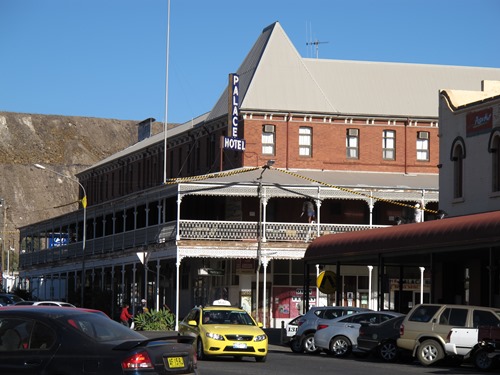
CONFERENCE CALLER: The 3rd annual Resources & Energy Investment Symposium is on 20-22 May, once again held in the unique city of Broken Hill.

Event organisers are confident this year’s Symposium can repeat the success of last year, which welcomed over 350 delegates, 12 keynote speakers and more than 30 resource companies presenting their stories.


According to Symposium managing director Kerry Stevenson the focus for this year will be on the current economic climate including its challenges and opportunities, not only in the Australian resources industry, but Australia’s position in the international market.

“We have a terrific line up of market intelligence, keynote speakers and investor presentations”, Stevenson said.

“We are also delighted to have the Minister for Resources and Energy New South Wales, Chris Hartcher, opening this year’s Symposium.”

The upcoming Federal budget in May will no doubt be a hot topic of conversation, having been released just prior to the event.

Giving his predictably forthright assessment of Treasurer Wayne Swan’s arithmetic skills will be Liberal Party heavyweight Nick Minchin who will be addressing the budget and its implications for the resources sector.

“As a nation, Australia must work to keep as globally competitive as possible or risk losing out to those countries whose governments supports the resources industry,” Stevenson said.

“Having thought leaders such as Nick Minchin address such issues is what makes this forum a must-attend event.”

The event will also look at ways Australia can collaborate and remain competitive as well as identify the outlook and opportunities for those who invest in the industry.

Perspectives on a global scale will be highlighted by a number of international keynote speakers from the United States and the United Kingdom.

President of the Colorado Mining Association (CMA), Stuart Sanderson, will be discussing opportunities and challenges for US and Australian cooperation.

Dave Kanagy of the Society for Mining, Metallurgy & Exploration in Denver will be addressing emerging workforce trends between the two countries.

John Molyneux of WHI Stockbrokers in the UK will be comparing international equity and the liquidity benefits of dual listings.

Apart from the informative keynote speakers and company updates, REIS offers those who attend unique networking opportunities.

These include the Outback Challenge golf day and BBQ dinner, networking drinks through to the closing Wild West dinner with camel racing.

There will also be mine site visits and a session dedicated to technology and its path to the future.

Symposium is a passionate supporter of the resources industry.

Profits from the Resources and Energy Investment Symposium are directed into scholarship programs managed by the AIG, which provides funds to educate students undertaking tertiary education within the resources field.

Exclusive offer for subscribers of Resources Roadhouse: Register you and a friend to attend the conference for only $600 inclusive of GST, this offer expires on 30 April. To redeem, simply contact Symposium directly on 02 9299 4350 and mention ‘Resources Roadhouse’.

For further information about REIS 2013 visit reis2013.symposium.net.au.

Horseshoe Metals begins diamond drilling Horseshoe Lights project

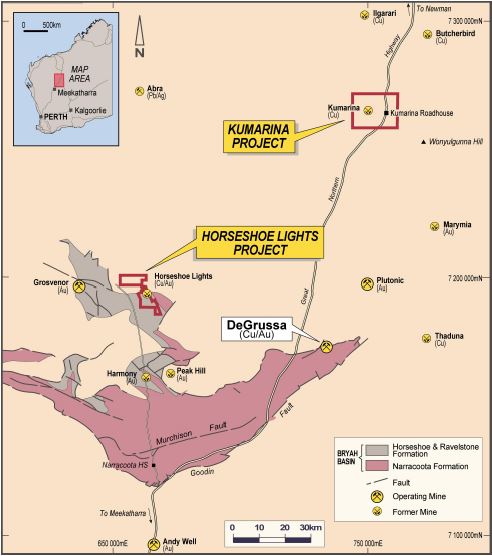
THE DRILL SERGEANT: Horseshoe Metals (ASX: HOR) has commenced diamond drilling on the company’s 100 per cent-owned Horseshoe Lights copper-gold project, located in the Peak Hill Mineral Field of Western Australia.


Horseshoe Metals projects location plan. Source: Company announcement


The drilling program has been designed to test for high-grade copper-gold zones down dip of the Main Zone beneath the existing open pit; and test a high priority volcanogenic-hosted massive sulphide (VHMS) exploration target located SE of the existing open pit.

Horseshoe indicated two diamond drill holes will be drilled to test for high grade copper-gold in a target zone down dip of the Main Zone, and will be collared on the west side of the existing open pit.

“These two drill holes are testing a zone approximately 100 metres down dip of historical copper intersections,” Horseshoe Metals sadi in its ASX announcement.

“As such they have the potential to significantly increase the company’s copper inventory and to greatly enhance our understanding of the deposit at depth.”

The drilling will also test the high-priority VHMS target beneath Chert Hill, initially with one 500 metre diamond drill hole.

The company said it would prepare each diamond drill hole to allow follow-up Down Hole Electromagnetic (DHEM) surveys to be undertaken.

Unconventional Gas play seeks Super Fund attention

Australia’s superannuation funds have been urged to rethink their investment strategies and funnel their investment deposits at a higher participation rate in emerging new unconventional gas projects along Australia’s east coast.

Unsurprisingly the call to superannuation arms came from one of the industry’s key participants, Liberty Resources managing director Andrew Haythorpe while presenting at the Australian Domestic Gas Outlook 2013 conference in Sydney.

Haythorpe intimated the long-term benefit from super fund participation would be slower domestic gas price rises, environmental gains covering water salinity, salt deposition, ground impacts and lower emissions, and sufficient ‘new era’ gas volumes to balance emerging supply and price pressure points from competition for gas along the east coast for domestic and LNG export needs.

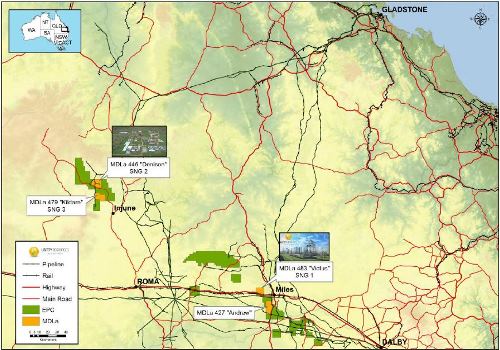
Perth-based by Liberty Resources (ASX: LBY) is proposing new $1.4 billion gas plant for central Queensland based on  a gas feedstock derived from the now third generation and more advanced and environmentally friendly technologies for accessing unconventional gas trapped in deep and un-mineable coal seams.


Liberty’s Queensland project locations. Source: Company quarterly report Dec 2012


“If one took a realistic view of the onshore and international appetite for funding new energy supply projects in Australia, it would be hard to go past the locked up potential of Australia’s super funds,” Haythorpe said.

“These funds are holding vast amounts of money, and one would suggest in the current equities environment, earning low or no interest.

“They have a significant portion of their assets ‘parked safely’ in low yielding government bonds at a time government, gas suppliers and industrial and domestic gas consumers collectively face the dire prospect of rising gas and energy prices in the immediate years ahead.

“Yet, while there is some justification in the more intense but somewhat Johnny-come-lately public and government scrutiny of existing and proposed coal seam gas production projects in Queensland and New South Wales, much of these use technologies are now surpassed by the emerging third generation of unconventional gas – what we at Liberty call ‘UGas3’.

“Critically, these new era unconventional gas projects have the potential to meet super funds’ criteria for financial and investment sustainability while delivering the funds’ obligations to meet public expectations of social and environmental accountability in their investment activities and performance.”

Haythorpe declared the potential increase in gas volumes and access offered by UGas3 diminished any need for a gas reservation policy while yielding higher jobs growth and a better managed and respected gas industry.

He said UGas3 could operate at far greater depth – down to 1.5 kilometres – than conventional existing coal seam gas operations, could recover 25 times more energy per area than CSG, and could produce gas at much lower cost, as well as lower electricity from UGas3 fuelled turbines.

Covering all bases, Haythorpe suggested UGas3 could use undrinkable surface saline groundwaters – which has been a problematic subject for the industry – for injecting into the coal seams.

He asserted there were no chemicals involved, and the technology accessed seams beneath the cap rock rather than above it, ensuring the sequestration rather than return to surface, as in CSG operations, of any remnant salt content.

Haythorpe also took aim at the use of shale gas, indicating he felt it was not the full answer to Queensland’s current gas demand of around 240 petajoules.

This demand, he said, faced a 10-fold increase in the amount of gas that has to be produced in the state as LNG projects come on stream over the next three years.

Haythorpe highlighted this as a market pressure point, which reinforced the need for the market to access fresh capital via Australian superannuation funds and the growth opportunity for UGas3 suppliers.

He said while new shale gas projects were a welcome development in Australia’s energy quarter, its challenges included the location of the reserves, the number of rigs in Australia suitable for the specialist shale gas drilling requirements, the longer lead times in well completion and hook up, and import delays on new rigs.

Liberty plans to develop its gas plant in the broader Injune area as a stand-alone development initially but still proposes an eventual world-first $4 billion integrated low cost gas, electricity and fertilizer complex, using UGas3 reserves.

The company has signed a Letter of Intent with global trader and Japanese conglomerate, Marubeni Corporation in regards to the development of its urea and ammonia proposals.

Haythorpe explained Liberty’s technology does not require fraccing as used in CSM.

Instead it injects saline water and oxygen into coal seams to generate natural hydrogen-enriched Syngas to bring to surface from un-mineable coal seams across the company’s tenements stretching in a corridor between Goondiwindi and Longreach.

The surface plant for the project would be able to process the UGas3 to both pipeline and LNG specification gas at estimated costs of $4.50 a gigajoule compared to current industry peer forecasts of $9 per GJ.

The company’s Denison project has an Inferred coal resource of 846 million tonnes with early work pointing to a production of 1000 petajoules (PJ) of raw Syngas per every 100Mt of coal or the equivalent of just under 900PJ per 100Mt of coal when upgraded to pipeline specification gas.

Mamba Minerals confirms Snelgrove hematite

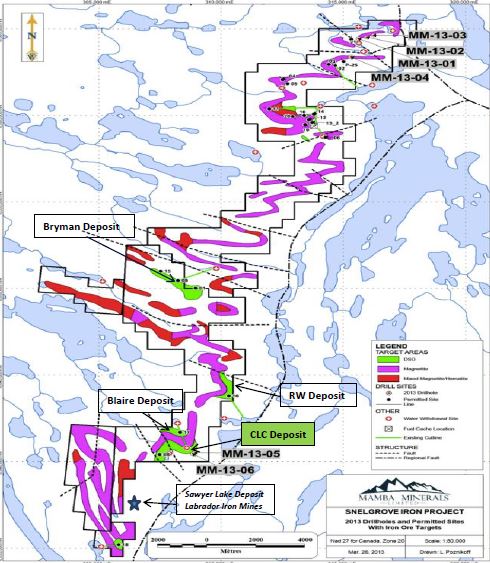
THE DRILL SERGEANT: Mamba Minerals (ASX: MAB) has intersected 61 metres of hematite in the second diamond hole drilled to test a significant hematite target at its Snelgrove Lake iron project, located in the Labrador Trough in eastern Canada.


Source: Company announcement


The hematite was intersected at a down hole depth of just eight metres and remains open at depth.

The hole is expected to be drilled to a down hole depth of 200m.

The second hole was drilled to test the hematite target after the initial discovery hole returned a 303m intersection of hematite.

This hole was still in mineralisation when drilling was stopped.

At a down-hole depth of 318m, geotechnical assessment confirmed the deposit is at least 235m deep.

Mamba said it considers the latest result to be of some significance as, based on the results of the discovery hole, hematite was not expected to be encountered until a down hole depth of 60 to 80m.

“The fact that the hematite has been intersected so close to surface suggests that the true thickness of the mineralisation is likely to be greater than the 90 metres estimated previously,” Mamba minerals said in its ASX announcement.

“This view is based on the mineralisation dipping at approximately 70 degrees from surface and drilling taking place at 50 degrees from surface.”

The company indicated its summer drilling program will now target step-out drill hole locations from both the discovery drill hole and the current hematite hole.

It is anticipated this will allow the company to better define the DSO gravity target geology and potential resource of the CLC Deposit.

At least two more holes are to be drilled in the upcoming winter program to target hematite.

Austral Resources’ Madagascar adventure

Madagascar is a country associated with the wildly successful animation film of the same name, but unlike animals trying to escape, Australian company Austral Resources is keen to stay. By Rebecca Lawson

A curiosity to find out what Madagascar had to offer led chief executive Scott Reid and director Wayne Kernaghan to cross the Mozambique Channel, having worked on the African continent for a number of years with another Australian company.

“Seven years ago, we started looking at projects in Madagascar,” Reid told The Resources Roadhouse.

“Everyone knows Africa is well endowed with minerals, and it’s no different with Madagascar.

“It is under-explored, under-exploited, and the government needs income from mineral projects coming on-stream to lift the country to a better standard of living.”

After liaising with the country’s government over areas of prospective tenements, Austral became involved with two French ex-patriots who had, for the past 10 years, held the Beravina zircon project.

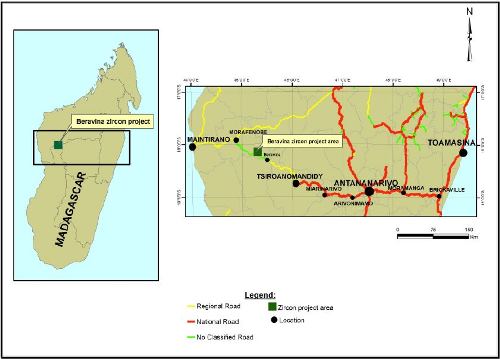
Beravina, located 440 kilometres north-west of Madagascan capital Antananarivo, is the centerpiece asset for Austral, which expects to list on the Australian Securities Exchange later this month.


The project was discovered by French geologists in the 1950s when Madagascar was a colony of that country, and was further explored in the late 1980s and 1990s by a Russian consulting group.

That work was verified by the two French ex-patriots, who also confirmed the high zircon grades which averaged around 30 per cent.

However it was only four years ago things started moving for Austral when Reid gave a serious nudge to the project’s holders, who were exploring Beravina at a relaxed pace in line with the country’s tranquil lifestyle.

Reid was keen to make something of the project, particularly after having seen its potential, combined with Madagascar’s continuing rebuild following the 2009 political coup that spawned a transitional government keen to move the country forward, significantly reducing the political risk.

Austral would also not be a foreign company going it alone in the country, with mining giant Rio Tinto having set up shop with its mineral sands operation, and the Ambatovy Joint Venture investing billions of dollars to develop a major nickel mine.

“For a small company its great not to be a trail blazer,” Reid said.

Two years ago, Austral inked a deal to buy the Bervina project but a tragedy during the process soon became a paperwork nightmare for the company.

“Unfortunately during the process of acquiring the property, one of the ex-patriot guys, was quite ill with cancer,” Reid recalls.

“He said he had signed the first round of documents, but then he needed to go back to France for tests.

“And soon after he landed, he died.”

To make matters worse, the ex-patriot had not left behind a will; complicating matters for Austral, which only had one of two signatures needed on the sale and purchase agreement.

While the French equivalent of a probate was being sorted out, Austral wasted no time in advancing Beravina.

Austral asked for more funds from seed investors in order to quickly firm up the project.

The funds went towards diamond drilling in 2011 and, following an evaluation by Badger Mining & Consultants, a JORC compliant indicated resource of 1.8 million tonnes at 29.47 per cent zircon, estimated to a depth of around 80 metres, was delineated.

The deposit, which remains open, is ideally suited to a simple open pit mining operation, Reid said, and Austral was not burdened with the prospect of having to remove millions of tonnes of sand to get to the zircon, rather the project contains the source rock.

Reid said pre-development work for Beravina started last year, with Austral sending two tonnes of ore to South Africa for preliminary testing, and a further sample has been sent for work on the proposed plant design.

The quick pace of work Austral is undertaking will be used for Beravina’s bankable feasibility study, due to be completed in September.

Austral is targeting annual production of up to 35,000 tonnes per annum of zircon concentrate over a mine life of about 13 years, based on the indicated resource. It is estimated to cost $20 million to develop.

Reid said those numbers give investors a different value proposition compared to Austral’s peers, some of which have had trouble getting off the ground due to increased cautiousness post-GFC.

“We’re in this unique position where when we list, we’ll have a market cap of $20 to 25 million but we’ll have a capex written up that’s less than our market cap,” Reid said.

“There’s no other story out there at the moment that has that scenario.

“Most of them have really good stories, but they’re three to five years away from developing their project at a cost of $300 million.

“We’re looking at having it operating and producing cash flow within 18 months.”

Austral is also looking to capitalise on the margins Beravina has to offer once it comes online.

Currently, zircon prices have settled at about US$1500 per tonne, down from its high of US$2500/t in early 2012.

Despite the drop, Reid said back of envelope numbers indicate operating costs at Beravina would be about $500 to $600/t, leaving a healthy margin for the company.

“So we know we’ve got a $1000 per tonne margin, that’s $30 to $35 million a year free cash flow and its only going to cost us $20 million to build it,” he explained.

“The cashflow that’s generated can pay off the capital cost in one year.

“There’s not a lot of moving parts, it falls into the low hanging fruit category, the mining is straightforward, and we know we can sell the concentrate.”

China is currently the largest zircon user, consuming about 41 per cent of the global market, followed by Europe at 23 per cent, Asia Pacific (excluding China) at 18 per cent and Americas at 13 per cent, research by Helmsec Global Securities show.

More than 50 per cent of zircon use is for the glazing of ceramics such as tiles, toilets and bathrooms.

With urbanisation, living standards and population growth to continue in developing countries, particularly those making up the BRICS countries, the medium to longer-term outlook for demand is positive, and prices are tipped to remain steady.

At around 35,000 tonnes a year, Reid said Austral will be supplying around one to two per cent of the world market.

“It’s a lot of production for a small company,” he said.

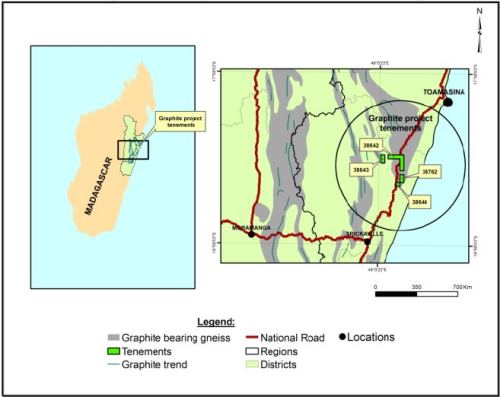
Austral also has an option to acquire four exploration tenements prospective for graphite.

The tenements are located in the Tamatave region of Madagascar, an area that has historically been a major producer of high quality rich flake graphite.


Under the deal, Austral can buy 100 per cent of the share capital of Mauritian company, Big Island Graphite, with the option to be exercised within six months from the date the tenements’ permits are converted to ‘exploration permits’.

Reid said once Beravina is at a stage where the majority of work will be on the development, the exploration team will be released to explore the graphite tenements.

However for now, Austral is focused on quickly developing Beraniva into an operating mine, potentially providing an uptick in value for shareholders in the not too distant future.


Austral Resources Limited
Proposed code (ASX: AZX)
…The Short Story

HEAD OFFICE
Level 14, 275 George Street
Sydney, NSW, 2000

Phone: +61 2 9290 3099
Fax: +61 2 9262 2502

Email: info@austral-resources.com

DIRECTORS and MANAGEMENT
Terry Willsteed, Scott Reid, Wayne Kernaghan, Glen Tetley