Castle Minerals claims new gold hits south of Bundi prospect

THE DRILL SERGEANT: Castle Minerals (ASX: CDT) has claimed to have intersected a new zone of bedrock gold mineralisation while conducting RAB drilling four kilometres south of the company’s Bundi prospect in north‐west Ghana.


Castle’s Wa project in north‐west Ghana. Source: Company announcement


The company is conducting RAB drilling testing of an earlier reconnaissance drill intercept of 3 metres at 2 grams per tonne gold.

The latest drilling has returned the following gold results from this area:

–    10m at 1.19g/t gold from 5m;

–    10m at 1.8g/t gold from 16m;

–    2m at 1.9g/t gold from 4m; and

–    2m at 3.28g/t gold from 15m.

“These results highlight a strong new gold target,” Castle Minerals managing director Mike Ivey said in the company’s announcement to the Australian Securities Exchange.

“A contract RC rig has arrived on site to test the Bundi zone and the program will now be extended to test this exciting new area.”

Castle said it will also be using RC drilling to test the newly-defined Jango prospect, from which it recently reported rock chip results up to 61g/t gold within a 300m long zone of artisanal workings in the Julie West area.

Castle’s Wa project in north‐west Ghana. Source: Company announcement

What the Brokers Say

WHAT THE BROKERS SAY: Interesting news and views from across the Resource Analyst universe.


Base Resources Ltd. (ASX: BSE)

Base is on track to begin commissioning the US$298 million Kwale mineral sands project in Kenya on schedule in Sept 2013.

Some US$196 million has been spent and funds are available for completion.

Key Points:
Base reported very good progress on construction at Kwale which is 71 per cent complete and rated one of the best undeveloped mineral sands projects in the world.

Its projected revenue to cost ratio of approx. 3.0x is amongst the very best and we assume commodity prices close to current levels.

Some US$196 million of the projected US$298 million capex has been spent and Base has US$108 million cash on hand and US$46 million yet to draw on its US$170 million debt facility.

We project $16 million cash at the low point in June 2014.

Commissioning is the next key hurdle and risk, in our opinion.

This risk can be significant for mineral sands but Kwale is planned as a simple dozer push mine like J-A and not a large-scale wet dredge project.

Timing:
Kwale is on schedule for production to commence in Q3 2013 with initial shipping in the Dec Q 2013.

We include a three-month buffer in our forecasts that may not be required.

We make no changes to our timing or forecasts at this time.

The dam wall was closed ahead of the wet season as planned and this was important because the wet season has begun and adequate water is required to run the process plant.

Funding:
Base is fully funded for its US$298 million spend but a US$20 million extension of the debt facility was added – to be sure.

We include some working capital in our total capex spend of US$308 million.

Cash of A$108 million as at March 2013 was down from A$94 million at Dec and debt drawn was US$124 million (US$52 million at Dec) with US$170 million total available in the facility.

Thus, a further US$46 million remains to be drawn in June and US $61m was spent in the March Quarter.

Recommendation: Speculative risk – price target AUD0.60


Aus-American Mining Ltd (ASX: AIW)

New high grade zones discovered

Key Points
Aus-American has released the latest batch of assay returns from its maiden drilling program at the Blue Bell VMS copper project in Arizona.

The results continue to show wide, high grade polymetallic intersections that build on the mineralisation discovered in the first seven holes.

The latest results better the first release and importantly, have potentially discovered a new, previously unrecognised high grade lens, with grades that better the historical mining grades from the 1920s.

The best intersection from the project so far – 17m at 4.6 per cent copper equivalent – has been returned in this second batch of assays.

Results from a further nine holes are expected in May. This will complete the program.

Aus-American is also about to start a VTEM geophysical survey over their entire land holding.

A Canadian based VTEM specialist has been contracted for this work.

The VTEM data collection and interpretation will be made simultaneously and we therefore expect a very quick turnaround once the VTEM has been flown.

We believe the VTEM survey could quickly establish the potential of the landholding.

The survey will utilise the existing mineralisation as a calibration aid in identifying new areas of mineralisation not exploited by mining in the early part of the 20th century.

Aus-American has set an exploration target at between 15 million and 20 million tonnes at a copper grade of between 0.6 per cent and 0.8 per cent and gold and silver credits of between 0.2g/t to 0.4g/t, and 15 to 30g/t respectively.

This is based on the concept of lower grade open pittable resources.

The higher grade massive sulphide lenses are seen as an upside case on the model.

Intersections reported so far support this model with DJC calculating that the weighted average grade of all reportable intersections is now at 1.1 per cent copper, up from 0.8 per cent copper before the release of the latest results.

Aus-American has stated its intention to strengthen the board through a search to find an executive chairman.

Jim Malone, who has been acting-chair, will step down from the position on the company securing a suitable candidate.

We believe there will be several catalysts in 2013, which have the potential to drive share price appreciation.

Aus-American has a current diluted market capitalisation of just $6.7 million and $1.5 million in cash.

We maintain our Speculative Buy on the stock.

Allan Mulligan: Walkabout Resources

ONE OFF THE WOOD: Walkabout Resources (ASX: WKT) managing director Allan Mulligan called into The Roadhouse to explain what the company has been up to.


Allan, Walkabout Resources reverse-listed into Nimrodel Resources on the ASX in 2011; Walkabout is a generic Australian term so can you explain how it fits the company’s African focus?

When working in Africa it is good to have an Australian connection. Australian companies operating in Africa are generally well-received so we felt it was important to establish an Australian identity moving into that space.

Is being an Australian company a good thing when working in Africa?

Yes, especially if, like us, you are an exploration junior company and you are operating in the areas we do, which is out in the regions where we work with local people and local companies.

Bringing Australian capital into the young mining regions of central and southern Africa is encouraged and welcomed warmly.

How does the new Walkabout Resources entity differ from its predecessor?

Nimrodel was a single-commodity company, focusing on coal in Botswana.

As Walkabout Resources we decided we to adopt a more diversified strategy and to have a broader portfolio, upon which we could create more value for our shareholders.

We have developed the Takatokwane coal project to be the largest Inferred coal Resource in Botswana at seven billion tonnes, with an Indicated Resource of 748 million tonnes.

That project is now going through a pre-feasibility study.

So, coal is one branch of you diversity tree, what are your other projects?

All together we have three, high-quality projects we are building the company on.

The first is, obviously the Takatokwane coal project and we also have an exciting copper project at Kigoma in Tanzania, which we secured earlier this year.

We also have a very interesting Platinum Group Element (PGE) project – the Makete platinum project – in Southern Tanzania, which has high PGE tenor grade and size.

Is that the order of priority you have placed on each of these projects?

Yes and no. That may sound strange, but the coal project is further developed, which gives it some seniority I suppose.

At this stage it doesn’t really require much of what we specialise in, which is greenfield and brownfield exploration.

We are a junior exploration company. That’s what we do best – acquiring projects and developing them.

Because the Takatokwane coal project is now in pre-feasibility our main focus is on the Kigoma copper project to move that up.

The thing with coal is its reliance on infrastructure development, which – along with other projects in the area – we are waiting on.

We have a very good deposit in a very good area and we don’t want to sit and wait too long.

We will look for solutions to commercialise that project – even in a moderate fashion – with a view to move it into the South African coal market.

How far have you managed to progress the Kigoma copper project?

We currently have a team on the ground at Kigoma and they are working at identifying what type of ore body we have there.

So far it appears we have two projects evolving – an oxide copper project with grades up to 25 per cent and there is also potential for a sulphide project.


At the moment we are looking at using a model similar to that being used by Tiger Resources where we can extract the oxide and create an early cash flow, which we can then use to develop the sulphide aspect of the project.

The scale we are seeing at this stage is quite large – similar to projects located in the copper belt of the Democratic Republic of Congo (DRC) and of Zambia – in that it demonstrates the geological elements required to have deposited, and concentrated the copper.

That leaves the Makete PGE project.

I have worked on PGE projects for 20 years and I consider the Makete project to be a very good project.

Having said that, to enter into PGE exploration – as a junior company of our size – you do need a Joint Venture partner, so we are going to be looking for mid-cap, or major, company which may be interested in helping us do that.

What have you learnt about the project to date?

Some exploration work was conducted there in the early 2000s, which recorded encouraging results, such as 17.6 metres at 4.9 grams per tonne PGE and gold, which included 1.7 metres at 26.8 grams per tonne.

Seven holes recorded intersections over one metre at plus 3.5 grams per tonne PGE and gold.

They were looking for a Bushveld complex-type deposit; however the current thinking on Makete is that it is not a Bushveld-complex deposit, rather it might be of ophiolite origin.

That means the geological model and the exploration techniques required will be different, so we are now going to have a look at it from that perspective.

We have all the data from the previous work – over 40 holes were drilled – once we have packaged that together we will start making enquiries to the PGE companies and see if anybody is interested in assisting us with its development.

Is it ready to present as such or will you need to conduct further work to bring it up to a level to create that interest?

We already have 10 intersections that are within an economically viable range, which were drilled across three separate areas within the project.

Our program will involve connecting those areas together and to gain an understanding of the project’s geological fluid dynamics.

When will you be commencing your drilling program at Kigoma?

We anticipate starting to drill at Kigoma by the end of May after conducting some trenching, which we are about to commence.

There are four types of mineralisation that have been identified at Kigoma and we will be trying to gain an understanding of the scale and tenor these in order to determine which ones we will be targeting.

The project compares favourably with the Michigan copper district near Lake Superior in North America.


It is quite an eclectic portfolio – what is the reasoning behind that?

That comes about from Walkabout Resources compiling a collection of quality projects and moving from a single-commodity focus into other commodities.

We felt that if, as a company, we were going to diversify then we needed to do it over a range of products that the market is quite keen on.

The coal project is too good to let go, the copper is very exciting – the early signs are that we may be able to grow something very substantial there, and PGE deposits are now moving back into exploration vogue.

The market can see there will be shortfalls, especially with copper and PGE, in the future.

It is a portfolio of commodities that, while they are not market-darlings, they are ones that are always in reasonable demand
.

They are also not co-dependent on each other. So there is always the chance one will have some substance to it while the others may be experiencing a pause.

Ironbark Zinc feasibility study dubs Citronen globally significant

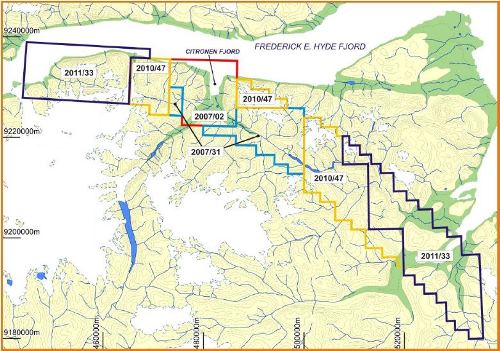
THE BOURSE WHISPERER: Ironbark Zinc (ASX: IBG) has received the results of a Feasibility Study of the company’s 100 per cent-owned Citronen project in Greenland.


Ironbark’s tenement holding in the Citronen Fjord region. Source: Company announcement


Highlights of the Citronen Feasibility Study include:
 
–    Net Present Value (NPV) of US$609 million (US$354M post tax);

–    Internal Rate of Return (IRR) 32.0 per cent (22.2 per cent post tax);

–    Equity Return 37.9 per cent (Geared NPV after tax);

–    Capital Cost US$429.3 million including contingency (US$484.8 million with First Fills);

–    Operating Costs of US$0.68 per pound of zinc (Payable, Net of by-product credits, Years 1-5, smelter fees additional US$0.22 per pound of zinc);
 
–    A Mine Life of 14 years;

–    Life of Mine Revenue US$5.65 billion; and

–    Life of Mine operating costs of US$3.42 billion.

“We are delighted the Citronen project has been ratified as a base metal mining project of global significance,” Ironbark Zinc managing director Jonathan Downes said in the company’s announcement to the Australian Securities Exchange.

“Located in Greenland, a nation actively seeking to foster a mining sector to help support its economy, Citronen’s mine life of at least 14 years is defined only by the limits of drilling to date.

“As such, one of the project’s most exciting aspects remains its exceptional exploration potential with identified mineralisation remaining open in almost every direction.”

The Feasibility Study incorporated a recent review of capital costs and the company’s 2012 updatedResources Statement.

Further advances and improvements, particularly surrounding resource confidence and mine scheduling, were released in 2012 were also included in the Study.

The company said it has achieved recent metallurgical breakthroughs with zinc flotation recoveries of 90 per cent.

Ironbark explained this testwork remains ongoing and as such, the results cannot be included in the Feasibility Study until it has achieved feasibility- level engineering confidence.

The company indicated these higher recoveries will be incorporated into the Feasibility Report following the completion of further studies.

Breakaway Resources identifies drill targets at Leinster

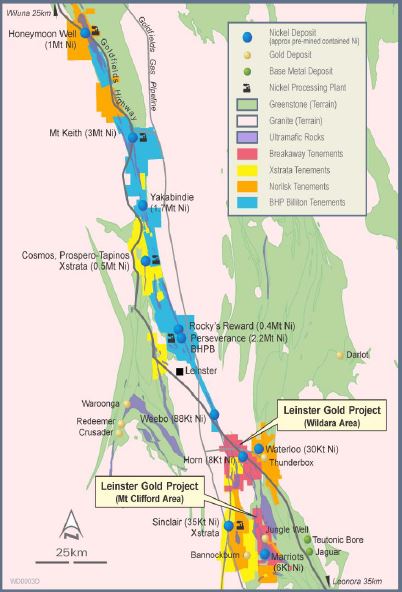
THE DRILL SERGEANT: Breakaway Resources (ASX: BRW) has identified multiple gold, nickel and base metal targets, including two priority drill-ready gold targets, at the company’s 100 per cent-owned Leinster gold project, located south of Leinster in Western Australia.


Leinster gold project location. Source: Company announcement


Breakaway identified the new exploration targets via a detailed structural analysis of the area combined with a comprehensive re-assessment of historic exploration data and recent surface geochemical sampling programs.

The company said the recent work has elevated the exploration potential of the owned Leinster gold project.

Breakaway is currently planning drilling programs for gold targets at Salute and Pond Well.

Planning is also underway for possible ground EM surveys over the nickel and base metal targets and in-fill sampling of the additional gold targets.

“The company is very pleased with the recent exploration results from the Leinster gold project, which represent the culmination of a significant in-house review of the gold potential of its tenements,” Breakaway Resources managing director Victor Rajasooriar said in the company’s announcement to the Australian Securities Exchange.

“A combination of good solid lateral thinking, structural geology and careful analysis of historic exploration data together with recent geochemical sampling has helped us to uncover significant new gold potential within our tenements, including at least two drill-ready targets which we plan to drill later this year.

“At the same time, recent surface sampling has uncovered some exciting nickel and base metals potential which requires follow-up.

“We are very excited by the potential of these targets and we are looking forward to progressing exploration activities to the next stage.”

The Leinster gold project is located in the Leinster gold, nickel and base metal province, which hosts BHP Billiton’s (ASX: BHP) Mt. Keith and Perseverance nickel mines to the north – where it has recently discovered the Venus nickel sulphide deposit – as well as the Thunderbox and Bannockburn gold mines, and the Jaguar / Bentley base metal mines.

Mike Young: Energy and Minerals Australia

ONE OFF THE WOOD: Better known for being the driving force behind successful junior iron ore miner BC Iron, Mike young has just been appointed as Chairman of uranium exploration play Energy Minerals Australia (ASX: EMA).


You have recently been appointed as Chairman of Energy and Minerals Australia. How did that come about, was it a case of them knocking on your door or vice versa?

A bit of both, really. Julian Tapp, who has recently been appointed Chief Executive Officer at EMA, and I have known each other for a long time, mainly through having worked on the Nullagine Joint Venture.

Julian, of course was on the Fortescue Metals side of the fence and I was obviously with BC Iron.

We first met in 2006, before BC Iron had even listed on the ASX.

Julian is a person you trust and want to work with?

From my experience, he has always been a fair-minded person to work with who is extremely intelligent.

He holds a Phd in Economics and is a great strategic thinker.

You certainly raised a few eyebrows by making the change from running a successful iron ore company, a commodity you are obviously passionate about, to tackle the uranium market. How do you see the future for uranium?

I do like uranium. I think uranium is a commodity for the future, especially in terms of providing clean base-load power, unlike coal and gas.

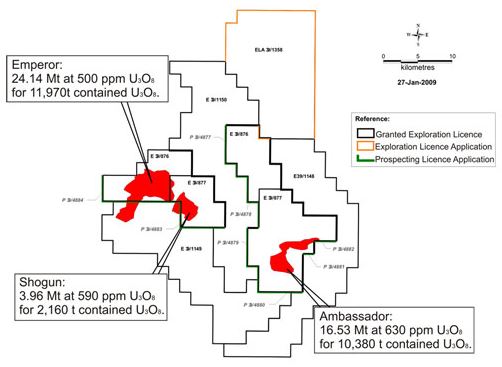
I also like the potential offered by the company’s Mulga Rocks Deposits, located near Kalgoorlie.


Mulga Rocks deposit uranium and base metal mineralisation. Source: Company announcement

Julian and I both agree this project has potential to be developed to become a uranium operation; however one of the key things about uranium projects is the approval process.

As he proved while at FMG, the best person I know when it comes to applying for the granting of approvals is Julian Tapp.

That’s why the two of us decided this company would be a good fit for us. We both like uranium and we both feel there is a good future for uranium.

Has the recent approval of Toro Energy’s Wiluna project also provided some impetus behind your decision?

I suppose if you wanted to draw some parallels you could say Toro is the Atlas Iron of the Western Australian uranium industry and we are going to be like BC Iron in that sense.

They’re leading the way and reinvigorating the junior uranium sector in the state.

Uranium producers are still quite bullish about the commodity despite its recent fall-back, John Borshoff of Paladin Energy is a great example of this, he is constantly telling people the demand and price for uranium will increase due to the lack of current global production.

The price of uranium has to go up. I don’t think you can continue to rely on coal and not have significant, detrimental health effects.

People have spoken of a significant number of people in China with significant respiratory illness caused by the particulate pollution.

The only other viable alternatives are hydroelectricity or gas. You’re not going to get base-load power from wind or solar anytime soon despite the hyperbole.

Have you received any less-than-positive reactions from people on your move from iron ore to uranium?

No, and I wouldn’t really expect to.  As Chairman your role within a company is not as technical as it is strategic in terms of directing the Board and the CEO.  One thing I do have is a track record of taking a project from concept to reality in a very short time; this is something I share in common with Julian.

It’s Julian’s job – and the geologists working for him – to be technical and we have some very good technical people working with us; a very impressive group.  

My skills are very well suited to what we want to do with EMA.

Is it fair to assume you would be reasonably well connected within the WA industry these days?

I’d hope so. I have been around the WA mining industry since 1987, so I know a lot of people within it.

As it also turns out, there are a number of people in the consulting sector I have previously worked with coming out of the woodwork with a vast knowledge of uranium.

I have a wide range of friends and Julian also has a very wide network of people.

Coming on board as a Chairman I don’t think it’s critical my recent experience has been in iron ore.

I think the key thing is you have to believe in the commodity and the market you are entering into and I do.

Had you received many other similar offers before electing to take up the position at EMA?

I did, however having said that I had always held the view that I wanted to stay and work in Western Australia and I wanted to work with a commodity that is interesting.

Uranium is always going to be that.

Every commodity is going to have upturns and downturns, you just have to look at what has happened with gold in the last couple of weeks to realise that.

The reality is that I am committed to staying in WA.

Through my participation in the mining tax debate and through policy debate with my role at AMEC, I have built up quite a good network in government – both at the Federal and State levels.

The last thing I want to do is traipse off to another country and start that all over again.

You don’t need to reinvent a new wheel?

That’s right. When you consider the network of people I have developed in Western Australia – if I venture elsewhere, for example Africa, I’m just another company man in a new country trying to make a dollar.

Here I have, I hope, integrity having steered BC Iron from being one person working from a desk in a mate’s office to a $400 billion company and being passionately involved in fighting government policies that I felt were unfair – particularly that damned MRRT.

What is going to be you role in BC Iron now?

I’m still going to be a non-executive Director, so I will still be on the Board.

The company’s new Managing Director, Morgan Ball and myself have worked together since 2009, so we have a good working relationship.

As I will still be on the Board, I will sit on Committees and still be available to him if he needs me to, so basically I’ll still be around – like a bad smell!

I’ll just have to remove the word Managing from in front of ‘Director’ my BC Iron business card.

What the Brokers Say

WHAT THE BROKERS SAY: This week we take a look at a Triple research treat from Seismic Research.



Carrick Gold (ASX: CRK)

Carrick Gold is aiming to commence mining gold ore during January 2013 from its Kurnalpi project (100 per cent CRK), within the larger KalNorth Field, which consists of four main projects that are all located within 50 kilometres of the gold mining town of Kalgoorlie in Western Australia.

Carrick has established a JORC‐compliant Reserve base of 103,000 ounces of gold across two open pits, from a global JORC-compliant Resource Base of over one million ounces of gold.

Carrick’s strategy is to commence the toll treatment of shallow oxide and transition ore, through one or more of the three nearby mills, to generate the cash needed to finalise a Feasibility Study on a Carrick‐owned‐and‐operated plant.

This plant would be strategically located to optimise the economics of a regional operation that would process ore from a number of deposits within Carrick’s projects.

This regional approach would be similar to the nearby Mount Monger project, owned and operated by Silver Lake Resources (ASX: SLR).

In addition to Carrick’s substantial Resource base of over one million ounces of gold, there is significant exploration potential within and external to the identified deposits.

The previous management even went so far as to release a Carrick global Resource of over 4 million ounces of gold.

This was before the recent addition of the Mt Jewell tenements, which increased Carrick’s Resources by 186,000 ounces of gold and added a significant amount of prospective exploration tenure.

Carrick’s current target is to increase its Resource base by 0.5 million ounces of gold per annum and to triple its Reserves by the end of 2012.

John McKinstry, Carrick’s relatively new managing director, is a specialist in mine development; with over 25 years’ experience with major companies including Normandy and Newmont.

John has also brought smaller gold mines to production before. In his previous role, as managing director of North Queensland Metals (ASX: NQM), John successfully developed, commissioned and operated the Pajingo mine in North Queensland, until NQM was taken over by Conquest Mining (ASQ: CQT).

Pajingo now forms part of the suite of assets held by Evolution Mining (ASX: EVN).

Recommendation: Speculative Buy


Venturex Resources (ASX: VXR)

Venturex Resources is aiming to commence producing copper and zinc, in concentrates, at its flagship Pilbara copper-zinc project (100 per cent VXR), located close to Port Hedland in Western Australia during the 2H of 2014.

Venturex has established a substantial JORC‐compliant Resource base containing in excess of 550,000 tonnes of copper‐equivalent within a number of high‐grade Volcanogenic Massive Sulphide‐type copper-zinc deposits.

Preliminary results from Venturex’s Feasibility Study suggest a low (C1) cash cost of $1.15 per pound copper‐equivalent.

While Venturex already has a substantial Resource base, there is exploration potential within and external to the identified deposits, in particular at the 35km of prospective, near‐surface mineralisation at the Whim Creek, Salt Creek and Liberty Indee Joint Venture areas.

Venturex is currently developing a drilling program to test down‐plunge extensions of the Evelyn deposit at Liberty Indee, the Salt Creek deposit and the Balla Balla prospect.

Venturex is also planning to drill test more regional targets within the broader Mons Cupri area.

The company recently finalised a strategic 15 per cent share placement with an ASX 300 gold producer that is operating in the Ashburton‐Pilbara region of WA, Northern Star Resources (ASX: NST).

NST invested $6.5 million and underwrote Venturex’s recent $4.5 million capital raising.

The companies have also entered into a Memorandum of Understanding to explore potential options for the joint‐development of the Pilbara project, which could result in significant costs savings for Venturex.

In addition to the Pilbara project, the company is exploring for large gold deposits in Brazil through its wholly‐owned subsidiary CMG Mineracao Ltda.

Out of the recent capital raisings, Venturex has allocated $1 million to explore its Brazilian assets.

The most‐advanced project in Brazil is Serre Verde (100 per cent VXR), which is currently awaiting the grant of exploration licences.

Serre Verde hosts VXR’s highest priority exploration targets.

Recommendation: Strong Buy


Estrella Resources (ASX: ESR)

Estrella Resources is a junior copper‐gold explorer primarily focused on developing its flagship Agustina copper‐gold project (100 per cent ESR).

The project covers an area of 18.5 square kilometres that is located approx. 90km northeast of the mining town of La Serena, in the prolific copper producing belt of central northern Chile.

Agustina is an advanced exploration‐stage project with ‘drill‐ready’ exploration targets.

The company is aiming to release a maiden JORC‐compliant resource at Agustina by the first quarter of 2013.

By developing a portfolio of copper‐gold projects in northern Chile (close to La Serena), Estrella is looking to emulate the success of other ASX‐listed companies, like Hot Chilli (ASX: HCH), but on an accelerated time frame.

By the point at which HCH had defined a resource, its share price had more than trebled.

This took over 16 months for HCH, while Estrella plans to get there in less than 9 months.

Estrella boasts a strong management team and Board. Dr. Jason Berton, the company’s managing director, is a specialist structural geologist with over 12 years’ experience.

On the ground in Chile, Estrella will be managed by Juan Pablo Vargas de la Vega, a Chilean national with over 10 years’ experience with Santos (ASX: STO), Rio Tinto (ASX: RIO) and BHP (ASX: BHP).

Julian Bavin, on Estrella’s Board, is a Chilean resident with over 30 years’ experience in mining, including eight years as Rio Tinto’s former Exploration Director for South America.

Juan Pablo’s and the Board’s local networks afford a sound position for Estrella to expand its asset portfolio on favourable terms.

Second in the development pipeline is the Venus project (100 per cent ESR), where the company has secured 46 exploration concessions, covering an area of 85sqkm immediately to the south of Agustina.

This area, where copper is currently being mined and processed on‐site by small‐scale artisanal (informal) miners, is seen by Estrella as a regional extension of the known mineralisation at Agustina.

The company is planning to start a field program at Venus in Q3 2012.

Recommendation: Strong Speculative Buy


Disclaimer: The above is intended as a guide only. The Roadhouse accepts no responsibility for investments made from this advice, successful or otherwise.

South Australian resources conference

CONFERENCE CALLER: When asked to name Australia’s resources friendly states most people tend to place South Australia low on the ladder.

South Australia was also one of the first states to introduce industry-friendly government policies, and in doing so has emerged from the resources wilderness to become a leader in Australian mining and hydrocarbon developments over the past decade.

South Australia is home to a number of world-class deposits and emerging producers.

From just four operations a decade ago, SA now boasts 20 operating mines and can also lay claim to being Australia’s second most popular exploration destination, outstripping Queensland in exploration expenditure for the second successive year in 2011.

While the Olympic Dam expansion may have been deferred, the growing presence of BHP Billiton, Rio Tinto, Xstrata, JOGMEC and a host of other international mining houses is proof that South Australia’s rise in prominence continues at a cracking pace.

Next week the Australian resources industry, from copper plays in the Gawler Craton, to iron ore developments on the Eyre Peninsula and the emergence of the Cooper Basin as Australia’s new era hydrocarbon frontier, will gather in Adelaide for the Paydirt South Australian Resources and Energy Investment Conference.

The conference will be the debut appearance of new Federal Government Resources and Energy Minister Gary Gray since his recent elevation to the key resources portfolio.


Also delivering keynote addresses will be South Australia Premier Jay Wetherill, who will be joind by his Mines and Energy Minister Tom Koutsantonis.

Filling the bill are a line-up of nearly 50 speakers to address the three day conference, including a leading commentator on Australia’s emerging potential sales of uranium to India and the head of Australia’s peak uranium industry lobby.

Also on the agenda are discussions of the issues of climate change, productivity challenges facing the mining sector, and an update on the new access arrangements for exploration and mining in the Woomera Prohibited Area.

In a departure from previous years, a specific uranium-only agenda has been set for the first day – Monday April 29 – with a forum of industry representatives gathering at the Intercontinental Hotel from 9.15 a.m.

It is expected more than 330 delegates will gather at the Adelaide Convention Centre over the following two days (Tuesday April 30 – Wednesday May 1) for the conference.

Negotiating in China

Kevin Rudd is an expert and Julia Gillard has just demonstrated doing it properly can pay off in spades. Chinese Language and Cultural Advice managing director Leonie McKeon tells us how to conduct successful negotiations in China.


Spend time developing and maintaining ‘guanxi’

The closest English meanings for ‘guanxi’ are relationships, connections and one’s social ties. Relationship in Chinese culture means a business relationship, and carries the same importance as a strong friendship, marriage or partnership. Solid ‘guanxi’ can be with you for the rest of your life, and like any relationship, it takes some effort to maintain. Developing and maintaining ‘guanxi’ is a vital part of the negotiation process. The Chinese often say ‘no relationship no business.’

Understand Chinese hierarchy

Chinese culture is a hierarchical culture; therefore you need to understand the hierarchy of the Chinese people with whom you are negotiating. This hierarchy will determine how you address people, where you sit in the meeting room, and how you introduce your group.
 

Understand ‘face’

‘Face’ is different to the notion of ‘self-esteem’. Self-esteem is about “how I feel about myself”, but ‘face’ is more about “how others feel about me”. ‘In Chinese society it is important to be respected by the group in which you belong, as the focus is on the individual’s position within his/her own social group.  ‘Face’ is always gained, lost, or given in front of others. A Chinese person’s reputation rests on how much ‘face’ he/she gains. It defines a person’s place in their social network. Sources of face can be wealth, intelligence, skills, position and solid social connections.

Asking very direct questions can cause loss of ‘face’. A strategy to avoid asking questions in such a direct manner is to change the structure of your questions. Instead of asking yes/no questions it is better to ask more open-ended questions.

You can give ‘face’ by pronouncing a Chinese person’s name correctly, and also knowing where the family name is situated in the name.

A ‘no’ can look like a ‘yes’

In communication, Chinese people often use a circular style to express rejection or refusal. Looking at this example, ‘Under the current circumstance, we would like to discuss this matter when the opportunity arises’, this sentence uses very positive words to send a ‘no’ message. This kind of answer can leave you with an optimistic view that things are moving forward, however it is a gentle rejection.
 

Translate your materials

Before meeting with your Chinese counterparts, you will need to have all of relevant materials translated. This paves the way for smooth communication. Make sure you use a reputable company to do the translation job, as an unclear translation has the potential to destroy a business deal.

Engage a professional interpreter

Always have your own interpreter rather than relying on the interpreter from the Chinese side. You need to engage a professional interpreter, as just because someone is Chinese doesn’t necessarily mean they can interpret. The more you prepare the interpreter for the interpretation assignment the smoother things will be. Good preparation means providing the interpreter with your presentations and meeting agendas so that they can research any unfamiliar terms and ask you questions prior to meetings.

Understand the Chinese negotiating culture

The physical surroundings that Chinese people are born into play a big part in how they feel about negotiation. It is common in China to see open air markets and people bargaining striving to get the best deal possible. Most Chinese people feel quite comfortable about the process of negotiation as this is a normal part of their everyday life. A well-known saying in China is “Everything is negotiable

Negotiating strategies from the Art of War

Chinese culture encapsulates the practice of negotiation in The 36 Chinese Strategies, which comes from “The Art of War”. Most Chinese people know and unconsciously use these strategies to negotiate.

They are widely known and applied in the contemporary business world.  A way of thinking about the 36 Strategies is that they are like idioms such as ‘don’t cry over spilt milk.’  Just like these idioms, the 36 Chinese strategies are learnt through families, friends, and to a lesser degree, at school. Knowing the 36 Strategies is a crucial part of knowing how to understand and conduct business with Chinese people.

An example of one of the 36 Strategies: Strategy 3: ‘Murder with a Borrowed Knife’. This means: To preserve your own strength by getting others to help you achieve your goals. For example: In a business negotiation the head person will not be the one who raises questions such as ‘Can you reduce the price?’ The person who asks this will be someone with much less status. The head person is therefore preserving his/her own strength.

 By: Leonie McKeon, Managing Director, Chinese Language and Cultural Advice

Contact us at Chinese Language and Cultural Advice
www.clca.com.au
info@clca.com.au
Phone: 08 8352 6128

Chinese Language and Cultural Advice in conjunction with Chamber of Commerce and Industry of Western Australia are conducting a full-day workshop on Wednesday 8 May in Perth.

For details of the event click here.

Elvis has left the building

THE BOURSE WHISPERER: The regular game of musical chairs continues within the boardrooms across the resources industry.


FEASIBILITY STUDY RESTRUCTURE

Following completion of a Feasibility Study, Venturex Resources (ASX: VXR) has streamlined its operations with some head office administrative restructuring.

This has resulted in non-executive directors Allan Trench and John Nitschke retiring from the Board.

NEW MANAGING DIRECTOR

Red Mountain Mining (ASX: RMX) has appointed Jon Dugdale as its new managing director.
 
The company has also announced, from 1 May 2013, executive chairman Neil Warburton will assume the role of non-executive chairman.

BOARD AND MANAGEMENT CHANGES

Goodrich Resources (ASX: GRX) has made a few Board room changes after the company’s Kimberley Diamond Company.

Alex Alexander is to take the role of executive chairman.

Rod Sainty is to step down as managing director of Goodrich, but will will remain a director of the company and continue to serve in an executive capacity as General Manager – Minerals.

Lee-Anne de Bruin will assume the role of managing director.

De Bruin is currently Kimberley Diamond chief executive officer.

APPOINTMENT AS CFO AND EXECUTIVE DIRECTOR

Coal of Africa (ASX: CZA) has appointed Michael Meeser as chief financial officer and executive director with effect from 1 June 2013.

“I would like to welcome Michael on board during a challenging and yet exciting period of the company’s development,” Coal of Africa chairman David Brown said.

“Michael brings a suite of unique skills that will enable the management to further strengthen the company’s balance sheet as we bring our coking and thermal coal projects to account.

“As a Board we are keen to ensure that we execute on the key milestones necessary for shareholder value growth.”

RESIGNATION OF DIRECTOR

Global Gold Holdings (ASX: GGH) has accepted the resignation of Patrick Ther Wee Cheng as executive director to pursue other private interests.

DIRECTOR RESIGNATION

The Board of Proto Resources & Investments (ASX: PRW) announced Aziz (Greg) Melick has resigned as a non-executive director of the company.

Melick will continue to have an ongoing contribution joining the board of Nickel Developments Limited, which is the operational vehicle behind Proto’s Barnes Hill nickel-cobalt project.

RESIGNATION OF DIRECTOR

ZYL Limited (ASX: ZYL) has advised the market that Ian Benning has resigned as chief executive officer and director.

Phillipe Lalieu, ZYL’s commercial director, and Jan Britz, ZYL SA’s chief operations officer, are to collectively take over the CEO’s duties, on an interim basis, until a new CEO is appointed.

RESIGNATION OF DIRECTOR

Scotgold (ASX: SGZ) has announced Shane Sadleir, who joined the company in 2007 and served as chairman between 2007 and 2008, has resigned as a non-executive director.

“Shane has made an important contribution to the Company and was instrumental in its listing on the ASX in 2007,” Scotgold chairman John Bentley said.

“I thank him on behalf of other Board members and shareholders for the expertise he has brought to his role with the company.”