Demand will drive uranium growth with M&A activity to rise

Demand will drive uranium growth with M&A activity to rise

THE CONFERENCE CALLER: Adam Myers corporate finance partner with tax and advisory firm BDO opened his presentation at the Australian Uranium Conference with a quote from Reserve Bank of Australia Governor Glenn Stevens.

“The global economy is likely to record growth a little below trend this year, before picking up next year. Among the major regions, the United States continues on a path of moderate expansion and China’s growth is running at a more sustainable, but still robust, pace.”

Myers said he considered that quote to still ring true with the US showing definite signs of growth and China growing at a realistic pace with inflation not as much of a concern as it would have been had the country continued down the path it was following.

Myers presented the results of a global mining study BDO conducted last year, which involved interviewing executives located around the world.


Source: Company presentation

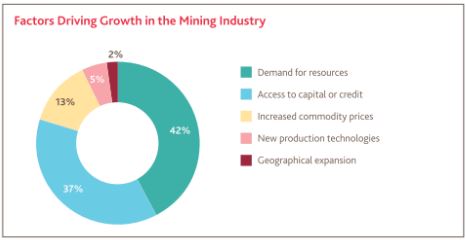
“There were some common themes to emerge and factors seen to be driving growth within the mining industry were the demand for resources,” he said.

“So we’re back to fundamental demand driving projects.”

Another aspect to emerge from the study was accessing capital or credit.

“So really you have to look at are you in an area where you have underlying demand, and have you got the capital to move forward,” Myers surmised.

“Uranium, I think, is something – in the long term – that does have that underlying demand.”

Myers gave his reasons for thinking this way down to global energy needs still not being met and that uranium and nuclear energy would play a large part in meeting that demand.

Like many other analysts are predicting, one area Myers anticipates a lot of action in next year is the Mergers and Acquisitions space.

Equity capital markets are currently very tight and there is no reason at present to think they will loosen up to by any great amount in the near future.

This is presenting some great opportunities for those companies in the position to do so.
 
“The majors are moving on some of their other projects, but there are certainly opportunities to pick up good quality projects, because companies are really running out of cash,” Myers said.

“So it is worth having a look at the market and seeing if there is a strategic deposit you could pick up.

“It really will be, I think, the theme of 2013.”

Uranium price rise to kick off sector M&A activity

Uranium price rise to kick off sector M&A activity

CONFERENCE CALLER: Matthew Keane metals and mining research analyst with stockbroking and research house, Argonaut opened the 2013 Australian Uranium Conference with a bullish approach for the metal’s immediate future.

Keane based his presentation on what he called an, “equities perspective of the uranium industry”.

“Argonaut have been long-term uranium bulls,” he told the opening day crowd.

“Following the rise and fall of many commodities over the past decade, probably the most recent being the decline in gold, I think uranium is yet to have its day.”

In terms of the price of uranium, Keane suggested it was not a matter of if, but when it began to shine.

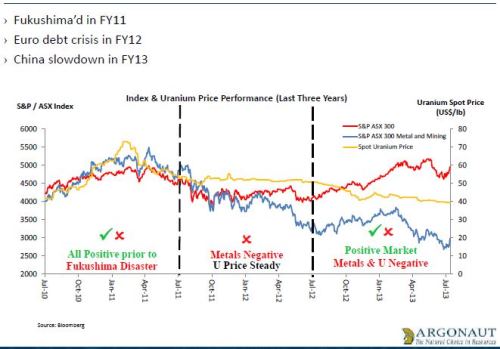
Looking back at the last three financial years Kean showed how uranium stocks kicked off 2011 in fine fettle, as did the rest of the market.


Source: Company presentation

The catalyst for the uranium industry at this time was the unfortunate Tsunami tragedy, which resulted in the meltdown of the Fukushima nuclear power plant.

“From there we see there was a gentle decline in the uranium price and also uranium equities,” Keane said.

FY12 delivered further bad news in the form of the European debt crisis, which again was a flat time for commodity markets in general.

FY13 commenced with some promise that was halted by concerns regarding the slowdown of the Chinese economy.

“Through that year we also saw a decline in the uranium price to where it is now at, effectively, pre-GFC lows,” Keane said.

Comparing the performance of uranium stocks to other commodities, in particular base metals, gold and iron ore, Keane suggested uranium stocks had under-performed over the past three years.

Through the recently-closed financial year (FY13) uranium stocks have performed in-line with both base metals and iron ore stocks while gold stocks have fallen away as investors have moved their interest away from the yellow metal.

In the uranium sector producers and developers have continued the trend of outperforming explorers, with producers having the best time of the three.

The best performing developers are those with projects closer to fruition, Toro Energy (ASX: TOR) leading the domestic charge.

“Others that have performed well are the ones with a lower capex,” Keane said.

“We are in a risk-averse market at the moment and those projects with a high capex are viewed, perhaps negatively, by the market to this point.”

Keane said Argonaut expect the uranium price to hit around $US70 to US$80 per pound in the near term, saying this is the price that is needed to incentivise supply.

“The next wave of projects to come on line are, generally, higher technical risk, higher cost of production, generated by lower grades, and are often located in higher sovereign risk regions.

“There are few projects out there that can proceed at current prices, although…just a handful.”

Keane also suggested there could be a rise in Merger and Acquisition (M&A) activity in the sector as the uranium price increases.

“We do see increased M&A activity when we have a rise in the uranium price,” he said.

Keane explained this was the case throughout 2007 and again in 2011.

He also said however, that activity could have been driven by either the uranium price driving investment or the other way around where investment places pressure on the price

“I think there is probably a bit of both there,” he said.

Keane indicated 2014 could well be a better year for uranium, especially if the anticipated uranium price rise eventuates.

Should this occur we should, Keane said, expect to see is higher levels of M&A within the sector itself.

Alliance Resources close to Four Mile environmental approval

THE CONFERENCE CALLER: The main focus of copper-gold uranium company Alliance Resources (ASX: AGS) is the company’s 25 per cent stake in the Four Mile uranium project in South Australia.

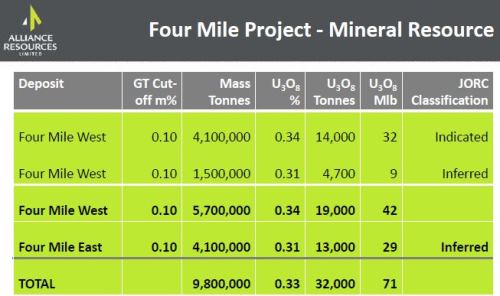
The Four Mile project boasts an Indicated and Inferred Resource of 71 million pounds of uranium oxide and is claimed to have the potential to be one of the largest and highest grade in-situ recovery uranium mines in the world.


Source: Company presentation

“Our share of that is just under 18 million pounds of uranium oxide,” Alliance Resources managing director Steve Johnston told the Australian Uranium Conference.

“It is a high-grade Resource at 3200 parts per million. I often get shareholders ringing up asking if we have made mistakes in our announcements and if it is 320ppm. It is 3200ppm.

“It’s a sensational mineralised zone.

“I can’t call it an ore body yet, but we’re not far away from demonstrating its viability.”

The Four Mile project is operated by Quasar (75 per cent), which has subsequently delegated that responsibility to its affiliate company Heathgate Resources, which is the owner-operator of the Beverly uranium mine.

“At this stage, based on current projected rates going forward of two million pounds per annum, this project has a mine life of 25 years,” Johnston said.

This surprised attentive members of the audience as Johnston had 15-plus years on his presentation slide.

“I’ve got 15-plus years there,” he explained.

“Because, ideally, I would like to see the production profile up around three million ponds per annum, but at this stage it is around two million pounds.”

Development of the project has been held up due to the approval of a Program for Environmental Protection and Rehabilitation (PEPR).

Johnston told the conference audience he had been in discussions that morning with Dr Ted Tyne executive director of minerals with the South Australia Department for Manufacturing, Innovation, Trade, Resources and Energy (DMITRE).

“He assured me that they would give approval, pending some minor feedback,” he said.

“They are intending to give approval over the next couple of weeks.”

Rattling the Tin

The Bourse Whisperer: Share Purchase Plans to raise capital are coming thick and fast at the moment. Here’s a couple to interest the Roadhouse this week.

Share Purchase Plan

Cassini Resources (ASX: CZI) announced its intention to make a Share Purchase Plan Offer (SPP) to its Shareholders to raise up to $1.3 million.

The SPP entitles Eligible Shareholders in the company, irrespective of the size of their shareholding, to purchase up to $15,000 worth of shares at an issue price of 10 cents per share free of brokerage and commission.

Cassini said that funds raised by the SPP will give the company flexibility to maintain exploration momentum after its initial program, and will provide capital to pursue additional opportunities as they arise.

Specifically, the funds will be used to:

Progress Cassini’s West Musgrave project beyond the current exploration program;

Fund other ongoing exploration expenditure at the discretion of the Directors, dependent on current exploration program results; and

Provide for the general working capital requirements of the company.

“This offer comes at an exciting time in the company’s short history, as it prepares to commence its first drilling program on the most advanced of its nickel and copper sulphide targets, the Pandora Target, at the West Musgrave,” Cassini Resources chairman Mike Young said.

“This target represents a possible, near‐term opportunity for exploration success in an area of Western Australia that remains significantly under‐explored.

“Any exploration success at Pandora is expected to deliver significant value for shareholders.”

The invitation to participate in the SPP is intended to be dispatched to Eligible Shareholders shortly.

Shareplacement raises $1.68M and proposed SPP

Aguia Resources (ASX: AGR) announced it has received firm commitments for a placement of 33.7 million new ordinary shares at five cents per share to raise a total of $1.7 million before costs.

The company said the placement has been well supported by a number of new and existing sophisticated and professional investors.

As part of the placement, the directors of the company have agreed to subscribe for 2.05 million shares totalling $102,500.

The issue of the shares to the directors will be subject to shareholder approval at a meeting expected to be held in the next two months.

Aguia  said the funds raised under will be used to supplement the company’s existing working capital and to provide funding for further testing of its Rio Grande phosphate projects in Southern Brazil.

Aguia also announced it proposes to offer shareholders the opportunity to participate in a capital raising on the same terms as the placees via a share purchase plan (SPP).

Further details on the SPP will be released in the coming weeks.

“The success of this placement, including participation by the majority of the company’s directors and several new investors, at what is a difficult time for junior resource companies, is a positive reflection on the quality of the company’s exploration assets,” Aguia Resources managing director Simon Taylor said.

Capital Raising

NSL Consolidated (ASX: NSL) announced the company has secured commitments for the placement of 23 million fully-paid shares at an issue price of two cents per share, raising $460,200.

The raising was supported by existing major shareholders, Board and management.

The placement will occur in two tranches, with 16.5 million shares being issued under the company’s 15 per cent placement capacity and the balance (Board of Directors contribution) subject to shareholder approval in early August 2013.

One free attaching option will be granted for each share allotted under the placement, subject to the receipt of shareholder approval.

The exercise price of the options will be set at four cents, with an expiry date of 30 June 2015.

The funds raised will be utilised by the company as it works with Vijay in relation to the fulfilment of Vijay’s financial commitments under the Joint Venture Agreement (JVA) and while the company continues to investigate alternative funding solutions.

The company remains in incomplete and confidential discussions with Vijay, which continues to fulfil its operational commitments under the JVA, by mining and delivering ROM (Run of Mine) material to the NSL stockyard.

What the Brokers Say

WHAT THE BROKERS SAY: Interesting news and views from across the Resource Analyst universe.

Tungsten Mining (ASX: TGN)

Tungsten Mining is a tungsten-only explorer that is primarily focused on developing its high-grade Kilba project (100 per cent), located in the Gascoyne region of Western Australia.

Kilba represents a high-grade, near-surface exploration target of 1.2 to 1.4 million tonnes at 0.6 to 0.8 per cent tungsten, based on historic exploration conducted in the 1980s.

After listing in December 2012, raising $5.1 million in the process, TGN commenced Phase 1 of its reverse circulation (RC) and diamond drilling program.

Phase 1 returned some promising high-grade, wide intercepts at shallow (open-pit) depths, including 14.5 metres at 0.8 per cent tungsten (from 42.5m).

These results replicated the historic drilling results across the same cross sections.

With the completion of the Phase 2 and 3 drilling programs, TGN is aiming to define a JORC-compliant resource by April 2013.

The company plans to undertake feasibility studies over the next four to six months, with the aim of defining an operation capable of producing up to 100,000 MTU tungsten per annum for a low capital expenditure (CAPEX) in the order of approx. US$30 million.

Such an operation could generate $28 million p.a. in revenue at the current tungsten concentrate price.

Recommendation: Speculative BUY

Decmil Group Limited (ASX: DCG)

Earnings risk now skewed to the upside

Decmil Group announced it has won a $137 million contract for the construction of a village on Manus Island in Papua New Guinea (PNG) for the Australian Department of Immigration and Citizenship.

Commencement on site is due this month, with anticipated completion by 31 January 2014.

The contract brings the FY14 construction order book to a solid level, such that no more work needs to be won for FY14 to meet implied market expectations, in our view.

Visible contracting revenue for FY14 of $390 million

We estimate that the FY14 construction order book is now approx. $250 million (excluding the $71 million Roy Hill contracts).

We still expect EDE to contribute at a minimum $140 million of revenue, and hence we believe there is visible revenue for contracting of $390 million. Hence we are very comfortable with our contracting revenue estimate for FY14 of $440 millon.

As a reminder, we assume increasing EBITDA margin assumptions for construction. While this could sound counter intuitive to some, there is sound reasoning. Our gross margins assumptions are approx. 15 per cent, but we expect a considerable reduction in divisional overhead expenses (from a peak of aprox $28 million per annum back to approx. $9 million per annum – more akin to FY07 levels).

The divisional overhead had been rapidly increasing as a result of skills shortages (ie carrying the expense of a latent pool of project managers) and the rising tendering costs (cost inflation, the number of tenders and the complexity/size of tenders).

With the lower industry pipeline of projects, we expect the divisional overhead to fall significantly and, in the short term, DCG should be able to retain this margin improvement.

Hartleys expects FY13 EBITDA of $67.5m, FY14 $77.4m

Our headline earnings estimates barely changed. For FY13, we expect NPAT of $43 million (reported NPAT $63.9 million) and have increased our final dividend estimate to six cents per share (from four cents per share).

We are more conservative on our debtor assumptions though and have reduced our net cash estimate at June 2013 to approx. $35 million.

We expect FY14 EBITDA of $77.4m and NPAT of $47.3m.

Maintain Buy recommendation

We value the Queensland village at approx. $1.20 to $1.60 per share (depending on one’s EBIT multiple assumptions and the depreciation in the village).

We value the combined construction and EDE contracting business at $1.58 (based on approx. $440m of perpetual revenue and a 6x EBIT multiple).

Combined with annual estimated overheads of approx. $11 million per annum and the cash on the balance sheet, we value DCG at approx. $2.76 on a multiple basis.

We see an additional approx. 50 cents of upside from better than expected contracting and another approx. 80 cents if the company secured another owned and operated 1,000 man village at cost (for example the final stage of the Gladstone village).

We have a twelve month price target of $2.96 and maintain our Buy.


Disclaimer: The above is intended as a guide only. The Roadhouse accepts no responsibility for investments made from this advice, successful or otherwise.

Australian Uranium and Rare Earths conference

THE CONFERENCE CALLER: The Roadhouse will be along to meet and greet international experts and political leaders will meet at the Esplanade Hotel Fremantle by RYDGES for the ninth annual Australian Uranium and Rare Earths Conference.

The conference is set to kick off on Tuesday 16 July and carry over to Wednesday 17 July with the subject of the future of uranium mining in Australia being the hot topic.

The uranium debate was reignited last month following New South Wales Minister for Resources and Energy Chris Hartcher’s decision to invite several companies to explore for uranium in far western NSW.

Conference organiser, Vertical Events managing director Stewart McDonald said the conference was an important forum for debate on the key issues of energy policy and the role uranium may play in the future of Australia’s energy mix.

“The Australian Uranium and Rare Earths Conference brings together quality representatives from government, the mining industry and the scientific community in a unique and engaging forum where debate over nuclear power can be openly discussed,” McDonald said.

The conference program begins with an opening address and keynote presentation from West Australian Mines and Petroleum Minister, Bill Marmion.

Other key speakers at the conference include:

Matthew Keane – Metals and Mining Research Analyst, Argonaut Securities;

Simon Youds – Head of Operations, Cauldron Energy;

Brian Reilly – Managing Director, Cameco Australia;

Professor Daniel Packey – Head of the Department of Mineral and Energy Economics, Curtin University;

Richard Henning – Executive Chairman, Stonehenge Metals;

Jim Graham – Managing Director, Anatolia Energy;

Vanessa Guthrie – Managing Director, Toro Energy; and

Fletcher Newton – Principal, New World Consulting LLP.

The Australian Uranium and Rare Earths Conference always attracts commodity buyers, brokers, fund managers and retail investors and government representatives, with over 500 delegates from Australia, Canada, France, Germany, Japan, UK and USA attending the conference last year.

The conference will again host a Technical and Issues Forum featuring presentations from John Hernage, Industrial Business Developer, Veolia Water; Andrew Somers, Global Business Development Manager: Mining, Olympus NDT; and Dr Ian J. Ellison, Senior Inspector of Mines, Department of Natural Resources and Mines.

The Technical and Government Forum will provide vital information in relation to the geology, mining, and metallurgy of Uranium and Rare Earths projects and will also include discussions on state government policy issues such as approvals, environmental management, OHS, transport and supply.

Click to view a copy of the conference program.

SA Group wants to remove investment hurdles

IN THE LOBBY: The South Australian Chamber of Mines and Energy (SACOME) says Federal policies addressing a flow through shares scheme, changes to the Petroleum Resources Rent Tax, and urgent resolution of South Australia’s infrastructure hurdles are essential for the State to realise its resources wealth and deliver much needed jobs and funds to the economy.

The group said implementing an exploration tax credit policy such as a flow through shares scheme would encourage much needed investment in junior resources companies and secure the start-up capital required for crucial mining and energy projects in the pipeline.

SACOME has been calling for an exploration tax credit policy since before it was first promised by the Federal Labor Government in 2007.

“With recent downtrends in mineral exploration expenditure, softening commodity prices and extremely constrained capital markets, junior resources companies are facing tremendous challenges right now to develop their deposits into economical projects,” SACOME chief executive Jason Kuchel said.

“The junior resources sector is absolutely vital – many people do not realise it’s the ‘engine room’ needed to find the resources, upon which our economy is so dependant.”

SACOME said the scheme would allow companies which are unable to access tax deductions as they accrue – given their lack of income – to issue shares with these deductions ‘flowing through’ to investors.

This would provide a strong incentive for shareholders, making investment in these juniors attractive while addressing the lack of start-up capital in a competitive market.
 
Labor first promised to introduce the scheme under the Rudd Government in 2007, but dropped this crucial policy when the mining tax was developed.

“Australia continues to lose its share of global exploration expenditure, down from 21 per cent in 1996 to only 17 per cent in 2010,” Kuchel said.

According to SACOME, the South Australian resources industry is in desperate need for key infrastructure development where there is clear market failure.

“The two major infrastructure issues holding back substantial development in this State are the need for a multi-user deep water port, and the upgrade of electricity transmission networks along the Eyre Peninsula,” Kuchel said.

“The Federal Government should use bodies like Infrastructure Australia and the Export Finance and Insurance Corporation (EFIC) to provide funding agreements to stimulate infrastructure in the State where the market has failed to deliver a solution.

“This solution has already proven its success with the Federal and State Governments assisting Nyrstar last year to arrange a funding agreement with EFIC to upgrade the Port Pirie smelter, securing the future of the company in the community and providing a solution to long-standing environmental issues.”

SACOME is also calling for key changes to the Petroleum Resource Rent Tax (PRRT).

These include the inclusion of contiguous licenses so exploration expenses are eligible to be deducted against production revenue, and a low profit offset where profits below $50 million are not subjected to the PRRT.

“With key basins tipped for significant unconventional oil and gas production, these two policy changes to the PRRT are essential for securing a prosperous energy industry in our State,” Kuchel said.

“In the Cooper Basin alone, there are junior companies operating alongside the majors to tap into a potential 29 billion barrels of oil, and a further 2.6 trillion cubic metres of gas, as identified by the Energy Information Agency.

“It is imperative that the junior companies operate in an economic environment where they can expand and diversify into other fields and basins.

“A low profit offset mechanism, which is currently utilised in the MRRT to shelter junior miners with low profits from the effects of this tax, should also translate into the PRRT for junior oil and gas companies.”

SACOME is calling for 10 key policy priorities to be addressed by the major parties before the Federal election.

Full details of these 10 election priorities can be found at www.sacome.org.au

A detailed report including responses from the key political parties will be published in the SA Mines & Energy journal, available in August.

The Roadhouse celebrates 100 issues

It really was party-time in the front bar of The Roadhouse this week as we celebrated the 100 issue of our newsletter.

The sausage rolls were hot and the beer was cold with many familiar faces filling the room to help us mark the occasion.


Over the past two years The Roadhouse has gradually settled in to its self-appointed role as the on-line forum for Australia’s junior mining sector.

Things might be tough right now, but the mining industry is tougher; and we can’t wait to bring you the next 100 issues to, hopefully, report on the turnaround.

Thanks for reading so far, and thanks in anticipation of your continued patronage.

Remember…

It all happens at The Roadhouse.


Why gold will continue to benefit from economic uncertainty and investor demand

GAVIN WENDT: The headlines over the past week or so have continued to revolve around the likely reasons for the speculative move away from gold.

Firstly, it’s suggested that the US Federal Reserve is looking to cut back on its level of QE stimulus; and secondly, the US dollar is forecast to rise as a result of likely move higher with respect to interest rates. It’s worthwhile focusing on both these situations.

The US economy is in many respects very much like the nervous bicycle rider, with training wheels firmly in place.

Whenever the Fed’s Ben Bernanke so much as hints at the removal of the ‘training wheels’ to see if progress can be maintained unassisted, the market goes into full-on panic mode. Shares and commodities are relentlessly sold off.

I believe this tells us two things: firstly, that confidence in the US economic recovery is misplaced and that things are probably much worse than what is presently apparent. The second point is that the Fed has provided the stimulatory means for markets to dramatically over-inflate, with the result that speculators are now concerned that the game might be up.

As we’ve highlighted in previous commentaries, it is not because of sound fundamentals that the US share market is trading at such lofty levels.

The underlying health of the US economy does not justify it – certainly not from the perspective of some of the real key indicators – such as real wages, labour force participation and home ownership.

The US share market has instead been pumped full of Fed stimulatory hot air and it’s this stimulus that has generated the enormous price growth in assets such as shares and property.

Low interest rates have assisted consumption to some degree, but they’ve also provided huge incentives for investors to gain exposure to higher-risk investments (because interest returns on bank deposits have been so low).

There are far harsher descriptions of what has been taking place. In the US, financial markets are described as exhibiting the classic behaviour patterns of a drug addict. Just a hint that the Fed may start slowing down the flow of “juice” has been enough to cause turmoil in financial markets.

What’s also significant is that Ben Bernanke has not actually stated that he will slow QE down (let alone stop) any time within the foreseeable future.

He’s merely stated that it may be “appropriate to moderate the pace of purchases later this year” if the economy improves. Unfortunately, the panicked reaction to his comments reflects the fact that US financial markets have become completely and totally addicted to ‘easy money.’

Which of course beggars the question, what will happen when it’s all taken away? How will the US economic recovery – as tentative as it is – be able to sustain itself? Judging by the panicked reaction of markets whenever withdrawal is even hinted at, there must be huge doubts.

It’s fair to say that the US Federal Reserve wields a disproportionate and unhealthy level of influence over the US economy.

The measures that the Fed has taken over recent years have grossly distorted the US financial system, generating a massive financial bubble that it is now attempting to take steps to unwind.
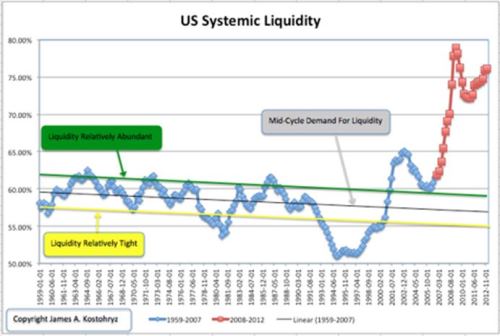
 

If the real economy in the US is as uncertain as I believe it is, the Fed risks derailing what is a tepid recovery through the removal of stimulus, despite its aim of deflating the various asset bubbles within the economy.

On the other hand, many Fed officials are cognizant of the risk of repeating the policy errors of 2003-2007. This was a period in which the Fed, which was at that time also dealing with a relatively lacklustre and ‘jobless’ economic recovery, perpetuated too much monetary accommodation for too long.

Let’s now look at our second discussion point, which involves the scenario of potentially rising interest rates/inflation in the US. Rather than a likely negative for gold, as many media pundits are suggesting, I see no reason why rising rates and inflation won’t be positive for gold.

In fact many gold experts at the outset of the Fed’s massive stimulus spending program suggested that this rising interest rate/inflation scenario would coincide with the commencement of the second leg of gold’s price run.

So far the Fed has managed to keep inflation in check, despite the massive blow-out in the money supply. Realistically however, higher interest rates/inflation is inevitable as the monetary chickens come home to roost – you cannot continue to undertake monetary expansion on such a mammoth scale without major longer-term economic consequences.

There is a widely-held view that a rising interest rate environment is bad for gold, but this is a fundamental misconception. Why shouldn’t gold benefit from a rising interest rate environment, just as it has done in a low interest rate environment since 2008?

The evidence of recent history tell us that gold rose along with interest rates during the 1970′s, which is sufficient to prove that gold doesn’t always fall when interest rates rise. Greece is a perfect modern-day example of a reasonably strong gold price despite wage deflation and rising interest rates.

The real driver of the gold price is negative real interest rates (defined by nominal interest rates minus inflation). Central bank policies of inducing negative real rates to ‘incentivize’ borrowing, expanding the money supply and devaluing currencies, have forced investors (particularly private investors such as mums and dads) into real assets like gold and silver.

Debt is inherently inflationary if you have the ability to print your own currency. Let’s analyse the situation in the US, where the M2 money supply has increased from $9.5 trillion to $10.4 trillion.
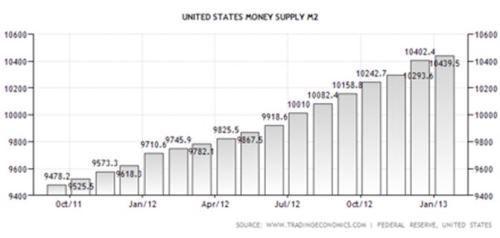
 

As money supply increases, so does the value of gold, because gold is a measure of the dollar’s purchasing power.

We can reasonably expect the money supply to continue to increase, so long as the Federal Reserve keeps increasing the monetary base at a rate of $85 billion per month. These increases in the monetary base and in the M2 money supply have not yet been reflected in the CPI, but they eventually will.

This is why we’re continuing to see robust levels of gold demand from both individual investors and central banks, despite selling from speculators and hedge funds. When it comes to risk-free wealth preservation, gold does a far better job than any other asset you can think of.

There is a clear lack of confidence on the part of emerging economy central banks in the established world currencies – the dollar, the euro and the yen. This is because countries inevitably expose themselves to all sorts of financial shenanigans by desperate central bank authorities, keen to apply short-term fixes to systemic, longer-term economic problems.

It wasn’t that long ago that China was consistently accused by the US of currency manipulation to benefit its own domestic political situation. Now the shoe is firmly on the other foot, as desperate governments meddle with the value of their own currencies in order to try and generate preferred economic outcomes.

Governments are simultaneously engaged in a furious act of currency debasement in order to try and keep interest rates and inflation at low levels, whilst also trying to boost their export industries.

Now let’s turn our attention back to gold. Whilst the price of the yellow metals has fallen dramatically from its peak to 3-year lows currently, there are two important factors to note.

If gold has been sold off because of the perceived strength of the US economy, why does the market plunge into free-fall whenever the removal of the financial training wheels is discussed?

Logic therefore dictates that the underlying health of the US economy is nowhere near as robust as official data suggests, meaning gold’s reign is far from over.

Furthermore, gold will ultimately benefit from the inevitable emergence of inflation in the US economy, even if the value of US currency rises. The vast sums of US government spending since the GFC have in actual fact generated a poor return when the evidence is analysed – low economic growth and high unemployment.

From a fundamental perspective, gold remains a strong investment option. Physical gold continues to move from West to East – and from less supportive holders to firmer ones. China and India continue to remain strong markets.

But China and India are not the only Eastern nations where the populations are buying gold in ever increasing amounts.  Virtually the whole of South East Asia is predisposed towards holding gold as long-term wealth protection.

In a recent note, long-term precious metals analyst Jeff Nichols commented: “It seems to me that the [gold] bears have a fairly provincial view and a limited understanding of gold’s increasingly bullish long-term fundamentals. By “provincial” I mean they are ignoring more than half the world – the half that loves gold and will accumulate more.  They seem to think not much is important to the future of gold outside the United States and Europe.”

Furthermore, as Laurie Williams from MineWeb wrote earlier this week, “Ultimately I believe it will be supply and demand for physical gold that will set the market price for the metal. It seems thus that the only thing holding the gold price back is the strange goings on in the US gold market and those global ones that can be manipulated with huge sums of US-backed paper gold.”

Gavin Wendt is the founder of MineLife, publisher of the MineLife Weekly Resource Report

In the Lobby Issue 99

In the lead up to the Federal Election we expect to hear a fair bit from Industry Lobby Groups.

Improved productivity should be the focus for new Prime Minister

The Chamber of Commerce and Industry of Western Australia wasted little time in congratulating Kevin Rudd on his return to the Prime Ministership.

It also wasted little time in letting him know its position in regards to when we should go to the polls.

“Stable government is vital to the WA business community,” CCI WA chief executive James Pearson said in a statement.

“An extended period of political uncertainty and anti-business policies has worn away the confidence of business and consumers.”

“A lack of confidence in the government and our economic prospects means less investment in industry and creating jobs.

“The easiest way to provide certainty for business and consumers is to let voters decide at an election as soon as possible.

“We hope this change in leadership means a change in focus, which puts the competitiveness and productivity of our nation at the forefront of economic policy.”

Pearson said he believed WA employers would welcome the new Prime Minister’s statement that he wants to work closely with business.

However, in the same breath he said it was important the government was able to get its policy settings right and that these should be undertaken in consultation with business, to take advantage of the opportunities from the continued growth of our regional neighbours.

“To do this though, Australian and WA businesses need to be competitive,” Pearson said.

“They need a competitive tax system, a regulatory environment that doesn’t unduly hold back their operations, employment relations that are flexible and investment in capacity building infrastructure.”

Timely commencement of the new Mining Rehabilitation Fund

The Association of Mining and Exploration Companies (AMEC) has welcomed the commencement of the Western Australian Government’s new Mining Rehabilitation Fund (MRF)  as a timely welcome boost for mid-tier miners and junior exploration companies in Western Australia.

Since the passage of legislation to create the MRF in late 2012 AMEC has worked with the Department of Mines and Petroleum (DMP) to ensure a smooth transition.

The Mining Lobby Group said the MRF will ultimately free up cash which is currently being used to support unconditional performance bonds.
    
The MRF is due to kick in on 1 July 2013, after which eligible companies may voluntarily apply to participate.

This will result in these companies not being required to provide a bond as security to meet their environmental obligations.

The MRF will become compulsory for all Mining Act projects from 1 July 2014.

“The MRF has apparently already attracted more than 370 voluntary registrations, which is a terrific response by industry and highlights the positive reception this has had already”. AMEC chief executive officer Simon Bennison said in a statement.

“AMEC has been a major supporter and driver of this legislation and has worked closely with the DMP to develop this positive outcome for industry.

“As a high proportion of existing unconditional performance bonds are cash backed, immediate access to that cash will enable companies to use those funds for operational purposes and expand existing drilling programs.”
 
Bennison said AMEC had received feedback from a recent information seminar that indicated the MRF was popular with industry participants, who consider the scheme will be a win-win for industry and the environment.

“The challenge is now for other Australian jurisdictions to acknowledge the significant benefits, and introduce it themselves,” Bennison said.

“While this is a great starting point, more work is required on the detail of the implementation of this initiative.”