


Why gold will continue to benefit from economic uncertainty and investor demand
GAVIN WENDT: The headlines over the past week or so have continued to revolve around the likely reasons for the speculative move away from gold.
Firstly, it’s suggested that the US Federal Reserve is looking to cut back on its level of QE stimulus; and secondly, the US dollar is forecast to rise as a result of likely move higher with respect to interest rates. It’s worthwhile focusing on both these situations.
The US economy is in many respects very much like the nervous bicycle rider, with training wheels firmly in place.
Whenever the Fed’s Ben Bernanke so much as hints at the removal of the ‘training wheels’ to see if progress can be maintained unassisted, the market goes into full-on panic mode. Shares and commodities are relentlessly sold off.
I believe this tells us two things: firstly, that confidence in the US economic recovery is misplaced and that things are probably much worse than what is presently apparent. The second point is that the Fed has provided the stimulatory means for markets to dramatically over-inflate, with the result that speculators are now concerned that the game might be up.
As we’ve highlighted in previous commentaries, it is not because of sound fundamentals that the US share market is trading at such lofty levels.
The underlying health of the US economy does not justify it – certainly not from the perspective of some of the real key indicators – such as real wages, labour force participation and home ownership.
The US share market has instead been pumped full of Fed stimulatory hot air and it’s this stimulus that has generated the enormous price growth in assets such as shares and property.
Low interest rates have assisted consumption to some degree, but they’ve also provided huge incentives for investors to gain exposure to higher-risk investments (because interest returns on bank deposits have been so low).
There are far harsher descriptions of what has been taking place. In the US, financial markets are described as exhibiting the classic behaviour patterns of a drug addict. Just a hint that the Fed may start slowing down the flow of “juice” has been enough to cause turmoil in financial markets.
What’s also significant is that Ben Bernanke has not actually stated that he will slow QE down (let alone stop) any time within the foreseeable future.
He’s merely stated that it may be “appropriate to moderate the pace of purchases later this year” if the economy improves. Unfortunately, the panicked reaction to his comments reflects the fact that US financial markets have become completely and totally addicted to ‘easy money.’
Which of course beggars the question, what will happen when it’s all taken away? How will the US economic recovery – as tentative as it is – be able to sustain itself? Judging by the panicked reaction of markets whenever withdrawal is even hinted at, there must be huge doubts.
It’s fair to say that the US Federal Reserve wields a disproportionate and unhealthy level of influence over the US economy.
The measures that the Fed has taken over recent years have grossly distorted the US financial system, generating a massive financial bubble that it is now attempting to take steps to unwind.
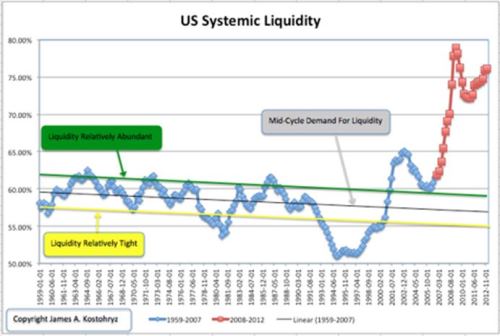
If the real economy in the US is as uncertain as I believe it is, the Fed risks derailing what is a tepid recovery through the removal of stimulus, despite its aim of deflating the various asset bubbles within the economy.
On the other hand, many Fed officials are cognizant of the risk of repeating the policy errors of 2003-2007. This was a period in which the Fed, which was at that time also dealing with a relatively lacklustre and ‘jobless’ economic recovery, perpetuated too much monetary accommodation for too long.
Let’s now look at our second discussion point, which involves the scenario of potentially rising interest rates/inflation in the US. Rather than a likely negative for gold, as many media pundits are suggesting, I see no reason why rising rates and inflation won’t be positive for gold.
In fact many gold experts at the outset of the Fed’s massive stimulus spending program suggested that this rising interest rate/inflation scenario would coincide with the commencement of the second leg of gold’s price run.
So far the Fed has managed to keep inflation in check, despite the massive blow-out in the money supply. Realistically however, higher interest rates/inflation is inevitable as the monetary chickens come home to roost – you cannot continue to undertake monetary expansion on such a mammoth scale without major longer-term economic consequences.
There is a widely-held view that a rising interest rate environment is bad for gold, but this is a fundamental misconception. Why shouldn’t gold benefit from a rising interest rate environment, just as it has done in a low interest rate environment since 2008?
The evidence of recent history tell us that gold rose along with interest rates during the 1970′s, which is sufficient to prove that gold doesn’t always fall when interest rates rise. Greece is a perfect modern-day example of a reasonably strong gold price despite wage deflation and rising interest rates.
The real driver of the gold price is negative real interest rates (defined by nominal interest rates minus inflation). Central bank policies of inducing negative real rates to ‘incentivize’ borrowing, expanding the money supply and devaluing currencies, have forced investors (particularly private investors such as mums and dads) into real assets like gold and silver.
Debt is inherently inflationary if you have the ability to print your own currency. Let’s analyse the situation in the US, where the M2 money supply has increased from $9.5 trillion to $10.4 trillion.
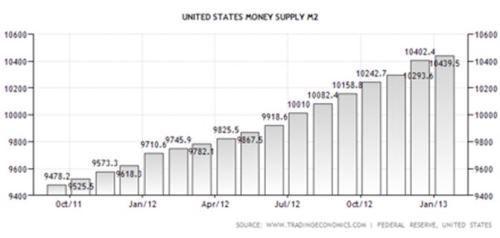
As money supply increases, so does the value of gold, because gold is a measure of the dollar’s purchasing power.
We can reasonably expect the money supply to continue to increase, so long as the Federal Reserve keeps increasing the monetary base at a rate of $85 billion per month. These increases in the monetary base and in the M2 money supply have not yet been reflected in the CPI, but they eventually will.
This is why we’re continuing to see robust levels of gold demand from both individual investors and central banks, despite selling from speculators and hedge funds. When it comes to risk-free wealth preservation, gold does a far better job than any other asset you can think of.
There is a clear lack of confidence on the part of emerging economy central banks in the established world currencies – the dollar, the euro and the yen. This is because countries inevitably expose themselves to all sorts of financial shenanigans by desperate central bank authorities, keen to apply short-term fixes to systemic, longer-term economic problems.
It wasn’t that long ago that China was consistently accused by the US of currency manipulation to benefit its own domestic political situation. Now the shoe is firmly on the other foot, as desperate governments meddle with the value of their own currencies in order to try and generate preferred economic outcomes.
Governments are simultaneously engaged in a furious act of currency debasement in order to try and keep interest rates and inflation at low levels, whilst also trying to boost their export industries.
Now let’s turn our attention back to gold. Whilst the price of the yellow metals has fallen dramatically from its peak to 3-year lows currently, there are two important factors to note.
If gold has been sold off because of the perceived strength of the US economy, why does the market plunge into free-fall whenever the removal of the financial training wheels is discussed?
Logic therefore dictates that the underlying health of the US economy is nowhere near as robust as official data suggests, meaning gold’s reign is far from over.
Furthermore, gold will ultimately benefit from the inevitable emergence of inflation in the US economy, even if the value of US currency rises. The vast sums of US government spending since the GFC have in actual fact generated a poor return when the evidence is analysed – low economic growth and high unemployment.
From a fundamental perspective, gold remains a strong investment option. Physical gold continues to move from West to East – and from less supportive holders to firmer ones. China and India continue to remain strong markets.
But China and India are not the only Eastern nations where the populations are buying gold in ever increasing amounts. Virtually the whole of South East Asia is predisposed towards holding gold as long-term wealth protection.
In a recent note, long-term precious metals analyst Jeff Nichols commented: “It seems to me that the [gold] bears have a fairly provincial view and a limited understanding of gold’s increasingly bullish long-term fundamentals. By “provincial” I mean they are ignoring more than half the world – the half that loves gold and will accumulate more. They seem to think not much is important to the future of gold outside the United States and Europe.”
Furthermore, as Laurie Williams from MineWeb wrote earlier this week, “Ultimately I believe it will be supply and demand for physical gold that will set the market price for the metal. It seems thus that the only thing holding the gold price back is the strange goings on in the US gold market and those global ones that can be manipulated with huge sums of US-backed paper gold.”
Gavin Wendt is the founder of MineLife, publisher of the MineLife Weekly Resource Report
