Barnaby does Diggers

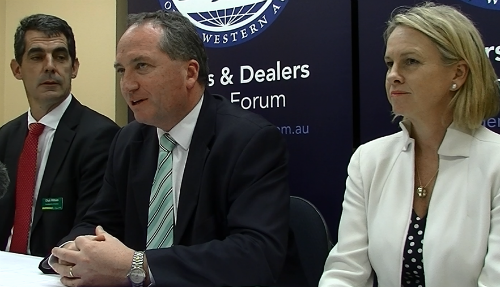
ON THE HUSTINGS: Nationals Senator Barnaby Joyce, who is running for the lower-house seat of New England recently vacated by Tony Windsor, dropped in to Diggers & Dealers.

Flanked by fellow Nationals Senator, Fiona Nash and Nationals hopeful for the seat of O’Connor Chub Witham, Joyce was quizzed by the attendant phalanx of journalists on a number of subjects, including the need to bolster the prospecting component of Australia’s mining industry.


Watch Barnaby give his thoughts on the prospects for prospecting here.

Witham is hoping to retain the seat of O’Connor for the Nationals, who won the seat at the last election by ousting long-time Liberal maverick, Wilson Tuckey.

The seat is currently sat in by National MP Tony Crook, who has surprisingly announced his intentions to retire at the 2013 election after just one term in the House of Representatives.

Witham outlined his credentials for the job by saying he has been a regular attendee at Diggers & Dealers throughout his career as a mining geologist.

Sandfire Resources celebrates DeGrussa mine opening

THE BOURSE WHISPERER: Sandfire Resources (ASX: SFR) celebrated the official opening of the company’s DeGrussa copper mine and The Roadhouse was there.

The mine was officially opened by Colin Barnett the Premier of Western Australia.

The opening comes just over four years after Sandfire first discovered the high-grade DeGrussa VMS copper-gold deposit. 

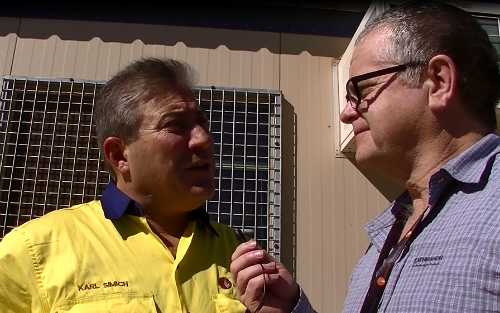
Watch our interview with Sandfire Resources managing director Karl Simich

Sandfire commenced mining at DeGrussa via a 2-year open pit operation in conjunction with the development of a longer-term underground mine which is now ramping up to a full production rate of 1.5 million tonnes per annum.

Ore is fed to an on-site concentrator which produces copper concentrate grading 25 per cent copper that is subsequently transported for export through Port Hedland and Geraldton.

DeGrussa has already produced over 70,000 tonnes of copper metal and 50,000 ounce of gold worth over $500 million since operations started.

Sandfire produced 64,017 tonnes of copper and 42,697oz of gold for the 2013 financial year.

The company is moving towards ramp-up to full nameplate production and has provided production guidance for the 2014 financial year of 65-75,000 tonnes of contained copper-in-concentrate and 35-45,000 ounces of gold

Sandifre claims tis will position DeGrussa as Western Australia’s largest copper mine.

Sandfire expects to be spending approximately $20 million per year on exploration in Western Australia.

It also has an active Business Development program both in Australia and offshore with $10 million of committed exploration and business development expenditure.

Sheffield Resources confirms marketability of Thunderbird products

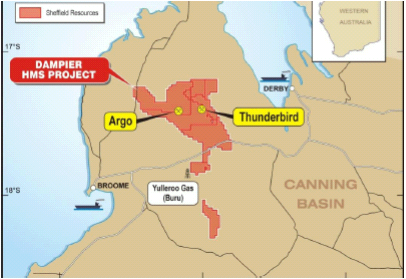
THE BOURSE WHISPERER: Sheffield Resources (ASX: SFX) has received results from a review of the quality of planned products from the company’s Thunderbird Heavy Mineral Sand deposit located near Derby in the Canning Basin region of Western Australia.


Thunderbird deposit location plan. Source: Company announcement


The review was carried out by mineral sands specialist consultants TZ Minerals International (TZMI) and forms part of a Scoping Study Sheffield currently has underway on Thunderbird.

The Scoping Study is focusing on a coherent high-grade core to the Thunderbird deposit of 517 million tonnes at 10.1 per cent heavy minerals (HM) (Indicated and Inferred) containing 3.6 million tonnes of zircon, 0.8 million tonnes of rutile, 2.2 million tonnes of leucoxene and 15.2 million tonnes of ilmenite (at 7.5 per cent HM cut-off). This zone averages 20 metres thickness.

According to Sheffield TZMI’s Product Assessment has taken into consideration the specifications and scoping level volumes of Thunderbird products, in comparison with other competing products in the marketplace, while assessing likely target markets.

TZMI’s work follows development of processing flowsheets based on metallurgical testwork, and analysis of final products of zircon, primary and secondary ilmenite, rutile and high-titanium leucoxene. This work was conducted by consultants Robbins Metallurgical of Brisbane.

“TZMI’s confirmation of the marketability of the Thunderbird products is another key step for the Thunderbird deposit,” Sheffield Resources managing director Bruce McQuitty said in the company’s announcement to the Australian Securities Exchange.

“Thunderbird is one of the largest and highest grade mineral sands deposits to be discovered in the last decade and zircon and ilmenite are expected to be the most important products by value and volume, respectively.

“This confirmation by a leading mineral sands specialist consultant that the Thunderbird products will achieve wide acceptance in the broadest market sectors is extremely pleasing, and further underpins our confidence in the project.”

Sheffield indicated the Thunderbird Scoping Study to be progressing well.

The company said it would now be extended to incorporate a resource upgrade, aimed at increasing the component of the mineral resource in the Indicated category.

The Study is expected to be completed post the anticipated resource upgrade, which is scheduled for Q4 2013.

Sheffield did, however, explain that it is uncertain if further exploration will result in an increase in Indicated Resources.

The company’s current 2013 drilling program comprises infill and extension drilling at Thunderbird and an initial test of the Argo deposit, located 12 kilometres to the west.

A 15 tonne sample will be composited from the Thunderbird infill drilling for further enhancing metallurgical testwork and to obtain products for market soundings.

Level two environmental survey work to support the environmental approvals process is also in progress.

Horseshoe Metals blazes rediscovery trail

To paraphrase the great American writer Mark Twain, ‘the reports of the demise of the Australian junior exploration sector have been greatly overstated’.

There may be some substance to the tales of woe and misfortune perpetuated by the mainstream media in order to sell tomorrow’s fish and chip wrappers, however, there are also plenty of good companies going around with equally good stories to tell.

Perth-based copper-focused Horseshoe Metals (ASX: HOR) announced Resource statements on its two Western Australian projects earlier this year.

The Horseshoe Lights copper-gold project is located 75 kilometres from Sandfire Resources’ (ASX: SFR) DeGrussa copper-gold mine, while the Kumarina copper project lies in the Peak Hill Mineral Field.

The maiden Mineral Resource estimation for the Kumarina project was completed on the Rinaldi prospect and came in at 835,000 tonnes at 1.3 per cent copper for 10,600 tonnes of contained copper, using a cut-off grade of 0.5 per cent copper.

The new total Measured, Indicated and Inferred Mineral Resource estimation for Horseshoe Lights is 12.85 million tonnes at 1 per cent copper and 0.1 grams per tonne gold for 128,600 tonnes of copper and 36,000 ounces of gold using a cut-off grade of 0.5 per cent copper.

This delivered a 40 per cent increase in copper metal content over the company’s 2011 Mineral Resource estimation.

Importantly, more than 30 per cent of the new Horseshoe Lights Resource estimate is now in the Measured and Indicated categories.

Combining the two Mineral Resources gives the company an overall copper metal inventory of 148,000 tonnes copper.

“Horseshoe Lights surprised us as the Resource estimate came out higher than what we were expecting, which is good because we always try to temper our expectations, so when the numbers came out we were very pleased,” Horseshoe Metals managing director Neil Marston told The Resources Roadhouse.

“It is shaping up really well and there are some obvious targets emerging for us to drill test in the next phase.”

Most of the company’s focus to date at Horseshoe Lights has been on the northern and western sides of the historically-mined open pit.


It has carried out limited drilling on the southeast shear zone, which has yet to encounter mineralisation; however Marston said that was mainly due to the fact it has yet to be fully tested.

“We do want to conduct additional exploration there as we have had some interesting indications in that area,” Marston said.

“The geology looks right but has never been drill tested. Our geophysics in that area also shows it to be very interesting and worth a good look.”

Horseshoe Metals aim for the project is to bring it to development and although it is yet to conduct a mining study the company has been encouraged by the results of the recent Resource Estimate.

“We expect we need to add a few more tonnes to the model to make it fly,” Marston explained.

“Where we hope to achieve those tonnes is from an area that has never been adequately drill tested, which is most likely due to its location in the footwall.

“That is on the east side of the pit, where we haven’t done any drilling at all.”

Limited historic drilling carried out into the footwall zone during the 90s, when the mine was still operating, hit mineralisation on the east side of the pit, at depth.

“The mineralisation daylights on the east wall and channel sampling conducted back then achieved results showing four per cent copper,” Marston said.

“We want to get in there with a specialised drill rig as it is an area we consider could quickly add tonnes and provide more clarity as to what we have there.”

Even during the heady days of the boom, when companies would run out and drill based primarily on a hunch, Horseshoe Metals was far more circumspect on how and where it spent its exploration dollars.

Different times call for different strategies and provide different opportunities and in the past 12 months, apart from the drilling it has completed, Horseshoe has also entered every piece of historical information it could find into a data base.

The exercise has resulted in some uncanny match ups with soil sampling taken in the 1960s and other drilling that basically confirms the existence of a copper anomaly on the eastern side of the open pit.

It has also identified enough targets on the eastern side to justify a measured program of drilling to ascertain whether there are any indications that warrant further investigation.

The company is also reviewing drilling pulps from the 80s and 90s, amongst which it has located a program of RAB drilling conducted a few hundred metres south of the pit.

“We did have collar locations but no assay results, but now we have located boxes of the pulps on site,” Marston said.

“Our geologist has commenced XRF analyses of those pulps, which won’t be definitive but the XRF is a great exploration tool that should provide an indicator as to the worth of the historic drilling pulps.

“There is quite a bit of work for us to do at Horseshoe Lights before we get to the point where we get into detailed feasibility studies, but it is a project we consider merits perseverance over the next 12 months.”


A chance discovery of three abandoned mine shafts on the Kumarina project has provided extra incentive for the company to step up its activities there.

The shafts were discovered during a recent soil sampling program and have sparked Horseshoe’s curiosity due to similarities to the scale of work carried out on old workings found at Rinaldi.

From what Horseshoe Metals has seen so far it is obvious the prospectors who dug these shafts put in some effort to do so.

The shafts go to around 10 to 15 metres in depth with two situated close together and the third along strike some 340 metres away.

Horseshoe recently ran its XRF machine over rock samples at the finds, with some encouraging readings of copper in veins.

The company believes this indicates that the former prospectors were obviously digging for good reason.

“When we look at where the shafts lie, we see they are situated along a definite structure, two on the eastern side into the footwall contact, and the other on the western side into the hanging wall contact.” Marston said.

“The exciting aspect of the structure is that it is an interpreted dolerite intrusive that shows up very clearly on the magnetic surveys.”

The company retrieved chalcocite and malachite samples from around the workings, which are very similar to what is found around the workings of the Kumarina copper mine.

There is also some evidence of copper running through the walls of the shafts, which demonstrate the prospectors were working on a vein system.

“There has never been any drilling here. Not a drill hole in sight,” Marston said.

“So we intend designing a drilling program, and gain clearance for drilling as part of our heritage survey work coming up in September.”

Horseshoe Metals Limited (ASX: HOR)
…The Short Story

HEAD OFFICE
Unit 6 11 Colin Grove
West Perth WA 6005

Ph: +61 8 9481 5866
Fax: +61 8 9481 5966

Email: info@horseshoemetals.com.au  
Web: www.horseshoemetals.com.au

DIRECTORS
Jeremy Shervington, Neil Marston, Michael Fotios, Stuart Hall

MAJOR SHAREHOLDERS
Investmet Limited (and associates)    17.90%
Wyllie Group Pty Limited              4.77%
Azure Capital Investments Pty Ltd      4.27%

SHARES ON ISSUE
83.8 million

MARKET CAPITALISATION
$6.6 million (at 1/8/13)

What the Brokers Say

Interesting news and views from across the Resource Analyst universe.

Wolf Minerals (ASX: WLF, AIM: WLFE)

Wolf Minerals has secured finance and development of the Hemerdon Ball tungsten-tin mine is now underway.

GR Engineering Services has been awarded the fixed term, fixed price contract which should see the 3Mtpa processing plant ‘production ready’ within 24 months.

Wolf Minerals continues to make steady progress towards the redevelopment of the world class Hemerdon Ball tungsten and tin project.

The company has now secured a $212 million funding package and has engaged GR Engineering Services to commence development of a 3 million tonnes per annum processing plant, plus associated infrastructure.

The plant will be delivered as a fixed term (24 months), fixed price (£75 million) contract with first production scheduled for mid-2015.

The $139 million (£85 million) mining contract was also recently awarded to CA Blackwell who are expected to commence pre-strip and mine development by March 2014.

Hemerdon hosts a JORC resource of 401 million tonnes at 0.13 per cent tungsten and 0.02 per cent tin, placing it as the fourth largest (known) tungsten deposit in the world.

A Definitive Feasibility Study (DFS), completed in May 2011, indicated robust economics based on a 3 million tonnes per annum operation over a 9.25 year life of mine.

Production is estimated at approx. 350,000 metric tonne units (mtu) per annum of a 65 per cent tungsten concentrate and a further approx. 450tpa of tin in concentrate at C1 costs of US$105/mtu (after tin credits) versus the current APT price of US$417/mtu.

The current mining Reserves of 26.7 million tonnes at 0.19 per cent tungsten and 0.03 per cent tin are bound only by the constraints of the open pit limits as per the parameters of the granted ‘Planning Permission’.

Significant opportunity exists to extend the mine life should approval for a larger open pit be sought in due course.

Papillon Mining (ASX: PIR)

A world class asset where the gold mid-tiers play
The Fekola project’s 4.21 million ounce resource at 2.38 grams per tonne meets the American Geosciences Institute’s definition of a world class gold deposit (i.e. greater than 3.2 million ounces).

Fekola has a 10 to 12 kilometre strike length in a 25km corridor with thick mineralisation open along strike and at depth.

Papillon has 1,460 square kilometres of tenements within the Birimian gold belt in SW Mali bordering Senegal.

Whilst gold grade of around 2 to 3g/t has been discovered to date recent drill results have shown potential of 4g/t at 75 metres.

The project has ready access to water and is within proximity to established infrastructure (i.e. 50km south of the Millenium Highway with Dakar 700km to the west and Mali’s capital, Bamako, 400km to the east).

Conventional mining and processing
The Fekola project purports to be delivered cost effectively via an open pit mining and conventional gravity gold-CIL processing method.

The PFS supports production of over 300,000 ounces per annum at low C1 cash costs of US$580 per ounce (all-in sustaining costs of US$725/oz) and an initial mine life of 9 years.

Leading with relevant West African experience
Mark Connolly (CEO) has experience in building and operating an initial 100,000 ounce mine in Ghana for Adamus Resources as its CEO, and later as group COO after its sale to Endeavour Mining in November 2011.

We value Connolly’s prior West African experience given Fekola is a start-up in a relatively high risk country.


Disclaimer: The above is intended as a guide only. The Roadhouse accepts no responsibility for investments made from this advice, successful or otherwise.

Diggers & Dealers kicks off on Monday

Diggers & Dealers kicks off on Monday

CONFERENCE CALLER: Next week the who’s who of the Australian mining industry lands in the Western Australian town of Kalgoorlie for the 21st annual Diggers and Dealers conference.

Preparations for the big event commenced weeks ago when the shell of the conference marquee was erected outside the Goldfields Arts Centre.


Conference organisers anticipate a bumper crowd of around 2000 delegates to be informed, fed, and watered within the confines of the marquee over three days and nights, which culminate in what is on record as being the largest sit down dinner to be held in the southern hemisphere.

Of much interest will be this year’s keynote address, which will be presented on the opening morning by Austan Goolsbee, former chief economic advisor to President Obama.

Goolsbee will be followed by a procession of just under 50 company presentations over the duration.

Last year the conference awoke to the news of Silver Lake Resources’ takeover of Integra Resources.

Market conditions this year has raised the expectation of many similar announcements or deals done as delegates sit down together in the nooks and crannies of Kalgoorlie’s many fine establishments.

Political parties need to consider investment incentives

IN THE LOBBY: Western Australia’s mineral and petroleum exploration continued its downward trajectory in the June 2013 quarter, according to the Chamber of Minerals and Energy of Western Australia (CME).

The lobby group outlined the decline it is latest edition of the WA Resources and Economics Report, prepared in conjunction with KPMG.

“While the decline over three quarters in exploration expenditure is likely due to the weak commodity price and high cost environment, every effort should be made to arrest this decline,” CME acting chief executive Nicole Roocke said.

CME is one of many mining groups that has been calling for incentives similar to the Canadian flow-through share scheme, which was part of Prime Minister Kevin Rudd’s original election platform in 2007.

The promise was welcomed at the time after the sector had struggled to receive any joy from previous governments.

CME said it time such a minerals exploration tax credit system was introduced to boost the flagging exploration sector.

“To establish a future pipeline of projects we rely upon increasing the current level of exploration activity here in Western Australia,” Roocke said.

The call for such a scheme has been something of a personal crusade of the Association of Mining and Exploration Companies chief executive Simon Bennison.

AMEC claims research undertaken by the University of Western Australia in 2012 showed that not only were mineral discoveries reducing, they were also getting deeper and harder to find.

Another concerning statistic raised by the study is the loss of equity investment to competitive offshore projects.

It also found that the national mineral inventory is gradually being depleted and the mining industry is becoming unsustainable in the long run.

“The research highlighted that about half of Australia’s non-bulk commodities mines would be exhausted in between seven and 18 years,” Bennison said.

“As it takes, on average, seven years to convert a discovery into an operating mine these trends are alarming.

“There is a desperate need to discover the mines of tomorrow to ensure that future revenue streams from base metals do not dry up.”

The CME report said total mineral and petroleum exploration for the recently-completed quarter declined by 22 per cent to $1.14 billion from the previous quarter.

This followed a four per cent drop in the December quarter, and a drop in total mineral exploration expenditure another 10 per cent in the March quarter to $422 million.

The latest result is the third consecutive quarter mineral exploration has declined.

Compared to the corresponding quarter a year ago, mineral exploration is now 14 per cent lower.

“Notwithstanding the transition underway in many major projects from construction to operational phase the future pipeline of projects relies upon increasing the current level of exploration activity here in Western Australia,” Roocke said.

CME said the issue is one will most likely become one of the key election policies affecting the resources sector leading into the federal election.

AMEC’s proposed solution is a reform initiative it calls the Mineral Exploration Tax Credit (METC) that will allow current eligible losses to be passed back to their Australian share owner in the form of a tax credit through the well-known franking system.

“The METC will stimulate the greenfield exploration sector, which has not seen an increase in actual metres drilled for over a decade, despite one of the strongest periods of growth in the Australian mining industry,” Bennison explained.

“Companies with income from mining activities will be ineligible.

“It will also increase the rate of discovery and lead to the mines of tomorrow and provide future revenue streams for governments.”

Bennison claims the METC system will be a win:win for Australian investors, Australian exploration companies, Australian communities and Australian governments at all levels through additional corporate and personal tax, royalties, state taxes, fees and levies.

He suggested it would also stimulate the Australian economy and ultimately contribute to a reduction of the national debt.

A report on the METC proposal by KPMG, which was commissioned by AMEC, found that a multiplier factor of two (2) in additional exploration activity would conservatively result in:

–    Potential to provide a positive annual tax revenue stream to Government of up to $283 million;

–    Up to 4,356 additional jobs across the whole mining sector;

–    Contributing an additional $2.2 billion in GDP across the mining sector; and

–    With a proposed commencement date of January 2015, the government investments would be around $50 million in 2016/17, $101 million in 2017/18 and $133 million in 2018/19.

“The challenge is for the political parties to have the vision now to create investment strategies and catalysts that are 10-15 years from when these revenue streams are fully achievable,” Bennison said.

“Jobs and other social and economic benefits are achievable in the short term.

“It is essential that all political parties remove any perceptions about the current mining industry, and think about the development of mines for the benefit of future generations.

“The METC will provide one policy solution that will help address the several declining trends in mineral exploration already identified by the University of Western Australia, assist in discovering the mines of tomorrow and contribute to future revenue streams.

“The time is to act now by amending tax laws which will free up tax losses already owned by investors, which can then translate into the mines of tomorrow.”

What the Brokers Say

WHAT THE BROKERS SAY: Interesting news and views from across the Resource Analyst universe.

Auroch Minerals (ASX: AOU)

Auroch Minerals has now bedded down the acquisition of the 3 million ounce Manica gold project and is steadily advancing towards its first production target of early 2015.

A recently completed scoping study indicates attractive economics centred around initially mining the non-refractory and transition zones of the deposit to produce approx. 40,000 ounces of gold per annum.

 The Manica gold project is an advanced gold exploration play with an established JORC Resource of approx. 50 million tonnes at 1.83 grams per tonne gold for approx. 3 million ounces of gold at three deposits with mineralisation reported to be open at depth and along strike.

Approx. 85 per cent of the resource is hosted within sulphide ore zones (refractory) while the remaining approx. 15 per cent of the resource is hosted within free milling, transitional or oxide ore zones (non-refractory).

The 42 square kilometre granted mining licence is valid for 25 years and is well serviced by existing infrastructure such as telecommunications, local airport, roads, rail, power and water.

Auroch Minerals recently completed a Scoping Study assessing the technical economic viability of initially mining and processing the non-refractory and transitional component of the resource (approx. 5 million tonnes at 2.23g/t for 380,000 ounces of gold).

The Scoping Study indicates robust economics based on a 720,000 tonnes per annum plant processing ore at an average head grade of 2.23g/t gold for approx. 40,000 ounces per annum.

Cash operating costs have been estimated at approx. US$643 per ounce (excluding CAPEX and before tax, depreciation and royalties) against a current gold price approx. US$1,220.

The company is now set to embark on a Definitive Feasibility Study and is targeting first production as early as Q1 2015.

Red Mountain Mining (ASX: RMX)

Established resources with immediate high grade upside.

While the appetite for speculative investment has waned over the past 12 months, Red Mountain Mining (RMX) possesses many of the key ingredients for a highly-leveraged investment.

The company’s Batangas gold project is located in a prospective region of the Philippines and will be the developmental focus for RMX going forward.

The project has a current JORC resource of 5.8 million tonnes at 2.2 grams per tonne gold for 408,000 ounces of gold and with a number of high grade, near-surface targets identified, the potential to grow the resources base is high.

With the market currently attributing little value towards the company’s asset portfolio we see potential upside for risk tolerant investors.

Batangas – a number of high grade targets.
Considering the modest drilling budget, we see it as prudent that RMX drill its highest grade targets in an effort to garner new shareholder enthusiasm about the story.

The Lobo project (194,000 tonnes at 7.2g/t for 45,000 ounces of gold) offers a number of extensional and parallel drilling targets that look highly prospective.

We expect the next phase of drilling to target the Pica and Japanese Tunnel prospects that collectively possess an Exploration Target of 45 to 120,000 ounces of gold equivalent.

Archangel could be the base load.
With a current resource of 5.5 million tonnes at 2g/t for 363,000 ounces of gold the Archangel project is a larger scale development opportunity.

In the near term, RMX is aiming to complete a scoping study demonstrating the Bantangas project as a viable development proposition.

Conceptually we envisage Archangel serving as the base load ore supply topped up with higher grades from Lobo.

Philippines a solid jurisdiction to operate.
The Philippines has a well-established history of mining and is governed under a US based democracy.

The country was recently upgraded to investment grade by Standard and Poors from BBB- to BB+ which will make future financing of development projects more competitive.

Pending outcomes of the Executive Order 79 will likely increase royalty rates but should also improve the regulation and sustainability of mining in the country.

Funded – for now.
The recent rights issue has seen RMX’s cash balance increase to approx. $1 million, which is enough to fund a modest drilling campaign and potentially a scoping study.

We believe securing additional funding is the biggest challenge facing the company in the near term.

Alternative routes to further equity placement include selling down at the project level or a JV, either of which may be favourable outcomes for RMX.

Cheap on an EV/Resource metric.
With a 408,000 ounce JORC resource RMX is trading on an EV/Resource of $3.70 per ounce compared to a peer average of $25 per ounce.

Catalysts.
1) Successful upcoming drilling campaign.
2) Resource upgrades at Lobo.
3) Scoping study outcomes.
4) Clarity on future funding.


Disclaimer: The above is intended as a guide only. The Roadhouse accepts no responsibility for investments made from this advice, successful or otherwise.

Papillon Resources encounters further Fekola mineralisation

THE DRILL SERGEANT: Papillon Resources (ASX: PIR) has released the results of a further 102 holes from drilling completed at the company’s Fekola gold project, located in south western Mali, on the border with Senegal.


Fekola project – location map. Source: Company announcement


Papillon said the results have continued to highlight extensions of mineralisation outside of the project’s current Mineral Resource Estimate, which comprises 54.97 million tonnes averaging 2.38 grams per tonne gold for a contained 4.21 million ounces of gold at a lower cut-off grade of 1g/t gold.

Re-entry and extension of previously-drilled holes intersected extensive mineralisation including:

–    75 metres at 4.66g/t gold; and

–    18 metres at 2.81g/t gold.

Shallow, high grade mineralisation intersected along strike to the north of the current MRE area included:

–    4m at 12.34g/t gold; and

–    7m at 5.68g/t gold.

“The results are, once again, outstanding in terms of thickness and grade,” Papillon Resources managing director and CEO Mark Connelly said in the company’s announcement to the Australian Securities Exchange.

“Perhaps the most important aspect of the extended holes, from a mining perspective, is that the new observed data points of thick high-grade intercepts will provide additional information to the resource model in an area that was previously considered to be low-grade or barren.

“The thickness and grade of these intercepts again highlight the significant exploration upside at Fekola and further drilling has the potential to continue to deliver quality ounces for the project.”

Papillon Resources explained the results represented approximately 17,000m of diamond and RC drilling targeting down dip extensions of the Fekola deposit, as well as near surface mineralisation along strike to the north and south of the MRE area.

The results include drilling of six extension holes, which had previously been drilled and intersected zones of mineralisation but did not intersect the expected high grade shoot.

Following reinterpretation of the six holes Papillon considered them to demonstrate potential for a high-grade zone deeper than the end point of previously drilling.

The company decided to re-enter and conduct extension drilling on them and the re-drilling campaign encountered broad zones of high-grade mineralisation.

Shallow RC drilling carried out along strike to the north of the MRE also delivered encouraging results with zones of high-grade mineralisation encountered in the near surface lithology, including 4m at 12.34g/t gold, and 7m at 5.68g/t gold.

EMA eager to move Mulga Rock project into development phase

THE CONFERENCE CALLER: Energy and Minerals Australia (ASX: EMA) chief executive officer Julian Tapp told the Australian Uranium Conference that his company’s recent change of its management structure was a deliberate move.

The move, he said, was to allow the company to focus on moving its Mulga Rock uranium project into development.

“This is a fabulous deposit,” Tapp told the auditorium.

“It is big enough to justify a standalone development; it’s big enough, and will have a long enough life, to be of interest to strategic off-take partners.

“We are targeting a $40 per pound cost of concentrate, which we think is achievable, and it has very good economics.

“At assumed $70 per pound the NPV with a ten per cent discounts rate it is over $330 million.

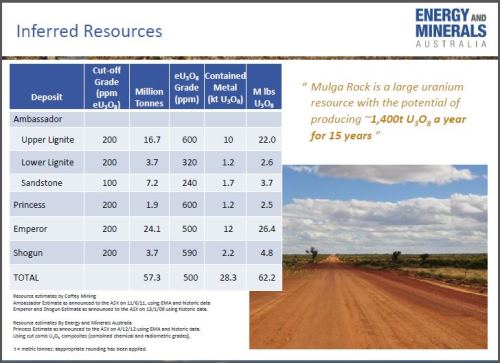
The Mulga Rock project has an Infrerred Resource of 28,300 tonnes uranium (approx. 62.2 million pounds) at 500 parts per million uranium.

The project is capable of producing approx. 1,400 tonnes of uranium per annum for 15 years.


Source: Company presentation

Tapp said although he was unable to say exactly when it may happen, he anticipated the uranium market would improve.

“For those that want to take advantage of that spike in price, now is the time when you have to be investing and moving the project forward, and that is what we are intending to do.”

When arrived at EMA, Tapp said he did so providing he could get the ball rolling to move the Mulga Rock project into production by 2016.

In order to achieve that goal the company has determined a decision to be reached on final investment by 2015.

“That has involved focusing on the existing asset,” Tapp said.

“There is a new deposit that was found, called Princess, the Princess and Ambassador deposits have an Inferred Resource of around 30.8 million pounds between them, which is certainly enough to sustain the first seven years of mining.

“That’s what the emphasis is now going to be on; focusing on that as the front end of mining – doing the testwork on that and getting that ready for it to go into production.”

EMA does have other deposits at Shogun and at Emperor, which have a combined Inferred Resource of approx. 31.2 million pounds, which the company considers could sustain some eight years of mining.

Tapp explained that at this stage these deposits are considered to be more the tail end of the project.