What the Brokers Say

WHAT THE BROKERS SAY: Interesting news and views from across the Resource Analyst universe.


Great Western Exploration (ASX: GTE)

Great Western Exploration recently executed a 50:50 Joint Venture agreement with Kazakhstan’s state owned mining company Tau-Ken Samruk (TKS).

This Joint Venture paves the way for a period of active exploration in a highly prospective, previously explored region.

The Joint Venture encompasses the 12,500 square kilometre Spasskaya project which hosts 120 historical copper prospects.

In the 1970’s, the Soviets conducted extensive, albeit incomplete, exploration on eight ‘high-priority’ sites.

Wide zones of ore grade and predominantly oxide mineralisation were intersected at all eight locations with widespread outcropping mineralisation evident at four locations.

Based on historical exploration results, just these eight projects have an exploration target of between 69 to 173 million tonnes grading approx. 1.10 per cent copper for approx. 750,000 tonnes and 2 million tonnes of contained copper.

Under the terms of the JV agreement, Great Western will earn its 50 per cent interest by sole funding the exploration phase and 50 per cent of the Bankable Feasibility Study.

Great Western has commenced a 2,500m maiden drill program aimed at testing the reliability of the historical Soviet exploration data.

Should the historical work be deemed reliable, resource definition drilling campaigns will then commence.

Great Western also has a quality portfolio of early stage, Australian based, exploration projects including the newly formed JV with Xstrata Glencore.

This JV incorporates the Cunyu project with Great Western’s existing Doolgunna project, creating a prospective tenement package of approx. 3,300sqkm.

Recommendation: Speculative BUY


Corazon Mining (ASX: CZN)

Top Up Rise – Copper Mineralisation Intersected

Corazon Mining Limited has intersected copper sulphide mineralisation (chalcopyrite) in the first diamond hole drilled into the Top Up Rise (TUR) gravity anomaly, Gibson Desert, Western Australia.

The copper exists in form of disseminated sulphide blebs over a drill interval from approx. 229m to 275m (approx. 46m).

The presence of copper mineralisation is potentially significant given the drill hole is located on the margin of the primary target (main part of the gravity anomaly).

However, the copper mineralisation intersected (to date) makes up less than 1 per cent of the overall rock mass (visual estimate), which implies generally low grade mineralisation.

The mineralisation is hosted in highly altered and deformed rocks (potentially mafic sediments) or volcanic origin.

The gravity anomaly (high) is still yet to be explained and more priority targets are now being drill-tested.

On current timing we would expect assays in late July 2013.

Large Gravity Anomaly Still Yet to be Explained

Corazon has an option to earn up to 75 per cent interest in the TUR project.

The project covers a large amplitude gravity anomaly (TUR anomaly) which has the characteristics of an iron oxide copper gold (IOCG) system, covering an area of 10 kilometres by 6 kilometres.

When comparing the TUR gravity anomaly to the gravity anomaly over Olympic Dam (IOCG deposit) it has similar size dimensions but TUR has a higher residual gravity response.

Due to the physical size of the TUR anomaly we are certainly encouraged by the reports of copper mineralisation so early into the exploration drilling program.

We remain hopeful that higher grade mineralisation will be encountered as higher priority targets within the gravity anomaly continue to be systematically tested.

Priority One Target now Being Drill-Tested

The drill information collected by Corazon will be used to reprioritise and adjust target ranking and drill hole positions as the program progresses.

The rocks intersected (to date) have not explained the gravity anomaly, but significant alteration and sulphide mineralisation (minor copper) within the bedrock is promising for more mineralisation to come.

Corazon is now drilling a diamond hole to test a ‘priority one’ target located some 3km to the southeast of the first completed diamond hole.

The target depth of the anomaly is interpreted to be closer to surface than the completed hole and RC drilling has now been completed to a depth of approx. 283m and a diamond tail is planned to be drilled to a depth of approx. 350m.

Cheap Option on Potentially Significant Upside

The TUR project is a highly speculative ‘greenfield’ play that could have massive upside.

The intersection of copper mineralisation, so early into the first-pass drilling program is a great result, though at this stage we would expect only low copper grades to be reported.

It is ‘proof of concept’ that mineralisation (copper) is present within the system.

The company is funded for the current drilling campaign.

With drilling ongoing to explain the gravity high, we continue to recommend Corazon as a Speculative Buy.

Disclaimer: The Roadhouse holds shares in Corazon Mining



Ascot Resources (ASX: AZQ)

Ascot Resources is an ASX-listed, Colombia-focused coking coal developer.

The company’s flagship asset is the Titiribi coal project in western Colombia.

Ascot Resources has completed a first phase drilling program at Titiribi; this returned some encouraging coal quality data that indicates coking coal at the project.

Preliminary results indicate that a semi-soft, high volatile coking coal could be mined at Titiribi.

The coal is likely to be relatively high in sulphur (although this is likely to be confined to certain seams), but exceptionally low in phosphorous; the latter quality is likely to be desirable to customers.

Drilling intersected some 25 coal seams with thicknesses varying from 0.3m to 13m.

Coal is reported to show good continuity across the project, with three seams (the thickest at 5m) likely to form the bulk of any future resources.

The seams are steeply dipping and likely to produce a profitable 250,000 to 750,000 tonnes per annum.

The project is located close to a sealed highway that is linked to both Atlantic and Pacific ports.

The coal is likely to be in demand in Brazil and/or Peru as well as domestically.

Management has done this before: MD Andrew Caruso and project director John Malysa have experience in mining steeply dipping coal seams.

Titiribi looks set to be a low capital project in a region with few barriers to entry in the junior coal space.

Ascot does not plan to wash the coal and this has resulted in relatively low capex.

Anticipated margins are expected to provide a healthy operating profit.

Titiribi is likely just a foothold in the country, with Ascot having plans to grow through future acquisitions in Colombia.

We see Colombia as a good mining investment environment.

The country is the fourth largest coal producer globally, and was recently ranked the seventh most attractive country in the world for mining investment.

Recommendation — SPECULATIVE BUY


Disclaimer: The above is intended as a guide only. The Roadhouse accepts no responsibility for investments made from this advice, successful or otherwise.
Avalon Minerals increases D Zone Resource by 30Mt

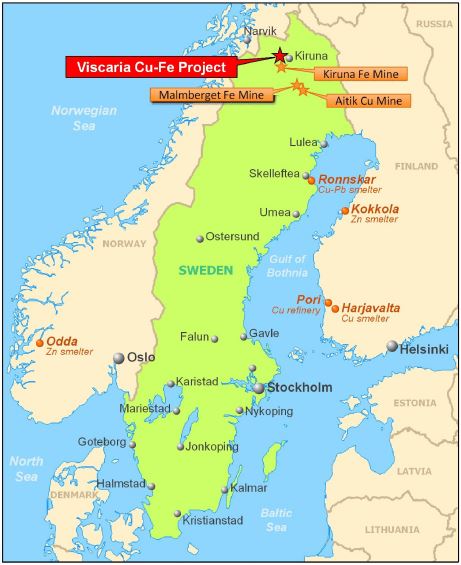
THE DRILL SERGEANT: Avalon Minerals (ASX: AVI) has announced a Mineral Resource estimate upgrade at the D Zone prospect, located on the company’s Viscaria project in northern Sweden.


Project location. Source: Company announcement


The company explained the resource upgrade follows a recently-completed 2012-2013 northern hemisphere winter extensional drill program where 43 drill holes were completed at the D Zone prospect.

Avalon has reported the D Zone Mineral Resource in terms of both iron and copper Mineral Resources separately to meet the guidelines of the JORC code.

Incorporating drilling information from the 2012-2013 winter extensional drill program as well as historical data deemed suitable for estimation, Avalon has reported the new Mineral Resources for the D Zone prospect as:

13.6 million tonnes at 1 per cent copper above a 0.4 per cent copper cut-off grade, and is classified as being 5.1 million tonnes at 1.07 per cent copper Indicated and 8.5 million tonnes at 0.96 per cent copper Inferred; and

25.6 million tonnes at 26.4 per cent iron at a cut-off above a 15 per cent iron Mass Recovery grade, and is classified as 11.7 million tonnes at 27.5 per cent iron Indicated and 13.9 million tonnes at 25.7 per cent iron Inferred.

“One of our major objectives for the extensional drilling at D Zone was to add 45,000 tonnes of copper to the Mineral Resource, so it is extremely pleasing to be able to announce that we have added 88,000 tonnes of copper, an increase of 183 per cent,” Avalon Minerals managing director Jeremy Read said in the company’s announcement to the Australian Securities Exchange.

“The copper Mineral Resource has increased by 152 per cent to 13.6 million tonnes at one per cent copper, which is further bolstered by the fact that the copper grade has also increased by 11 per cent.

“When the copper and iron Mineral Resources are combined, the overall Mineral Resource at D Zone has almost doubled from 15.5 million tonnes to 30 million tonnes.

“Importantly, at a 0.8 per cent copper cut-off, the copper Mineral Resource has grown from 2 to 7.6 million tonnes at 1.4 per cent copper, an increase of 280 per cent, which has strengthened the possibility of mining sections of D Zone via underground methods.

“This increase in high-grade copper resource indicates our drill program was very successful in preferentially adding higher grade tonnes of copper mineralisation.

“The indication that the D Zone copper-iron mineralisation has the potential to be mined underground and is still open at depth and along strike to the southwest, should further strengthen the project’s economics.”

Breakaway Resources advancing Cloncurry portfolio

THE CONFERENCE CALLER: Breakaway Resources (ASX: BRW) managing director Victor Rajasooriar used his presentation at the 2013 Australian Copper Conference to tell the audience how the company is advancing the discovery and development of high-quality standalone mineral deposits within the Cloncurry Mineral District of North West Queensland.
 

The bulk of the company’s current exploration activities are centred on its 100 per cent-owned Eloise exploration project where recent exploration activities have identified a copper – gold system at the Sandy Creek prospect and a pipeline of additional priority drill targets throughout the surrounding project area.

Source: Company presentation


The Eloise exploration project is a 510 square kilometre landholding, located in the Cloncurry District of Queensland.

Breakaway completed a diamond drilling program at Sandy Creek in November 2012, and subsequently reported an updated Mineral Resource estimate for the deposit in February this year.

This updated Inferred Resource comprises 2 million tonnes grading 1.32 per cent copper and 0.3 grams per tonne gold for 26,400 tonnes of contained copper and 21,400 ounces of contained gold.

“The Eloise exploration area is in a very well-endowed mineral district,” Rajasooriar told the conference.

“In the first six months of this year we have had some success, even though we are a junior with very little cash, we carried out some reasonable programs

“We did a ground based EM program at Eloise, which identified two new targets straight away, and these were very strong conductors.

“At the same time we conducted some heritage surveys, which included the new targets at our Sandy Creek deposit that we are planning to grow in to bigger results, so we have cleared that area for the next drilling program.”

Other strings to the Breakaway bow include a strategic partnership with Sandfire Resources over the Broader Altia project JV, located 70km south-east of Cloncurry in north-west Queensland, which Rajasooriar said provides the company with value for the Altia deposit.

Under the terms of the partnership agreement Sandfire is required to spend $4 million to earn a 60 per cent interest in the project over three years, followed by an option to spend an additional $4 million to earn a further 20 per cent.

Exploration activities already conducted at the Broader Altia JV has identified a number of targets, including Boralis, Capricorn, Coral Reef and Altia West.

Heritage surveys have been completed and drill pads ready for drilling scheduled to commence in July 2013.

The project has an Inferred Resource of 5.8 million tonnes at 4 per cent lead, 0.5 per cent zinc and 40g/t silver for 229,000 tonnes of lead, 29,000 tonnes of zinc and 7.5 million ounces of silver.

In other work Breakaway has completed some soil geochemistry at the Leinster gold project in Western Australia, which identified a number of drill-ready targets the company is planning to drill in the September quarter.

In what is currently, a very tight market, Breakaway was also able to sell the Scotia tenements north of Kalgoorlie to Minotaur Exploration (ASX: MEP) for $600,000.

“The Scotia tenement is prospective for gold,” Rajasooriar said.

“We owned the tenements but we only had 20 per cent of the gold rights – and that is what we are selling to Minotaur Exploration.”

Still in WA Breakaway has been able renegotiate some pre-emptive and claw-back rights involved with Norilsk Nickel.

“We have dissolved those clauses and have exchanged them for a 2.5 per cent Net Smelter Return.

“What that does now is it gives us more opportunities to go and do something with our nickel tenements in Leinster.

“We are also pursuing other opportunities for our non-core assets.

“Some of these are being sold at the moment and we are looking for other options with our Leinster and West Kambalda nickel assets as well.”

Antofagasta Minerals setting the standard for major behaviour

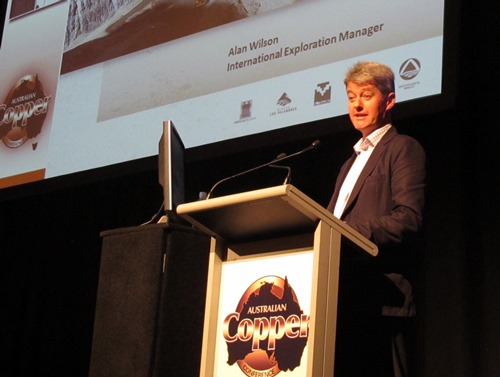
THE CONFERENCE CALLER: The 2013 Australian Copper Conference was treated to a presentation by Dr Alan Wilson, international exploration manager of UK-listed, Chilean-based major copper mining entity Antofagasta Minerals.

Antofagasta has become a name synonymous with cooper and the company currently operates four copper mines in Chile with one more currently in development.

The company has developed a high international profile since it kicked off its strategy of partnering companies overseas in 2009 and now boasts around 30 exploration projects located in 12 countries spanning five continents.


Dr Alan Wilson


“One thing I have noticed here in Australia is the market and companies are generally aware of what we are doing in Australia, but many people have never heard of Antofagasta,” Wilson told the conference.

“We are very open about where we operate and what we look for. We are porphyry geologists – that’s our background in Chile – we’re not really that fussed, as long as the project has copper.”

Wilson explained that although Antofagasta was on the lookout for copper projects in the classic copper belts of the world, it is also prepared to take a serious look at projects that may be in new and emerging copper belts.

“We have minimal geographical restrictions in terms of where we go – so we have five regions and we are active in all of those regions,” he said.

“We do specifically target junior or mid-tier companies that have high-quality, early-stage exploration projects that we see upside potential.

“We have also partnered with a number of junior companies that have attractive landholdings for the right exploration teams in the right jurisdictions to be able to go out and basically go out and perform exploration on our behalf, so we form exploration alliances.”

The Antofagasta model is innovative and one that many of its major contemporaries would be well-advised to look at when dealing with junior and mid-cap companies.

Instead of marching in and taking over a company, Antofagasta is more comfortable working with the company to ensure it, and its shareholders, receive the maximum benefit of its participation.

“What we have not done, and what we won’t do as part of our strategy, is that we are not interested in setting up large regional offices with a lot of infrastructure and overheads,” Wilson said.

“We would rather leverage from junior companies and make sure the money goes in the ground – drill lots of holes and hopefully find something.”

The Antofagasta strategy has divided the world into five regions – North and South America, Africa, Europe, Central Asia and Australasia.

In each of those regions there are two people – a regional exploration manager and a chief geologist.

Those ten people are supported by a small team from Santiago with senior management providing support from Toronto and now from Wilson, who has set up shop in Brisbane.

“There is senior support around the world, but basically five regional managers and five chief geologists,” Wilson said.

“These guys are empowered to get out and review projects under confidentiality agreements…and come back with recommendations.

“Then if it [prospective project] meets all the technical benchmarks and the benchmarks of the commercial terms of agreement – there’s a very streamlined approvals process in place in Santiago.”

The company’s benchmarks involve its threshold in terms of the minimum size of a project with a resource of one million tonnes of contained copper; a figure Wilson suggested could be achievable in most jurisdictions.

The company’s team of ten people are rarely still, which is exemplified by its achievements during 2012 of signing 112 confidentiality agreements, which led to the review of 182 projects in 34 countries.

However, the high company’s high benchmark meant of those 182 projects reviewed, 12 of them actually were approved.

In Australia Antofagasta has alliances with Monax Mining (ASX: MOX) in South Australia and Sipa Resources (ASX: SRI) in Western Australia.

It also has project-specific farm-ins in place with Diatreme Resources (ASX: DRX) in Queensland and with Encounter Resources (ASX: ENR) for the Yaneena project in the Paterson province of Western Australia.

Antipa Minerals has eyes on development

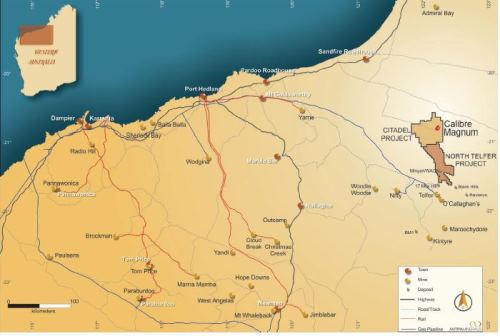
THE CONFERENCE CALLER: Antipa Minerals managing director Roger Mason told the 2013 Australian Copper Conference in Brisbane the company’s Calbre discovery may well have the potential to take the company from being an explorer to a developer.

Antipa Minerals (ASX: AZY) owns the 3,000 square kilometre Citadel exploration project in Western Australia.


Source: Company presentation


It is located 400 kilometres east of Port Hedland and just 20km north of Newcrest’s Telfer gold and copper mine and project stretches for 115km north to south as one continuous package.

“It is interesting just to reflect that if you took that package and placed it over the Eastern Goldfields of WA,” Mason said.

“it would extend from the St Ives goldfield all the way to 30 kilometres north of the Kanowna Belle gold mine, picking up Kambalda Nickel and the Kalgoorlie Super Pit along the way.

“The reason we believe this is important is that it is giving Antipa, statistically, a very strong chance and excellent opportunity to make several significant mineral discoveries in what is a grossly under-explored, world-class mineral province.”

The Citadel project hosts the Magnum Dome mineral camp.

The area is just 30 square kilometres in size, but RC and diamond drilling conducted by Antipa on six prospects, all within one to four kilometres of each other has delivered three mineral deposit discoveries, including Calibre, Magnum and Corker.

The Calibre prospect was Antipa’s second greenfield discovery last year with the first drillhole at the prospect intersecting gold-copper-silver-tungsten mineralisation.

“We have completed just six drill holes at Calibre, all of which intersected semi-continuous mineralisation over, virtually, their entire length – generating intersections between 250 to 450 metres in length,” Mason said.

Highlights of this drilling included:

–    373.3m at 0.67 per cent copper equivalent (CuEq);

–    450m at 0.5 per cent CuEq;

–    87.2m at 1.05 per cent CuEq; and

–    76m at 1.05 per cent CuEq.

So far drilling carried out by Antipa at the Calibre deposit has encountered mineralisation along 200m of strike across a width of up to 400m horizontally and to a depth below surface of 450m.

This mineralisation remains open in all directions, including across strike.

Mason said the Calibre mineralisation has, to date, correlated extremely well with the prospect’s magnetic anomaly, which is 800m long by 600m wide and extends to a depth of over 600m.

“Publicly-available, independent research reports propose that, depending on cut-off grade, the Calibre deposit could host between 50 to 300 million tonnes and 2.5 to 6.3 million gold-equivalent ounces,” Mason said.

“In copper terms, that is half a million tonnes to 1.3 million tonnes of copper equivalent.

Mason said geophysical surveys conducted at Calbibre suggest the deposit may continue to increase with depth.

This is most likely to occur at the 254 metre-long Conductor 4, which is the largest downhole EM anomaly Antipa has identified at either Magnum or Calibre.

With a conductivity three to four times higher than the region investigated by the existing Calibre drillholes, Mason intimated an increase in sulphide mineralisation – and therefore grade – could be expected.

In addition the company has noticed the gold grade at Calibre has been increasing significantly as it moves to the north.

The northern-most drill hole at Calibre generated the company’s best intersection to date and included a bulk intersection across the entire hole of 274 metres at 0.75 per cent copper equivalent.

“Whichever way you look at Calibre it is emerging as a very large, low-grade deposit – potentially amenable to open pit or underground bulk mining methods, with the potential to transform Antipa’s future,” Mason said.

The Antipa exploration team is scheduled to recommence drilling at Calibre next week to with the aim of testing the higher-grade targets and to also provide support to, what the company’s considers to be, large tonnage potential of the deposit.

Adelaide Resources maintains copper focus

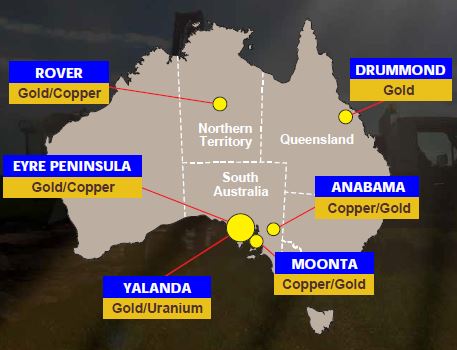
THE CONFERENCE CALLER: Speaking at the 2013 Australian Copper Conference in Brisbane, Adelaide Resources (ASX: ADN) managing director Chris Drown described his company to the audience as an, “explorer with a very tight commodity focus on copper-gold”.

Adelaide Resources has projects located in the Northern Territory, South Australia, and Queensland.


Source: Company presentation


With a number to choose from, Drown concentrated his presentation in the company’s Moonta copper-gold project on the Yorke Peninsula in South Australia.

Mines at Moonta were part of the historic copper triangle, which also included mines at Kadina as well as smelting and export facilities at Wallaroo.

“We have a very simple goal at Adelaide Resources and that is to turn the triangle into a figure with more sides,” Drown said.

The Moonta project has a long history of exploration conducted by major mining companies including Western Mining, Mount Isa Mines and BHP Billiton (ASX: BHP).

All the previous exploration data is available to Adelaide Resources, which intends working back through the historic data hoping to find some value.

“If we had to go and repeat all of this work it would cost us tens of millions of dollars,” Drown said.

“That’s the advantage we have with this old data; it will probably cost us a couple of hundred [thousand dollars] to capture digitally, but compared to doing it all again, that’s very, very cheap and a very good investment.”

The Moonta project sits within a belt that is totally pegged – where ownership is dominated by the world’s largest copper producers.

The depth of cover at Moonta averages around 10m and is the shallowest within the region, which Drown indicated allowed for cost efficient exploration using technology such as geochemistry, which is not able to be used as efficiently at deeper deposits.

Adelaide Resources is conducting a second program of aircore drilling (Stage Two) at its wholly-owned Alford West prospect, located within the Moonta project.

The Stage Two drilling is following on from the company’s first program at the prospect, which returned a number of encouraging copper-gold intersections.

The new round of drilling is to consist of around 90 new holes with the aim to:

Extend drill coverage of the target zone along strike;

Conduct infill drilling on existing traverses to allow confident interpretation of lode dips; and

Obtain samples from areas of historic drilling to present samples for gold assay.

To date, Adelaide Resources has completed 23 Stage Two holes,upon which it has conducted Field Portable X-Ray Fluorescence (FPXRF) analysis of samples from these holes, which the company says has indicated the presence of intervals of copper mineralisation in a number of the new holes.

“We have analysed the surface soils, contoured the results up and we can see we have a lovely big copper anomaly, which basically coincides with the historic augur anomaly,” Drown said.

“We are using that information, plus the augur drilling, to design the next round of drilling, which is currently in progress.”

Drown finished his presentation by highlighting a couple of other prospects within the company’s tenement package it considers having potential.

The first of these is the Willamulka prospect, located 10km north east of Kadina.

Willamulka is a shallow 550m-long coherent zone of copper and gold mineralisation open at depth.

The Paskeville prospect is a shallow 400m-long coherent zone of copper mineralisation open at depth and along strike 15km east of Kadina.

Recent drilling conducted at Paskeville has defined a steeply north dipping 50m-wide zone of copper mineralisation.

The Wombat prospect is located 10km north east of Wallaroo, where recent drilling returned encouraging intersections of copper in a large shear zone.

“There’s a whole cluster of copper deposits in this area,” Drown said.

“It becoming clear to us that Moonta clearly has exceptional prospectivity for shallow copper-gold deposits.

“What we believe we can do here is build a project-wide resource base.

“We are starting to see this inventory emerge, but we do need to be persistent and keep working here.”

Queensland Government to reform Resources Act

CONFERENCE CALLER: As part of his address to the second-day audience at The 2013 Gold Coast Resources Showcase, Robert Milbourne of law firm Norton Rose Fulbright said investors should be aware of the introduction of the Queensland Government’s Common Resources Act (CRA).

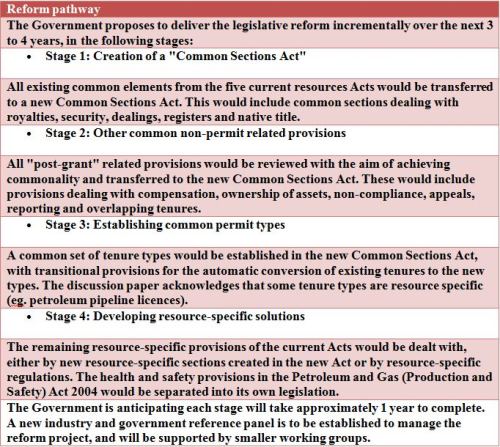
The Queensland Government is proposing to replace the State’s five current Acts with the single Common Resources Act by 2016.

The Act will include multiple resource-specific regulations and will envelop the Mineral Resources Act, the Petroleum and Gas Act, the Petroleum Act, the Greenhouse Gas Storage Act, and the Geothermal Energy Act.

Milbourne said he considered the new Act would an improvement on the current status quo in Queensland and, although information regarding the Act has not been widely disseminated, it is important to maintain discussion about it.

“It is important for the resources investor to be aware this is happening,” Milbourne said.

“The government has made clear that their intent is that no existing rights will be jeopardised, in fact, there probably will be a strengthening of certain rights of resources investors and resources companies in project development in Queensland.

“Given the significant overhaul, I think this is perhaps one of the most ambitious legislative reforms I have seen.”

The reforms stem from electoral promises made by the Newman Government to reduce resources-related red tape by 20 per cent.

The Government recently completed a Streamlining Approvals project, which it claimed identified the benefits that could be achieved by the single-Act regulation of resource tenures.

The upshot was the current Queensland resources legislation had become unnecessarily complex and inefficient, which in an article by Clayton Utz lawyers Andrew Smith and Ben Cansdale was said to ha come as a result of having historically separate tenure regimes for minerals and petroleum, and cumulative amendments to legislation being made over time rather than genuine reform.

“The Government undertook an analysis of similar mining jurisdictions to compare various models of tenure legislation, and concluded that a model adopting a single Act with multiple resource-specific regulations was the preferred reform approach,” Smith and Cansdale wrote.

According to the Clayton Utz lawyers the Queensland Government has claimed the new Common Resources Act stands to be the most significant reform to Queensland’s resources legislation in over 150 years, and is aimed at harmonising the tenure processes and streamlining regulatory administration.


Source: Clayton Utz


“This will have an impact on many projects and it is something you do need to be alert to,” Milbourne said.

“It’s a good sign, in that the government will ultimately reduce the amount of legislation.

“The idea is to reduce the number of pages by 20 per cent…but in addition to that it really is aiming to simplify how the resources industry is regulated in Queensland.

“So in three or four years, we really may have best-in-class legislation, which is a very good sign.”

When will the climate improve for resources investors?

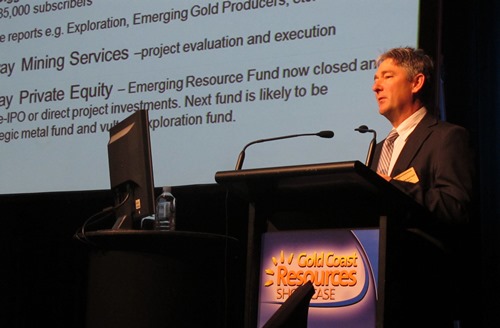
CONFERENCE CALLER: The opening day of the Gold Coast Resources Showcase was greeted by an ominously overcast Queensland sky.

As the weather reflected the current downcast mood of the Australian investment market, Lime Street Capital managing director Stephen Bartrop opened the conference by stating the market, in particular the resources sector is currently in an oversold situation.

Taking a look at the current state of the market, Bartrop indicated that the month of June is usually a time of pre-tax loss selling and that presently we are probably seeing the bottom of the market cycle.

Resource equities typically perform stronger in the September to March period each year.

According to Bartrop, by buying broader-based resources at the moment – particularly the larger companies – you are likely to see some recovery over the next six months.

That’s not to say there is no life in companies operating in the crowded space in the smaller end of town.

The recent belting of these stocks has seen many good companies with good projects and management capable of delivering project finance and milestones falling into the very-affordable realm.

This area has the potential to be where the real money is to be made within a one to two year time frame where you pick the right stocks.

The right stocks, of course being the ones that survive as opposed to those that are destined to hit the wall.

Bartrop suggested there could be an early recovery story to been told soon, but medium-term a few important things need to happen, one of which is a re-basing of the Aussie dollar.


“The marginal investor is overseas and the Australian dollar has fallen,” Bartrop said.

“We suspect it does need to fall to around 80 to 90 cents, maybe sit around the 85 cents range.

“It then needs to hold some stability for investors from overseas to then come back in, because at the moment they’re all nervous about – the share price may go up but the currency will erode any of those gains.”

Bartrop’s comments came the morning after the Australian dollar had fallen to its lowest value in 32 months of US93.47 cents.

He highlighted the need to discourage the flow of capital to the US, where growth projections are improving, which is resulting in the assumption the US dollar is going to appreciate.

“What we have seen is a much stronger dollar for a longer period of time relative to base metal prices,” he said.

“I would argue that…base metal prices at the sort of levels they are now, suggests the dollar probably should be around 85 cents.

“Overseas investors look at those sorts of charts and try to estimate to where they feel the dollar will fall – and then expect to see some stability.

“The Australian dollar really needs to fall in line with commodity prices to provide that confidence to the overseas investor.

“Once we achieve that is when we will start to get some true traction in our market.”

Laramide Resources’ uranium tale gets easier to tell

THE CONFERENCE CALLER: Uranium has always been a difficult commodity and telling its story is always challenging.

“The uranium story is a little bit different to that of other commodities in that the demand remains fairly constant and supply has been constant,” Laramide Resources managing director Peter Mullens told the 2013 Gold Coats Resources Showcase.

Currently there are 436 nuclear reactors operating around the world while a further 65 new reactors are being constructed.

“The 65 new reactors being built are important as they will be coming on and commissioning over the next five to eight years,” Mullens said.

“They will require significant new uranium production in order to operate.”

Laramide Resources’ (ASX: LAM) main project is the Westmoreland project, an advanced uranium exploration stage project located in Queensland, Australia, which the company claims to rank as one of the best undeveloped uranium assets in the world.


Westmoreland project location. Source: Company web page

Westmoreland has a JORC/NI 43-101 compliant resource of 51.9 million pounds (36m lbs. indicated) of uranium with average grade of 0.089 per cent (890ppm) and 15.9 million pounds with average grade of 0.083 per cent (830ppm).

Other highlights of the Westmoreland project include:

Simple mineralisation
Mineralisation is near surface and has significant resource expansion opportunities; 80 per cent of the resource is within 50 metres from surface

Excellent metallurgical results
High uranium recovery of 90.6 per cent and relatively low acid consumption. More recent uranium recoveries of 97 per cent were confirmed by ANSTO with the use of a conventional metallurgical processing route.

Simple mining operation
Westmoreland is intended to be an open cut operation using conventional acid leaching and solvent extraction technology to produce greater than 3 million pounds per annum.

“It’s one of the ten largest uranium deposits in Australia and is one of only two or three that is actually owned and controlled by a junior mining company,” Mullens explained.

“We’re looking at a long mine life of plus 12, probably 15 years producing between 4 to 5 million pounds of uranium per year.

“It is a good size project, no quite a Rio Tinto-scale project, but it is certainly a good mid-tier sized project.”

Auzex Exploration: unlisted but far from uninteresting

CONFERENCE CALLER: Attending events such as the Gold Coast Resources Showcase allows investors first hand communication with and vital insight into the activities of the mining companies in attendance.

They also throw up companies punters may never get to hear about.

One such enterprise at this year’s Showcase was unlisted public company Auzex Exploration.

Auzex Exploration was formed in late 2011 following a demerger from former ASX-listed company, Auzex Resources, which was consumed by Bullabulling Gold (ASX: BAB).

The existing shareholders received one Auzex Exploration share for every six shares they held in Auzex Resources.

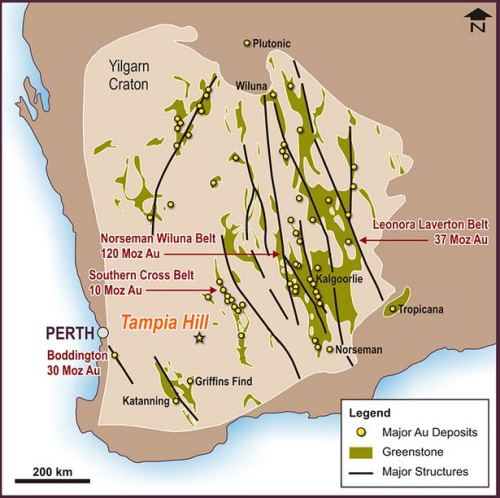
The company has put together a strong portfolio of projects with its major focus being the Tampia Hill gold project in Western Australia.

The Tampia Hill gold project is located 300 kilometres east of Perth in the Wheat Belt of WA near the township of Narembeen (a wheat and sheep farming community), which is 12km north west of the project area.

The project consists of an Exploration Licence and two Mining Leases and covers a total area of approx. 35 square kilometres.

Auzex acquired an 80 per cent interest in the Tampia gold project in April 2012 for a $500,000 cash payment to Tampiagold and Goldoro, who retain a free carried interest to completion of a definitive feasibility study.

The vendors also retain 20 per cent participating interest or convert to equity and, or, a royalty interest.

“This is a very exciting project,” Auzex Exploration managing director John Lawton told The Roadhouse.

“It would have to be one of the most exciting gold projects in the country, simply because the mineralisation is high-grade, at surface and open in all directions.”


Tampia Hill gold project location. Source: Company web page


Gold was first discovered at Tampia Hill by BHP Gold Mines in 1987.

Historic drilling of the project confirmed the continuity of the gold mineralisation along strike, at depth and particularly along plunge.

Mineralisation discovered to date covers a strike length of 850m long and 250m wide.

Tampia Hill has an existing Inferred resource, which was calculated in 2000, of 3.4 million tonnes at 2.89 grams per tonne gold for 324,100 ounces at 1.0g/t gold cut-off.

“It was a BHP resource that was finalised and released in 2000, which is why the cut-off grade is so high at one gram per tonne, because that was at the bottom of the gold market,” Lawton explained.

“Nothing has happened since that time. No modern exploration has been conducted over the area.

“The only reason it hasn’t been subjected to any exploration over the last decade, or longer, is largely due to some litigation and legal activity that had nothing to do with us.

“We acquired it fully understanding the legal framework, which we have since resolved, so there are no outstanding legal issues here.

“We have signed up the farmers who are the landholders, it is all privately-owned land, and they have been more than happy to sign up and get on board.”

Because the project has remained unloved for so long and modern exploration methods and modelling have yet to be applied, Auzex considers Tampia Hill exploration to be at an early stage.

The company intentions over the coming twelve months entail the identification of a number of gold targets that will add to the current resource, targeting 750,000 to one million ounces of gold.

Work in the next twelve months also aims to define a list of new prioritised exploration targets that will lead to an increased resource base to allow the project to grow into the future.

Auzex plans to commence drilling at Tampia Hill in July.

For more information regarding the Tampia Hill gold project and the rest of Auzex Exploration’s portfolio contact: kristin@auzex.com