Centaurus Metals drills high-grade iron at Candonga

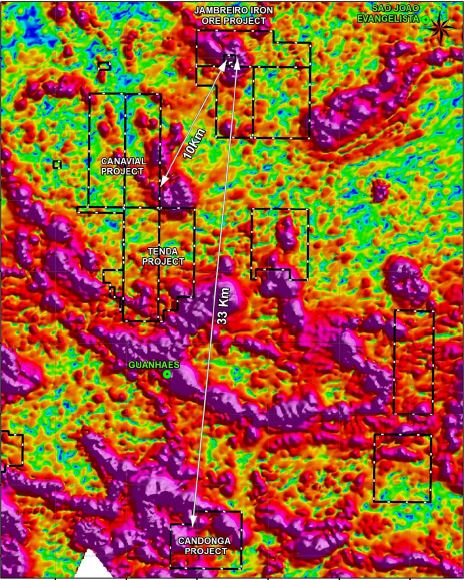
THE DRILL SERGEANT: Centaurus Metals (ASX: CTM) has reported, high‐grade results from the latest drilling at the company’s 100 per cent‐owned Candonga iron ore project, located 33 kilometres from its flagship Jambreiro iron ore project in Minas Gerais, Brazil.


Candonga project location map. Source: Company announcement


The results will be included in the maiden JORC resource estimate for Candonga which is on track to be delivered later this month.

The latest results include intersections of high‐grade, near‐surface mineralisation Centaurus believes to demonstrate Candonga has the potential to provide a source of high‐grade coarse grained friable itabirite to the Jambreiro project.

Highlights of the recent RC drilling results from Candonga include:

–    32 metres at 48.5 per cent iron, 1.4 per cent aluminium oxide and 0.08 per cent phosphorous from surface;

–     27m at 38.6 per cent iron, 1.3 per cent aluminium oxide and 0.05 per cent phosphorous from surface;

–    23m at 39.4 per cent iron, 4.9 per cent aluminium oxide and 0.09 per cent phosphorous from surface;

–     18m at 46.9 per cent iron, 0.8 per cent aluminium oxide and 0.05 per cent phosphorous from 7m;

–    5m at 59.1 per cent iron, 0.6 per cent aluminium oxide and 0.07 per cent phosphorous from 17.0m;

–    13m at 47.8 per cent iron, 4.1 per cent aluminium oxide and 0.04 per cent phosphorous from surface; and

–    12m at 45.3 per cent iron, 1.3 per cent aluminium oxide and 0.07 per cent phosphorous from 44m.

The company has now planned a small program of diamond drilling to provide the samples necessary to undertake detailed beneficiation testwork.

Centaurus expects the Candonga mineralisation will be able to be upgraded to a high-grade, low impurity product using a similar process flowsheet to the one that will be utilised at Jambreiro.

The company said the latest drilling results provided more evidence Candonga was shaping up as another significant satellite project alongside the Canavial project.

“The maiden resource for Candonga due by the end of this month will include these new results and should give us a good indication of the scale and potential of the deposit,” Centaurus Metals managing director Darren Gordon said in the compnay’s announcement to the Australian Securities Exchange.

“Both Candonga and Canavial represent very attractive regional growth opportunities for us once Jambreiro is up and running, with the potential to increase our production profile or extend the life of our operations.”

Iron Ore: keeping things in perspective

Iron ore continues to be in the news in a major way.

There are arguments and counter-arguments with respect to the near to medium-term price outlook, with varying degrees of optimism and scepticism.

If you read some of the reports about in the financial press you could be forgiven for thinking that the iron ore industry must be in the midst of a catastrophic crisis, with prices plumbing all-time lows as demand plummets and supply surges.  

The reality, once one looks past the dramatic headlines accompanying recent developments, is vastly different.

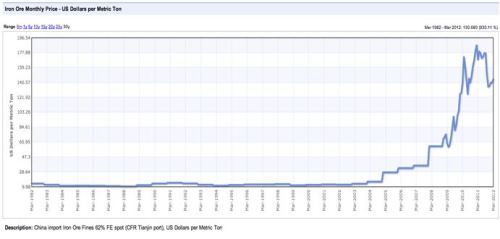
The chart below puts everything into perspective. Whilst the iron ore price has retreated from its pre-GFC peak, it is still trading at a price that’s almost seven times higher than the $20 per tonne price that it averaged for more than two decades between 1980 and 2004.


This provides an enormous margin for iron ore players, particularly when compared to the margins that the industry had become accustomed to during the course of the preceding decades.

BHP, Rio and Fortescue

From a local perspective, Rio Tinto (ASX: RIO), BHP Billiton (ASX: BHP) and Fortescue Metals Group (ASX: FMG) – the world’s second, third and fourth biggest iron ore miners behind Brazil’s Vale – plan to add a combined 235 million tonnes of new mine capacity by 2015, nearly equal to Rio’s total output in 2012.

In terms of the outlook for demand, Rio Tinto forecasts steel demand will grow by about 3 per cent  a year for the next decade, which is well down on 10 per cent  growth rates during 2009 – 2011, but in my view reflective of a more realistic and sustainable demand scenario.

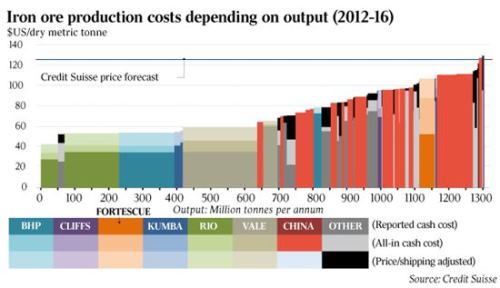
Rio Tinto, which derives more than two-thirds of its revenue from iron ore, is counting on its premium ore and low operating costs to provide hefty profit margins despite any cyclical downturn in the iron ore market. Rio’s economies-of-scale allow it to mine iron ore at a lower production cost than anyone else in the iron ore business, as the chart below demonstrates.

What’s also significant is how much iron ore production would be wiped out at an iron ore price of $80/t or lower – much of it Chinese.


The iron ore business has typically been dominated for decades by three major players – Rio, BHP and Vale – which together have accounted at one stage for as much as 80 per cent of the world’s seaborne iron ore trade.

And there’s a simple reason for this – iron ore is a bulk commodity, which means it’s typically a low-margin business, where the stuff has to be dug and moved in enormous volumes in order to generate a reasonable profit.

Being a bulk commodity, infrastructure costs are huge, with returns generated over a lengthy period of time.

The fundamental characteristics of the iron ore business – high capex/ low-margins/large volumes/massive funding requirements/medium to long-term pay-back – are not features that typically attract smaller players into the industry.

As a result, iron ore is predominantly the domain of mining heavyweights that can utilise their sizeable balance sheets to minimize exposure to potentially crippling debt levels.

Chinese Production a Major Factor

Falling grades and volatile prices are making life difficult for China’s iron ore miners and threatening to push them out of business.

It is estimated that as much as 40 per cent of China’s more-than-a-thousand iron ore producers shuttered production during the course of 2012 when iron ore prices slumped.

China’s mostly small-scale miners produce around a third of the raw material for the country’s steel industry.

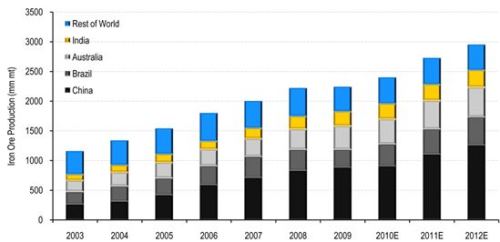
The chart below highlights exactly how big an iron ore producer China is, which is probably a surprise to many.


China is typically a swing producer and its mines rely on strong iron ore pricing above $120 in order to remain viable.

However, despite the critical role their output plays in determining China’s need for imports, the fragmented nature of the industry makes it difficult to estimate how deeply the miners were hit when iron ore prices fell to three-year lows below $87 a ton during September 2012.

Any future price weakness will once again place significant pressure on China’s iron ore producers.

Pricing Outlook

Iron ore will always tend to be a relatively low-margin business. The ultra-high pricing environment of the past decade, which encouraged smaller hopefuls into the sector, is in no way typical.

Prices will eventually level-off and begin to recede as supply catches up with demand. However as we highlighted earlier, iron ore prices are around seven times higher than their average over the preceding two decades – and are unlikely to retreat back to these former levels.

The key from my perspective is how much supply effectively becomes uneconomic if the iron ore price falls below $80/t.

Indeed, let’s cast our minds back to the latter stages of 2011 and 2012, when iron ore prices fell below $100/t to see the panic that was generated in iron ore markets.

The one thing we can be sure of is volatility, with the bulk of iron ore sales based on the volatile spot market, rather than the certainty of an annual fixed price as had been the case for decades.

The iron price hit a 16-month high of $158.90/t on February 20 this year, but has since dipped to be currently trading around $110/t.

The production cost for the smaller Chinese miners is around $100 – $120/t, about three times more than the major producers in Australia and Brazil.

With respect to BHP and RIO’s Pilbara production expansions, the new capacity is aimed at meeting demand surges and minimizing the strong price spikes that can be disruptive to the industry.

In many instances the larger producers have touted major capacity expansions that have eventually translated into production on timeframes markedly longer than initial estimates.


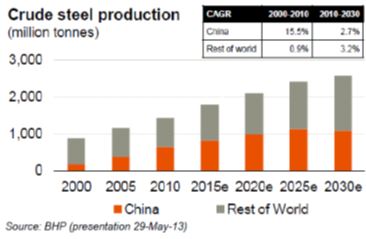
A BHP presentation on 29 May forecasts China’s steel production to peak in about 2025 at about 1.1 billion tonnes per annum. Steel production growth is forecast to moderate as steel intensity per unit of GDP declines.

The market consensus view is firmly of the opinion that iron ore is easing in price and may have further to fall, as Chinese steel mills run down inventory before restocking.

Both Morgan Stanley and Macquarie believe this to be the case and have published similar reports over the past fortnight. They believe iron ore prices will weaken further over the coming months (from current seven-month lows around $110/t), before rebounding during H2 2013.

This is no great surprise, as it is merely a reflection of typical annual Chinese buying habits.

As the annual summer holiday season approaches, China’s steel mills typically run down inventories as production levels decline. They then look to take advantage of the low iron ore price environment to replenish inventories.

The move over the past few years away from annual contract pricing and towards spot pricing has resulted in a correspondingly higher level of price volatility, which accentuates underlying price movements.

Pressure on Fortescue

The problem for Fortescue is that circumstances are to a large degree beyond its control. Its future is solely dependent on the maintenance of strong iron ore prices. It’s a one-commodity company, without the earnings diversification of BHP and RIO.

Exacerbating the problem is the fact that FMG has taken on massive debt levels to compete with BHP and Rio Tinto in terms of size and scale. Unfortunately, they operate better assets, produce product at a much lower cost and are in a much sounder financial position.

Fortescue was initially fostered and supported by the Chinese in a similar fashion to the way the Japanese during the 1970s fostered and financed many Australian coking coal producers in order to try and break the market dominance of the key coal industry players, with the aim of sourcing cheaper product.

Whilst Chinese and Indian steel producers have been vocal supporters of independent iron ore players like Fortescue, which have the potential to break the market dominance of the sector leaders, they won’t pay a higher price to purchase iron ore.

Steel producers are going through enormously tough times and will accordingly purchase the lowest-cost product available.

BHP and RIO’s lower-cost operations and hence capacity to operate in a lower-price environment puts tremendous pressure on FMG position over the medium to longer-term.

Summary

I believe prices will average around $125 per ton during 2013, with prices easing further during the course of H2 2013, before recovering on restocking during late 2013. For 2014 I anticipate prices will average around $115 per ton, which will still provide robust margins for the major iron ore producers; albeit not as lucrative as pre-GFC levels.

Gavin Wendt is the founder of MineLife, publisher of the MineLife Weekly Resource Report

What the Brokers Say

WHAT THE BROKERS SAY: Interesting news and views from across the Resource Analyst universe.


Adelaide Resources (ASX: ADN)

Adelaide Resources is currently advancing exploration at the Alford West prospect within the Moonta project area.

Broad widths of high grade copper and gold mineralisation have been intersected at shallow depths, highlighting the prospectivity of this target.

Follow up drilling is now underway and with only 10 per cent of the anomaly drill tested, significant opportunity exists for further high grade results.

Adelaide has an EV of $13.2 million and is highly leveraged to exploration success.

In a market where exploration companies are receiving little attention, Adelaide Resources (ASX: ADN) stands out as delivering material exploration results with all the hallmarks of discovering a significant copper/gold deposit.

Adelaide’s recent focus has been on the Moonta region which has a rich history of mining with an estimated 355,000 tonnes of copper and approx. two tonnes of gold extracted by the old-timers.

Some of the world’s more significant mining houses have since undertaken extensive exploration in the area looking for major copper/gold deposits, and while unsuccessful in this endeavour, numerous high priority (smaller) prospects where identified.

Adelaide Resources has an extensive exploration data base from the early explorers and is undertaking shallow drilling campaigns to test the historical prospects.

The most exciting of these prospects is Alford West where the company’s first drill program recently intersected 20m at 4.2 per cent copper and 0.27g/t gold from 32m and 45m at 1.55 per cent copper and 1.81g/t gold from 15m, with mineralisation present to the end of the hole.

Breakaway is highly encouraged by these high grade shallow intercepts, and the fact that every traverse of the Alford West drilling campaign has intercepted ‘ore grade’ copper/gold mineralisation.

With only 10 per cent of a three kilometre geochemical anomaly now drilled, significant opportunity exists along strike and at depth to establish a significant ore body.

Breakaway recommends Adelaide as one of the better explorers with early but promising results.

Recommendation: Speculative BUY


Cabral Resources (ASX: CBS)

Cabral expanded its footprint in the Sincora area to approximately 1,195 square kilometres with the lodgement of sixteen new tenement applications lifting its total landholding in Brazil to 1,782sqkm.

Low-contaminant, high-grade direct shipping ore (DSO) hematite iron occurrences have been identified in the newly-named Queixada and Coral Zones from assays of surface samples, raising the prospect of near-term production and cash flow generation.

Queixada and Coral Zones – positive assay samples

Exploration work at the recently pegged Sincora Area has identified a new high-grade hematite zone to the north along the Tombador formation, namely the Coral Zone; and additional new high-grade DSO hematite iron ore occurrences at the central zone, named Queixada, which now spans an area of 3km by 2km.

Dual infrastructure option available

Cabral’s Sincora Area is well situated to the currently operating FCA rail line, which passes directly within the tenement holding en route to Port of Aratu on the coast near Salvador.

Sincora is also in close proximity to the FIOL rail development, 30km away, which is scheduled for completion in 2015/16.

Valuation: Focusing on DSO hematite

Cabral’s shares are currently trading at 2.3 cents per share which equates to an enterprise value of $0.12 million, based on cash of $6m (2.4 cents per share) as at 31 March 2013.

This compares with a net asset value (NAV) per share of 7.9 cents, based on financials reported for the interim period end December 2012.

Although a JORC-compliant resource has yet to be reported, Cabral is well positioned in terms of proximity to existing and planned infrastructure.

Initial surface samples now from two sites on the newly pegged Sincora Area augur well for the potential delineation of a high-grade DSO hematite resource.

Using a subgroup of peers focused on DSO hematite generates an average EV/t multiple approaching 12 cents per tonne, which, when applied to our three hypothetical resource scenarios, generates an implied share price for Cabral of between 5 cents and 7 cents.


Venturex Resources (ASX: VXR)

Venturex Resources has validated its recent strategy change to focus on exploration in 2013 with positive results from Kangaroo Caves.

This confirms that exploration upside may provide further Reserve scale as part of the ongoing assessment of the feasibility study.

VXR remains highly leveraged to exploration success.

Kangaroo Caves drilling results validate exploration strategy: A shift of strategic focus towards exploration in 2013 has yielded positive results from Kangaroo Caves (KC) with the extension of copper and zinc mineralisation.

KC provides upside for a future revision of the Sulphur Springs (SS) feasibility study given its proximity to SS and the improving grade trend.

Grades of up to 4 per cent copper and 9.3 per cent zinc have been defined within discrete zones and structural offsets which present an opportunity to identify additional mineralisation.

Key results include:

• KRC007 6m at 0.6 per cent copper, 9.3 per cent zinc, 7.3g/t silver from 137m from 154m;

• KRC007 4m at 2.6 per cent copper, 0.8 per cent zinc, 2.8 g/t silver, 0.02 g/t gold from 165m; and

• KRC008 5m at 4.0 per cent copper, 0.2 per cent zinc, 3.3g/t silver, 0.01 g/t gold from 143m.

$4 million earmarked for exploration in 2013: Proceeds of the current $6.4 million capital raising (together with current $2.2 million cash) will be weighted towards brownfields and greenfields exploration at both SS and Whim Creek (WC).

This forms part of the enhancement program to increase the modest Resource/Reserve base that underpinned the 2012 feasibility study.

VXR has identified near-term targets which include geophysical targets at Liberty Indee, Salt Creek and additional exploration at KC.

Enhancing the feasibility study: The study provided a ‘base case’ for a production scenario moving forward.

Argonaut’s valuation confirms that increasing the current mine life beyond approx. 8.5 years (based on a one million tonnes per annum operation) is a key lever to NPV accretion.

Whilst SS is the current ‘centre of gravity’ based on existing Reserves, new discoveries at SS or WC may change this outcome.

Brazil exploration remains measured, without being a distraction: Whilst VXR’s Brazilian gold exploration projects offer a second angle for VXR’s strategy, exploration will be limited in 2013 with a budget allocation of around $200,000.

The assets offer strategic appeal and joint venture partners are being sought to continue exploration.

Recommendation: Speculative buy maintained.

Argonaut’s valuation has been reduced to 3.5c (was 4.5c) based on a pre-production peer average EV/Resource pound metric of US3.1 cents per pound.


Disclaimer: The above is intended as a guide only. The Roadhouse accepts no responsibility for investments made from this advice, successful or otherwise.

Paul Roberts: Predictive Discovery

ONE OFF THE WOOD: Predictive Discovery (ASX: PDI) managing director Paul Roberts dropped by to tell us how the company is progressing at its gold prospects in eastern Burkina Faso.

 

You recently announced drilling and metallurgical results from your Bongou prospect, what light do they shed on the Predictive Discovery story?

The Predictive Discovery story is about taking a strong technical approach to exploring one very large, 95 to 100 per cent-owned ground position in two adjacent highly prospective greenstone belts which contain abundant artisanal gold workings.

We hold some 1600 square kilometres in Burkina Faso, which has recently emerged as an established gold mining hub.

Our exploration has achieved encouraging drill results from multiple prospects. We are now accumulating those prospects with the intention of turning them into a large mining operation feeding a central mill.

What can you tell us about the recent results?

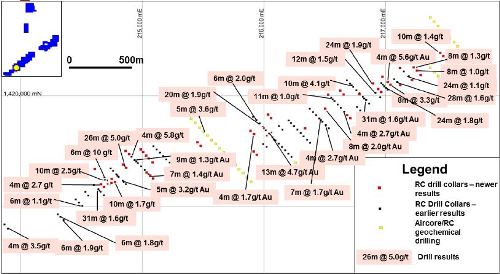
By most standards it was a small program of drilling but it delivered big in terms of results including 48 metres at 4.3g/t gold, including 16m at 9.7g/t gold and 23m at 6.9g/t gold, including 16m at 8.9g/t gold.

These are close to true width intercepts, and importantly, correlate to previous intercepts of 20m at 4.8g/t gold and 10m at 7.4g/t gold.

These seem to appear in a panel of high-grade mineralisation open at depth and potentially plunging to the east.

Geochemical results indicate we may find more Bongou-style mineralisation nearby, expanding potential for discovering substantial, good grade gold mineralisation in a small area.

Is Bongou your main focus?

It’s where we’ve achieved the best combination of continuity, grade and width.

Saying that, we have many prospects we believe have potential to deliver economic resources.

It’s really a matter of knitting them together to create a significant mining operation.

What about your other prospects?

We’ve achieved good results at the Dave prospect, a big system with gold mineralisation over about 5km of strike that remains open, eight kilometres from Bongou – but they’ve been in the moderate-grade category.
 

We have Dave-style mineralisation from other areas of bedrock geochemical anomalies in the 20km long Laterite Hill Grid in prospects such as Laterite Hill itself and Prospect 71.

We’ve also drilled the Solna and Tambiri prospects up at Bangaba some 60km to the north and acquired the Bira ground, a similar distance to the north east that shows consistent 20m widths over at least 500m of strike with good mineralisation continuity and grades of 1 to 2g/t gold.

What results have you been able to achieve at Bongou?

We recommenced our activities this field season determined to focus on grade.

We focused our first round of drilling on prospects most likely to deliver the most favourable combination of continuity, grade, and width.

We obtained good results from several prospects, but realised Bongou fitted those criteria the best, so we focused most of our work there.

Our March drilling produced the best drill results we’ve seen so far, displaying a consistent pattern of high-grade gold mineralisation on the contact between granite and gabbro at Bongou, which is open to depth.

The known Bongou gold mineralisation is limited to around 150m of strike, leading us to step our exploration outwards to try and find more Bongou-style anomalies in the surrounding areas.

Geochemical drilling suggests we’re getting those anomalies 500m or more from Bongou, but we’ve still a long way to go to test the whole area.

What has the Bongou drilling told you?

We have a zone of high-grade mineralisation, which is averaging about 10m in true thickness, which, at a 3g/t cut-off, contains an average grade so far of around 10g/t.

We have, what you could describe as, a nice slab of high-grade mineralisation anyone would be able to mine profitably; as long as follow-up drilling proves it continues with consistency to depth.

We then have lower-grades of gold along the high-grade’s southern margin, so the true width of the gold mineralised part of the system averages, maybe, 25m but ranges up to nearly 50m, which should offer good stripping ratios for open pit mining.

Geological mapping along the fault zone at Bongou identified outcrops of granite, what is the significance of this?

The Bongou mineralisation is new for this area as it’s hosted in a granite body surrounded by mafic rocks.

There is a series of small granite outcrops surrounded by a wide plain of soil and alluvial cover along strike to the east and west, which is important as a number of granite-hosted Bongou-like ore deposits could be sitting under thin cover nearby.

These granite outcrops lie close to a large, deep 43km long fault within our permits, which we are certain is the fault that has delivered the fluids to form the Bongou gold mineralisation.
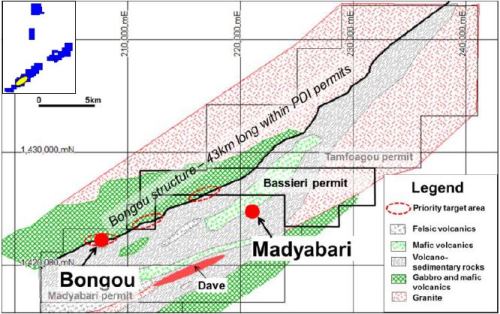
 

We want to determine where that combination of granite and the major fault may reappear, especially when the granite is in contact with mafic rocks like at Bongou.

In the immediate vicinity of the drilled area, we’ve identified several areas of interest within about 2km of strike.

Adding to this, we have identified other targets on the major fault through mapping and geophysics 4km and 10km to the northeast.

What did your recent exploration work at Bongou include?

An electrical geophysical survey, covering about 2.5km of strike, as well as bedrock geochemical drilling of the electrical geophysical anomalies.

This geochemical drilling turned up more Bongou-scale anomalies, one of which is definitely in altered granite. We are now trenching that granite to see how it looks.

We also carried out metallurgical testwork, not only at Bongou, but also on other prospects, including the Dave prospect nearby and the higher grade Tambiri and Solna prospects to the north.

What did that metallurgical testwork return?

It gave us high-gold recoveries from all of the prospects we tested.

The Bongou prospect returned recoveries of 94 per cent gold while the Solna and Tambiri tests recovered 96 per cent and 92 per cent gold respectively.

At Dave, we focused on the possibility of heap leach gold recovery from moderate grade oxide mineralisation.

At Dave there’s an average depth of oxidation of about 50m where there could be quite a lot of material that could be put on a heap.

The testwork indicated heap leach is possible. Bottle roll cyanide leaching of reverse circulation drill chips and powder gave us 89 per cent recovery.

An economical heap leach operation should be recovering more than 60 per cent of the gold. While there is a long way to go yet, with agglomeration, we think this may be achievable at Dave.

You did the metallurgy early, were you pleased with those results?

Absolutely; it reduced a big risk element in some of our key prospects.

We’ve seen no evidence of refractory gold, which can be cause for concern in some West African gold deposits.

We can also see the possibility of recovering gold economically from some of the lower grade material as a supplement to standard CIL treatment of higher grade material from such places as Bongou and Tambiri.

If we can find more mineralisation with the same characteristics as Bongou, it gives us the opportunity to rapidly drill out resources with above average grades, which can get us started with high profitability and rapid capital payback earlier.

In the current, very difficult, investment climate, my picture of the near future is that we should aim to build on the Bongou results to identify enough reserves to get started with high-grade ore production, possibly not with a huge mill throughput to begin with.

This could keep initial capital costs relatively low and provide a springboard for increasing gold production as time goes on.

Producing and being profitable allows you to move onto the lower grade material?

That’s right and a heap leach operation on a prospect like Dave would be a classic case in point.

Getting started and producing gold would also allow time to progressively develop other prospects in our large ground holding.

We’ve always said we’re aiming to get more than two million ounces at over 2g/t here and we believe we have the ground position to deliver that.

Troy Resources confident of completing Azimuth takeover

CONFERENCE CALLER: Acquisitive gold producer, Troy Resources (ASX: TRY), is confident its friendly takeover bid for fellow Perth-based gold explorer, Azimuth Resources (ASX: AZH), will create a sustainable mid-tier South American focused gold producer with considerable exploration and new project upside – despite current global conditions for gold.

Addressing the second day of the Paydirt 2013 Latin America Down Under resources conference in Sydney, Troy Resources managing director Paul Benson said the proposed larger entity would emerge from a successful takeover with three core business drivers going into the new financial year.

These would include the completion of a prefeasibility study by the end of the year on its West Omai gold project in Guyana, the commissioning of new ball mill infrastructure at the Casposo gold mine in Argentina and the commencement there of a high grade underground stoping operation, and ongoing gold production in Brazil.

“The takeover is designed to deliver an enlarged but profitable gold producer focused on high grade gold resources but an entity with a development pipeline and considerable exploration upside,” Benson said.
 
“The offer is scheduled to close on June 14th and if we achieve the 90 per cent minimum take-up, we would be confident of wrapping it all up by the end of the financial year.”

Troy announced its off-market takeover offer at the end of March. It proposes to acquire all of the issued shares of Azimuth in a share based transaction whereby Azimuth shareholders are offered one Troy share for every 5.695 Azimuth shares held.

Under the proposed terms, Troy shareholders will hold 55 per cent of the combined company.

Benson said the proposed acquisition of Azimuth complements Troy’s existing project pipeline and represents a long-term value proposition for both sets of shareholders.


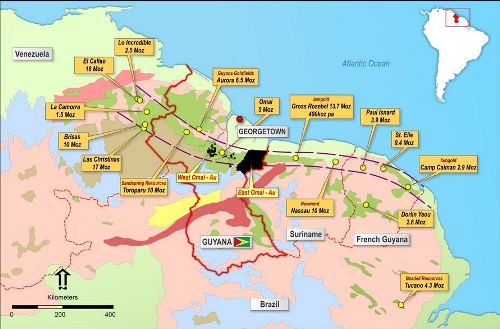
Azimuth Resources projects are in a good neighbourhood. Source: Company website


Troy is dual-listed on the Australian and Toronto Stock Exchanges and has gold production at Andorinhas in Para State, Brazil and Casposo in San Juan Province, Argentina.

The company has a record of fast-track mine development, low cost operations, strategic acquisitions and exploration discoveries.

As of the market close on Wednesday night, Troy was already holding a 10.7 per cent stake in its takeover target.

Azure Minerals predicts Mexican copper-gold production by 2015

CONFERENCE CALLER: Australia’s Azure Minerals (ASX: AZS) says it will commence a mining study in the second half of this year with the intention of commencing first mining by 2015 at the company’s advanced and high-grade Promontorio copper gold project in Mexico.

Addressing the first day of the Paydirt 2013 Latin America Down Under resources conference in Sydney, Azure Minerals managing director Tony Rovira, said the completion of a positive scoping study had underpinned Promontorio’s potential to be a near-term producer.


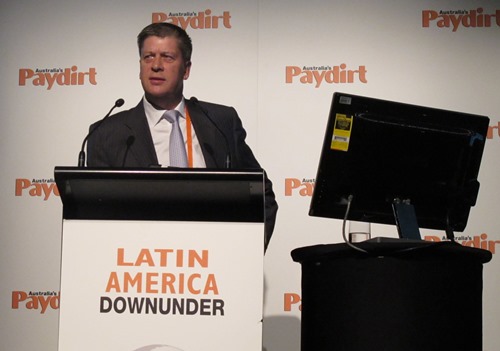
Azure Minerals managing director Tony Rovira.


“Our focus is on developing the deposit so that we can become a copper-gold producer in Mexico – a province we regard as mineral rich and mineral friendly,” Rovira said.

“Mexico’s mining jurisdiction is important to us. It is the world’s fourth most favoured country for mineral exploration, has a simple, transparent mining legislation.

“It also has more than 300 mining companies operating in Mexico and that is the perfect environment for us as an Australian developer to bring a new copper gold mine into production.”

Located in central Mexico, Promontorio has a total JORC Indicated and Inferred resource of 840,000 tonnes at a grade of 4.1 per cent of copper equivalent.

“This is a ‘high confidence’ resource for us as 75 per cent of the mineralisation is already in the Indicated category and contained totally to date within two specific veins,” Rovira said.

“Our forward plan now is to commence a mining study and ore reserve work in the second half of 2013.

“We also plan to develop the exploration potential of the high grade copper zone at the Cascada prospect just 200 metres northwest of Promontorio but which we believe has strong potential to be a second major copper contributor to the project.”

A drilling program has already commenced on Cascada.

Latin Resources on the hunt for JV partner

CONFERENCE CALLER: Australia’s Latin Resources (ASX: LRS) is now on the hunt for a joint venture partner to help develop the company’s large 100 per cent-owned Guadalupito iron and mineral sands project in western Peru.

Addressing the first day of the Paydirt 2013 Latin America Down Under resources conference in Sydney, Latin Resources managing director Chris Gale said the resource had now been developed to such a stage that a mining start in 2015 was a realistic target.

Guadalupito has a 1.4 billion tonne JORC Inferred mineral sands resource averaging 5.7 per cent heavy mineral and a conceptual exploration target of four billion tonnes of mineralised sediments.

The deposit’s gold grades have also been identified of potential economic significance.


Latin Resources managing director Chris Gale addressing the conference.


“This is a big year for us and we have set a number of goals for the next 12 months,” Gale said.

“Heading that priority is to now find a joint venture partner to help develop the deposit as it is favoured by a port – just 25 kilometres away as well as local water, power and steel smelter infrastructure.

“Importantly, it has a discrete suite of liberated mineral grains of recoverable size of zircon, rutile, ilmenite, titanium and andalusite so that enhances its investment appeal.”

A recently-completed scoping study at Guadalupito has shown favourable support for a dredge mining operation for production of a heavy mineral concentrate.

A resource upgrade to 1.4 billion tonnes in the most recent quarter was a 370 per cent increase, which Gale said positions Latin Resources to become one of the worlds’ biggest mineral sands producers.

“There is also still huge exploration upside at Guadalupito as we have explored barely a tenth of the area,” he said.

“We are commencing mining planning and permitting and hope to be in production by 2015, subject to successful joint venture partner outcomes.

“This maiden output will occur at a time forecasters expect average annual growth in demand across the titanium and zircon markets of at least four per cent until at least 2020.”

Austrade urges Australian juniors to take higher position in Latin America

THE CONFERENCE CALLER: Australia’s junior mineral explorers and equipment suppliers have been encouraged to take a higher profile position and involvement in Latin America’s future mining industry.

Addressing the second day of the Paydirt 2013 Latin America Down Under resources conference in Sydney, Austrade chief executive officer Bruce Gosper said some 200 Australian junior resources companies were involved in Africa’s mining sector.


 “Yet only around 50 such Australian entities in the junior end of the market are involved in Latin America,” he said.

“The opportunities for these and other Australian companies to enter the growing Latin American mining market are significant as the sector there is keen to partner these Australian juniors in their mining, environmental, safety, technology and innovative mining techniques.”

Gosper said the application of mine water technologies was a notable opportunity.

“Australia’s mining sector consumes about four per cent annually of Australia’s national water consumption and has become very skilled in mine water management techniques,” Gosper said.

“Water is a real issue for Latin American mines including in  Peru and Chile and we will shortly be taking our water skillsets to Mexico so there is a strong opportunity there for Australian technologists in that space.”

Gosper said if junior resource plays needed any encouragement to move into Latin America, they only need look at the 60 per cent growth in two-way trade there in recent years to more than $8 billion annually in 2011-12.

ASX needs to counter TSX hold on Latin America

CONFERENCE CALLER: The Australian Securities Exchange (ASX) said its continual outperformance of other regional trading exchanges underpinned its case to be the exchange of choice for new IPOs or listings by joint stakeholders in Australia and Latin America’s future resources sector.

However, while the ASX based miners and explorers outgunned bourses such as Toronto and London in terms of capital investment across the heavily mineralised African continent, Australia was lagging in a similar comparison with its investment in Latin America’s mining sector.

Addressing the first day of the Paydirt 2013 Latin America Down Under resources conference in Sydney, ASX senior manager listing business development Eddie Grieve said that with a market capitalisation of $6.5 billion, the ASX itself had a larger market cap than Singapore and London.

“The ASX offers access to the world’s third largest pool of investment, has an annual turnover in excess of $1.1 trillion and is globally relevant with about 45 per cent of the market in foreign ownership.” Grieve said.

“We also have a world-class trading, clearing and settlement systems so our fundamentals are sound.

“So outside of Australia and Canada, the two other regions that attract around 40 per cent of the world’s exploration spend are Africa and Latin America – Africa around 16 per cent and Latin America around 24 per cent.


“In terms of Africa, over 220 ASX companies are now operating in Africa, more than on the Toronto and London exchanges, and we have raised $6.83 billion in the last five years, compared to $6.53 billion on Toronto exchanges.

“But it is from the Latin American quarter that we are behind, with Canada’s bourse clearly dominating that market – and to snare a greater share of Latin America’s listed exploration and mining capital is our greatest opportunity.”

Grieve said more than 96 ASX companies were now operating in Latin America, well up on recent years.

They are involved in more than 530 minerals projects there across 16 countries in central and South America.

“However, while our equity market appeal has lifted in terms of that arena, the total capital raised for Latin American projects by ASX companies over the past five years was $2.56 billion.

“This compares with more than $8.3 billion raised by Latin America entities on the Toronto exchanges in the same period – so we need to use the ASX’s superior liquidity in mining stocks compared to Toronto, to swing the capital markets balance more in favour of the ASX.”

What the Brokers Say

WHAT THE BROKERS SAY: Interesting news and views from across the Resource Analyst universe.

Swala Energy Ltd (SWE: ASX)

Exposure to the prolific East African Rift System

Investment Highlights:

Early mover, partnered with quality operators. SWE is an oil and gas exploration company with a particular focus on Sub-Saharan Africa. SWE’s portfolio of assets consists of a 50 per cent interest in one onshore block in Kenya (12B), in which Tullow are partner and operator and an indirect 32.5 per cent interest in two onshore licenses in Tanzania (Pangani and Kilosa-Kilombero), partnered with ASX-listed Otto Energy (OEL: ASX).

Importantly, the Permits were secured well before the recent unprecedented level of industry activity. There are no available licenses along the tertiary rift in Kenya and Tanzania, with the only way for majors to enter the play being transactionally via M&A or farm in.

Leverage to the East African Rift System (EARS).

East African Rift System (EARS) is attracting significant industry attention and investment, with an estimated total of greater than  two billion barrels of oil discovered since 2006 by UK-listed Tullow Oil plc (TLW: LSE) at Lake Albert in Uganda exemplifying the potential of the region.

More recently 3 wells drilled for 3 discoveries in Kenya by Tullow have raised expectations that Kenya could potentially host billions of barrels of untapped reserves.

Unprecedented level of investment and exploration to provide news flow.

With an increase in industry interest and investment, the next phase of exploration in Kenya and Tanzania, consisting of 13 wells to be drilled in CY13, is predicted to lead to a significant increase in activity and discovery rates which could result in a sea change in valuation for companies with exposure to the EARS.

Early stage exploration indicators look promising.

All three of SWE’s permits exhibit early stage exploration indicators which have us excited about the company’s prospects.

Basins have been delineated on all three permits via aeromag; sedimentary basin depths have been identified to exist at an optimal level for oil source generation and potential hydrocarbon seepage have been identified coincidental with fault boundaries on each block.

Highly experienced and proven management with frontier exploration experience.

SWE’s board and management will consist of technical personnel with significant experience in onshore EARS. Members of SWE’s management have a proven track record having had success with Black Marlin Energy, which listed on the TSX in March 2010 and was taken over by Afren PLC in May 2010 for C$106.5 million.

Catalysts for CY13 include:

– Seismic survey at Tanzania commences June;
– Prospective resource at Tanzanian assets Q3CY13;
– Seismic Block 12B Kenya Q4CY13;
– 11-13 regional wells to be drilled, ongoing and
– Awarding of new licenses, ongoing

SWE has all the key attributes that we look for in a quality oil and gas exploration company which include a play type which has been relative de-risked, significant “blue sky” potential, high calibre management with a proven track record of delivery, an aggressive work program and tier one JV partners.

With an EV of approx. $10 million SWE is extremely leveraged to success and therein lies the opportunity for investors.

Recommendation
We initiate on SWE with a SPEC BUY recommendation and a price target of 40 cents per share .


Northern Star Resources (ASX: NST)

Northern Star Resources (ASX: NST) is producing gold from its flagship Paulsens underground mine in the Ashburton-Pilbara region of Western Australia. In the March quarter NST produced 24,633 ounces and remains on-track to reach its FY 2013 target of 100,000 to 115,000 ounces of gold, given its financial YTD output of approx. 75,000 ounces of gold.

Background: Paulsens acquisition

NST acquired the Paulsens mine for $40 million in July 2010 – a price that was repaid from the mine’s cashflow in less than seven months. Upon acquisition, the mine had a life of under a year.

The company has since increased the mine life to over 5 years, while increasing production and processing capacity.

Paulsens JORC-compliant resources have grown 485 per cent in two and a half years, from 129,000 ounces to 550,000 ounces, even after allowing for 200,000 mine depletion (grade has also increased 14 per cent to 5.7 grams per tonne gold).

Reducing costs and generating cash

At the start of 2011, NST moved Paulsens from a contractor-run to an ‘owner-operated’ model through its own mining services division. As a result, mining costs fell 36 per cent from $98.8 per tonne mined in Q1 2011 to $63.5 per tonne mined in Q4 2012.

This cost reduction, along with an increase in the tonnes mined and processed, has resulted in substantially increased cash flow.

The company expects to generate $65 to 85 million in surplus cash this calendar year – not bad for a company with an enterprise value (EV) of $243 million.

Due to these cost-cutting measures and low overheads, Paulsens had cash costs (C1) of $601 per ounce in Q1 2013 and total costs of just $935 per ounce (including royalties, sustaining CAPEX, mine exploration and corporate costs).

Even at the current spot price ($1424 per ounce) these low costs result in margins of $489 per ounce, or approx. 34 per cent.

Earnings growth and yield support

In line with its strategy of creating a business first, miner second, NST has made capital return to shareholders its priority.

In September 2012, the company paid a maiden fully-franked dividend of 2.5 cents per share, and has since declared an interim dividend of 1 cent per share.

At a share price of 72.5 cents, these dividends equate to a fully-franked yield of 4.82 per cent or 6.9 per cent, including 1.5 cents in franking credits.

With strong free cashflow and a substantial cash balance of $58 million, NST has scope to increase dividend payments; an outcome we view as likely.

Will the good times continue?

Paulsens has sufficient JORC-compliant reserves (204,000 ounces gold) to support a +2 year mine life and JORC-compliant resources to support a +5 year mine life.

Recent drilling has substantially increased the Paulsens resource, while step-out drilling has identified numerous targets to follow up outside the current mining area.

We expect the resource upgrades and mine life extensions at Paulsens to continue.

And now for the blue sky…

In addition to Paulsens, there is the potential to develop the Ashburton, located around 200km southeast of Paulsens, as a stand-alone project.

Ashburton, which produced 340,000 ounces gold at 3.3g/t gold between 1998 and 2004, hosts a 1.7 million ounce gold resource. Studies are well underway for a stand-alone 100,000 ounce per annum gold operation.

In our opinion, the current share price assigns little value to the Ashburton project, but considering management’s track record of finding underpriced assets and developing them into cash generating mines, we feel it should be ascribed more value.

The recent drop was overdone

With the recent drop in the gold price, it is justified that NST has come off, but we feel that the drop was overdone.

At the current spot price, NST is still running at an operating margin of around 34 per cent ($489 per ounce).

Based on our analysis, NST’s earnings this year have already surpassed last year’s by 30 per cent, with a quarter in hand.

Despite this, NST still trades at a price-earnings (P/E) multiple of less than 10, putting the company firmly in undervalued territory.

Given the potential for further earnings growth, mine life extensions and higher dividend payouts, we believe NST has a very positive outlook for the rest of the year.

Disclaimer: The above is intended as a guide only. The Roadhouse accepts no responsibility for investments made from this advice, successful or otherwise.