AMEC cheers WA Government PoW validity increase

IN THE LOBBY:     The Western Australia Department of Mines and Petroleum has increased the validity period for Programs of Work from two to four years.

The DMP claims the decision will improve efficiency, provide flexibility and uphold environmental standards, as the State Government has cut red tape for the mining industry with a change to the Program of Work (PoW) approvals system.
 
Announcing the change WA Mines and Petroleum Minister Bill Marmion said the change would improve efficiency and reduce duplication for the resource industry – and continue to ensure strict environmental standards were met.

First of the lobby groups to jump on the announcement was the WA-based Association of Mining and Exploration Companies (AMEC), which has claimed some credit for the expansion to the PoW time frame.

“This will give exploration and mining companies far greater flexibility in their drilling programs and will be in a better position to manage changes in company circumstances and weather constraints,” AMEC chief executive officer Simon Bennison said.

“AMEC has been the key driver encouraging the Department of Mines and Petroleum to seriously look at the need for greater efficiency in the issuing of PoWs.

“This change will also bring Western Australia more in line with similar administration practices of PoWs in other states.

“This has been a critical area of advocacy for AMEC to improve efficiencies within Government and industry.

“It is part of an ongoing process to improve the regulatory environment in Western Australia and is certainly pleasing to see the Minister and the Department respond positively to AMEC’s recommendation.”

Minister Marmion said PoW approvals ensured resource companies conducted exploration in an environmentally sustainable way and set out the timeframe for companies to complete exploration works.
 
The Department of Mines and Petroleum indicated it received 2,596 PoW applications in 2012.
 
“This will improve efficiency and reduce duplication for the resources industry, while at the same time ensuring strict environmental standards,” Marmion said.
 
“This decision provides greater flexibility for industry to manage exploration programs. This includes unforeseen events that can impact on exploration work such as extreme weather, access to operators and equipment, and funding.”
 
In December last year the WA Government took the step of extending the standard PoW period of validity from one to two years.

That move was given a rousing thumbs up by industry stakeholders, providingthe impetus behind the DMP’s latest decision.
 
“This will see a reduction in the number of PoWs requiring annual review and will deliver considerable efficiencies for the department and industry,” Marmion said.
 
According to the DMP the period of validity for a PoW will only apply where the scope of the exploration work remains unchanged.
 
“If a company wants to conduct work outside what was approved, they will need to seek further approval before they are able to carry out that work,” Marmion said.
 

“This decision strikes an important balance between reducing duplication, providing flexibility, increasing efficiency and upholding environmental standards.”

Source: WA Department of Mines and Petroleum


Altona Mining inks JV with Chinalco Yunnan Copper Resources

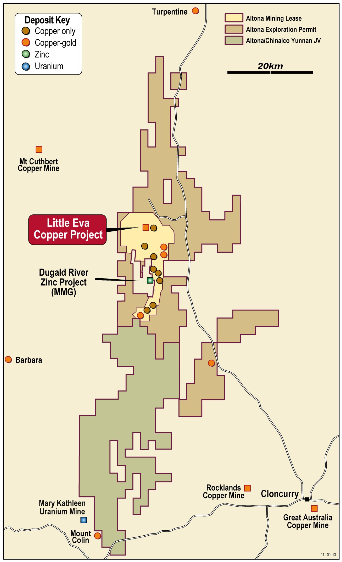
THE BOURSE WHISPERER: Altona Mining (ASX: AOH) has struck an exploration Joint Venture agreement with Chinalco Yunnan Copper Resources (ASX: CYU) where Chinalco may earn up to a 70 per cent interest in the southern tenements at Altona’s Roseby project in Queensland.


Source: Company announcement


Chinalco is 43 per cent-owned by Yunnan Copper Industry (Group), which is a subsidiary of Aluminium Corporation of China.

Under the terms of the agreement:

–    Chinalco must spend a minimum of $1 million on exploration activities in the next two years;

–    Chinalco can earn a 30 per cent interest by spending $2 million (inclusive of the $1 million above);

–    Chinalco can earn a 60 per cent interest by spending $4 million within 5 years; and

–    Chinalco can earn a 70 per cent interest by funding and completing a Definitive Feasibility Study along with a decision to mine on a substantive mining project.

“Altona is concentrating its efforts at Roseby on the Little Eva development through reviewing and updating the 2012 Definitive Feasibility Study,” Altona Mining managing director Dr Alistair Cowden said in the company’s announcement to the Australian Securities Exchange.

“We are seeking a transaction to sell, partner or finance Little Eva whilst minimising dilution to shareholders.

“The Joint Venture with CYU allows us to focus on our extensive northern leases at Roseby (800 square kilometres) whilst retaining what is essentially a 30 per cent free-carried interest to a decision to mine in the southern tenements, should CYU complete the Joint Venture earn-in.”

Explorers tap capital markets

THE FUND RAISER: The glorified lamington drives continue apace as junior miners raise important funding.

Share Placement

Drummond Gold (ASX: DGO) has made a share placement of 35 million fully-paid ordinary shares at an issue price of 0.2 cents per share raising a total of $70,000 to sophisticated investors.

The Placement consists of an allotment of 20 million fully-paid shares at an issue price of 0.2 cents per share to Resource Capital Fund V L.P. which represents the completion of the first tranche of the capital raising to RCF that was announced on 5 September 2013 and an allotment of 15 million fully-paid ordinary shares at an issue price of 0.2 cents per share to Cairnglen Investments Pty Ltd.

The total funds raised under the Placement will be used for working capital purposes and to identify and evaluate opportunities with potential for copper and gold.

After this placement the company will have 270,688,642 fully paid ordinary shares on issue.

Completion of Shortfall of Entitlements Offer and Placement of Options

Laconia Resources (ASX: LCR) referred the market to its announcement on 7 June 2013 regarding its re-issued prospectus for an entitlement issue of (1) share (New Share) at an issue price of 1 cent per New Share for every three (3) shares held on the 19 June 2013, together with one (1) free attaching option exercisable at 6 cents each on or before 30 September 2018 for every one (1) New Share subscribed for and issued (New Option) (Entitlement Offer), to raise a maximum of $915,852.

The prospectus also provided for the issue of 45,792,649 options (Placement Options) exercisable at 6 cents each on or before 30 September 2018 at an issue price of 0.1 cent per Placement Option to raise $45,793.

Laconia shareholders approved the issue of the Placement Options at a general meeting held on 21 June 2013.

The company confirmed the finalisation of the shortfall comprising 59,091,930 New Shares and New Options.

The Company previously announced on 9 July 2013, it had received valid applications for 32,493,270 New Shares and New Options raising $324,933.

Laconia also confirmed the issue of 45,792,649 Placement Options.

Funds raised (before costs of the offer) through the shortfall of the Entitlement Offer and the Issue of the Placement Options is $636,712.

The company indicated the funds raised from the Entitlement Offer and Shortfall will be predominately used for completion of Community Access Agreements and obtaining drilling permit for Rasuhuilca copper-gold-silver project in Southern Peru.

Completion of Placement

Renaissance Minerals (ASX: RNS) announced in July its intention to undertake a two tranche placement and a Share Purchase Plan to raise funds to continue to advance, de-risk and add value to the company’s 100 per cent-owned Cambodian gold project.

Renaissance has confirmed it has now completed the second tranche of the placement with the allotment of 16.31 million shares at 5 cents per share to raise gross proceeds of $0.8 million.

Tranche one of the placement being the issue of 27.69 million shares to raise gross proceeds of $1.38 million was completed on 29 July 2013.

A further 34.2 million shares were issued on 29 August 2013 under the SPP to raise gross proceeds of $1.71million.

$3M raised for next phase of exploration

Corazon Mining (ASX:CZN) has raised approximately $3 million via a placement to fund the next phase of exploration at the company’s Top Up Rise (TUR) project in the Gibson Desert of Western Australia.

Corazon has resolved to raise up to approximately $3 million via a placement of approximately 107.1 million shares at 2.8 cents per share.

The Placement will be completed in two tranches, with up to approx. 61.2 million shares in Tranche One, and the balance of up to approx. 45.9 million shares to be issued in Tranche Two (subject to shareholder approval).

Australian financial services firm and Corazon’s corporate advisor, Hartleys Limited, is the Broker to the Offer.

Funds raised will be used for drilling and exploration activities at the Top Up Rise project, studies and exploration at Corazon’s Canadian gold and nickel projects and for general working capital.

At TUR, the drill rig is already on site and exploration is planned to recommence in the coming weeks, with RC and diamond core drilling, plus a VTEM (airborne electromagnetic) survey to test for zones of massive sulphides.

This next phase of exploration will further test the TUR gravity anomaly and will also test for economic concentrations of mineralisation intersected in the recently completed maiden drilling program.

“It is very encouraging to receive such strong support for the Placement,” Corazon Mining managing director Brett Smith said.

“This is an excellent validation of the prospectivity of Corazon’s Top Up Rise project.

“We will now be fully funded for the next phase of high-impact exploration of this very large mineralised system.”

Placement, Non-Renounceable Rights Issue and Loyalty Option Issue

Metals of Africa (ASX: MTA) has reached agreement on a three part capital raising, involving a placement, a non-renounceable rights issue and a pro-rata loyalty option issue.

Under the three staged capital raising process the Company will raise $2,466,800 before costs.

Funds raised will be used to undertake further exploration activities and a maiden drill program of the company’s recently discovered Rulio prospect.

The Placement has been arranged and the Rights Issue and Option Issue are proposed to be underwritten by Lead Manager, CPS Capital Group.

“We are delighted to work with our supporting broker CPS Capital who has been with us since listing on these capital raising initiatives, and also to welcome new sophisticated and professional investors to the company,” Metals of Africa executive director Cherie Leeden said.

“These funds will allow the company to enter into a maiden drilling program on the highly prospective Rulio prospect whilst simultaneously exploring for additional high priority drill targets.”

Key factors pointing to a resources sector turnaround

GAVIN WENDT: If one looks at long term charts of most metal prices, one sees a very distinct cyclical pattern. When commodity prices are high this stimulates new mine development, but unfortunately it is the nature of things that new mines tend to come on stream at or around the same time. As a result, commodities move into surplus and prices retreat.

This is exactly what we’ve witnessed in the resources space over the past couple of years. Profitability has fallen, uneconomic operations have been closed down (some unlikely to ever reopen) and global production has stalled. But things are beginning to turn – commodity prices in many instances are rising and the resources cycle is beginning to repeat itself.

Most mining companies and sophisticated resources investors comprehend this process well, although a prolonged period of high metals prices (as we saw during the recent boom) often means that this basic premise is forgotten. The short-termism of the financial community also helps compound the process – providing a barrage of funding for all sorts of questionable resource plays during boom times, then slashing financing immediately times turn bleak.

The essence of the resources boom is this: stock prices rise as miners make larger profits; institutional shareholders press for more production (which they see as leading to ever higher returns); banks make lending easier for building of new operations; high stock prices make raising equity capital easier; and miners get carried away in the general euphoria.

The upshot is that many horrendously expensive new projects get commissioned as operating costs escalate out of control – in essence, growth for growth’s sake. Suddenly miners find themselves on the back foot – just as we’ve seen over the past couple of years.

Profits and share prices have fallen, and the same shareholders that were previously calling for expansion are now calling for cost reductions and output restrictions. As a result capital projects are either deferred or cancelled, and exploration expenditure is slashed. Further down the food chain things are even worse with most juniors and mid-tier companies cutting expenditure in a battle for survival until prices start to rise and the cycle begins again.

This is why I am confident that we are starting to see the beginnings of the next resources cycle. There are enough important factors that have emerged over the past few months that indicate that this is so.

1.    Supply side cutbacks are beginning to bite

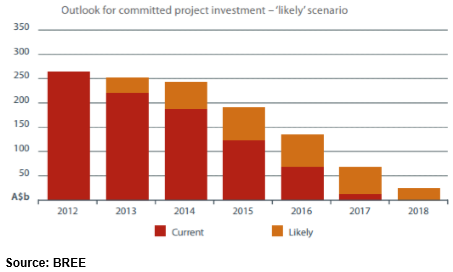
Supply side factors are set to have a major impact on commodity prices. As the chart below highlights, resource companies have slashed their level of committed projects dramatically as a result of lower commodity prices, rising costs, funding difficulties and shareholder pressure. These factors will in turn hasten the onset of the recovery, as future supply restrictions will mean higher commodity prices.


2.    Growth figures are encouraging

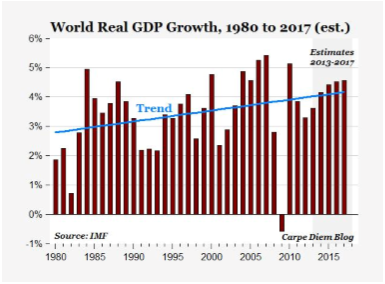
Global growth is beginning to recover – China is still growing at around seven per cent a year, there’s modest growth in the US, and even Europe is showing some signs of life. The outlook for world economic growth in the chart below paints a quite positive picture. Uncertainty about the potential longevity of monetary stimulus has taken some of the shine off risk appetite, but global central banks should continue to provide support given the global recovery is nowhere near being self-sustaining.


3.    Commodity prices are recovering

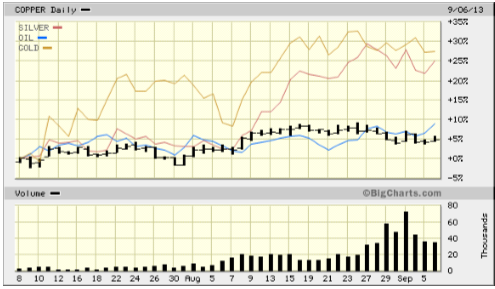
Bullish sentiment for commodities (particularly cyclically sensitive sectors) has picked up over the past month, as indicators of economic activity from China and the Eurozone continue to improve. Several key commodities are performing well over recent months – oil, gold, silver, iron ore and copper. Steel production levels remain solid and iron ore prices are defying gravity.

After a difficult start to the year for commodity markets, demand conditions are becoming more favourable and prices are beginning to reflect the strength of the global recovery. Outside of the agricultural sector, rising supply tightness will continue to be a key trend that provides price support.

The energy and metals sectors will be the main beneficiaries from concerns over reduced production. South African labour developments for platinum group elements, along with unrest in the Middle East and North African regions for the crude market, are the key upside price risks that investors will primarily be focusing on.


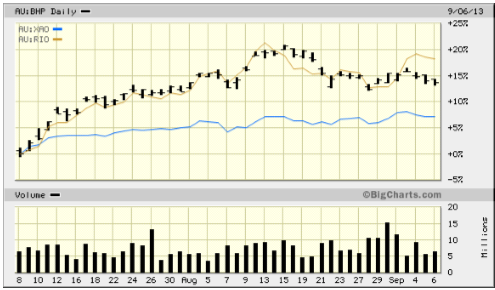
4.    Sector heavyweights BHP and RIO are performing solidly

Any potential recovery in the resources sector always begins with the sector heavyweights. There’s been a steady flow of funds into ‘cheap’ sector heavyweights BHP Billiton and Rio Tinto over the past couple of months, as investors have moved away from the high-yield plays in the industrial space (particularly banks) over the past two years.

This is reflected in the robust share price performances of both companies in the chart below, as they have outperformed the All Ordinaries Index. Over time, funds will trickle down to the mid-caps and junior sector, and as a result access to badly-needed exploration and project funding will improve.


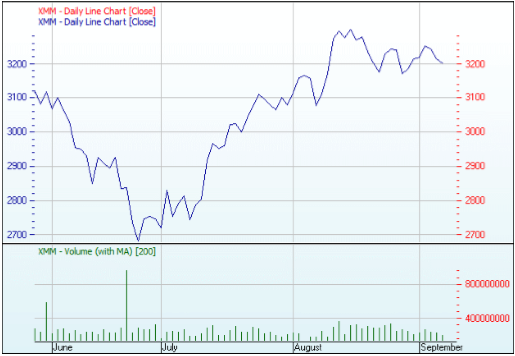
5.    Bargain hunting following EOY tax-loss selling

The chart below highlights the decline in the ASX 300 Mining Index during the latter stages of the previous financial year, followed by a subsequent strong rebound. This is not surprising, as tough markets often result in a ‘clean out’ of underperforming stocks on the part of investors as part of tax-loss selling prior to 30 June.

This also provided the opportunity for sophisticated resources investors who had been eyeing discounted, high-liquidity stocks for some time to dip their toe in the water and begin accumulating. In my view, this accounts for the robust recovery that we’ve seen in the resource equity market since late June to the present.


6.    Change of Government

The Coalition’s win in the recent Federal election should provide a significant boost for resources investors and junior exploration companies in particular. The first reason is change – the market is looking for some sort of catalyst that might provide a boost to sentiment – and a change of government might just provide it.

The second reason for optimism is the Coalition’s desire to implement a flow-through taxation scheme, which would enable a ‘flow-through’ of companies’ exploration expenses to investors in the form of a tax credit. The Coalition said it would allow investors to claim tax deductions on share investments in ASX-listed exploration companies from 1 July 2014.

Known as the Exploration Development Incentive, it would allow investors in mineral exploration companies to claim tax deductions against their investment in companies which were involved in exploration, and which accrued relevant deductible expenses. It would also ensure that the system is not open to abuse by non-genuine exploration investing or rorting.

Finer points of the plan are expected to emerge now that the election has been run and won, but it is expected the scheme will target small exploration companies by limiting eligibility to companies with no taxable income, and will be capped at $100 million over the forward estimates. The plan should stimulate investment in exploration over the next three years.

The plan should provide a strong incentive for investors and shareholders to commit capital to the exploration sector, making investment in small cap explorers attractive again. It should also play a part in helping boost the rate of resource discovery and provide future revenue from the mines of tomorrow.

Gavin Wendt is the founder of MineLife, publisher of the MineLife Weekly Resource Report

What the Brokers Say

WHAT THE BROKERS SAY: Interesting news and views from across the Resource Analyst universe.

Blackham Resources (ASX: BLK)

The Matilda gold project (MGP) covers a large tenement position in the Wiluna Greenstone Belt.

The global resource is 24.8 million tonnes at 1.9 grams per tonne gold (1.5 million ounces) and Blackham is steadily building confidence to transition into production – either on a stand-alone basis or by accessing the nearby Wiluna gold plant.

In a difficult market, Blackham enjoys strong financial support from its cornerstone shareholder Great Central Gold (GCG).

Blackham Resources continues to make significant progress in its aspiration of becoming a self-sufficient gold producer, having increased its MGP resource to over 1.5Moz of contained gold at an average grade of 1.9g/t, as well as steadily upgrading the confidence levels for its resources.

Overall, the MGP resource has been increased by 380 per cent since acquisition of the project in November 2011, most recently upgrading the Williamson deposit resource to 6.3 million tonnes at 1.7g/t gold for 0.35 million ounces, of which 2.7 million tonnes at 1.7g/t gold (0.15 Moz) is now in the Indicated Resource category.

Significantly, the geological interpretation associated with the updated resource model has highlighted further exploration targets and opportunities to test for extensions to the mineralisation–in both open pit and underground settings.

Excellent exploration progress has also been achieved at the M1 deposit (Matilda Mine Area) where a thick, high-grade intersection (35 metres at 5.05g/t gold) confirms the potential for a proposed deepening of the existing open pit.

Blackham Resources is well funded to aggressively advance its exploration and assessment plans, having completed $3.3 million of placements at 21 cents per share to Great Central Gold, as well as reaching agreement to raise a further $10 million from GCG via a Convertible Note facility at 25 cents per share.

Bligh Resources (ASX: BGH)  

Bligh Resources has a portfolio of five projects, predominantly prospective for gold and manganese at varying stages of advancement.

The projects of particular interest from a Breakaway perspective revolve around the Leonora Goldfields of Western Australia.

The Bundarra gold project is a relatively new addition to Bligh’s portfolio.

The company completed the acquisition during late December 2012, acquiring a 42.9 per cent interest in the project.

Bundarra is located within the historic Leonora region of Western Australia and hosts a recently upgraded JORC Resource of 7.48 million tonnes at 2 grams per tonne gold for 489,000 ounces.

The Bundarra acquisition provides near-term production and cash flow potential.

In April ’13, Bligh released the positive results of a Scoping Study which confirmed the development potential at Bundarra.

The Study was modelled on the previous resource of 318,000 ounces at 2.1g/t gold and assumed a nine year mine life based on 250,000 tonnes per annum process feed rate for 156,000 ounces of recovered gold.

Cash costs for the four deposits range between $886 to $1126 per ounce; with an average of $1036 per ounce.

Following the recent approx. 54 per cent resource upgrade to 489,000 ounces at 2g/t gold, the economics parameters of the project are being updated.

The resource upgrade also provides sufficient data for a maiden reserve estimate (expected within the coming months).

The Leonora gold project encompasses 49 square kilometres of prospective tenure and is located just six kilometres from the 3 million ounce Tarmoola gold project.

The company recently boosted its Leonora acreage position with the acquisition of the Little Wonder project, which hosts old gold workings dating back to 1894.

Exploration is at a relatively early stage however these projects augment the company’s Leonora exposure and provide numerous high-priority targets which will be followed up in due course.

The Bootu Creek Two project is strategically located 40km south of the OM Holdings’ (ASX: OMH) Bootu Creek manganese mine, which hosts a 32 million tonnes resource at 22.3 per cent manganese.

Bligh has a 100 per cent interest in a 130sqkm tenement that has been interpreted to host a similar geological and structural setting to that of the Bootu Creek deposit.

The Bootu Creek formation is the primary source of manganese mineralisation in the region.

Bligh has also recently agreed terms to earn up to 80 per cent in the neighbouring tenement, increasing its possible footprint in the area to approx. 266sqkm and ensuring access to rail is not hampered in the event of production.

The Kumarina project is highly-prospective for manganese mineralisation.

A desk-top review examining geology and recent air-core drilling results revealed that the drilling had intercepted paleochannels and supergene manganese enrichment (e.g. 15m at 17.5 per cent manganese oxide from 46m).

The supergene manganese enrichment is within the saprolitic shale zones between the Tertiary surface sediments and fresh bedrock.

The new interpretation of geology and drill results will be used to plan further exploration.

Bligh is an active explorer with a strong portfolio of projects located in well-known producing regions.

The favourable Scoping Study outcomes provide confidence the Bundarra project has sufficient merit to advance towards production.

Our view is reinforced by the recent 54 per cent increase to the JORC Resource which will likely lead to enhanced economics.

Bligh has an enterprise value of just $1.6 million and is highly leveraged to positive news flow.

The upcoming maiden Reserve estimate and revision of Scoping Study outcomes provides near term impetus for a company re-rating.


Disclaimer: The above is intended as a guide only. The Roadhouse accepts no responsibility for investments made from this advice, successful or otherwise.

MacPhersons Resources increases Nimbus lifespan

Since acquiring the Nimbus silver-zinc-gold project just 20 months ago Macphersons Resources has taken it from zero resources to the brink of production.

In July Macphersons released a JORC-compliant resource at Nimbus of 4.9 million tonnes at 149 grams per tonne containing 23.4 million ounces of silver equivalent, including 12.4 million ounces of silver, 65,000 tonnes of zinc and 46,000 ounces of gold.

A feasibility study was indicating potential mine life for Nimbus of around two and a half years.

However, this had not taken into consideration a subsequent resource statement for the company’s Boorara gold project of 7.37Mt at 1.09g/t gold for 258,000 ounces of gold, which added a further four years mine life to the project area.

“The great outcome is we have, effectively, updated the feasibility study,” MacPhersons Resources managing director Morrie Goodz told The Resources Roadhouse.

“Essentially all aspects of the program are completed, having been finalised and independently audited.”

The feasibility study update has established an initial mine plan and schedule for Nimbus of five and half years.

All the Nimbus deposits contain more resources MacPhersons has yet to include in its modelling, which has only included 25 per cent of the resources.

All current silver resources at Nimbus are in the measured and indicated categories, of which Goodz is confident a substantial amount will be converted into the next mine plan.

“The reason we focused on a small portion of the mineralisation is that we have gone to the highest grade portions to reduce the payback period as much as possible,” he explained.

“We are aiming at a payback on the capital of between two to three years and basically, what we have done is focused on a higher grade resource, in particular the underground resource, which averages a recovered grade of 365 grams per tonne silver equivalent, so we can ensure that quick payback.”

The underground stopes at Nimbus form about one tenth of the measured and indicated resource modelled in the potential underground mine development, which the company considers offers the opportunity to double the mine life.


One important aspect MacPhersons has paid particularly close attention to has been cost management.

Over the life of the updated schedule the cost per ounce of silver at Nimbus will range between A$12 and A$16 per ounce, depending on the grade of the deposit being mined at the particular time of the schedule.

“We will initially be concentrating on that underground operation,” Goodz said.

“The main part of the underground operation will be at a cost of between A$12 and A$13 dollars per ounce for the silver.

“We modelled the deposit on a US$19.80 per ounce silver price.

“The current silver price is now between US$23 and US$24 per ounce, and obviously that has added an extra 20 per cent to the revenue side of the equation.

“Even when you look at the positive reporting we have achieved in our financial modelling, the extra 20 per cent increase in that silver price has not been included in our financial models, so I believe the upside there is quite substantial.”

MacPhersons also modelled a gold production price for ore to be mined from its Boorara and MacPhersons Reward mines.

These sums produced a cost price, for the life of the mine schedule, ranging between A$600 and A$1050 per ounce of gold produced, which again is dependent on the grade of the ore being mined at the time.

The first stage of the company’s mine schedule will commence with the Nimbus open pit and underground operations running concurrently.

Once the first stage Nimbus open pit operations are complete, MacPhersons will move the mining fleet to the northern Boorara pit and commence mining the pits at Boorara and start the gold production.


“Initially – for the first two years – the main production centre is focused on silver, but then the gold production starts to increase substantially,” Goodz explained.

“By year four the value of the gold production may exceed the value of the silver production.”

The Nimbus and Boorara projects are only approximately 1000m apart, which means rotating between operations is akin to moving the same mining fleet from one part of the same mine to another.

The two projects are close enough to each other to be essentially one project and one deposit – the difference highlighted by one being silver dominant and the other gold dominant.

“In reality they are still in the same paddock,” Goodz said.

“That is one synergy we gain by being able to have the mining fleet rotate between the pits at Nimbus and Boorara.

“Another is all our overheads – the management overheads, mining team overheads, etc. are all handled by the same people, meaning there is no need to replicate and duplicate our workforce.”

There is, of course, more to come with MacPhersons having identified more than ten similar prospects, most of which are already drill-defined deposits.

These all sit within a 5km radius of the company’s proposed processing facility, providing a long pipeline of projects that can be operated and managed from the one site.

When MacPhersons will be able to get to them, however, is anybody’s guess, as it appears it will be busy at the Nimbus and Boorara deposits for some time.

Particularly at Boorara and MacPhersons Reward where gold mineralisation remains open at depth.

MacPhersons has only modelled a small portion at each of these deposits and at Boorara it claims to have modelled less than 50 per cent of the deposit with 90 per cent of the deposit resource modelling and drilling completed so far reaching just 70m depth below surface.

“We really haven’t touched the surface, considering the local mines, in our region – and along that geological belt – reach depths of up to 1.5 kilometres,” Goodz said.

“The Super Pit is only eight kilometres away, where drilling is reaching depths of three kilometres.

“Boorara is a deep-seated system, of which we have only tested the top 70 metres.”

One popular school of thought concerning any shallow gold to be found close to and around Kalgoorlie is that it has already been found and mined.

MacPhersons is proving shallow deposits do exist in the region, as demonstrated by the discovery of Nimbus Lens No4 discovery only 12m below surface, the Tycho gold deposit outcrop discovery in 2011 and their nickel sulphide discovery in the Kambalda North domain in 2012, all within 30km of Kalgoorlie and Nimbus.

Finding such deposits, it seems, basically comes down to a company being prepared to invest in and carry out exploration.

MacPhersons’ exploration team has been highly successful, something Goodz puts down to the 3D exploration modelling software it uses.

MacPhersons Resources is well on target to meet its stated goal of being in production by quarter three next year.

“We’re keen to move forward from being a developer to becoming a producer,” Goodz said.

“Right now we are scheduled for breaking ground in late quarter one, early quarter two next year.

“We have already started a stockpile – but to ensure that we have a big enough stockpile for continuous flow – we want to start pre-production mining in late quarter one, early quarter two 2014.”

MacPhersons Resources Limited (ASX: MRP)
…The Short Story

HEAD OFFICE
109 Maritana Street
Kalgoorlie WA 6430

Ph: +61 8 9068 1300
Fax: +61 8 9068 1310

Email: info@mrpresources.com.au
Web: www.mrpresources.com.au

DIRECTORS
Ashok Parekh, Morrie Goodz, Jeff Williams

MAJOR SHAREHOLDERS
Ashok Parekh and associated entities                           13.50%
Ray Wright and associated entities                                13.05%
JP Morgan Nominees Australia Limited (Red Kite)           9.24%
Bond Street Custodians Limited                                      8.93%
BT Portfolio Services Limited                                           3.40%

SHARES ON ISSUE
250.3 million

MARKET CAPITALISATION
$78.8 million (at 12/09/13)

The Parkdale Motor Inn

THE HOTEL INSPECTOR: Accommodation for the sole corporate traveller can be a hit and miss affair.

From the outside the Parkdale Motor Inn looks like what you would expect from what has been a landmark on Nepean Highway in Mentone for at least 40 years.

The brown bricked facade has long been a part of the landscape but is, however, a dead giveaway of the time that style forgot, otherwise known as the 1970s, in which the hotel was built.

For many years the hotel, originally known as the Mentone Hub Motel, suffered a bad reputation due to a clientele consisting, what polite society may describe to be, unsavoury elements.

However, a change of name and a new owner prepared to spend money to refurbish the interiors of the rooms has breathed new life into the place.

On this particular trip The Roadhouse was required to stay in the suburbs of Melbourne instead of the main CBD where hotel choice is a lot wider than in these parts.

The first big tick for the Parkdale Motor Inn is that it is a designated stopping point for the Peninsula Airport Shuttle Bus service, which means you get delivered from stepping off your plane at Tullamarine airport directly to the front door. ($31).

Friendly, welcoming staff ensure the check-in process is seamless, from where they direct you to your room.

All rooms are located on two floors that and open onto the ground floor courtyard-come-car park where free off-street parking is available.

The room configuration is simple: a substantial bed, from which you can easily view all free-to-air and Foxtel channels on the wall-mounted flatscreen television; a small table and chairs complemented by a healthy amount of desktop for those needing to work; and a comfy armchair.


The bathrooms are small but are clean and well-maintained and adequate for the task.

As a small suburban hotel the Parkdale Motor Inn offers something too many of its inner-city brethren, for some reason, fail to do and that is to supply free high-speed Wi-Fi Internet access in all rooms.

Breakfast is available, however there are enough cafes along the nearby main strip of Mentone these days serving good coffee with comestible accompaniments it’s worth taking a walk down and treating yourself.

For a couple of nights on the road the Parkdale Motor Inn is right on the money.

202 Nepean Hwy
Parkdale, VIC 3195

AUSTRALIA

P: 03 9584 4222

F: 03 9583 0723

E: stay@parkdalemotorinn.com.au

Coalition promises tax reform for exploration investors

IN THE LOBBY: The opening speeches at the Association of Mining and Exploration Companies (AMEC) conference in Perth included a juicy pre-election bone for the mining industry from the Coalition.

A Coalition spokesman told the conference it intends to introduce an Exploration Development Incentive, which will allow investors to deduct the expense of mining exploration against their taxable income.

The scheme would come into effect on 1 July 2014.

“This is fantastic news for the mineral exploration and mining industry throughout,” AMEC chief executive officer Simon Bennison said.

“AMEC has been advocating for a proactive tax reform measure that will allow current eligible losses to be passed back to their Australian share owners in the form of a tax credit through the well-known franking system.

“The Coalition has listened to industry and recognised the importance of such a policy and the role this plays in maintaining international competitiveness and investment in the exploration and mining industry.

“It will also increase the rate of discovery and lead to the mines of tomorrow, providing future revenue streams for governments.

“These proposed policy changes will assist in making Australia globally competitive once again and hopefully reduce the amount of capital raised in the exploration sector heading offshore.”

The Chamber of Minerals and Energy of Western Australia joined the cheer squad and shook its pom-poms in support scheme.  

The CME said an Exploration Development Incentive would strengthen the pipeline to ensure future mining activity continues to underpin the growth of the Australian economy, allowing investors to deduct a proportion of mining exploration expenditure against their taxable income.

“CME has been calling for incentives, such as a mining exploration tax credit, to boost the critical minerals exploration sector,” CME chief executive Reg Howard-Smith said.

“We have seen the competitiveness of Australia as an attractive place for exploration expenditure decline with research showing Australia’s share of global exploration has reduced from 21 per cent in 2002 down to only 12 per cent in 2012.

“Exploration is the lifeblood of future industry.  With sensible and encouraging policy initiatives such as the Exploration Development Incentive, there are positive signs for establishing the future pipeline of projects.”

CME said it will work closely with the next federal government to see such exploration incentive policies put in place for the benefit of the future growth of the resources sector and the Western Australian and Australian economies.

What the Brokers Say

WHAT THE BROKERS SAY: Interesting news and views from across the Resource Analyst universe.

Evolution Mining Limited (ASX: EVN)

Evolution Mining released its FY2013 Financial Results, which were broadly in-line with our expectations. But more importantly Jake Klein and his team delivered yet again. This time it was on the previously announced dividend policy, despite a large impairment charge wiping out available retained earnings. We believe that EVN is in a good position to build on the productivity and efficiency initiatives implemented and deliver a positive free cash flow in FY2014.

Impairment
The full year review of the company’s asset carrying values, in the context of a lower gold price environment and other factors, resulted in an impairment loss of $384 million across EVN’s asset base.

Maiden dividend
Due to impairment losses, EVN had no available reserves or earnings from which to distribute a dividend payment.

However, EVN will pay an unfranked dividend of one cent per share out of 2014 financial year profits. Our modelling suggests there will be sufficient earnings in FY2014 for the dividend and for EVN to continue paying dividends in FY2014 based on 2 per cent of EVN’s sales of gold and silver, payable in cash.

Underlying Estimates
EBITDA of $211.7 million and net profit of $44.4 million were below the PSL estimates of $241 million and $96 million respectively. This is mainly explained by a $19.8 million inventory charge due to a reduction in Net Realisable Value of $311 per ounce on low-grade stockpiles and the $15 million amortisation of costs associated with the Venue Open pit at Pajingo, which is now closed. We note that 90 per cent of the inventory charge will been reversed at the current spot price of $1,570 per ounce.

Looking forward
EVN has gone past the peak in its capital expenditure program and it is looking to generate sufficient cash from all operations (based on a spot gold price assumption of $1,400 per ounce) next year to cover all capital, exploration and corporate expenditure, including interest and dividend payments.

Global Strategic Metals (ASX: GSZ)

Investment Case
This is an opportunity to invest in Europe’s first primary lithium mine. Europe consumes approximately 24 per cent of lithium produced globally but does not currently produce any.

With a growing demand for this high tech metal and a mine which is partially developed and is kept in survey, we see Global Strategic Metals as an ideal opportunity to gain an exposure to one of the highest grade hard rock lithium mines in the world.

Once the mine has been successfully established we expect that downstream processing will commence with the establishing of an integrated lithium carbonate plant in Wolfsberg.

Potential to Expand Ore Resources
The Zone 1 ore bodies are open both along strike and down dip, whilst Zone 2 has the potential to significantly increase the resource. Some of the funds being raised are to be allocated to drilling to further define the extent of the Zone 1 ore bodies so that the size of the mine and processing plant can be determined.

Highly Sensitive to the Lithium and Feldspar Price
The expected profitability of the proposed mine and processing plant are very sensitive to both the spodumene concentrate (lithium) and feldspar prices. The operation is also expected to produce silica, quartz and road base material, all of which are expected to be sold in Europe. The potential sales of these minerals have been excluded from the base case net present value.

Excellent Location
The ore body is located just outside Wolfsburg in politically stable Austria. The local infrastructure is excellent, with good road and rail connections and a main European trunk gas pipeline passing through the town.


Disclaimer: The above is intended as a guide only. The Roadhouse accepts no responsibility for investments made from this advice, successful or otherwise.

Where to for the Aussie dollar?

ROADHOUSE REGULAR: Acuity Capital’s Stephen Earl takes a look at expectations for the Australian dollar and what this means for resources companies.

The Australian dollar performed superbly during the mining led boom of the 2000s.

Its rise from 65 cents in January 2000 to above parity in December 2010 – a period which also included a jarring if short lived correction during the global financial crisis – ensured that inflation in Australia was kept in check, allowing the Reserve Bank to moderately rather than drastically increase interest rates over the period.

This provided for a strong and stable business environment in which Australian companies could confidently grow and ultimately thrive.


The performance of the AUD over recent times has, however, been a little less ideal.

Until very recently, the dollar has remained stubbornly high in the face of a deteriorating Australian economic landscape, thereby failing to deliver the critical benefits Australian exporters – resources companies chief among them – so desperately crave.

Its fall from above parity to around 90 cents over the past few months has gone some way to addressing things, but not as far as many would expect or like.

In fact, the Reserve Bank itself recently said that the dollar is, “still a bit too strong to help, to the extent it could, in the transition [the Australian economy needs] to make”.

The factors in play
In order to understand what might happen to the Australian dollar going forward, we need to look at its key drivers.

While there are many factors which influence FX rates, the key parameters to consider are: interest rates; general economic conditions; and sentiment.

As far as interest rates are concerned, momentum is certainly pointing to a downward currency move.

As well as recently cutting our benchmark overnight cash rate to a record low 2.5 per cent, the RBA indicated it still maintains a downward bias for the cash rate.

This, coupled with the RBA’s explicit and repeatedly stated want for a drop in the exchange rate, bodes well for a decline in the AUD as ‘yield seekers’ move to higher yielding currencies or other assets.

General economic conditions also point to a drop in the Australian dollar.

While it is a stretch to call the Australian economic situation bad, the economy certainly has less momentum now than in past years largely due to mining infrastructure investment having passed its peak.

Australia’s terms of trade in particular have come off over the past twelve months on the back of a drop in resources prices and a slowdown in China, pointing to reduced demand for the dollar from our trading partners.

As in all economic analysis, sentiment is the great unknown. Unfortunately, the fact that sentiment is hard to predict does not mean it is not influential: the general level of Australian dollar love / hate can have a marked effect on the exchange rate and can act quickly to turn a trending market on its head.

Where to next?
What the Australian dollar should do is, of course, all well and good, but the real question for business is what will it do?

According to Bloomberg, currency analysts are divided on where the Australian dollar is headed over the next two years. If we look at all analyst forecasts made since the Reserve Bank last met and cut interest rates, we get the picture below.


What this says is that, while some analysts believe the currency could again hit parity and remain there for some time, the bulk of analysts see the rate slowly decreasing over the next two years.

Average expectations are that it will finish this year around 90 cents, finish next year around 88 cents and then fall further to 87 cents in 2015.

A significant number are, however, predicting a much steeper decline, with some analysts expecting a rate of less than 75 cents by 2015.

Given the headwinds the currency faces, it is perhaps surprising that analysts are not more biased towards the downside.

In fact, many experienced market players are expecting a far lower rate than the average analyst in short time, with Bloomberg reporting large amounts of sophisticated money heading to hedge funds with expectations of a rate of 75 cents.

Perhaps most critically of all, the one player with real influence in the space, the Reserve Bank of Australia, is very keen to see the AUD fall, suggesting some real firepower sits behind a slow and steady AUD depreciation.

What does this mean for resources companies?
For Australian resources companies, the good news is that expectations of a fall in the Australian dollar mean that fortunes may finally be turning.

As to exactly how big a turn they take, it all depends on where and how you play.

For resources companies with Australian assets, a drop in the Australian dollar is all good news.

The value of minerals exports, virtually all of which are denominated in US dollars, increases in Australian dollar terms with a depreciation in the FX rate, meaning more Australian dollar revenue for a given Australian dollar cost base.

This increases profits as well as providing a buffer against any downturn in global minerals prices, greatly nullifying what many believe to be the key risk faced by the resources sector.

For resources companies with assets outside of Australia, the picture is good overall but a little more mixed.

Assets in emerging markets tend to imply a US dollar cost base (or a cost base in a currency pegged to the US dollar), meaning the benefits of the drop in the Australian dollar extend only to the profits on the minerals extracted rather than on the entire mineral revenue.

This is, of course, still great news, but there is an added complication in needing to get a handle on expectations for the exchange rate of the asset currency itself, something which could have markedly different drivers to the Australian dollar.

The wash up
The bruising twelve months experienced by the resources sector may not be altogether over, but the prospect of a drop in the Australian dollar offers new hope.

In short, the depreciating dollar means there is a ray of light at the end of the resources tunnel.

Stephen Earl is a Director at Acuity Capital, an Australian based provider of capital raising solutions for ASX-listed companies. For more information,visit acuitycapital.com.au or email info@acuitycapital.com.au.