Kula Gold upgrades Woodlark

THE BOURSE WHISPERER: Kula Gold has upgraded the JORC Ore Reserves estimate at the company’s Woodlark Island gold project to 10.39 million tonnes at 2.1 grams per tonne gold for 700,000 contained gold ounces of gold in the Proved and Probable category.


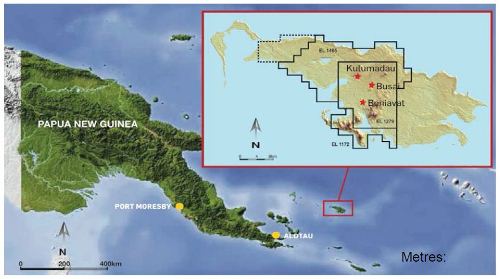
Woodlark Island gold project, PNG. Source: Company announcement

This represents an increase of 20 per cent on the prior estimate the company released in July 2010.

Kula Gold said the new estimate was a result of intensive studies it has undertaken in 2011 as part of its Feasibility Study process.

The Reserve Estimate is based on a conservative gold price of US$1,200 per ounce.

“This substantial increase in our Proven and Probable Reserves at a robust gold grade clearly demonstrates the strength and attractive economics of the Woodlark Island project,’ Kula Gold managing director Lee Spencer said in the company’s announcement to the Australian Securities Exchange.

“We are confident our existing reserve base will be upgraded as our Inferred Resources are infill drilled to higher resource categories in the near term.

“Subsequent increases of project Ore Reserves will further strengthen our project.”

The Kula Gold Feasibility Study has plans for a 1.5 million tonnes per annum processing plant that has the capacity to be upgraded to 2.6Mtpa.

The company remains confident further reserve upside exists for the resource at Kulumadau East and resource upside through future exploration success based on its eight other epithermal targets on the island.

Kula Gold has estimated an initial seven year mine life for the project with the ability to extend that period with any future resource conversion and exploration success.

Caltex closer to closing Australian refineries

Caltex is a step closer to closing its 70-year old Australian refining businesses.

Caltex Australia (ASX: CTX, Share Price: $12.35, Market Cap: $6.1 Billion) has flagged the closure of its two domestic oil refineries at Kurnell in Sydney and Lytton in Brisbane, threatening 800 jobs and possibly marking the end of its presence as a fuel refiner in Australia after almost 70 years.

The refineries supply around one-third of Australia’s petrol needs.

Caltex has written down the value of the refineries by $1.5 billion (from $1.8 billion to $340 million), partly because of the effect of the strong Australian dollar on its business.

The closures would leave Australia with five remaining operating refineries.

The review of the two refineries is about six months from being completed.

The company says no decision had been made, but that the status quo could not continue.

Caltex Australia said its forecast net operating profit for calendar 2011 was unchanged at between $180 million and $200 million, compared to $302 million in 2010.

The review will also investigate how to improve the refineries’ productivity, including expanding the types of crude that could be processed, thus increasing the range of refined products with commercial uses.

Refineries in countries such as India and Singapore are more modern, sometimes producing more than one million barrels a day and handling a wider array of crude oils, compared to an average 100,000 barrels a day for an Australian refinery.

What you might not know is that Caltex isn’t your typical oil company.

What makes it different from the others is that it doesn’t explore for and produce its own oil, like for example BP or Shell.

These are known as fully-integrated energy companies, with upstream operations (i.e. exploration and production (E&P), as well as downstream operations (refining).

Caltex by comparison is purely a refiner of crude oil that it purchases from its suppliers, which it then processes into different types of fuels.

Caltex is also a retailer, owning service stations right across Australia.

Caltex is an interesting situation to reflect upon for a couple of reasons.

Firstly, its problems are symptomatic of those being faced by most value-added, manufacturing industries in Australia at the present time.  

The success of our mining industry has led to a robust Australian Dollar, which in turn is destroying the viability of many other industries.

Rising cost pressures that Caltex and many other businesses are facing are being exacerbated by our strong currency.

Global refiners like Caltex face relatively high input costs, as fuel demand in the United States and Europe remains fragile and cheap supply comes online in Asia.

Caltex’s refining business competes in a regional marketplace, where product can be moved internationally, so the company’s margins are impacted by regional demand and supply dynamics.

Over the past decade, there has been increasing refining capacity built into the Southeast Asian region, particularly in Singapore, where new mega-refineries can produce petrol and other refined fuel products much cheaper than they could possibly be produced here in Australia.

And it’s not just a temporary phenomenon either.

There are structural issues that have made it a tough business to be in for companies like Caltex for some time.

Caltex is one of the biggest refiners in Australia but is competing with Shell on the east coast, which has the benefit of producing its own oil.

Caltex in the future is likely to be just a retailer, running service stations and selling impulse items when you stop to pay for fuel.

They’ll still operate here as a listed company, but domestic refining won’t be part of their picture.

In the meantime, Caltex will most likely concentrate on higher-margin oil products, a strategy that is working well for its marketing unit, which is expected to achieve a record result for 2011.

All of this is a sobering reminder of how important it is to look past the rhetoric typically associated with the petroleum industry.

Governments are always quick to put the boot into oil companies, when in actual fact it’s usually governments that manage to gouge the unsuspecting motorist the most.

Caltex is a refiner and with most motorists constantly griping about the rising cost of filling their tanks, it’s enlightening to examine exactly how ‘lucrative’ the refining business really is.


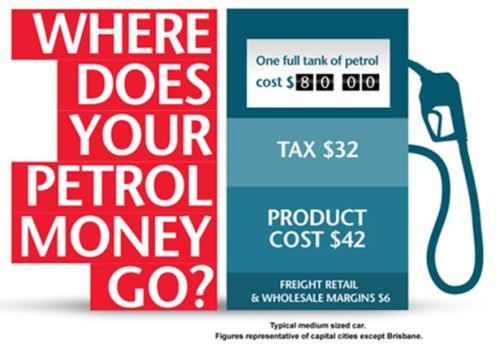
I’ve shown this graphic before, but it’s worth taking another look.

It shows exactly where the money goes from a typical tank of petrol, with governments at both state and federal levels taking the lion’s share.

Given the massive cost of establishing and maintaining refining infrastructure, the low returns generated from the business in Australia really make it a mug’s game.

No rational-thinking CEO would enter the business (or continue in the business) given the return on investment now on offer.

Companies like Caltex therefore appear unlikely to have a long-term future in refining in Australia, given the marginal returns on offer.

This opens up discussions on issues like whether it’s strategically necessary for Australia to have refining operations based here, from a security angle for example.

In the event of some sort of military conflict, surely it’s preferable for us to be able to source own petroleum locally, rather than have to rely on international shipments?

This is the scenario potentially facing Australia if both Caltex and Shell decide to throw in the towel on domestic refining.

National security issues should at least be considered in my view.

We’ll know more in about six months time, but the writing is on the wall for another business that’s suffering as a result of the mining boom.

Gavin Wendt is the founder of MineLife, publisher of the MineLife Weekly Resource Report


Les Davis – Silver Lake Resources

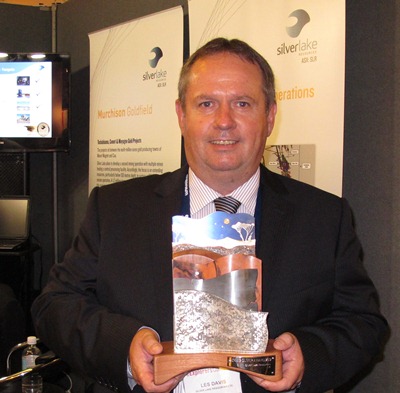
ONE OFF THE WOOD: Silver Lake Resources was presented with the Craig Oliver Award at the 2012 RIU Explorers conference in Fremantle.

Now in its second year, the Craig Oliver Award is bestowed upon an ‘all round’ small to mid-cap Australian Mining Company which has excelled in several of the following areas over the past 12 months:

Exploration; Mining; Corporate; Market results; Environmental; and Community.

The award is in memory of Craig Oliver who passed away on the Sundance Resources plane that crashed in the Congo with the loss of all people on board and is sponsore by Patersons Securities, Atlas Iron and Western Areas.

The Resources Roadhouse spoke to Silver Lake Resources managing director Les Davis after the presentation.


Winning the Craig Oliver Award: what does it mean to you personally and to Silver Lake?

On a personal level; I knew Craig reasonably well through the mining circle.

He certainly was an industry icon, because he fought many political battles to make sure mining is what it is today. That it can be sustainable well into the future.

It is also a very special award for us, because Craig’s sister, Janie Jones, who presented the award today along with Craig’s daughter Georgia; her family owns the pastoral station that we mine on at Mount Monger.

Janie and her Husband, Brendan used to be my neighbours in Kalgoorlie and they are very special friends of mine and my family.

It was very emotional for me today, but very special at the same time.

You were in pretty special company as far as the other nominees were concerned, which probably made the win even more significant.

The other names up on the board included companies, the likes of Regis Resources and BC Iron.

Here we are Silver Lake Resources. The win was totally unexpected, and full credit must go to the judges and to the crew from Vertical Events who were able to keep the result a secret right to the end.

I did not have a clue. When I got up there to accept the award I was speechless, which is not the norm for Les Davis when he gets up on stage, let me tell you.

I think that may have surprised a large percentage of the people in the room.

I was humbled, very honoured and this is a very special award for Silver Lake Resources to win.

It’s probably not totally unexpected that  you should pick up such an award given the fact the Silver Lake story, especially over the last 12 months has been a good one to tell and to listen to.

It certainly has, Wally and I think it’s getting better.

We still have a long way to go, but I think our growth targets are becoming more transparent with each drill hole.

Throw in Philips River, to have that in advanced exploration is good for us, bearing in mind that we now have three project areas.

Mount Monger, which is in production; Murchison, which is under construction and the third area now with the Philips River assets being merged into Silver Lake really gives us transparent growth.

Is there a point where Silver Lake might consider stopping this growth spurt?

I don’t think we should, not while we have the momentum we presently have.

If you were to have asked me back in November 2007 did I think Silver Lake would be an $800 million market cap company from its $30 million IPO, I would have said no.

But back then we did commit to the exploration, that’s where it all starts. It all starts with the geology, without that the rest doesn’t matter.

Our team has done a fantastic job. Not only have they been able to fund our exploration requirements but they have used the money wisely and have got the desired results.

Timing has been on your side as well. You were able to get a lot of that work done before the GFC hit and you had a lot of stuff in place, which allowed you to ride out that storm.

Absolutely. Having money in the bank today is a key, but form day one our strategy hasn’t changed and the assets haven’t changed, apart from the recent introduction of the Philips River assets.

In my presentation today I mentioned that if you wanted a model for what direction Silver Lake could possibly take, I held up Regis Resources in a glowing light.

I have the utmost respect for Mark Clarke and Nick Giorgetta. They have built a $2 billion market cap gold mining enterprise based in Western Australia.

They’re targeting three hundred thousand ounces per annum; we’re also targeting three hundred thousand ounces per annum and their market cap is double ours.

It’s a really good model to aspire to and we’re not going to stop here. We’re on the trail and I’d like to think that our market cap will be north of one billion dollars by the end of the year.

We’re sitting at $800 million but if we can keep getting the runs on the board we could get there.

It’s all about execution and deliverability and, to date, we’ve been able to do that.

Kingrose expands Talang Santo

THE DRILL SERGENT: Recent drilling conducted by Kingsrose Mining at the Talang Santo prospect, part of the company’s Way Linggo project in Indonesia, has expanded the dimensions of the deposit.

Kingrose said the latest three holes drilled at the deposit have all returned high-grade gold and silver intercepts at the extremities of the ore system.

“This has extended the strike of the vein to over 600 metres with excellent results at both extremities confirming the structure is still open, particularly on the Mawi Vein,” Kingrose Mining said in its ASX announcement.

Kingrose has now drilled Talang Santo to approximately 350m vertical depth.

The deepest hole it has drilled returned a solid quartz vein and further evidence the silver to gold ratio is increasing the deeper the company drills.

Details of the drilling include:

–    1.80 metres at 16.29 grams per tonne gold and 12.8 grams per tonne silver from 321.5 metres down hole or approximately 250 metres vertical depth, including 0.80 metres at 36.23 grams per tonne gold and 28.0 grams per tonne silver.

“This hole shows the ore system opening at depth to and along strike to the west,” Kingrose said.

–    3.19m at 7.07g/t gold and 18.1 g/t silver from 352.2m down hole or approximately 300m vertical depth.

“This is the most easterly hole drilled on the Mawi vein so far and this hole has increased the continuity of the vein to over 600m with both extremity intercepts being of excellent grade,” Kingrose said.

–    5.35m at 5.33 g/t gold and 31.1 g/t silver from 456.85 m or approximately 350m vertical depth, including a sub-interval of 0.35m at 46.55 g/t gold and 273.5 g/t silver from 460.85m.

“This is the deepest hole drilled so far into the vein system and reveals a well-developed quartz vein with higher silver to gold ratio and is beginning to show epithermal textures that lead our geologists to believe that the system is getting better with depth,” Kingrose explained.

The company said the latest holes sit outside the maiden mineral resource estimate it announced in December 2011 when it reported an inferred resource estimate containing 879,000 tonnes at 5.89g/t gold and 14.63 g/t silver.

Kingsrose also advised that trial mine development on the Mawi vein is progressing on schedule.

The company said it remains on track for first production late in the June 2012 quarter.

Haranga continues drilling success at Selenge

THE DRILL SERGEANT: Haranga Resources has announced further intersections of high-grade iron mineralisation have been defined at the Bayantsogt prospect, located within the company’s Selenge iron ore project area in Mongolia.


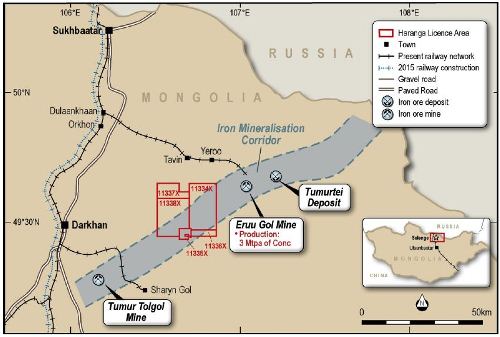
Location of the Selenge iron ore project. Source: Company announcement

The latest assays results represent the final set from Haranga’s 2011 drill program at Bayantsogt, where 31 of the 35 drill holes intersected significant widths of iron mineralisation.

The latest results include:

18 metres at 36 per cent iron from 176 metres, including 8 metres at 48 per cent iron from 178 metres.

16m at 36 per cent iron from 174m;

28m at 35 per cent iron from 155m;

97m at 44 per cent iron from 223m, including 14m at 58 per cent iron from 248m, including 29m at 54 per cent iron from 265m.

15m at 33 per cent iron from 127m, including 6m at 50 per cent iron from 128m; and

41m at 27 per cent iron from 181m, including 3m at 50 per cent iron from 183m.

“The results are considered highly encouraging because this type of magnetite mineralisation has proven amenable to very low cost beneficiation at the nearby Eruu Gol mine, Mongolia’s largest iron ore export mine,” Haranga Resources said in its ASX announcement.

“The Eruu Gol deposit is also hosted within a large hill, resulting in a very low strip ratio.”

Haranga said it is targeting the release of a maiden JORC Code compliant resource for Bayantsogt in March 2012, based on the drilling it has completed so far.

The company has concluded drilling at Selenge for the current field season and is scheduled to recommence in April/May 2012 with drill hole planning for the upcoming field season underway.

The final set of assay results from the drilling conducted at the Dund Bulag and Huiten Gol prospects at Selenge during 2011 are still being processed.

Haranga said its focus for the upcoming season will be on defining and expanding the resources at Bayantsogt and Dund Bulag and to drill the other prospects on the property.

Argonaut hits strong Lumwana intercepts

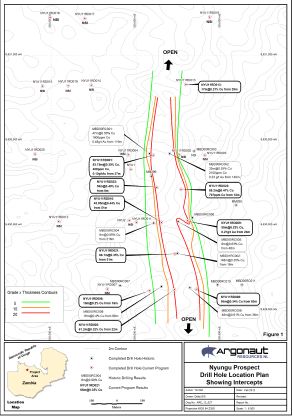
THE DRILL SERGEANT: Argonaut Resources has completed a program of RC precollar drilling at the Nyungu prospect on the company’s Lumwana West project in north-western Zambia.

Although the company is yet to receive results of diamond core tails from this drilling it said it expected the results will extend and enhance RC pre-collar results.


Source: Company announcement


The program targeted shear-hosted copper mineralisation associated with cobalt and gold within the Mwombezhi Dome.

Results have been received for all RC drilling conducted, which Argonaut said show shallow oxide to transitional copper mineralisation striking north south with a strike length of more than 1,200 metres.

Highlights of the latest round of drilling include:

–    88.2 metres at 0.47 per cent copper and 707 parts per million cobalt from 12 metres, including:

o    20m at 1,379ppm cobalt and 0.47 per cent copper from 32m; and

o    34m at 0.67 per cent copper and 708ppm cobalt from 64m;

–    59m at 0.49 per cent copper from 8m including 47m at 0.57 per cent copper from 20m; and

–    45.85m at 0.44 per cent copper from 51m.

“We are very pleased to have received such encouraging results and this further confirms the Board’s belief in the prospectivity of the Lumwana West project,” Argonaut Resources director Lindsay Owler said in the company’s announcement to the Australian Securities Exchange.

“We have only drilled 1,200 metres of the 9,000 merte anomaly at Nyungu and the company believes that there is the potential for strong exploration upside.

“Argonaut is also continuing to develop drill targets at Lumwana, Kavipopo and ZNS prospects on the Lumwana West Licence.

“During the coming field season (April to November), Argonaut plans collect over 1,000 soil samples, more than 40 line kilometres of IP and to drill test strike extensions of the Nyungu mineralisation.”

Paramount hits new gold intersection at Gunung

THE DRILL SERGEANT: Paramount Mining Corporation has received assay results from the final four diamond drill-holes from the company’s first stage due diligence drilling program conducted at its Gunung Rosa gold-silver project in West Java Province, Indonesia.


Map showing location of Gunung Rosa in West Java in relation to major cities. Source: Company announcement


According to the company the results have continued to build on encouraging results the company had received from previous nine diamond drill-holes carried out on the project.

These final last four holes of the program were designed by Paramount to test at the bottom or below the level of previously drilled vein mineralisation to assess changes in vein widths and grades going to depth.

Best results from the latest drilling include:

–    1 metre at 1.17 grams per tonne gold, 1.80 grams per tonne silver;

o    0.7m at 1.35 g/t gold, 1.20 g/t silver; and

o    0.6m at 7.44 g/t gold, 12.5 g/t silver

–    2.55 metres at 1.02 grams per tonne gold, 4.0 grams per tonne silver, 0.17 per cent copper, Including:

o    0.95m at 2.00 g/t gold, 5.60 g/t silver, 0.23 per cent copper, Including 0.65m at 2.57 g/t gold, 6.90 g/t silver, 0.26 per cent copper;

o    18.30 metres at 3.57 grams per tonne gold, 4.22 grams per tonne silver, 0.40 per cent copper, Including:

o    5.50m at 4.12 g/t gold, 0.35 per cent copper, Including 4.40m at 3.12 g/t gold, 0.38 per cent copper, Including 3.20m at 5.77 g/t gold, 0.94 per cent copper.

–    1.20 metres at 0.81 grams per tonne gold, 0.3 grams per tonne silver; and

o    0.4m at 2.15 g/t gold, 56.4 g/t silver, 0.82 per cent copper, 0.53 per cent zinc.

The first two holes tested the base metal-rich Cisudi vein below previous drilling, while the final two holes tested beneath the southern and central sections of the more pyritic copper bearing Cap Palu section of the vein.

“These results have added to our confidence in the Inferred Resources of gold and base metal mineralisation recognised at Gunung Rosa and potential to add to this with additional drilling,” Paramount Mining Corporation chairman Mo Munshi said in the company’s announcement to the Australian Securities Exchange.

“The variation in grade and intersection widths seen in this program was anticipated and is normal in epithermal and mesothermal vein systems.

“Significant is the persistence of wide intersection widths achieved at depth giving scope for increased resources over that previously estimated.

“We can now comfortably move our program of bulk metallurgical and beneficiation testing of ores collected from existing underground development forward, undertake a planned detailed helicopter borne magnetic survey to support ongoing exploration and extend our drill program to systematic testing of recognised veins and new target discoveries.”

Viking Ashanti hits thick gold in Ghana

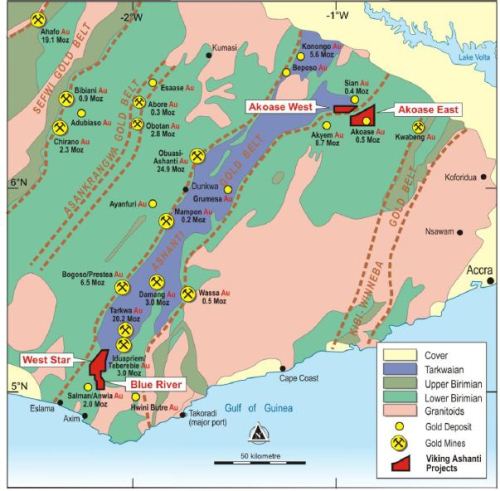
THE DRILL SERGEANT: Viking Ashanti has reported the thickest and highest grade gold intercepts it has encountered at its 100 per cent-owned Akoase East gold project in southern Ghana, West Africa.

The Perth-based company announced that first drilling of previously untested soil anomalies northeast of the Akoase East deposit had identified new zones of mineralisation. 


Project locations in Southern Ghana. Source: Company announcement


The drilling encountered one metre intercepts of up to 11.15 grams per tonne gold.

 
Highlights from reverse circulation (RC) drilling results received to date on the project’s Alimac and Andy Hills prospects include:

RC drilling carried out at Alimac, directly northeast of the Akoase East resource intersected 15m at 4.67 grams per tonne gold and 9m at 3.00 g/t gold, including one metre intervals of 9.99 g/t, 9.13 g/t, 9.14 g/t and 11.15 g/t.

A new zone of mineralisation was also identified over 800 metres strike length at Andy Hills, 2.5 kilometres northeast of Alimac, including 16m at 1.32 g/t gold.

“The results received to date from drilling at the Alimac prospect confirm that the extension of the Akoase East mineralisation continues for at least 200 metres immediately northeast of the current resource,” Viking Ashanti said in its ASX announcement.
 
The company claimed this had been indicated by previous drilling results combined with the latest results, which include:

–    11 metres at 2.06 g/t gold, 9m at 3.00 g/t gold and 4m at 4.69 g/t gold; and

–    2m at 2.57 g/t gold and 15m at 4.67 g/t gold.
 
At the Andy Hills prospect, 2.5km northeast of the Akoase East deposit, 14 RC holes were drilled with best results of:
 
–    16m at 1.32 g/t goldand 1m at 9.48 g/t gold;

–    7m at 1.57 g/t gold; and

–    4m at 1.48 g/t gold and 5m at 0.85 g/t gold.

“These intersections are interpreted to represent a new zone of mineralisation up to 800m long,” Viking Ashantis said.

“A further three strike kilometres of the Kadewaso structural trend, to the northern licence boundary remains to be drill tested.”

Bulls strain at the leash on China retail results

Equity markets lately, while showing some long awaited stability, still have a tendency to swing like the breeze.

North, south, east or west, it could be any direction, and it could be at any rate of velocity.

One minute we are back on the “to infinity and beyond” trajectory, to paraphrase one of my favourite Pixar characters, while in another we are back in the midst of a Greek tragedy, which is not one of my favourite genres.

The world’s financial markets are generally struggling in a classic Bull versus Bear scenario, and at present the bull is edging more forward, albeit at a pedestrian pace, however, the bear, like the proverbial tortoise, is never that far away.

The resident ABC doomsdayer Stephen Long was recently at his very skeptical best, predicting the fire wasn’t out yet.

That would be the ABC approach though, wouldn’t it?

I personally hope that the United States works through its current woes and reclaims its position as global economic beacon.

This hope has been fanned by a number of indicators leaning towards a Chinese slowdown.

The construction super cycle is showing signs of a cool-down apparently, but it is very hard to read Chinese numbers.

US numbers are way more transparent.

There are some schools of thought which would argue that an American renaissance cannot happen without Chinese super growth.

I would argue that eight per cent Gross Domestic Product (GDP) growth is plenty for the American consumer, as is expected in the short term, for the Chinese.

Also, oft hyped rumours of Chinese buying Euro debt are helping any real meltdown.

But, there are mixed signals coming from China.

The city of Shanghai, China’s financial and business centre, saw a rise in its GDP of 8.2 per cent year-on-year to 1.92 trillion yuan ($304 billion) in 2011.

According to a report in China Daily the full-swing economic turnaround was attributed to Shanghai cutting its reliance on fixed-asset investment, heavy and chemical industries, real estate, and labor-intensive processing industries.

The fixed-asset investment in Shanghai rose 0.3 per cent year-on-year to 506.7 billion yuan.

The real estate sector dropped back to 5.3 per cent of the GDP last year, compared to 5.8 per cent in 2010.

Retail sales in Shanghai set the standard by growing 12.3 per cent annually.


The rolling 12 month change in Chinese retail sales domestically. Source: National Bureau of Statistics of China

The day by day ramifications of the markets are confounding.

One day we are back, then the next we are at the abyss. No wonder people have been pulling their money out of equities and managed funds, and going to fixed deposits.

Either way, in the current environment the bull versus Bear battle is very similar to the current recriminations within the Federal Australian Labor party.

In both instances we will know more in the next three months. My feeling is that the Bear and the Redhead will both lose out.

Jody Elliott – The Resource Channel

ONE OFF THE WOOD: The Roadhouse was paid a visit this week by Resource Channel director and Human Resources guru Jody Elliott to tell us the latest regarding her resources employment foucused website.

 

What is The Resource Channel?

The Resource Channel is an employment news website and job board for the Australian resource sector – covering mining, oil and gas, and construction.  

What differentiates us from mainstream media is that where it reports on a project and the number of jobs generated, we break that down to the next level for the job market.  We communicate what jobs will be generated, where those jobs will be generated, what companies they’re with and when they will come on line.  

Would there be any specific project you could use as an example of what The Resource Channel does differently?

The Gorgon project is a perfect example. It was, of course, all over the media at the time of its announcement with speculation of around 10,000 jobs to be created.

To the uninitiated, it would be easy to assume all of those jobs would be with the main company involved in the project, in this case Chevron.

We tracked which companies were awarded which work contracts, the type of jobs and timeframes and delivered this information to the job market.

The site has expanded to be operating in that space since you launched but it is more one dimensional than that isn’t it?

The reason why we originally launched the site was to create a platform to enable employers to communicate directly with the job market themselves.  

So who would your customers be: the employers or the employees?

Both, but from a paying perspective it is the employers.

We enable employers to utilise the site as their communication platform to broadcast their employee and candidate value proposition, the positive elements of their culture, employee achievements, project progress…essentially anything and everything that helps to better educate and engage the job market about who they are and why they should be considered a potential employer.
 
That is useful information, which is not readily accessible for people when they’re looking for it.

Our aim is to make it as easy as possible for the job seeker to find information about employers that is not readily accessible elsewhere.  Most company career websites are very ‘vanilla’ and do not or cannot feature dynamic content.  The Resource Channel enables employers to provide information online that they may already generate for candidates, or even internally for current employees, in other forms like magazines or brochures.  It allows them to bypass the complexity of trying to change their own careers web page.

The other important point to make is that the information provided for the job seeker is free and does not require a log in or subscription to access.

So, for a job seeker your site is a very valuable tool as it allows them to check out what jobs are available and which companies are offering them?

Whether you are actively looking for a new role, looking to enter the industry for the first time or simply wanting to keep informed about what is happening across the industry in the employment space, the site offers a simple one go-to location.

What is the value for a junior company?

Most  companies have a careers website, or at least a company website, but being found and being known in the job market remains a challenge, particularly if you are not well known in the industry.

For junior companies working their way through the development phase of a project, their challenge is generating awareness ahead of their labour needs.

We have examples of organisations like CiticPacific Mining who actively educated the job market ahead of project approval about who they were, what jobs they anticipated and project timelines.

They continued to do this during the construction phase and posted videos and photos to illustrate the site progress.  This was an outstanding approach to engaging the job market well ahead of company needs.

When it came to posting actual vacancies with CiticPacific Mining, they were well known.

In this market, it’s dangerous to be not engaging with the job market during pre-feasibility or at least the construction phase, and prior to the bulk of operational roles coming online.

All too often we see this happen, where the project is approved and 500 jobs are advertised but the market has no idea who you are.  

There is a bit of myth surrounding the industry that you can just catch a plane up north walk into any mining company’s office and be handed a job on the spot.

That’s one of the advantages of the site.

There are some discussions we blog about that are pretty brutal in their honesty in regard to why some job seekers aren’t getting where they want to be.

That way, job seekers can be better informed about what it is they need to do and how.  This is one of the key reasons why industry has embraced our site; because we are providing that up-front reality in a way that they really cannot but would like to.

You have launched a couple of new features lately but the one I find most interesting is the company profiling.

The company profile enables our subscribers to follow a particular company.

If a subscriber just wants to know what Inpex is doing for example, they can nominate to follow that organisation.

This means that every time that organisation posts information, they receive an alert to let them know.

It also enables the company to see how many followers they have across different categories, including ‘blue collar’, ‘professional’, ‘trainee’, ‘managerial’ etc.

And you have also launched a Q&A forum.

We field hundreds of emails every week. We wanted industry to see both the frustration and the questions the job market has.

We also felt that publishing questions will further guide companies on the sort of content they should be providing on the site.

You must be doing something right because you have already won a number of awards.

We won the best national blog website in 2010 and then last year we were awarded best industry website by Reuters International.

So The Resource Channel is obviously one people should be tuning into?

Even if you are not an active job seeker, the site will keep you abreast of movements across the industry.

We had more than 330,000 visitors in 2011 and in January 2012, had our highest number of visitors at 44,500.

This demonstrates a growing interest by the job market for authentic, transparent employment news and information direct from the source – the employer.

Importantly, nearly 30 per cent of our visitors return at least monthly for updates.

This suggests those not actively looking are opting in regularly and for employers, this is exactly the market you are looking to communicate with.