Emmerson begins new drilling at Tennant Creek

THE DRILL SEREGEANT: Emmerson Resources has commenced a new drilling program on its ground holding located within the Tennant Creek Mineral Field.

Emmerson said the $10 million campaign has been designed to enable it to unlock a new generation of copper/gold deposits on its ground.

Last year Emmerson made two significant discoveries at Goanna and Monitor and the company said it aims to build on these during the 2012 field season with aggressive exploration programs and expenditure.

“This new drilling program, starting earlier in the season than ever before, has the potential to be a game changer for Emmerson,” Emmerson Resources managing director Rob Bills said in the company’s announcement to the Australian Securities Exchange.

“The geophysical and geological work we have completed over the past few years, combined with the recent string of drilling success based on the HeliTEM airborne survey completed in 2011, positions the company with what we believe is an unprecedented understanding of the copper/gold mineralisation in the well-endowed Tennant Creek Mineral Field.

“We are aiming to replicate our 2011 success and the 2012 drilling program is shaping up as the most important in the company’s history.”

Emmerson’s new round of drilling will initially extend several previously drilled RC holes that the company was unable to test the potential of for deeper gold mineralisation due to the depth limitations of the 2011 drill rig.

The first diamond hole to be drilled will be an extension to one of the Goanna drill holes, which terminated in mineralised ironstone within the interpreted central shear zone.

Depending on how the Northern Territory wet season shapes up another RC rig is scheduled to commence in early March testing for extensions to the high-grade copper zone discovered at Goanna and Monitor and then move onto new regional targets.

Funding for these programs will come from a mix of the company’s $28 million Farm‐in and Joint Venture with Ivanhoe Australia and from Emmerson’s own healthy bank balance of approximately $12 million as at 31 January 2012.

Black Range gauges borehole technique

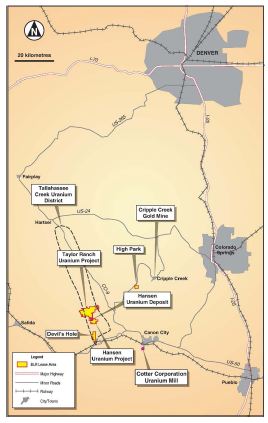
THE BOURSE WHISPERER: Black Range Minerals has had a detailed preliminary technical and economic evaluation of mining conducted on the company’s Hansen uranium deposit located in Colorado in the United States using an engineered hydraulic borehole mining technology.

Location of Black Range Minerals’ Hansen/Taylor Ranch uranium project in Colorado, USA. Source: Company announcement


Black Range said the study indicates Borehole Mining could be a low cost method of mining the Hansen deposit.

Probable mine operating costs have been estimated at US$27 per pound of uranium including cemented backfill but excluding processing costs.

The recent evaluation included the assessment of the Hansen deposit’s geotechnical and geological parameters, to allow the company to develop a suitable approach for extracting mineralised material.

“The result of this preliminary evaluation indicates that Borehole Mining could be an alternative method of mining the Hansen deposit” Black Range Minerals managing director Tony Simpson said in the company’s announcement to the Australian Securities Exchange.

“Previous feasibility studies for both open pit and underground mining methods are currently being updated.”

Black Range said the Borehole Mining technique presented it with a number of many advantages over conventional mining methods.

These advantages include:

–    Environmentally protective;

–    Low capital requirements;

–    Low operating costs;

–    Small surface impact;

–    Selective, high-grade mining if required; and

–    High mining recoveries.

Australian Bauxite drills further wide intercepts

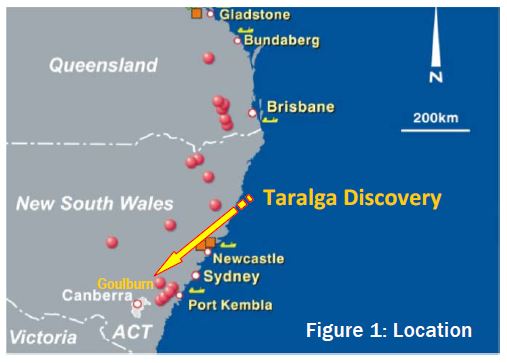
THE DRILL SERGEANT: Bauxite exploration and development company Australian Bauxite (ABx) has completed four new vertical drill holes at Mt Rae, part of the company’s Taralga discovery located within the Goulburn bauxite project in New South Wales.

Source: Company announcement

The holes were drilled around the location of a previous drill hole carried out in December last year, which hit the company’s then record thickest high-grade bauxite intersection of 28 metres.

At the time ABx claimed the discovery to be possibly one of the thickest bauxite intersections in Australia.

The company has announced a thicker bauxite intercept from the latest drilling of 33 metres true thickness of bauxite from surface to 33m depth.

Another of the four holes intersected 24m with the remaining two holes intersecting 32 true thickness of bauxite.

ABx and Marubeni Corporation are currently conducting a $1.5 million pre-feasibility study of the Goulburn bauxite project.

“This zone of thick bauxite increases the resource potential of the Taralga bauxite areas,” Australian Bauxite said in its ASX announcement.

“The district’s deposits contain thick zones of premium grade bauxite, with good potential for more discoveries.

“Areas of thick, good quality bauxite continue to be discovered across the Taralga – Mt Rae Areas.

“It is intended to upgrade the resource estimate for Taralga before the end of the current Pre-Feasibility Study, which is scheduled to conclude at the end of March.”

The current bauxite resources at Taralga total 25 million tonnes.

Kerry Stevenson – Symposium

Resources conference doyen and managing director of Symposium, Kerry Stevenson dropped into The Roadhouse this week to run the measuring tape across our Lang Hancock room as a potential site for one of her upcoming events.

A quick glance at the calendar on your website tells me you’re in for a fairly busy year.

The upcoming year is going to be very busy and that can most probably be credited to the meteoric rise we have had.

Symposium was established at the end of 2009, right in the middle of the GFC, but my view is that if you’re really passionate about what you’re doing it makes life a lot easier.

I love the resources industry, but I can also see where roadblocks exist in terms of how companies market themselves and how they might need to approach things a bit differently than how they have in the past.

Saying that then, what was the first conference, or event, Symposium organised that you feel set you apart from the rest of the pack?

The first event we organised was taking five, fairly well-known Australian mining identities up to China to meet some interesting investment types.

From a Symposium point of view, Australia has a population of 23 million and we have to look beyond our shores for investment.

Having said that there also needs to be a bit of support from, not just the Government, but also the Australian people, who need to realise that we do live in a resource-rich country and we should be doing everything we can to support that.

There is a disconnect from those that work in the resources industry and those that would like to know more.

One of our passions is to help educate all Australians about the industry and the opportunities

We should also be encouraging investment from overseas without, ultimately selling off the farm.

So how does what you do make that difference and help educate Australians?

As a company, Symposium works hard to encourage better dialogue and understanding between industry and the general population.

We look to provide the industry with the opportunity to not continually talk to industry people but to look at everyday Aussies that are keen to understand the industry but just haven’t felt comfortable asking basic questions.

As an industry we need to communicate better with all Australians not just those that work or currently invest in the industry.

When we ran the Gold Symposium in November 2011, which you attended Wally, you would have noticed that there was a lot of people, who I like to describe as, ‘not the usual suspects’, in attendance.

There were people there who wanted to learn more about how and what to invest in, in regards to the gold sector.

People, who hadn’t made the connection before, walked away from that conference understanding that investing in a gold exploration or mining company was another way of investing in gold itself. That’s what makes us feel that we have done our job.

As successful as the Gold Symposium was, the conference world is one where you’re really only as good as your next show, so what do you have in the offing?

We don’t rest on our laurels, Wally. We will be taking clients up to North America at the end of February but not to the usual places but to San Francisco and Denver.

These are areas with real money and a true understanding of the industry and they are thirsty to know more about Australian companies.

We have our monthly roadshows in Sydney and Melbourne and then we have the flagship event “The Resources and Energy Symposium 2012” in Broken Hill from the 21-23 May.

We ran that conference for the first time last year and received amazing feedback.

We hold the event in Broken Hill for two reasons: first because once delegates arrive they are there for the duration of the conference. They can’t just slip back to their offices. That way deeper relationships develop that enable deals to be done.

Secondly, Broken Hill was the town that started the industrialisation of Australia. It was the birth place of some iconic mining houses, as we know.

The whole premise behind the Resources and Energy Symposium, which is a slow-growing gorilla in the room as we move forward this century, is the consumption and cost of energy and you can’t run a mine unless you have access to energy.

It’s not just a conference it is a think tank of some real issues facing the industry such as the coal seam gas issues and the mining and farming debate that needs to be given a good platform. We have an extraordinary line up of speakers.

But more importantly and something we are very proud of is that this Symposium gives back by putting funds aside for scholarships for students. If we don’t look to keep educating the next generation then we are not doing our best to help educate the community.

As big and as bold as the Broken Hill event may become, it may not be as glitzy or as glamorous as your upcoming foray into Las Vegas with the Australian pavilion at MINExpo.

That is an interesting story. We, as one of the world’s leading resources nations, were very close to losing out on having Australian representation at the largest mining expo on the planet, which is only held every four years.

But it has turned out that we will have a market stall in the big tent?

We were delighted that we were able to acquire space at MINExpo and we will be running the Australian pavilion for 40 or so Australian supply companies.

If Symposium hadn’t have put its hand up to take on the task that would not be happening.

This is the largest mining expo in the world and is only held every four years. There will be close to 40,000 visitors over the three days and a fantastic opportunity for Aussie supply companies to market themselves to an international audience.

It sounds like your feet aren’t going to touch the ground for a while, but it will certainly be a fun ride?

It is going to be an interesting ride, but we have the right team on board, and I think we can safely say that we are starting to come of age.

Especially given there were a number of naysayers around when you launched, who doubted that you would get off the ground let alone fly.

You’re right. I heard all the naysayers. I guess that’s a good lesson to be learnt by all business owners.

If you truly believe in what you do and you are passionate about it, just don’t listen to the negative comments.

We get phone calls every day now from people who have heard about what we are doing and want to be involved.  I think they like our can do attitude.

As a company we love the resources industry and we look forward to working with more companies and helping them communicate through our Symposiums.

Natural Gas, a Tale of Two Nations

NYMEX (New York Mercantile Exchange) natural gas has been one of the worst-performing commodities this year; it’s down over 16 per cent already, while most commodities are posting year-to-date gains.

The price reached a 10-year low of US$2.336 per million British thermal units (MMbtu) on the 19 January.

Natural gas in the United States has been a simply story of demand-supply fundamentals.

According to the Department of Energy, US production grew by a record 4.5 billion cubic feet per day (BCF/day) in 2011, while demand grew by just 920 million cubic feet per day (MMCF/day).

Relatively new technologies, like fracture stimulation and horizontal drilling, have enabled trailblazing companies and majors alike to unlock massive natural gas reserves and significantly increase production.


Meanwhile, demand has not kept up with supply, despite the price weakness.

About 27 per cent of natural gas demand in the US comes from industry, which has not been doing all that well recently (GFC-related weakness).

Warm winters haven’t helped either; because 51 per cent of total US demand is accounted for by home use and utilities producing electricity.


The result – a gas price freefall.

In Australia, however, it’s quite a different story.

Liquefied Natural Gas (‘LNG’) demand from Asia (primarily China and Japan) has meant that the booming Australian natural gas supply has been met with surging demand.

Japan is heavily dependent upon energy imports and China’s voracious appetite for energy from any variety has meant that Australia has what the US does not – an export market.


But it’s the future that holds the key for Australian natural gas, and for that future we need to look a little closer to home and to the political dynamic.

Australia is dependent upon coal for generating power; around 77 per cent of our power comes from coal and almost all of our ‘base load’ power is coal-fired.

Either through a “big fat carbon tax” or subsidies and incentives, most politicians are saying they want to reduce this dependency to reduce CO2 emissions.

Not many politicians, however, have stopped to consider the possible real alternatives to a fuel source that providing virtually all of Australia’s base load power.

But we have.

Seismic Research considers that natural gas, something that Australia has no shortage of by any means, presents the only alternative to coal for base load power.

The problem is that a lot of the major natural gas projects are export-only and have committed to off-take agreements.

But with every problem there lies an opportunity.

Natural gas in Australia will benefit from an energy boom in Asia, but it will doubly benefit, in our opinion, from domestic environmental policy.

This is definitely a ‘watch this space sector’ that will be providing opportunities in the coming weeks, months and years.

Howard Humphreys
Director & Research Analyst


Gascoyne completes Glenburgh Resource Estimate

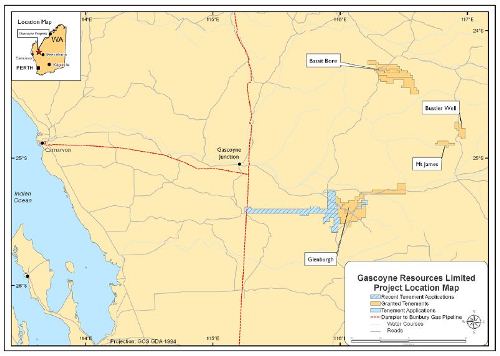
THE DRILL SERGEANT: Gascoyne Resources has completed an update to the Resource Estimate for the company’s 100 per cent-owned Glenburgh gold project in the Gascoyne province of Western Australia.


Gascoyne Resources project locations. Source: Company announcement


The combined Indicated and Inferred Resource for the Glenburgh gold project now stands at:

–    17.4 million tonnes at 1.3 grams per tonne gold for 703,000 ounces of gold.

Gacoyne indicated the highlights from the upgrade to include:

–    A 35 per cent increase in total resource;

–    An increase in global gold grade by 8 per cent over previous estimate;

–    A 26 per cent increase in global resource tonnes over previous estimate;

–    Inclusion for first time of resource in the Indicated category of 1.6 Mt at 2.0g/t gold for 103,500 ounces of gold;

–    First Resources from the Torino deposit, contributing 1.3 Mt at 1.5g/t gold for 65,000 ounces of gold;

–    Plunging high grade shoot at Zone 126 includes Indicated Resource of 200,000 tonnes at 4.5g/t gold for 32,000 ounces of gold; and

–    An increase of gold grade with depth.

“This is a significant achievement by the Gascoyne team to discover and add over 500,000 ounces to the resource base since listing two years ago,” Gascoyne Resources chairman Graham Riley said in the company’s announcement to the Australian Securities Exchange.

“The potential of the Glenburgh Field is still to be fully realised.”

Gascoyne said it will commence a program of diamond and RC drilling at Glenburgh later this month that will include follow up RC drilling at the Torino prospect.

The company also intends carrying out follow up RC and diamond drilling at the plunging “shoot” at Zone 126 as well as RC drilling down plunge of modelled plunging shoots similar to the one identified at Zone 126.

Additional RC drilling will be testing the down dip, down plunge and strike extensions of the known gold deposits at Glenburgh, while exploration RC drilling at the South Western target zone, will be undertaken to define additional targets along strike from the Torino prospect.

The company will also conduct infill Resource RC drilling to allow further resource conversion from the Inferred to Indicated categories.

Gascoyne has commenced a Feasibility Study on the Glenburgh project.

ABM finishes sampling Old Pirate

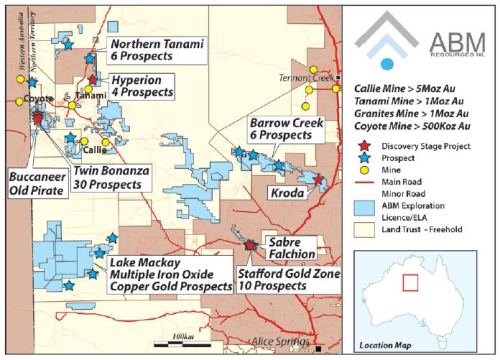
THE BOURSE WHISPERER: ABM Resources has completed the final, Phase 4 of a Bulk Sampling and Trenching program at the company’s Old Pirate gold prospect, which is part of its Twin Bonanza gold camp project located on the Northern territory side of the border with Western Australia.


ABM project location map Northern Territory. Source: Company announcement


According to ABM the Phase 4 results averaged 24.70 grams per tonne gold over a combined vein strike length of 144 metres (118 samples) with a peak value of 320grams per tonne gold.

From the total of 118 samples, 30 graded greater than 10g/t gold with an average of 88.15g/t gold.

Nine samples graded greater than 100g/t gold with an average of 187.55g/t gold.

Individual higher grade vein lengths included:

–    102m strike length vein exposed with average width of 1.1m and average grade of 32.62g/t gold including a higher grade vein portion of 18m strike length averaging 104.9g/t gold.

Combined results from Phase 1, 2, 3 and 4 of the Old Pirate Bulk Sampling and trenching included:

–    726m of combined strike length averaging 24.01g/t gold; and

–    799.4 square metres of total vein area exposed with veins up to 6m width, averaging 1.1m width.

“These results from the Old Pirate sampling program have once again extended the system with some spectacular grades,” ABM Resources managing director Darren Holden said in the company’s announcement to the Australian Securities Exchange.

“It is remarkable to think that these veins are outcropping at surface or just below the shallow soil profile and, in places, are running in excess of 100 grams per tonne gold.

“This sampling program has proven extremely valuable in providing quality spatial and statistical information relating to the distribution of gold at Old Pirate.

“The Western Limb Lodes exposed in Phase 4 extend to the north and head under shallow soil cover.

“Overall the gold anomalism at Old Pirate extends over a four kilometre long trend and the possibility of uncovering further veins with detailed exploration work remains a distinct possibility.”

Pan Aust extends Laos mineralised zones

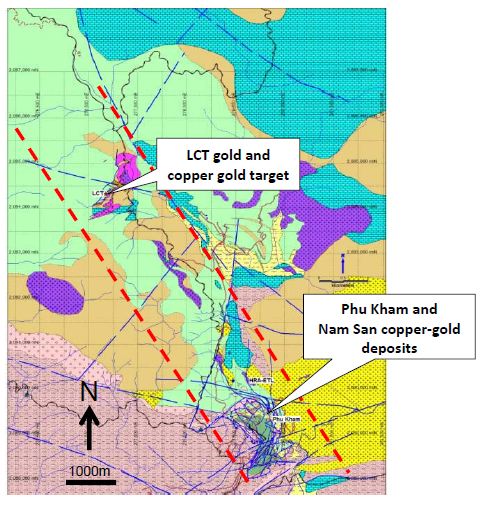
THE DRILL SERGEANT: Pan Aust has claimed drilling results from the company’s Nam San copper‐gold deposit and LCT gold and copper‐gold prospect in Laos have confirmed the Phu Kham district to be a high priority target for exploration and resource development.


Phu Kham district. Source: Company announcement

The latest drilling conducted by Pan Aust at the Nam San copper‐gold deposit has extended the lateral continuity of mineralisation to at least 500 metres.

Drilling conducted in one hole intersected:

–    42 metres at 1.71 per cent copper, 0.38 grams per tonne gold and 6 grams per tonne silver from 522 metres, including 12 metres at 2.83 per cent copper and 0.31 grams per tonne gold from 538 metres; and

–    44m at 1.10 per cent copper, 0.28g/t gold and 2g/t silver from 620m.

Pan Aust said it would be increasing drilling at the Nam San deposit over the next six to twelve months with the objective of defining an inaugural inferred mineral resource in the second half of 2012.

The company has commenced conceptual studies to investigate possible portal locations for underground access, mining methods and mining rates.

Aust said the latest drill results have confirmed a continuous zone of primary gold and copper-gold mineralisation with a strike length of 400m with results including:

–    27m at 1.26g/t gold and 4g/t silver from 108m;

–    22m at 3.20g/t gold and 1g/t silver from 139m; and

–    12m at 0.71 per cent copper, 0.70g/t gold and 44g/t silver from 231m.

“Several types of mineralisation are evident at the prospect including gold‐rich quartz‐carbonate vein sets which is overprinted by a later poly‐metallic copper and silver rich massive sulphide and vein type mineralisation,” Pan Aust said in its ASX announcement.

“Step‐out drilling is continuing at LCT, targeting strike extensions of the mineralisation.”

PanAust said it has established a brown‐fields exploration team to investigate potential extensions to the Phu Kham mineral resource envelope.

These including Nam San, and repeats of Phu Kham‐style mineralisation along the corridor which runs at least seven kilometres along strike of the northern boundary of the Phu Kham deposit.

Forge announces McLaren Maiden

THE BOURSE WHISPERER: Forge Resources has announced a maiden JORC compliant heavy mineral (HM) resource estimate for the McLaren heavy mineral sand deposit, situated within the company’s Eulca West mineral sand project tenements, located in the Eucla Basin Western Australia.


The Eucla West mineral sand project location. Source: Company announcement

The resource estimate for the McLaren deposit has come in at 470 million tonnes at 4.6 per cent heavy minerals for 21.5 million tonnes of contained HM.

The Eucla West project is made up of three contiguous granted exploration licences located approximately 45 kilometres west of the Balladonia roadhouse, on the Eyre Highway in Western Australia.

According to Forge the project was proven to host significant heavy mineral sand (HMS) occurrences in 2009 as a result of wide spaced reconnaissance drilling.

In September last year Forge agreed to enter into a Farm-in agreement that gave it the right to earn 50.1 per cent of the project by spending $2.0 million within two years.

Forge can either elect to earn a further 28.9 per cent (total 80 per cent) by spending a further $4 million over a further three year period, or acquire the project outright with a payment of $7.5 million and the grant of a 1.5 per cent gross sales royalty.

Since the announcement of the Farm-in Forge has completed a program of 212 aircore drill holes to define the deposit.

“The maiden JORC compliant McLaren heavy mineral deposit Resource is now defined at a 500 metre by 200 metre drill spacing over approximately six kilometre strike length, and significantly the deposit is at, or near, surface and remains open to further extensions to the north,” Forge Resources said in its ASX announcement.

“The deposit is contained within three contiguous tenements, which cover an area of approximately 218 square kilometres.”

Mike Young – BC Iron

ONE OFF THE WOOD: BC Iron managing director sidled up the bar into The Roadhouse this week to give us some insight as to what’s happening at the Nullagine irn ore project.


You recently confirmed Direct Shipping Ore mineralisation at the Bonnie Creek deposit. Was this expected news?

Bonnie East has been known to us since we drilled the Nullagine iron ore project resource. It has always been in the Inferred category and to bring it into Reserve we needed to bring it up to Measured or Indicated.

We finally got to drilling that up last year. It took us a while to get around to doing it because we did have a few other things on the go, such as starting an iron ore mine, which some people might be surprised by how much time that can take.

What do the new Bonnie East numbers bring?

It stands at 8.6 million tonnes of Direct Shipping Ore in the Inferred category and our latest round of infill drilling has confirmed all of that to be there.

We have carried out a mining study on the inferred material, all of which went into a pit design, so I would expect to convert that directly to Reserves, which will add another year at least, to our mine life.

Where does Bonnie East fit into your mining schedule?

The important thing to note about Bonnie East is that it is right next door to Outcamp.

We are currently in the middle of year two of our schedule, so by year five we should be moving to a deposit called Coongan.

Coongan is about eight kilometres away with a higher strip ratio, which increases our mining costs.

In any mining operation, what you ideally want to do is carry out all your low-cost operations upfront, to maximise its value.

So with Bonnie East situated adjacent to where we are currently mining at Outcamp, it becomes a higher priority than Coongan, which will now move out a year in the schedule.

It’s interesting to look at your project in terms of the new areas we’re talking about, such as Bonnie East and Coongan, as many people might possibly consider BC Iron to be the Outcamp mine and that’s it.

Outcamp accounts for about half of the project’s Ore Reserve. Wally, you’ve been to site and stood on Outcamp. When you look to the northeast from there you see the line of mesas stretching off several kilometres into the distance called Warrigal Well; part of the reserves.

There are 105 kilometres of channel that we have drilled, from which we have established seven or nine kilometres are mineralised.

Is it all DSO?

We do have a lot of low-grade ore. When I say low-grade, I mean sub 55 per cent but higher than 50 per cent iron.

Some of that has carbonate in it, which means it can’t be easily upgraded, but some of it actually just contains fine sized clay and we think that may be amenable to upgrading.

For example, from the Outcamp deposit we have 10 million tonnes of this that is destined to be mined as waste, but if we can beneficiate it from low fifties to high fifties percentages we can extract value from it.

Are there any plans to expand the BC Iron portfolio?

If we are to really grow as a company the only way to do that is through acquisitions.

We held a strategy sessions late last year and the really important thing to emerge from that was that we have confirmed ourselves to be an iron ore-focused company.  We want to grow, but having spent five years building up exceptional value, we will be a bit picky re: the next project!

There was some press speculation late last year that you were having a look around at different projects?

That wasn’t speculation. I said it, back in October; I said we were looking at other commodities. Part of the reason I did that was a fishing expedition to see what the reaction might be and to see what may be out there.

As it turned out there was a project we could have looked at but our shareholders, by and large, said to us they liked things the way they are.

They said, ‘we really like you guys, because you’re so simple. You mine iron ore, you have ‘X’ tonnes, you get ‘Y’ price, and your costs are ‘Z’. You throw other metals into the mix it makes it complicated’.

One thing that resonated with me was when one of our New York-based shareholders said, “You let us do the diversification. We like you because you’re simple”.

I want to make it clear that they were talking about the company – not me.

Are you sure about that?

I’m pretty sure, although he was pointing at me when he said it…

So we took that on board and considered what our strengths are and what we have learnt about iron ore over the last five years.

We like operating in Western Australia but having said that we’re not limited to WA. We’re looking at all manner of projects.

What is your order of preference?

Our preferences are Western Australia, Australia then overseas. Then we’re looking at hematite DSO, then at BBSO.

What is BBSO?

Beneficiate Before Shipping Ore. You will see people use the term Benificiated DSO, and that’s wrong.

So is this term directly from the Mike Young glossary of mining terms?

Yes it is, and you can be the first to put it in print.

It’s either DSO or it’s not. DSO means you dig it, you put it through a plant and everything you put through the plant goes on a ship.

If anything goes out the back end of the plant – that’s beneficiation.

I call that BBSO, so it’s not misleading.

Your relationship with FMG is still strong?

It is one of the things I’m most proud of. When we did the deal we got a lot of bad press, yet today we are making money and the value of the project has more than doubled since we struck the Joint Venture.

So we have been able to leverage off the upside by doing a JV that people said, at the time, was silly.

A lot of others who said we were silly are no closer to production now than what they were back then.   I am proud that from year one, from day one, we have stuck to our goals and accomplished them.