Chrysalis acquire Zambian Copper project

THE BOURSE WHISPERER: Chrysalis Resources has reached an out of court settlement with the Zambian Government that has allowed it to finalise a 100 per cent acquisition of Zambian copper and 99.9 percent acquisition of Sedgwick Resources; a Zambian company which owns in excess of 3,000 square kilometres of exploration ground.

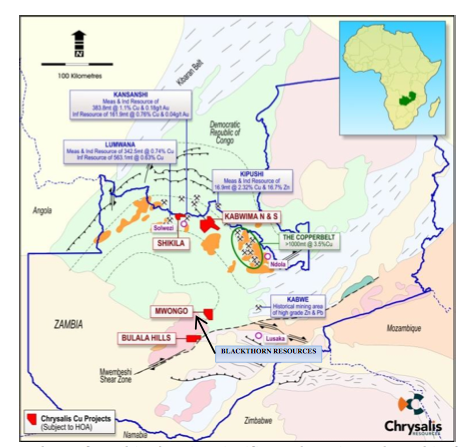
The Northern projects of Shikila and Kabwima North and South, and the Central Zambian project Mwongo (pending) and Bulala Hills are included within the exploration ground area.

In a statement released by the company, directors said they were encouraged by recent drilling results announced to the ASX by Blackthorn Resources from its Mumbwa project, 15 kilometres and 50km respectively from Chrysalis’ Mwongo and Bulala Hills projects.

Geology of Zambia showing significant deposits and Zambian’s Tenements. Source: Company announcement

The Lufilian project area, which includes the Shikila and Kabwima North and South tenements, is located in the North Western Province of Zambia, approximately 400km north of the national capital, Lusaka, and bordering the Democratic Republic of Congo.

The Mwongo project area is located approximately 150km west of Lusaka in the Central Province of Zambia and has an area of 459.2 sqkm.


Chrysalis plans to immediately put in place steps to have its licence application at Mwongo converted from pending to granted.

Postive metallurgical results at Lennons Find

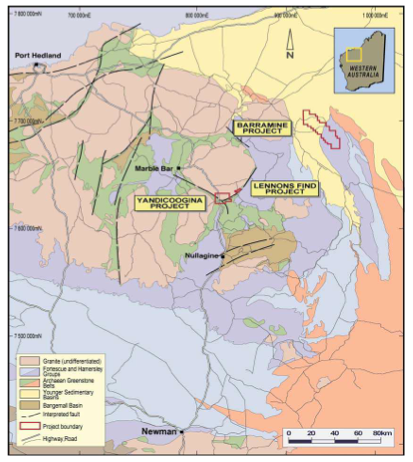
THE DRILL SERGEANT: Perth-based exploration company Laconia has announced that it has returned positive results from preliminary metallurgical test work at its Lennons Find base and precious metals project in the eastern Pilbara region of Western Australia. 


The results come from a recently completed program of metallurgical leach testing on the oxide component of mineral resource at Lennons Find.

The results indicate that the oxide ore from the project is amenable to acid leaching for the extraction of copper and zinc, followed by cyanidation for extraction of Gold and Silver.

The leach recovery results to date suggest a potential two-stage heap leach treatment route for the oxide ore:

Stage 1 – Acid leach recovering the bulk of the copper and zinc,
Stage 2 – Cyanide leach to recover the bulk of the precious metals.

Results included;

  • Sulphuric Acid leach recovered 75 per cent of the copper and 87 per cent of the zinc
  • Subsequent cyanide leach recovered 87 per cent of the gold and 94 per cent of the silver
  • Oxide mineral resource is 197,000 tonnes at 89 grams per tonne silver, 0.37grams per tonne gold, 0.2 per cent copper, 1.2 per cent lead and 1.4 percent zinc in Indicated category.
  • Sulphide mineral resource is 1.65 million tonnes at  81g/t silver, 0.25g/t gold, 0.2 per cent copper, 1.5 per cent lead and 5.6 per cent zinc in Inferred category
  • Total mineral resource is 1.85Mt at 82g/t silver, 0.26g/t gold, 0.2 per cent copper, 1.4 per cent lead and 5.1 per cent zinc in combined indicated and inferred categories


Lennons Find project location map. Source: Company announcement

Future work will focus on column leach testing at coarser crush sizes, which will more closely represent the conditions expected in a small scale/low capital cost heap leach operation.

Laconia acquired a 95 per cent interest in the Lennons Find project from Jabiru Metals in March 2011.

Further drilling is planned at the Lennons Find project to test for additional resources at depth, at the Hammerhead deposit, and to target further oxide resources within the project area.

Dampier Gold identifies Apex drill targets

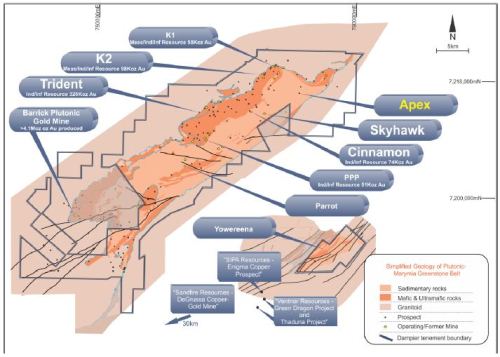
THE DRILL SERGEANT: Dampier Gold has received results from a Mobile Metal Ion (MMI) soil geochemistry program recently conducted on the Apex copper prospect at the company’s 100 per cent-owned Plutonic Dome project located in central Western Australia.


Plutonic Dome project simplified geology and deposit/prospect locations. Source: Company announcement


Analysis of the multi-element assay data has outlined two compelling copper targets.

The company said these targets are coincident with fault structures interpreted from the available aeromagnetic and gravity geophysical coverage over the area.

Dampier has a program of drill testing for these anomalies scheduled to commence early in the June quarter once all approvals have been received.

In the company’s announcement to the Australian Securities Exchange, Dampier Gold chief executive officer Richard Hay described the outcome of the Apex geochemistry program to be, “highly encouraging with two drill-ready targets identified coincident with prominent fault structures evident on the available gravity and aeromagnetic survey data.”

“Drill testing is the next logical step in ascertaining the source to this extensive supergene copper anomaly.”

The soil geochemistry program has also identified several new areas of copper anomalism the company said requires follow-up evaluation.

Dampier also conducted analysis on a suite of pathfinder elements commonly associated with copper sulphide deposits.

It said these displayed a notable absence other pathfinder elements such as arsenic, antimony, lead and zinc associated with the main copper anomalies at Apex.

The company considers the geochemical attributes of Apex to be comparable to other nearby copper-dominant sulphide deposits, such as Ventnor Resources’ Thaduna and Green Dragon projects, where the copper mineralisation characteristically lacks common pathfinder elements.

Steven Michael – Segue Resources

ONE OFF THE WOOD: Managing director of South Africa-focused manganese play Segue Resources, Steven Michael walked into the front bar of The Roadhouse this week, slammed a big black rock on the bar and proclaimed, “That’s manganese, Wally and we’ve got plenty of it!”.

Steven, can you give us a quick run-down on the Emang Manganese project and Segue’s involvement in it?

Segue Resources is farming into the Emang manganese project. We’re going for 30 per cent of the project by spending 14 million rand on the initial drilling program.

That will be completed this month, by the first quarter of 2012, and will culminate in a maiden Resource for the project.

We will then move into the second phase where we will spend up to 21 million rand on a feasibility study and that will take us to a 51 per cent stake in the project.

You have just completed a two million dollar raising. Is that how you will be funding all this upcoming activity?

Most of the two million dollars we recently raised will go into completing the initial drilling program, making payments to vendors, and commencing the scoping study stage of the feasibility study.

Where is the Emang project located?

It is in the Postmasburg region of South Africa, about two and half hours north of Kimberley.

It was the original manganese field of South Africa and produced consistently from around 1925 through to the mid-1980s.

It was typified by, what is nowadays called, medium to high-grade manganese of around 36 to 40 per cent manganese combined with reasonably high levels of iron, anywhere from 10 to 15 per cent, up to 20 per cent iron.

What happened to halt production there in the 1980s?

The manganese producers, which were predominantly Asmang and Billiton, discovered the Kalahari field, which is about 100 kilometres to the north.

The Kalahari field is higher-grade manganese of around 40 to 45 per cent manganese and very low iron, about five per cent iron.

Is that much different to Postmasburg?

Where Kalahari differs from Postmasburg is that most of the manganese mineralisation at Postmasburg sits at surface, or within the first 15 to 20 metres of surface.

The Kalahrai field is more of a dome structure, so Asmang and BHP have got the near-surface and outcropping mineralisation, but the newer entrants to that field, such as Aquila and Jupiter Mines, their projects are all 100 to 200 metres below surface.

Typically projects there are underground and therefore do need the higher grade to justify development.

Was entering Postmasburg a conscious decision or were you just looking for a project and it raised its hand?

It all began with some of the previous directors of Segue Board being involved with a company called ZYL, which is a South Africa-based anthracite coal company.

Through their connections in South Africa they became aware of the project.

I guess what attracted Segue, and myself, to the project was the fact that, even though it was located in Postmasburg, which is considered the second best location for manganese in South Africa, it is near surface and close to infrastructure, we have roads, rail and water all nearby.

In South Africa the biggest challenges usually involve infrastructure.

Therefore, if you’re developing a project that entails moving big tonnes of ore, you are going to struggle as you are going to have to wait for new infrastructure to be put in place.

How do you envisage moving your tonnes around the country?

We are currently assessing three options.

The cheapest solution would be to use the existing bulk rail to port system.

That has the greatest limitations, which is why we are also assessing a road haulage option, which is our third favoured option.

The final solution, and the one that is probably our most favoured, or tying for first, at this stage, is containers.

There has been a lot of work done on the use of containerised bulk movements. It started in the chrome sector and is now moving into manganese.

That would still involve utilising a rail option?

It would be a different train line than that for the bulk shipping.

There is a dedicated train line that runs from Postmasburg to Port Elizabeth, the main bulk export terminal. There are a number of shipping terminals in South Africa capable of taking containers.

What we could end up doing is loading containers onto a flatbed truck to be shipped to a rail terminal, which is just one kilometre away, and from there to Bloemfontein, from where they can be shipped to any container terminal in South Africa.

How does that option stack up against the bulk rail option?

To transport a container from site onto a ship is more expensive than using a bulk rail wagon.

But, getting a container from South Africa to China is cheaper than using bulk shipping methods because container traffic is, presently, predominantly in the direction from China to South Africa.

They are completing the return voyage almost empty and welcome the extra freight.

When you announced the raising you said that a JORC compliant Resource for Emang could be due for delivery as soon as the end of the first quarter this year. Is that still on schedule?

Yes. Having said that it has been delayed, it was due at the end of last year.

That delay came about for a couple of reasons, the first being we had decided on having all our assays carried out by the ALS Laboratory in Vancouver.

There was an issue with the laboratory in Johannesburg, which meant we had to go to Vancouver, and that added about three weeks on the turnaround time on our samples.

What was the second reason?

When we formulated our initial timeline and budget, we expected to have around 600 assays to be completed.

We have actually intersected a lot more manganese that what we had expected.

Our drilling has intersected manganese in about 80 per cent of all of our drill holes.

We were expecting that figure to be around 50 per cent and that we would intersect manganese at widths of around eight metres.

We have had manganese hits in some holes over 30 metres thick.

Hitting extra manganese is not a bad problem to have.

It’s not a bad problem at all but it meant that we had generated around 1500 samples to be assayed rather than the 600 we had originally bargained for.

So, twice as many samples and a three week turnaround for results instead of one has put us back a bit, but I think it will be well worth the wait.


Ventnor Resources enters Dragon country

For most companies entering a second year on the Australian Securities Exchange the term exploration play is generally an apt fit.

For Ventnor Resources (ASX:VRX) , however it is something of a misnomer, given the advanced nature of most of the company’s projects.

Ventnor listed in February 2011 on the back of a healthy portfolio of tenements, most of which have either been previously working mines, or have been subjected to substantial exploration by previous owners.

“We have three project areas, where the bulk of our exploration activity has been taking place,” Ventnor Resources managing director Bruce Maluish told The Inside Story.

“The Thaduna/Green Dragon copper project is in the Doolgunna district of the Gascoyne in Western Australia.

“The Warrawanda/Nickel Hills nickel project is located in the Pilbara region and the Georgina Basin IOCG project is in western Queensland.”


Unfortunately there is not a precise term for a company, like Ventnor, that acquires advanced projects like these, to adequately describe where it sits between the exploration and development stages.

If there were such a term, Ventnor would be the company qualified to coin it.

It would probably run along the lines of the company being a, ‘we are not carrying out exploration drilling to try and discover a project, we actually have projects that were once in production or have been subjected to not much previous exploration, which require us to carry out confirmation drilling to establish the best ways to bring them back to modern production’.

The company’s major project, the Thaduna/Green Dragon, is a perfect example of this conundrum.

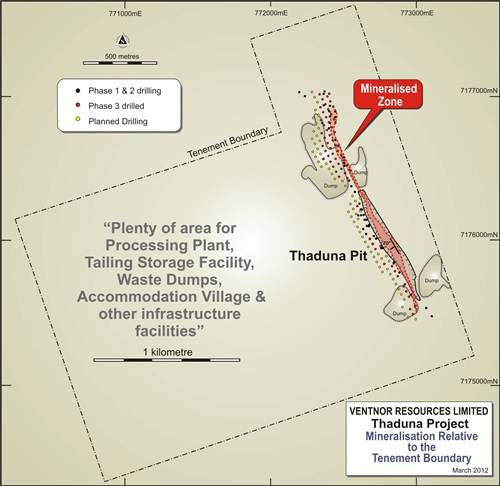
The project consists of the Thaduna copper mine located 175 kilometres north of the Western Australian town of Meekatharra and the Green Dragon mine, which is approximately 4km further north from Thaduna.
Thaduna/Green Dragon came to Ventnor as an advanced exploration prospect with a number of priority drill-ready targets.

Thaduna was discovered by prospectors in 1941 and small scale production continued at the mine until 1953.

It was intermittently subjected to open cut mining and trial underground mining from 1955 to 1971 and a flotation plant operated from 1962 to 1971 producing copper additives for fertilisers.

Having produced 30,290 tonnes at 8.7 per cent copper, the abandoned Thaduna open pit is approximately 700 metres long by 80 metres wide.

The project’s location and potential have been highlighted in recent years by a number of major new copper/gold discoveries in the area, not least of which is the DeGrussa prospect of Sandfire Resources (AS:SFR), situated some 40km to the west.
 

“Doolgunna, at the moment, is probably one of the hottest prospect areas in Australia,” Maluish said.

“There is currently a lot of activity out there, mainly for copper exploration on the back of the De Grussa discovery.

“We have also had some significant results out of the area so far, having conducted three phases of drilling.

“We are currently in the process of a fourth phase.”

Ventnor focused its first phase of drilling at Thaduna in and around an old diamond hole that had been drilled by earlier owners of 9m at 5.22 per cent copper from 80m.

The results from the first phase included:

–    16m at 3.47 per cent copper from 80m;

–    4m at 4.37 per cent copper from 87m; and

–    7m at 5.70 per cent copper from 75m.

Ventnor was encouraged by these results, which it considered to provide a platform for a Resource definition drilling program, and embarked on a second phase of drilling down dip and along strike from the first.

The second phase of drilling results from Thaduna confirmed continuous copper mineralisation with intersections including:

–    5 metres at 4.21 per cent copper from 30 metres down hole;

–    3m at 4.47 per cent copper from 121m;

–    5m at 5.10 per cent copper from 100m;

–    4m at 3.85 per cent copper from 122m; and

–    11m at 5.57 per cent copper from 100m.

Additional copper mineralisation was also discovered along strike 300m north of the existing Thaduna pit.

Second Phase drilling conducted at the Green Dragon prospect also confirmed continuous copper mineralisation with intersections including:

–    2 metres at 9.00 per cent copper from 85m downhole;

–    4m at 2.98 per cent copper from 44m;

–    4m at 7.86 per cent copper from 60m;

–    5m at 6.07 per cent copper from 80m;

–    12m at 5.07 per cent copper from 64m; and

–    5m at 5.93 per cent copper from 88m.

The drilling confirmed an additional hanging wall copper mineralised zone at Green Dragon and also identified an additional footwall zone.

At the time Maluish claimed the drilling program had revealed, in his opinion, the most significant copper results in the Doolgunna District, since Sandfire’s DeGrussa discovery.

A subsequent Phase 3 drilling program commenced in October 2011 and was completed in December 2011.

The Phase 3 drilling of RC and diamond drilling discovered the primary mineralisation at Thaduna.

The deeper holes carried out during the program increased the company’s understanding of the geology and dimensions of the deposit.

Best results from the third phase of drilling at Thaduna returned:

–    10m at 7.53 per cent copper from 134m; and

–    32m at 3.10 per cent copper from 127m.

Green Dragon wasn’t about to be left out of the Phase 3 celebrations and chimed in with some impressive near surface copper mineralisation assays of its own.

These included:

–    10 metres at 6.82 per cent copper from 34 metres, including 6 metres at 10.96 per cent copper from 37 metres downhole;

–    7m at 4.43 per cent copper from 75m, including 5m at 6.07 per cent copper from 80m downhole;

–    19m at 3.33 per cent copper from 63m, including 12m at 5.07 per cent copper from 64m downhole;

–    7m at 4.33 per cent copper from 88m, including 5m at 5.93 per cent copper from 88m downhole; and

–    29m at 2.22 per cent copper from surface, including 9m at 4.00 per cent copper from surface.

The third phase of RC carried out at Green Dragon completed the company’s investigation of the extent of the main zone of mineralisation to a vertical depth of 200m.

The significant high-grade results achieved from the program, at or near the surface, greatly enhance the economics of the deposit by identifying its ability to immediately access ore for production.

Ventnor has maintained its aggressive approach to the Thaduna/Green Dragon project and has kicked off a Phase 4 drilling program of 9,000m.

This time the bulk of the program is to be diamond drilling, which the company expects will be completed in April 2012 with a JORC compliant Resource estimate anticipated to be completed by June.

The Phase 4 drilling program at Green Dragon is intended to achieve 4 goals:

Drill four deeper RC holes to the north to finalise the drill out of the mineralisation to 200m depth;

Drill four shallow holes to the south to follow up the near surface mineralisation;

Drill three RC holes to the east will test a possible second shoot of mineralisation that has splayed off the main mineralised zone; and

Drill two HQ diamond holes within the main mineralised zone to generate metallurgical samples as well as geotechnical data to aid with pit design work.

Ventnor anticipates the drilling of the two HQ diamond holes will add to its geological understanding Green Dragon’s mineralisation.

Ventnor’s original expectation for the Thaduna/Green Dragon project areas was that the ground was typical of the region and would host hydrothermal copper geology.

“We did think that it eroded down to an off-side blanket and the old guys, in the 1960s, had pretty much mined-out that supergene material,” Maluish said.

“Our real exploration target here was the chalcocite below those pits.”
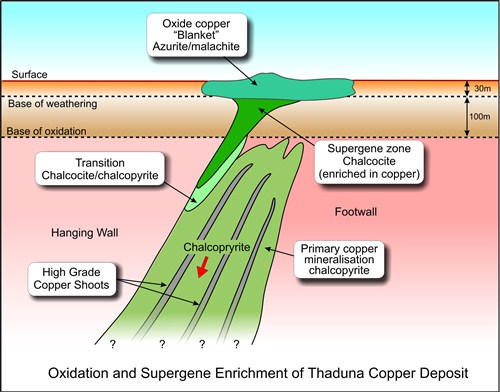
 

In its first two drilling phases Ventnor was hitting the targeted chalcocite, with significant results down dip and along strike from the 1974 diamond holes which yielded the target.

What did whet the company’s appetite however, were the drill holes at Thaduna stopping in 0.1 per cent copper, which meant it had yet to penetrate the footwall.

“When we entered our third phase we instructed the geologist on site, that if he was still in 0.1 per cent or 0.2 per cent copper, he was to push the hole on into the footwall in order to determine what may be within the footwall,” Maluish said.

The geologist did as he was instructed to, having to return a couple of times, first reporting in 0.2 per cent copper.

Another 10m of drilling had struck five metres of visible chalcopyrite and instructions to push further resulted in another 96m and the drill rig had reached its capacity.

“We ended up with a string of extensive drilling results that included 62 metres at 2.19 per cent copper from 125 metres,” Maluish said.

“These were all in chalcopyrite. It was something of a surprise for us, but it also confirmed a conceptual target we then devised on a deeper primary zone sitting within the footwall.

“What we have now discovered is that we have got a mineralised zone of about 1.5 kilometres strike, basically across three major zones, the northern, southern and central zones.

“What we have ended up with is quite different from what we expected from the conventional geothermal modelling.”

Ventnor realised that all its initial drilling had only penetrated the chalcocite at the surface and it was only when it pushed the drilling deeper it discovered, in the footwall, chalcopyrite.

The current 9,000m drilling program, which includes 2,000m of diamond drilling, is in the process of doing just that.

“From that we should establish a greater understanding of the geology and the geometry, in particular, of this deposit,” Maluish said.

“To the point where, near the end of this current program, we should be able to drill holes that will translate into significant tonnes.”

WARRAWANDA AND NICKEL HILLS

Ventnor’s Warrawanda project is located 60kms south of Newman.

The project was subjected to exploration by Anaconda Nickel for nickel-cobalt laterite deposits in 1996 and 1997.

This activity included air-photo interpretation, airborne magnetic surveys, geological mapping, gridding, RAB, AC and RC drilling and metallurgical testwork.

“What we do know about Warrawanda, is that at the nearby Karlawinda project, Independence Group (ASX:IGO) has gold in black shales, at around 140 metres depth,” Maluish said.

“So our drill target at Warrawanda was the interaction between the low-grade nickel in the ultra-mafic and the black shales, and we were expecting a magnetic or EM response, where there might be a concentration of nickel.”
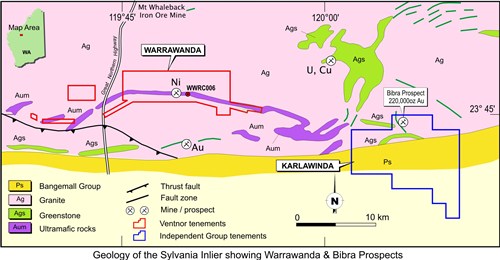
 

Ventnor conducted a helicopter-mounted EM survey and was surprised by the results, which indicated the magnetics fit geological model, almost perfectly.

“Disconcertingly so, because they very rarely fit the geological modelling,” Maluish continued.

“The EM also supported the geological model, so we selected 13 targets and drilled them.”

The drilling confirmed Warrawand as a massive east-west, largely uniform high magnesium ultramafic intrusion with associated low-grade nickel background values of around 0.2 per cent.

It is 15km long and 400m at its widest point and is open at depth.

The drilling returned elevated grades of up to 0.50 per cent nickel, over four metres, including coincident iron and sulphur, which the company read to suggest the project holds potential for mineralisation similar to that found at Mt Keith.
 
“The 13 holes we have drilled over the 15km are really only orientation holes at this point, but we did find some encouraging concentrations,” Maluish said.

“We have our eye on that Mt Keith-style iron-sulphur-coincident assay, and also an Indian-style iron-cobalt assay.

“We have more work to do there.”

Nickel Hills was explored in the 1970s by Pacminex, which conducted geophysics, soil sampling and auger sampling.

Three copper anomalies were identified and six percussion/diamond drillholes were completed, targeting the contact of an ultramafic intrusion.

“The magnetic survey carried out at Nickel Hills indicated that we have around 7.5 kilometres of Banded Iron Formation,” Maluish said.

“Interestingly enough, there are some features running alongside the BIF that were our original targets looking for nickel and copper.

“We have done some mapping there and have scheduled drilling there as well to be undertaken this year.”

GEORGINA BASIN

The Georgina Basin project is located 200km southwest of Mount Isa in northwest Queensland within the Proterozoic Mount Isa Inlier, which is one of the world’s most productive mineral provinces.

It is a significant silver-lead-zinc province, with significant iron oxide-copper-gold (IOCG) and massive sulphide deposits.

“Our Georgina project is a fairly large landholding, which we had granted just last year,” Maluish said.

“We picked it up in 2007, just after the Queensland government had flown a magnetic survey over it in 2006.

“We selected a couple of, what we considered to be interesting anomalies, modelled the magnetic gravity results and identified a drilling target.

“We applied for co-funded drilling from the Queensland government, which it accepted and we plan to drill an orientation hole into the Georgina Basin this year.”

Ventnor Resources Limited (ASX:VRX)
…The Short Story

HEAD OFFICE
Level 1
6 Thelma Street
West Perth, WA, 6005

Ph: +61 8 9226 3780
Fax: +61 8 9226 3764

Email: brucem@ventnorresources.com.au
Web: www.ventnorresources.com.au

DIRECTORS
Paul Boyatzis, Bruce Maluish, Peter Pawlowitsch, John Geary

MAJOR SHAREHOLDERS
Goldbond Super Pty Ltd        5.25%
Ms Neeltje Elisabeth Renes    4.85%
Mash Super Pty Ltd        4.53%
Ms Deborah Mary Schwann    4.53%
Sell Power Pty Ltd            4.21%

SHARES ON ISSUE
51.4 million

MARKET CAPITALISATION
$32.4 million (at 8 March 2012)

China’s Consumption Revolution

HOWARD HUMPHREYS: China announced on Monday a reduction of its growth target to 7.5 per cent, from the previous target of 8 per cent, which has been in place since 2005.

China’s ambition for the coming years is to improve the quality as well as the quantity of its economic growth; in other words it wants to increase domestic consumption.

The recent decision to widen the currency’s trading band largely reflects this move as well; as low interest rates (required for the lower yuan) boost investment, which, in turn, ‘crowds out’ consumption.

The big question is, however, not what impact the lower growth rate will have on your portfolio, but how do you position your portfolio for higher Chinese domestic consumption?

In the early stages of economic development, growth is driven by infrastructure and building development so that ‘early cycle’ metals, like construction steel used in rail and housing, are demanded in elevated levels.

Beyond the initial construction and development boom, there is just replacement demand for these commodities, as buildings need upgrading and rail replacing.

But later in the development cycle, economic growth moves from being driven by infrastructure spending to consumer spending; around 70 per cent of the United States’ economy is accounted for by consumer spending, whereas in China, that number is just 35 per cent.

As a result of growing income, China’s 1.3 billion or so individuals will demand those essential modern consumer goods, like iPhones and other electronics.

What goes into all of these electronic goods you may ask? Solder.

And, with the advent of lead-free solder, this means tin.

In 2006, Indonesia, the world’s largest exporter of tin, declared it would overhaul its tin mining industry.

On 23 February 2007, a number of harsh new measures came into effect to tame ‘informal’ tin mining (mainly small-scale alluvial operations).

Many of these, and subsequent, measures, including environmental permits, advance payment of royalties and metal purity requirements, are standard in countries like Australia.

As a result of these regulatory changes, a number of other reforms since, and declining onshore mine reserves, Indonesia’s mine production is well below the high seen in 2007.

Outside of Indonesia, China, the world’s largest miner and refiner of tin, has been a net importer (on an annual basis) since 2008.

Meanwhile, many companies are effectively boycotting Central African tin, due to its conflict status.


Indonesian Tin Mine (Primary) Production. Source: USGS Mineral Survey, Tin

The result of tight supply and strong demand growth has been persistent market deficits, with the recent exception of 2009 (12,900 tonne surplus).

In response to higher prices, tin miners and smelters have expanded existing operations.

Historic operations are also being re-evaluated and exploration activity has increased.

But few of these developments will make a meaningful supply contribution late 2013 or 2014.

On the balance, we believe that a lacklustre supply growth will continue to result in tin market deficits in the near-term.

But in the longer-term, we hold that strong consumption growth in China will ultimately translate to even stronger growth for ‘late-cycle’ metals, such as tin.

This change in China’s development cycle should ensure that market deficits for tin will continue.

The future looks bright for tin, despite a drop in China’s official growth rate target.

Howard Humphreys
Director & Research Analyst


Laconia gives thumbs up for acquisition of Rasuhuilca project in Peru

THE BOURSE WHISPERER: Perth based exploration company Laconia Resources has completed its due diligence regarding the Rasuhuilca project in Peru and has reached the decision to proceed with its acquisition.


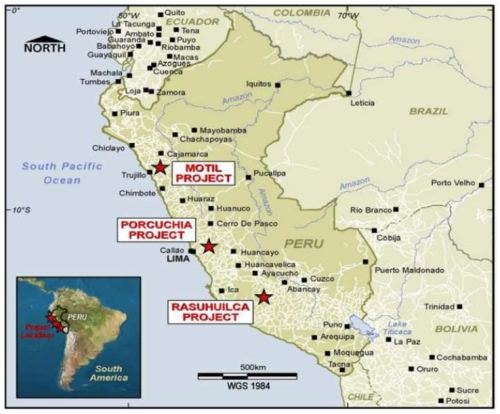
Projects location map. Source: Company announcement


The next hurdle for the company to clear will be to obtain shareholder approval for the deal, which it will seek at a shareholders meeting planned for mid to late April 2012.

The Rasuhuilca project is a high-grade gold and silver project, with outstanding near-term development potential and major exploration upside and is located approximately 500 kilometres south east of the capital Lima, in the southern part of the country,” Laconia Resources explained in its ASX announcement.

Laconia is acquiring the Rasuhuilca project from Perth-based exploration company Gold Mines of Peru.

Consideration for the acquisition consists of:

42.055 million ordinary Laconia shares;

14.5 million performance shares;

$120,000 paid over six months to a third party;

$500,000 from production revenue only if production revenue is reached within five years; and

Dr Saliba Sassine, the Chairman of Gold Mines of Peru, will join the Laconia Board once shareholder approval for the acquisition has been achieved.

As part of the transaction, Laconia will also acquire Gold Mines of Peru’s other Peruvian projects, the Motil and Porcuchia gold-silver tailings projects.

Wolf receives credit approval for Hemerdon project

 THE BOURSE WHISPERER: Specialty metal exploration and development company Wolf Minerals has received £55 million (AU$80.1 million) project finance for the company’s Hemerdon tungsten and tin project located in Devon in southwest England.

The support has come from three globally recognised leaders in mining project finance: UniCredit Bank AG, ING Bank N.V. and Caterpillar Finance.

Wolf said the funding will support the planned construction of the project, based on the Definitive Feasibility Study it completed in May 2011.

The study confirmed the robust economic viability of the project and estimated a post-tax, ungeared net present value of £74 million.

The company said it has commenced negotiations with potential off take partners to provide subordinated debt.

This along with the senior debt funding, will enable Wolf to minimise the equity component of the funding package required to put the Hemerdon project into production.

“This represents a major milestone in the company’s funding plans for the Hemerdon project, and is the first of several significant announcements that Wolf expects to make over the coming months as Hemerdon moves into the development stage,” Wolf Minerals managing director Humphrey Hale said in the company’s announcement to the Australian Securities Exchange.

“Having the support of three such high calibre mining finance providers is a further recognition of the project’s potential to become a major specialty minerals mining operation.”


Mike Ivey – Castle Minerals

 ONE OFF THE WOOD: The Roadhouse was visited by Castle Minerals managing director Mike Ivey who had a lot of interesting things to say regarding his company’s exploration success on its greenfield discoveries in Ghana.


How did the Castle Minerals story begin?

Castle is a company I floated in 2006.

I moved down to Perth from Kalgoorlie and got talking to a friend of mine who had been living in Ghana for around 15 years.

He had started pegging ground over there in his own right. I eventually acquired a package of ground and IPO’d the company on the back of it.

What was the ground like, exploration-wise, back then?

There had not been one drill hole carried out on any of the projects. There was a Ashanti-belt projects that we considered to be remarkably attractive, so we saw the opportunity existed for a junior company to add some value to it.

Had you had much experience in Ghana before this?

None. I was lucky to be able to find it on the map.

The bloke who had originally pegged the ground is my best friend; he has been since our university days.

His experience in the country enabled us to hit the ground with a lot of local relationships already established and a great understanding of how we should operate within the country.

We were able to build on his list of contacts, ranging from expat Australians to Ghanaians.

We still had a learning curve to negotiate but it was without as many road bumps as other juniors entering the region would possibly encounter.

Why did you elect to IPO on land in Ghana instead of Australia?

It’s getting much harder in Australia to make a meaningful discovery from a three to five million dollar IPO whereas West Africa in general provides massive opportunity for a junior explorer.

Plus exploration in Australia comes at a high cost, whereas in Ghana that cost is relatively low.

What sort of progress have you made on the project since listing?

We have found five greenfield gold discoveries and we embarked on our biggest drilling program so far, this year, which is currently underway.

We now have the largest exploration landholding in Ghana.

We found three new deposits in 2011, and increased the Resource base to a quarter of a million ounces.

Those three deposits were all greenfields discoveries; we have gone from target generation, to geochemistry, to drilling them out and hanging a Resource off them.

The bulk of your attention seems to be focused on the Wa project. To you find that you have to explain to people that you are actually exploring in Africa not Western Australia?

I have given presentations where people have commented that they thought we were in Africa and hadn’t realised we had ground in Western Australia.

Can’t you just tell them Wa stands for West Africa?

It’s something people will get used to once they’re more familiar with our story.

Wa is where the majority of work is being conducted.

How are you managing to maintain such a solid work schedule?

We transported our own drill rig last year.

It was shipped it over in a container along with a whole lot of spare parts, almost enough to build another rig.

We cleared customs in January and we have been drilling for the last three weeks at a cost below ten dollars per metre.

As well as saving valuable dollars, having your own drill rig must also be saving a great deal of time?

We have our own rig and the beauty of that is we don’t get delayed by having to rely on waiting for contractors to be ready to carry out our work, we can just move it around our tenements as we need to.

That flexibility is actually quite empowering and our team are really getting a lot of drilling done, averaging 150 to 250 metres per shift.

You’re in a pretty good neighbourhood as far as recent gold discoveries go.

We surround the 800,000 ounce Kunche and the 300,000 ounce Julie projects of Azumah Resources and are just across the border, from Burkina Faso, where Ampella has found three million ounces at Konkera.

We have this massive landholding, which is 200 kilometres north to south. It takes four hours to drive it from top to bottom, and it is over 100 kilometres wide at its widest point.

There’s a lot of activity in West Africa in terms of gold how do you stack up against some of the others in the space?

We consider ourselves to be one of the best value companies sitting in there at the moment, lined up against our peers.

Wa is a cracking project and we are the first ones to be in there drilling and exploring it and unlocking its potential.

We carried out a lot of work last year and now that we have our own drill rig we should be able to get even more done this year while gaining much greater value for our exploration spend as we do.

Do you have any idea yet how far off development or even production may be?

Not yet. We still need to build up the Resource to the critical million ounce point, but that’s our goal.

That’s what we are aiming to do.

Black Range ready to tackle next phase

The appointment of a new managing director has heralded the beginning of a new phase for this Colorado-focused uranium explorer.

The United States of America is the world’s largest consumer of uranium.

Around one quarter of global nuclear reactors are located in the US, devouring 50 million pounds of uranium each year, 85 per cent of which is imported.

In the US, domestic supplies of uranium are at a premium, with just five permitted conventional uranium processing facilities in existence.

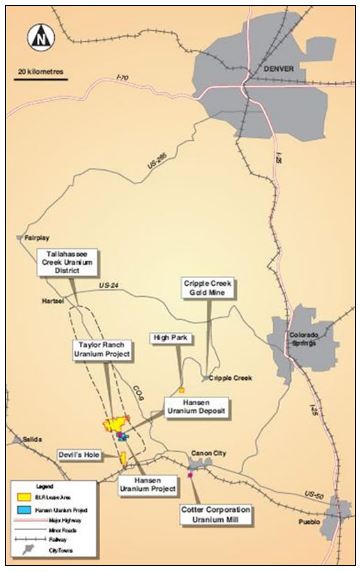
Black Range Minerals (ASX:BLR) currently holds the exclusive right to acquire 100 per cent of the plus-60 million pounds Taylor Ranch uranium project and exclusive rights to acquire 100 per cent of the adjacent circa-30 million pounds Hansen uranium deposit.

As a consolidated entity the company has around 90 million pounds of uranium on its landholdings.

This makes the company’s Taylor Ranch and Hansen uranium project one of the largest in the US and an important vehicle for the US domestic market.

Black Range recently appointed Tony Simpson as managing director.

Simpson brings a great deal of industry experience to the Black Range Board having held a number of senior management, technical and operational positions throughout a 40 year career.

The most recent of these was with ASX-listed Peninsula Energy (ASX:PEN) as chief operating officer where he was directly responsible for the successful exploration and permitting activities of Peninsula’s Lance uranium project in Wyoming.

“The reason I have been brought in as managing director is that Black Range is making the move from exploration to production status,” Tony Simpson told The Inside Story.

“My experience is extensive in terms of bringing projects together, and that is what I hope to bring to Black Range.

“Permitting plays a major role with the decision making involved in mining, and what I was able to learn and achieve with Peninsula Energy gave me a thorough understanding of the requirements that work best for a permitting environment in the US.”

Location of the Taylor Ranch / Hansen uranium project.

Black Range Minerals began exploring for uranium in Colorado in November 2006 after acquiring a 100 per cent interest in the 13,000 acre Taylor Ranch uranium project.

Taylor Ranch now boasts a JORC Code compliant resource of over 60 million pounds of uranium.

In addition to Taylor Ranch, Black Range was also interested in the Hansen project, where between 1977 and 1981 previous explorers had drilled-out the Hansen and Picnic tree deposits to reserve status.

After its initial discovery, the Hansen deposit was subjected to approximately 2,200 holes of exploration drilling.

Three feasibility studies were completed and the deposit was fully permitted for mining in the early 1980s.

Mining at Hansen was never to occur however, due to the collapse of the global uranium price after the “3 Mile Island incident” in 1979.

In June 2009 Black Range acquired NZ Minerals’ 49 per cent interest in the Hansen deposit and in May 2010 agreed on commercial terms to acquire STB’s 51 per cent interest.

By February 2011 final agreements over terms of the acquisition had been refined, providing Black Range an exclusive option to acquire the remaining 51 per cent.

Once Black Range had secured the rights for 100 per cent of Taylor Ranch, the company quickly moved to secure the rights to the Boyer ranch, which is a lease with the State of Colorado.

Having built such an impressive suite of assets in a uranium mining friendly jurisdiction, it is little wonder Black Range was able to secure the services of an experienced campaigner such as Simpson.

With his background in and knowledge of the uranium sector in the US, Simpson didn’t need much encouragement to take his chair at the Black Range boardroom table.

“I conducted a due diligence on the project before I made the move,” Simpson said.

“I knew about the project, and had for some time. I actually thought it may have been an interesting idea for Peninsula and Black Range to have merged a number of years ago to work the project up together.

“However, the opportunity with Black Range arose. The team members I brought with me conducted their own due diligence and agreed that this is a project that can be permitted.”

The company is extremely confident in its ability to develop the project into a mining operation.

Whether extraction will be via open pit or underground operation or by implementing other innovative techniques such as borehole mining is yet to be determined.

“What we have is a very robust ore body; probably one the highest-grade and largest uranium ore bodies in the USA,” Simpson said.

“ We have the opportunity to open pit mine technically and we are currently testing it economically.

“The ore body can be high graded sufficiently to use underground mining methods.

“So we have a number of opportunities available to us from the one project.”

Black Range recently conducted a detailed preliminary technical and economic evaluation on the use of engineered hydraulic borehole mining technology on the Hansen deposit.

“The result of this evaluation indicated borehole mining could be an alternative method of mining the Hansen deposit,” Simpson said.

Mine operating costs, using this method, have been estimated at US$27 per pound of uranium, excluding processing costs.

Simpson said the borehole mining technique opened up a raft of advantages over more traditional and conventional mining methods.

These advantages include being more environmentally protective with a smaller surface impact, as well as requiring low capital expenditure.

The borehole mining technique also offers the ability of selective, high-grade mining if required and can produce high mining recoveries.

Previous feasibility studies for both open pit and underground mining methods are currently being updated.

The quality of the ore body and corresponding ability to high grade is providing the company with some flexibility to adopt different ideas when approaching the permitting of the project.

“The first long-term item to be addressed is the permitting of the project so we have put that train in motion,” Simpson said.

“Hopefully we will be able to time things right so that the permitting and feasibility study are completed at the same time so the decision to mine can then be made.”

Black Range Minerals (ASX:BLR)
…The Short Story

HEAD OFFICE
Suite 9
5 Centro Avenue
Subiaco, WA, 6008

Ph: +61 8 9481 4920
Fax: +61 8 9226 2027

Email: info@blackrangeminerals.com
Web: www.blackrangeminerals.com

DIRECTORS

Alan Scott, Tony Simpson, Michael Haynes, Duncan Coutts, Benjamin Vallerine

MAJOR SHAREHOLDERS
Pershing Australia Nominees 4.46%
STB Minerals 3.98%
Bullseye Geoservices 3.64%
NZ Minerals 3.38%

SHARES ON ISSUE
841 million

MARKET CAPITALISATION

$24.4 million (at 1 March 2012)