Refined nickel price gets a boost

GAVIN WENDT: Here’s some positive supply-side news that’s set to boost the price of refined nickel

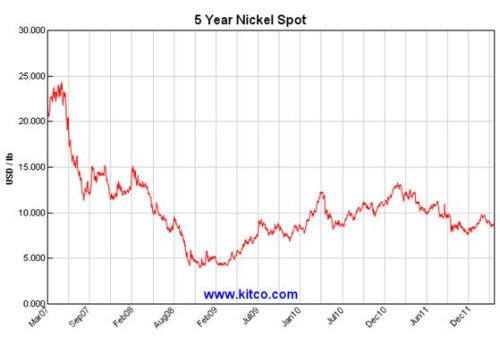
The past few years have been pretty tough ones for nickel, as the five-year price chart below attests.

The price has endured some fairly nasty headwinds, both in terms of a fluctuating demand side and also a burgeoning supply side in the form of cheap Asian pig nickel.

Since the Global Financial Crisis the nickel price has firmed, but not nearly to the same extent as many other commodities.
 

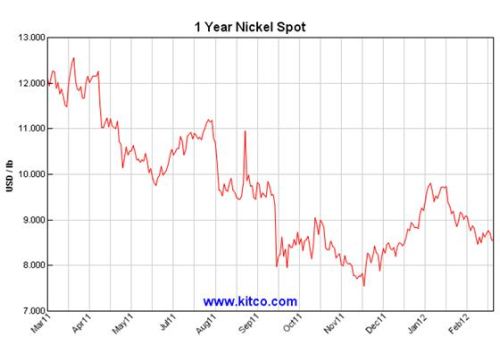
Nickel was actually the second-worst performing metal on the London Metals Exchange during the second half of 2011.

Nickel slumped by more than 40 per cent during the second half of 2011, making it cheaper than pig iron, a substitute made from low-grade ore typically from Indonesia and The Philippines.

However, this looks set to change, with a major potential game-changer announced recently that could significantly cut nickel supplies and hence bolster nickel prices.

Indonesia has advised that it is bringing forward by two years its ban on nickel ore exports.

A recent Bloomberg News report proclaimed that nickel-ore and bauxite shipments from Indonesia, the top supplier to China, could plunge by 75 per cent during 2012 as a consequence of a ban on metal-ore sales that comes into force during May, two years earlier than scheduled.

Indonesia is a major nickel supplier, so this is big news.

Indonesia shipped 33 million metric tons of nickel ore during 2011 (up from 4 million tons in 2008) and 40 million tons of bauxite during 2011 (up from just 8 million tons in 2008), according to data provided by the Indonesian Mining Association.

It was this surge in Indonesian exports of these raw commodities that prompted the government to advance the ban on companies that hold mining business licenses for production operations.

The government effectively wants to see more value-adding, instead of exports of pure raw materials.

Indonesia is the major supplier to China, so any impact on supplies is likely to have a very positive impact on nickel prices.

Data shows that China buys around 80 per cent of Indonesia’s bauxite imports and 53 per cent of its nickel-ore purchases.
 

Declining shipments from Indonesia is likely to generate increased competition for supplies amongst Chinese processors – potentially benefiting nickel-ore mining companies elsewhere, like those in Australia for example, as prices are likely to rise.

The move is also likely to increase China’s demand for refined nickel as a substitute for nickel-pig iron, which is positive for traditional Australian nickel companies.

Nickel has dropped by 30 per cent on the London Metal Exchange over the past year, largely as a result of cheap pig nickel.

The situation in Indonesia is that miners with Contracts of Work, including heavyweights Freeport-McMoRan Copper & Gold and Newmont Mining, will be allowed to export ores until 2014.

The immediate ban will mostly affect small miners, as the country’s major nickel producers PT Vale Indonesia and PT Aneka Tambang have already started local processing.

The decree, signed by Energy and Mineral Resources Minister Jero Wacik in February, will ensure miners process ores locally, boosting state revenues and ensuring supplies and investments in the local industry.

Exports will be allowed in processed metal, such as ferronickel and nickel-in-matte, and smelter- or chemical-grade alumina.

It is understood that business license holders could be exempted if they submit ore processing plans.

Indonesia shipped 25.7 million tons of nickel ore to China last year, according to Chinese customs data, which compares with 22.1 million tons from the Philippines, making Indonesia the biggest supplier to China.

Indonesia supplied China with 36.1 million tons of bauxite, while Australia sold 8.4 million tons, ranking as the second-biggest supplier, according to official data.

The critical trade market impact would be that Indonesia exports more refined metal over primary ore.

It produces 15 per cent of global nickel ore and just one per cent of refined nickel.

Chinese nickel- pig iron makers will therefore find it difficult to fully replace lost Indonesian supplies as ore from the Philippines is used more for its iron content.

Furthermore, nickel-bearing ores from Indonesia are generally laterite ores, which means Chinese production of nickel-pig iron will be affected.

Nickel laterite ore can be processed into nickel-pig iron as a substitute for the refined metal for use in stainless steel.

This situation has had a dramatic negative impact on nickel prices over recent years, so hopefully things will improve significantly.

The Chinese to some extent had already begun to purchase more refined nickel, as pig iron has become more expensive over the past six months.

Nickel pig iron has typically been a source of swing production – meaning it’s there when nickel prices are robust, but falls away when prices ease.

In terms of demand-side factors, looser capital rules that have recently been implemented could also have a major impact in terms of raising economic expectations for China, which in turn could drive base-metal prices higher on the expectation of increased demand.

It certainly seems to have played a role in terms of the recent price performance of copper during 2012.

So the outlook is positive in my view for nickel plays for 2012 and beyond.


Gavin Wendt is the founder of MineLife, publisher of the MineLife Weekly Resource Report


Resources Roadhouse Issue 40

All eyes are on the Big Pineapple this week as the Queensland State election is finally held.

There hasn’t been so much anticipation and excitement in the land of the white-shod pensioner since Matilda, the winking kangaroo opened the 1982 Commonwealth Games.

The Roadhouse has volunteered its services as a polling booth this Saturday for any Banana-Benders out on the road, be they grey nomads or old members of Bob Hawke’s surf team who still haven’t found their way home.

We were setting up the cardboard booths and sharpening all the HB pencils in the lounge bar when a sudden commotion emerged from the kitchen.

With a metal colander on his head, living Australian legend Clive Palmer was incoherently babbling something about scientologists, the CIA and that we all needed to cram into his DeLorean and drive to some futuristic coal mine.

It was an unwelcome distraction from the interesting chat we were having with Canyon Resources managing director Phillip Gallagher, who had just dropped by for one of The Roadhouse’s famous steak sandwiches.

Seeing the kitchen’s colander perch atop Big Clive’s bonce, Roadhouse Regular Peter Hayes quickly changed his order from Spaghetti Bolognese to a Ham and Cheese toastie.

It all happens at The Roadhouse.

The Roadhouse Dictionary of Australian Language

The Roadhouse has an audience reaching beyond these shores that are girt by sea that has requested we explain a few local idioms.

Language is the mainstay of modern civilisation. It is an organic being and always subject to change.

We encourage our readers to contribute to our dictionary. Please send your submissions to wally@resourcesroadhouse.com.au

The Roadhouse is a family establishment so please keep your contributions publishable.

A

Africa: Where Australian-based, ASX-listed companies search for gold.

Australian Innovation: Something the country has in spades but, unlike 1982, now lacks the provision to put any of it into action.

See: Matilda the Winking Kangaroo

Australian Securities Exchange: Because most investors don’t feel too secure these days is colloquially referred to as the Australian Stock Market.

B

Banana Benders: Colloquial term used for Queenslanders due to the tropical state’s banana trade being for a large chunk of the country’s intake.

Big Pineapple, The: A 16 metre-high landmark and tourist attraction, which is a working pineapple and nut farm situated at Woombye near Nambour in Queensland.


Set a trend for the proliferation of ‘Big’ tourist attractions around the country.

See: Pineapple, Rough end of.

Bob Hawke’s Surf Team: In the 1980s many Dole recipients would be itinerant surfers who would collect their dole checks from Post Offices up and down the coastline of Australia as they chased the best waves.

Put to end by former Prime Minister John Howard’s, Work for the Dole scheme.

See: Un-Australian.

Brothel Creepers: The name given to white shoes worn by retiree males; especially those moving to Queensland from colder southern states.

Burkina Faso: See Africa.

C

Canada: Apparently where all mining companies will go once the Mining Tax settles in.


See: Mining Tax; MRRT;RSPT.

D
Diggers and Dealers: (aka Diggers) An annual conference held in the wild Western Australian town of Kalgoorlie where mining companies, financial institutions, and members of The Media gather to tell each other how good they are.

See: Skimpies

E

F

G

Gold: Best performing commodity price-wise since the Global Financial Crisis.


See: Africa.

H

I

Iron Ore: What BHP Billiton, Rio Tinto, and Xstrata allegedly won’t be paying taxes on.


J

K

L

M

Matilda the Winking Kangaroo: State-of-the-art robot kangaroo that was the mascot for the 1982 Brisbane Commonwealth Games.


Set the world alight with its breath-taking technology, which enabled it to wink at the camera.

See: Australian innovation.

Mining Tax: First came to public attention in The Henry Report and picked up and run with under the banner of the Resources Super Profits Tax (RSPT) by the Labor Government, led by then Prime Minister Kevin Rudd.

The tax was fine-tuned through a conciliatory process inclusive of government, by this stage led by Prime Minister Julia Gillard, and the three biggest mining outfits in Australia, BHP Billiton, Rio Tinto, and Xstrata, to become the Mineral Resources Rent Tax (MRRT).

The three companies have since been reported in the press to be allegedly bragging to senior Liberal politicians they won’t pay a cent extra in tax.

Did they ever?

See: RSPT; MRRT.

N

O

P

Pineapple, Rough end of: Something not everybody would like to receive, especially given the way it is intended to be delivered.

See: RSPT; MRRT.

Q

R

S

Skimpies: Barmaids who work in the hotels of the wild Western Australian town of Kalgoorlie during Diggers and Dealers. 

T

U

Un-Australian: Term coined by John Howard to describe anything that detracts from the idyllic Australian lifestyle.

See: Bob Hawke’s Surf Team.

V

W

White shod pensioner: (aka White Shoe brigade) Queensland became the go-to place for Australian retirees. The chosen footwear by most male retirees became white slip-on shoes.

See: Brothel Creepers.

X

Y

Z

Monax identifies graphite potential on Waddikee Project

THE BOURSE WHISPERER: In a release to the ASX today, Monax Mining announced plans for a drilling program to test widespread graphite evident from previous exploration at its Waddikee Project on the central Eyre Peninsula, South Australia.


The planned exploration program follows a comprehensive review by the company of historical exploration data showing in excess of 20 drill holes with reported graphite on the Waddikee tenement.


“Monax has for some months been collating historical drill hole information and reviewing all available geophysical data specifically focused on the graphite potential at Waddikee,” Monax managing director, Gary Ferris, explained.


“This review has provided us with confirmation that our tenement is highly prospective for graphite, and our Board has approved a graphite focused exploration strategy for Waddikee.”


“Our initial graphite exploration will comprise on-ground geological mapping and sampling and reviewing available drill hole samples, followed by a drilling program to evaluate the prospectivity,” he said.

Location of the Waddikee project, central Eyre Peninsula, highlighting graphite and iron projects. Source: Company announcement
 
South Australia’s Eyre Peninsula has become the focus of graphite exploration in response to increased prices and reduced supply.

Graphite Exploration Program

Graphite is highly conductive and this makes graphite easy to detect via electrical geophysical methods.

Six target areas have been identified as containing prominent conductivity anomalies and/or graphite identified in surface samples and therefore these target areas will be the focus of Monax’s initial exploration for graphite on the tenement.
 
Any samples from the current drilling program which contain graphite will be assayed by Monax to ascertain the carbon content.

Phillip Gallagher – Canyon Resources

ONE OFF THE WOOD: Canyon Resources managing director Phillip Gallagher is a busy man with his company currently working up five greenfields projects in the gold boom African country Burkina Faso.

As busy as he is he was still able to take a few minutes to tell us what progress Canyon is making.

You have a number of project areas in Burkina Faso, but which is your main focus at this stage?

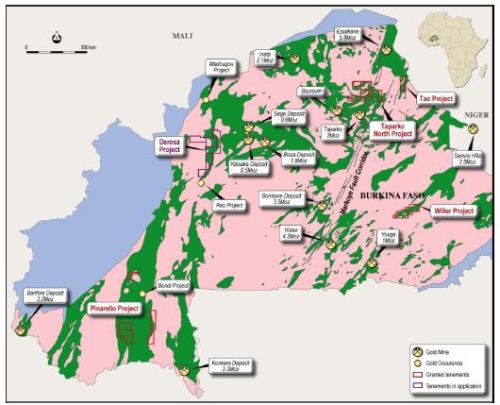
The Tao project, which is a stand-alone permit located up near the Niger border, in the northeast of Burkina Faso.

What was it about the Tao project that propelled it to the top of your to-do list?

When we acquired the project, a little over 12 months ago, we were aware of a 700 metre long artisanal operation on the permit, and there had been a very small amount of historical drilling carried out by a Canadian company.

We utilised that knowledge to conduct a small soils program and immediately kicked off into an RC drilling program.

Even though Burkina Faso is one of the hottest neighbourhoods in the mining address book at the moment you were still able to find some, virtually unscathed exploration ground?

It probably does seem that every second ASX-listed company is in Burkina Faso, but, it is an entire nation basically possessing geology very similar to that of the Goldfields region of Western Australia.

It is also, still, an extraordinarily under-explored place with plenty of opportunities for companies to make greenfields discoveries.


Canyon Resources project areas over Burkina Faso regional interpreted geology map. Source: Company

What have you been able to accomplish at Tao since picking it up?

We have taken from having no exploration to completing around 12,000 metres of RC drilling.

We have identified a structure on the permit we believe runs to around 20 kilometres in length.

Within that we have tested some three kilometres of strike and have hit mineralisation. The opportunity for us now is to test the remainder of those 20 kilometres.

When is that due to happen?

It’s ongoing as we speak. We have drill rigs there at the moment and will be drilling for the rest of this year.

Drill rig availability is often the lament of the junior exploration play. How have you managed engage drillers in such a populate space?

There is access to rigs. At the moment the bottle neck is occurring in the laboratories processing assays.

As far as drilling goes, the company conducting our drilling is a locally-based concern, which actually took a significant investment in Canyon late last year, which we feel is great vote of confidence.

That certainly makes access to rigs, and the flexibility of those rigs, a lot easier than what it would be otherwise.

What sort of progress are your other projects making?

Our second most advanced project is our Taparko North project, which is just north of the multi-million ounce Taparko gold mine.

Taparko North, like most of Burkina Faso had absolutely no prior exploration done on it.

We have carried out about 50,000 metres of auger soil geochemical surveys during the last field season and identified some fairly significant soil anomalies.

One is a ten kilometre long gold anomaly we are calling our CS prospect, as well as two polymetallic anomalies, both extending around the four kilometre mark on the Karga prospect.

This a landholding of just over 1100 square kilometres, situated approximately 100 kilometres along strike from a multi-million ounce operating gold mine, and we are conducting absolute, first pass exploration drilling.

We are the first to put a drill hole in that area; that’s the opportunity West Africa offers.

Not only are you the first ones there but it also seems like you’re identifying some substantial targets?

Absolutey; particularly on the Tao and Taparko North projects.

Thankfully the first projects we acquired have turned out to be very interesting.

Since then we have added another three project areas giving us a total of 4,000 square kilometres, where we have targeted specific belts, in specific locations.

Can you be a bit more specific about that?

Our recently-acquired Wilier project is located on the Fada N’Gourma Greenstone Belt, which is a bit of a hotspot in Burkina Faso at the moment.

The Pinarello project is on the Hounde Gold Belt. Other companies have been getting some very exciting results along there.

That region is somewhere we spent a lot of time targeting and we managed to get results we were hoping for.

The Derosa project is on the same structure that hosts the Batte deposit of Ampella Mining.

It was a large holding there in excess of 1000 square kilometres that, to us, looked as though it was unpegged.

Unfortunately, someone had beaten us to the punch and already had an application in. We tracked them down and did a deal.

Have you deliberately targeted landholdings in key strategic areas around the country?

Yes. Currently they’re all very early stage, but they are also in the parts of Burkina Faso that we feel are the best parts to be exploring.

All our permits on the Wilier, Pinarello, and Derosa projects are newly granted permits, so they have a nine year life ahead of them.

Is all your current exploration focus dedicated to the Tao project?

We’re not focusing on just one project; we are actually exploring four of our five project areas at once.

The Tao project is our most advanced, simply because it came with a little bit of historic exploration data we were able to follow up quickly.

That, thankfully, came up with some pretty good numbers and has continued to do so.

We are quite excited by the anomalies we have identified on the Taparko North area and we are now awaiting assays from the lab with a RAB drill rig currently in action there.

At Wilier we have completed an auger geochemical program, exactly what we did at Taparko North.

That auger rig has now been moved down to the Pinarello project.

How are you funding all this exploration activity?

We raised funds late last year and currently have around $5 million in the bank.

We are actively exploring, we have two RAB rigs and two auger rigs operating full time, and we are planning a follow up RC program on Tao and potentially another on Taparko before the current exploration seasons ends.

What would you like to be able to tell us in six months’ time?

I hope that we have advanced our projects. That’s the simple answer.

We’re still at such an early stage that whilst we are confident, we really don’t know how good these projects could turn out to be.

The Tao project is a great start with a three kilometre zone of mineralisation. That’s something we believe will extend, and extend quite significantly.

On Taparko North, I hope we will have drilled both the gold and polymetallic zones and have identified new targets and have developed the project further.

MRRT passage sidelines lack of exploration spend

PETER HAYES: The Minerals Resource Rent Tax was given its final passage through the Australian Senate earlier this week, and the market reacted by generally taking it all in its stride.

Apart from long-term anti-tax advocate Andrew ‘Twiggy’ Forrest’s Fortescue Metals Group that is, which commenced a High Court challenge to the Legislation, arguing the new tax was unconstitutional.

The rest of the market however, particularly at the speculative end, just continued on in the scatterbrain way the Australian Securities Exchange has been trading of late.

Some stocks are killing it, while most are not. It’s a tough market, because the losers are way outperforming the winners.

The MRRT has basically made speculative stocks with Australian projects less sought after.

“The tax is simply unfair to smaller emerging miners, and is so complex that the administrative and compliance burden on industry and government will be extreme,” Association of Mining and Exploration Companies chief executive officer Simon Bennison said in an announcement pre-empting the passing of the MRRT.

“Expert independent modelling undertaken by the University of Western Australia confirmed small and emerging miners will be paying a higher effective tax rate (includes income tax, royalties and the MRRT) than the large mature miners.

“The differential could be as much as four per cent.

“The Australian Government has also not recognised the damage the MRRT will cause to our Nation’s future, and the mines of tomorrow.”

It’s not just that Julia Gillard and Wayne Swan have finally been able to get their MRRT legislation through, however; another factor to throw into the mix is the fact exploration is a mature industry in Australia.

There are definitely more discoveries out there, but smaller companies are finding they get better value for their money in Africa, South Asia, Mongolia or South America.

The fact is a lot of these areas have been under-explored because of domestic issues, lack of capital, and/or a lack of willpower.

With the fact Australia-focused companies now have to deal with more red tape, are working up ground that has usually been subjected to previous heavy exploration, and have an unsympathetic government; at least it seems like it.

While all this is providing a lot of angst amongst Australia-focused exploration plays, the other parts of the world are quickly becoming more and more attractive to prospective junior mining companies.

Also, Australian companies come with generally experienced operators, some being experienced at exploration, some being experienced at “promotion”.

Nonetheless, the Aussie companies do come with capital, and that is sorely needed in a lot of these emerging areas.

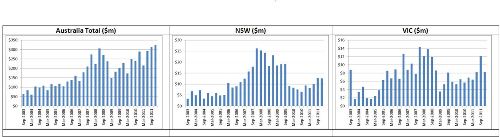
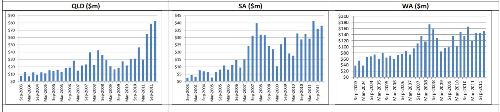
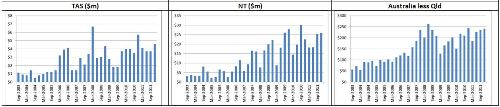
Recent statistics have helped to show just how much Australia is lagging in exploration expenditure.

It seems that it is the big oil and gas companies and multinationals are spending the money, not the junior sector.

Australian Bureau of Statistics data estimated the trend for total mineral exploration expenditure rose 2.9 per cent or $26.6 million to $944.7 million in the December quarter 2011, while the seasonally adjusted estimate rose 2.4 per cent or $22.1 million to $946.7 million in the December quarter 2011.


Source: Australian Bureau of Statistics

Simon Bennison believes these figures should be no cause for celebration.

“This headline expenditure figure does not tell the full story about the health of Australia’s exploration industry,” he told MiningNews.net.

Bennison said a better indicator of the health of Australia’s exploration industry was metres drilled, which had decreased for both brownfield and greenfield exploration over the quarter.

ABS data showed total metres drilled fell 6.4 per cent while drilling in areas of new deposits fell 2.9 per cent and drilling in areas of existing deposits fell 8.2 per cent.

Bennison said greenfields share of total metres drilled fell from around 45 per cent in 2003 to just over 30 per cent while exploration drilling of brownfields had risen from 55 per cent to 70 per cent.

New discoveries are being drilled in the Philippines, Somalia, Peru, and at a number of other new areas.

Greenfields are no longer in Australia generally, and most Australian companies are raising money through Australian taxpayers to explore in other countries.

Basically, a lot of the money is going offshore.

Clancy hits new gold copper and silver at Meritilga

THE DRILL SERGEANT: Clancy Exploration has received results from the first round of results from recent reverse circulation (RC) drilling conducted at the company’s 100 per cent-owned Condobolin project in central New South Wales.


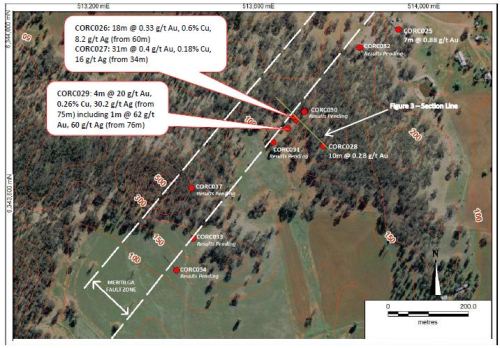
Plan view of RC drill program at the Meritilga Prospect showing major intercepts. Source: Company announcement


Results have been received for five holes with results for a further six holes pending.

The company reported one high-grade gold shoot, which intersected:

–    4 metres at 20 grams per tonne gold, 0.26 per cent copper, 30.2 grams per tonne silver from 75 metres, including 1 metre at 62 grams per tonne gold, 60 grams per tonne silver from 76 metres.
 
Mineralisation is open at depth and along strike to the south.

Clancy said this high-grade shoot occurs adjacent to broad zones of gold, copper and silver:

–    31m at 0.4g/t gold, 0.18 per cent copper, 16g/t silver from 34m, including 11m at 0.8g/t gold, 0.5 per cent copper, 19.5g/t silver from 52m; and

–    18m at 0.33g/t gold, 0.6 per cent copper, 8.2g/t silver from 60m.
 
Clancy completed a 20-hole RC program on the Meritilga prospect at the Condobolin project, following its definition in late 2011 by a 3D Induced Polarisation (IP) survey and a regional soil sampling program.

“Given the size of the IP and soil anomaly, we were confident that a substantial gold- and sulphide-rich hydrothermal system exists at Meritilga and that is what we have found,” Clancy Exploration managing director Gordon Barnes said in the company’s announcement to the Australian Securities Exchange.

“This first-pass drilling has demonstrated that there is at least one high grade gold shoot, with silver and copper, plus a broad, lower grade gold-silver-copper halo, which enhances the tonnage potential.”

One of the holes was drilled in an area where no previous historic mining or drilling has taken place, however Clancy screen fire assay of the intersection attained suggests there is free gold in the system.

Another was drilled near the historic Eureka Mine, where visible gold was found in shallow aircore drilling in late 2011.

“This round of drilling also further tested the Potters, Bluebell and Phoenix prospects,” Barnes said.

“We have some visually encouraging results in drill chips, so we’re expecting further good news from Condobolin in the coming weeks.”

Australians in Africa don’t just explore for gold

OUT TO LUNCH: Africa-focused juniors Minbos Resources and Kaboko Mining joined forces recently to buy lunch for a hungry hoard of journalists in order to inform them about recent developments on their respective projects.

Minbos is a phosphate development company, which just 12 months ago was a phosphate exploration play.

The company is focused in West Africa, where it has two near-production projects, one in Northern Angola and another across the border in the Democratic Republic of Congo.

“In Africa, there are not many projects that can boast that they have existing infrastructure they can go out and touch and can access; we do,” Minbos Resources chief executive officer Robert McCrae announced across a chorus of soup slurping.

The company describes its Cabinda project in Angola as an easily exploitable, high-grade, close to surface deposit.

The current JORC inferred resource at Cabinda stands at 304 million tonnes at 11.5 per cent phosphate.


Cabinda project overall Resources, December 2011. Source: Company quarterly report.


Minbos is involved in a 50:50 Joint Venture with LR Group, a privately-owned Israeli group.

The LR Group is the largest agricultural company within Angola as well as being one of the largest construction companies within Angola.

It is large enough to extend the government of Angola a $US1.5 billion line-of-credit for agriculture and construction projects.

“The reason we brought the LR Group in, basically, when we were applying for the licence we were a new company in Angola, a small exploration company; the government liked what we could provide, but they felt they were giving away a national asset to an unknown company,” McCrae said.

“The LR Group was recommended to us as a potential Joint Venture partner, which brought a lot of credibility to our application.”

Minbos is currently focussing its attention on two projects situated within the Eastern Limb of the Cabinda project.

These are the 22.5Mt at 21.4 per cent phosphate Cavata project, and the 6.7Mt at 20.3 per cent phosphate Chivovo project.

“We have just completed a diamond drilling campaign on both of those projects and we will be moving those projects from the (JORC) Indicated into the Measured category over the next couple of months,” McCar said.

“Those Resources will form the basis for the Bankable Feasibility Study, which we will be kicking off before the middle of the year.”

McCrae said the projects were, “a dream for a small company such as ourselves”, due to such benefits as the ore bodies lying on surface providing strip ratios less than 2:1.

He said the company will be mining an ancient seabed with soft material that will not require any blasting or drilling to access keeping mining costs lower.

“The high-grade material is also very close to the surface, which has made our metallurgical processing very simple,” McCrae explained.

“We have done the met-work and it is a very simple scrubbing and wet screening process to upgrade the ore from just over 20 per cent to over 34 per cent phosphate.”

Minbos has run a scoping study on the Cabinda project from which it has defined it to be a one million tonne export operation with operating costs of less than $US50 per tonne Free On Board.

The company’s current revenue expectations are approximately $US200 per tonne with a capital expenditure of less than $US100 million.

“If we run the financial model it comes out as a very attractive project with Cacata and Chivovo combined together,” McCrae said.

As the soup bowls were replaced by main course Kaboko Mining executive director Jason Brewer took hold of the remote control to run us through his company slide show.

Kaboko listed in September last year since when it has already moved into production producing high-grade manganese from its projects located in Zambia.

The company is targeting low-cost, high-quality, high-grade export lumps of manganese for export to the Asian markets.

To this end it has already completed a trial shipment of its product to China.

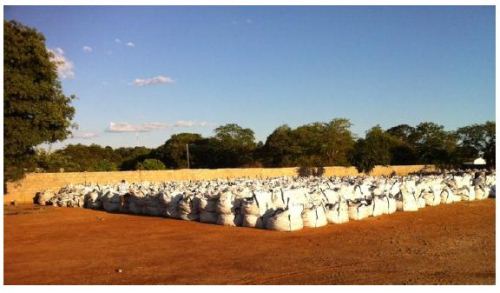
Bagged manganese ore mined from the Chowa open pit. Source: Company quarterly report.

“We are mining, we’re developing, and we are actively exploring in the country at the moment,” Brewer said.

Kaboko has three main projects: Emmanuel, Peco; and Kanona containing five large-scale prospecting licences and three small-scale mining licences covering 2,734 square kilometres.

The company is currently mining the Chowa open pit one within the Emmanuel project, where small scale open pit mining activities commenced in 2010.

It is also carrying out pre-stripping and conducting infill drilling on another licence area within the Peco project, which it hopes to have producing by the end of this year.

“It is very much a production story,” Brewer said.

“Zambia has always had high-grade manganese mining opportunities.

“There are mines that have been operating for several decades and the Chinese are very active in the country.”

In January Kaboko completed a trial shipment of around 5 million tonnes to China.

Samples taken at the mine site and at port graded at 59 per cent manganese.

That shipment arrived in China in February, where it is undergoing final testing phases while the company finalises the details for the offtake agreement.

“This is a key for the group, as we move forward,” Brewer explained.

“We have demonstrated our ability to get our product to market, which in any commodity is critical.”

Allan Mulligan – Epic Exploration

ONE OFF THE WOOD: The Roadhouse is never short of interesting clientele and this week has been no exception with Allan Mulligan executive director of privately-owned South Sudan-focused explorers Epic Exploration pulling up a stool at the bar.

Epic Exploration is a private company looking to establish itself in South Sudan. How did that happen?

Epic.Ex was formed about 18 months ago. We consider the next hotspot for Australian exploration companies in Africa will be the Horn of Africa.

We decided at the outset to select South Sudan. The emancipation of South Sudan has opened it up to potential mining operations.

What is it specifically you are looking for in South Sudan?

We’re not following any particular commodity, as such. We are following whatever the country provides for us.

Our philosophy was to go there and see what was there first, simply because the country is so under-explored.

A book was produced in the 1970s, on the geology of Sudan. It said that at that time there had been over 120 projects and mineral deposits in North Sudan.

In the South there were only about two or three.

So you could pretty much describe the entire country as a potential greenfield for mining exploration?

We like to consider it as a green canvas.

It is completely undeveloped, infrastructure-wise as well.

The only developed resources-related infrastructure in the country dates back to the 1970s when Chevron developed some oil fields.

How large is your landholding over there?

We have around 70,000 square kilometres of exploration ground.


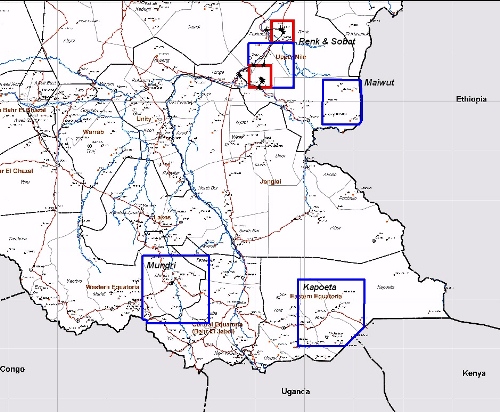
Map of Epic.Ex applications in South Sudan. Source: Company


How was Epic.Ex able to acquire that?

The first thing we did was to go there and meet with the government.

This was before the country had conducted a referendum that resulted in it being granted its independence in July 2011.

We also have an Australian-South Sudanese associate who has been invaluable as a cultural information link for us.

How is your landholding distributed across the country?

We have four zones: Paloich, Maiwut, Mundri, and Kapoeta.

Our major focus is on the Paloich manganese project, which has two historic drillholes that were drilled by a missionary who was moving through the country, to provide water for the villagers.

He actually had a geological background. He sent off the rocks that had been extracted from these water bores and found out there was manganese at 32 per cent and iron at 38 per cent in one of them.

In the other hole the manganese grade was lower at less than six per cent, however, the iron ore graded up to 70 per cent.

These two holes are 110 kilometres apart; who knows what we could find sitting in between them.

So that’s where our focus is going to start.

What about the other zones?

Maiwut is a large area with manganese, and gold potential, with the possibility of rare earths.

Kapoeta is an extension of the cross-structure from the Rift Valley that we believe has potential for gold.

There are three listed gold occurrences on the application area as well as an occurrence of copper mineralisation.

There is evidence that there has been a fair amount of artisanal gold mining carried out there over the years.

Mundri is also a possible gold play.

It appears you can really take a diversified approach to this in that you have a reasonable target at Paloich but you are quite open minded about what you may actually end up chasing?

We intend putting experienced greenfield geologists on the ground to start from the beginning with these projects.

We consider ourselves to be geographically-focused entering into this country, not commodity focused.

So you are going to be an exploration play in the true sense of the term, almost to the point where Epic.Ex could be considered to be pioneers?

Exactly; except that we have these two holes, which are an extraordinary point to start from, especially given they were drilled some sixty years ago and have never been followed up.

You’re at the stage now where you have identified these possible project areas, so what is your next move?

We are raising seed money now. We are hoping to raise up to one million dollars to enable us to drill the two sites located on the Paloich zone.

We have already located a drill rig, which is a man-portable rig that we have flown in.

We will drill those two sites in order to confirm the two historic intersections.

On the back of that, along with some upgraded geological information we will go to the market.

Will you be seeking a standalone IPO for Epic.Ex or go for a reverse listing?

It all depends on the market. We are confident that if we can have success with the drilling at Paloich, the market will be keen on an IPO.

When do you think you could be ready to list, be it via IPO or reverse listing?

If we can get the results from the initial drilling program by June, then we would be looking at listing in the third quarter of this year.

There is no time constraint on listing, although there is an element of risk involved in the project, simply because of the greenfield nature of the project, so we would like to approach the market with a greater sense of geological certainty.

It is a risk, being the first company to get on the ground in the country, but is does seem to be a calculated one because you do already have a significant target to initially focus upon.

There were a couple of other companies in working three or four years ago but their efforts came to naught because it was too difficult working in the country at that time.

We are in there now, under the new regime; we’re free to travel around, the economy in the capital of Juba is developing, and there is a robust foundation within the country on which to construct business.

People might raise their eyebrows at your decision to try and develop a mining operation in a totally greenfield country, but once upon a time there was nobody looking for iron ore in the Pilbara.

Look at West Africa. We say this is the new West Africa for Australian exploration companies.

If you are heading to West Africa now, you’re only going to pick up scraps as far as opportunities go.

This is pioneer country, and we are at least 12 months ahead of anybody else.

We have our ground and we have more than enough to get on with.

The Next Speculative Bubble

TONY LOCANTRO: Since March 2011 the markets have not been conducive to speculative bubbles and in fact the lull in Australia reminds me of 2001/2002 when activity and interest in the juniors dried up considerably.

Following the madness that was Dotcom we have seen speculative bubbles in:
 
• Retractable syringes
• Childcare
• Uranium
• Potash/Phosphate
• Coal
• Iron Ore
• Rare Earths
• Molybdenum
• Lithium
• Micro-breweries
• Nickel
• Geothermal (short-lived and confined to a small number of stocks)
• Regional mini bubbles in Cloncurry and at Doolgunna (Sandfire and surrounding companies)
• West African gold stocks
• Mongolia

For those with pay TV and in fact any TV, you may have noticed the ridiculous number of ads for funeral plans, income and life  insurance, and products for seniors, and pets.

The sports betting craze continues on now and companies are offering money back promos on protests, paying out on fourth placed horses and a refund if your football team is leading with ten minutes to go and gets beaten.


I follow and analyse a number of sports, however, apart from my once a year splurge on the Melbourne Cup I am going nowhere near this as it’s all about human nature and addictions.

Black Caviar has been great for racing and bringing the crowds in but placing a large bet at teeny weeny odds on favourites is a strategy likely to bring even the most seasoned gambler unstuck.
 
Outside of insurance and gambling we have also seen a cider bubble that has spread from apple to pears and more exotic fruit combos.

I don’t know how Strongbow sales have been, however, I have occasionally splurged on one over many years but on this occasion it is all about the more arty, retro and hip brands.
 
Please note, I am pretty good at stereotyping and general observations but have no psychic ability whatsoever.

The odds are that something will go ballistic that isn’t on the list (citrus shirts and marble wash anyone?).
 
Graphite
 
Stocks have been performing very strongly in Canada and to a lesser extent in Australia. (Syrah Resources the notable exception)

Similarities exist with the lithium bubble and how it formed in Canada. I have also noted an increase in blogs and calls for graphite to become another “fad” investment.

Based on activity and hype the bubble is already underway, however, it could well be a case of how powerful it gets and when it will deflate.

Results from Archer Exploration in March 2012 saw the stock rise 52 per cent at its peak from its Campoona graphite project, which indicates increasing investor interest.

If markets can remain stable to even slightly negative over the next six to 12 months it may even help the cause as frustration increases with non-performing sectors/stocks and higher returns are sought.
 
Potential sales pitch: Did you know that it in a lithium-ion battery there is more graphite than lithium itself?
 
Zinc
 
Who would have thought that iron ore, coal and Susan Boyle would have become sexy?

Whilst we don’t hear of analysts referring to zinc in the same manner they love their airlines, it has been a sector that hasn’t aroused much in the way of speculative fervour.

Zinc has been an underperformer in 2011 and with plentiful supply the remainder of 2012 isn’t looking much better.

I have read a number of forecasts but will use Barclays Capital Research who provided the following:
 
“The key swing factor for the zinc market outlook over the next few years is supply. While currently plentifully supplied, a medium-term concentrate crunch may be looming, although the timing and extent of this will be partly defined by prices (high prices will encourage marginal production).
 
“The three likely causes for this shortfall are: mine closures (such as Brunswick 215,000 tonne per year, Perseverance 135Ktpy); steep declines in ore head grades (the reason for the almost halving in Century’s production in 2014 to 290Ktpy); and an expected decline in tightening in metal supply and a period of much higher prices starting 2013.”
 
The issue I have here is the zinc situation has been so well documented and reminds me a little of the uranium bubble that was due in 1998.

The uranium bubble was an almighty event but turned up seven years later no doubt testing the patience of those expecting it much earlier.
 
Potential sales pitch: Yeah I know zinc stinks but why don’t we get a few stocks just in case these analysts are right.
 
Gold Stocks
 
Apart from a few growth stories including Regis Resources, Silver Lake Resources, Ramelius Resources and Northern Star Resources it has been tough going for the Australian gold sector.

The African stories Perseus Mining, Gryphon Minerals, Amplella Mining, and Azumah Resources have fared better along with Azimuth Resources in Guyana but a number of juniors in Australia and North America/Canada are yet to escape some very low valuations.

Outside of looking for the next growth stocks the sector needs a major discovery and/or Merger and Acquisition activity to see it fire up.

Gold equities suffered through much of 2011 in line with markets and it could be argued that they will require a more stable environment to thrive and this may involve lower spot prices.
 
I have suggested a number of sub-five cent gold stocks to my subscribers and I must admit it only takes a run to seven cents to provide some excitement.

When you look back at the great gold stock bubbles of 1985 to 1987 and 1978 to 1980 even thinking of taking profits at seven cents looks ridiculous.
 
If gold stocks suddenly become sought after I would expect silver juniors to outperform due to a limited number of ASX-listed companies.

In the short to medium-term I cannot see silver stocks going it alone although I would love to be proved terribly wrong.
 
Potential sales pitch: The gold stocks are finally moving we better get set before the herd moves in.
 
Alternate Energy
 
I will never forget the quote, “The alternate energy bubble will be like the Nasdaq on steroids”.

There have been a number of brief spurts in geothermal, solar, wind and fuel cells.

The sector has shown some promising signs, however, in the case of geothermal there have been considerable funds thrown at exploration/drilling for not much return on the scoreboard.

With carbon pricing initiatives to commence from July 2012 two new institutions (Clean Energy Finance Corporation (CEFC) and the Australian Renewable Energy Agency (ARENA) have been created to oversee over $13 billion in financing and funding initiatives.

This could see renewed interest in the sector; however, it may take further oil price shocks to again see alternate energy attract more attention.
 
Still a market for the stock pickers and I often suggest investing with funds you don’t need tomorrow

If a bubble forms I would expect the fear of missing out and the fact you cannot watch prices trade 24/7 could see it eventually go much further than anyone expects.
 
Other Threats
 
Potash/Phosphate were the scene of a number of very strong rallies and despite positive arguments could need more time before they really go again.

Watching the movie Contagion again got me interested in the biotech sector and if the next flu season is a bad one I can see another rush for the vaccine stocks.
 
The rare earths sector suffered in September 2011 on the back of a JP Morgan downgrade of Molycorp, whilst Lynas has been the subject of protests in Malaysia with an appeal being lodged on the approval of its temporary operating licence.

There is always the possibility that the next speculative bubble could involve something not mentioned or widely known.

The key will be to recognise the early signs and look at ways to profit from it.
 
The broader market in Australia has underperformed the U.S., however, I still regard conditions as being conducive to seeing a sector finally rise to prominence.

There is so much to research against a backdrop of negativity that could well lead into something powerful and ultimately destructive.
 
To finish off here is a great quote from George Soros who has a handy back catalogue:
 
“Stock market bubbles don’t grow out of thin air. They have a solid basis in reality, but reality as distorted by a misconception.“

 
Tony J Locantro

Managing Director

Email: tony@locantro.com