Quarter Time Wrap

THE BOURSE WHISPERER: The Roadhouse’s inbox was inundated with quarterly reports this season so we thought we’d take a random selection and see what the companies had to say.

Ventnor Resources

During the quarter base metals exploration play Ventnor Resources commenced a fourth phase of drilling at the company’s Thaduna and Green Dragon copper project.

During the quarter there were 18 RC drill holes for 3,118 metres and 13 NQ2 diamond tails for 1,197m drilled at Thaduna and 11 RC holes for 1,352m and 2 HQ diamond holes for 390m at Green Dragon.
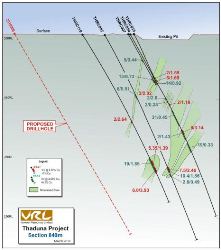
 

Deeper diamond tails are proposed to intersect the
mineralisation at depths from 280 metres to 300 metres below surface and
drilling is underway. Source: Company report

The quarter’s drilling has brought the total undertaken at the Thaduna and Green Dragon project to 145 RC drill holes for 18,700m and 15 diamond tails for 1,517m drilled at Thaduna and 89 RC holes for 11,643m and 2 HQ diamond holes for 390m at Green Dragon drilled to the end of the quarter.

The company has a deep drilling program underway to test the projected mineralisation at 280m to 320m below ground level.

The fourth phase program is designed to achieve two goals:

–    To complete the resource drill out above 200m vertical; and

–    To investigate the potential for economic mineralisation below 200m vertical along a strike length of 1,000m.

The company’s third phase of drilling at the Thaduna and Green Dragon copper prospects was completed in December 2011 and some results were received in the March 2012 quarter that included:

37m at 2.61 per cent copper from 111m, including 10m at 7.53 per cent copper from 134m downhole;

62m at 2.19 per cent from 125m, including 32m at 3.10 per cent copper from 127m downhole ending in mineralisation –  3.70 per cent copper at EOH, to be extended by diamond drilling

19m at 1.85 per cent copper from 246m including 6.57m at 3.93 per cent copper and 19.2 grams per tonne silver from 258m downhole;

13m at 2.87 per cent copper from 130m, including 8m at 4.48 per cent copper and 15.6g/t silver from 131m downhole; and

9m at 2.68 per cent copper from 180m downhole.

Laconia Resources

Perth based exploration company Laconia Resources’ activities for the March quarter included progress on its acquisition of the Rasuhuilca gold-silver project in Peru and results from preliminary metallurgical testwork at the company’s Lennons base metals project in Western Australia.

Laconia completed Due Diligence on the proposed acquisition of the Rasuhuilca gold-silver project during the March quarter.
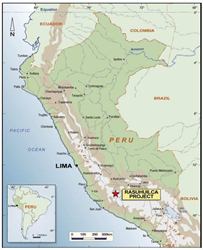
 

Rasuhuilca project location map. Source: Company report

The company said the acquisition will establish it as an emerging precious metals producer and complement its existing portfolio of precious and base metals projects in WA.

The project is a high-grade gold and silver asset with near-term development potential and major exploration upside.

Other March Quarter highlights included:

At the Lennons Find Base Metals project in WA, preliminary test work was completed on composite samples from the oxide component of the Resource.

Results included:

–    Sulphuric acid leach extracted 75 per cent of the copper and 87 per cent of the zinc; and

–    Subsequent cyanide leach tests extracted 87 per cent of the gold and 94 per cent of the zinc.

Geological and litho-geochemical study was completed at Lennons Find in preparation for detailed field mapping and interpretation of the mineralising system.

The total Mineral Resource at Lennons Find is currently at 1.80 million tonnes at 82g/t silver, 0.26g/t gold, 0.2 per cent copper, 1.4 per cent lead and 5.1 per cent zinc.

Laconia is in a solid financial position with $2 million in cash at bank at the end of the quarter.

Exploration planned by Laconia for June 2012 Quarter includes Reverse Circulation (RC) drilling targeting additional oxide resources at Lennons Find and metallurgical test work on bulk samples from Lennons Find oxide resources.

The company will also RC drill test co-incident XTEM and geochemical targets at its Barramine project in addition to complete Phase 2 infill and regional auger drilling at the 701 Mile project.

Brazilian Metals Group

During the March Quarter Brazil-focused iron ore exploration and development company Brazilian Metals Group forged an agreement to acquire the advanced stage Carrapato iron project in the Northern Minas Gerais state, in Brazil.  

BMG announced an agreement to acquire 100 per cent of the Carrapato iron project, which it stated was a significant step in the company’s strategy to complement its existing large scale iron projects with smaller, high grade projects with near term production potential.

The Carrapato project is an extension of the Sarzedo mine, which has a 1.3 billion tonnes resource and was recently sold to Chinese state-backed East China Mineral Exploration and Development Bureau (ECE), for $1.2 billion.
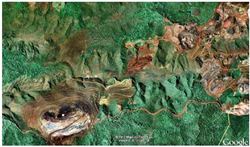
 

Location of Carrapato tenement, Itaminas Sarzedo Mine to the
east; Vale’s Corrego do Feijao mine to the south. The tenement is about
1000 metres wide east-west. Source: Company report

Carrapato is also immediately adjacent to the Corrego do Feijao Mine of global big boy Vale, which produced direct ship iron ore at a grade of 66.6 per cent iron.

The project has proximity to domestic steel mills and rail infrastructure, to provide future domestic or export options for early development of a low cost iron ore operation.

The company has two larger projects, also located in the Northern Minas Gerais state the Gema Verde and Rio Pardo iron projects where further metalurgical testwork and pre-feasibility work was conducted during the quarter.

Alligator Energy

Uranium explorer Alligator Energy lit up its March Quarter performance with a maiden JORC Code-compliant Resource statement at its flagship Tin Camp Creek uranium project in the Northern Territory.

Alligator Energy confirmed a maiden Resource at the Caramel prospect within the Tin Camp Creek project of 944,000 tonnes at 0.31 per cent uranium for 6.5 million pounds of uranium.
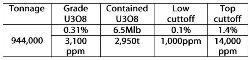
 

Caramel Resource. Source: Company report


The company also carried out a comprehensive revision of the geology of the Caramel prospect, which identified a number of extension targets.

Company has a sound cash position with $8.1 million in in the bank.

Further activities for 2012 will involve drilling a seven kilometre zone from Caramel to South Horn within the Tin Camp Creek project area.

Alligator plans to drill 5,000m of Diamond Drilling in 2012 and drilling is due to commence late May.

Corazon Mining

Canada-focused exploration company Corazon Mining identified further strong nickel-copper-cobalt sulphide mineralisation at the company’s Lynn Lake nickel-copper sulphide project in Canada.

Drilling beneath the EL Mine at Lynn Lake Project continued to identify strong nickel-copper-cobalt sulphide mineralisation, including:

–    73.46m at 0.81 per cent nickel, 0.50 per cent copper and 0.022 per cent cobalt from 727.54m, including 32.46m at 1.26 per cent nickel, 0.72 per cent copper an 0.032 per cent cobalt from 727.54m.

Corazon conducted down-hole EM surveys taht defined several conductors it will use to direct exploration drilling of extensions to the EL Deposit between 700m to 1,200m below surface.


EL Deposit – Drill hole cross-section. Source: Company report

Drilling of priority target areas identified a new zone of nickel-copper sulphide mineralisation.

One hole  intersected approximately 51m of disseminated to massive sulphide mineralisation approximately  50m east of previously discovered sulphide breccia.

Drilling of these targets is continuing.

Corazon has kicked off mining studies for the Lynn Lake project and early results indicated copper and cobalt may provide a valuable credit (greater than CAD$2.00 per pound of nickel benefit).

Canadian underground mining costs have come in showing an approximate 30 per cent reduction in comparison to Australian costs.
 
Corazon is holding approximately $2.18 million at end of the quarter.


Talga Gold

During the March Quarter Talga Gold conducted exploration on the company’s 100 per cent-owned projects in Sweden (graphite, iron ore, copper-gold) and the Pilbara and Yilgarn regions (gold and iron ore) of Western Australia.

Fieldwork completed on Talga’s WA projects included Reverse Circulation (RC) drill testing of gold and iron targets and geochemical surveying over first pass targets.

In Sweden, the company acquired seven advanced graphite projects in its own right before entering an option agreement to acquire a further eleven graphite, iron and copper/gold prospective projects from TCL Sweden, a subsidiary of Teck Resources.
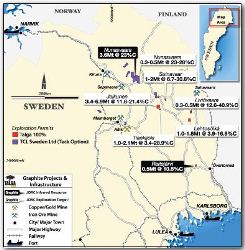
 

Sweden project location and transport infrastructure map
showing graphite deposits and Talga/TCL Sweden tenure. Source: Company
report

Work completed by Talga in Sweden included ground geophysical surveys, project reconnaissance, data compilation, logging and sampling of historic drill cores and the estimation of maiden JORC Code-compliant Inferred mineral resources at three projects.

Talga claims one of these project areas to include the highest grade graphite deposit published by any public company in the world. (Ref. Technology Metals Research – Advanced Graphite Projects Index).

Talga has $2.71 million cash at bank and enjoyed a strong increase in market capitalisation during the period.
ASX extended hours suits big end of town

PETER HAYES: As we approach the end of what can only be described as a fairly disappointing financial year, I can only hope that the powers that be in that venerable institution, the Australian Securities Exchange, desist with their fanciful notion of extending the opening hours of the Exchange.

My prediction is that if they do proceed with this idea, the result will be a mass exodus of retail brokers from the industry.

Extending the bourse’s daily trading hours would be mental disintegration of the highest order, akin to a stint in Guantanamo Bay detention camp if you ask me.

The current situation of screen staring for six hours per weekday is tantamount to torture, and an extension of this would see me applying for a far more “cushy” job, perhaps as a war correspondent for the ABC.

Even water boring may be a more stimulating alternative.

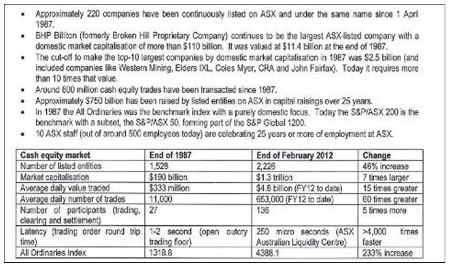
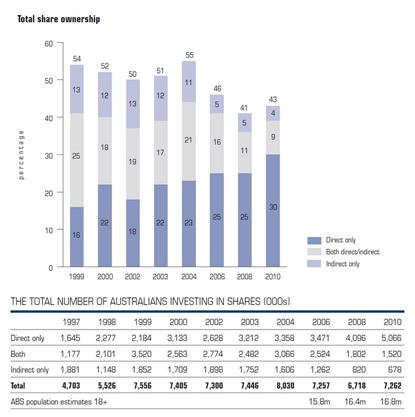
The reasoning behind this push to extend its hours must stem from the ASX struggling with lower investor participation rates.

Source: Australian Securities Exchange

Combined with the fact the all ordinaries has been a pretty disappointing place to invest your coin since October, 2007.

Since then the Australian market has come down from an all-time high of 6748 points, to its current level where it is hovering around the 4420 point mark.

With the Minerals Resource Rent Tax, carbon tax, and now rumoured changes to superannuation contributions for high-income earners, the ASX has been laundered.

It is almost as convenient to take money from the ASX as it is for a HSU union official to…! But, I digress.

The ASX obviously is looking at the companies that populate the larger end of town to support these proposed longer trading days. It usually does.

It is a bit like the Board of the RBA, in that it is made up of people who inhabit a higher stratosphere than the likes occupied by this correspondent.

In the latest statistics, released by the Australian Financial Markets Authority (AFMA) the figures are impressive as they show that the turnover has only dropped slightly in a down market.


Source: Australian Securities Exchange 2010 share ownship study

In 2010/2011 the physical market turnover in shares has decreased only 1.5 per cent, but the current financial year would be a reasonably larger drop.

I know anecdotally that many retail based brokers in Perth are struggling, and the interest in small mining stocks has waned for most of the past financial year.

Hopefully July 2012 takes us to a new financial paradigm, and a new financial era for yours truly.

In all honesty I’m really looking forward to having One Off The Wood with the esteemed Editor of this publication to see the end of an annus horibils, especially if he’s buying.


Peter Hayes
Investment Manager

Communities battle FIFO for local workforce

OUT AND ABOUT: The Fly In Fly Out scheme of work has many detractors and just as many supporters.

Companies can’t be taken to task for using a system that works to keep their financial bottom line operating in their favour.

Workers can’t be answerable for opting to work within a system that allows them to earn big – working away from home – dollars, while not having to leave their urban-based residential address.

Towns that are in close proximity to mining operations also can’t be blamed for expressing concerns about the effect such a transient week-by-week population shift has on its services and livelihoods.


Of course, any mining industry associated debate wouldn’t be worth its salt unless some form of parliamentary inquiry was held to look into its machinations.

When the recent inquiry made its way to Perth junior sector lobby group the Association of Mining and Exploration Companies (AMEC) outlined what it felt about the argument.

“FIFO has provided a viable solution in attracting and retaining the right skill sets to work on mining and minerals exploration related projects in remote and regional communities throughout Australia,” AMEC national policy manager Graham Short said.

“AMEC and our members support FIFO as a legitimate workforce strategy which provides an adaptive management capacity to meet industry demand and the differing needs of the workforce”.

“Minerals exploration, mining companies, suppliers and contractors choose workforce strategies that suit their individual business circumstances, needs and financial requirements.

“A FIFO workforce for many companies may be the only viable option open to them, particularly with the current constrained workforce conditions.

“There are a number of factors which influence workforce strategies, such as the cyclical nature of the industry, mine location, mine life cycle, the skills required and the transient nature of the workforce.

“FIFO has not only been successful in meeting the immediate needs of employers for construction and production purposes but it also provides workers with a choice.”

Although the government appears to have reached the verdict that FIFO is the root of all evil falling upon regional centres it would be surprised to hear the people living in with the reality of the FIFO conundrum do understand why the industry operates that way.

“The consideration of Fly In Fly Out is something that we all have to grapple with within regional Western Australia,” Mayor of Port Hedland Kelly Howlett told The Roadhouse.

“Certainly in my time, particularly here in my time on Council, our thoughts and our views on Fly In Fly Out has certainly matured and I guess that’s something that has happened, even from 2008, when we did our last position statement and we are currently reviewing our position statement now.

“There is an appreciation and understanding of the real competitive nature of competing for high-expertise skilled trade, and the real competition, whether it be from Gladstone to Darwin to Western Australia.

“All the different resource projects that are happening at the moment means there is a really high competition to get the necessary skills and expertise to make that happen.”

As a big FIFO town due to the number of mining operations, including those of BHP Billiton, Fortescue Metals Group, Atlas Iron, and BC Iron that utilise its port facilities to ship their iron ore, Port Hedland is a fine example of just how competitive that employment market can be.

“All the roles that we are filling are for companies that are based in Port Hedland,” Pia Thornett safety manager of local recruitment agency Category 5 Labour Management told The Roadhouse.

“We have a lot more people looking for Fly In Fly Out work but as we don’t fill those type of positions, we can’t help those people.”

I may surprise some people but Port Hedland is something of a magnet for workers seeking better paid employment opportunities than what they may be able find at home.

However, as more people arrive in town and start work they soon realise the potential earnings they can be making are soon eaten up by the high rent market.

Being close to the action also enables them easier access to the mining companies.

The desired ‘industry experience’ or better still that acquaintance who works on a mine site who tells his boss, ‘I know a bloke looking for some work’, is much closer than when you are living and working thousands of kilometres away from the action.

It is for reasons such as this that many local businesses associated with the mining industry tend to see themselves as being no more than a revolving door as far as staff levels go.

Employees that do end up staying in town become a valuable commodity and can shop themselves around, which makes it more and more difficult for the smaller, local businesses to retain staff.

 “Occasionally they lose them to a Fly In Fly Out position, other times they may lose them to another company that is able to pay the employee a bit more money,” Thornett explained.

“Once people get their foot in the door – they do come here fully intending to become a Port Hedland local but they soon realise – after they have developed their skills and have gained the necessary experience – all of a sudden they want to start working on  a Fly In Fly Out basis.

“Local employers are constantly going through staff, who are always on the lookout for that bigger, better job.

“They become a training ground for some of the bigger businesses around, and that’s sad because they are forking out all this money to train new staff only to lose them.”

The question raised by FIFO is how to reach equilibrium between how a regional centre such as Port Hedland can successfully operate and evolve when placed in direct competition for a work force with the very industry that helped put it on the map when the first iron ore boom exploded in the early 1960s.

Kelly Howlett said she considers it to come down to the State of Western Australia and that it has an over-arching obligation to make sure there aren’t any gaps, that it needs to make sure there is the flow-on in terms of the health professionals, police, emergency services, and telecommunications.

“Even the state of Western Australia is now starting to catch up,” She said.

“Hopefully, now with the revision and the changes under the State Agreement Act, there will be a much greater collaborative effort between the state government, the actual mining proponents when they do projects and the involvement of the community and local government to make sure we are looking at the cumulative impact and filling any of those gaps.”

Ignore the skepticism – the outlook for copper remains robust

GAVIN WENDT: In Rio Tinto’s March quarter production report released recently, it was evident that there are significant difficulties being faced by the company’s copper business.

Rio’s mined copper production was 18 per cent lower than the first quarter of 2011, due to anticipated lower grades at Kennecott Utah Copper.

I reiterate our position that this isn’t anything particularly new, as we’ve previously addressed the production issues afflicting many of the world’s major copper mines.

It’s these very same issues that reinforce our positive view on the outlook for copper prices.

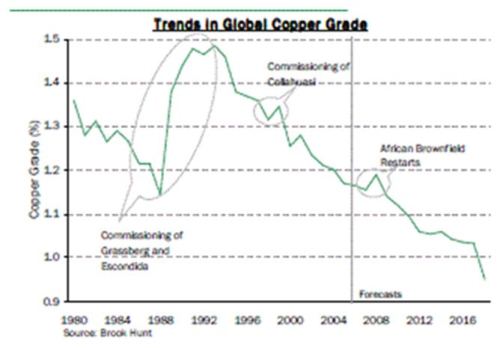
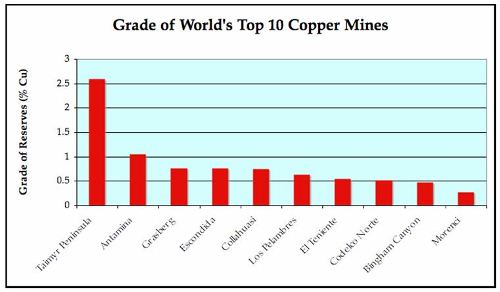
Copper head grades are declining alarmingly at virtually all of the world’s major copper mines, forcing up production costs, which in turn are impacting significantly on world copper supplies.

In fact, the average head grade at the world’s major mines has fallen by around a third over the past decade, meaning miners have to mine a third more ore (at significantly higher cost) just to maintain production levels of a decade ago.

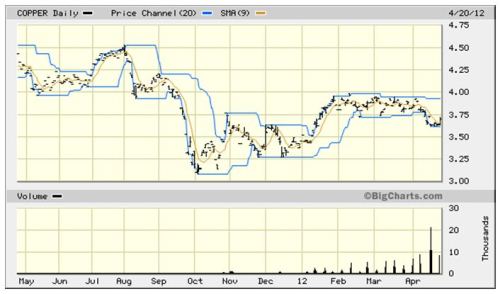
And it’s not just a recent phenomenon, as the graphic below clearly demonstrates.

From a demand perspective copper has long been regarded as the bellwether commodity of international economic growth – and rightly so, as it’s used extensively in everything from homes to motor vehicles to electronics.

Despite comments over recent times predicting significant price falls based on weakening demand, copper’s fundamentals in my view remain robust.

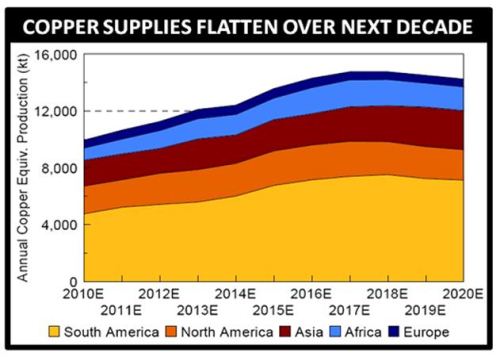
This supports my bullish argument that the copper market will likely see another deficit during 2012 as existing operations struggle, whilst new projects are still a year or two away from making a significant contribution.

And one of the best case studies is Chile, the world’s biggest supplier of the red metal.


As Bloomberg highlighted recently, “While the global copper market is nervously eyeing signs of slowing demand in China, tumbling ore grades, energy protests, extreme weather and labor unrest in top miner Chile were the focus of the annual CESCO conference.”

While Chile continues to produce a third of the world’s copper supply and holds an estimated 28 per cent of global reserves, the nation needs to address various fronts in order to boost annual output to the plus-seven million tonnes it’s aiming for by the end of the decade.

Joaquin Villarino, head of the country’s Mining Council that represents Chile’s biggest miners, said during a recent forum on energy, “We’re frankly at a very delicate moment, especially in terms of energy.

“If we’re not able to solve several problems, mining isn’t going to develop in the country or it will develop less than we would like.”


Of course, supply constraints are good news for prices.

With no significant deposits slated to come on-line this year, the so-called “strike season” yet to kick off in Chile, and both Xstrata and Rio predicting falls in their production during H1 2012, Chilean miners are predicting tight supplies will offset any Chinese slowdown.

Codelco, Chile’s state-owned copper producer has an ambitious plan to boost its annual output to 2.1 million tonnes by 2020, but forecasts a slight easing in production this year.

Chile is seen attracting $1 billion in mining investment through 2020, but some analysts have questioned that figure as overly upbeat.

Antofagasta Minerals last year launched its flagship mine Esperanza, or “Hope” in Spanish, one of the few promising deposits to come online in a copper market defined by its scarcity of new projects.

But Esperanza’s has so far disappointed in output terms, contributing to Antofagasta missing its 2011 copper output target.

As Bloomberg highlights, “Few deposits are more emblematic of Chile’s potential decline than its massive but tired, water-short and energy-strapped copper mines in the mineral-rich Atacama desert.”

A prime example is Codelco’s century-old Chuquicamata mine, which has seen its output drop from 528,000 tonnes in 2010 to 443,000 tonnes last year, chiefly due to declining grades.

Chuquicamata is set to undergo massive transformation to become an underground operation, whilst major expansions are planned at both Collahuasi, owned by Anglo and Xstrata, and Escondida, which is majority owned by global miner BHP Billiton.

Collahuasi is the world’s third-biggest copper mine and its output dropped during Q1 2012 on the back of weather disruptions and lower grades.

Meanwhile the world’s biggest copper mine, Escondida, saw its output plummet 25 per cent during 2011 due to a shock two-week strike and declining ore grades.

All of this should translate into a tight copper market during 2012, a view shared by Thomson Reuters GFMS’ Research director Sanjay Saraf, who this week predicted that supplies would remain constrained as factors that have impacted output in previous years continue to persist.

“Even factoring in increased mine supply, we are still forecasting a deficit for 2012 as a whole, albeit a smaller one than last year’s estimate of 256 000 tonnes,” he said.


Freeport-McMoRan chief executive officer Richard Adkerson expressed his view on a first-quarter earnings conference call that the fundamentals of the copper market remain strong, given China’s drive to invest in infrastructure projects and lower levels of inventory in the United States and Europe.

“Markets continue to be very positive this year for copper … 2012 appears to be another year of deficit in the copper market,” Adkerson said.

We retain a positive outlook on copper’s fundamentals and anticipate that prices will range between US$3.50 – US$4.25 during the course of 2012.

Gavin Wendt is the founder of MineLife, publisher of the MineLife Weekly Resource Report

Richard Bevan – Cassini Resources

ONE OFF THE WOOD: Cassini Resources managing director Richard Bevan casually sat at the bar of The Roadhouse this week and told us how this new kid on the ASX block has managed to pick up some exciting new projects in Nevada.


Cassini listed in January this year on the back of an interesting tenement package located in Western Australia. Could you give us a bit of detail about what and where they are?

We listed on the back of four early-stage projects in Western Australia located in the West Musgrave, out near Warburton; Forrestania; Peak Charles; and the Eucla Basin.

We worked pretty hard to get, what we considered to be a reasonable asset package. They’re all early-stage projects, but we believe they all have a great deal of potential.

Particularly the Musgrave, which we think is pretty exciting due to the fact there is plenty of exploration activity in the region being carried out by some of the bigger companies.

We’ve had some independent reports done on the ground we hold out there and it really is looking quite prospective.

What was in in particular that attracted you to assemble the package of projects you did?

For us they just displayed some prospectivity, mainly for nickel, copper and gold.

The Musgrave is mainly nickel and copper, with some platinum group elements while Forrestania is mainly nickel and gold.

The Forrestania tenement is only about ten kilometres from the Flying Fox nickel mine and about 25 kilometres south of the Bounty gold mine.

The reason the tenement had originally been identified by the guys we bought it off was that some new survey results showed an extension of the Greenstone Belt running into it, which is undercover and therefore had not previously been identified.

So that tenement is in close proximity to producing gold and nickel mines with an opportunity to discover an extension to that Greenstone Belt.

Which of the four projects has been Cassini’s major focus since listing?

We conducted a drilling program on Forrestania in late March, really just to test that there was indeed an extension to that Greenstone Belt.

That came back with some positive results indicating that is the case.

So the next stage at Forrestania is that we are going to need to obtain some environmental approvals to allow us some further access to enable us to conduct a more comprehensive drilling program.

The WA projects are ticking along fairly well considering your recent-listed status, but you have just acquired a new group of projects in the state of Nevada in the USA. How did that happen?

It came about through an Australian unlisted company called Search Resources, which had been looking at a number of projects in Nevada.

They were originally intending to IPO on those assets but we were able to structure a different transaction with them.

We just liked the assets. It’s interesting that Nevada is not that well known and is off the radar of a lot of Australians.

Real estate wise, it is the Peppermint Grove of gold districts. The US is the third largest gold producing region in the world. Nevada, by itself, comes in at number six.

That has a lot to do with the Carlin Trend that is a Gold Belt running through Nevada and one of our new deposits, the Leonid project is located in this trend.

So for us the acquisition ticked a few of the right boxes; it was a transaction of the size we could do despite having only been a listed entity for three months; and they are really good projects.

It has really brought forward our timeline for finding a potential discovery by having some more advanced project than what we already had.


How much more advanced are the Nevada projects compared to the WA ones?

We can pretty much commence drilling there straight away and over the next six months we should have a very good idea of what we have there.

All the Nevada projects have been subjected to some work. A lot haven’t been drilled, although the Goldstar project has returned rock chip samples of 20 grams per tonne gold, so there is gold there.

You have negotiated a Joint Venture for the Nevada projects with a local company in Renaissance Gold?

They are a highly-regarded company with a number of projects in the region. Their model is to generate these sorts of projects and to then Joint Venture them.

The way our Joint Venture has been structured reduces a lot of our risk. We can spend money on these projects as long as the exploration results support it.

It wasn’t an expensive acquisition; it was mainly scrip so that means we have been able to maintain our good capital structure while binging in some, what we believe to be, excellent projects.

I suppose one advantage of being in Nevada is that you can dig up all that gold, take it straight to Vegas and double it?

I once read a quote that said, ‘if you want to double your money in Vegas, fold your bills in half and put them in your pocket’.

As far as being in Nevada goes, our chairman Mike Young pointed out that in terms of sovereign risk, the last time there was any trouble there was in 1861 during the American Civil War.

It is a very good mining environment with a lot of expertise and infrastructure.

All the big guys are there and there is still a lot of exploration activity going on. A lot of people think Nevada has been mined to death for gold but there have actually been more significant multi-million ounce discoveries there, in the last ten years, than what there has been in Australia.

You mentioned your chairman Mike Young. How much of an advantage is it for Cassini having somebody with his background involved?

Mike completed his geology studies in Toronto so for him Nevada is like what Kalgoorlie or Ballarat is to an Australian-trained geologist.

When he first saw the projects he understood how good the gold district is they are located in.

Also, a lot of his contemporaries are now working in that area running gold companies, which affords us another level of access and provides already established relationships in the region.

Another key for us is a fellow called David Johnston, who is an Australian-trained geoscientist based in Utah.

He’s worked for such companies such as Western Mining, Rio Tinto, LionOre and Independence Group.

He is very experienced and well-regarded within the industry and he will be running those projects for us.

So while we have been able to leverage of those relationships to pick up some very good projects we also have an already established network in terms of logistics and access to good exploration people.

As exciting as Nevada is, will it deflect your attention from the WA projects?

Our intention is to operate the two in tandem. We have the capital to run both and because the Australian projects are at such an early stage there are things we can do to add value to those and progress them.

We do need to be mindful about where we spend our money, but the good thing is that with the Nevada assets, especially with some of the early drilling programs, we should know sooner rather than later if we do have something there.

We can then sit back and assess where we would be best placed to allocate our capital in terms of adding value.

Elemental identifies third potash seam

THE DRILL SERGEANT: Elemental Minerals has identified high-grade potash in a third seam at the Kola deposit, situated within the company’s 93 per cent-owned Sintoukola potash project, located on the Republic of Congo coastline.


Location of Sintoukola potash permit and historic drill hole locations. Source: Company announcement


The company said it is ready to now include all assay results from a recently-completed Phase 2 drilling program in an updated resource estimate of the Kola deposit.

Results include high-grade (sylvinite) mineralisation in a seam previously known to contain only lower-grade (carnallite) mineralisation located approximately 45m below the Lower Seam.

Highlights of the recent drilling campaign include:
 
Intersections from EK_32
 
–    4.65 metres at 18.01 per cent potassium oxide (28.53 per cent potassium chloride) from 289.87 metres in the newly identified Footwall Seam (FWS)

Intersections from EK_33

–    Upper Seam: 3.82m at 22.51 per cent potassium oxide (35.64 per cent potassium chloride) from 272.06m; and

–    Lower Seam: 5.64m at 10.89 per cent potassium oxide (17.25 per cent potassium chloride) from 278.91m;

Intersections from EK_35

–    5.27m at 17.85 per cent potassium oxide (28.27 per cent potassium chloride) from 264.03 in the newly identified Footwall Seam (FWS); and

Intersections from EK_36

–    Upper Seam: 4.65m at 19.16 per cent potassium oxide (30.35 per cent potassium chloride) from 281.10m.

Elemental said the results will be the last included in the Resource Estimate update for the Kola deposit as all data is currently compiled and validated for integration ready for its delivery.

Based on these and previous results, the company believes it remains on track to achieve its Phase 2 Exploration Target of between 320 million tonnes and 1.08 billion tonnes of potash mineralisation grading between 19 per cent potassium oxide (30.15% potassium chloride) to 21 per cent potassium oxide (33.33% potassium chloride).

“The discovery of a new seam is extremely exciting in the development of this project,” Elemental Minerals chief executive officer Iain Macpherson said in the company’s announcement to the Australian Securities Exchange.

“While we realise that we will have to complete more drilling and test work on this seam and it will not be included in our pre-feasibility study due for release later this year, the identification of a new seam shows the growth potential of our deposit.

“I am pleased that we have been able to meet our tight deadlines on all our assay results and I look forward on commenting on our resource update shortly.”

Blackham looks to unlock secrets of Wiluna

OUT AND ABOUT: Perth-based gold explorer Blackham Resources has told the Paydirt 2012 Australian Gold Conference making up for an historic lack of detailed drilling is the key to unlocking its future gold opportunity in one of Western Australia’s oldest goldfields.

Presenting on the second day of the Perth conference Blackham Resources managing director Bryan Dixon, said the Wiluna goldfield province remained a large, highly prospective tenement holding but had suffered from being formerly unloved and forgotten – despite significant previous operating mines, infrastructure and residual gold resources.

Blackham took ownership of the Matilda gold project in November last year through its acquisition of Kimba Resources.

It has since announced a strategy to grow the existing gold resource of 12.5 million tonnes at 1.9 grams per tonne for 757,000 Inferred ounces to above one million ounces in the medium term through delineating 4 million tonnes of plus 2 grams per tonne oxide reserves.

“Our objective is to grow the existing resources to over one million ounces in the short term and convert a large portion of our existing oxide resources to reserve status,” Dixon said.

“What has been ignored is that Blackham now commands a very major position within the Wiluna greenstone belt – a structure that has already supported more than four million ounces of gold production.

“Yet there has been little systematic regional exploration of Matilda in more than a decade.”

Dixon explained that the Wiluna greenstone belt is a structure, which has historically been subjected to more than 39,000 drill holes sunk.

He said Blackham’s approach will be a “data mining” one to revalidate and assess this massive bank of knowledge to enable the company to identify any new opportunities for oxide resources and to identify the primary gold resource in the area.

”Limited drill testing has proven that depth extensions at Matilda continue for at least 300 metres but only the project’s oxide material has been mined from local source pits and generally to less than 50 metres depth,” Dixon said.

“Most of these pits also remain open along strike and we have identified primary down-plunge targets that have yet to be fully tested – so in our view, the upside for Matilda is considerable and benefits from the fact the broader area has been mined on and off for more than 100 years.”

Dixon said Blackham’s analysis of the various existing pits along the Matilda project suggested previous mining had only scratched the surface of what is a very large mineralised gold system with mineralisation found to extend beneath and along strike of those current pits.

“Our conclusion is that Matilda, including its high grade shoots, offers the sort of geometries for multiple ore bodies, possibly on a bulk mining approach to either open pit or underground,” he said.

Blackham has commenced a re-evaluation of the mining economics of the Matilda pits and resources based on the current gold price.

Ian Fairnie – Edutravel

ONE OFF THE WOOD: Ian Fairnie is a member of the Stockwatch Group, which conducts regular top performing ASX-listed company briefings at the Western Australia Club in Perth.

He is also executive director with Edutravel, which is gearing up to lead a group of investors on a business-focused educational tour of China in October.


What sort of people usually travel on these tours?

Mostly those who attend the Stockwatch Group briefings as well as people who are clients of Travel Directors, the travel company that are helping us put the tour together.

They specialise in tours aimed at a similar demographic, which is people who are looking for tours that provide an educational slant and are not just an off-the-rack sightseeing adventure.

There are a number of key stockbrokers around town who are inviting their clients given the strong demand and interest for exposure to invest in Chinese high-growth sectors.

Why do you run the tour through Travel Directors?

Because I am not a travel agent; I am a person who puts together unique study tours. I guide the travel agent by telling them where we want to go, and where we want to stay to ensure the maximum value is offered for those attending.

What is the purpose of the tour and what does it hope to achieve for those participating?

The tour focuses on companies that are listed on the Australian Securities Exchange that are conducting business in China.

For example, we will be visiting the Algae.Tec facility that is currently under construction in the Shandong province. We will also receive personal boardroom presentations by HSBC, the Hong Kong Monetary Authority and the Haier Corporation who have a strategic joint-venture with Fisher & Paykel.

So for investors that may be following the Algae.Tec story who know the company is building the facility in China they can actually go and see it in operation.

These visits aim to provide a first-hand view of the company operations that would not be available to the general public.

What other highlights for the tour do you have planned?

The touring party will attend briefings given by Australian companies that have spent some time in China, providing them with some insight as to how the Chinese economy is growing.

We often hear about the levels of Chinese government investment in construction and how this has slowed down somewhat giving rise to fears the country may be slipping into a European-type malaise.

The difference the Chinese economy is displaying is that instead of growing at 11 per cent it has slowed to be growing at 9.2 per cent.

China is still steaming along, just not at levels of over 10 per cent.

If you were to describe what the Study Tour actually is, how would you do that?

The essence of the tour is to provide investors with a first-hand look at China – what it is today and where it has come from.

To allow them to understand some of the country’s nuances that underlie the way the Chinese leadership thinks and what is driving that from a historical point of view.

What benefits would investors gain from travelling on your tour than if they were to travel to China under their own steam?

They certainly wouldn’t enjoy the same access to the companies that we are going to see.

That is an important feature of the Study Tour and is something that has been organised by the Stockwatch Group.

Who will the Study Tour group be visiting?

We are starting in Hong Kong where we will be calling on the Hong Kong Monetary Authority.

We will visit the Hong Kong exchange and in Beijing we will be attending briefings from companies such as Westrac.

The tour will provide numerous opportunities that would just not be available to the average tourist who may simply be on a trip to visit the Great Wall or the Forbidden City.

Would it be fair to say the tour provides participants first-hand knowledge affording them a greater appreciation or understanding of China that they can bring to any media report or broker analysis regarding a company’s operations in the country?

Exactly; that plus the fact they have suddenly developed a network of some twenty or so people who they will be able to contact directly to ask any question or discuss any queries they may have.

What demographic are you targeting this tour at?

If it was geared towards any particular demographic I would say that would be self-funded superannuants as opposed to those locked up in a corporate superannuation fund, who would not be influencing any of the investment decisions being made.

It would be more useful to the self-funded investor and would also assist them with any future dialogues they may enter into with their brokers.

The Investor’s Study Tour of China is priced at $2990 (land only) and departs 13 October 2012. Places are strictly limited. For information call 9242 4200 within Western Australia or 1300 856 661 if calling from outside Western Australia.

PLEASE NOTE: This tour is intended to provide general securities advice, and does not purport to make any recommendation that any securities transaction is appropriate to your particular investment objectives, financial situation or particular needs. Prior to making any investment decision, you should assess, or seek advice from your adviser, on whether any relevant part of this report is appropriate to your individual financial circumstances and investment objectives.

Gold price to hit US$5,000 by 2016

OUT AND ABOUT: Opening his address to the Paydirt 2012 Australian Gold Conference, Barry Dawes managing director of Sydney-based Martin Place Securities held a quick poll via a show of hands to ascertain the audience’s bull or bear sentiments towards gold.


The bulls took the result, which is probably not so surprising given the way the gold price is almost spoken of in reverential tones on any news service around the country each day.

For some people their day hasn’t started, or is yet to be completed, unless they hear how the price for the most precious of metals has fared in the last 24 hour period.

Many don’t really understand why they need to do this but they do understand it has something to do with the strength of the Australian dollar and whether or not they will need to be diligent with their money on their next overseas trip or will be able to spend like a sailor on shore leave.

In recent times gold has captured the imagination of the investment community.

They can’t be blamed really given its run over the last couple of years. Gold greeted 2009 at US$875 per ounce mark on its way to breaking through to enter the magical realm of US$1000 per ounce-land.

Lately it has been hovering between the low to high US$1600 mark.

Source: www.goldalert.com

Gold has been the only sure-fire go-to investment strategy since the Global Financial Crisis put the brakes on the 20 cent resources sector IPO market, when companies would list on an almost daily basis at premium prices.

Back at the Paydirt Gold Conference Dawes tipped a gold price of US$5,000 an ounce by 2016, suggesting he expected a price of at least US$2,000 this year with that high to be reached “quite rapidly”.

“We are bullish on gold and if you examine the historic price trends for gold – and we have to look long-term –a parabolic curve emerges that comfortably pushes the price to $5,000 in four years’ time,” Dawes said.

“I’m also confident that Australia will lift its annual gold output to 400 tonnes by that time from around 280 tonnes currently, if not by 2015.”

Dawes pointed to the success enjoyed by Australian gold explorers, in particular what has been achieved in Western Australia where resources had increased through activity in new areas as well as through brownfields upgrades.

He highlighted the influence new deeper drilling in old mining areas where previous penetration had been beyond 100 metres had also had on this success saying this deeper drilling was now delivering sound gold grades and intersections.

Dawes predicted solid earnings being reported and for gold equities to pay put some very attractive dividends.

“The most recent correction in the Australian gold index from the post GFC-highs in April had been an irrational 31 per cent whilst many smaller gold stocks had been hurt in the trashing of their share prices in recent years by over 50 per cent,” he said.

“Australian gold shares should now follow the recent major breakout in the United States of gold equities in 2010, which ended a period of 30 years of consolidation in the sector.

“The recent pullback there just corrected the strong run up from the GFC lows in 2008.

“We have got a long way to go before gold peaks out.”

Dawes rattled out the regular gold-bull line of gold now being a global commodity being traded against all main currencies, with strong physical demand.

He said this reflected a general lack of confidence in governments that was underlined by strong net buying by central banks, strong demand from jewellery consumers and the hoarding of gold in the form of coins or ingots under any number of mattresses around the world.

“Gold’s standing in Australia will always be a question of price but we forecast a surprising growth in earnings and dividends in gold equities and that will change things quite positively for these stocks,” Dawes said.

Doray to launch BFS after receipt of Scoping Study

OUT AND ABOUT: Doray Minerals has completed a preliminary economic assessment of the company’s 80 per cent-owned Andy Well gold project, located approximately 45 kilometres north of Meekatharra, in the Murchison region of Western Australia.

Doray said the assessment has confirmed the Andy Well project’s economic viability and its ability to deliver significant positive cashflows.

The study consisted of mining, geotechnical, metallurgical, processing, infrastructure, environmental and financial analyses, which used the December 2011 Wilber Lode resource as a base-case scenario.

The study did not include increases to the total Andy Well gold resource that have been made through extensions to the Wilber Lode deposit and/or additional discoveries.

“Over the last six to nine months we have been doing some internal modelling and we looked at a number of mining and processing options and basically came up with a small open pit with the majority of the deposit being mined underground,” Doray Minerals managing director told the Paydirt Gold Conference in Perth.

“We have settled on a 150,000 tonne standalone gravity and CIL plant, based on site.

Kelly highlighted the key parameters from the scoping study to be a 100,000 tonnes per annum mill, a diluted head grade processing at around 12.3 grams using a metallurgy recovery of around 96.5 per cent, which gives the company a mine life of between four to four and a half years with its current resource.

“We are looking at a start-up capex, including the camp and the plant and other site infrastructure of around $5 million and operating costs per ounce, due to the high-grade and simple recovery, of around $500 an ounce,” Kelly said.

“After looking at various mining and processing options, the study concluded a standalone operation starting as a small open pit followed by a mechanised narrow vein underground mine, with ore processed on-site via a gravity and CIL plant, would be the optimal scenario for the company to adopt.”

Using an assumed gold price of $1600, Doray said the study demonstrated attractive operating margins with potential operating costs in the range of $500 to $600 per ounce, producing a cash surplus (after payment of royalties) of $135 million, an IRR of 79 per cent and an NPV of $106 million (using a discount rate of 8 per cent).

The study highlighted Doray’s potential to repay capital expenditure within 18 months of commencing production from its current resource base.

The company has now committed to complete of a Bankable Feasibility Study.