Silver Lake sets Mt Monger a 200,000 ounce per annum target

OUT AND ABOUT: Silver Lake Resources is considering a serious ramp-up of the company’s Mount Monger gold mine in Western Australia with the implementation of an approach to lift overall total gold output within two years.

Silver Lake is hoping Mount Monger can achieve a sustained output of 200,000 ounces of gold per annum by 2014 – compared to the total gold output so far of 220,000 ounces since the company listed in 2007.

“We are spending $18 million per annum on gold exploration at our Mount Monger, Murchison and Great Southern suite of gold assets in WA and have debottlenecked our mines and mill at Mount Monger” Silver Lakes managing director Les Davis said in his presentation to the Paydirt 2012 Australian Gold Conference in Perth.

“We are currently expanding the processing facility at Mount Monger to achieve a throughput rate of one million tonnes a year later this year.

“Our objective is to expand our resource base to greater than 10 million ounces of gold and extend our mining operations with a mine life in excess of 10 years based around our current four underground producing mines and one open pit.

“We believe however, that our other close proximity deposits around Mount Monger will generate a number of new mines in that area.”

Davis said the company is backing that up with an anticipated first start to mining at its $65 million 1.9 million ounce Murchison project in the March 2013 quarter sourcing ore from across 14 open pits and four underground deposits.

Silver Lake is spending $35 – $40 million on Murchison’s processing capability and a further $25 million on pre-production mine capital to generate an 8-10 year underground and open pit mine life at a minimum 100,000 ounces a year.

A 250 man camp to service the project is due to be completed at Cue by the end of June.

“Critically, Murchison – which includes copper processing opportunity – offers us a payback period of less than two years at a $1,400 an ounce gold price,” Davis said.

Integra boss takes umbrage with Federal Government’s attitude to gold miners.

OUT AND ABOUT: Integra Mining managing director Chris Cairns pulled on the steel-capped safety boots to take a well-aimed kick at the head of The Federal Government.

Cairns slammed the government for jeopardising investment in Australia’s gold sector at a time the sector was described to have suffered, “a long time between major gold discovery drinks”.

Presenting at the Paydirt 2012 Australian Gold Conference in Perth, Cairns said that despite being the country’s third highest export earner by contributing $18.9 billion a year, gold remained unloved by the Federal Government.

“What we have is a Government which is encouraging industrial disputes, considering expanding the MRRT to other metals and ignores the fact that any idiot can find a coal or iron ore deposit but gold is invariably in highly complex systems which are difficult to find,” Mr Cairns said.

“On top of that, the Government is looking at cutting the diesel rebate for our mining trucks – which don’t leave the mine sites and don’t use the public roads for which the tax pays for – and is removing exploration expenditures as carried forward tax losses.

“That action will not encourage gold exploration investment, discovery and therefore contributing gold revenues.”

Mr Cairns agreed it had been a long time between drinks in Australia for major gold discovery – pointing out the last such discovery being the 5 million ounce Tropicana deposit in southern Western Australia, which was discovered six years ago.

“In the six years since Tropicana, Australia has produced 40-50 million ounces of gold but the best recent discovery of five to six million ounces was made seven years ago so our discoveries are not replacing the volumes mined.”

Cairns went on to say Australian gold production had peaked at 300 tonnes a year in 1999 whereas global gold production peaked in 2001.

“The perspective gets skewed because of the really dramatic increase in the gold price which has quintupled over the past 12 years,” he said.

“The gold exploration spend has increased but compared to 1990 dollars, has actually decreased by one third compared to the spend in 1997.

“What the equities market has to factor in is that of the Top 10 gold producers in Australia, most of them are very mature mines and will be coming offline over the new few years.”

Cairns predicted Australian gold production to ease to around 200 tonnes per annum in the next 5-10 years reasoning that while the gold price is up significantly, the global all-up cost of gold production is $1100 an ounce with forecasters predicting a hike by 2017 to around $1,700 an ounce.

“So the gold price has been rising but so too have costs so marginal gold mining operations will continue to remain marginal mines,” he said.

The Integra head pointed to gold’s grassroots exploration spend which had collapsed from 47 per cent of new deposit discoveries across major minerals in 2004 to 35 per cent in 2011.

“We are certainly not looking for new gold deposits in the same way we used to in Australia,” Cairns said.

Blackthorn hits further high-grade copper at Mumbwa

THE DRILL SREGEANT: Blackthorn Resources has extended its run of good news with the reporting of further high-grade copper intersections from a Phase 5 drilling program being conducted at the company’s Mumbwa copper-gold project in Zambia.

The latest highlights from the drilling program have come from drill hole S36-038 and include:

223 metres at 4.67 per cent copper between 188 metres and 411m, including:

–    23m at 11.28 per cent copper between 205m and 228m;

–    23m at 9.06 per cent copper between 231m and 254m; and

–    36m at 8.84 per cent copper between 260m and 296m.

Drill hole S36-038 is a redrill of S36-033, which the company was originally forced to abandon incomplete at a depth of 463.20m due to drilling rods becoming stuck in the hole.

Drill hole S36-038 is located approximately 5m from the S36-033 collar and was drilled vertically to an end of hole depth of 653.55m.

Drill hole S36-38 was drilled vertically, with Balckthorn targeting the known higher-grade core of the Kitumba mineral resource area, with the primary purpose of completing the abandoned drill hole S36-033.


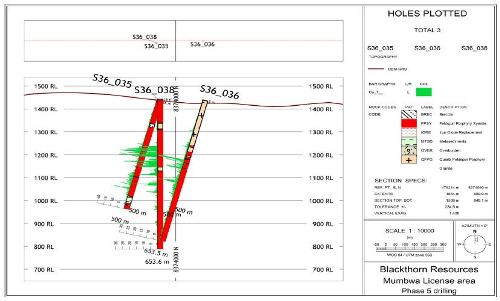
Geological cross section for drill holes S36-035, S36-036 and S36-038,
showing copper assay results. Source: Company announcement

The company was also seeking to validate the high-grade intersections in that drill hole it had reported in February 2012.

“We are very pleased that these results provide further evidence of the presence of an exceptionally high-grade core in the Kitumba area,” Blackthorn Resources managing director Scott Lowe said in the company’s announcement to the Australian Securities Exchange.

“The intersections are of similar width and grade at similar depth to those reported in S36-033.

“Drilling is continuing, with the holes yet to be reported from this phase being “step out” holes designed to test for an extension of the Kitumba mineralisation zone.

“The exploration work undertaken at Kitumba since regaining control of the project has delivered some excellent results and our understanding of mineralisation continues to improve.

“We look forward to completing the drilling in coming weeks and undertaking a recalculation of the mineral resource to be announced mid-year.”

Horseshoe hits copper mineralisation in first Kumarina diamond hole

THE DRILL SERGEANT: Horseshoe Metals has finished a third drilling program at the Rinaldi prospect situated on the company’s Kumarina copper project in Western Australia.


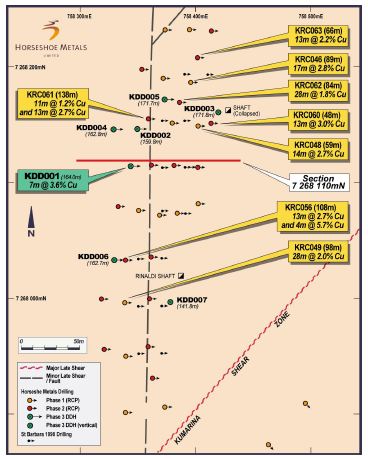
Rinaldi prospect drill hole location plan. Source: Company announcement


Seven diamond drill holes were completed last week for a total of 1,134 metres of drilling, with the holes ranging in depth from 141.8 to 171.8 metres.

Horseshoe has received the results from the first of these holes (KDD001), which intersected copper mineralised zones.

Best results so far have included:

–    7 metres at 3.6 per cent copper from 58 metres, including 1 metre at 10.1 per cent copper from 60 metres;

–    2m at 1.4 per cent copper from 77m; and

–    4m at 1.4 per cent copper from 96m, including 1m at 4.1 per cent copper from 99m.

The results of the remaining six diamond drill holes from the Kumarina project have yet to be received.

“Initial observations from KDD001 confirm that the copper mineralisation is quartz vein hosted mainly within an interpreted altered dolerite host,” Horseshoe Metals said in its ASX announcement.

“The copper mineralisation appears to be structurally controlled with the main concentration of quartz veins occurring as a stockwork in the hanging wall zone of a westerly dipping dolerite dyke.

“The dyke has intruded through thinly bedded siltstone and shale sediments which dip gently to the north.

“The mineralised quartz veins continue throughout the dyke to a lesser degree with an interpreted sub-vertical orientation.

“Another stockwork of quartz veins occurs at the footwall of the dyke which is less mineralised.”

Horseshoe Metals said the diamond drill rig has now relocated from Kumarina to the Horseshoe Lights project where the company expects to recommence drilling before the end of April 2012.

The diamond drilling will initially test the DDIP (Dipole-Dipole Induced Polarisation) anomaly Horseshoe identified south east of the existing open pit last year.

Horseshoe Metals’ 100 per cent-owned Kumarina copper project is located 95 kilometres north of Sandfire Resources’ DeGrussa copper-gold mine, 90km north of Ventnor Resources’ Thaduna copper project and 35km southwest of Montezuma Mining Company’s Butcherbird copper project, in the Gascoyne region of Western Australia.

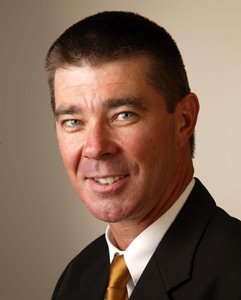
Ian Mulholland – Rox Resources

ONE OFF THE WOOD: Rox Resources managing director Ian Mulholland popped into the front bar this week to fill us in on the company’s exciting exploration portfolio.

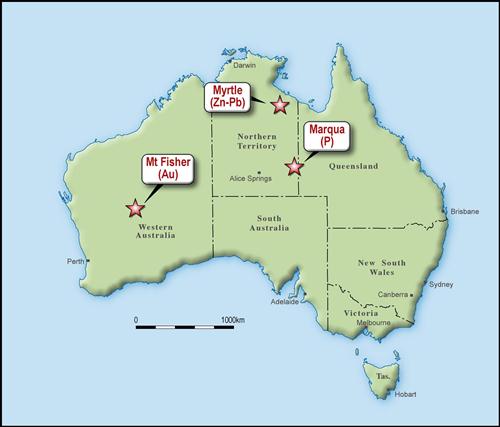
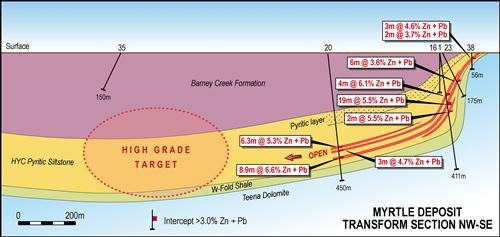
The company is currently working away of the Mt Fisher gold project in Western Australia; and the Myrtle zinc / lead Marqua phosphate projects in the Northern Territory.


Two of your three projects, Mt Fisher and Myrtle, are receiving a lot of exploration attention at present, how would you rate these in order of importance for the company?

Both are important.

The major focus for Rox Resources at present, operationally, is the Mt Fisher gold project in Western Australia which we believe has the potential to host gold deposits in the 1-2 million ounce range.

However, Myrtle, which we have farmed out to Teck, has the potential to be a major world class zinc deposit and if it proves up as we hope  that willhave a major impact on us as a company..

We’re very keen to keep an eye on how Teck is progressing with Myrtle because if you consider the different, relative potential size of each project, Myrtle could potentially end up being ten times the value of a one or two million ounce gold deposit, which is what we are looking for at Mt Fisher.


You acquired Mt Fisher from Avoca just over 12 months ago and since then have been fairly active out there. To what stage have you brought it to?

Last year we conducted 8,500 metres of RC (reverse circulation) drilling, basically following up drilling that previous explorers had done.

That drilling campaign allowed us to issue a Resource statement, the first for the Mt Fisher area,  earlier this year stating we had 86,000 ounces of gold in three high-grade deposits.

Do you have any immediate plans for any of those three high-grade deposits you have identified?

We would much rather press on with our current exploration schedule in order to move to that 1-2 million ounce target.

I look at that project and at the Mt Fisher Belt and I compare it to the Yandal Belt to the west.

Back in the mid-1980s everyone said there was no gold in the Yandal Belt and so far there has been 17 million ounces discovered and mined there.

That said, we do however have an opportunity to maybe toll treat one of them at one of the plants located nearby but that would really be only a small amount tonnage-wise and is not our main focus.

Is Mt Fisher far away from Yandal?

Geologically, Mt Fisher is the next belt over from Yandal so there is a good chance it should also contain multi-million ounce gold deposits.

So far between Rox, and another company exploring to the south of us, there has been around 400,000 ounces of gold identified.

We have a large number of anomalies and targets to follow up on our tenements; the hardest decision for us at the moment is deciding which one we start with.

As exciting as the Mt Fisher project could be you still seem to be quite bullish in your regard to the Myrtle project. How did that Joint Venture relationship with Teck come about? Did they come knocking at your door or had you let it be known you were looking for a partner for the project?

We’d had a relationship with Teck for a while, well before the Myrtle project came up, through previous lead and zinc exploration we had carried out in Laos.

They had liked that project and the way we operated it. They approached us in regards to that project, but as it turned out we were unable to do a deal at that time.

When we acquired Myrtle and realised its potential, Teck were the first people we thought of.

Were they happy to receive that call?

Absolutely; I think it is now one of their main projects within Australia, at least.

What are the terms of the JV?

They have to spend $5 million to earn 51 per cent of the project by mid-2014 and they are well on track to do that.

They had to spend one million dollars and conduct 2,000 metres of drilling by July this year. They have spent the one million dollars but bad weather restricted them from completing the 2000 metres of drilling.

They’ll be back there as soon as the weather permits and we’re confident they will easily meet the required number of metres in time.

If they want to move beyond the 51 per cent stake they can earn 70 per cent by spending another $10 million – taking it to $15 million in total.


That’s two projects behaving nicely for you, is the Marqua phosphate project falling in to line as well?

We spent around half a million dollars on our Marqua phosphate project last year, which is also in the Northern Territory.

We did quite a bit of drilling there, which took the project to the point where we are now looking to bring a Joint Venture partner in there as well.

Have you raised the Marqua flag to the market place yet?

To a small degree, but at this point I think we are really looking for more foreign investment for this particular project rather than local investment.

We have been approached on Marqua  but we’re still considering what we want to do with the project and we have people out there looking to see what options are available to us.

Is it a case of taking the time to ascertain exactly what sort of partner the project demands to enable you to define your search?

To a certain degree; you can spend a lot of time spinning your wheels by talking to people and not getting anywhere.

We were very-focused when it came to our JV partner search for Myrtle and that paid off for us and we would like to repeat the success of that process at Marqua, if we go down that route.

Should you strike a JV agreement for Marqua that would pretty much free Rox up to solely concentrate on Mt Fisher?

The opportunities offered to Rox at Mt Fisher really excite me.

I can see parallels between what happened at the Yandal Belt and what we have at Mt Fisher is very encouraging.

With the way the market is behaving at the moment, for a small company such as ours, gold is a good sector to be in.

Are you looking at building your own plant at Mt Fisher or would the toll treatment plan you mentioned earlier be the way forward for you?

I would think building our own plant would be the way we are heading.

We are clearly seeing the project has the potential to host multi million ounce deposits, so that’s the direction we want to follow.

We will build-up that resource inventory so that when we do launch a project at Mt Fisher it will be a very successful project.

Port Hedland and the FIFO conundrum

OUT AND ABOUT: Wikipedia describes the iron ore hub of Port Hedland as, “the highest tonnage port in Australia”.

It also claims it to be the, largest town in the Pilbara region of Western Australia.

Anybody, who upon reading the second of these descriptions decided to visit Port Hedland would probably understand why Wikipedia is not the preferred reference site of the country’s major tertiary education institutions.


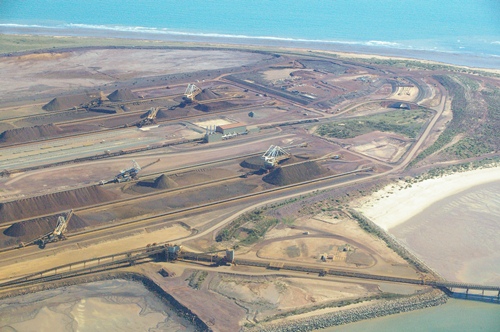
Iron ore stockpiles at port Hedland

Having recently visited Port Hedland I think it is safe to say that if something were to occur that would normally make a loud noise it would do so silently, as there would be nobody there to hear it.

Port Hedland is now a Fly In Fly Out (FIFO) town; a place existing on the fringes of the mining boom.

FIFO workers of the mining industry arrive in Port Hedland in their thousands every week; however, few of them ever lay their feet upon the local footpaths.

They have little need to. Once they’re at work onsite, that’s where they stay. That’s where they eat, sleep, drink and work.

They do this all day, every day, until their allocated weeks of work are done, then they jump on the company bus to the airport and wait for flights to take them to their other homes, dotted around the country.

Much is said about this reasonably new workplace scheme of arrangement because of the so many different affects it is having on the health and well-being of workers, their families, and communities.

Port Hedland was originally gazetted by the Western Australian government as a town site in 1896 to take advantage of its natural harbour.

The early port facility serviced a sparingly populated pastoral hinterland, as well as some early goldmining and fleeting pearling industries.

The Pilbara region came into its own with the discovery of large deposits of iron ore in the 1960s, which resulted in the lifting of a ban on the export of iron ore put in place during World War II.

According to the Chamber of Minerals and Energy of Western Australia web site, the Federal Government export ban on iron ore was lifted due to the significant iron ore resource discoveries made during the 1950’s.

“As a result work commenced on developing iron ore projects within Western Australia, which has subsequently resulted in making Australia a global player in iron ore production,” the Chamber says.

“The establishment of many towns throughout the North West is a direct result of this commodity.”

In the mid-1960s, a satellite suburb was established 23 kilometres south of Port Hedland.

The imaginatively-named South Hedland is now home to approximately two-thirds of the town’s population.

Around 5000 houses were built by mining companies to accommodate workers and plans were drawn up for houses to accommodate a population expected to erupt to 60,000 to support the burgeoning mining business and the anticipated rapid expansion of the port and town centre.

In 1986 the Federal government led by Bob Hawke introduced the Fringe Benefits Tax and mining companies stopped building houses.

“The town didn’t develop 5000 houses, the mining companies built many of them, because nobody else could, or would,” Port Hedland Real Estate stalwart Jan Ford told The Roadhouse.

“That is why the town experienced such a boom throughout the 1960s and 1970s.”

The new tax regime resulted in mining companies applying the brakes on housing and residential infrastructure with both feet.

Private development became impossible because the land was held by the Crown, which was in no particular hurry to release it.

If companies did manage to get hold of any land they weren’t building houses to accommodate workers because they would be liable for further FBT payments.

The idea of decentralisation had the opposite effect as the management level workforce of companies headed back to the cities where companies could avoid making FBT payments.

Gone also were the added extras to weekly pay packets for workers with all regional bonuses no longer required to be paid to the swelling numbers of urban-based personnel.

All of a sudden companies found they could still maintain their operations without paying as much to do so.

With no need to worry about accommodating their workers in regional centres companies were no longer building new houses, which meant they were also no longer doing what they had done in the past – developing communities.

“It meant we stayed with the same number of houses for the next twenty years,” Ford said.

Ford said of the 6000 houses in Port Hedland around 2,000 of them are owned independently of government or mining companies.

“That translates to a solidifying to the liquidity of the Port Hedland real estate market and extremely high prices for buyers,” she said.

Fast forward from 1986 to the year 2000 and China is awakening from its self-imposed exile from the rest of the developed world.

All of a sudden the arrows on every chart indicating the value of every mineral that was still in the ground pointed to magnetic north.

BHP Billiton recognises the need to pump as much iron ore through Port Hedland as it possibly can to the point where ‘Port Expansion’ becomes as much a part of the local vernacular as ‘what are you lookin’ at?’.


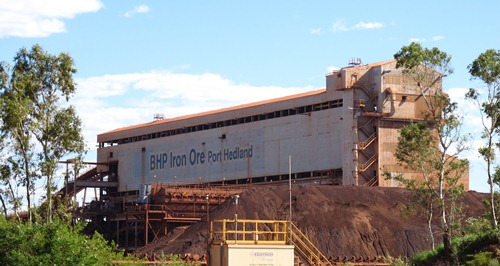
BHP operations keep watch over the city of Port Hedland

The Department of Minerals and Energy undoubtedly looks at the 6,000 houses still standing in Port Hedland and realises a fatal error was made by not encouraging the development to house the 60,000 population earmarked 20 years earlier.

In 2012 Port Hedland is struggling to catch up to, let alone keep pace with, the mining boom.

Planning for expansion such as that now proposed by companies like BHP is done years in advance, after all a port doesn’t go from shipping 130.7 million tonnes of iron ore in 2008 to shipping just under 200 million tonnes of iron ore without some preparation.

The only plans amongst all this development giving any consideration to housing workers is for the construction of FIFO camps.

“In 2000 BHP was talking about what they were going to be doing at Outer Harbour and the possible train line from Queensland to Western Australia, but they weren’t talking about housing,” Ford explained.

“They want it [housing], but unfortunately the mining industry and the State Government can’t get their act together.”

If another 60,000 people, adults and their families were suddenly added to the local population of Port Hedland that would equate to the possible addition of around 20,000 voters.

These people would require facilities and infrastructure, things that have been, in recent times, provided through the WA state government’s Royalties for Regions Scheme.

There may be votes for politicians in such activity but those votes don’t count around Boardroom tables and in the end companies are left, at this stage with no other choice than to use a FIFO workforce.

So they take everything back to the city.

Navarre hits more high-grades at Tandarra

THE DRILL SERGEANT: Victorian gold exploration play Navarre Minerals has announced further high-grade gold results from a Reverse Circulation (“RC”) drill program currently underway at the Tandarra prospect, part of the company’s Bendigo North project, located 40 kilometres north of Bendigo.

Highlights from the current drilling campaign include:

–    4 metres at 9.2 grams per tonne gold from 18 metres down hole, including 1 metre at 30.9 grams per tonne gold;

–    6m at 3.1g/t gold from 40m down hole, including 4m at 4.5g/t gold;

–    5m at 3.9g/t gold within 12m at 1.8g/t gold from 73m down hole; and

–    2m at 5.5g/t gold from 77m down hole, including 1m at 10.3g/t gold.


Satellite image of Tandarra prospect showing location of diamond
drilling, significant drill intercepts and status of RC drilling.
Source: Company announcement

“We are extremely pleased with the RC program to date as the assays are continuing to record broad zones of gold mineralisation, interspersed with pockets of high-grade gold, which we believe supports our Bendigo Goldfield analogy”, Navarre Minerals managing director Geoff McDermott said in the company’s announcement to the Australian Securities Exchange.

“Furthermore, we believe that we are outlining extensively mineralised quartz reef systems, which occur close to surface and appear likely to be continuous along considerable strike lengths.

“Our work so far is delivering encouraging results over 650 metres of strike on the Tomorrow Line, which lies within the 2.5 kilometres of strike previously delineated by air-core drilling at Tandarra.”

Navarre said it believes mineralisation at the Tandarra prospect to be analogous to the nearby Bendigo Goldfield, which historically has produced 22 million ounces of gold.

The company is focusing its drilling on the top 100m from surface, as it believes gold mineralisation intersected at shallow depths offers potential for an open pit project that could benefit from bulk mining techniques.

“Underground gold mining in Victoria has been a challenge in recent times because of the requirement to locate and selectively mine erratically distributed high-grade pods around and under historic mines,” McDermott said.

“We believe that an open pit project in a previously un-mined area may prove more successful because the reduced cost structure of open pit mining, as compared to underground mining, allows extraction to commence on the basis of lower costs and lower break-even gold grades.

“Such an approach at Tandarra could potentially enable the high grade gold to be recovered within the broader zones of gold mineralisation, without the challenges of developing deeper underground mines and navigating around old workings that are often poorly documented.”

Navarre said it expects to release more drill results from over 25 already-completed RC and diamond holes at Tandarra yet to be assayed, as well as further holes to be drilled as part of the current program.

The company has another air-core drill rig scheduled to be onsite in May this year to resume scout drill testing of potential quartz reef targets identified by recent geophysical surveys.

Radar confirms hematite at Johnston Range

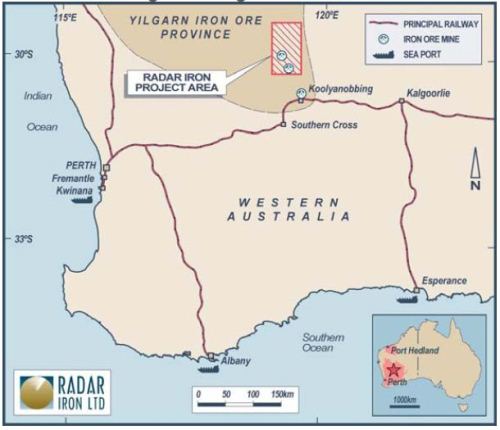
THE DRILL SERGEANT: Radar Iron claims to have confirmed hematite mineralisation at the company’s Muldoon prospect, located on the Johnston Range in the Yilgarn region of Western Australia.


Radar Iron project location. Source: Company announcement


The company conducted an RC drilling program in March 2012 completing 34 holes for 1410 metres.

Best results from the recent campaign include:

–    32 metres at 60.4 per cent iron;

–    34m at 59.4 per cent iron;

–    26m at 59.5 per cent iron;

–    22m at 59.1 per cent iron;

–    18m at 58.6 per cent iron;

–    16m at 56.4 per cent iron;

–    22m at 56.1 per cent iron; and

–    20m at 55.8 per cent iron.

Radar said the drilling defined two adjacent zones of hematite mineralisation measuring approximately 10 to 25m in width and has been tested to 30 to 40m below surface.

“These results confirm the continuity and economic grades of the two zones of hematite mineralisation at the Muldoon prospect,” Radar Iron managing director Jonathan Lea said in the company’s announcement to the Australian Securities Exchange.

“The near surface mineralisation presents potential for a low cost development opportunity using open cut mining methods.

“The latest drill data is still being assessed and it is the intent of the company that resource estimation will be completed in coming months – possibly following some further infill drilling.”

Radar is hoping to identify hematite resources in 2012, through the drill testing of several individual hematite bodies.

The company said the confirmation it has achieved through the recent drilling that mineralisation can continue under cover suggests the potential for mineralisation could be greater than it previously thought.

Sirius extends Inky with copper – zinc hits

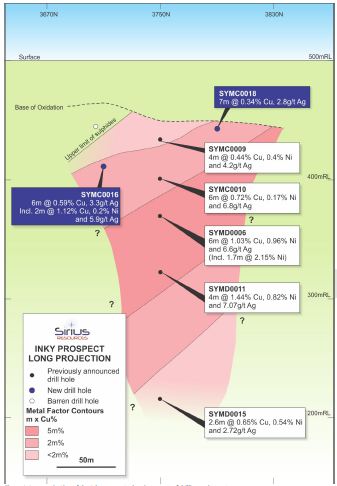
THE DRILL SERGEANT: The first round of drilling conducted by Sirius Resources north and south along strike from known mineralisation at the Inky prospect on the company’s Youanmi project in Western Australia has intersected copper-nickel mineralisation.

In its announcement to the ASX, Sirius said the step-out drilling had demonstrated sulphide mineralisation may occupy a broad south plunging zone that has yet to be adequately tested by drilling.

Mineralisation is open north along strike, down dip and down plunge to the south.


Long projection of the Inky prospect, showing extent of drilling and target areas. Source: Company announcement

Sirius drilled four reverse circulation (RC) to determine the trend of the mineralisation as a prerequisite to planning further deeper drilling.

Three holes were effective and two of these intersected sulphide mineralisation, while the fourth hole did not reach target depth due to difficult drilling conditions.

The company intends having another attempt at this hole once it is able to source an appropriate drill rig.

The drill intersections from the recent drilling include:

–    6 metres at 0.59 per cent copper and 3.3 grams per tonne silver from 88m, including 2 metres at 1.12 per cent copper, 0.2 per cent nickel and 5.9 grams per tonne silver from 92 metres; and

–    7m at 0.34 per cent copper and 2.8g/t silver from 56m.

Sirius also conducted two reconnaissance RC holes on a separate zone known as the Boundary Gossan situated approximately two kilometres southeast of the Inky prospect.

Drill intersections from this drilling include:
 
–    3m at 0.34 per cent copper from 25m; and

–    4m at 0.22 per cent copper from 30m.

The company also claimed the discovery of a new gossan near Shirley Bore in the northern part of the project area.

Rockchip samples collected from this gossan contain up to 2.01 per cent copper, 4.2g/t silver and 0.17g/t gold.

Sirius said it intends to conduct RC drilling to test further strike continuation of the Inky prospect, the Boundary gossan, and the Shirley Bore gossan.


Sandy Moyle – Goldminex

ONE OFF THE WOOD: Goldminex is something of a curiosity in that it is an ASX-listed gold exploration play with an international focus that isn’t actually exploring in Africa.

The company’s chief executive officer Sandy Moyle pulled up a stool at the bar this week to tell us why.
 

Instead of Africa Goldminex has chosen to focus its exploration endeavours in Papua New Guinea, why?

We view PNG as a highly-prospective country. It is situated on the Pacific margin and is host to numerous documented gold deposits and large, well-performing gold and porphyry gold-copper mines.

The country is a proven destination for porphyry copper-gold deposits and, when Goldminex was looking at possible exploration destinations, PNG was an area where it was possible to acquire a large tract of prospective land.

That was in the mid-2000s when PNG wasn’t particularly flavour of the month with potential exploration plays.

Subsequently that attitude has changed with new discoveries and rising commodity prices so it is very difficult to find any free ground there at the moment.

Why would companies have been shy about heading to such a renowned mining destination?

I think was probably the low commodity prices at the time. It can be an expensive place to conduct exploration.

However, having said that, I still consider PNG to provide good bang for your exploration buck.

It’s not as if the country has been flogged to death and there is certainly a lot more near surface prospectivity than what you will find in Australia.

What differentiates PNG prospectivity from Australian?

Primarily the size of the deposit that can be located. The prospectivity to find a large economic deposit in PNG is very good.

That probably explains why you describe PNG in one of your presentations as elephant country. So how is the Goldminex elephant hunt progressing?

In PNG we have exploration licences in two areas covering approximately 10,700 square kilometres.

Our main area of focus is in the Owen Stanley Ranges region, which is a conglomerate of tenements, some of which are held 100 per cent by Goldminex while the others are incorporated in the a farm-in agreement with Vale.

Our other area of interest is the Awari project in the East Sepik Provice.


We have outlined several key projects in the Owen Stanley region, of which the Liamu porphyry copper-gold project is the most advanced.

The Liamu project lies within the Vale farm-in agreement area

The Liamu intrusive complex covers an area of around 35 square kilometres and soil sampling has revealed eleven square kilometres of highly-anomalous copper or gold geochemistry.

We are currently in the middle of a 4000 metre, deep diamond drilling program testing several of the eleven prospects that lie within the Liamu project.

What is the agreement with Vale?

Vale is spending $20 million to earn 51 per cent of the project. That’s a good indication of the value and the prospectivity of our Owen Stanley region tenements.

To attract a partner of the likes of Vale demonstrates it must hold some potential?

To a point, yes; but we were fairly selective when it came to deliberating in regard to suitable partners.

We had several offers from other interested parties but considered Vale’s to be the best match for us.

Their terms were reasonable and they have retained us as on-ground operators due to our good PNG exploration capability and infrastructure set up in Port Moresby.

To what stage have you progressed Liamu so far?

All the regional work has been completed there, including detailed mapping, sampling, and an airborne magnetic and radiometric survey.

This has highlighted some geophysical and geochemical targets. Vale’s approach is to conduct some targeted drilling primarily based on geophysics, geology and some geochemistry to try and define a third dimension on the porphyry system.

We have identified 11 prospects within the Liamu project and this current activity is only testing around five of them.

At the same time work is also ongoing on at the other targets in order to advance them.

Liamu is obviously the elephant that is leading the Goldminex parade, what other elephants are following up behind?

We have 19 other targets located within the agreement area and outside it.

Within the area, the targets we have been pursuing include Sibium, Wavera and Ubei, however, Vale are keener on moving onto some of our regional targets.

How are you funding all this activity?

The Vale budget for this year is around $7 million for the farm-in area. Our Goldminex activities budget is around $3 million.

We recently completed a capital raising for $3.4 million and that will fund this year’s budget as well as some of next year’s.

We also currently have some $3 million cash in the bank taking our total up to around $6 million.

One of the benefits of the agreement with Vale is that it allows us to split the overall logistics and operating costs proportionally to the on-ground exploration -activities conducted in the Vale agreement area and the 100 per cent-owned Goldminex area.

Where has the bulk of your exploration activity been carried out?

Last year most of the key areas of activity were located within the Vale farm-in agreement area.

This year, within the Vale farm-in agreement area, in addition to advancing the Liamu project, we are investigating other targets and have conducted a ZTEM airborne geophysics survey. Goldminex is exploring sulphide nickel prospects in its own right.

Externally to that we have two main exploration licences within the Owen Stanley project that are 100 per cent-owned by Goldminex.

Each of these has six key porphyry copper-gold or epithermal gold targets. We will be exploring several of them this year.

You haven’t mentioned the deal you managed to cut regarding the project’s nickel rights?

Goldminex has retained 100 per cent of the nickel rights within the area covered by the agreement.

Was Vale only interested in the copper-gold rights?

Not exactly; when we looked at farming out this area, we deliberately retained the rights for the nickel, primarily to get the best deal for our shareholders.

As one of the largest nickel producers in the world, Vale was a bit shaken by the fact we were retaining the nickel for ourselves.

Obviously they will be keeping a pretty good eye on our progress on that front, especially if we come across something big.

Does the agreement hold synergies that benefit both companies?

The synergies that exist are quite substantial.

Vale is primarily in PNG seeking a large porphyry copper – gold deposit.

We have retained the right contribute or dilute on a program by program basis once Vale has achieved 51 per cent.

We also negotiated the right to pursue small gold targets that emerge from regional work carried out.

Vale hold the right to buy back up to 49 per cent interest in those precious metal projects for three times exploration costs once we reach a 2 million ounce gold equivalent JORC Resource.

We would retain the right to operate those projects even if the buy-back was elected because of our retained 51 per cent.

What’s happening at the Awari project while all this is happening at Owen Stanley?

We see the Awari project to be an opportunity to bring in another partner in order to advance the encouraging discoveries to-date.

We are reasonably advanced in discussions with another party regarding that opportunity.