


Australians in Africa don’t just explore for gold
OUT TO LUNCH: Africa-focused juniors Minbos Resources and Kaboko Mining joined forces recently to buy lunch for a hungry hoard of journalists in order to inform them about recent developments on their respective projects.
Minbos is a phosphate development company, which just 12 months ago was a phosphate exploration play.
The company is focused in West Africa, where it has two near-production projects, one in Northern Angola and another across the border in the Democratic Republic of Congo.
“In Africa, there are not many projects that can boast that they have existing infrastructure they can go out and touch and can access; we do,” Minbos Resources chief executive officer Robert McCrae announced across a chorus of soup slurping.
The company describes its Cabinda project in Angola as an easily exploitable, high-grade, close to surface deposit.
The current JORC inferred resource at Cabinda stands at 304 million tonnes at 11.5 per cent phosphate.

Cabinda project overall Resources, December 2011. Source: Company quarterly report.
Minbos is involved in a 50:50 Joint Venture with LR Group, a privately-owned Israeli group.
The LR Group is the largest agricultural company within Angola as well as being one of the largest construction companies within Angola.
It is large enough to extend the government of Angola a $US1.5 billion line-of-credit for agriculture and construction projects.
“The reason we brought the LR Group in, basically, when we were applying for the licence we were a new company in Angola, a small exploration company; the government liked what we could provide, but they felt they were giving away a national asset to an unknown company,” McCrae said.
“The LR Group was recommended to us as a potential Joint Venture partner, which brought a lot of credibility to our application.”
Minbos is currently focussing its attention on two projects situated within the Eastern Limb of the Cabinda project.
These are the 22.5Mt at 21.4 per cent phosphate Cavata project, and the 6.7Mt at 20.3 per cent phosphate Chivovo project.
“We have just completed a diamond drilling campaign on both of those projects and we will be moving those projects from the (JORC) Indicated into the Measured category over the next couple of months,” McCar said.
“Those Resources will form the basis for the Bankable Feasibility Study, which we will be kicking off before the middle of the year.”
McCrae said the projects were, “a dream for a small company such as ourselves”, due to such benefits as the ore bodies lying on surface providing strip ratios less than 2:1.
He said the company will be mining an ancient seabed with soft material that will not require any blasting or drilling to access keeping mining costs lower.
“The high-grade material is also very close to the surface, which has made our metallurgical processing very simple,” McCrae explained.
“We have done the met-work and it is a very simple scrubbing and wet screening process to upgrade the ore from just over 20 per cent to over 34 per cent phosphate.”
Minbos has run a scoping study on the Cabinda project from which it has defined it to be a one million tonne export operation with operating costs of less than $US50 per tonne Free On Board.
The company’s current revenue expectations are approximately $US200 per tonne with a capital expenditure of less than $US100 million.
“If we run the financial model it comes out as a very attractive project with Cacata and Chivovo combined together,” McCrae said.
As the soup bowls were replaced by main course Kaboko Mining executive director Jason Brewer took hold of the remote control to run us through his company slide show.
Kaboko listed in September last year since when it has already moved into production producing high-grade manganese from its projects located in Zambia.
The company is targeting low-cost, high-quality, high-grade export lumps of manganese for export to the Asian markets.
To this end it has already completed a trial shipment of its product to China.
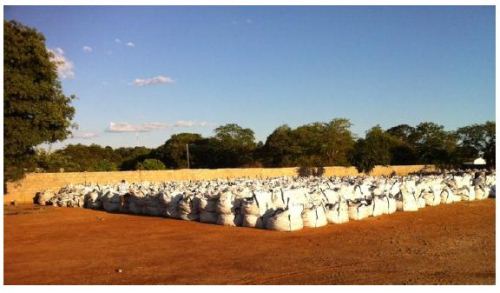
Bagged manganese ore mined from the Chowa open pit. Source: Company quarterly report.
“We are mining, we’re developing, and we are actively exploring in the country at the moment,” Brewer said.
Kaboko has three main projects: Emmanuel, Peco; and Kanona containing five large-scale prospecting licences and three small-scale mining licences covering 2,734 square kilometres.
The company is currently mining the Chowa open pit one within the Emmanuel project, where small scale open pit mining activities commenced in 2010.
It is also carrying out pre-stripping and conducting infill drilling on another licence area within the Peco project, which it hopes to have producing by the end of this year.
“It is very much a production story,” Brewer said.
“Zambia has always had high-grade manganese mining opportunities.
“There are mines that have been operating for several decades and the Chinese are very active in the country.”
In January Kaboko completed a trial shipment of around 5 million tonnes to China.
Samples taken at the mine site and at port graded at 59 per cent manganese.
That shipment arrived in China in February, where it is undergoing final testing phases while the company finalises the details for the offtake agreement.
“This is a key for the group, as we move forward,” Brewer explained.
“We have demonstrated our ability to get our product to market, which in any commodity is critical.”