


Port Hedland and the FIFO conundrum
OUT AND ABOUT: Wikipedia describes the iron ore hub of Port Hedland as, “the highest tonnage port in Australia”.
It also claims it to be the, largest town in the Pilbara region of Western Australia.
Anybody, who upon reading the second of these descriptions decided to visit Port Hedland would probably understand why Wikipedia is not the preferred reference site of the country’s major tertiary education institutions.
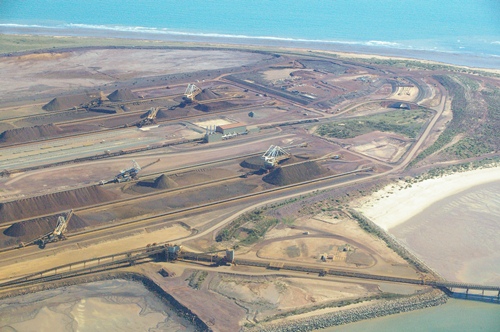
Iron ore stockpiles at port Hedland
Having recently visited Port Hedland I think it is safe to say that if something were to occur that would normally make a loud noise it would do so silently, as there would be nobody there to hear it.
Port Hedland is now a Fly In Fly Out (FIFO) town; a place existing on the fringes of the mining boom.
FIFO workers of the mining industry arrive in Port Hedland in their thousands every week; however, few of them ever lay their feet upon the local footpaths.
They have little need to. Once they’re at work onsite, that’s where they stay. That’s where they eat, sleep, drink and work.
They do this all day, every day, until their allocated weeks of work are done, then they jump on the company bus to the airport and wait for flights to take them to their other homes, dotted around the country.
Much is said about this reasonably new workplace scheme of arrangement because of the so many different affects it is having on the health and well-being of workers, their families, and communities.
Port Hedland was originally gazetted by the Western Australian government as a town site in 1896 to take advantage of its natural harbour.
The early port facility serviced a sparingly populated pastoral hinterland, as well as some early goldmining and fleeting pearling industries.
The Pilbara region came into its own with the discovery of large deposits of iron ore in the 1960s, which resulted in the lifting of a ban on the export of iron ore put in place during World War II.
According to the Chamber of Minerals and Energy of Western Australia web site, the Federal Government export ban on iron ore was lifted due to the significant iron ore resource discoveries made during the 1950’s.
“As a result work commenced on developing iron ore projects within Western Australia, which has subsequently resulted in making Australia a global player in iron ore production,” the Chamber says.
“The establishment of many towns throughout the North West is a direct result of this commodity.”
In the mid-1960s, a satellite suburb was established 23 kilometres south of Port Hedland.
The imaginatively-named South Hedland is now home to approximately two-thirds of the town’s population.
Around 5000 houses were built by mining companies to accommodate workers and plans were drawn up for houses to accommodate a population expected to erupt to 60,000 to support the burgeoning mining business and the anticipated rapid expansion of the port and town centre.
In 1986 the Federal government led by Bob Hawke introduced the Fringe Benefits Tax and mining companies stopped building houses.
“The town didn’t develop 5000 houses, the mining companies built many of them, because nobody else could, or would,” Port Hedland Real Estate stalwart Jan Ford told The Roadhouse.
“That is why the town experienced such a boom throughout the 1960s and 1970s.”
The new tax regime resulted in mining companies applying the brakes on housing and residential infrastructure with both feet.
Private development became impossible because the land was held by the Crown, which was in no particular hurry to release it.
If companies did manage to get hold of any land they weren’t building houses to accommodate workers because they would be liable for further FBT payments.
The idea of decentralisation had the opposite effect as the management level workforce of companies headed back to the cities where companies could avoid making FBT payments.
Gone also were the added extras to weekly pay packets for workers with all regional bonuses no longer required to be paid to the swelling numbers of urban-based personnel.
All of a sudden companies found they could still maintain their operations without paying as much to do so.
With no need to worry about accommodating their workers in regional centres companies were no longer building new houses, which meant they were also no longer doing what they had done in the past – developing communities.
“It meant we stayed with the same number of houses for the next twenty years,” Ford said.
Ford said of the 6000 houses in Port Hedland around 2,000 of them are owned independently of government or mining companies.
“That translates to a solidifying to the liquidity of the Port Hedland real estate market and extremely high prices for buyers,” she said.
Fast forward from 1986 to the year 2000 and China is awakening from its self-imposed exile from the rest of the developed world.
All of a sudden the arrows on every chart indicating the value of every mineral that was still in the ground pointed to magnetic north.
BHP Billiton recognises the need to pump as much iron ore through Port Hedland as it possibly can to the point where ‘Port Expansion’ becomes as much a part of the local vernacular as ‘what are you lookin’ at?’.
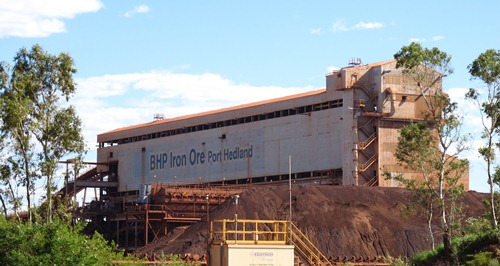
BHP operations keep watch over the city of Port Hedland
The Department of Minerals and Energy undoubtedly looks at the 6,000 houses still standing in Port Hedland and realises a fatal error was made by not encouraging the development to house the 60,000 population earmarked 20 years earlier.
In 2012 Port Hedland is struggling to catch up to, let alone keep pace with, the mining boom.
Planning for expansion such as that now proposed by companies like BHP is done years in advance, after all a port doesn’t go from shipping 130.7 million tonnes of iron ore in 2008 to shipping just under 200 million tonnes of iron ore without some preparation.
The only plans amongst all this development giving any consideration to housing workers is for the construction of FIFO camps.
“In 2000 BHP was talking about what they were going to be doing at Outer Harbour and the possible train line from Queensland to Western Australia, but they weren’t talking about housing,” Ford explained.
“They want it [housing], but unfortunately the mining industry and the State Government can’t get their act together.”
If another 60,000 people, adults and their families were suddenly added to the local population of Port Hedland that would equate to the possible addition of around 20,000 voters.
These people would require facilities and infrastructure, things that have been, in recent times, provided through the WA state government’s Royalties for Regions Scheme.
There may be votes for politicians in such activity but those votes don’t count around Boardroom tables and in the end companies are left, at this stage with no other choice than to use a FIFO workforce.
So they take everything back to the city.