Highlands Pacific hits highest grade copper in final Olgal prospect drilling hole

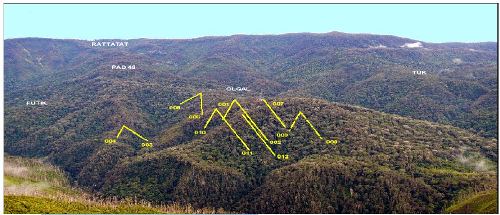
THE DRILL SERGEANT: Highlands Pacific has reported the final assays it has received from a 14 hole diamond drilling program at its Olgal prospect in the Star Mountains, located 20 kilometres northeast of the Ok Tedi mine in Papua New Guinea.


Star Mountains prospects and Olgal drilling. Source: Company announcement

The company was made to wait until assaying of the bottom of the final hole of the 14 hole program to receive the best results, which included:

596 metre at 0.61 per cent copper and 0.85 grams per tonne gold from 24m down hole (at a 0.2 per cent copper cut‐off), including 294 metres at 0.67 per cent copper and 1.16 grams per tonne gold from 320 metres down hole (at a 0.5 per cent copper cut‐off).

“This hole is quite a surprise and the grade exceptional and more than justifies the effort and resources that we have expended at Star Mountains in the last two years,” Highlands Pacific managing director John Gooding said in the company’s announcement to the Australian Securities Exchange.

“There is no doubt that this is a new copper gold porphyry province close to the established infrastructure of the Ok Tedi Mine.

“Importantly, with each hole we are increasing our conceptual understanding of the area and the interplay between the more than a dozen targets we have in mind to test.

“Drilling at Olgal has stopped for now with the rigs now located at the Futik and Pad48 prospects.

“Based on the Olgal results, we look forward to results from these and the next drill target at Rattatat in the coming months.”

Of the 14 holes drilled in the recent program at Olgal, 12 have encountered copper and gold mineralisation.

Sarawak drilling continues to encourage Olympus Pacific

THE DRILL SERGEANT: Olympus Pacific Minerals has received encouraging results from drilling being conducted at the Jugan Sector of the company’s Bau Central property in Sarawak, East Malaysia.

Source: Company announcement

Highlights of the drilling program include:

–    61.10 metres at 2.40 grams per tonne gold, including 2.00 metres at 5.93 grams per tonne gold, 7.00 metres at 5.36 grams per tonne gold, 5.70 metres at 3.53 grams per tonne gold, and 4.00 metres at 3.90 grams per tonne gold;

–    34.00m at 2.47g/t gold, including 8.8 at 3.2g/t gold;

–    36.00m at 1.15g/t gold;

–    33.00m at 1.48g/t gold;

–    24.00m at 1.76g/t gold, including 7.00m at 3.27g/t gold; and

–    32.40m at 1.92g/t gold, including 28.00m at 2.21g/t gold.

“Ongoing drilling in the Jugan Sector of the Bau Gold Trend continues to return highly encouraging results,” Olympus Pacific Minerals chief executive officer John Seton said in the company’s announcement to the Australian Securities Exchange.

“Drilling has now shown that the Jugan Hill deposit remains open, both at depth and along strike and that the deposit strikes, parallel to the regional northeast-southwest trend of Bau Central gold mineralisation.

“This substantially enhances the scope for step-out drilling to expand resources and increases confidence in the large-scale potential of the Jugan deposit.”

Olympus aid the current phase of infill and step-out drilling at the Jugan Hill deposit has continued to upgrade and expand the prospective open pit resource.

The company considers the latest results to have confirmed continuity of ore grade mineralisation well beyond the limits of the previous resource model.

Monto releases first Confederation drilling results

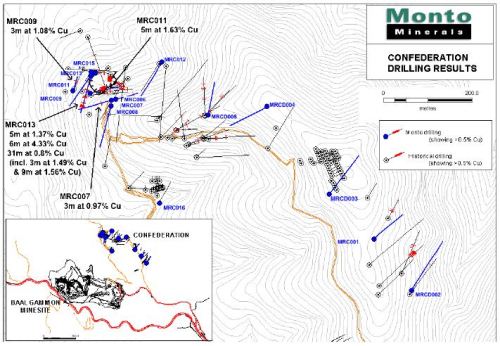
Monto Minerals has released the first batch of results it has received from a program of reverse circulation (RC) drilling conducted at the Confederation prospect, located 800 metres northeast of the Baal Gammon copper mine near the Herberton Tin Field of Northern Queensland.

The company said the initial batch of results has revealed a number of significant intersections, including:
 
–    6 metres at 4.33 per cent copper, 1.25 per cent tin, 106 grams per tonne silver and 301g/t indium from 87 metres;

–    9m at 1.56 per cent copper, 0.15 per cent tin, 43g/t silver and 102g/t indium from 123m; and

–    5m at 1.63 per cent copper, 0.2 per cent tin, 110g/t silver and 209g/t indium from 53m.

Monto said the results from the Confederation drilling program demonstrate the high grade nature of shallow copper mineralisation in the area and, given the proximity to the Baal Gammon mine, confirms the prospect as a potential additional source of high grade ore.


Source: Company announcement

“The initial batch of results received from the Confederation drilling program have confirmed the high grade nature of copper mineralisation in close proximity to the Baal Gammon pit and have also, rather unexpectedly, demonstrated significant tin grades associated with the copper,” Monto Minerals managing director James Allchurch said in the company’s announcement to the Australian Securities Exchange.

“The Confederation prospect provides great optionality for increased tonnes at the Baal Gammon operation and also represents a great deal of exploration upside given that both Baal Gammon and Confederation are located at the southwestern end of a strong northeast-trending aeromagnetic anomaly.”

Monto has completed the drilling program at Confederation and indicated that it will release results as they are received from the laboratory.

The company is currently finalising a forthcoming drilling program for Confederation, which will exclusively target high-grade tin mineralisation in the northern Herberton Tin Field.

This round of drilling is expected to commence late June 2012.

Peter Balsarini – Carbon Conscious

ONE OFF THE WOOD: Carbon credit provider Carbon Conscious chief executive officer Peter Balsarini took time off from the company’s recent tree planting activities to give The Roadhouse a quick lesson in carbon sequestration.

What is it that Carbon Conscious does?

We take marginal agricultural land, which we either buy outright or lease from the farmers, and plant mallee eucalypt trees, which are native to the wheatbelt areas of Australia.

As a tree grows it sequesters carbon into the mass of the tree. It starts off as a seedling and each year the incremental growth provides a carbon credit.

If you were to pull a tree out of the ground, roots and all, remove all the dirt and place it on a scale – there is actually a conversion between the weight of a tree and how much carbon it stores.

So it is the storage of the carbon in the mass of the tree – in the leaves and the trunk and the roots – all of it.

What companies would benefit most from utilising your services?

Companies that have carbon liabilities; in a simple sense we are selling a financial hedge.

Our two major clients are BP and Origin Energy. They are emitters of carbon and they have long term assets, be they power generation or oil, these types of assets.

This means they have a liability under the Clean Energy Scheme that starts on 1 July 2012, and they have that liability for any number of years because they have assets that last for any number of years.

Basically, our trees deliver a stream of carbon liability offsets as they grow.

Does your contract period with these companies reflect the potential life of their projects?

Our contract period is 15 years. When companies contract with us they make an initial upfront payment and continue to make contract payments throughout the 15 year period.

Through that period they earn the carbon credits as the trees are growing.

Does that mean they buy a tree and that tree is theirs for the term of the contract?

We buy the land, we buy the trees, we plant the trees and then we hold a licence over those trees for a period of 15 years. We’re responsible for managing the land and the trees, and our clients have the rights to the carbon credits the trees generate over 15 years.

How many trees does it take to sequester one tonne of carbon?

You would need four to five trees to sequester one tonne of carbon. So we talk in terms of carbon lots and we grow 1000 stems per hectare.

This year we are planting 10,000 hectares, which is ten million trees; that’s the scale we work on.


Why are mallee eucalypt trees your tree of choice?

The mallee eucalypt is the primary native tree of the wheatbelt areas of Australia. Not just the Western Australian wheatbelt, but the South Australia, Victorian, and New South Wales wheatbelts too.

These areas have been cleared for farming over the last hundred years or so. We are now earning carbon credits because we are reforesting these areas.

Why do you conduct your planting in the wheatbelt areas?

There are a couple of reasons; one being in order to earn a carbon credit that is compliant under the terms of the Kyoto Protocol a tree has to be planted on, what is termed, cleared agricultural land – that is land cleared through human endeavour.

That means somebody has to have gone out and cleared the land and that has to have happened pre-1990.

This means we are actually talking about agricultural land, and that is broken down into land that has been cleared to raise cattle or grow sugar or wheat.

Of all these, wheat country is considered to be the lower-value land as it is usually in areas of less rainfall, areas where these trees don’t require irrigation as they are native and thrive in those conditions.


You must anticipate an extremely busy time for the company after July 1?

We have been around since 2008. In 2009 the CPRS (Carbon Pollution Reduction Scheme) was coming through until it was eventually voted out of parliament in December that year.

2009 was when we actually executed the BP and Origin contracts. That was in anticipation of the CPRS being passed.

Since the latest legislation has been passed Origin has exercised an option, which is why we are currently planting 10,000 hectares and we are talking to a number of other parties about potential opportunities to plant for them.

There is always some element of political dynamics where people want to wait and see how things pan out, but I do anticipate conversations being a lot stronger on the other side of 1 July.

Having said that, a lot of the parties we are dealing are, in turn, dealing with a lot of compliance issues.

They’re actually dealing with the fact that after 1 July they have to start counting their carbon and they have to start understanding their liabilities and begin managing those liabilities.

You have already established a revenue stream for the next 15 years from the tree planting. How does this work?

Our clients pay 50 per cent of the project costs up front and the other 50 per cent over the 15 year life of the contract.

Our clients are at the high-end of town, such as BP and Origin, but potentially we could also be planting for others such as Woodside, Rio Tinto, or Chevron.

These companies want to ensure we are able to maintain the 15 year management of the contract which is why payment spans the life of the contract.

That’s good from our perspective as it means we have an ongoing, enduring revenue stream through the management process, not just from the initial planting of the trees.

After the 15 years is up, what happens to the trees?

All the assets are ours. We can continue to sell the carbon and the trees will continue to grow.

We own the land and we own the trees so we see them as being a long-term asset for the company.

So far you have made inroads planting trees in Australia and New Zealand. Do you have your gaze set on any other horizons?

We plant pine trees in New Zealand. We have completed around 800 hectares of planting over there.

New Zealand has had a scheme in place since 1 July 2010. There is huge potential for the New Zealand scheme to be joined to the Australian scheme.

Obviously we are interested in other types of opportunities; there are international units that are allowable in the Clean Energy Scheme but they don’t come along until 2015.

So we are still a few years away from being able to sell other types of projects, perhaps out of Asia and other places.

The reality is that our current business plan is pretty strong. We would like to get more trees under management and that involves expansion.

I would think that if other opportunities came along we would always look at them but at the moment we are pretty heavily focused on our main business.

Cassini moves into prospective Nevada neighbourhood

Mention Nevada and most people think of Las Vegas, but a package of three highly-prospective tenements acquired by this junior gold explorer has stacked all the odds in its favour.

Cassini Resources (ASX:CZI) successfully listed on the Australian Securities Exchange in January 2011 during a period that saw many other IPOs fail to achieve the same feat.

Cassini garnered support for its listing on the back of a tenement package of four early-stage projects in Western Australia located in the West Musgrave, out near Warburton; Forrestania; Peak Charles; and the Eucla Basin.

“We listed on the back of some tenements we believed, and still do believe, to be really good assets,” Cassini Resources managing director Richard Bevan told The Inside Story.

“They are all early-stage projects, but we believe they have a great deal of potential.”

The potential of Cassini’s WA projects is exemplified by the Musgrave project, which is situated in what had been a poorly explored province until the discovery of BHP Billiton’s Nebo and Babel nickel-copper-Platinum Group Element (PGE) sulphide deposits initiated a surge of aggressive exploration activity.

A number of gravity and magnetic anomalies have been identified on the Cassini leases which appear to have similar characteristics to the nearby Nebo – Babel deposits, none of which have been subjected to any serious drilling.
 
Cassini is expecting to finalise an access agreement with traditional owners at Musgrave by the end of May, which should result in the granting of exploration licences at the project.

“Once that is done we have a ground geochemistry program we anticipate commencing around July / August,” Bevan said.

“We are looking to add value and progress all of our WA projects, but our priority is progressing our North American projects.”

Casssini’s North America projects are set to become the envy of the ASX junior gold exploration sector.
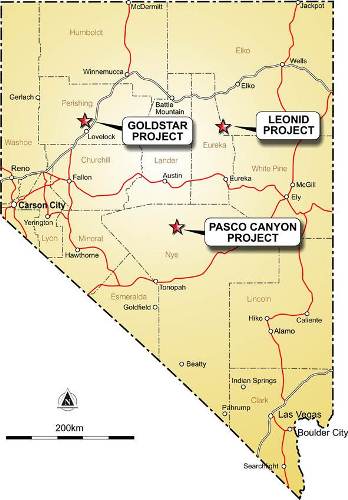
Cassini Resources Nevada projects map.

“We have acquired three highly-prospective projects in Nevada that are situated amongst a number of multi-million ounce gold deposits and operating mines,” Bevan said.

“These projects are a lot more advanced than our Australian projects and provide us with three great opportunities to find something of significance that could possibly become a company maker”

The company is poised to acquire 100 per cent of private Australian company Search Resources, whose United States subsidiary company has signed a Joint Venture agreement with Nevada‐based gold/silver-focused exploration company Renaissance Gold.

Cassini will acquire the rights of the existing JV agreements to earn a 70 per cent equity interest in three prospective gold exploration projects in Nevada.

The most advanced of these projects is Pasco Canyon, which is endowed with existing defined drill targets.

The company has re-interpreted the geology at Pasco Canyon and will drill two to four deeper holes against the direction of previous drilling to intercept the mineralised zone.
 
“The three projects are all at slightly different stages of advancement,” Bevan explained.

“The Pasco Canyon project is ready to drill and we have already had the drilling permits granted.

“We are just finalising the commencement date for that drilling program and hopefully will be drilling by July/ August.”

The company’s second project in Nevada is Goldstar where rock chip sampling returned impressive results including 19.8 grams per tonne gold and 1,213 grams per tonne silver from quartz veining at surface, but is yet to be drilled.

“There is more sampling and mapping work to be done at Goldstar but we anticipate drilling on that project by the end of the year,” Bevan said.

The final project is the Leonid project, which is at an earlier stage of advancement than Pasco Canyon or Goldstar, however the company feels it could hold the most potential.

Over seven kilometres of anomalous gold mineralisation is already identified at Leonid.

Cassini intends following up exploration work by Renaissance Gold that has defined drill targets.

Leonid is situated within the Carlin Trend, which is considered to be one of the world’s richest gold mining districts.

The Carlin Trend is host to seven 20Moz-plus gold deposits, including the largest gold assets of major mining companies Newmont and Barrick Gold.

By 2010 mines operating in the Carlin Trend had produced over 100Moz of gold.

“The Carlin Trend hosts a number of significant deposits, which are located in close proximity, some just 20 kilometres away, from Leonid,” Bevan said.

“The early signs emerging from Leonid are that all the markers and pathfinders for a deposit are there.

“We expect to be in a position where we can commence drilling Leonid by the end of the year but we still have some preliminary work in terms of soil geochemistry testing as well as some surveying and mapping activity.

“In the next six months, before winter sets in over there, we should be able to progress all of these projects.”

Cassini is confident the bulk of the work required to progress its American-based project portfolio is not in the high-cost bracket.

The drilling to be conducted at Pasco is probably its most expensive task but the other groundwork is reasonably low-cost, which means the company will be able to keep proving up the project models without a huge financial outlay.

To understand how prospective these projects are, Bevan said it was important the market began to understand how prolific the state of Nevada is in terms of gold production.

In 2011 Nevada produced some 6.1 million ounces of gold, making it responsible for approximately 83 per cent of US gold production that year.

The US sits third in on the list of gold producing countries. If you were to take the US out of the list and replace it with Nevada it would come in at number six.

Despite having been explored and mined for over 150 years the region continues to yield new discoveries.
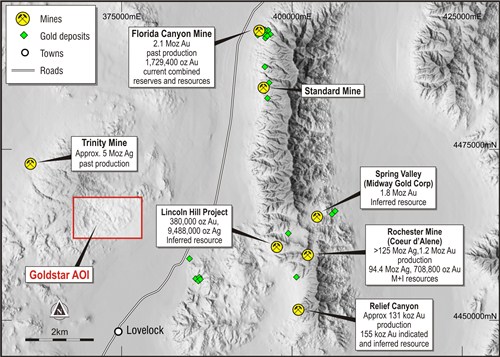
 

Cassini’s Nevada projects are situated near a number of multi-million ounce gold deposits

“Nevada is a mining state providing a well-trodden path for explorers with excellent infrastructure and expertise and equipment, all readily available,” Bevan said.

“There is a lot of exploration activity happening that significantly de-risks our projects and we also have a 30 per cent Joint Venture partner that resides in Nevada.

“We are also fortunate having our newly appointed executive director – exploration David Johnson, based in Salt Lake City, Utah.

“That combination provides us with a strong technical background with strong local links enabling them to access services and expertise.”

Johnson is an Australian-trained geoscientist who has worked for such companies such as Western Mining, Rio Tinto, LionOre and Independence Group.

His appointment reflects the make-up of the Cassini Board with the company’s chairman, Mike Young being a Toronto-trained geologist now based in Perth.

Young is also managing director of BC Iron, which successfully made the transition from iron ore exploration company to become the most recent iron ore producer in WA’s Pilbara region.

As exciting as the company’s Nevada projects are Bevan indicated Cassini Resources has no intention of turning its back on the WA projects it listed on.

“Our intention is to operate the two in tandem,” Bevan said.

“We have the capital to run both but we need to be mindful how we spend our money.

“The good thing with the Nevada assets, especially with some of the early drilling programs, is we should know sooner rather than later if we do have something there.

“We can then sit back and assess where we would be best placed to allocate our capital in terms of adding value.”

Cassini Resources Limited (ASX:CZI)
…The Short Story

HEAD OFFICE
945 Wellington Street
West Perth WA 6005

Phone:    +61 8 9322 7600
Fax:        + 61 8 9322 7602

Email: admin@cassiniresources.com.au
Web: www.cassiniresources.com.au

DIRECTORS and MANAGEMENT
Mike Young, Richard Bevan, Phil Warren, Greg Miles

MAJOR SHAREHOLDERS
Richard Bevan         7.44%
Freelight Nominees    6.80%
Mike Young            6.47%

SHARES ON ISSUE
18.75 million

MARKET CAPITALISATION

$2.81 million (at 15/05/12)


Ferrum Crescent updates Moonlight estimate

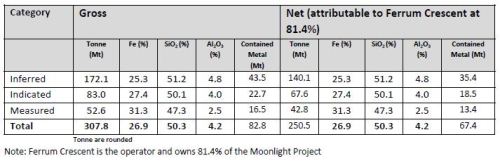
THE BOURSE WHISPERER: Multi-listed (ASX, AIM and JSE ) iron ore developer Ferrum Crescent has had a Mineral Resource estimate update completed at the company’s Moonlight iron ore deposit in Limpopo Province, South Africa by The Mineral Corporation Consultancy.

Source: Company announcement

The estimate was completed using the results of Phase 3 drilling consisting of 11 holes totalling 990 metres of diamond core drilling and 13 holes totalling 1,600m of RC drilling, and assays on the Moonlight deposit.

The Mineral Corporation also conducted a thorough re‐interpretation of the geological structure of Moonlight.

This was based on historical South African Iron and Steel Industrial Corporation data collated and validated by Ferrum Crescent and recent exploration offorts by the company.

Ferrum Crescent said that although the total average iron grade has decreased slightly from the company’s previously estimated JORC-compliant resource of 74Mt at 33 per cent iron in the Indicated Resource category and 225Mt at 29 per cent iron in the Inferred Resource category, the tonnage has increased proportionately along with a substantial increase in the confidence and classification of the Mineral Resource.

“The Mineral Corporation has reinforced the Board’s confidence in the quality of Moonlight project,” Ferrum Crescent executive chairman Ed Nealon said in the company’s announcement to the Australian Securities Exchange.

 “We knew how good the material is, from a metallurgical and processing point of view. The work by The Mineral Corporation, which is of a meticulously high standard and has been conducted with a level of conservatism that you would expect from such a reputable firm, has built upon the previous good work done by the company and its advisers.

“The cmpany now looks forward to exploring the potential to add to the Moonlight Mineral Resource, as well as to carrying out further drilling and other testwork to confirm the mineralisation at the Julietta and Gouda Fontein farms, adjacent to Moonlight.

“The company’s mining right application, which is expected to be determined in the very near future, covers these three farms, and we are excited about this exploration potential.”

Chris Cairns – Integra Mining

ONE OFF THE WOOD: On the road at the RIU Syndney Resources Roundup, Integra Mining managing director Chris Cairns put aside a few minutes from his busy schedule to bring The Roadhouse up to speed on the company’s Randalls gold project.

Integra has recorded a couple of important milestones recently with the first being the production of the first ore from the Maxwells open pit. What can you tell us about that?

Maxwells is the second open pit at our Randalls gold project. It has undergone pre-stripping over the last couple of quarters and is now in full production.

Maxwells will be our main source of ore over the next two and a half years. Notwithstanding that we expect to have the Majestic open pit available and permitted and ready to mine in March.

So with the stockpile, combined with those two open pits we certainly don’t have any lack of material.

Now it’s a case of making sure we maximise our cash flow and maintain consistency of production.

You were able to bring on production at Maxwells a bit ahead of schedule, which is a big achievement in the language of any mining company. How were able to achieve that?

Maxwells was intended to be in production by June but full production was achieved in April. Really it was just that material movements were a little bit better than what we anticipated.

I think that is one of the strengths of the operation. We have had sufficiently strong cash flows that have enabled us to do a major pre-strip at Maxwells and at the same time build up a 1.8 million tonne stockpile.  The invested mining cost of the stockpile alone is $60 million which could be considered foregone profit.  If we stopped mining and just processed the stockpile, it would net us $100 million cash.


Is that a fair indication of the overall health of Integra’s operations at Randalls?

It is. Certainly in the context that we have strong margins and we are not existing hand to mouth in terms of just-in-time type management of delivering ore to the mill.

We have the capacity to mine the deposits quickly and more efficiently. The unit costs are commensurately lower because we are moving a lot of material within a short space of time.

But it does mean that we had to have a lot of money tied up in work early as it was always our objective to de-risk the operation.

We have 1.7 years of milling capacity sitting in front of the mill in a stockpile.

If, heaven forbid, we did experience a pit slippage or we encounter any issues that you do experience from time to time in mining, we have that very strategic buffer up our sleeve.

Let’s shift our gaze over to Cock-eyed Bob, where you recently encountered more mineralisation underground; you were aiming for it, you knew it was there, you went after it, and there it was?

The Banded Iron Formations that host the three high-grade deposits including Cock-eyed Bob have nice high grades, but are not so nicely behaved in that the grade is highly variable over short ranges so it meant we couldn’t drill them out as an underground reserve from surface.

So you had to wait until you reached them in order to do that?

It was a far more efficient and reliable proof of concept that the underground operation is viable to go in there, mine out a 50,000 tonne bulk sample put through it the mill and reconcile the amount of gold that we have got. We are confident this will result in a clear demonstration of the profitability of underground mining these deposits.

That’s not an unusual mode of operation for a gold mine?

No, particularly when you have a high proportion of coarse visible gold.

We anticipate those deposits will be producing 60 per cent plus gravity gold, just to give you an indication of how much coarse gold is in them.

There is going to be quite a lot of variation in grade and contained ounces from day to day or week to week, but over the longer term those variations should smooth out.

The underground deposits will only be providing about 10 to 20 per cent of our overall volume with the rest of the mill feed being open pit material that is more reliable in terms of grade so the overall variance is significantly muted.

The Randalls project has come a long way during the extended conversation we have had since you began working it up. That must provide a great sense of achievement?

There’s a great story behind the story as well. In 2005 we determined we needed to acquire projects to enhance the Aldiss project closer to Kalgoorlie.

We identified the Randalls assets, bought them and as we were executing the deal, at the last minute, the vendor said, ‘we have this other tenement off to the west, we’ll throw that in for free’.

We identified six possible targets and went to the market to raise $5 million. On the sixth of those six targets, drilling the fifth of five holes we hit Salt Creek, which subsequently evolved into a 400,000 ounce disseminated, dolerite-hosted gold deposit.

Without that we wouldn’t have been able to develop the project the way we have because that large volume of very reliable grade mixes so well with our much more variable high-grade deposits.

Fast forward to 2012 and drilling is still uncovering new discoveries for Integra – a case in point being the recent Imperial discovery?

It was while we were in construction at Salt Creek that we discovered the Majestic deposit, which looks like just over 100,000 ounces at just over two grams per tonne from a nice open pit.

In November last year in the vicinity of Majestic we were following up some additional targets where we started hitting some really special mineralisation and were being surprised by such intercepts as five metres at 44 grams per tonne gold and 4.5 per cent copper.

Overall my feeling is, as we know it today and we’re still drilling, it is looking anywhere around six to seven grams average grade, maybe 1.5 per cent copper.

We need to do some met-test work to ascertain whether the copper is going to affect the gold recoveries, but indications from Majestic, which does have some copper in it, are that it doesn’t have a material impact.

It seems the more you unwrap Randalls the more it keeps on being the gift that keeps giving?

People kept telling us we wouldn’t find much gold to the east of Kalgoorlie or any decent sized deposits out that way. We discovered Salt Creek.

As understanding of the area evolves we consider it to be highly prospective for some very sound and fundamental geo-scientific reasons.

You’re no longer in the position where you’re drilling the last hole on your last target using your last exploration dollar?

Now the operation has one year under its belt and is stabilising at around 1.2 million tonnes per annum, we have plenty of feed sitting in front of the mill and we’re almost debt free.

All the hard work is done; we have a strong cash flow that supports our aggressive exploration program from here on.  Anything we add from here on in is pure profit with all the infrastructure in place and paid for.

Gascoyne drilling exceeds expectations

THE DRILL SERGEANT: Gascoyne Resources has received results from its first infill and extensional RC and diamond drilling being conducted on the Apollo and Icon deposits at the company’s 100 per cent-owned Glenburgh gold project in Western Australia.


Glenburgh project deposit overview and recent RC drill intersections. Source: Company announcement


Gascoyne is pleased with the results it has received so far from the 2.2 million tonnes at 1.5 grams per tonne gold for 103,000 contained gold ounces Apollo deposit with the intersections exceeding the grades predicted by the company’s February 2012 resource model.

The results include near surface high-grade zones including:

–    31 metres at 3.8 grams per tonne gold, including 18 metres at 6.2 grams per tonne gold from 43 metres down hole;

–    19m at 2.0g/t gold from 1m and 18m at 1.4g/t gold from 82m down hole;

–    21m at 2.4g/t gold from 80m down hole; and

–    3m at 10.1g/t gold from 70m down hole.

Gascoyne said it had designed the infill drilling program to enable it to upgrade the Apollo resource at the Glenburgh project to JORC Code Indicated status, to permit estimation of an Ore Reserve for a Feasibility Study.

Further results were received from an extensional diamond hole completed underneath the 6.4Mt at 1.1g/t gold for 217,000 ounces gold Icon deposit.

These included:

–    8m at 6.3 g/t gold and 28m at 3.0g/t gold from 92m and 116m down hole respectively from the pre-collar to the diamond core hole.

“This result is particularly encouraging as the intersections lie beneath the current resource and remain open down dip,” Gascoyne Resources said in its ASX announcement.

“With these broad and higher grade intervals, there is high potential for the resource to continue to greater depths.”
RC and diamond drilling is continuing, with the rigs undertaking further infill and extensional drilling in the Icon, Apollo, Zone 102 and 126 deposit areas.

Gascoyne said samples from a further 50 holes are either with a laboratory in Perth or in transit and that it  anticipates receiving the next batch of results in around 10 days.

Bruce Franzen – Riedel Resources

ONE OFF THE WOOD: A portfolio encompassing prospective tenements in Western Australia and Burkina Faso gives Riedel Resources executive director Bruce Franzen plenty to talk about and he perched on a stool in the front bar this week to do just that.

Riedel has a portfolio consisting of projects in Western Australia and Burkina Faso. Which of these is winning to be the company’s major focus at the moment?

We listed about 15 months ago on the back of the suite of projects we acquired in Western Australia.

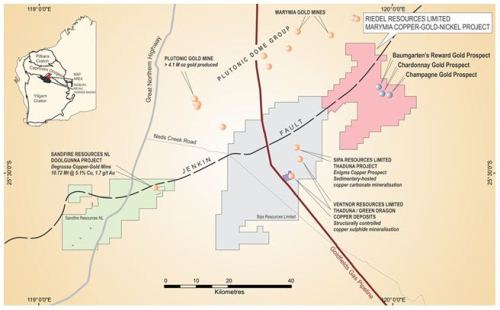
The main project and focus of all of our recent exploration activities is a gold and base metal project called Marymia.

It comprises of two tenements of approximately 430 square kilometres situated in the Doolgunna-Thaduna trend about 150 kilometres northeast of Meekatharra.

These tenements are part of a cluster of exploration activity within a 10 kilometre radius which includes explorers Ventnor Resources, Sipa Resources, and Lodestar Minerals.


We’ve been on the ground at Marymia since October last year and have recently completed soil sampling and detailed mapping over the entire 431 square kilometres.

We are presently finalising heritage surveys with the view to commencing a 5,000 metre air core drilling campaign to test high priority targets as soon as we can.

There certainly seems to be a lot of drill rig traffic heading up that way these days?

Everybody in the area is either drilling or planning to drill and subsequently news flow from all players is ongoing.

The area is evolving rapidly by virtue of the substantial exploration spend that is occurring.

This means that the area is financeable and consequently funding is being made available.

What did the soil sampling tell you?

We have recently published the geochemical results in regard to gold and this has produced a number of high priority drill targets – some of which are based on strong arsenic anomalies that are coincident with geophysical anomalies and mapping data.

We will be following up those high order gold targets in our upcoming drill program.

When will that drilling commence?

Final heritage clearance is commencing Monday, next week, so we expect to be able to commence drilling within a few weeks.

We concede, as is typical of this process, that we have been subjected to delays in the heritage clearance process which is nothing short of frustrating. Anyway, that’s what we are aiming for.

What’s happening with the copper geochemical results from Marymia?

The copper and base metals data is still being standardised and interpreted; however we expect results to be ready for release to the market within the next few weeks.

Is this the first time these tenements have seen any exploration?

There has been historical work at Marymia over the last 30 years, including RC and RAB drilling and some limited diamond drilling.

When we acquired the project, we had 20 years’ plus worth of data to reinterpret and that had been focused primarily on gold with a small amount of work looking at nickel.

We have been able to revisit all of the historical work and apply new technology and ideas, particularly in the area of geophysics which has changed immensely. This has given us a vastly different outlook for Marymia compared to past explorers.

Earlier exploration technologies didn’t have the same resolution that we have today, for example some of the structural controls that we now understand to be important at Marymia were simply not understood previously.

The gold price is also far superior these days which is stimulating significant focus for us on gold as well as copper.

What have you been able to identify that hadn’t been before?

We have come up with a stand out gold target that is represented by a seven kilometre arsenic halo coincident with a significant structure, which hasn’t been drilled or previously prospected at all.

It is sitting under cover which explains why in the past it was overlooked. We have demonstrated a distinct correlation between arsenic and gold mineralisation elsewhere in the tenement area where primary veins are exposed at or near surface.

This is a massive target, potentially, which is untested and we plan to test that in our next round of drilling. The team is currently in the field completing infill geochemical sampling over this anomaly to better define the key target area.

You recently added to your project portfolio by picking up some ground in Burkina Faso. What’s the story there?

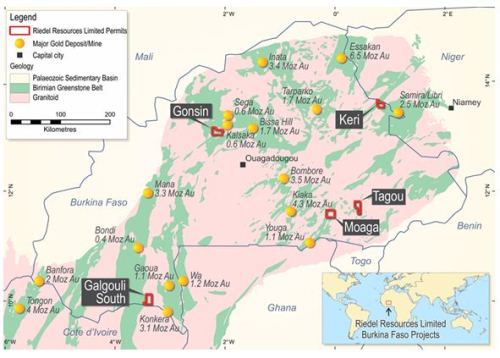
We recently completed a transaction to acquire the rights over five gold permits in Burkina Faso from Golden Rim Resources.

Within 24 hours of completing that transaction we had guys on the plane and within seven days we had commenced an auger drilling program on the Gonsin permit.


You didn’t waste any time there, did you?

Burkina Faso has a pro-mining culture and as a developing country competing for foreign investment, has substantially less bureaucracy and impediments to gaining approvals for field exploration activities.

That meant we were able to move very rapidly without being hampered by onerous bureaucracy, it was absolutely refreshing.

As far as costs go, Burkina provides excellent value for your exploration dollar and they are very accommodating to encourage foreign companies to establish business there.

There are a lot of explorers in the country now, including a number of Australian companies as well as others from Canada and UK.

There does seem to be a particular buzz emanating from that part of the world at present but there are also Burkina-sceptics emerging saying perhaps its gold race has been run?

It’s not a case of there not being any gold there. The question is how much gold is there? That is the reality.

With only about five years of exploration completed to date in Burkina, we believe that it offers explorers staggering potential and could even look like Western Australia 100 years ago.

It is evolving rapidly and there are opportunities being created for everyone. We don’t see this changing in a hurry.

You were on the ground nice and quickly after its acquisition. What has that work led you to so far?

Right now we have a 5,000 metre auger drilling program underway that we expect to be completed within the next week or so. We expect results will start to flow in about six weeks.

Concurrently we have started soil sampling and trenching programs across two of the other permits in Tagou and Galgouli South.

So we are very active on the ground now in Burkina and, subject to the weather not closing in on us, which is the real risk, possibly by mid-July, we hope to have completed 2,000 metres of RC drilling planned on our Tagou permit as well.

Tagou is becoming increasingly prospective for us, in the sense that we are just 30 kilometres north of Mt Isa Metals’ new Nabanga discovery.

Their results this year have really changed the game in Burkina and shown that there are high-grade deposits in the country as well as the more typical large tonnage–lower grade deposits. This has come about by simply applying modern exploration methods to the right geology.

The artisanal miners have also proved that they can adeptly read ASX announcements and we have found a swelling population at Tagou keen to benefit from proximal structures to Nabanga to the south.

It is our intention to work collaboratively with the local artisanal miners to complete our planned geochemical programs.  We definitely see this as a positive development.

It would appear that Riedel has been able to situate itself right in the midst of two the worlds emerging exploration hotspots?

The Doolgunna – Thaduna area at the moment is arguably the most prospective metallogenic province in Australia.

There is a serious amount of activity occurring in the area other than the Sandfire development project. It would not surprise me if there were to be more than $50 million per year being spent on exploration in that area alone.

West Africa in general has Burkina Faso as well as Sierra Leone, Mali, Senegal, Niger, Ivory Coast, and Liberia all evolving rapidly and it is an extremely prospective area that has been acknowledged by the global industry as such.

What would say Riedel offers any potential investors at the moment?

The immediate opportunity for investors, and for the market generally, is to watch Riedel right now.

We will have results from our auger drilling at Gonsin that will be out in the near term followed by RC drilling at Tagou, plus commencement of the aircore program at Marymia focusing on the high priority gold targets which includes the 7km arsenic anomaly previously discussed.

They could be the stand out highlights for Riedel over the coming months and have the potential to significantly re-rate the company.


Monax draws on graphite results from Waddikee

THE BOURSE WHISPERER: Monax Mining has received encouraging coarse graphite flake results from geochemical assays conducted on samples collected at the Argent and Stanley prospects on the company’s Waddikee project, located on the central Eyre Peninsula in South Australia.


Location of the Waddikee project, central Eyre Peninsula,
highlighting other graphite and iron projects within the region. Source:
Company announcement

Monax undertook a sampling program at the Argent prospect in 2006 to identify base metals and silver.

Based on the graphite potential identified in a subsequent petrological report, the company recently collected four samples from the Argent prospect and one sample from the Stanley prospect.

These samples were submitted for geochemical analysis and, according to the company, results confirmed the presence of graphite with the Argent prospect reporting between 10.23 per cent carbon to 16.04 per cent.

The one sample from the Stanley prospect reported 2.54 per cent carbon.

The combination of the coarse flake graphite and the high carbon assay results led to Monax designating the Argent prospect as a high priority graphite target.

Monax has previously outlined six target areas based on previous surface sampling, historical drilling and assessment of the airborne electromagnetic (AEM) data.

The company is currently reviewing all available data and will commence planning for a maiden drilling program targeting graphite.

“Further field reconnaissance will be undertaken prior to the drilling program to determine access for drilling, undertake additional sampling areas of known surface graphite and to field check the six target areas identified by Monax as being prospective for graphite,” Monax Mining said in its ASX announcement.