Bryan Dixon – Blackham Resources

Blackham Resources managing director Bryan Dixon called into The Roadhouse this week on his way home from the company’s historic Matilda gold project.

The Matilda project has been a constant source of good news since Blackham acquired it in November last year hasn’t it?

It’s still early doors on the Matilda project as we are still really trying to get our heads around it.

We announced an initial Resource in January of around 600,000 ounces of gold, and then conducted RC drilling at the old Matilda mine, which confirmed that there appears to be plenty of ore left in there.

Four months down the track the resource has grown to 790,000oz of gold, with 630,000oz sitting in the two core deposits in Williamson and Regent.

Both these deposits sit on the Wiluna Mine Sequence that has produced four million ounces.

Blackham controls 40 kilometres of strike where we believe there’s a lot more ounces and potential for a hefty stand-alone operation.

Is Matilda where the company looks like focusing the bulk of its attention?

Of the three main deposits we have identified: Matilda, Regents and Williamsons – Matilda is probably the one requiring the most work, but it is also probably the one we could get into production the quickest.

M10 was the first deposit we drilled, which confirmed high grades starting from surface.

You referred to it as the ‘old’ Matilda mine. Could you tell us why?

The Matilda mine has previously been called Mt Wilkinson and Wiluna South and was operated by Chevron back in the late 1980s and then in the early 1990s by Eon Metals.

Around 160,000oz of gold was mined up until it was closed in 1992. So it has basically been on care and maintenance for 20 years, during which time it has seen very little drilling.

Back then ore grade cut-offs were 1.5 grams per tonne and the M1 and M2 pits ran close to 3g/t, whereas today ore grade cut-offs are closer to 0.5g/t.

You’ve been busy drilling since you acquired the project. What has that told you so far?

We’ve been drilling along strike from the old pits on the project and confirmed the mineralised bodies appear to be continuous.
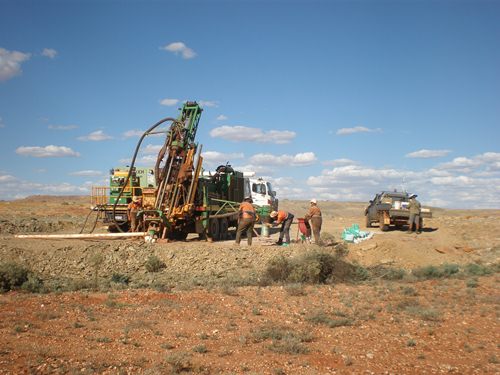
Drilling in February this year. Source: Blackham Resources.

We anticipate releasing a Resource around those results in the coming months.

What about the Regent deposit?

Regent is a deposit that both Newmont and Agincourt had their reserves.

The last mining study carried out at Regents was in June 2006 when the gold price was fluctuating and they didn’t actually press the button to start mining.

Since acquiring Regents we have worked to validate the old data and everything has come up trumps so far.

We have increased that Resource up to 270,000oz and increased the grade by two grams to 2.2g/t.

We firmly believe Regents will be a mine as well.

You released the new Resource at Regent this week. What difference has that made to your thoughts for that particular deposit?

We have upgraded the Indicated Resource at Regents to 738,000 tonnes at 2.5g/t, which has also increased our confidence in the deposit.

Our next step there will be to carry out some mining scoping work.

Are you pleased with the way Regents is progressing?

Yes, Regents is going really well for us at this stage. Since that mining study was done by the previous owners the gold price has more than doubled – costs have gone up too, but nowhere near that extent – so the economics of Regents are far more favourable these days.

We are looking forward to completing a scoping study there as soon as possible.

Where is the next focus for your drilling?

We are very keen to get in and drill our largest deposit, Williamson. It historically produced about 40,000oz and still contains 364,000oz at 1.9g/t.  We are eager to get in and drill below the old pit where we have seen intercepts up to 231g/t.

Does the project’s previous life provide any infrastructure on site?

The old Matilda site has a rehabilitated old plant site. If we were to construct our own plant, that’s where we would put it.

There is an old tailings dam too that would enable us to minimise our environmental footprint, making our environmental approvals quicker to achieve.

Are there any other options besides building your own plant?

There is the option of toll-treating up the road at the Wiluna gold plant. Matilda, Regents and Williamson all have haul roads in place leading back to that plant site.

What stage is Matilda at in the present state of play?

We have drilled an old site at Matilda called M10. Matilda was shut down quite abruptly 20 years ago, at which time they were still mining the M4 pit and the M5 pit.


One of the old Matilda mine pits. Source: Blackham Resources

The M10 pit had been cleared in preparation for mining, but they never got around to starting digging.

That was one of the obvious areas for us to target straight away and it emerged with some impressive grades that we were hitting from surface.

It must have been good to walk onto a project area that already had a number of identified targets?

It has made it a bit easier for us. There has been some 39,000 drill holes put down across the 600sqkm of this project area.

We have been focusing on the more developed areas with Resources, drilling along strike from those.

We are basically involved in a data mining exercise, which makes what we are trying to achieve significantly cheaper than drilling all those holes ourselves.

There is still a lot of work, however, involved in auditing and validating old data and ensuring its integrity.

Is all that data throwing up anything for you to chase?

There are numerous other prospects emerging, and we will eventually get around to them, but in the immediate future we will be focusing on the old mine sites.

The great thing about his project is that there are a number of ways we could develop it. It really all depends on our exploration success.

Is there a school of thought as to what would be your best option?

Depending on who you talk to, there are many different views on how we should go about it.

We could stand back and build up the ounces we have until we have a stand-alone project.

However, the great thing about the Matilda project is that we do have options and right now we really don’t need to make that decision.

We are focused on getting Matilda, Regents and Williamson mine-ready and then we can make the call of a stand-alone operation or whether we toll treat up the road down the track.

You’re almost at the magical one million ounce mark. Is that an important milestone?

It seems to be the point where people actually stand up and take notice of you.

When we acquired the project we knew we had 300,000oz, we now have close to 800,000oz grading close to 2g/t.

We believe we can get over the one million ounce mark in the near term and once we do we will reassess our goals.

We’re confident Matilda, Regents and Williamson will provide the one million ounces then we have a great deal of exploration potential lying beyond those initial targets.

Adrian Griffin – Midwinter Resources

Taking the time to drop into The Roadhouse this week was Midwinter Resources managing director Adrian Griffin to give us the lowdown on how the company’s projects in South Africa and Swaziland are developing.


What is the current major focus of Mindwinter Resources?

Without a shadow of a doubt the major focus of the company is ferrous metals in Southern Africa.

Primarily South Africa, but we are looking at adjacent countries; we are looking at Mozambique, Botswana, and a couple of others.

Midwinter’s main project is the Northern Lights project in the Limpopo province of South Africa, but you have extensively added to your landholding there with the addition of the Musina project.

Initially we purchased a controlling interest in a company that had some applications within the Limpopo province.

Some of those applications at Northern Lights were already granted and we commenced drilling there in 2010.

The interesting thing about that area is that it looks like a billiard table; everything is sand covered and there is no outcropping to be seen.

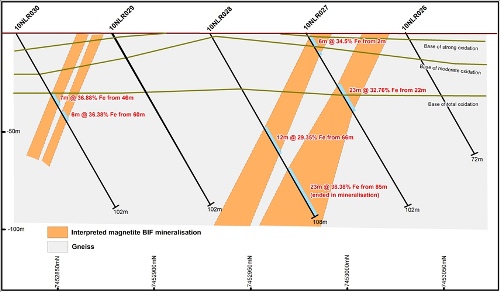
So all the drilling we conducted was based on geophysical and magnetic surveys. We were technically successful and we did locate exactly what we were looking for and we determined the magnetic anomalies were indeed a consequence of magnetite in banded iron formations.


Cross section of area drilled at Northern Lights. Source: Company

The major issue we had was the geometry of those banded iron formations. They are relatively narrow and steeply dipping.

As a consequence – long term if we are to mine them – we are going to have high stripping ratios, which make mining costs high.

So we started looking at the entire Limpopo province on the basis more formations must exist with better geometry.

What sort of picture did taking a wider view of the province produce for you?

A few years back, the South African Mines Department had a tenure system that was totally opaque.

There was no way of determining who owned what tenements. Not even the government really knew. Titles were being duplicated and it was more than a bit confounding.

The South Africa Department of Mines and Petroleum made the decision to stand down the system in order to complete an audit of titles and remove any anomalies and computerize the system making it much more transparent.

We identified this as a once in a lifetime opportunity as it exposed a great deal of available land.

We had a good hard look at it all and determined where the best banded iron formations could exist and prepared a series of applications ready for when the new system was implemented.

How successful were the applications you submitted?

We got about half of the land we applied for. Some of it already had prior tenure over it, which we couldn’t know at the time.

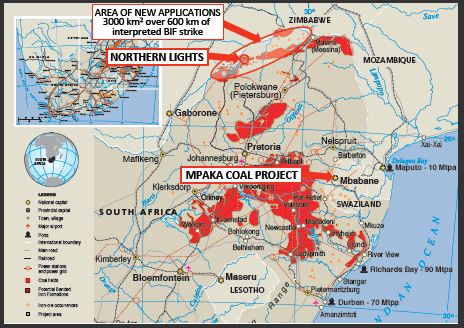
We ended up with a land package including the Musina project, of about 3,000 square kilometres over a strike length of 270 kilometres.


Is all the land similar to what you already had at Northern Lights?

As the tenements move east we start to get more elevated topography with greater topographical relief in the form of outcrops with visible ore bodies.

Our priority now is to improve the geological mapping and prioritize resource targets within the banded iron formation sequence, whether they are outcropping or buried. Those targets will be the mineralized zones, close to surface and exhibiting shallow dips

We have a strike extent of about 600 kilometres of banded iron formations within these tenement applications now with a number of iron ore occurrences that have been documented by the South African government.

Have these applications been finalised?

They are uncontested applications. That means they have been accepted as being valid applications.

They’re in process, although we are not totally sure of the timetable. It is fair to say they rarely take more than 18 months to be approved and we have had them in the system for 13 months, so we are confident they will emerge soon.

What plans do you have in place for them once they do emerge?

We’ll take a good look at the areas with outcrop. We’ll focus on the deposits that have the best geometry being those with relatively shallow dip and reasonable thickness. That will ensure that we can establish resources with a minimum number of drill holes.

We will also fly regional magnetics over the area to locate extensions that run undercover, as we do think there will be a number of these, and we will also conduct a remote sensing campaign.

So by utilising a combination of techniques we expect we will filter all the targets we have and prioritise the ones we anticipate being able to get up to resource fairly quickly.

Is the outcropping mineralization the only aspect of the newer tenements drawing your gaze in the Musina direction?

One of the reasons we want to concentrate on the western are of our tenements is logistics.

They are sitting right on a railway line with spare capacity that runs all the way down to the port at Maputo.

We also have the option of shipping our product to the domestic steel producing market.

On top of all that you also have some news emanating from Swaziland regarding a coal project?

We have an option to buy a controlling interest in Teeman Investments, a company that has a 20 square kilometre Prospecting Licence application over the Mpaka coal mine, which is currently dormant. If granted the Licence will provide an interest in the deposits of 50 per cent and management control. The other 50 per cent will be controlled by the government.

What are the company’s immediate plans there?

On the basis that it gets granted, we would immediately commence a feasibility study as there is a huge amount of historical information available.

The deposit has been drilled out by the government, which quotes a non JORC-compliant Reserve of 50 million tonnes.

Is that as impressive as that sounds?

The thickness of the coal seam is constant; it has mine openings into it and a mine history having been mined by a major company in Gencore, which achieved 28 years of production out of the mine.

We reckon infill drilling of the areas within the application, not previously drilled by the government could meet our exploration target of up 85 million tonnes, which would be rapidly upgraded to JORC-compliant resources.

We’ll conduct that infill drilling and move on to produce a feasibility study then proceed to development.

And Mpaka also has in-situ infrastructure nearby?

It has a railway line that runs right to the headframe and it still has some of the old mine buildings in place.

Most importantly it also has around two years of Gencore production stockpiled.

There is a developed market within the region for the coal in metallurgical applications, primarily across the border in South Africa.

Infrastructure is pretty much a key to any developing project in Africa and it would seem that Midwinter’s current projects have that box well and truly ticked?

They do. Northern Lights has a freeway running right to the front door of the deposit.

There are high-tension power lines running out to Musina and the railway line runs to the port of Maputo for export or we can deliver our product to the local steel industry.

Swaziland is a land-locked country, which means the 80 kilometre rail trip from Mpaka to Maputo – under international convention – receives priority port allocations. So not only do we have the port located close to the project but we can also jump the queue.

Zinc prices likely to firm on improving demand – supply fundamentals

The price of zinc in international markets has mirrored a general decline in commodities as a result of Europe’s debt crisis, with London Metal Exchange zinc dropping more than 10 per cent from its high for the year so far, reached during January.


However, I am bullish with regards to zinc over the next two to three years and even longer.

Given the level of growing underlying demand for zinc that’s coinciding with a lack of new mines, there is inevitably going to be a supply problem emerging over the next few years.

Throw in the unwillingness of banks to lend since the GFC and new projects are now even harder to commission.

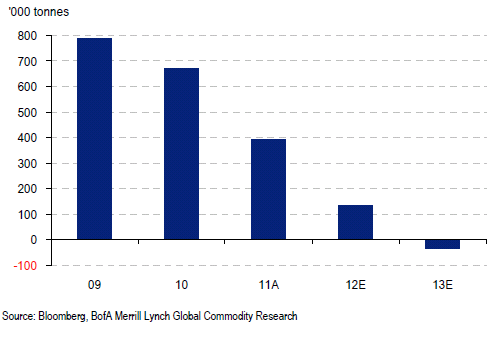
According to Morgan Stanley, the current zinc surplus is narrowing and will shrink during 2012 to its smallest level since 2007. China’s steel usage means there could be zinc shortages as early as 2014. Production may lag because miners are fearful of commissioning new supply given the lackluster price environment of the past five years.

China accounts for around 29 per cent of global zinc supply, but its mines need as much as US$2,200 a ton to break even.

World steel production is estimated to rise by 7 per cent to 1.6 billion tons next year according to the Australian Bureau of Agricultural and Resource Economics and Sciences (ABARE, whilst steel consumption in China will advance 6 per cent to 664 million tons during 2012.

China’s zinc demand may reach 6.58 million tons in 2015, compared with 4.75 million in 2010, according to Beijing Antaike Information.

One current indicator of where mined zinc supply levels will go this year is the negotiations between miners and refiners for benchmark 2012 treatment and refinement charge (TC/RC) rates.

TC/RC rates are negotiated annually and tend to mirror the trends in supply: a fall in zinc supply will lead to a fall in TC/RC rates.

Data from the International Lead and Zinc Study Group also show a consistent increase of global zinc mine supply during the last quarter of 2011, while metal production and consumption have levelled off.

These numbers are the result of a number of regional dynamics.

China experienced 20 per cent growth in mined zinc during 2011, reaching 4,458,000 tonnes of concentrate, while refined zinc also grew last year by 3.8 per cent to reach 5,344,000 tonnes, according to the National Bureau of Statistics.

These gains were offset by production declines in places like Peru, where zinc production plunged by almost 15 per cent to 1,255,899 tonnes for 2011.

China is the world’s top consumer of zinc and it’s likely to boost imports during the course of 2012 as a result of Beijing announcing this week that it would speed up infrastructure investment. Zinc is set to reap the benefits of a push to fast-track investment into railways and other projects, with relatively high domestic prices likely to push merchants towards imports when demand gathers momentum.

However, zinc output in China is likely to lag real consumption by around 400,000 tons during the course of 2012 due to production cuts, according to state-backed research firm Antaike.

With domestic production falling by 7.3 per cent during the first four months of 2012, the contraction in supply has seen stocks monitored by the Shanghai Futures Exchange decline by 17 per cent to 348,785 tons last week, from a record 417,784 tons during August 2011.

Galvanized steel, used in buildings, infrastructure and motor vehicle manufacturing, is the primary source of zinc usage in China.

Demand however was badly hurt as a result of Beijing cutting railway investment and suspending thousands of kilometres of rail projects, following a fatal accident in July 2011; whilst use in the property sector has fallen as a result of Chinese government restrictions on property investment.

Resuming these projects and allocating investment for new projects would take 3 to 4 months, according to analysts cited by Reuters.

Galvanized steel accounted for about a fifth of China’s 5.2 million tons of zinc demand during 2011, although galvanized steel output fell 3.1 per cent from March 2012 to 3.2 million tons during April 2012.

Looking ahead, we believe the recent trend of declining surpluses should continue, with the zinc market likely in deficit by 2013/14, despite substantial zinc inventories at present.

With mine supply will in all likelihood remaining tight going forward, I therefore believe that zinc prices should find support at current price levels, before they rally into 2013 as the refined market should move into deficit.

What has seemingly scared some investors is the US$90 billion proposed merger between Glencore and Xstrata.

The merger has pushed zinc markets into the spotlight, as the move – if approved by European regulators – would result in Glencore controlling between 16 per cent and 18 per cent of both zinc ore and zinc metal supply globally.

It would also mean that zinc prices would become a central component of the health of one of Europe’s largest companies.

The merger has the potential to consolidate a large portion of the traditionally separated mining and refining functions within the zinc market.

Xstrata’s zinc properties in more than 20 countries, combined with Glencore’s extensive role as the world’s largest commodities retailer (accounting for 60 per cent of zinc trade internationally during 2010, has European steel markets concerned that Glencore would possess too great an influence over refined zinc prices.

However, despite the potential to control more than one third of European smelting capacity, some industry experts have argued that most traders already treat Glencore and Xstrata as one company.

While the exact impacts of the merger are not yet clear, Glencore’s influence on prices must be considered in tandem with an understanding of Chinese zinc producers’ actions.

As the world’s largest miner and refiner of the base metal, China’s share in shaping the fate of zinc markets is even greater than that of the Glencore.

Interestingly, another major zinc producer is very positive on the outlook for zinc prices.

Teck Resources, which is the world’s fourth-largest zinc miner, sees demand exceeding supply because of mine closures and rising demand for the metal in China and India.

Teck Resources chief executive officer Don Lindsay recently said, “We now think that the deficit is visible, that it’s coming. We see the potential for the zinc market to look very exciting indeed.”

Despite its rather inauspicious history over the past five years, I am therefore positive about zinc.

There are some sound junior zinc opportunities with fabulous growth projects that I am following, but which aren’t necessarily yet at the buying stage.

These companies include:

–    Ironbark Zinc (ASX: IBG, Share Price: $0.16, Market Cap: $59m);

–    Venturex Resources (ASX: VXR, Share Price: $0.038, Market Cap: $41m); and

–    Laconia Resources (ASX: LCR, Share Price: $0.032, Market Cap: $4m).

Gavin Wendt is the founder of MineLife, publisher of the MineLife Weekly Resource Report


Australian Bauxite expands Goulburn PFS

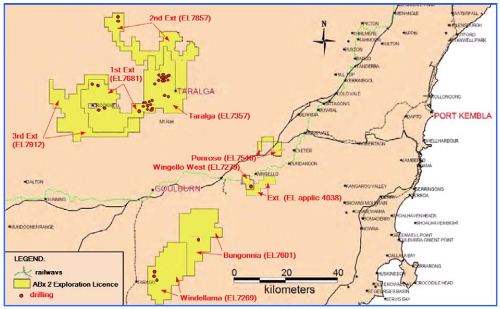
THE BOURSE WHISPERER: Australian Bauxite is expanding the focus of a prefeasibility study (PFS) on the company’s Goulburn bauxite project located near Goulburn in New South Wales.


Goulburn bauxite project area. Source: Company announcement


The company has commissioned Como Engineers and other metallurgical and environmental engineering firms to prepare the study, of which Marubeni Corporation has contributed 35 per cent of the cost.

At the completion of the pre-feasibility study Marubeni can elect to acquire a 35 per cent joint venture interest in the Goulburn-Taralga bauxite project

Australian Bauxite’ original focus for the PFS was a conservative, lowest-capital cost case of 1.2 million tonnes per annum of bauxite delivered to ship at Port Kembla.

A second study was also based on a 1.2Mtpa scale but involved higher rail capital costs so as to reduce the operating costs.

According to the company both of the 1.2Mtpa cases yielded positive results with high internal rates of return and confirmed the feasibility to commence the project at the rate of 1.2Mtpa, modelled on current road-base quarry operations in the area.

Modelling is now being expanded to provide a ramp-up option to 2.5 to 3Mtpa bauxite out of Port Kembla.

“Continued drilling over the Goulburn bauxite project in the March quarter intercepted high grade bauxite of extraordinary thicknesses in excess of 30 metres, which is probably the thickest bauxite ever discovered in Australia,” Australian Bauxite chief executive officer Ian Levy said un the company’s announcement to the Australian Securities Exchange.

“This significant discovery substantially increased the scope of the Project and warranted extending the modelling to provide for significant ramp-up possibilities.

“We are in discussions with a number of potential customers and are confident that the demand and price for our low silica, gibbsite Direct Shipping Ore bauxite will be mutually beneficial to our customers and to Australian Bauxite Limited.”

Levy said he considered the bauxite market to currently be the strongest of all mineral commodity markets with China importing all-time record tonnages.

He also highlighted an Indonesia government clamp-down on bauxite export operations and an increase to export taxes on bauxite by 20 per cent, claiming it to be an opportunity for Australia to expand its exports of quality-enhanced bauxite.

Vector Resources records big gold intercepts

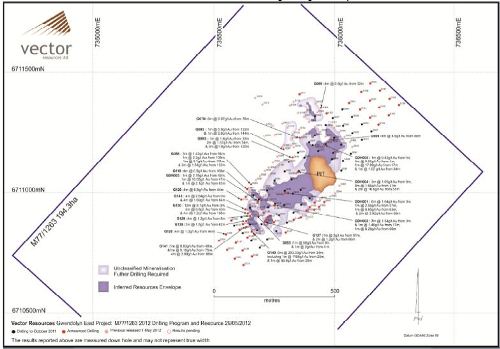
THE DRILL SERGEANT: Vector Resources has received some fairly impressive assay results from a round of high-priority drilling of the Phase 3 reverse circulation (RC) program being conducted at the company’s Gwendolyn East project in Western Australia.


Plan view of collar locations of holes with significant gold intercepts. Source: Company announcement

A review of hole G140 carried out by Aurum Laboratories returned a single metre result of 1,212 grams per tonne gold with a repeat sample of 1,165 grams per tonne gold within a significant intercept of 5 metres at 253.33 grams per tonne gold.

Vector then sent a number of additional single samples to the laboratory of SGS Kalgoorlie, which achieved results of 1,475g/t for the same metre intercept.

Just to be sure the company had the material reviewed by consulting mineralogists Roger Townend and Associates, which conducted a mineralogical examination of one drill sample (G140, 25 to 26m) as well as an analytical lab pulped split equivalent for gold.

Vector said the Towner report identified gold mineralisation where the sample was screened into three fractions, of minus-500 millimetres, plus-500mm and plus-2mm.

Polished sections were made of each fraction and these examined with particular reference to gold. Gold was detected in all samples.

“The latest results from Gwendolyn continue to justify our faith in this resource,” Vector Resources chairman Damien O’Reilly said in the company’s announcement to the Australian Securities Exchange.

“The naturally rich endowment of the Gwendolyn prospect notwithstanding, and increasingly apparent: it is a credit to our executive management, geologists and drilling crews upon whose efforts, experience and instincts we rely so much upon.”

Vector said it considers Gwendolyn has the potential to increase the current resource, with encouraging fundamentals including:

–    High grade intercepts identified outside current mineralisation envelope;

–    Mineralisation remains open in all directions;

–    Extensional exploration will continue to push existing ore boundaries as a priority; and

–    Infill drilling of the unclassified material is ongoing.

Thor Mining updates Molyhil reserve estimate

THE BOURSE WHISPERER: Thor Mining has released an updated reserve ore estimate for the company’s wholly-owned Molyhil project in the Northern Territory.


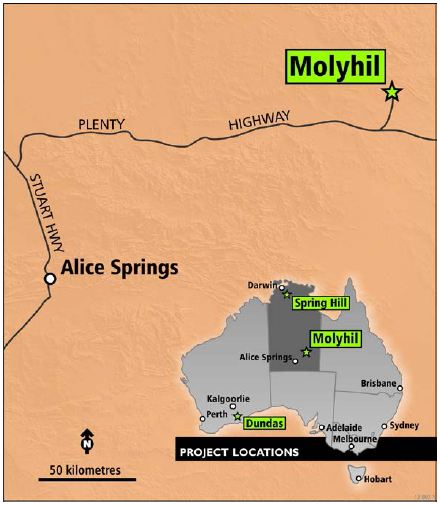
Molyhil project location. Source: Company announcement

The reserve ore estimate now stands at 1.64 million tonnes at 0.42 per cent tungsten and 0.13 per cent molybdenum.

Thor said the tungsten grade in the reserve is 50 per cent above resource estimate grade, which it considers to provide the opportunity for early payback of project capital.

The company indicated the new reserve provides a four year initial mine life at Molyhil with substantial upside potential to extend project life as only 35 per cent of resource tonnage is included in this initial reserve.

Runge is currently preparing a detailed mining plan using the new reserve statement, and incorporating minor elements of the inferred resource, to provide Thor with a monthly mining schedule for the currently estimated life of the proposed operation.

This will then be incorporated into the financial model for the project to estimate economic returns.

The company anticipates this process will be completed during June 2012.

“A development decision for Molyhil is progressively becoming closer,” Thor Mining executive chairman Mick Billing said in the company’s announcement to the Austyralian Securities Exchange.

“This updated reserve is very robust, and we have significant upside beyond this new ore reserve, both in the resource and from exciting exploration potential.

“This statement of ore reserves underpins a profitable mining plan for an initial period of approximately four years.”

Apollo Minerals sizes up Port Pirie option

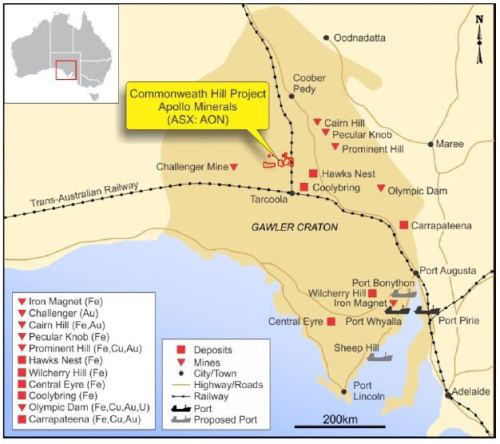
THE BOURSE WHISPERER: Apollo Minerals a Memorandum of Understanding (MOU) with Flinders Ports to investigate optimal port export services for up to 2.5 million tonnes per annum of iron ore exports from the company’s Commonwealth Hill iron project (CHIP), situated in the Gawler Craton of South Australia.


Source: Company announcement

The company said it intends to use the Port Services MOU to secure capacity at Port Pirie for exports of iron ore products from CHIP.

“Securing port services for the export of iron ore products from CHIP is an important milestone in the development of this project,” Apollo Minerals chief operating officer Dominic Tisdell said in the company’s announcement to the Australian Securities Exchange.

“Apollo looks forward to working closely with Flinders Ports to ensure the next phase of growth for South Australia’s expanding iron ore industry.”

Apollo said it intends to assess the feasibility of exporting from Port Pirie via a transhipment arrangement similar to the arrangement employed by OneSteel at its Port Whyalla export facility in the Spencer Gulf.

In March this year, Carpentaria Exploration announced its plans to investigate establishing a 20mtpa common user iron ore export facility at Port Pirie, of which it would seek to lock in 5mtpa of export capacity.

Apollo’s desired allocation of 2.5mtpa now takes the initial allocation at Port Pirie under investigation to 7.5mtpa.

Nemex encouraged by drilling results from Télimélé

THE DRILL SERGEANT: Perth-based iron ore-focused explorer Nemex Resources has reported further drill results from an ongoing 150 to 300 hole program being conducted on the Télimélé iron licence, situated within the company’s Coastal project in west Guinea.


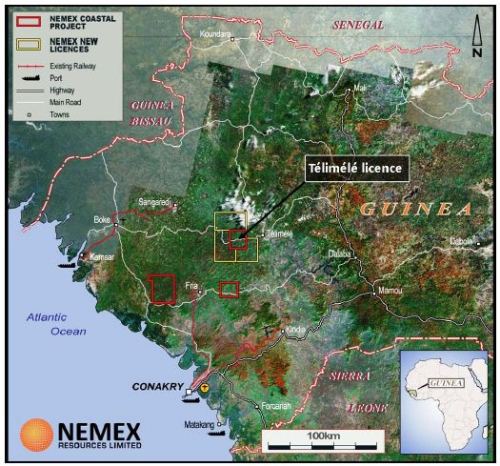
Regional location of Nemex’s Coastal iron project (red outlines),
including the Télimélé licence area and new exploration licence
applications (yellow outlines) in western Guinea. Source: Company
announcement

Nemex said the majority of holes have so far intersected high-grade iron mineralisation, mostly from surface.

Results include:

–    5.5 metres at 51.1 per cent iron (57.3 per cent calcium iron) from 3.5m;

–    3m at 55.7 per cent iron (60.6 per cent calcium iron) from surface;

–    2.5m at 58.7 per cent iron (62.3 per cent calcium iron) from surface;

–    3m at 57.9 per cent iron (62.1 per cent calcium iron) from 2.5m;

–    3.5m at 57.7 per cent iron (61.8 per cent calcium iron) from 3m; and

–    3m at 57.1 per cent iron (61.8 per cent calcium iron) from surface.

The drilling was carried out on the Boulere prospect, which is one of four prospects Nemex said it intends to drill in this maiden program over, what it described to be as, “a black, oolitic, iron-rich geological unit known simply as the Télimélé ‘ironstone’”.

The company said the latest results demonstrate it is continuing to discover a high-grade ironstone unit of consistent chemistry across a very large area at Boulere.

Nemex said the ironstone outcrops and topography at the Boulere prospect are identical to where the drill rig is now positioned at the Boulere North prospect, where it is about to commence a 32-drill-hole program.

“We continue to be very encouraged with these results and will begin discussions with resource estimation and metallurgical consultants in line with the next stage of the project,” Nemex Resources managing director Peter Turner said in the company’s announcement to the Australian Securities Exchange.

Chris Torrey – Silver City Minerals

ONE OFF THE WOOD: The Roadhouse was in Broken Hill for the Resources and Energy Symposium recently and caught up with Chris Torrey managing director of local company Silver City Minerals to find out how it was working to reawaken the region’s mining potential.


Chris, Silver City has put together a package of tenements that has the potential to put Broken Hill back on the mining map. Could you tell us a bit about where you are and what you’re doing there?

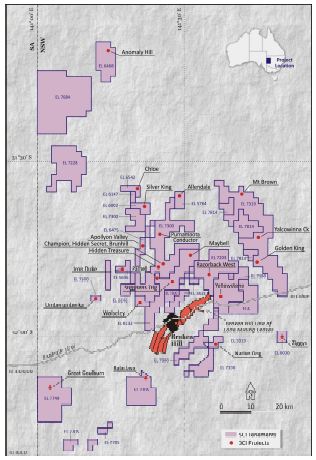
We have pulled together a large tenure package around Broken Hill.

We control, probably 50 to 60 per cent of the major exploration ground around Broken Hill.


Silver City tenement holding map. Source: Company

You only listed on the ASX in July, which means you’re a relatively new company. How did you manage to accumulate such a portfolio of ground?

We listed in July, but the company started in 2007 by a group of people pulling together the ground by completing some Joint Venture deals and sales agreements with the view to eventually floating a company.

Once it had the ground it became a matter of raising money. Prior to my appointment with the company they had raised around $2 million, which was used to begin working the projects up and isolating areas of particular interest.

What was the result of that original, early exploration work?

We identified numerous areas of interest but have decided to turn our early focus on four in particular.

One, located just north of Broken Hill called the Razorback project, is emerging as a very interesting prospect.

It has the potential to be, geologically, the northern extension, offset by a fault, of the Broken Hill line of lode.

It is a geochemical anomaly that was found by shallow auger drilling across this flood plain.

Now we have drilled more of these shallow holes and defined a very strong geochemical anomaly over five kilometres containing zinc, lead and manganese – the mineral constituents of Broken Hill.

There has never been a deep drill hole conducted to test this area and we started drilling on Razorback last week.

What are the other areas of interest?

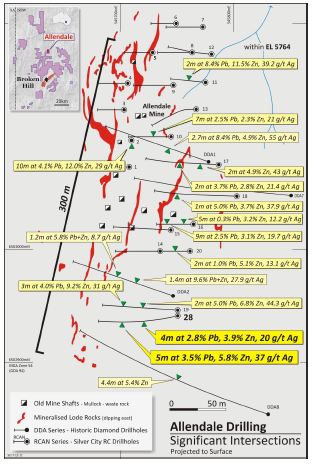
We announced results of some drilling we conducted on Allendale last September.

We are closer to achieving an actual Resource statement there having recorded some base metal and silver intersections.

We’ve modelled the zone and we know where it’s going. We’re bringing another dill rig in there this week and will be conducting a major drilling program there over the next two months.


Source: Company

The other, really interesting project is a more silver-rich project than the others called the Umberumberka project.

It is not like normal Broken Hill ore bodies, which normally twist, bend and squirt off in different directions.

This one is much planar in that it is a much easier vein to explore and was a historic silver mine that produced millions of ounces of silver.

One million ounces may not considered by some people to be much, but this was only mined from within a couple of hundred metres from surface, meaning the grade of the silver is very high, about 800 grams per tonne.

If we can put together a structure with 800 grams per tonne in it, these days that makes a lot of money.

How does it come about that such a potentially rich group of tenements has never been properly explored in what is, invariably, one of the country’s premier mining locations?

There are two reasons. First of all, the Broken Hill ore body that was mined for years was so rich the big companies that held it didn’t bother exploring for more.

The other thing was the big companies controlled the mine and they controlled the district.

When they eventually did venture out exploring they were looking for another big Broken Hill ore body.

We’ve taken a different attitude – we would love to find a big deposit, but the fact of the matter is that with just one per cent of the Broken Hill ore body, which is only 3 million tonnes, it is still possible to make a lot of money.

Our exploration method is to map out  surface outcrops, sample them in detail and drill close-spaced holes following mineralisation down.

We have been very successful at Allendale using this methodology and we are hopeful it could develop into something fairly big at depth.

Is the shallow drilling enough or will you need to chase it down deeper?

If we keep drilling it will get deeper and deeper, but we have – at Allendale for example – the potential for an open pit.

Or, if we find a really good ore body that keeps plunging we could have the potential to develop an underground operation.

We’re not sitting back like the big companies did here, who just drilled deep holes – sometimes they hit mineralisation – but were discouraged if they hit something that was ‘only’ five metres wide.

Five metres is fabulous for us. We’re looking over old data in some places to locate potential targets we can track down.

Has that been a modus operandi – studying the old data to find out where to go?

We do look at the old data, but we also do a lot of detailed geological mapping on the surface.

We pay a lot more attention to detailed geochemistry because it is possible to map these silver veins a long way and learn where the mineralisation shoots exist.

The way to find out if they are mineralised is through systematic sampling, and it is amazing that this hasn’t been done here in Broken Hill before.

You have brought your projects to the stage they’re at now, what’s the next stage for Silver City?

We have just commenced drilling at the Razorback prospect and at Allendale we are just about to commence our second round of drilling.

After they have been completed we will move over to Umberumberka to carry out some drilling there.

All up we have around 5,000 metres of drilling scheduled leading up to September. That could go out to 8,000 metres depending on what we find.

You appear to have a fair amount of confidence in the targets you’re going after?

We would like to think we could have a resource at Allendale, certainly by October, and be drilling out something we were pleased enough with to move into development.

That’s the sort of progress that could be very rapid, but it all depends on whether we get onto something.

If we get onto something – if we hit 20 per cent combined lead / zinc – all hell will break loose.

You sound like a football team that could be a potential premiership threat that is battling to keep a lid on how things are going in order not to get too far ahead of yourself?

It is a bit like that. We could burn a lot of money chasing all sorts of things, but we don’t want to do that.

We have these initial targets lined up and we are just systematically working our way through them.

Do you think more companies will start looking out this way now that you have demonstrated the actual potential that still exists here?

There is definitely an enthusiasm to get out here. There are plenty of companies already drilling around us.

There is a lot more junior sector activity than there has been for a long time and it is simply because the juniors have finally been able to get out on the ground.

The big companies are out and we’re in.

MRRT and Mining an ideal partnership

OUT AND ABOUT: When Justin Di Lollo, managing director of government relations and lobbying firm Hawker Britton, approached the microphone at the Broken Hill Resources and Energy Symposium this week one could almost smell the cauldron of oil bubbling away in the foyer and hear the chickens being denuded back stage.

The stage had been set for a colourful appearance in a press release from the organisers of the conference, Symposium, in which Di Lollo had committed, what is in mining industry terms, a mortal sin.

In the release Di Lollo had thrown down a well-aimed gauntlet by declaring the Mineral Resources Rent Tax (MRRT) to be an essential piece of economic reform which addresses a growing structural issue in Australia.

What possibly irked most in the room was his insistence that some elements of the mining industry are greatly overstating the impact of the new tax before its true effects are known.

“The minerals industry is vital to our prosperity but remains only a small proportion of our large and diversified economy,” he said before attending the symposium.

Needless to say he was not greeted by the audience with the enthusiasm or friendliness they had afforded earlier speakers – and to most of those that followed over the course of the two and half day event.


“We are living in a changing world, and a world that it is really changing for the better in Australia,” Di Lollo announced to the packed auditorium.

“What this means is that the Australian economy is really changing and we have all got to change along with that broader rotation of the world or we are going to end up being quite injured by it.”

The crux of Di Lollo’s argument was that change is coming and the entire community, not just the minerals and resources sector, has to face up to reality.

“We have got the choice to embrace change,” he said.

“That goes for the labour movement and the unions, it goes for the environmental movement and it goes for the short term losers in the current Australian economy – the agricultural and manufacturing sectors.

“The embracing of change also goes for the winners in the new Australian economy, and essentially I am talking to the resources and energy sectors when I say that.”

Essentially Di Lollo was emphasising the need for this economic change to be embraced across the entire community.

Unions, he said, through all sectors of the economy are going to have to change their mindset.

This change will need to be reflected by discarding our traditional manufacturing methodology, while the agricultural industry will change dramatically and probably located in different areas.

The mining sector wasn’t the sole recipient of a rebuke with the environmental sector also collecting a slap as Di Lollo said it is going to have to accept that we are a fossil fuel driven economy and we are going to remain so into the future.

“They (environmentalists) are going to have to start embracing this and working out how they can use their activism to make it (the economy) cleaner and more appropriate rather than trying to make it go away, which it is not going to,” he said.

“But for the resources and energy sector there is also a lot of change on the way.”

Di Lollo told the mining-based audience that as it was a much larger and more central part of the economy, and as such the importance of its role was to become much greater, bringing with it proportional responsibilities.

“The claim,” he said, “of political, economic, social, and environmental stability in Australia is not going to be an option.

“It is going to have to be something that we must do.”

This will lead to the disappearance of some of the old ways of thinking from the traditional political framework.

Farmers refusing to give up their land for the benefit of the greater good would no longer be able to repeat of the phrase, ‘my family has farmed on this piece of land for five generations’.

Neither would the union movement be able to chant, ‘we’ve always had this penalty rate and we’re not going to give it up’.

According to Di Lollo, this is not participating in the change.

“Trying to hold out against that change could result in them losing everything instead of embracing and evolving with change,” he said.

Di Lollo knew he was working a tough room and acknowledged that what he had to say probably wasn’t going to please many of the crowd.

He had many shifting in their seats as he said the resource industry needed to not only accept the MRRT but that it needs to embrace it.

“I’m not here to change your opinion, so don’t get too upset about what I have got to say, but by the end I hope to challenge some traditional thinking,” Di Lollo said.

“We have got this problem now in the two speed economy that we’ve been talking about for a long time that now is really not going to go away.

“This is a problem for the entire Australian economy, including the energy and resources industry.

“We have to make the choice of either choosing to try and haul back the tide or…choosing to surf the wave instead.

“I think surfing the wave can make us all really prosperous, but if we are going to do this it is going to upset a lot of the traditional old ways of the economy.”

Di Lollo said the carbon constrained economy approaching Australia was not going to go away, instead it will soon be here and all of us, across all sectors from all schools of thought are going to have to get used to it.

He said it will be here regardless of what anybody may think about the science of climate change and that it doesn’t actually matter, because the shift in the economic landscape has nothing to do with climate change.

“It is the economic changes that are coming with a carbon constrained economy, globally,”
 he explained.

“In Australia, we are going to be harder hit than just about any other country and like it or not we are going to have to do something to help our economy.

“Carbon pricing is a simple and smart way of doing it, and I would say that carbon pricing and a rigorous minerals sector go hand in hand.

“Carbon pricing, and addressing the emissions issue, allows the industry to go ahead in a new economy.

“In other words, to not try to haul back change, but embracing that change and moving forward.”