FMG launches MRRT challenge

THE BAR EXAMINER: The gloves are off and the Australian Law Society is set to establish a third tier to the existing two-speed economy.

The big smiles beneath the wigs came as Andrew Forrest’s Fortescue Metals Group lodged a challenge in the High Court of Australia today against the Federal Government’s Mineral Resources Rent Tax (MRRT).


The challenge is on constitutional grounds.

“We believe we have a good case for challenging the MRRT on constitutional grounds and we look forward to the resolution of these important issues by the High Court,” FMG chief executive officer Nev Power said in the company’s announcement to the Australian Securities Exchange.

According to Power the company has taken legal advice and is challenging the tax on the grounds that the MRRT:

–    Discriminates between the States contrary to section 51(ii) of the Constitution;

–    Curtails State sovereignty contrary to the Melbourne Corporation principle;

–    Gives preference to one State over another contrary to section 99 of the Constitution; and

–    Restricts a State’s ability to encourage mining contrary to section 91 of the Constitution.

The MRRT is due to come into effect on 1 July with the intention of raising $10 billion over the next three years.

Octagonal processing gold at Porcupine Flats

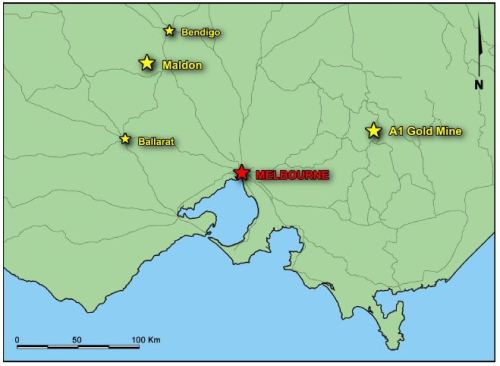
THE BOURSE WHISPERER: Octagonal Resources has commenced processing gold-bearing ore from the A1 gold mine at the company’s Porcupine Flat gold processing facility at Maldon in Central Victoria.


Location of the A1 gold mine with respect to Maldon. Source: Company announcement


The A1 gold mine historically produced more than 450,000 ounces of gold at an average grade of 30 grams per tonne gold and was one of Australia’s longest operating mines having been worked from 1861 through to 1992.

Octagonal entered into an Ore Processing Agreement with A1 Consolidated in February to process gold bearing ore from the A1 Gold Mine at the company’s Porcupine Flat gold processing facility at Maldon.

Under the terms of the Ore Processing Agreement, Octagonal will process of up to 150,000 tonnes of gold bearing ore from the A1 gold mine over a three year period at a rate of 50,000 tonnes per year.

In return for processing gold bearing ore from the A1 gold mine, Octagonal will receive:

–    An ore processing fee that will cover all costs associated with the processing of A1 ore including; labour, consumables, mill maintenance, tailings disposal, and administration; and

–    10 per cent of the gold produced from the A1 gold mine.

Trucking of ore from the A1 mine to Maldon commenced during April and over 5,500 tonnes have been delivered to site for processing.

Consolidated Tin receives first 2012 drill results

THE DRILLSERGEANT: Tin exploration and development play Consolidated Tin Mines has received assay results from the first 2012 drill program on the Pinnacles deposit at the company’s Mt Garnet tin project near Cairns in northern Queensland.

This drill program consisted of a total 54 holes drilled at the Pinnacles deposit with the aim of testing the North Area of the deposit and followed drilling undertaken by the company late last year.

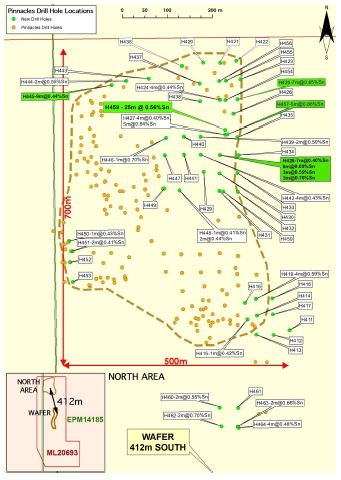
Pinnacles drill collar locations. Source: Company announcement

The 2012 drilling campaigns has continued to drill test a large area contained within a 700 metre (north-south) by 500 metre (east-west) boundary.

Drilling highlights include:

–    25 metres at 0.56 per cent tin from 9 metres to 34 metres, using 0.2 per cent tin cut off.

“This is another excellent result from the Pinnacles deposit which continues to expand with drilling,” Consolidated Tin Mines managing director Ralph De Lacey said in the company’s announcement to the Australian Securities Exchange.

“The large, near surface ‘North Area’ is an excellent low cost open pit mining target.

“The Pinnacles deposit may also have a significant Fluorine by-product as well as an iron by-product that is a feature of these Mt Garnet tin skarn deposits.

“The Pinnacles deposit is intended to be brought into production after the initial three to four year mining of Gillian and Deadmans Gully.”

The Pinnacles deposit was originally explored by Comalco as a Fluorine deposit and currently has a JORC Inferred Resource of 960,000 tonnes at 15 per cent Fluorine.

The company commenced its second 2012 drill program in May, which is ongoing, while assay results from the Gillian drill program, which was also part of the first 2012 drill program, will be released to the market as they become available.

The Mt Garnet Tin project comprises three main deposits: the Gillian, Pinnacles and Windermere/ Deadmans Gully deposits.

The Mt Garnet project has a total JORC Mineral Resource of 7.3 million tonnes at 0.60 per cent Tin, which includes 1.2 million tonnes at 0.82 per cent tin in the Measured category at the Gillian deposit.

Global Metals reveals more gold anomalies at Jutson Rocks

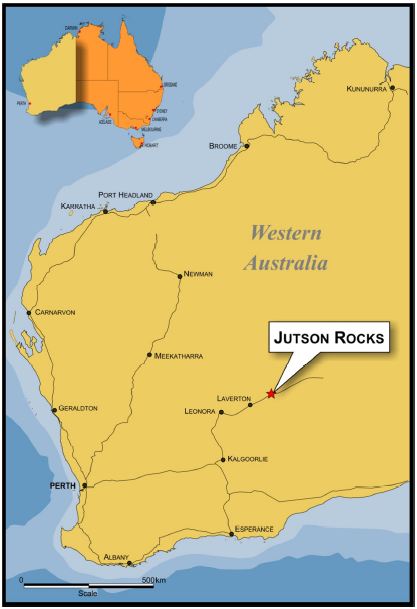
THE DRILL SERGEANT: Global Metals Exploration has released assay from a third phase of a geochemical auger sampling program it conducted during April and May 2012 on tenements situated within the company’s Jutson Rocks project in the Eastern Goldfields district of Western Australia.


Location map of the Jutson Rocks project in Western Australia. Source: Company announcement

Global Metals described the results as being “highly encouraging” as they have revealed further anomalous gold results, ranging from greater than 10 parts per billion gold, which the company considers anomalous, up to 1,605 parts per billion, which it unsurprisingly considers to be “very highly anomalous”

“These results provide the company a great degree of confidence, as they confirm that the exploration model used to date has been a success and provides great encouragement for Global Metals to move ahead with follow-up drill testing, expected to be approximately 10,000m of air core in the second half of this calendar year,” Global Metals said in its ASX announcement.

Auger geochemical drilling programs Global Metals has completed to date have been located along the structural corridor south of an anomalous RAB drill hole intercept of 4 metres at 3.5 grams per tonne gold from 32 metres to 36 metres the company announced in April.

Global Metals said it has interpreted the orientation of the most sizeable anomalies to be controlled and contained by bedrock structural and lithological contact trends.

“Three anomalous areas of most significance in terms of their size indicate the potential for broad gold anomalism to occur in the underlying bedrock,” the company explained.

“Throughout the following months, a second phase follow-up program of exploratory RAB or air core drilling, will be initially planned to test the underlying bedrock regolith to blade-refusal depth for anomalous gold mineralisation, within the boundaries of the more significant areas of pedogenic gold geochemistry.”

The company indicated it would most likely undertake some infill sampling as preparatory work for the air core drilling.

Global Metals said the recent exploration program at Jutson Rocks had provided it with a number of strong and extensive gold anomalies located in prospective geological settings.

The gold anomalies provide a number of excellent drill targets it will test over the next two months.

Tanami Gold updates Groundrush Resources

THE BOURE WHISPERER: Tanami Gold has announced an increase in the Mineral Resource estimate for the Groundrush deposit, which is part of the company’s 100 per cent-owned Central Tanami project, located in the Northern Territory.

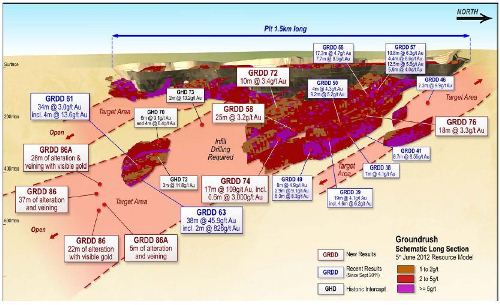
A new Mineral Resource estimate of 5.1 million tonnes at 4.5 grams per tonne gold for 742,900 ounces of gold has been completed for the Groundrush deposit.

According to Tanami Gold the Resource upgrade has resulted in a 39 per cent increase in contained ounces as well as increasing the company’s confidence in the mineralisation outlined in an estimate the company released in October 2011.


Groundrush schematic long section as at 5 June 2012. Source: Company announcement


“This is a very pleasing result, and clearly validates our strong view that Groundrush is a large mineralised system, which will continue to deliver increases in gold Resources as our drill programs continue to test down plunge and down dip extensions,” Tanami Gold deputy chairman Denis Waddell said in the company’s announcement to the Australian Securities Exchange.

“This interim Resource upgrade further demonstrates the potential to rapidly increase the Groundrush Resource.”

Tanami said although drilling at Groundrush is set to continue indefinitely, the current phase of infill and extensional drilling the company is currently undertaking is expected to be completed by December 2012.

It anticipates this will enable completion of a Stage 1 Central Tanami project Feasibility Study by April 2013.

There are still outstanding recent significant step-out drilling intersections (with visible gold present) the company has encountered deeper in the Groundrush mineralised system yet to be included in the Groundrush Resource.

 “A significant proportion of the recent drilling was aimed at increasing the geological confidence level and upgrading Inferred Resources to the Indicated category,” Waddell added.

“We have been successful in this regard which is an important step in delineating mining Reserves and designing the mine plan necessary for completion of the Feasibility Study.

“We will continue to strike a balance between growing the Resource base through step-out drilling and Resource/Reserve upgrade drilling.

“We are very confident the Groundrush deposit will underpin the successful development of a multi-deposit Central Tanami project.”

Tough month June, has been so far anyway.

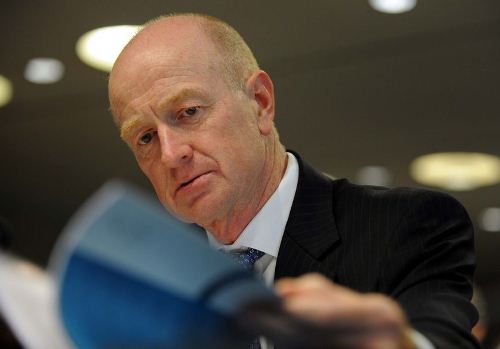
Winter is hard enough without a bitter dessert of Tax Loss selling and more Greek elections topped off with a cheery of Prime Minister Julia Gillard and Reserve Bank Governor Glenn Stevens telling us that business leaders should be talking up the economy.

The ASX 200 index dropped seven per cent in May, and so far we are currently down 0.5 per cent for the month of June.

As I write the ASX 200 is on an approximate forward Price Earnings multiple of 12 times earnings.

Historically, this figure is cheap. But try telling that to potential investors, or for that matter, Julia and Glenn.


Investors are running scared with falling returns on their superannuation, and the increasing likelihood of falling rates on their cash balances.

It’s fairly hard to see the wood for the trees at present, and as June is historically a bad month for investors, July cannot come soon enough.

The trouble with looking to July, is the ever increasing likelihood of some break-down of the Eurozone union and/or its currency.

The ‘Euromess’ is really the biggest challenge global markets have faced for decades, and the outlook is very cloudy.

There is really no clear plan emerging to resurrect the European crisis, and most European politicians will be more concerned with self-preservation rather than truly courageous decision making.

My feeling is Greece will leave the Euro currency at some time, and when it does there should be harsh penalties.

Basically, if one member leaves then the rest in the union should see the repercussions.

That way, the Italians and the Spanish should heed the call of austerity.

The BBC recently did a show on the Great Euro crash, and a heady mix of politicians, economists and investors all lent their theories on the past, present and the future.

GEORGE SOROS, HEDGE FUND INVESTOR:
“Whether the Euro is held together or not, Europe is facing a lost decade, or more.”

WILLEM BUITER, CHIEF ECONOMIST, CITIGROUP:
“The banks were dying on their feet, many of them insolvent and illiterate.”

DAVID MCWILLIAMS, ECONOMIST AND AUTHOR:
“The dream was that you bring people together. The reality is that in order to save the Euro, the Euro elite are destroying the dream.”

The dream is definitely now a nightmare and Australia cannot expect to escape the ramifications.

Germany chancellor Angela Merkel is now, rather optimistically, suggesting the European Union should ultimately have a single national identity, with political and fiscal, as well as financial union.

A position that is easy to adopt for a country revelling in its position of economic dominance.


However, right now, after two years teetering on the brink of disaster, the opposite is a more likely prospect: being the collapse of the single currency and incredible political strain on the whole of Europe.

If there is a meltdown, Australia will not escape the impact.

Banks here get 30 per cent of their funds from Europe.

Paradoxically, we are where we started two years ago, and the progression hasn’t been impressive.

The markets generally are in Groundhog Day, and investors are getting bored with watching the same move each weekday.

Same bat cave; Same bat channel. 


Overland mining study opts for Andrew and Darcy open pits

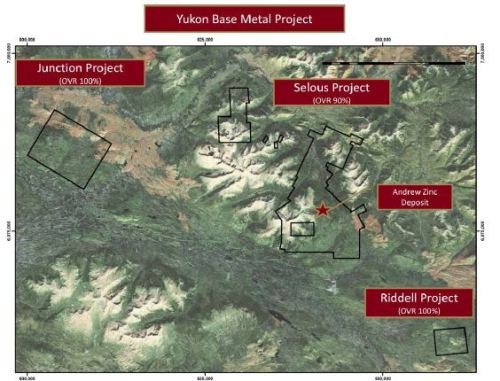
THE BOURSE WHISPERER: A mining study being conducted by Overland Resources at its 90 per cent-owned Yukon base metal project in Canada has concluded the company’s best investment returns can be provided by developing separate open pits at the Andrew zinc deposit and the Darcy zinc deposit.


Overland Resources ground holding showing at the Yukon base metal project. Source: Company announcement


The study determined a total of eight million tonnes of ore at an average grade of five per cent zinc and 1.5 per cent lead would be recovered over a seven year mine life.

The mine site development would entail establishment of a 1,000,000 tonne per annum SAG and ball mill crushing, grinding and flotation circuit to produce separate zinc and lead concentrates.

According to Overland the estimated capital cost to develop such an operation is $227 million with a further 20 per cent contingency allowance of $45 million and an estimated pre-strip cost of $20 million.

The mining operation would be expected to produce, annually, approximately 95,000 wet metric tonnes of zinc concentrate grading 58 per cent zinc and 28,000 wet metric tonnes of lead concentrate grading 62 per cent lead for the life-of-mine (LOM).

Concentrates would be transported by truck to the port of Skagway, Alaska where they would be loaded onto bulk carriers and shipped to a customer’s selected discharge port.

The study also ascertained operating costs to deliver the concentrate to the ore loading terminal at Skagway would equate to US$0.70 per pound of payable metal (zinc or lead), inclusive of all mining and processing costs and transport charges to the port, yet exclusive of stevedoring, shipping, treatment and refining costs, taxes, permitting costs, government or community fees and charges.

“The results of this economic evaluation indicate a sustained long term improvement in both zinc and lead metal prices will be required to provide a suitable return to the company and its shareholders from a mine development,” Overland Resources said in its ASX announcement.

“The company remains confident that the outlook for long term metal prices, particularly zinc, are positive and that they will increase over the next three to five years as demand increases following the recovery in global economies and with the anticipated closure of several zinc mines, thereby reducing supply.”

Having said that Overland indicated the results of the recent economic study had given it pause to the current uncertainly in the global equity and financial markets.

Having given these subjects some careful consideration, the company has elected to suspend all further mine permitting work for its Yukon base metal project.

“Importantly there are no expenditure obligations for the company to maintain the claims that host the Andrew and Darcy Deposits in good standing until at least 2026,” Overland explained.

“Hence the company can monitor the global economic situation without risk of losing an extremely valuable asset.”

Brumby upgrades Oakover manganese estimate

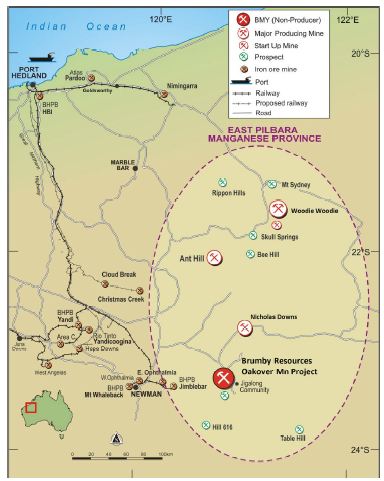
THE DRILL SERGEANT: Brumby Resources has announced upgraded total Inferred Mineral Resource Estimate for the company’s Oakover manganese project, located in the East Pilbara of Western Australia.


Location of the Oakover manganese project in the East Pilbara manganese province. Source: Company announcement


The new estimate stands at 64 million tonnes at 10 per cent manganese based on a cut-off grade of 8 per cent manganese.

This result is up from the Maiden Inferred Mineral Resource Estimate of 27Mt at 10.2 per cent manganese the company announced in March 2012.

“With the latest upgrade to the resource, the team at Brumby has shown again that we can deliver on the goals we set, on time and on budget,” Brumby Resources chief executive officer Alison Morley said in the company’s announcement to the Australian Securities Exchange.

“The project is reaching a critical size where we can start to seriously examine its commercial potential.

“The next phase will allow the company to gain a more detailed understanding of the metallurgy and the resultant data will be used as inputs to a Scoping Study planned for the end of 2012.

“Meanwhile, follow-up exploration will continue at the JayEye, Sixty Sixer and Taya prospects at the Oakover project.”

Brumby said it has more resource definition drilling planned for Oakover, with 3,000m of RC drilling designed at the JayEye prospect with the aim of potentially expanding the project’s current Resource.

The company expects the next phase of drilling will test an area of approximately 600m by 1000m.

A further 500m of drilling will provide samples for metallurgical beneficiation testing.

Resources Roadhouse to speak on panel at Gold Coast Showcase.

OUT AND ABOUT: The Gold Coast Resources Showcase kicks off on Wednesday 13 June at the Sheraton Mirage.

Attendees to the Showcase will see over 30 company presentations over the two days as well as having first-hand access to numerous companies at their booths situated within the exhibition area.

The Roadhouse is privileged to be part of a panel discussion consisting some of the industry’s best and brightest analytical minds that will close the conference on the Thursday.

We hope to catch up with as many of our readers as possible over the two days.

The Showcase runs for two days and is a free resources investment forum and exhibition with morning tea, lunch and afternoon tea supplied to all attending, registered delegates.

Growth main priority for Silver Lake Resources

The Silver Lake Resources (ASX:SLR) story appears simple at face value.

Silver Lake Resources is an ASX 200 gold producer and explorer with a current resource base of 3.6 million ounces of gold located in renowned prospective regions including the Mount Monger goldfield and the Murchison of Western Australia.

Silver Lake’s current main focus is its Mount Monger operation located 50 kilometres south east of the historic gold mining centre of Kalgoorlie.

“Mount Monger has got us to where we are today,” Silver Lake director of exploration and geology Chris Banasik told The Inside Story.

“Since we listed in 2007, we have only gone to the market twice to raise funds; once for an exploration kick-up in 2009 and then last year to fund our new Murchison project.

“Apart from that we have managed to pay our own way, which is a good thing as we have maintained control of the company and minimised dilution our shareholders.”

Silver Lake commenced mining operations at Mount Monger in 2007 from the Daisy Milano underground mine.

It now mines three other underground sources in Daisy East, Rosemary and Haoma as well as numerous open pit mines at Wombola.
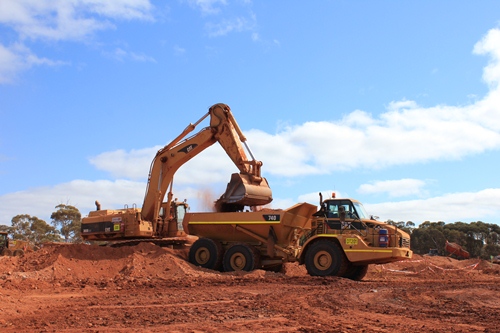
 

Mining at Wombola. Source: Silver Lake Resources

Ore from Mount Monger is processed at the Lakewood gold processing facility, which recently underwent a 700,000 tonne per annum expansion.

A new 1.6 megawatt ball mill was commissioned on low grade feed at reduced throughput rates to allow the new mill componentry to be run in and to stabilise the CIL circuit to required operating parameters.

The mill was operated at 700,000tpa design rates in February, March and April 2012, however Silver Lake has completed Stage 2 of the upgrade to the point where the mill can be operated at 900,000tpa.

Combined milled production for ore produced from Mount Monger mines for the March quarter this year totalled 134,507 tonnes at 4.3 grams per tonne gold for 17,284 recovered ounces.

Once fully completed, the facility will be capable of producing at a rate of one million tonnes per annum.

Work still to be undertaken includes completion of the crusher upgrade, construction of a ROM bin and installation of a new tailings storage facility later in 2012.

“The mill expansion was always going to be a two-stage operation,” Banasik explained.

“Until late last year the Lakewood mill was good for around 400,000 to 500,000 tonnes per year.

“The expansion we completed in January takes us to around 750,000 to 800,000 tonnes per year.

“The last phase, which will enable milling of one million tonnes per year, will happen gradually and be finalised by the end of 2013.”

The Lakewood facility affords Silver Lake the flexibility to adjust its production rate should it discover more open pittable deposits in the area, which it says it is confident of doing.

Should the company’s production profile change in the alternate direction the mill has been designed to ensure it does not go hungry.

“If we don’t achieve one million tonnes per year we can turn the mill down,” Banasik said.

“That means we will not have to utilise the full circuit and will remain just as efficient on a dollar per tonne basis.

“The last thing we wanted to do was spend a lot of money on a mill we would be constantly trying to fill.”

Silver Lake recently announced an interim resource upgrade at Mount Monger to 6.8 million tonnes at 7.8 grams per tonne gold for 1.7 million ounces.

This included a 100 per cent increase in the resource at Haoma to 465,000 ounces with more than 1.3Moz of resource now accessible from existing infrastructure.

“By this time next year we will have already poured gold from our second operation we are developing in the Murchison region of Western Australia,” Banasik said.

“By then we expect to be underground and open pit mining at that second operation and our new mill will have been reconstructed and rebuilt.”

The Murchison project is similar to Mount Monger with a number of mine sources servicing a central processing facility.

The company announced an interim resource upgrade at Murchison, which now totals 20.6 million tonnes at 2.8g/t gold for 1.9 million ounces.

The upgrade included an increase to Measured and Indicated Resources to 880,000 ounces as well as a 48 per cent increase in resource at the Tuckabianna underground deposits of Tuckabianna West and Caustons to 460,000 ounces.

Silver Lake is currently undertaking infill and extensional drilling targeting strike and depth extensions to the planned underground mines at Caustons, Tuckabianna West and Comet.

The Comet project consists four ore deposits and has a current JORC Resource of 4.7 million tonnes at 2.90g/t gold for 440,700 ounces.

Comet also includes the Pinnacles deposit, located approximately 100m west of the main Comet deposit.

Pinnacles will become the first of 14 open pit mines in the Murchison with mining expected to commence in the September 2012 quarter to prepare mill feed.

Production at the Murchison project is anticipated to commence in the March 2013 quarter ramping up to 100,000 ounces per annum in 2014.

Approvals for a Project Management Plan, Mining Proposal and Works Approval have already been received from regulatory authorities and construction of a 250 man camp located in the town of Cue is almost complete.

Relocation of company owned milling infrastructure has also commenced with the final design for the gold mill allowing for a potential copper circuit.
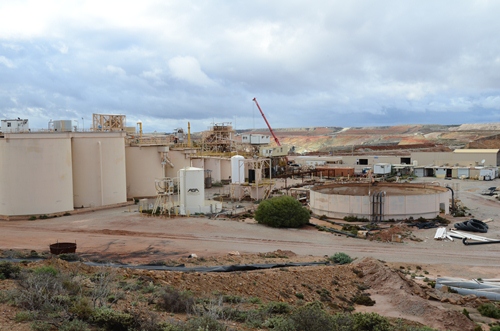
 

Company owned milling infrastructure to be relocated for the Murchison project. Source: Company announcement

A copper circuit may just come in handy after the company received assay results from a nine hole diamond drill program confirmed Hollandaire deposit as a high-grade copper deposit.

Results included:

–    9.3m at 15.4 per cent copper, 2g/t gold and 29g/t silver from 61m, including 1m at 45.5 per cent copper, 2.8g/t gold and 51g/t silver and 0.8m at 41.2 per cent copper, 5.5g/t gold and 62g/t silver.

“It is unreasonable to expect the first nine holes you drill in an area to be as good as the first nine holes we drilled,” Banasik said.

“However, we are excited by the copper we have found at Cue, but we really don’t know what it is yet.

“It could be anything; but it is early days yet.

“It has been a very interesting start – there have been some very good grades returned and we are getting encouragement from some other places as well.”

Silver Lake is finalising the purchase of the Kundip gold project and the Trilogy polymetallic project from Phillips River, located near Ravensthorpe in the south of WA.

Silver Lake has also purchased Phillips River’s Munglinup project.

This project consists of five exploration tenements covering over 1,600 square kilometres located in the Albany Fraser belt, one of Australia’s most significant gold belts and host to the 5Moz Tropicana deposit.

“We should be able to conclude the Phillips River transaction within the next few months,” Banasik said.

“We will then be producing at Mount Monger, and by next year be producing at Murchison as well as conducting exploration and evaluation down at Ravensthorpe.

“The real thing about Silver Lake for the next 12 to 18 months is to watch how this entire growth profile emerges.”

Silver Lake Resources (ASX:SLR)
…The Short Story

HEAD OFFICE
Suite 4, Level 3
South Shore Centre
85 South Perth Esplanade
South Perth  WA   6151

Ph:    +61 8 6313 3800
Fax:    +61 8 6313 3888

Email: contact@silverlakeresources.com.au
Web: www.silverlakeresources.com.au

DIRECTORS and MANAGEMENT
Paul Chapman, Les Davis, Chris Banasik, Peter Johnston, Brian Kennedy, David Griffiths

MAJOR SHAREHOLDERS
Directors                11.6%
Sprott Asset Management    6.9%
Goodman & Company         6.6%

SHARES ON ISSUE
220.3 million

MARKET CAPITALISATION
$674 million (at 7 June 2012)