


Chris Torrey – Silver City Minerals
ONE OFF THE WOOD: The Roadhouse was in Broken Hill for the Resources and Energy Symposium recently and caught up with Chris Torrey managing director of local company Silver City Minerals to find out how it was working to reawaken the region’s mining potential.

Chris, Silver City has put together a package of tenements that has the potential to put Broken Hill back on the mining map. Could you tell us a bit about where you are and what you’re doing there?
We have pulled together a large tenure package around Broken Hill.
We control, probably 50 to 60 per cent of the major exploration ground around Broken Hill.
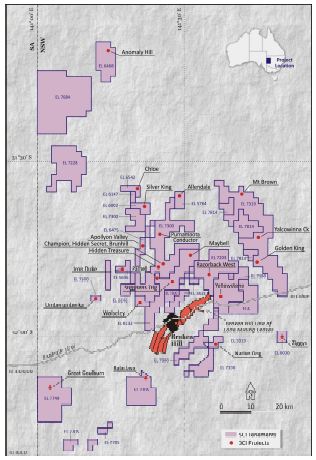
Silver City tenement holding map. Source: Company
You only listed on the ASX in July, which means you’re a relatively new company. How did you manage to accumulate such a portfolio of ground?
We listed in July, but the company started in 2007 by a group of people pulling together the ground by completing some Joint Venture deals and sales agreements with the view to eventually floating a company.
Once it had the ground it became a matter of raising money. Prior to my appointment with the company they had raised around $2 million, which was used to begin working the projects up and isolating areas of particular interest.
What was the result of that original, early exploration work?
We identified numerous areas of interest but have decided to turn our early focus on four in particular.
One, located just north of Broken Hill called the Razorback project, is emerging as a very interesting prospect.
It has the potential to be, geologically, the northern extension, offset by a fault, of the Broken Hill line of lode.
It is a geochemical anomaly that was found by shallow auger drilling across this flood plain.
Now we have drilled more of these shallow holes and defined a very strong geochemical anomaly over five kilometres containing zinc, lead and manganese – the mineral constituents of Broken Hill.
There has never been a deep drill hole conducted to test this area and we started drilling on Razorback last week.
What are the other areas of interest?
We announced results of some drilling we conducted on Allendale last September.
We are closer to achieving an actual Resource statement there having recorded some base metal and silver intersections.
We’ve modelled the zone and we know where it’s going. We’re bringing another dill rig in there this week and will be conducting a major drilling program there over the next two months.
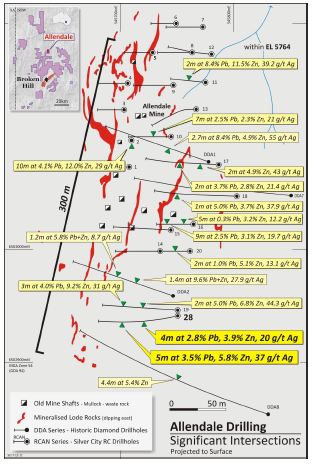
Source: Company
The other, really interesting project is a more silver-rich project than the others called the Umberumberka project.
It is not like normal Broken Hill ore bodies, which normally twist, bend and squirt off in different directions.
This one is much planar in that it is a much easier vein to explore and was a historic silver mine that produced millions of ounces of silver.
One million ounces may not considered by some people to be much, but this was only mined from within a couple of hundred metres from surface, meaning the grade of the silver is very high, about 800 grams per tonne.
If we can put together a structure with 800 grams per tonne in it, these days that makes a lot of money.
How does it come about that such a potentially rich group of tenements has never been properly explored in what is, invariably, one of the country’s premier mining locations?
There are two reasons. First of all, the Broken Hill ore body that was mined for years was so rich the big companies that held it didn’t bother exploring for more.
The other thing was the big companies controlled the mine and they controlled the district.
When they eventually did venture out exploring they were looking for another big Broken Hill ore body.
We’ve taken a different attitude – we would love to find a big deposit, but the fact of the matter is that with just one per cent of the Broken Hill ore body, which is only 3 million tonnes, it is still possible to make a lot of money.
Our exploration method is to map out surface outcrops, sample them in detail and drill close-spaced holes following mineralisation down.
We have been very successful at Allendale using this methodology and we are hopeful it could develop into something fairly big at depth.
Is the shallow drilling enough or will you need to chase it down deeper?
If we keep drilling it will get deeper and deeper, but we have – at Allendale for example – the potential for an open pit.
Or, if we find a really good ore body that keeps plunging we could have the potential to develop an underground operation.
We’re not sitting back like the big companies did here, who just drilled deep holes – sometimes they hit mineralisation – but were discouraged if they hit something that was ‘only’ five metres wide.
Five metres is fabulous for us. We’re looking over old data in some places to locate potential targets we can track down.
Has that been a modus operandi – studying the old data to find out where to go?
We do look at the old data, but we also do a lot of detailed geological mapping on the surface.
We pay a lot more attention to detailed geochemistry because it is possible to map these silver veins a long way and learn where the mineralisation shoots exist.
The way to find out if they are mineralised is through systematic sampling, and it is amazing that this hasn’t been done here in Broken Hill before.
You have brought your projects to the stage they’re at now, what’s the next stage for Silver City?
We have just commenced drilling at the Razorback prospect and at Allendale we are just about to commence our second round of drilling.
After they have been completed we will move over to Umberumberka to carry out some drilling there.
All up we have around 5,000 metres of drilling scheduled leading up to September. That could go out to 8,000 metres depending on what we find.
You appear to have a fair amount of confidence in the targets you’re going after?
We would like to think we could have a resource at Allendale, certainly by October, and be drilling out something we were pleased enough with to move into development.
That’s the sort of progress that could be very rapid, but it all depends on whether we get onto something.
If we get onto something – if we hit 20 per cent combined lead / zinc – all hell will break loose.
You sound like a football team that could be a potential premiership threat that is battling to keep a lid on how things are going in order not to get too far ahead of yourself?
It is a bit like that. We could burn a lot of money chasing all sorts of things, but we don’t want to do that.
We have these initial targets lined up and we are just systematically working our way through them.
Do you think more companies will start looking out this way now that you have demonstrated the actual potential that still exists here?
There is definitely an enthusiasm to get out here. There are plenty of companies already drilling around us.
There is a lot more junior sector activity than there has been for a long time and it is simply because the juniors have finally been able to get out on the ground.
The big companies are out and we’re in.