


Adrian Griffin – Midwinter Resources
Taking the time to drop into The Roadhouse this week was Midwinter Resources managing director Adrian Griffin to give us the lowdown on how the company’s projects in South Africa and Swaziland are developing.

What is the current major focus of Mindwinter Resources?
Without a shadow of a doubt the major focus of the company is ferrous metals in Southern Africa.
Primarily South Africa, but we are looking at adjacent countries; we are looking at Mozambique, Botswana, and a couple of others.
Midwinter’s main project is the Northern Lights project in the Limpopo province of South Africa, but you have extensively added to your landholding there with the addition of the Musina project.
Initially we purchased a controlling interest in a company that had some applications within the Limpopo province.
Some of those applications at Northern Lights were already granted and we commenced drilling there in 2010.
The interesting thing about that area is that it looks like a billiard table; everything is sand covered and there is no outcropping to be seen.
So all the drilling we conducted was based on geophysical and magnetic surveys. We were technically successful and we did locate exactly what we were looking for and we determined the magnetic anomalies were indeed a consequence of magnetite in banded iron formations.
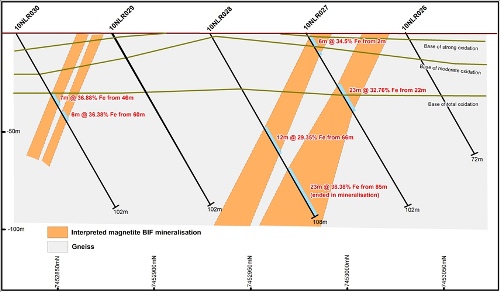
Cross section of area drilled at Northern Lights. Source: Company
The major issue we had was the geometry of those banded iron formations. They are relatively narrow and steeply dipping.
As a consequence – long term if we are to mine them – we are going to have high stripping ratios, which make mining costs high.
So we started looking at the entire Limpopo province on the basis more formations must exist with better geometry.
What sort of picture did taking a wider view of the province produce for you?
A few years back, the South African Mines Department had a tenure system that was totally opaque.
There was no way of determining who owned what tenements. Not even the government really knew. Titles were being duplicated and it was more than a bit confounding.
The South Africa Department of Mines and Petroleum made the decision to stand down the system in order to complete an audit of titles and remove any anomalies and computerize the system making it much more transparent.
We identified this as a once in a lifetime opportunity as it exposed a great deal of available land.
We had a good hard look at it all and determined where the best banded iron formations could exist and prepared a series of applications ready for when the new system was implemented.
How successful were the applications you submitted?
We got about half of the land we applied for. Some of it already had prior tenure over it, which we couldn’t know at the time.
We ended up with a land package including the Musina project, of about 3,000 square kilometres over a strike length of 270 kilometres.
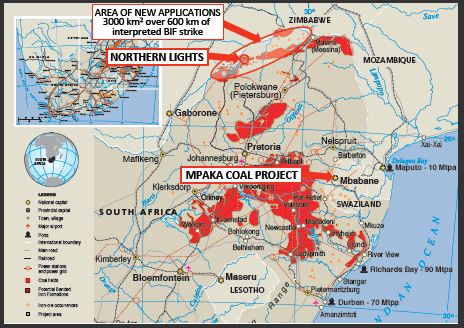
Is all the land similar to what you already had at Northern Lights?
As the tenements move east we start to get more elevated topography with greater topographical relief in the form of outcrops with visible ore bodies.
Our priority now is to improve the geological mapping and prioritize resource targets within the banded iron formation sequence, whether they are outcropping or buried. Those targets will be the mineralized zones, close to surface and exhibiting shallow dips
We have a strike extent of about 600 kilometres of banded iron formations within these tenement applications now with a number of iron ore occurrences that have been documented by the South African government.
Have these applications been finalised?
They are uncontested applications. That means they have been accepted as being valid applications.
They’re in process, although we are not totally sure of the timetable. It is fair to say they rarely take more than 18 months to be approved and we have had them in the system for 13 months, so we are confident they will emerge soon.
What plans do you have in place for them once they do emerge?
We’ll take a good look at the areas with outcrop. We’ll focus on the deposits that have the best geometry being those with relatively shallow dip and reasonable thickness. That will ensure that we can establish resources with a minimum number of drill holes.
We will also fly regional magnetics over the area to locate extensions that run undercover, as we do think there will be a number of these, and we will also conduct a remote sensing campaign.
So by utilising a combination of techniques we expect we will filter all the targets we have and prioritise the ones we anticipate being able to get up to resource fairly quickly.
Is the outcropping mineralization the only aspect of the newer tenements drawing your gaze in the Musina direction?
One of the reasons we want to concentrate on the western are of our tenements is logistics.
They are sitting right on a railway line with spare capacity that runs all the way down to the port at Maputo.
We also have the option of shipping our product to the domestic steel producing market.
On top of all that you also have some news emanating from Swaziland regarding a coal project?
We have an option to buy a controlling interest in Teeman Investments, a company that has a 20 square kilometre Prospecting Licence application over the Mpaka coal mine, which is currently dormant. If granted the Licence will provide an interest in the deposits of 50 per cent and management control. The other 50 per cent will be controlled by the government.
What are the company’s immediate plans there?
On the basis that it gets granted, we would immediately commence a feasibility study as there is a huge amount of historical information available.
The deposit has been drilled out by the government, which quotes a non JORC-compliant Reserve of 50 million tonnes.
Is that as impressive as that sounds?
The thickness of the coal seam is constant; it has mine openings into it and a mine history having been mined by a major company in Gencore, which achieved 28 years of production out of the mine.
We reckon infill drilling of the areas within the application, not previously drilled by the government could meet our exploration target of up 85 million tonnes, which would be rapidly upgraded to JORC-compliant resources.
We’ll conduct that infill drilling and move on to produce a feasibility study then proceed to development.
And Mpaka also has in-situ infrastructure nearby?
It has a railway line that runs right to the headframe and it still has some of the old mine buildings in place.
Most importantly it also has around two years of Gencore production stockpiled.
There is a developed market within the region for the coal in metallurgical applications, primarily across the border in South Africa.
Infrastructure is pretty much a key to any developing project in Africa and it would seem that Midwinter’s current projects have that box well and truly ticked?
They do. Northern Lights has a freeway running right to the front door of the deposit.
There are high-tension power lines running out to Musina and the railway line runs to the port of Maputo for export or we can deliver our product to the local steel industry.
Swaziland is a land-locked country, which means the 80 kilometre rail trip from Mpaka to Maputo – under international convention – receives priority port allocations. So not only do we have the port located close to the project but we can also jump the queue.