Integra hits gold with maiden drilling campaign at Batavia

THE DRILL SERGEANT: Wide-spaced first pass RC drilling conducted by Integra Mining at the recently identified Batavia prospect has returned encouraging results.

The Batavia prospect is located within Integra’s Aldiss gold project, some 60 kilometres east of the company’s producing Randalls gold project.


Integra tenement location plan. Source: Company announcement


Integra is currently focussing much of its exploration efforts on the Aldiss project.

It’s reasoning for doing so being Aldiss has already been identified to possess a substantial gold endowment and a relatively modest additional discovery of economic mineralisation could be sufficient to justify the establishment of a stand-alone mining / milling operation.

Results from the latest drilling at Batavia include:

4 metres at 6.50 grams per tonne gold;

4m at 3.68g/t gold;

4m at 2.90g/t gold; and

4m at 2.27g/t gold.

“Integra is very excited to get these excellent results from our first RC drill program in the Batavia trend with additional results from the Challenger trend pending,” Integra Mining managing director Chris Cairns said in the company’s announcement to the Australian Securities Exchange.

“Field reports note wide-spread and intense alteration and sulphides indicating to us the potential for a large scale gold system.”

Wide-spaced reconnaissance aircore drilling completed by Integra in mid-2011 defined a greater than one metre at 1g/t gold anomalism trend over 500m at Batavia.

Previously released aircore drilling results in the immediate vicinity of the recent RC drilling at Batavia included:

8m at 2.11g/t gold, including 4m at 3.37g/t gold;

3m at 1.35g/t gold; and

1m at 2.40g/t gold.

The identification of the Batavia prospect stem from drilling conducted by Integra in 2010, which defined three gold anomalous trends, referred to as the Admiral, Batavia and Challenger trends.

RC drilling has also been completed in the Challenger trend and assays are pending.
Fox hunts down further copper at Ayshia

THE DRILL SERGEANT: Diamond drilling being carried out by Fox Resources at the company’s Ayshia copper-zinc project in the West Pilbara, Western Australia has intersected encouraging intersections of copper mineralisation.

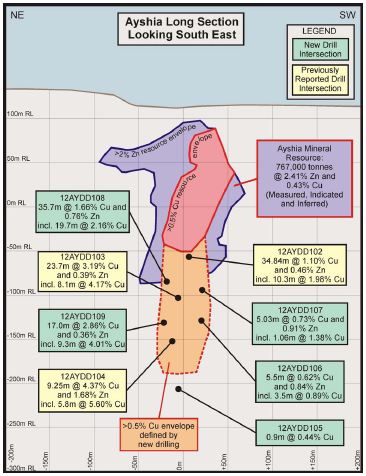
The company has completed five diamond drill holes for a total of 1610.8 metres, which were designed to further test both the down-plunge extent and also the strike length of a mineralised shoot at Ayshia.


Ayshia Long-Section. Source: Company announcement


Results from two of the holes include the following.

Hole 12AYDD108:

–    35.7 metres at 1.66 per cent copper, 0.76 per cent zinc, 4.19 grams per tonne silver and 0.12 grams per tonne gold from 206.5 metres down hole.

This intersection included:

–    5.7m at 2.37 per cent copper, 0.87 per cent zinc, 5.47g/t silver and 0.27 g/t gold from 210m down hole; and

–    19.7m at 2.16 per cent copper, 0.14 per cent zinc, 5.73g/t silver and 0.11g/t gold from 222.5m down hole.

Hole 12AYDD109 returned intersections of:

–    17m at 2.86 per cent copper, 0.36 per cent zinc, 8.06g/t silver and 0.17g/t gold from 243m down hole.

This intersection included:

–    9.27m at 4.01 per cent copper, 0.52 per cent zinc, 11.35g/t silver and 0.19g/t gold from 243.63m down hole; and

–    1.25m at 7.31 per cent copper, 0.50 per cent zinc, 19.81g/t silver and 0.21g/t gold from 256.35m down hole.

“This exploration program clearly demonstrates the potential of Ayshia, which is in close proximity to the Radio Hill and Sholl projects,” Fox Resources chief executive officer Laurie Chew said in the company’s announcement to the Australian Securities Exchange.

Fox said the two two intersections outlined above, which are situated to the north-east of the previously defined mineralisation, suggest the mineralisation is open and continues to the north-east.

The company will carry out down-hole electromagnetic surveys to test the extents of this mineralisation, prior to further drill testing.

Gyroscopic surveys will be completed within all drill holes completed when this program is conducted.

Fox Resources will continue to evaluate the Ayshia project once the DHEM has been completed, with a view to extending the known extents of the deposit.

The company said its focus will be maintained on delineating targets along strike, and down-plunge, based on the typical volcanogenic massive-sulphide (VMS) model where multiple deposits often cluster within camps.

Peak hits high-grade REO at Ngualla

THE DRILL SERGEANT: Peak Resources has scored a number of new high-grade rare earth mineralised intersections from surface at the company’s 100 per cent-owned Ngualla rare earth project in Tanzania.

The company claims the project to be the fifth largest rare earth project in the world outside of China.

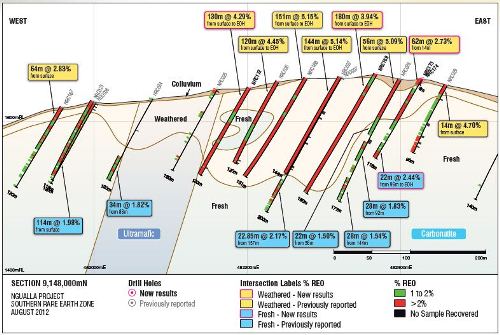
Peak’s latest drilling at Ngualla has intersected the deeply weathered carbonatite it anticipated, which the company said is typically enriched in rare earths in the three to eight per cent Rare Earth Oxide (REO) range.


Cross section on the Southern Rare Earth Zone showing new and
previously reported rare earth mineralised intersections within
colluvial sediments and the weathered portion of the carbonatite.
Source: Company announcement

“Drill intersections confirm the continuity of significant areas of high grade, weathered rare earth mineralisation from surface that may be amendable to sulphuric acid leach processing,” Peak Resources said in its ASX announcement.

Assay results Peak has received from ten new drill holes conducted in the central bastnaesite core of the Southern Rare Earth Zone include several high-grade intersections mineralised from surface to the end of hole.

Highlights from the results are:

– 180 metres at 3.94 per cent REO from surface to end of hole;

– 130m at 4.29 per cent REO from surface to end of hole;

– 140m at 5.21 per cent REO from surface to end of hole;

– 20m at 4.01 per cent REO from 28m, including 14m at 5.16 per cent REO from 30m; and

– 36m at 2.82 per cent REO from surface and 34m at 3.84 per cent REO from 48m.

“These wide intersections confirm the continuity and consistency of the rare earth mineralisation in the heart of the deposit,” Peak said.

“Mineralisation still remains open at depth and to the south.”

Drilling operations are continuing at Ngualla with Peak now having completed a total of 52 holes for 5,900m within the Southern Rare Earth Zone by the end of July.

The company has received assay results for 15 of these new holes.

“The drilling program will provide information and samples to support the scoping and metallurgical studies currently in progress on the Southern Rare Earth Zone,” Peak said.

“This will take several more months to complete and the company will provide regular updates regarding the progress of the drilling and assay results as they are received.”

Breakaway ready to run maiden Resource numbers

THE DRILL SERGEANT: Breakaway Resources is about to commence work on a maiden JORC compliant resource estimate for the company’s Sandy Creek copper-gold prospect, located south-east of Cloncurry in North Queensland.

The estimate calculation follows the receipt of results from a recent 10-hole Reverse Circulation (RC) drilling program completed in June, which the company said has laid the foundations both for the maiden resource and for a preliminary economic assessment of the Sandy Creek project.

The recent drilling intersected broad widths of copper-gold mineralisation in both the Main and Western Zones at Sandy Creek.

Breakaway said the results from the Main Zone confirm potential for a steeply-plunging high-grade shoot or core.

Results include:

–    12 metres at 1.38 per cent copper, 1.56 grams per tonne gold from 218 metres;

–    8m at 1.99 per cent copper, 0.14g/t gold from 128m and 4m at 1.99 per cent copper, 0.45g/t gold from 156m; and

–    4m at 1.99 per cent copper, 0.44g/t gold from 156m.


Sandy Creek prospect Main Zone long-section showing new drill results and DHTEM Conductor. Source: Company announcement


Broad widths of higher grade mineralisation were intersected at the newly identified Western Zone, situated 100m west of the Main Zone, with best results including:

–    10m at 1.34 per cent copper, 0.23g/t gold from 213m;

–    10m at 1.63 per cent copper, 0.22g/t gold from 32m; and

–    6m at 2.00 per cent copper, 0.28g/t gold from 118m.

Mineralisation at the Western Zone remains open along strike and at depth.

“The drilling results from Sandy Creek indicate the potential for a medium size open pit development encompassing the Main Zone and the currently poorly tested Western Zone,” Breakaway Resources managing director Victor Rajasooriar said in the company’s announcement to the Australian Securities Exchange.

“During the current Quarter, we will undertake initial scoping work in parallel with the resource estimation to determine how best to progress Sandy Creek to the next level.

“Of particular note is the higher grade zone of mineralisation intersected down-plunge at the southern end of the Main Zone.

“The higher tenor copper and gold results in this area, combined with the presence of a strong offhole DHTEM anomaly further down-plunge of the most recent drilling, point to a potential emerging high-grade core.

“The presence of a plunging core is typical of the nearby Eloise copper mine, and could indicate the presence of a much larger deposit at Sandy Creek.

“Developing a better understanding of this potential and undertaking some drilling to test the down-plunge extensions of the mineralisation will be a priority for us moving forward.

“The positive drill results from the Western Zone highlight the larger potential of the Sandy Creek mineralised system and the requirement for further drilling.”

ABM Resources extends Buccaneer

THE DRILL SERGEANT: ABM Resources has announced further results of extensional drilling being conducted at the company’s 2.67 million ounce gold Buccaneer porphyry deposit, located in the Northern Territory.

The Buccaneer porphyry gold deposit is situated within the company’s Twin Bonanza gold project, which also includes the Old Pirate high-grade gold deposit.

The 2012 field programs being conducted by ABM are primarily focused on advancing the Old Pirate deposit.

However, several areas at Buccaneer remain untested where the company is drilling to infill and extend the deposit.

Highlights from the drilling at Buccaneer include high-grade intercepts at the Cypress Zone of:

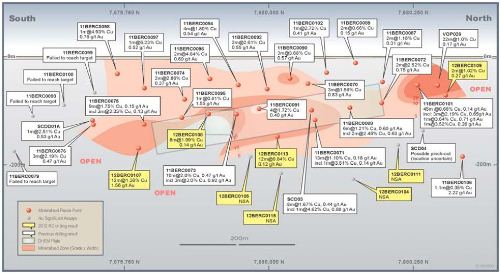
–    6 metres averaging 20.37 grams per tonne gold (1.1g/t cut-off), within 294 metres averaging 0.73 grams per tonne gold (0.2g/t cut-off).

Other results include extensions of the Eastern Contact Zone at Buccaneer of:

–    157m averaging 0.45g/t gold (0.2g/t gold), including two zones of 39m averaging 0.90g/t gold (0.5g/t cut-off) and 22m averaging 0.97g/t gold (0.5g/t cut-off).


Schematic contour map of the Buccaneer porphyry gold deposit with latest drill results labelled. Source: Company announcement


“The identification of further high grade gold bolsters the economic prospects of the bulk tonnage Buccaneer gold deposit,” ABM Resources managing director Darren Holden said in the company’s announcement to the Australian Securities Exchange.

“The latest results extend the Cypress Zone and the overall Buccaneer gold deposit footprint further along the north western contact.

“Mineralisation along the north western contact extends for more than a kilometre from the Caribbean Zone in the south to the Cypress Zone to the north.”

Ventnor makes high-grade copper discovery

THE DRILL SERGEANT: Ventnor Resources has claimed the discovery of a significant high-grade zone of strong bornite copper mineralisation at the company’s Thaduna/Green Dragon copper project.

The Thaduna/Green Dragon project is located north of Meekatharra, Western Australia, in the Doolgunna district, 40 kilometres east of the DeGrussa project of Sandfire Resources.

High-grade intersections from the drilling results include:

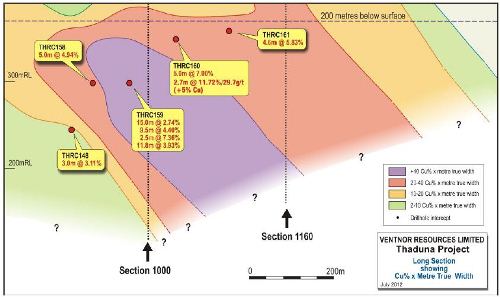
5 metres at 7.00 per cent copper, including 2.7 metres at 11.72 per cent copper and 29.7 grams per tonne silver at a 5 per cent copper cutoff;

–    9.5m at 4.40 per cent copper;

–    10m at 3.26 per cent copper;

–    4.6m at 5.83 per cent copper;

–    2.5m at 7.36 per cent copper;

–    13m at 3.57 per cent copper;

–    5m at 4.94 per cent copper;

–    6m at 4.78 per cent copper;

–    10m at 3.28 per cent copper; and

–    3m at 4.47 per cent copper.

Ventnor Resources managing director Bruce Maluish said this new high-grade discovery of strong bornite mineralisation as the primary sulphide at the project had resulted in higher copper grades.


High grade shoot at depth where strong bornite mineralisation is
reflected in high grade assay results. Source: Company announcement

“The significance of the increasing presence of primary bornite, compared to primary chalcopyrite, lies in the increase in relative copper by weight percentage,” Maluish explained in the company’s announcement to the Australian Securities Exchange.

“Chalcopyrite is 34.6 per cent copper compared with Bornite, which is 63.3 per cent copper, an increase of 183 per cent in copper for the same mass of sulphide.”

“The high-grades intersected continue to increase the company’s confidence in this quality copper project.”
 
To date, Ventnor has drilled 177 RC holes for 25,144m with 29 Diamond Tails for 3,758m, totaling 28,902m at Thaduna over four phases of drilling that it commenced in April 2011.

The company has completed a series of deeper holes at Thaduna covering the central portion of the identified mineralisation.

According to the company these holes have identified a change in the sulphide mineralogy with primary bornite becoming the dominant source of copper mineralisation.

Copper sulphide mineralogy intersected prior to this had been either primary chalcopyrite or secondary chalcocite with specks of bornite observed.

Ventnor explained that Thaduna and Green Dragon are low sulphur mineralising systems, which it said was evidenced by the lack of iron sulphides such as pyrite or pyrrhotite.

A change to the primary copper sulphide mineralisation from chalcopyrite to bornite results in an increase in the copper tenor of the mineralisation.

A further 6 drill holes have been drilled in the central zone with analyses pending.

The company said it anticipates a JORC compliant Resource estimate based on the drilling to the end of Phase 4 to be completed by September 2012.

Focus scores strong results at Burtville

THE DRILL SERGEANT: Focus Minerals has recorded a number of high-grade results from drilling underway at the Burtville mining centre in Laverton.

Focus said the drilling has confirmed depth extensions to the existing pit floor and expansion beyond the current pit shape.

Focus has been drilling a Mineral Resource definition program of 142 RC holes on the western section of the existing Burtville pit to a vertical depth of 110m.

The company’s aim has been to test up to 70m below the base of the current pit to assess the potential for Burtville’s inclusion in its near-term production schedule.


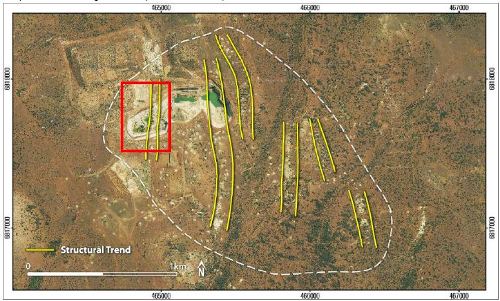
Plan view of the Burtville area, highlighting the focus of the
current drilling (in red box). Numerous historical shafts and spoil
heaps are evident. Interpreted structural trends are indicated (in
yellow), along with the outline of the interpreted area of the
granodiorite (white dashed lines). Source: Company announcement


Drilling results included:

–    6 metres at 17.3 grams per tonne gold from 33 metres;

–    5m at 19.3g/t gold from 90m;

–    4m at 57.4g/t gold from 90m;

–    1m at 139.4g/t gold from 22m;

–    5m at 16.0g/t gold from 22m;

–    5m at 21.5g/t gold from 85m;

–    1m at 169.5g/t gold from 55m;

–    2m at 84.2g/t gold from 72m;

–    8m at 9.5g/t gold from 12m; and

–    12m at 9.9g/t gold from 23m.

Focus said mineralisation at Burtville remained open in all directions and outside of the immediate existing pit area.

“It appears that the first stage of drilling has just touched on the potential of this system,” Focus Minerals chief executive officer Campbell Baird said in the company’s announcement to the Australian Securities Exchange.

“Burtville is a high-priority target for us as there are multiple factors pointing to the existence of a very big system.

“So far we’ve just focused on the western third of the existing Burtville pit where our modelling is indicating there’s the potential for a very low strip ratio pit expansion.

“This, in combination with what we believe to be a very large mineralised system, points to the opportunity to develop a long-term, low unit cost mining centre at Burtville.”

Burtville has been one of a series of priority development targets for Focus since the company acquired the Laverton operations last year.

Burtville was a large, low strip open pit operation that was mined in the 1990s by Sons of Gwalia producing 64,000 ounces of gold at 1.4 grams per tonne.

Foyson confirms Atui porphyry system

THE DRILL SERGEANT: Foyson Resources has claimed to have confirmed the presence of a substantial mineralised porphyry system via drilling conducted at the company’s Atui porphyry prospect in south New Britain, Papua New Guinea.

The results stem from the company recently re-commencing of drilling a hole at 152.6 metres, which it has now progressed to 234m.

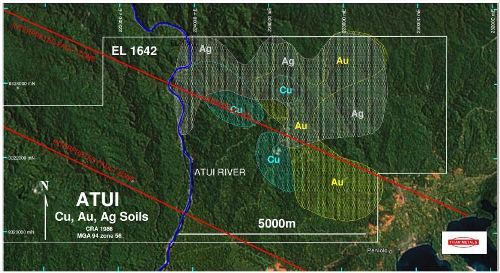
This is the first drill hole ever targeted into the Atui prospect, which Foyson consider to be a substantial, at-surface area of porphyry mineralisation and alteration.

Atui was originally discovered by CRA in 1985 but was never drill tested.


Geochemical zonation within the Atui prospect. Source: Company announcement


“The first drill hole has already shown intrusion, alteration and mineralisation characteristics that indicate the Atui porphyry system merits ongoing, wider scale drill testing,” Fosyon Resources non-executive director John Holliday said in the company’s announcement to the Australian Securities Exchange.

The company said the drilling at Atui had intersected porphyry mineralisation in the form of disseminated sulphides and occasional vein sulphides from base of soil cover to the current depth.

“The hole has traversed a suite of mixed porphyryitic diorites intruded into an andesitic volcanic sequence, suggesting a relative high level setting in the porphyry system,” the company’s ASX announcement said.

“All the rocks intersected are mineralised in the range of trace to three per cent sulphides (pyrite, chalcopyrite, molybdenite). Alteration is inner propylitic or phyllic.”

Foyson has half drill core from the upper 152m of the hole on its way to be assayed in Townsville while core from below 152m is currently being logged and sampled at site.

In conjunction with the current diamond drilling the company is also conducting a 3D pole-dipole induced polarisation (IP) survey over the entire Atui area.

So far one quarter of the survey has been completed and Foyson has been encouraged by the data received up to now.

Foyson said it would use the data in additional targeting guidance for future drill holes into the porphyry area.

Horseshoe Metals continues to hit copper

THE DRILL SERGEANT: Horseshoe Metals has continued its run of high-grade copper intersections from an ongoing drilling campaign underway at the company’s 100 per cent-owned Horseshoe Lights copper/gold project, located in the Peak Hill Mineral Field of Western Australia.
 
The company has been drilling at the Horseshoe Lights project since May 2012 employing a specialist Reverse Circulation Percussion (“RCP”) rig.

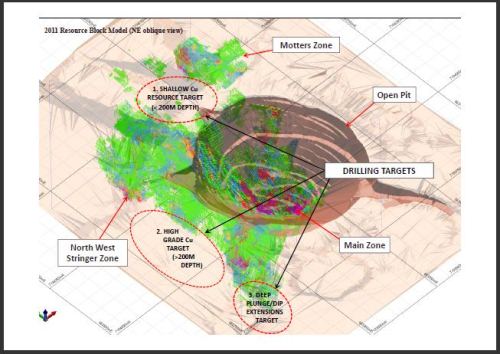
The rig has been drilling low angle holes to test for shallow copper mineralisation north along strike of the open pit in 3 zones from west to east comprising the North West, Main and Motters zones.


Source: Company


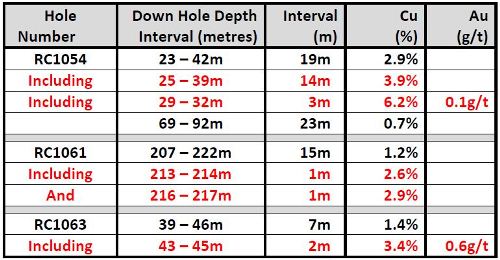
To date 24 holes have been completed for 3,497 metres, with holes ranging from 63m to 160m in depth while a larger conventional RCP rig has also been on site to drill test some deeper targets with a total of five holes being drilled ranging from 150m to 414m in depth.

Latest laboratory analyses have been received with the results including:


Source: Company announcement

At a cut-off grade of 0.5 per cent copper, the current estimate is a total Measured, Indicated and Inferred Mineral Resource of 8.6 million tonnes at 1.06 per cent copper and 0.13 grams per tonne gold for 91,000 tonnes copper and 37,400 ounces of gold.

The company said it plans to complete a revised mineral resource estimate, split between oxide and sulphide mineralisation, once drilling has been completed.

Commencement of a preliminary feasibility study, potentially based upon a staged redevelopment of the mine, is expected to follow shortly thereafter.

West African re-assays Sartenga copper hits

THE DRILL SERGEANT: West African Resources has completed re-assaying of 15 aircore holes for copper at the 100 per cent‐owned Sartenga prospect, part of the company’s Boulsa project in Burkina Faso.

The company made the decision to conduct the analyses after achieving encouraging results from holes SAC0119 and SDH001 it reported to the market in June.

All re-assayed holes returned anomalous copper intercepts at greater than 0.15 per cent.

“The Sartenga oxide copper‐gold results are interpreted to represent flat‐lying supergene mineralisation adjacent to sub‐vertical higher‐grade mineralisation intercepted in SDH001,” West African Resources managing director Richard Hyde said in the company’s announcement to the Australian Securities Exchange.

“The broad, consistent nature of the supergene zone over such a large area indicates potential for significant copper‐gold mineralisation near‐surface and at depth, which is a compelling target for deep diamond drilling later in 2012.”

Results include:

–    16 metres at 0.55 per cent copper and 0.19 grams per tonne gold from 8 metres;

–    27m at 0.57 per cent copper and 0.20g/t gold from 12m;

–    20m at 0.60 per cent copper and 0.44g/t gold from 4m;

–    20m at 0.57 per cent copper and 0.48g/t gold from 8m; and

–    21m at 0.55 per cent copper and 1.34g/t gold from 40m.

The company has also purchased an XRF machine, which it is now using to work through a backlog of aircore and auger samples previously only assayed for gold.

The XRF machine allows for rapid multi‐element analysis for base metals and pathfinder elements (excluding gold).

The onset of the wet season has resulted in all regional exploration being halted, along with RAB drilling at Moktedu and Aircore drilling at Sartenga.

The company expects to stop diamond drilling at Sartenga within two weeks.

West African is now waiting on exploration results for RAB and diamond drilling at the Meguet prospect, and Auger, RAB and RC drilling the Moketdu prospect.

At this stage the company said it should be able to recommence diamond and aircore drilling at Sartenga in September 2012, with all exploration programs underway by late October, weather permitting.

West African Resources is targeting its first resource estimate in late 2012.