Renaissance diamond drilling reveals Okvau potential

THE DRILL SERGEANT: Renaissance Minerals has received the latest results from an ongoing diamond drilling program being conducted at and around the company’s Okvau gold deposit in Cambodia.

The company completed a small reconnaissance program of five shallow diamond drill holes to test anomalous gold in soils extending for over 500 metres to the immediate north of the JORC-compliant indicated and inferred resource estimate already defined at Okvau of 12.6 million tonnes at 1.8 grams per tonne gold for 729,000 ounces of gold.
 
Highlights include:

–    4 metres at 1.86 grams per tonne gold from surface; and

–    9m at 6.60g/t gold from surface and 2m at 3.50g/t gold from 18m and 1m at 15.90g/t gold from 37m.


Okvau soil geochemistry and new drill hole collar locations. Source: Company announcement


“The acquisition of the Cambodian project was driven by a strong belief in the potential for new gold discoveries in the near vicinity of the Okvau gold deposit,” Renaissance Minerals managing director Justin Tremain said in the company’s announcement to the Australian Securities Exchange.

“We are extremely pleased that drilling of the first target outside of Okvau has returned 9m at 6.60g/t gold from surface.

“This intersection, located 500 metres north-west of Okvau, combined with the soil geochemistry, demonstrates this exploration and resource growth potential.

“The 729,000 ounces of gold defined at the Okvau gold deposit has been delineated over an area of just 500 metres by 300 metres, so opening up a further 500 metres is significant.”

The company is of the opinion the results, although from an area outside of the Okvau gold deposit demonstrates its potential for new gold discoveries.

It also considers them to highlight the potential of the Cambodian projects as the area outside of the Okvau deposit remains largely unexplored.

Over the coming months Renaissance intends to continue its efforts to unlock, what it perceives to be, the value of its Cambodian project by targeting a number of satellite targets.

As the wet season approaches the company is conducting a comprehensive surface geochemistry program, including stream sediment sampling and soil sampling, to prepare for an aggressive drilling program testing satellite targets during the dry season.

Meanwhile, diamond drilling will continue on the Okvau gold deposit.

Follow The Roadhouse on Twitter: @RoadhouseWA

Horseshoe drilling brings more good luck

THE DRILL SERGEANT: Horseshoe Metals has received results from an ongoing drilling campaign at the company’s 100 per cent-owned Horseshoe Lights copper-gold project, located in the Peak Hill Mineral Field of Western Australia.

According to the company the drilling has continued to intersect shallow high-grade copper mineralisation immediately north of the historic Horseshoe Lights open pit.

Results include:

North West Stringer Zone

–    23 metres at 4.2 per cent copper from 43 metres to 66 metres, including 8 metres at 8.6 per cent copper;

–    24m at 3.1 per cent copper from 39m to 63m, including 7m at 6.7 per cent copper; and

–    11m at 2.0 per cent copper from 52m to 63m, including 1m at 11.7 per cent copper.

Motters Zone

–    39m at 1.6 per cent copper from surface to 39m, including 4m at 3.7 per cent copper and 2m at 3.9 per cent copper; and

–    19m at 1.1 per cent copper from 1m to 20m.

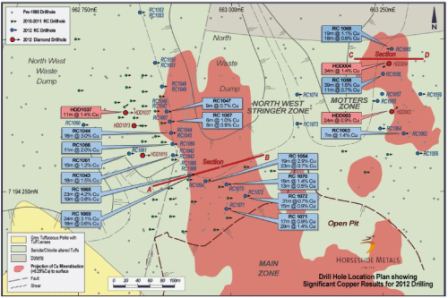
“The North West Stringer Zone is located immediately north – west of the Main Zone of high-grade mineralisation, which was the focus of mining in the historic Horseshoe Lights open pit,” Horseshoe Metals said in its ASX announcement.

“The latest drilling in this area has continued to intersect multiple zones of copper mineralisation.


Drill hole location plan. Source: Company announcement


“The Motters Zone is located approximately 100 metres north-east of the existing open pit and is considered to be a parallel zone of copper mineralisation to the Main Zone.

“A total of eight RC holes have now been completed to test for extensions of this shallow copper resource.”

Horseshoe Metals said it plans to continue drilling at the Horseshoe Lights project throughout the remainder of 2012.
 
The company is focusing its efforts on proving up additional mineral resources to the north of the existing open pit.

It intends drilling deeper holes in in the North West Stringer Zone and the Main Zone areas where copper and gold mineralisation has previously been intersected as well as testing for deep, high-grade copper/gold zones, potentially located down dip and down plunge of the Main Zone.

Shallow exploration targets outside of the immediate pit area, which have not been adequately tested by previous exploration efforts will also be looked at.

The project’s current estimate stands at a total Measured, Indicated and Inferred Mineral Resource of 8.6 million tonnes at 1.06 per cent copper and 0.13 grams per tonne gold for 91,000 tonnes of copper and 37,400 ounces of gold, at a cut-off grade of 0.5 per cent copper.

The company said it plans to complete a revised mineral resource estimate once drilling has been completed and the results analysed.

Indications are that recent drilling and other exploration activities will lead to a significant increase on that figure.

Commencement of a Preliminary Feasibility Study, potentially based upon a staged redevelopment of the mine, is expected to follow shortly thereafter.

Kidman intersects high-grade mineralisation at Home of Bullion

THE DRILL SERGEANT: Kidman Resources has received its first assay results from drilling being conducted at the company’s modestly-named Home of Bullion project located at Barrow Creek in the Northern Territory.

The company has received the results for the first 3 drillholes, of a 24 drillhole RC program, testing the Main lode at the project.

Three of the remaining holes were holes drilled into the Southern Lense.

Kidman said the drilling had encountered multiple high-grade polymetallic intercepts of copper-silver-lead-zinc and gold that it considers to be close to true width.

The mineralisation identified by the drilling appears close to surface providing the company with some confidence of potential for an open-pittable resource.


Main Lode long-section – recent intercepts (yellow dots). Source: Company announcement


The initial results include:

–    HRC020: 4 m at 4.7 per cent copper, 5.1 per cent zinc, 84.6 grams per tonne silver, 1.3 per cent lead, 0.52 grams per tonne gold (4m at 7.7 per cent copper equivalent) from 49 metres;

–    HRC002: 3m at 1.9 per cent copper, 4.7 per cent lead, 2.2 per cent zinc, 204g/t silver, 1.13g/t gold (3m at 6.2 per cent copper equivalent) from 25m (sampling required in footwall); and

–    HRC009 3m at 2.7 per cent copper, 2.3 per cent zinc, 45.5g/t silver, 0.45 per cent lead, 0.46g/t gold (3m at 4.9 per cent copper equivalent) from 208m.

Kidman considers the result from hole HRC020 confirms previous high-grade drill intercepts at Home of Bullion Main Lode.

Similarly it also claimed hole HRC002 confirms oxide potential and includes very high-grade silver at 204 grams per tonne.

“We are very excited with the initial results for the first three holes of our 25 hole program at Home of Bullion with more assays due over coming weeks,” Kidman Resources executive director Shane Mele said in the company’s announcement to the Australian Securities Exchange.

“These results have encouraged us to immediately up our exploration efforts which will include a follow up diamond drilling program due to start in early September.

“The high grade Main lode now has an identified strike length of approximately 170 metres and potentially extends further east under cover.

“Assays are yet to be received for the separate Southern Lode located 200 metres south of the Main Lode.

“Within the company’s tenement there is up to 15 kilometres of potential strike to the west and east of these known high grade lodes.”

The drilling has also identified magnetite in the ore, which Kidman said would assist its upcoming geophysics (magnetics) survey to define strike extensions to the ore body under shallow cover.

The company has a detailed airborne magnetic survey scheduled to start before end of August to define further drill targets across its entire tenement.


Marengo strengthens ‘starter’ zone at Yandera

THE DRILL SERGEANT: Marengo Mining has received a series of broad, near-surface high-grade copper intersections from drilling being undertaken at the company’s Yandera copper-molybdenum-gold project in Papua New Guinea.

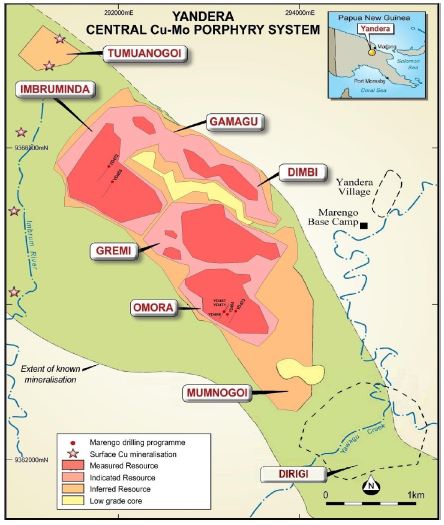
The latest results come from the project’s Omora and Imbruminda zones and form part of an ongoing program of resource in-fill drilling being undertaken at Yandera.


Yandera central porphyry system – drill location plan. Source: Company announcement


Results included the following high-grade intersections:

Omora Zone:

–    126 metres at 0.92 per cent copper, 700 parts per million molybdenum from 30 metres;

–    159m at 0.90 per cent copper, 303ppm molybdenum from 42m;

–    186m at 0.80 per cent copper, 1449ppm molybdenum from 42m;

–    72m at 0.83 per cent copper, 392ppm molybdenum from 378m; and

–    165m at 0.67 per cent copper, 284ppm molybdenum from 39m.

Imbruminda Zone:

–    150m at 0.68 per cent copper, 198ppm molybdenum from 87m;

–    114m at 0.51 per cent copper, 80ppm molybdenum from 3m; and

–    93m at 0.49 per cent copper, 97ppm molybdenum from 24m.

The results include some of the highest grade intersections recorded at Yandera – where Marengo has completed over 145,000m of diamond drilling as part of resource development activities.

“It’s great to see results like this come from our ongoing in-fill drilling programs at Yandera,” Marengo Mining managing director and CEO Les Emery said in the company’s announcement to the Australian Securities Exchange.

“The recent drilling has returned individual intersections of up to 186 metres and grades in some instances of close to one per cent copper – double the average resource grade of the project, and among our best ever drill results.

“These intersections from Yandera provide further evidence of the potential of the Yandera project, both through its long life mining potential as well as identified higher grade initial production areas.

“The high-grade ‘starter’ zones we continue to delineate are of great strategic importance to the project, as they have the potential to enhance returns in the early years of operations and accelerate capital payback.”

The company said the latest results fall within the resource envelope for its recently updated JORC/NI 43-101 compliant resource estimate for Yandera.

At a 0.25 per cent copper cut-off grade the Resource comprises 248 million tonnes grading 0.43 per cent copper Measured and 114Mt grading 0.42 per cent copper Indicated for a total Measured and Indicated Resource of 362Mt grading 0.43 per cent copper for 3,407 million pounds of contained copper.

Inferred Resources currently total 218Mt grading 0.37 per cent copper for 1,778Mlbs of contained copper.

Marengo said the results are not expected to be included in a further resource update prior to the completion of the Yandera Feasibility Study.

It did, however, indicate they do provide further evidence of the presence of high-grade, near-surface zones which the company expects to enhance revenues and cash flows from mining in the early years of the targeted 20 year operations at Yandera.


Pioneer to follow up gold results at Juglah Dome

THE DRILL SERGEANT: Kalgoorlie-focused gold and base metals explorer Pioneer Resources has resumed drilling at the company’s 100 per cent-held Juglah Dome gold project, located southeast of Kalgoorlie in Western Australia.

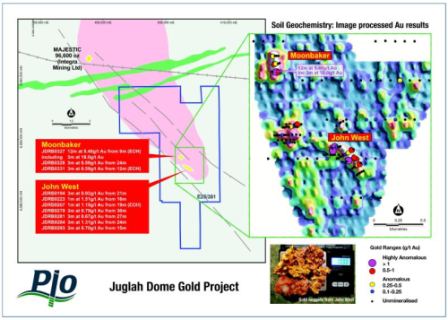
The program is set to drill 150 rotary air blast (RAB) holes to test for continuity between the priority Moonbaker and John West prospects, which are one kilometre apart, followed by further testing for strike length extensions.

On completion, Pioneer will have RAB drill hole tested approximately three kilometres of prospective strike length.


Source: Company announcement


Exploration programs at the Juglah Dome project commenced in collaboration with local prospectors interested in finding gold nuggets.

Pioneer has since completed modern geochemistry surveys and initial RAB drilling, which the company informed the market in July, identified the John West and Moonbaker prospects as priority targets.

Previous drilling at the Moonbaker prospect intersected 3 metres at 18.0 grams per tonne gold from 9 metres within a broader intercept of 12 metres at 5.4 grams per tonne gold to the end of the drill hole.

“Initial RAB drill holes will target locations adjacent to the very exciting Moonbaker prospect and will provide information about the geometry of the deposit,” Pioneer Resources managing director David Crook said in the company’s announcement to the Australian Securities Exchange.

“RAB drilling will also test for connecting structures between the John West and Moonbaker prospects, and then a north westerly-trending structural corridor where soil geochemistry results show trace anomalies of gold and copper.

“Our objective on completion of this RAB drilling program is to have sufficient information to undertake a more targeted and systematic reverse circulation (RC) drilling program with a view to defining a commercial gold deposit.”

The current program is expected to be completed during August with results anticipated by mid-September 2012.

The inaugural RC drilling program will be scheduled for the December 2012 quarter, provided Pioneer continues to receive encouraging drilling results.

The Moonbaker Prospect is located approximately 10km south east of the Majestic and Imperial deposits currently being worked by Integra Mining, which is currently in the process of being taken over by Silver Lake Resources.


Tiger encouraged by drill results at Kileba

THE DRILL SERGEANT: Tiger Resources has received more encouraging results from a diamond drilling program conducted at the Kileba deposit, situated within the company’s Kipoi copper project mining licence area in the Democratic Republic of Congo.

Tiger said it will be using the results to upgrade the existing JORC-standard Inferred mineral resource at Kileba of 9.5 million tonnes at 1.40 per cent copper containing 133,000 tonnes of copper, in support of a definitive feasibility study currently underway for a Stage 2 solvent extraction-electro winning (SXEW) facility at Kipoi.

Results from Tiger’s final 40 holes of the 64-hole Priority 1 program at Kileba include:

–    63.4 metres at 2.71 per cent copper (43.8 metres to 107.2 metres);

–    56.5m at 3.17 per cent copper (36.0m to 92.5m);

–    50.0m at 2.38 per cent copper (22.0m to 72.0m);

–    63.5m at 3.03 per cent copper (44.5m to 108.0m), including 18.3m at 5.48 per cent copper (73.0m to 91.3m);

–    107.1m at 1.61 per cent copper (from surface), including 52.2m at 2.40 per cent copper (0.0m to 52.2m);

–    69.0m at 2.74 per cent copper (22.0m to 91.0m), including 24.2m at 5.0 per cent copper (22.0m to 46.2m);

–    49.0m at 2.65 per cent copper (from surface), including 38.0m at 3.26 per cent copper (0.0m to 38m); and

–    36.0m at 1.95 per cent copper (from surface), including 5.0m at 5.63 per cent copper (20.5m to 25.5m).

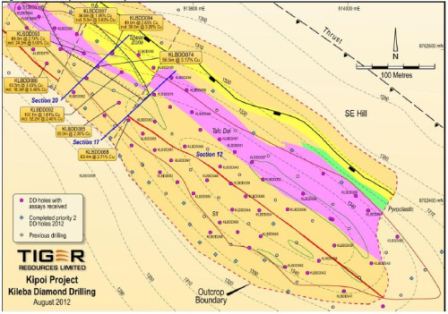
The company recently completed a Priority 2 diamond drill program at Kileba of 2,824.5m for 29 holes in July and is now waiting on those results.


Priority 2 drill plan for Kileba. Source: Company announcement


“The drilling program at Kileba, totalling 93 holes, was designed to convert existing JORC-standard Inferred mineral resources to the Measured and Indicated categories,” Tiger Resources said in its ASX announcement.

“Results received for Priority 1 DD holes (KLBDD0062 to KLBDD100) confirm that copper mineralisation is consistent with the proposed resource model.

“The drilling campaign confirms the company’s understanding of the structural controls of the Kileba deposit, which appears to be a tight anticline with mineralisation dipping in the axis of the anticline.

“Kileba South represents the top of the anticline with a shallow plunge to the South and North and copper oxide enrichment reducing as the ground tightens away from the top.”

According to Tiger the recent assay results confirm the continuity of copper oxide mineralisation at Kileba while demonstrating mineralisation remains open at depth and along strike to the northwest and southeast.


Peak gets more good drilling news from Ngualla

THE DRILL SERGEANT: Peak Resources has received results from drilling carried out at the company’s 100 per cent-owned Ngualla rare earth project in Tanzania.

The drilling encountered new high-grade mineralised intersections from surface, which Peak said has confirmed exceptional grades exist at the project it claims to be the fifth largest rare earth project in the world outside of China.

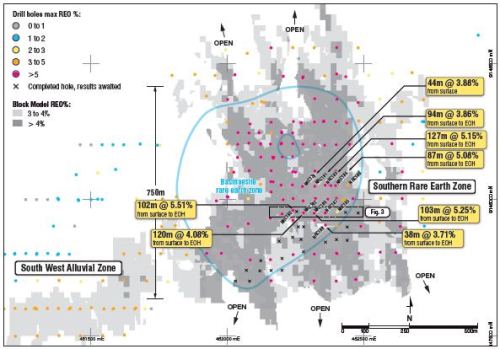
Highlights from the recent drilling at the Southern Rare Earth Zone include:

–    102 metres at 5.51 per cent rare earth oxide (REO) from surface to end of hole;

–    94m at 3.86 per cent REO from surface to end of hole;

–    120m at 4.08 per cent REO from surface to end of hole;

–    127m at 5.15 per cent REO from surface to end of hole;

–    87m at 5.08 per cent REO from surface to end of hole; and

–    103m at 5.25 per cent REO from surface to end of hole.


Plan of new rare earth intersection highlights (hole numbers labelled)
and drilling completed to date coloured by maximum down hole REO per
cent, holes drilled and awaiting results and Ngualla Mineral Resource
block model. Source: Company announcement

The company said the latest intersections define a 200 metre wide zone of deep weathering that is enriched in rare earth mineralisation from surface to vertical depths of over 90 metres.

“Drilling in the Southern Rare Earth Zone continues to intersect wide zones of deeply weathered carbonatite, containing long intersections of plus 5 per cent REO mineralisation,” Peak Resources said in its ASX announcement.

“The new results confirm the continuity of significant areas of high grade, weathered rare earth mineralisation from surface that may be amenable to sulphuric acid leach processing, a potentially lower cost method.

“These wide intersections confirm the continuity and consistency of the rare earth mineralisation in the heart of the deposit that is targeted for first development and production.

“Mineralisation still remains open at depth and to the south.”

Drilling operations are continuing within the Southern Rare Earth Zone while Peak waits on results from 35 of 86 holes it recently completed.

The company said the drilling program is expected to provide information and samples to support scoping and metallurgical studies it currently has in progress on the Southern Rare Earth Zone.

Peak anticipates being able to provide the next update for the metallurgical studies before the end of August.

Aphrodite hits 168.66 grams per tonne gold

THE DRILL SERGEANT: Aphrodite Gold has received the highest gold result so far from its drilling programs being conducted on the company’s Aphrodite gold project near Kalgoorlie in Western Australia.

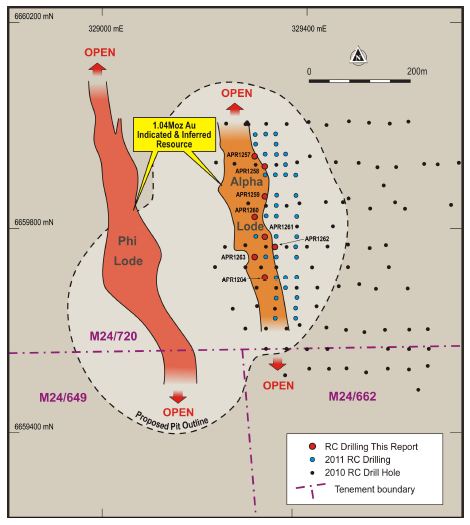
The Aphrodite has received results from a further eight Reverse Circulation (RC) holes drilled on the Alpha Lode, one of two principal lodes which host the current JORC resource for the Aphrodite Gold deposit.


Drill hole locations. Source: Company announcement


The current JORC Resource for the Aphrodite gold project consists of 7.31 million tonnes at 2.75 grams per tonne gold for 645,000 ounces (Indicated) and 2.87 million tonnes at 4.30 grams per tonne gold for 395,000 ounces (Inferred) for a total of 10.18 million tonnes at 3.18 grams per tonne gold for 1,040,000 ounces.

Aphrodite said all of the recently completed holes reported multiple zones of gold mineralisation with a peak gold value of 168.66 grams per tonne gold over a one metre interval.

Gold intersections include:

–    7 metres at 24.92 grams per tonne gold from 150 metres, including 1 metre at 168.66 grams per tonne gold;

–    3m at 8.33g/t gold from 64m;

–    13m at 2.83g/t gold from 78m and 11m at 2.22g/t gold from 113m and 14m at 1.74g/t gold from 152m;

–    19m at 2.30g/t gold from 170m and 6m at 1.84g/t gold from 126m and 6m at 1.64g/t gold from 80m; and

–    4m at 4.35g/t gold from 81m, including 1m at 13.04g/t gold.

“There are some excellent intersections which demonstrate the potential for delineating high-grade areas within the planned open pit,” Aphrodite Gold exploration and development director Leon Reisgys said in the company’s announcement to the Australian Securities Exchange.

“Further drilling is planned around these zones.”

The latest program on the Alpha Lode has been resource definition / infill drilling to a maximum vertical depth of around 200 metres with the positioning of the holes largely constrained by the Scoping Study modelled open pit the company announced in February.

Sartenga drilling continues to encourage West African

THE DRILL SERGEANT: West African Resources has intercepted primary sulphide mineralisation at depth at the company’s 100 per cent-owned Sartenga copper-gold prospect, situated within the Boulsa project in Burkina Faso.

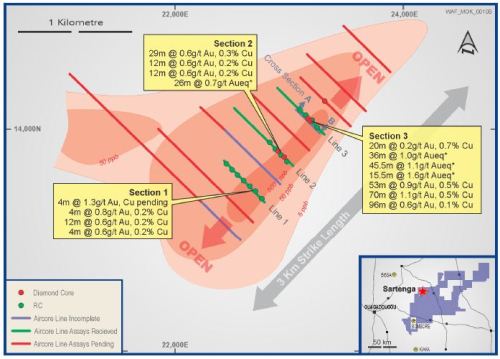
Results include:

– 45.5 metres at 1.1 grams per tonne gold equivalent (0.5g/t gold, 0.3 per cent copper, 315 parts per million molybdenum), including 15.5 metres at 1.6 grams per tonne gold equivalent to end of hole, (0.7g/t gold, 0.5 per cent copper, 407ppm molybdenum) From 112m downhole with the hole ending in in mineralisation; and

– 36m at 1.0g/t gold equivalent (0.5g/t gold, 0.2 per cent copper, 295ppm molybdenum) from 140m downhole with hole ending in mineralisation.

Shallow copper oxide RC intercepts include:

– 12m at 0.9 per cent copper, 0.2g/t gold from 12m;

– 12m at 0.8 per cent copper, 0.5g/t gold from 4m;

– 8m at 1.2 per cent copper, 0.4g/t gold from 8m; and

– 8m at 0.7 per cent copper, 0.3g/t gold from 16m.

“Confirming primary mineralisation at depth is an important step towards advancing Sartenga to resource status by the end of 2012,” West African Resources managing director Richard Hyde said in the company’s announcement to the Australian Securities Exchange.

“The intersections are at good grade and width, beneath extensive supergene mineralisation near surface.

“Two holes ended in significant gold-copper-molybdenum mineralisation at more than 150m depth.

“The next step is to ascertain how far the mineralisation extends at depth and along strike, to the

southwest and northeast.”


Sartenga cross‐section Line 3 showing drill results. Source company announcement


West African has completed six diamond holes and has received results for two so far, with results from the four remaining holes pending.

“We still have a large amount of results to be reported from completed aircore and diamond drilling,” Hyde explained.

“We are preparing for a follow-up diamond drilling program in the new field season and will also be carrying out preliminary metallurgical testwork oxide and primary mineralisation.”

Exterra increases Second Fortune

THE DRILL SERGEANT: Exterra Resources has increased the high-grade Second Fortune lode Resource at the company’s 100 per cent-owned Linden gold project.

The increase follows the recent completion of a nine hole diamond drilling program.

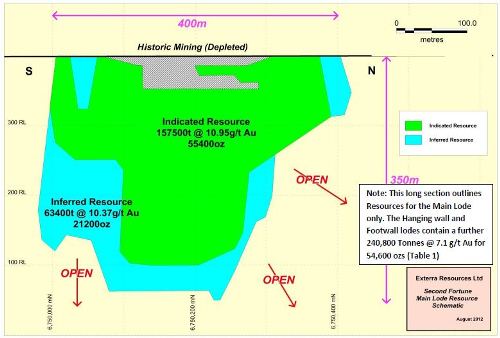
The combined Indicated and Inferred Resource for the Second Fortune Main lode and associated hangingwall and footwall lodes at a 4.00g/t gold lower cut-off now totals:

461,900 tonnes at 8.8 grams per tonne gold for 131,200 ounces of gold.

The updated Resource represents an increase of 151 per cent from the maiden Resource reported by Exterra in May 2011 (Inferred 207,000 Tonnes at 7.9 g/t gold).


Second Fortune Main Lode Long Section Resources. NOTE: This long
section outlines Resources associated with the Main Lode only and a
further 240,800 Tonnes at 7.1 g/t gold for 54,600 ounces is contained in
the adjacent Hanging wall and Footwall lodes. Source: Company
announcement

The company highlighted the fact 47 per cent of this updated Resource is classified as Indicated.

The Second Fortune lode Resource has now been defined to approximately 300 metres below surface and remains open at depth.

The Resource contains both footwall and hangingwall lodes, immediately adjacent to the main lode, which the company expects will increase gold ounces per vertical metre.

“The substantially increased Resource confirms the robust nature of the Second Fortune lode system being a significant high grade gold deposit and confirms Exterra’s confidence in progressing development activities via a Pre-Feasibility study,” Exterra Resources said in the company’s ASX announcement.

“Exterra has elected to complete a Pre-Feasibility study on the current Resource to determine the viability of an underground operation prior to completing infill and step out drilling.”
 
Development activities which will form the basis of the company’s Pre-Feasibility study and which are underway include:

–    Environmental Baseline studies;

–     Underground mining contractor discussions;

–    Underground mine design optimisation studies; and

–    Toll treatment arrangements.

The company said it anticipates treatment of ore offsite in the initial stages will be beneficial in that it allows for a shorter time frame to production with significantly less capital costs.

Exterra said it is currently in discussions with nearby plant operators with regards to the potential treatment of Second Fortune ore.