Sirius confirms grade-width copper at Nova discovery

THE DRILL SERGEANT: Sirius Resources has undertaken preliminary XRF analysis of the sulphide zones intersected in further holes undertaken at the company’s market-jolting Nova nickel discovery.

These holes were drilled, at what the company described to be, a considerable distance either side of the discovery hole at Nova, which intersected 4 metres at 3.8 per cent nickel and 1.42 per cent copper to spark a run of ASX releases by companies eager to let investors know they live next door.
 
The first hole, drilled 55 metres up-dip from the discovery  hole, intersected 13m averaging 4.1 pwer cent nickel and 2.2 per cent copper from 123m, including 6m averaging 6.1 per cent nickel and 2.6 per cent copper from 128m.

The second was drilled 50 metres down-dip from the discovery hole and intersected 5m averaging 2.0 per cent nickel and 0.4 per cent copper from 233m, within a broader intercept of 9m averaging 1.2 per cent nickel and 0.7 per cent copper from 229m.

The company highlighted this intersection also contained a one metre interval of massive sulphide grading 4.1 per cent nickel, which it said indicated high-grade massive sulphides continue down dip.
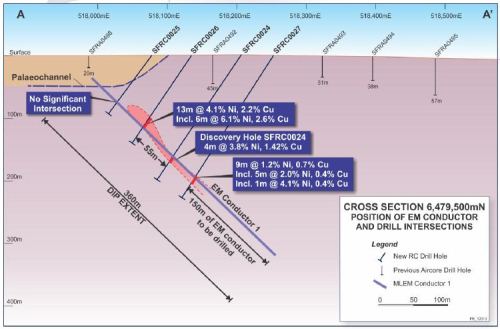
 

Cross section of the uppermost tip of EM conductor 1 showing new
intersection, approximately 50 metres down dip from discovery hole and
the modelled position of sulphides based on the EM anomaly. Source:
Company announcement


“These preliminary results are very encouraging as they are good grade and width over a considerable distance,” Sirius Resources managing director Mark Bennett said in the company’s announcement to the Australian Securities Exchange.

“The next step is to determine how far the mineralisation extends down plunge to the north, and how consistent it is.
 
“We are gearing up for a diamond drill program and while we push forward with this we will also be doing some preliminary work on the metallurgical characteristics of the mineralisation in order to get an early feel for the flotation and metal liberation characteristics of the sulphides and the levels of those elements which can potentially add to or detract from value of any concentrate.”

Sirius drilled a single hole around 50m to the south of the discovery drill hole, to determine the extreme up-plunge end of the target, which did not intersect sulphide mineralisation.

This was the first of an additional six RC holes the company intends to drill south and north of the discovery drill section.

The company is conducting RC drilling to scope the uppermost tip of the EM target and has a diamond drill program scheduled to commence next week.

The purpose behind this program will be to initially scope the extent of the mineralisation and infill drilling to determine its internal continuity.

While all this is going on systematic downhole electromagnetic (DHEM) surveys will be conducted to guide and optimise the drilling.

Sirius said it will also commence preliminary metallurgical characterisation of the mineralisation as soon as is practicable.
Stonehenge inks new land access agreements

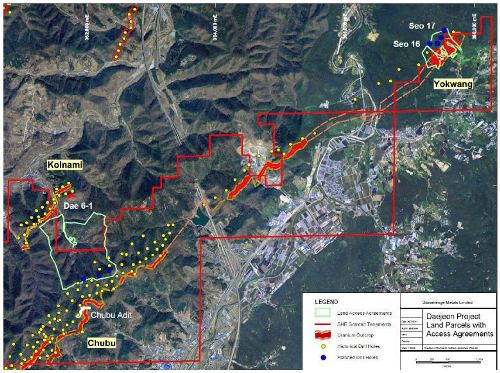
THE DRILL SERGEANT: Stonehenge Metals has signed three separate land access agreements to undertake a maiden exploration drilling program across the company’s Daejon project in South Korea.

The Daejon project has 225 historical diamond drill holes and outcrops over a six kilometre strike containing, what the company claims to be, the largest known uranium resource within South Korea at 65 million pounds (Inferred) grading 320 parts per million uranium at a 200ppm cut-off (in accordance with JORC guidelines).

Daejon also has a Vanadium exploration target of 70 to 90 million tonnes at a grade of between 0.25 per cent to 0.35 per cent vanadium for contained 385 to 695 million pounds vanadium.


Map of Daejon project area showing location of land access agreements. Source: Company announcement


Agreements for two parcels of land, Seo 16 and 17, located within the Yokwang deposit have been secured, where the company intends to drill to intersect the mineralised zone.

Stonehenge considers Yokwang to hold exploration potential with a JORC exploration target of 15 to 59Mt with uranium grade ranging between 300 to 500ppm uranium.
 
Although the purpose of the Yokwang drill program is to confirm the continuity of the uranium mineralised zone, including thickness and grade, Stonehenge will also use it in estimating a maiden vanadium resource over the area.
 
“This program represents the first stage in converting our vanadium exploration target into a resource,” Stonehenge metals managing director Richard Henning said in the company’s announcement to the Australian Securities Exchange.

“There is little doubt that the quantity and grade of the vanadium that we have tested to date means that it cannot be ignored, and our metallurgical work continues to improve the co-extraction process of uranium and vanadium.

“Early modelling shows a strong economic case based on processing the two minerals, both of which are of major significance to Korean industries.

“As we prove up some of the earlier work done by Korean geologists back in the 1980’s and add our expertise in metallurgy, environmental planning, and adopting ‘best practice’, we will continue dialogue with central and provincial government and all members of the local communities with regard to open and transparent activity.”

Sirius uncovers new nickel province

THE DRILL SERGEANT: Sirius Resources has claimed the discovery of a new nickel province after striking nickel and copper sulphide mineralisation in the first reverse circulation (RC) drill holes to be conducted at the company’s 70 per cent-owned Fraser Range project in Western Australia.

The company has named the discovery the Nova deposit.

The Nova deposit is located in a previously unexplored and inaccessible area, beneath transported overburden.

Sirius said it was discovered with the first drill hole it had designed to test a large electromagnetic (EM) conductor – one of three EM conductors it has identified at the Eye prospect.


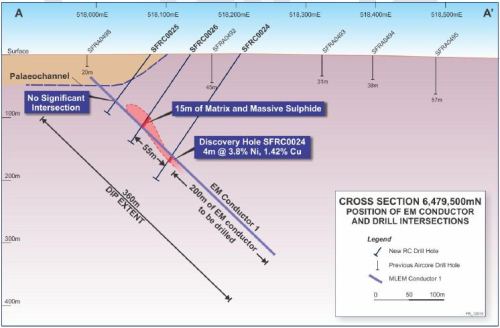
Cross section showing the uppermost tip of EM conductor 1 showing
intersections relative to the extent of conductor. Source: Company
announcement


The first hole (SFRC0024) – hosting the discovery intersection – intersected 4 metres at 3.8 per cent nickel and 1.42 per cent copper where the EM model predicted it would.

A subsequently drilled step-out hole (SFRC0026) intersected 15 metres of similar matrix to massive style sulphide mineralisation some 55 metres up-dip from the discovery hole.

Sirius is curently awaiting assay results on this hole.

According to Sirius the EM model indicates sulphide mineralisation may continue for a further 200 metres down dip from the discovery hole on this drill section.

The company indicated these intersections to be at the uppermost edge of a  large (1,000 long x 300 metre wide) EM anomaly, which it considers to indicate potential for the Nova discovery to be a very large massive nickel-copper sulphide deposit.

“This appears to be a major new nickel-copper discovery, of a new deposit style in an entirely new province,” Sirius Resources managing director Mark Bennett said in the company’s announcement to the Australian Securities Exchange.

“It is very gratifying to start from scratch in a new frontier doing what we do best and make a discovery.

“This success vindicates our somewhat unfashionable corporate strategy of seeking to identify early stage exploration opportunities with low entry cost in safe jurisdictions and creating real value through discovery and definition of significant resources.
 
“It is very early days but it ticks all the boxes. The mineralogy looks ideal for the production of a high quality concentrate because there are none of the troublesome silicate minerals which can cause recovery problems in the typical Goldfields-style nickel deposits, and its location relative to port is second to none.”

Catalyst hits high-grades at Four Eagles

THE DRILL SERGEANT: Catalyst Metals has recorded its highest gold assay to date, occurring in diamond drillhole FEDD008 at the Discovery prospect located at the company’s Four Eagles gold project in Victoria.

The drilling hit a narrow zone of quartz, which contained 0.2 metres at 152 grams per tonne gold from 150 metres.


Four Eagles gold project drilling locations and results. Source: Company announcement


The company indicated it considered additional quartz with gold mineralisation may be present as the intersection lies close to the contact with the overlying Murray Basin sediments and is incomplete because the upper part of the zone was within the rotary mud section of the pre-collar and was not sampled.

The drilling also encountered high-grade intervals in a second diamond drillhole FEDD007, which contained two narrow high grade intervals, including:

–    0.20 metres at 1.35 grams per tonne gold from 160.3 metres;

–    0.40m at 16.20g/t gold from 167.7m;

–    0.75m at 15.30g/t gold from 170.4m; and

–    0.45m at 1.04g/t gold from 183.95m.
 
Catalyst said the results from these two drillholes confirm the presence of several parallel zones of narrow high-grade gold mineralisation on the Eagle 2 Structure, where another diamond drillhole – FEDD001 contained 0.8m at 17.5g/t gold from 170m and an aircore hole contained 6m at 82.7g/t gold from 123m.

“These results are extremely significant and confirm the high grades intersected in previous aircore drilling,” Catalyst Metals technical director Bruce Kay said in the company’s announcement to the Australian Securities Exchange.

“Gold is related to shear zones with brecciated quartz veins. The gold in FEDD007 appears to be a steep zone present on the eastern limb of an anticlinal structure. The setting of the gold in FEDD008 is probably on a steep westerly limb of the same anticline.

“The drilling has also confirmed the presence of a steep fault zone which is probably the regional Tandarra Fault and contains sporadic high grade gold values (as in FEDD001) and anomalous arsenic.”

So far the first half 2012 aircore and diamond drill program conducted by Catalyst has upgraded three prospects at Four Eagles which lie on three separate trends.

The company anticpates the Boyd’s Dam prospect on Eagle 4 trend, the Hayanmi prospect on Eagle 3 trend and the Discovery prospect on Eagle 2 trend (where this diamond drilling was undertaken) will all require further angled diamond or RC drilling as well as additional vertical infill aircore drilling.

Catalyst considers the prospects represent only a small part of the total area of the gold footprint at Four Eagles.

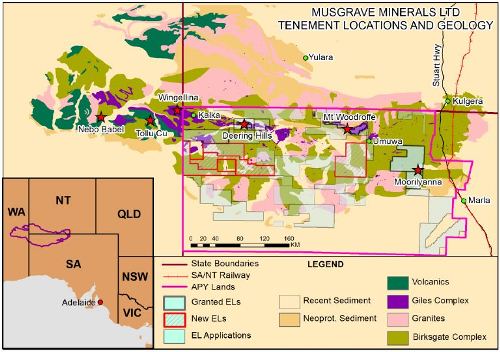
Musgrave Minerals defines new targets at Mt Woodroffe

THE DRILL SERGEANT: Musgrave Minerals has identified a new nickel-copper target at the company’s Mt Woodroffe project, located in the Musgrave Geological Province of South Australia.

The Mt Woodroffe project is situated on Musgrave’s wholly-owned tenement in the eastern portion of the Musgrave Geological Province located approximately 115km west of the Stuart Highway and Adelaide to Darwin railway line.

Location of Musgrave Minerals’ exploration licences. Source: Company announcement

Musgrave has classified the newly-identified Lister target as high-priority.

Lister is in an area of shallow cover and is described by the company to be a versatile time-domain electromagnetic (VTEM) target with coincident geochemical, magnetic and gravity responses.

Musgrave is set to commence a regional VTEM survey of 11 blocks over five tenements covering new priority exploration areas.

This survey will include a block at Mt Woodroffe to the west of the current exploration in an area dominated by a coincident regional gravity and magnetic high.

The regional survey is due to commence this week and will take approximately three weeks to complete.

“The Musgrave geological province is considered very prospective for magmatic nickel-copper sulphide deposits with the region host to the large Nebo-Babel nickel-copper sulphide deposit in the West Musgrave currently held by BHP Billiton,” MusgraveMinerals said in its ASX announcement.

Besides the activity at Mt Woodroffe, Musgrave’s said it will recommence its regional vacuum drilling program at Deering Hills in August.

Winmar scores big results at Hamersley Iron project

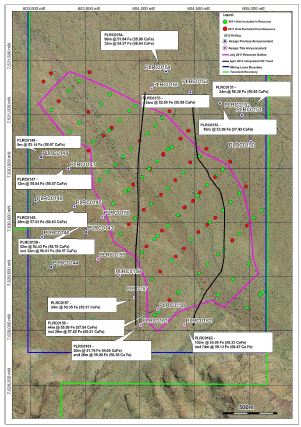
THE DRILL SERGEANT: Winmar Resources has received assay results from the remaining nine holes from the latest phase of drilling at the company’s Hamersley Iron project in the Pilbara region of Western Australia.

Winmar recently completed a 20 hole, 4012 metre RC drilling program at the Hamersley project, which included one diamond pre-collar.


Location of significant intercepts from the 2012 drill program. Source: Company announcement

The recently received assay results include a shallow high-grade intercept (from 28 metres) of:

–   74 metres at 59.14 per cent iron (60.47 per cent calcined iron), within a broader Channel Iron Deposit (CID) zone of 102 metres at 56.00 per cent iron (58.33 per cent calcined iron).

“The results of this phase of drilling are designed to deliver a significant Resource upgrade, due later in quarter three, which will be used to provide an updated scoping study and as input for potential mining plans,” Winmar Resources explained in its ASX announcement.

“The majority of holes on the program intersected CID material with the higher grade and thicker zones occurring on the Northern side of the deposit, and 13 holes returned significant intercepts. The project remains open in most directions.”

Winmar said CID intercepts were returned from six of the remaining eight target depth holes.

These included:

–    28m at 57.62 per cent iron (60.21 per cent Calcined iron); and

–    32m at 56.81 per cent iron (60.57 per cent Calcined iron).

According to the company the latest assay results also returned results from overlying detrital material in three of the holes from the southwest portion of the deposit.

These results included:

–    26m at 55.01 per cent iron (56.36 per cent Calcined iron), from 34m.

Winmar has a large diameter Bauer rig due on site in the next week to collect metallurgical samples of the detrital material.

The south western zone of CID and high grade detrital material will be the initial focus of Winmar’s development plans for the deposit.

The company said this may provide an early pathway to production of beneficiated material and Direct Shipping Ore.

Golden Rim re-assaying records new intercepts at Netiana Lodes

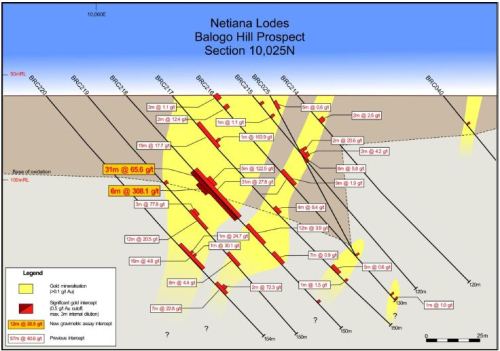
THE DRILL SERGEANT: Golden Rim Resources has re-assayed recent drilling results to record an intercept of 31 metres at 65.6 grams per tonne gold from 48 metres, including 6 metres at 308.1 grams per tonne gold.

The intercept was achieved via gravimetric re-assaying of a previously reported high-grade intercept in drillhole BRC218 undertaken at the Netiana Lodes at the company’s Balogo project in Burkina Faso.


Drill section 10,025N at Netiana showing gold intercepts (new
gravimetric intercepts with yellow label background) and interpreted
zones of gold mineralisation. Source: Company announcement

Previous results from BRC218 included:

–    31m at 27.8g/t gold from 48m, including 5m at 122.5 g/t gold.

Golden Rim said the results of the gravimetric assaying demonstrate standard fire assaying can underestimate gold grades in higher grade portions of the Netiana Lodes.

The company added the results reaffirm its routine practice of conducting gravimetric check assays on all standard fire assays greater than 10g/t gold.

“The intercept of 31 metres at 65.6 grams per tonne gold, including six metres at 308.1 grams per tonne gold, obtained from gravimetric re-assaying of samples from hole BRC218 is exceptional and is one of the best intercepts obtained to date from the Netiana Lodes,” Golden Rim Resources managing director Craig Mackay said in the company’s announcement to the Australian Securities Exchange.

“The gravimetric gold intercept is 136 per cent higher than the original intercept obtained by standard fire assaying.

“We are now consistently intercepting an extremely high grade blanket of gold mineralisation at around 35 to 40 metres below surface, which we believe has been enhanced by supergene enrichment at the base of oxidation.

“Our panning of drilling samples has shown the gold in this high grade blanket is predominantly free gold and we look forward to receiving the results of the gravity metallurgical test work for this zone towards the end of this year.”

Golden Rim indicated it is planning to re-commence diamond drilling in mid-September to test the depth extent of the Netiana Lodes below the current limit of drilling at around 85m below surface.

Based on the results of this drilling, the company has scheduled a maiden JORC Resource estimate for late in the fourth quarter of 2012.

Renaissance encouraged by Okvau drilling results

THE DRILL SERGEANT: Renaissance Minerals has received results from the first three drill holes from an inaugural diamond drilling program being carried out at the company’s Okvau gold deposit in Cambodia.

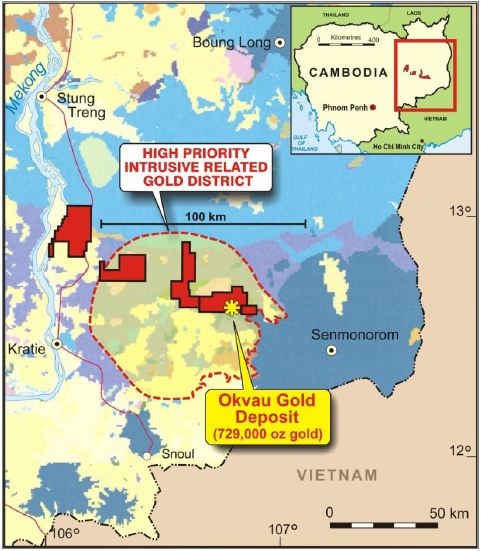
Renaissance has previously announced an independent JORC-compliant indicated and inferred resource estimate for the Okvau deposit of 12.6 million tonnes at 1.8 grams per tonne gold for 729,000 ounces of gold.


Okvau deposit location, Cambodia. Source: Company announcement

Initial results from the initial three (3) diamond core holes highlight both high grade and broad zones of gold mineralisation at shallow depth, which the company considers to demonstrate potential to increase the Okvau deposit with shallow drilling.

Results from the drilling include:

–    16 metres at 3.7 grams per tonne gold from 13 metres and 3 metres at 2.1 grams per tonne gold from 61 metres;

–    1m at 15.7g/t gold from 6m, 1m at 5.1g/t gold from 21m, 1m at 6.2g/t gold from 29m, 1m at 90.1g/t gold from 62m, and 7m at 2.0g/t gold from 71m; and

–    11m at 1.2g/t gold from surface.

“The results from just the first three holes drilled at Okvau support our expectation that the deposit could grow considerably beyond the current resource estimate,” Renaissance Minerals managing director Justin Tremain said in the company’s announcement to the Australian Securities Exchange.

“We now have two rigs drilling step out holes on the Okvau deposit and targeting nearby high priority prospects which are supported by promising soil geochemistry.

“Drilling will continue through the wet season and we look forward to reporting results as they come to hand.”

Renaissance said the recent drilling results also demonstrate diorite intrusion extending further to the west than it had previously interpreted.

The company expects this will have positive implications for the expansion of the existing resource estimate.

Mineralisation at the Okvau deposit starts at surface and remains open at depth and along strike.

The company is continuing an extensive diamond drilling program targeting extensions to Okvau along the western and southern margins of the diorite intrusion that hosts the gold mineralisation.

Renaissance is also targeting a number of new prospects along the margins of the same diorite intrusion that extends for approximately eight kilometres to the north, which it said are supported by highly anomalous gold in soils.

MOD increases Sams Creek estimate

THE DRILL SERGEANT: MOD Resources has increased the inferred mineral resource estimate for the company’s Sams Creek gold project in New Zealand by 33 per cent.

The new JORC-compliant inferred resource estimate for Sams Creek now stands at 18.65 million tonnes at 1.71 grams per tonne gold, at 0.7grams per tonne cut-off to a revised total of 1.024 million ounces.


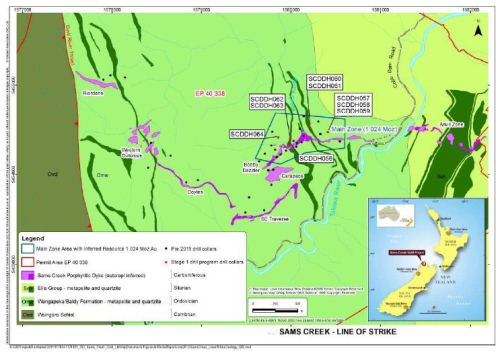
Project location. Source: Company announcement


The resource is all contained within an 800 metre strike length of the Main Zone prospect, which represents less than 15 per cent of the known six kilometre strike length of the Sams Creek dyke.

The Main Zone resource remains open at depth.

The increased resource is based on the results of a stage one drilling program of 9 diamond holes within the Main Zone prospect MOD recently completed at Sams Creek in March 2012.

MOD Resources chairman Miles Kennedy said being able to increase the resource at Sams Creek to more than one million ounces with its initial 9-hole drilling program gave the company confidence Sams Creek had the potential to host a multi-million ounce gold resource.

“Sams Creek is an intrusive-related gold deposit and there are many examples around the world where these types of gold deposits are very large – including Fort Knox and Donlin Creek in Alaska, Vasilkovskoe in Kazakhstan and Kidston in Australia,” Kennedy said in the company’s announcement to the Australian Securities Exchange.

“It is also significant that limited exploration has been completed on the remaining 85 per cent of the known strike length contained within the Sams Creek permit, which provides significant scope for us to expand the existing one million ounce resource.”

Previously reported results from the stage one drilling program at Sams Creek included:

–    29 metres at 2.23 grams per tonne gold, including 10 metres at 4.27 grams per tonne gold;

–    48m at 1.5g/t gold, including 9m at 3.17g/t gold; and

–    12m at 2.11g/t gold, 9m at 4.01g/t gold.

MOD is earning up to 80 per cent of Sams Creek from OceanaGold by sole-funding staged exploration programs.

New Zealand Petroleum & Minerals agreed to extend the Sams Creek exploration permit for five years to March 2017 following the successful completion of the stage one drilling program.

Completing that preliminary drilling program was also the prerequisite for MOD to earn its initial 40 per cent interest in the Sams Creek permit from OceanaGold.

Phoenix Gold strengthens Castle Hill

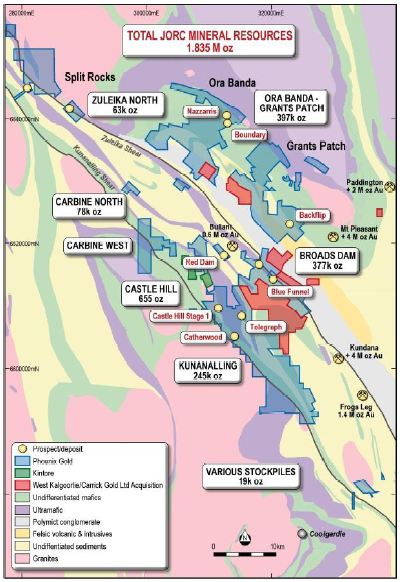
THE DRILL SERGEANT: Phoenix Gold has increased its Total Mineral Resources to 32.4 million tonnes at 1.8 grams per tonne gold for 1.835 million ounces of gold.

This represents an increase of 208 per cent since the company acquired the project in 2010.

The upgrade includes increases to resources at the company’s Castle Hill project and from drilling it completed in the recent December and March quarters plus a recently announced increase at the Broads Dam gold project.

Phoenix has taken the resource at Castle Hill from an initial 253,000oz to 655,000oz in less than two years.


Project location and Phoenix tenements. Source: Company announcement

“Castle Hill is fast becoming the latest large scale gold discovery in Western Australia’s Gold fields and we have barely scratched the surface,” phoenix Gold managing director Jon Price said in the company’s announcement to the Australian Securities Exchange.

“The recent Kintore deal will give us near complete ownership over this large gold system and is clearly demonstrating its multimillion ounce potential.

“Our focus is now squarely on growing this resource below the current 80 metres and completing mine development studies to determine optimal mining and processing routes including the construction of our own processing plant at Castle Hill.”

The current resource envelope at Castle Hill is from surface to 80 metres depth with little to no drilling beneath.

Strike length is now over seven kilometres and remains open in all directions.

Lateral extension drilling carried out by the company has linked structures to form a continuous mineralised system with broad mineralisation supplemented with high-grade vein sets.

The company said deeper drilling it currently has underway is focussed on growing the resource below the current envelope at 80 metres from surface.

Some 376,000oz is currently in the Measured and Indicated resource category and Phoenix has commenced a pre-feasibility study on Castle Hill Stage 1 to assess optimal mining and processing routes and indicative capital and operating costs for mine development.

The company said it expects to receive more drilling results in the September quarter.