


Foyson confirms Atui porphyry system
THE DRILL SERGEANT: Foyson Resources has claimed to have confirmed the presence of a substantial mineralised porphyry system via drilling conducted at the company’s Atui porphyry prospect in south New Britain, Papua New Guinea.
The results stem from the company recently re-commencing of drilling a hole at 152.6 metres, which it has now progressed to 234m.
This is the first drill hole ever targeted into the Atui prospect, which Foyson consider to be a substantial, at-surface area of porphyry mineralisation and alteration.
Atui was originally discovered by CRA in 1985 but was never drill tested.
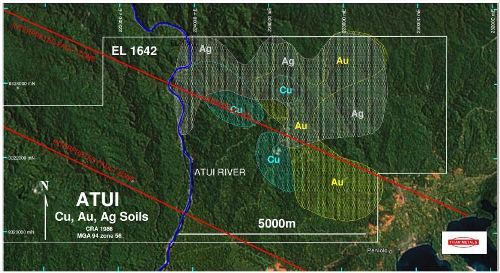
Geochemical zonation within the Atui prospect. Source: Company announcement
“The first drill hole has already shown intrusion, alteration and mineralisation characteristics that indicate the Atui porphyry system merits ongoing, wider scale drill testing,” Fosyon Resources non-executive director John Holliday said in the company’s announcement to the Australian Securities Exchange.
The company said the drilling at Atui had intersected porphyry mineralisation in the form of disseminated sulphides and occasional vein sulphides from base of soil cover to the current depth.
“The hole has traversed a suite of mixed porphyryitic diorites intruded into an andesitic volcanic sequence, suggesting a relative high level setting in the porphyry system,” the company’s ASX announcement said.
“All the rocks intersected are mineralised in the range of trace to three per cent sulphides (pyrite, chalcopyrite, molybdenite). Alteration is inner propylitic or phyllic.”
Foyson has half drill core from the upper 152m of the hole on its way to be assayed in Townsville while core from below 152m is currently being logged and sampled at site.
In conjunction with the current diamond drilling the company is also conducting a 3D pole-dipole induced polarisation (IP) survey over the entire Atui area.
So far one quarter of the survey has been completed and Foyson has been encouraged by the data received up to now.
Foyson said it would use the data in additional targeting guidance for future drill holes into the porphyry area.