Northern Star predicts increased grades at Voyager 1

THE DRILL SERGEANT: Northern Star Resources has received the latest round of results from infill and resource drilling being conducted on the 25 grams per tonne gold Extension zone of the Voyager 1 lode at the company’s Paulsens gold mine in Western Australia.
 
The company said the results provide further evidence it is on track to deliver the sharp increases in production and cash generation it has forecast for 2013.

Northern Star now anticipates grades at Paulsens will be increased next year from the current head-grade of around seven grams per tonne, which will in turn help drive a rise in production to as much as 115,000 ounces of gold, a lowering of costs resulting in surplus cash generation of $65 to $85 million next calendar year.
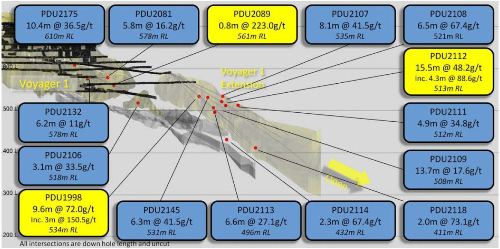
 

Long Section view of significant drill results for Voyager One including the Extension zone. Source: Company announcement

“These latest drilling results reinforce our strategy to deliver sharply higher production and cashflow next year,” Northern Star Resources managing director Bill Beament said in the company’s announcement to the Australian Securities Exchange.

“At the same time, we have a multi-pronged exploration program underway in and around Paulsens and at our neighbouring Ashburton project.

“We are confident that these programs will be generating substantial growth in our inventory and further increases in mine life, production and cashflow.”

The Voyager 1 lode is currently the main ore source at Paulsens and has produced 170,000 ounces over the past two years.

The lode continues to be open down plunge and the company believes this lode will continue to grow and be the mainstay for production for a number of years.

The high-grade extension zone at Voyager 1 formed the major part of Northern Star’s recently released resource upgrade on the Paulsens project to 403,000 ounces of gold.

The latest drilling results from Voyager 1 were not included in the resource upgrade.

Northern Star has intersected the extension zone ahead of its initial timeframe of the December Quarter 2012, which the company outlined will result in the higher-grade ore boosting the project’s production profile sooner.

The first development level in the extension has been underway for the past month with face grades averaging 12g/t so far.

The first extension zone level is one of the highest grade levels ever developed in the seven-year history of the Paulsens mine.

The company expects future head-grade will also be boosted by the fact that historical mine performance indicates stoping/production grades are normally higher than development grades.

 

Tanami continues Groundrush gold rush

THE DRILL SERGEANT: Australian gold producer Tanami Gold has continued its golden exploration run at the company’s 100 per cent-owned Groundrush deposit, which forms part of the Central Tanami project.

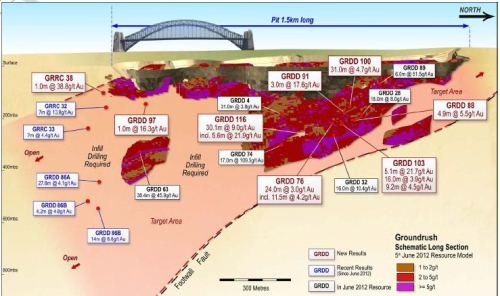
The ongoing Resource upgrade drilling program defined further wide zones of high-grade mineralisation in multiple holes.


Groundrush schematic longsection. Source: Company announcement


Recent results include:

–    30.1 metres at 9.0 grams per tonne gold, including 5.6 metres at 21.9 grams per tonne gold and 10.4 metres at 12.6 grams per tonne gold;

–    31.7m at 4.7g/t gold;

–    5.1m at 21.7g/t gold;

–    16.0m at 3.9g/t gold;

–    9.2m at 4.5g/t gold;

–    3m at 17.6g/t gold;

–    24.0m at 3.0g/t gold, including 11.5m at 4.2g/t gold; and

–    4.9m at 5.5g/t gold.

Tanami also received initial results from drilling undertaken at the Groundrush South High Grade Vein:

–    1.0m at 38.8g/t gold; and

–    1.0m at 16.3g/t gold.

“It is extremely encouraging that the ongoing extensional and infill drill programs consistently confirm the width and grade of our Resource model,” Tanami Gold deputy chairman Denis Waddell said in the company’s announcement to the Australian Securities Exchange.

“We are very confident of delivering a robust and compelling investment case when the Central Tanami Project Definitive Feasibility Study is completed in April 2013.

“The continued and consistent discovery and delineation of additional high grade Resources close to surface and at depth reinforces the quality of the Groundrush mineralised system and its potential to deliver increasing Resources and Reserves.

“Groundrush has an exceptionally strong historical production record, previously producing 610,000 ounces in three years.

“Based on the consistent and strong drill results returned during the past 15 months, we are confident that this strong production record will continue once we re-establish mining operations.”

Tanami has been conducting the Groundrush Resource upgrade drill program since June 2012.

The company said its key objective is to advance a significant portion of the Mineral Resource to an Indicated and Measured status with close spaced drilling.

The purpose of the company’s current p program is to provide adequate Resource confidence for mine design and planning, which it has scheduled for completion towards the end of 2012.

Bullabulling looking to expand eponymous Resource

THE DRILL SERGEANT: Bullabulling Gold has received assay results from a completed program of infill drilling at the company’s Bullabulling gold project in Western Australia.

Bullabulling conducted the drilling targeting two areas where it was seeking additional information to finalise open pit designs for a prefeasibility study it currently has underway to evaluate development of the 3.4 million‐ounce Bullabulling gold project.


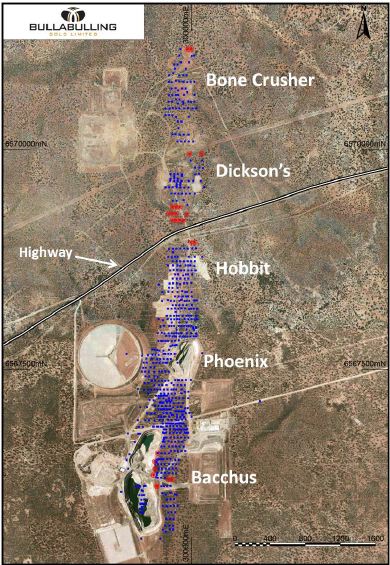
Drill hole collar locations with July 2012 holes shown in red. Source: Company announcement


The drilling from Bacchus East tested areas below the Bacchus Pit, where hole spacing was previously too broad to confirm geological continuity reported healthy intercepts including:

–    24 metres at 1.14 grams per tonne gold from 19 metres;

–    11m at 1.10g/t gold from 212m;

–    3m at 3.18g/t gold from 75m; and

–    5m at 1.59g/t gold from 48m.

“The results demonstrate down‐dip continuity of the footwall lodes in Bacchus East below the Bacchus Pit and confirm significant widths of higher grade mineralisation (+1g/t gold) remain open at depth,” Bullabulling Gold said in its ASX announcement.

“This is expected to lead to an expansion of the resource in this area.”

Drilling also tested a largely undrilled section of the corridor between the Hobbit and Dickson’s Prospects, which is traversed by the Great Eastern Highway.

Results from the two drill fences immediately adjacent to the road reserve indicate that mineralisation is sporadically developed in close proximity to the highway.

This drilling also returned encouraging results, including:

–    8m at 6.59g/t gold;

–    10m at 0.88g/t gold; and

–    8m at 1.53g/t gold.

“The drilling between Hobbit and Dickson’s has successfully demonstrated continuity of mineralisation along strike, albeit with some thinning evident immediately adjacent to the highway,” the company said.

“It is anticipated that this will expand the resource and increase the mining inventory within this area.

“An assessment of whether there is sufficient additional resource present to warrant relocation of the highway will be incorporated into the prefeasibility study.”

Cove to drill new exploration target at Quartz Circle

THE DRILL SERGEANT: Cove Resources is about to embark on a drilling campaign focused on the Royal EM anomaly located within the Quartz Circle VMS project, located southeast of Port Hedland in the Pilbara region of Western Australia (Cove 80 per cent interest).

The company said it believes the Quartz Circle project contains widespread copper, gold, silver, zinc, and lead with classical Volcanogenic Massive Sulphide (VMS) alteration and metal zonation.

Cove has recently completed drilling and new geophysical Electro-magnetic (EM) modelling at Quartz Circle, which it said has strengthened and confirmed the potential of the project to host large copper-gold bodies within the mineralised VMS system.


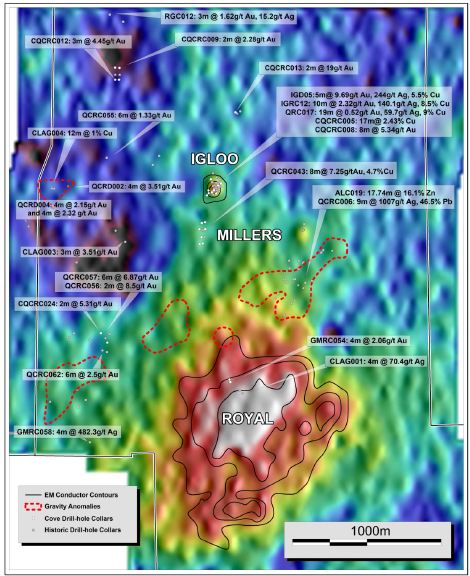
The large Royal EM Anomaly and significant drilling results in the surrounding lease. Source: Company announcement


The company has interpreted the data it received from this drilling data to have provided insights into the structural and geochemical features of known mineralised bodies.

This information will be used to guide the drilling of the Royal anomaly.

The recent drilling activity also confirmed for the company that a number of prospects within the project contain open zones of mineralisation.

“The EM anomaly at the Royal prospect lies to the south of the main Quartz Circle zones of mineralisation (including Igloo) and is over 1000 metres wide and extends to 500 metres depth,” Cove Resources said in its ASX announcement.

“It is important to note that the Royal anomaly is much larger than the Igloo EM anomaly, which is the geophysical signature of a small Indicated Resource of 93,000 tonnes grading 2.92 per cent copper, (previously delineated and announced).

“Also, the Royal anomaly has several drill holes above and to the west of the main anomaly’s predicted source, with significant silver results.

“The Cove VMS Model for Quartz Circle predicts that silver mineralisation could occur as a halo around a copper-gold rich core.”

The planned exploration activity is aimed to delineate clusters of gold-copper VMS deposits at Royal spatially related to the very large complex electro-magnetic anomaly, coincident magnetic features and multiple gravity anomalies.

Given its size, extent and position within the large Quartz Circle VMS system, Cove regards the EM anomaly to deserve immediate drill testing.

Cove said it intends to test Royal with a ten hole, two phase program which includes downhole electro-magnetics.

Phase 1 of this program will be composed of an initial three holes drilled to test the main anomaly and examine alteration within the anomaly envelope.

Alara confirms copper at Washihi project

THE DRILL SERGEANT: Alara Resources has received encouraging assay results from a diamond drill program currently underway at the company’s Washihi copper-gold Joint Venture project in Oman (Alara earning 75 per cent).

The company announced results of a hole drilled in the middle of a recently identified magnetic anomaly, which it claims to have confirmed continuous copper mineralisation.

Assay results of the latest drilling showed:

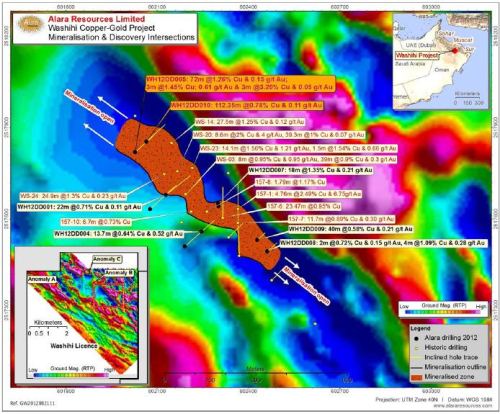
–    112.35 metres at 0.78 per cent copper and 0.11 grams per tonne gold from 112.65 metres, including 67.35 metres at 1.0 per cent copper from 112.65 metres and 12.75 metres at 7.5 grams per tonne silver from 105.25 metres.


Drill hole locations at the Washihi copper-gold project. Source: Company announcement


The results follow three previous holes drilled within the low magnetic anomaly, which returned:

–    72m at 1.3 per cent copper and 0.15g/t gold;

–    18m at 1.4 per cent copper and 0.21g/t gold; and

–    40m at 0.6 per cent copper and 0.21g/t gold.

Alara claims its exploration activities have discovered copper-gold-silver mineralisation at Washihi thickens and extends considerably.

Prior to the commencement of the company’s current drill program, historical exploration had been focused to the south and south-east of current drill holes.

According to Alara its current drilling has indicated sulphide mineralisation to be open to the north-west and south-east.

Future drilling will be focused on expanding current mineralisation.

“We are now beginning to see the fruits of our extensive geophysical work including detailed magnetic susceptibility measurements on drill cores and drilling campaign in Oman where the most recent results have indicated the potential for a major copper-gold discovery,” Alara Resources managing director Shanker Madan said in the company’s announcement to the Australian Securities Exchange.

“These drilling results are very encouraging and provide further visibility around the potential project size and economics of the Washihi project.”

Alara indicated it will shortly be announcing further assay results from the Mullaq prospect, which is situated adjacent to the Washihi prospect, where the company said drilling has confirmed the presence of copper mineralisation.

Kibaran score strong graphite hit at Mahenge

THE DRILL SERGEANT: Kibaran Resources has reported a further big graphite hit at the company’s Mahenge graphite project.

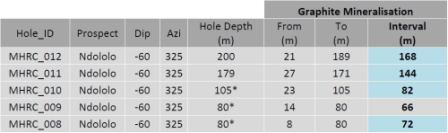
Reverse circulation (RC) drilling being conducted on the Ndololo prospect has intersected 168 metres of graphite mineralisation from a single RC drill hole.
 
The drill hole is 250 metres along strike of the hole Kibaran reported last week, which intersected 144 metres of graphite mineralisation.

The latest result comes from the fifth RC hole the company has drilled at Ndololo prospect, all of which have intersected graphite.


RC Intersections at Mahenge graphite project. Source: Company announcement


“To consistently encounter significant intersections of graphite at our key Tanzanian project is a great result for the company” Kibaran Resources chairman Simon O’Loughlin said in the company’s announcement to the Australian Securities Exchange.

The company said the two most recent holes have demonstrated the potential width and size of graphite mineralisation, especially as they follow up the previous intersections encountered in the previous three holes, which ended in mineralisation.

The holes have intersected graphite schist over consistent widths and along strike.

Kibaran has had initial geological interpretation of the geometry that has shown the graphite mineralisation it has intersected so far shows reveals drill hole intercept widths are close to true widths.

The company recently acquired the rights to the Mahenge and Merelani-Arusha projects, which it considered, correctly as it would seem, to be highly prospective for commercial graphite.

Graphite is regarded as a critical material for future global industrial growth, destined for industrial and technology applications including nuclear reactors, lithium-ion battery manufacturing and a source of graphene.


Bassari encounters high-grade gold at Makabingui

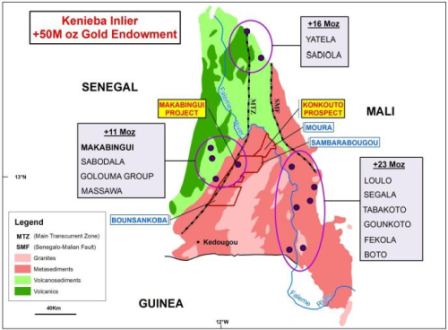
THE DRILL SERGEANT: Bassari Resources has encountered high-grade gold intercepts from a resource drilling program currently underway at the company’s Makabingui gold project in Senegal, West Africa.

Bassari is conducting the drill program with its focus on growing Resources at Makabingui to over one million ounces by year’s end.

The current resource drilling program has returned high-grade intercepts from combined diamond and reverse circulation drilling.


Bassari Permits – Kenieba Inlier, Senegal – West Africa. Source: Company announcement

Highlights from the latest drilling include:

–    6 metres at 22.8 grams per tonne gold from 192.3 metres and 2 metres at 4.8 grams per tonne gold from 117 metres;

–    3m at 36.6g/t gold from 45m;

–    2m at 7.6g/t gold from 13m;

–    4m at 2.2g/t gold from 88m;

–    1.1m at 11.9g/t gold from 106.2m;

–    8m at 4.5g/t gold from 99m;

–    4m at 8.7g/t gold from 95m;

–    6m at 6.7g/t gold from 46m; and

–    2.4m at 3.4g/t gold from 178.6m.

“The latest drill results continue to show the mineralised system is large and our expanded drilling program is growing the resource,” Bassari Resources managing director Jozsef Patarica said in the company’s announcement to the Australian Securities Exchange.

“We have now drilled more than 18,500 metres with a significant area covered.

“With our step out drilling strategy we are still seeing continuity of mineralisation at depth and along strike.

“The latest results have also confirmed new lodes across strike and a continuation of the system at depth.

“Since recently visiting assay facilities we have also seen an improvement in sample turnaround times which will continue to be an area of focus for the remainder of the program.”

The current gold inventory at Makabingui stands at in 6.1 million tonnes at 2.6g/t gold for 503,000 ounces of gold at a 0.5 g/t cut-off.

The resource is defined to an average depth of 115 metres.

Bassari has concluded preliminary metallurgy work it said points to high recoveries and a simple processing path.


Historic drilling confirms Talga’s Swedish graphite

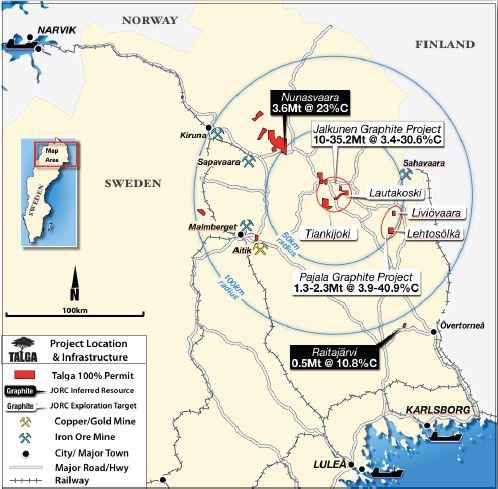
THE DRILL SERGEANT: Talga Gold has received analytical results from a program of historic assay verification and resampling it had carried out on selected historic drill cores for graphite.

The historic drill cores used in the program were drilled at five of Talga’s 100 per cent-owned Swedish graphite projects either by the Swedish Geological Survey (SGU) or Anglo America Group during the period 1958 – 2000.


Talga Gold’s graphite projects and established transport infrastructure, north Sweden. Source: Company announcement


Talga had selections of the historic drill core accessed and re-sampled in order to verify earlier reported grades and intersections of graphite mineralisation.

Highlights of historic assay verification and re-sampling include the following:

DH 4488: Nunasvaara deposit

–    26.7 metres at 23.6 per cent graphitic carbon from 41.8 metres;

DH 1A: Lautakoski prospect of the Jalkunen project

–    40.6m at 17.1 per cent graphitic carbon from 25.12m; and

–    9.4m at 24.6per cent graphitic carbon from 78.21m.

DH 00LIV004: Liviövaara prospect of the Pajala project

–    4.0m at 20.7 per cent graphitic carbon from 32.00m; and

–    12.2m at 13.7 per cent graphitic carbon from 65.84m.

“These assay results confirm the very high tenor of graphite mineralisation within our 100 per cent-owned projects in northern Sweden,” Talga Gold managing director Mark Thompson said in the company’s announcement to the Australian Securities Exchange.

“They not only support the current JORC-code compliant resource at Nunasvaara but also reveal high graphite grades over much greater strike length than previously thought at Liviövaara.

“While the presence of copper and gold in the Liviövaara system over significant widths is worthy of further attention our focus remains on the potential fast tracking of graphite production.

“Talga’s strategy to acquire high grade deposits in close proximity to infrastructure and end-user markets will likely ensure that as a potential first quartile cost producer, these projects would remain economically viable in an environment of weaker commodity prices.”

Talga Gold currently has drill programs underway on its Swedish graphite projects, which it said negates any need for it to continue working on the limited historic core material.

The company has completed some preliminary mineral size work and anticipates that will be reported when finalised.

Its focus now will be on new drilled core that will be subject to more comprehensive metallurgical testwork programs including graphite flake size estimations, distribution analysis and preliminary flotation tests with final concentrate recoveries.

These programs will commence as soon as Talga receives drill core from the drilling and will be integrated into the scoping studies, which the company expects to commence in the fourth quarter of this year.

Successful drilling campaign allows Mutiny to increase Deflector Resource

THE DRILL SERGEANT: Mutiny Gold has updated the JORC-compliant Resource for the company’s Deflector gold-copper deposit in Western Australia.

Using a 0.5 grams per tonne gold cut-off grade, Mutiny announced the August 2012 Deflector resource model represents an increase of 61,000 ounces of gold, and a 26 per cent increase of average gold grades when compared to the previous resource model the company used in its recently released Bankable Feasibility Study.


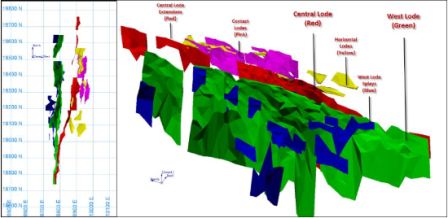
Plan and three-dimensional view of Deflector. Source: Company announcement

“As expected, the recent highly successful exploration results have translated into a more robust resource model with significantly higher gold grades and additional ounces,” Mutiny Gold managing director John Greeve said in the company’s announcement to the Australian Securities Exchange.

“The key impact on the Deflector project is likely to be an increased head-grade due to fewer tonnes mined at a higher grade, which will be determined by mining studies.

“The drilling programs from November 2011 to March 2012 have been outstanding.

“Mutiny Gold’s exploration strategy has been to support a low-cost, profitable operation and the results have achieved this.

“With an improved understanding on the geological controls of mineralisation and gold distribution, the company will now aggressively pursue our corporate goal of reaching 2.5 million ounces for Deflector.”

The new estimate for Deflector includes all drilling, including high-grade intersections the company reported in June from the 2012 exploration program.

The Deflector resource now contains JORC-compliant mineral resources of 2.87 million tonnes at 6.41 grams per tonne gold, 6.82 grams per tonne silver and 0.95 per cent copper for 729,000 ounces of Equivalent gold including 591,000 ounces gold, 628,000 ounces silver and 27,000 tonnes of copper using a 0.5 grams per tonne gold cut-off grade.

Mutiny has commissioned consultants to update the open-pit and underground mine designs, with the intention of converting the updated resource to a new reserve.

The company said indications so far demonstrate the higher-grades have the potential to increase the metals production rate of gold and gold copper concentrate, with an associated positive impact on the economics of the project.

Mutiny anticipates the higher head grade should lead to a greater metals output per tonne of ore processed, potentially up to a 28 per cent increase.

The company said the resource model appears to lend itself to a greater overall increase in tonnes of ore mined leading to the expectation that that the deliverables from the new model will be a significant increase.


Exco receives positive drilling results from Kangaroo Rat

THE DRILL SERGEANT: Exco Resources has received results of recently completed infill diamond and extensional Reverse Circulation (RC) drilling programs at the company’s wholly-owned Kangaroo Rat deposit, located within the Elder Creek project area.

Exco said it believes high-grade ore from the Kangaroo Rat deposit may be economically extracted by conventional open pit mining techniques and transported to nearby processing facilities for toll treatment or a mine gate sale arrangement.

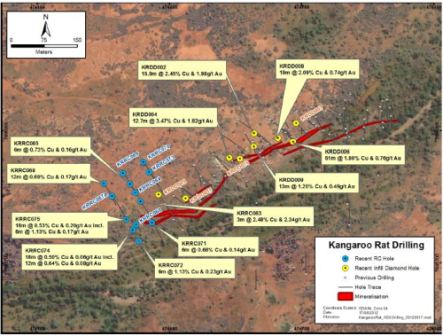
Highlights from the infill diamond drilling include:

–    15.9 metres at 2.45 per cent copper and 1.98 grams per tonne gold from 68.1 metres;

–    12.7m at 3.47 per cent copper and 1.82g/t gold from 37.3m;

–    19m at 2.09 per cent copper and 0.74g/t gold from 29m; and

–    13m at 1.20 per cent copper and 0.49g/t gold from 39m.

Exco commenced the 10 hole infill diamond drilling program in April, which was aimed at increasing the drilling density and the company’s confidence of potentially open pittable portions of the Kangaroo Rat deposit.


Kangaroo Rat drilling location plan. Source: Company announcement


Assay results and bulk densities collected from drill core will be incorporated into an updated resource estimate.

In addition to the infill diamond holes, Exco has completed a total of 13 RC holes aimed at identifying resource extensions at Kangaroo Rat.

Results from this drilling included:

–    3m at 2.48 per cent copper and 2.34g/t gold from 65m;

–    6m at 0.73 per cent copper and 0.16g/t gold from 11m;

–    12m at 0.69 per cent copper and 0.17g/t gold from 66m;

–    18m at 0.50 per cent copper and 0.06g/t gold from 18m; and

–    18m at 0.53 per cent copper and 0.20g/t gold from 48m, including 6m at 1.13 per cent copper and 0.17g/t gold from 48m.

“Broad intervals of anomalism were intersected in a number of the holes with the deposit remaining open to the west as well as at depth,” Exco Resources said in its ASX announcement.

“The copper-gold mineralisation has been intersected to a maximum depth of 110 metres (historical RC hole W31: 12m at 2.03 per cent copper and 1.37g/t gold).”

Exco is currently planning a round of follow up drilling targeting high-grade depth and potential strike extensions.