


Peak hits high-grade REO at Ngualla
THE DRILL SERGEANT: Peak Resources has scored a number of new high-grade rare earth mineralised intersections from surface at the company’s 100 per cent-owned Ngualla rare earth project in Tanzania.
The company claims the project to be the fifth largest rare earth project in the world outside of China.
Peak’s latest drilling at Ngualla has intersected the deeply weathered carbonatite it anticipated, which the company said is typically enriched in rare earths in the three to eight per cent Rare Earth Oxide (REO) range.
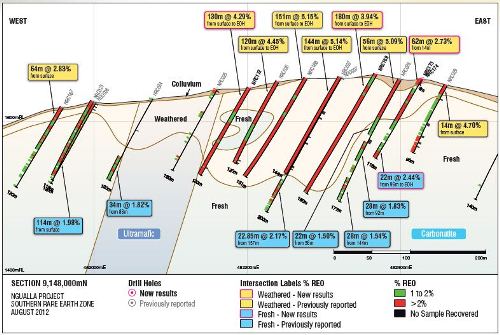
Cross section on the Southern Rare Earth Zone showing new and
previously reported rare earth mineralised intersections within
colluvial sediments and the weathered portion of the carbonatite.
Source: Company announcement
“Drill intersections confirm the continuity of significant areas of high grade, weathered rare earth mineralisation from surface that may be amendable to sulphuric acid leach processing,” Peak Resources said in its ASX announcement.
Assay results Peak has received from ten new drill holes conducted in the central bastnaesite core of the Southern Rare Earth Zone include several high-grade intersections mineralised from surface to the end of hole.
Highlights from the results are:
– 180 metres at 3.94 per cent REO from surface to end of hole;
– 130m at 4.29 per cent REO from surface to end of hole;
– 140m at 5.21 per cent REO from surface to end of hole;
– 20m at 4.01 per cent REO from 28m, including 14m at 5.16 per cent REO from 30m; and
– 36m at 2.82 per cent REO from surface and 34m at 3.84 per cent REO from 48m.
“These wide intersections confirm the continuity and consistency of the rare earth mineralisation in the heart of the deposit,” Peak said.
“Mineralisation still remains open at depth and to the south.”
Drilling operations are continuing at Ngualla with Peak now having completed a total of 52 holes for 5,900m within the Southern Rare Earth Zone by the end of July.
The company has received assay results for 15 of these new holes.
“The drilling program will provide information and samples to support the scoping and metallurgical studies currently in progress on the Southern Rare Earth Zone,” Peak said.
“This will take several more months to complete and the company will provide regular updates regarding the progress of the drilling and assay results as they are received.”