AusAmerican drills copper-zinc-silver-gold intersections at Blue Bell

THE DRILL SERGEANT: Australian-American Mining Corporation (ASX: AIW) has received the latest results from the on-going maiden drilling program being carried out at the company’s Blue Bell project in Arizona.

The company has been encouraged by the drilling, which it said has continued to return copper-zinc-gold-silver intersections.

“These further positive Phase 1 drill results extend the mineralised system further to the North,” AusAmerican managing director Richard Holmes said in the company’s announcement to the Australian Securities Exchange.

“The VMS system appears to be exhibiting metal zonation, which is a common characteristic and is possibly becoming zinc dominant towards the North.”

The latest holes have returned the following intercepts:

The company explained the drill holes BBRC13013 to BBRC13018 were designed to test the northern extent of the mineralised system and to drill around the old workings known as the Blue Bell shaft.

AusAmerican considers the latest drill holes to have demonstrated that moderate widths of mineralisation are present.

The results returned also include a number of zinc dominated intersections.
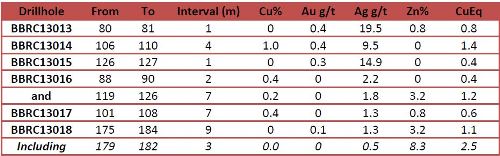
 

NB: Intervals are down hole widths. Copper equivalent grades are
presented for the zinc and/or precious metal dominated holes for
consistency of reporting. Source: Company announcement


The initial drilling program, which finished earlier this month, consisted of 26 holes for approximately 5,300 metres of RC drilling.

To date the company has received results from 23 holes; 21 of which are mineralised.

AusAmerican said it expects the remaining results to be returned before the end of May and that work will commence on the calculation of a maiden resource once all results have been received.

Kibaran Resources releases maiden JORC Resource for Epanko prospect

THE DRILL SERGEANT: Kibaran Resources (ASX: KNL) has announced a Maiden Inferred JORC Mineral Resource for the Epanko prospect, which the company considers to be a key graphite target within its Mahenge graphite project in Tanzania, Africa.

The Resource outperformed internal expectations by measuring in at 14.9 million tonnes at 10.5 per cent total graphitic carbon (TGC), for 1,560,000 tonnes of contained graphite.

Kibaran said the maiden Resource estimate provides it with a sound technical basis to advance the Epanko prospect towards Scoping Study stage.

The company is of the opinion the Mineral Resource estimate is the highest grade graphite resource yet to be delineated in Tanzania.

“Importantly, the Mineral Resource estimate represents only a very small footprint (20 per cent) of the known Epanko project area,” Kibaran Resources said in its ASX announcement.

“As mineralisation remains open in all directions, there is significant potential for further Resource growth.”


Epanko deposit showing the area of the Mineral Resource estimate footprint. Source: Company announcement


The company explained that recent trenching activity has supported this potential with trenching assays released in May demonstrating near-surface mineralisation extends north along strike, a further 500 metres than what was previously defined.

The results also support the conceptual Exploration Target the company released for the Epanko prospect the previous quarter.

Kibaran indicated the Mineral Resource estimate will be used to underpin a Scoping Study, which will assess the potential viability for the Epanko prospect.

“Subject to the terms of reference for the study, Epanko prospect could support an initial operation producing 20,000 tonnes per annum of high-grade flake graphite, but more importantly could support increased production as future demand for graphite rises,” Kibaran said.

Impact Minerals identifies nickel sulphide targets at Mulga Tank project

THE DRILL SERGEANT: Impact Minerals (ASX: IPT) has completed a review of the company’s Mulga Tank nickel project near Kalgoorlie in Western Australia.

Impact said the review has demonstrated the project’s potential for further massive nickel sulphide mineralisation and has identified two priority areas for immediate follow up.

The company said the review and synthesis of previous exploration data from Mulga Tank had confirmed its view the project is highly prospective for both nickel and gold deposits.

Impact considers the mineralisation at Mulga Tank to be similar to bulk tonnage nickel deposits found at Mount Keith near Leinster, WA and the Dumont deposit in Quebec, Canada, as well as high-grade nickel sulphide deposits similar to those at the nearby major WA mining centres of Kambalda and Forrestania.


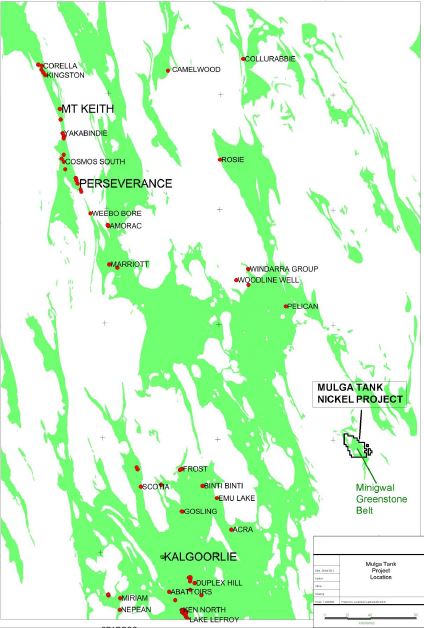
Location of the Mulga Tank project and significant nickel sulphide
deposits (red dots) including the world class Mount Keith and
Perseverance deposits. Source: Company announcement


“The results of the review have given us further confidence in Mulga Tank’s potential to host high-grade massive nickel sulphide deposits,” Impact Minerals managing director Dr Mike Jones said in the company’s announcement to the Australian Securities Exchange.

“The review also identified two very significant target areas for priority follow up, and ground geophysical surveys are scheduled to commence in June to identify drill targets.”

Upcoming work for Mulga Tank includes a detailed program of re-logging and sampling of the diamond core, and a moving loop ground EM survey over the dunite to identify conductive anomalies the company thinks may represent massive sulphide mineralisation near the interpreted feeder vents.

The results of this work will be used to prioritise drill targets for a drill program scheduled to commence later in the year.

Impact Minerals is earning 50 per cent of Mulga Tank, which is located 200 kilometres northeast of Kalgoorlie and covers 50km strike of the under-explored Minigwal Greenstone Belt.

The company is purchasing the rights to the current Mulga Tank joint venture from Endeavour Minerals in a joint transaction with Impact’s 75 per cent-owned company, Invictus Gold (ASX:IVG).

Silver Lake intercepts thick copper-gold at Hollandaire

THE DRILL SERGEANT: Silver Lake Resources (ASX: SLR) has received results from recently-conducted infill drilling activities at Hollandaire, situated within the Eelya Complex, part of the company’s Murchison gold project located 600 kilometres north of Perth.

Highlights from the drilling include:

–    12 metres at 8.7 per cent copper, including 5 metres at 3.1 grams per tonne gold from 88 metres;

–    12m at 8.1 per cent copper, including 5m at 2.1g/t gold from 73m;

–    10m at 8.8 per cent copper and 2.8g/t gold from 138m;

–    8m at 10.8 per cent copper, including 4m at 2g/t gold from 110m;

–    17m at 5.9 per cent copper from 95m;

–    12m at 4.4 per cent copper, including 4m at 3.2g/t gold from 136m; and

–    2m at 14.9 per cent copper and 3.1g/t gold from 114 metres.

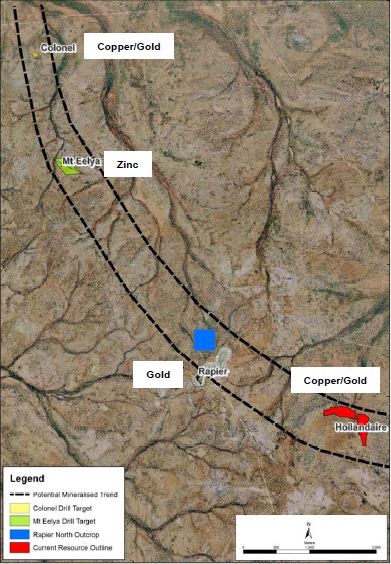
Since Silver Lake commenced drilling at the Eelya Complex in September 2011 it has intercepted mineralisation along a 10 kilometre mineralised corridor that includes Hollandaire, Rapier, Mount Eelya and Colonel.


Aerial view of potential mineralised trend north of the Hollandaire deposit. Source: Company announcement


The company explained that the copper resource at Hollandaire sits below gold mineralisation extending from the surface down to approximately 50 vertical metres depth.

Hollandaire has a current inferred resource totalling 2.8 million tonnes at 1.6 per cent copper, 0.4g/t gold and 5g/t silver with the supergene zone averaging 4.7 per cent copper.

“We are confident that the current resource at Hollandaire is the catalyst to add a copper, gold and silver concentrate revenue stream to our Murchison gold project,” Silver Lake resources managing director Les Davis said in the company’s announcement to the Australian Securities Exchange.

“The Eelya Complex, beginning with Hollandaire, has the potential to add significant value to our Murchison gold project.

“The result is expanded gold production with copper and other base metal credits which can be processed at a marginal capital and marginal operating cost at the nearby gold mill.

“As an example, on a by-product credit basis, every $10 million per annum of margin realised from the base metals over 100,000 ounces of gold produced equates to $100 per ounce lower all in sustaining cash cost at the current gold operations.”

Hollandaire is currently the subject of a pre-feasibility study, which Silver Lake said is progressing to plan.

The company anticipates the results from the study will be announced in late June 2013.

The nearby gold mill has been constructed with the possible addition of a concentrate circuit in mind.

The crusher already has excess capacity and provision has been made for the ready addition of a grinding and flotation circuit.

Mutiny Gold doubles Deflector strike length

THE DRILL SERGEANT: Recent exploration activities conducted by Mutiny Gold (ASX: MYG) have identified extensions to the mineralised host structure of the Deflector gold-copper deposit, more than doubling its previously known footprint.

The Deflector deposit is situated within the company’s Deflector project, located in the Murchison Region of Western Australia.

Mutiny said it had also identified favourable structural settings for, what it described to be,  Deflector ‘clones’ near the Gearless Well Intrusive – supported by historical drilling results.

The company is confident this new information increases the potential of the Deflector project beyond the current exploration target range of 1.65 to 3 million ounces.

The latest discoveries were confirmed by Southern Geoscience (SGC) using Sub-Audio Magnetics (SAM) technology.

SGC has mapped the weathering profile under cover, and developed a detailed structural framework based on existing high-resolution magnetics data.

The strike of the Deflector resource had previously been identified as being 950 metres in length.


SAM results indicating mineralisation extensions. Source: Company announcement


According to Mutiny, interpretation of new SAM data has confirmed the existing resource signature, and indicates the mineralised host-structures continue at least 450m north and 950m south to a combined strike length of over 2,350m.

“The success of the use of SAM technology at Deflector supports our belief in the prospectivity of the Deflector project and Corridor, which suggests it may become one of the most significant gold discoveries in Western Australia in recent years,” Mutiny Gold managing director John Greeve said in the company’s announcement to the Australian Securities Exchange.

“The company’s exploration strategy has successfully delivered targets, aligning with Mutiny’s ‘smart targeting’ approach and unlocking the exploration potential of the Gullewa tenements.

“Mutiny has always suggested that its previous success in proving up a highly valuable, high grade, low cost gold-copper project at Deflector was just the start of something big and this new work is validating that confidence.”

Potash Minerals releases maiden JORC Resource at Hatch Point

THE DRILL SERGEANT: Potash Minerals has completed its first JORC-compliant Mineral Resource estimate at the company’s 90 per cent-owned Hatch Point potash project in the United States.

The JORC Mineral Resource estimate has been defined on less than 20 per cent of the 405 square kilometre project area encompassing an area of the Hatch Point project located on State land and 22 recently-granted Federal Prospecting Permits.

The project currently boasts a JORC compliant Mineral Resource of 902.4 million tonnes at 20.3 per cent potassium chloride equivalent (12.8 per cent potassium oxide) average grade at a 15.9 per cent potassium chloride equivalent (10 per cent potassium oxide) composite cut-off grade.

The Mineral Resource includes a proportion of higher grade sylvinite comprising 303 million tonnes at 24.4 per cent potassium chloride (15.4 per cent potassium oxide) average grade, and within this 104 million tonnes at 30 per cent potassium chloride (18.9 per cent potassium oxide) average grade.


Hatch Point potash project – total Mineral Resource footprint. Source: Company announcement


Potash Minerals believes the potash JORC Resource is one of the largest and best quality to be discovered in the USA.

“Delivering the 902 Mt Maiden JORC Mineral Resource estimate is an exciting development for the company and all shareholders,” Potash Minerals chief executive officer Ben Binninger said in the company’s announcement to the Australian Securities Exchange.

“The fact that this has been defined on less than 20 per cent of the project area and only includes potash beds at least two metres thick and of greater than a 15.9 per cent potassium chloride-equivalent composite grade points to the significant potential of the Hatch Point potash project and quality of the resource.”

The Mineral Resource estimate was based on data from 45 drill holes, including four cored holes with potash assays, on the site or in the immediate project area.

Upon completion of a four hole federal drilling program, Potash Minerals said it expects the Resource to increase in size and status as additional land should be able to be included in the calculation.

Gascoyne hits gold during initial Dalgaranga drilling

THE DRILL SERGEANT: Gascoyne Resources (ASX: GCY) has encountered high-grade gold intersections during its first exploration drilling program at the Golden Wings prospect at the company’s newly-acquired 80 per cent-owned Dalgaranga gold project in the Murchison region of Western Australia.

Gascoyne has completed an initial 12 hole RC drill program at Dalgaranga and assay results have now been received for all the holes.

A total of 8 RC holes were drilled around the known Gilbeys resource area and 4 RC holes at the Golden Wings prospect.

This RC drilling is the first exploration in the area for around 12 years.

In its announcement to the ASX, Gascoyne said the drilling had identified a significant shallow and high-grade zone of gold mineralisation at the Golden Wings prospect, which is outside the known resource.


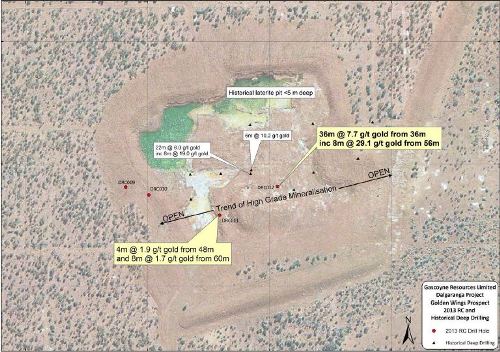
Golden Wings prospect – recent drilling results. Source: Company announcement


Four metre RC composite sample results include:

–    36 metres at 7.7 grams per tonne gold from 36 metres, including 8 metres at 29.1 grams per tonne gold from 56 metres.

Drilling at the Gilbeys pit has also intersected mineralisation, including:

–    13m at 2g/t gold;

–    6m at 1.8g/t gold and 33m at 0.9g/t gold;

–    16m at 1.2g/t gold, including 4m at 2.5g/t gold; and

–    32m at 0.8g/t gold.

The company said the drilling has confirmed mineralisation extends below the current Measured and Indicated JORC Resource of 7.5 million tonnes at 1.6g/t gold for 380,000 ounces of contained gold.

“There is significant potential to grow the resource with additional exploration,” Gascoyne Resources said in its ASX announcement.

“These new results will now be incorporated into the resource estimate update which is in progress.”

Gascoyne has further drilling planned, which will include approximately 2,500m of shallow RC / aircore drilling at the Gilbeys pit and approximately 2,000m of aircore drilling around the Golden Wings prospect to continue to scope out and extend the shallow high-grade mineralisation.

The drilling program is scheduled to commence in the last week of May, once drilling is completed at Glenburgh.

Mindax kicks off second phase drilling at Mt Forrest project

THE DRILL SERGEANT: Mindax Limited (ASX: MDX) has commenced the second phase of its 2013 field program at the company’s Mt Forrest iron project in Western Australia.
 
The planned drilling program of approximately 4,000 metres is to be conducted by Yilgarn based drilling contractor, Westdrill and is anticipated to be finished within four weeks, depending on prevailing weather conditions.

“Mt Forrest is our flagship project and has considerable potential,” Mindax Limited managing director and CEO Dr Steve Ward said in the company’s announcement to the Australian Securities Exchange.

“We are pleased to be able to begin our second phase of drilling for 2013.

“This is a key component of our work program as we drive the project forward.”

The upcoming work program will entail:
 
–    Definition drilling of the three detrital areas identified in phase one drilling earlier in 2013;

–    Testing for the existence of additional detrital iron mineralisation from the surface gravity surveying completed in March 2013; and

–    A small drill program targeting additional regolith iron mineralisation (approval from the Department of Mines and Petroleum is awaited for this element of the program).

Mindax indicated this work is part of the company’s program to optimise its previously completed direct shipping ore (DSO) regolith Scoping Study.

The company aims to increase the scale of both the mining output and project life by increasing the iron inventory.

Preliminary assessments indicate the distinct possibility of being able to include detrital material as part of the iron inventory.

Drake hits 52.4 cumulative metres of nickel-sulphide mineralisation at Granmuren

THE DRILL SERGEANT: Drake Resources (ASX: DRK) has received results for the first 40 per cent of a recently-drilled hole at the company’s nickel-copper discovery at Granmuren in Sweden.

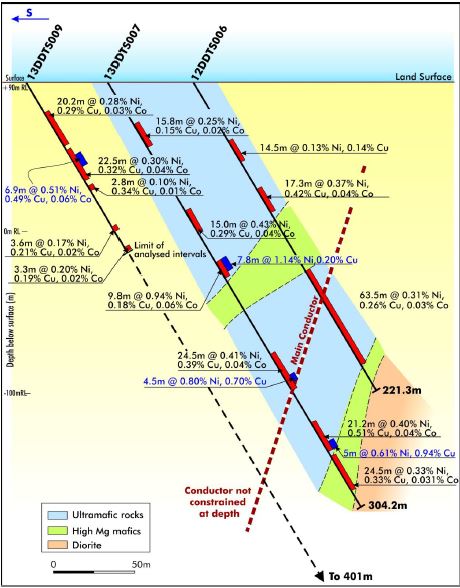
Drake said the results have confirmed shallow, moderate grade mineralisation from 26 metres below surface, predominately in two thick widths of 20.2m and 22.5m down hole.

The company said further analyses for the deeper disseminated and semi-massive sulphide mineralisation encountered in the latest hole are expected in late May.

Drake considers the results demonstrate continuation of shallow mineralisation encountered by previous drilling and have confirmed a strike length of near surface mineralisation of over 150m.


Granmuren cross section. Deeper results for hole 009 expected in late May 2013. Source: Company announcement


“This result is very encouraging on a number of fronts, the shallow mineralised zone in hole TS009 is the widest we’ve seen thus far and adds potentially significant volumes to near-surface mineralisation; grades appear fairly consistent across nickel, copper and cobalt compared to the other holes and our visual log of hole TS009 compares well with the resulting assays,” Drake Resources chief executive officer Jason Stirbinskis said in the company’s announcement to the Australian Securities Exchange.

“The deep mineralisation in hole TS009 visually resembles the better intercepts encountered in hole TS007.

“We expect results for the rest of the hole to arrive later in May.”

Drake also conducted an Electromagnetic down hole survey, which it said confirmed the continuation of the strong conductor, previously detected in other EM surveys, and representative of massive to disseminated mineralisation.

This deep conductor appears to extend from about 50m below surface to the North of hole 006 to at least 300m below surface towards the south.

The previous surface EM survey suggested that it is about 100m in east-west strike length.

Cross-hole or ‘mise-a-la-masse’ surveys between holes 006 and 009 show that the mineralisation is continuous between these holes, with disseminated and vein sulphides.

“The suggestion of a broad mass of conductive sulphides is very exciting,” Stirbinskis added.

“However it also means it was not possible to correlate more massive, higher grade intersections of mineralisation between the holes surveyed.”
 
Drake now has wireframe modelling of the mineralisation is currently underway at Granmuren, which the company expects will be integrated with the geophysical models to develop further drill targets to explore the potential for mineralisation.

“Our investigations to date have identified broad bands of shallow moderate mineralisation and deeper zones of richer, semi-massive and occasionally massive sulphides that are still at potential open pit depths,” Stirbinskis said.

“We have geophysical evidence to suggest these broad bands become shallower to the north of our current drilling, and also continue to the south at depth.

“We also have geophysical evidence to suggest they extend to both the east and west of the 006, 007, 009 drill line.”

Venturex Resources drills high-grades at Kangaroo Caves

THE DRILL SERGEANT: Venturex Resources (ASX: VXR) informed the market regarding progress from an RC drilling program being conducted at the company’s Kangaroo Caves zinc-copper prospect in the Pilbara region of Western Australia.

The Kangaroo Caves prospect is located approximately seven kilometres southeast of Venturex’s Sulphur Springs copper-zinc deposit.
 
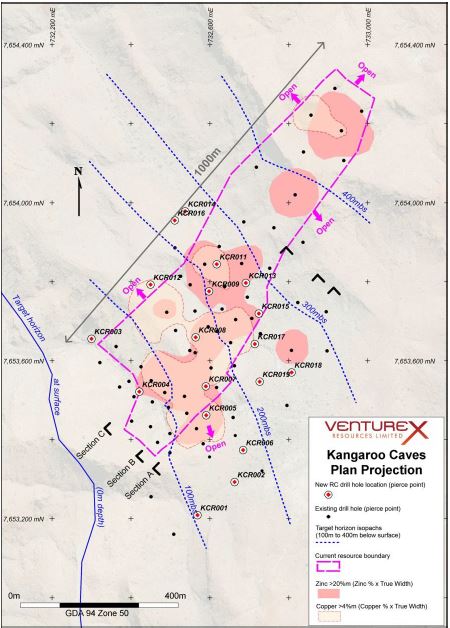
The RC drilling program at Kangaroo Caves has intersected zinc-copper mineralisation with results from first eight holes of the 19-hole program including:

15 metres at 0.3 per cent copper, 6.99 per cent zinc, 0.21 per cent lead, 31.5 grams per tonne silver, 0.12 grams per tonne gold;

6m at 0.62 per cent copper, 9.3 per cent zinc, 0.19 per cent lead, 7.3g/t silver, 0.06g/t gold and 4m at 2.61 per cent copper, 0.79 per cent zinc, 0.19 per cent lead, 2.8g/t silver, 0.02g/t gold; and

6m at 0.09 per cent copper, 4.89 per cent zinc, 0.09 per cent lead, 5.1g/t silver, 0.02g/t Au and 5m at 3.97 per cent copper, 0.15 per cent zinc, 0.01 per cent lead, 3.3g/t silver, 0.01g/t gold.


Kangaroo Caves drill hole location and existing Mineral Resource outline. Source: Company announcement


“These high grade intersections have enhanced our understanding of the complex deposit geometry and significantly extended the zone of higher copper grades in the Kangaroo Caves area,” Venturex Resources managing director Michael Mulroney said in the company’s announcement to the Australian Securities Exchange.

“We are working on revising our geological model ahead of planning a further drilling program to test the deeper levels of the mineralised system prior to incorporating Kangaroo Caves into the planning for the Sulphur Springs development.”

Venturex  said it anticipates receiving assays for the remaining holes in the program over the next two to three weeks.

The company has commenced work on revising the interpretation of the Kangaroo Caves resource model in preparation for the next drilling program.