


Drake hits 52.4 cumulative metres of nickel-sulphide mineralisation at Granmuren
THE DRILL SERGEANT: Drake Resources (ASX: DRK) has received results for the first 40 per cent of a recently-drilled hole at the company’s nickel-copper discovery at Granmuren in Sweden.
Drake said the results have confirmed shallow, moderate grade mineralisation from 26 metres below surface, predominately in two thick widths of 20.2m and 22.5m down hole.
The company said further analyses for the deeper disseminated and semi-massive sulphide mineralisation encountered in the latest hole are expected in late May.
Drake considers the results demonstrate continuation of shallow mineralisation encountered by previous drilling and have confirmed a strike length of near surface mineralisation of over 150m.
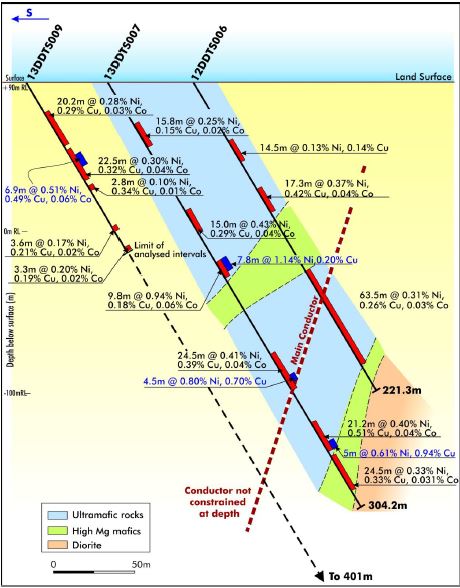
Granmuren cross section. Deeper results for hole 009 expected in late May 2013. Source: Company announcement
“This result is very encouraging on a number of fronts, the shallow mineralised zone in hole TS009 is the widest we’ve seen thus far and adds potentially significant volumes to near-surface mineralisation; grades appear fairly consistent across nickel, copper and cobalt compared to the other holes and our visual log of hole TS009 compares well with the resulting assays,” Drake Resources chief executive officer Jason Stirbinskis said in the company’s announcement to the Australian Securities Exchange.
“The deep mineralisation in hole TS009 visually resembles the better intercepts encountered in hole TS007.
“We expect results for the rest of the hole to arrive later in May.”
Drake also conducted an Electromagnetic down hole survey, which it said confirmed the continuation of the strong conductor, previously detected in other EM surveys, and representative of massive to disseminated mineralisation.
This deep conductor appears to extend from about 50m below surface to the North of hole 006 to at least 300m below surface towards the south.
The previous surface EM survey suggested that it is about 100m in east-west strike length.
Cross-hole or ‘mise-a-la-masse’ surveys between holes 006 and 009 show that the mineralisation is continuous between these holes, with disseminated and vein sulphides.
“The suggestion of a broad mass of conductive sulphides is very exciting,” Stirbinskis added.
“However it also means it was not possible to correlate more massive, higher grade intersections of mineralisation between the holes surveyed.”
Drake now has wireframe modelling of the mineralisation is currently underway at Granmuren, which the company expects will be integrated with the geophysical models to develop further drill targets to explore the potential for mineralisation.
“Our investigations to date have identified broad bands of shallow moderate mineralisation and deeper zones of richer, semi-massive and occasionally massive sulphides that are still at potential open pit depths,” Stirbinskis said.
“We have geophysical evidence to suggest these broad bands become shallower to the north of our current drilling, and also continue to the south at depth.
“We also have geophysical evidence to suggest they extend to both the east and west of the 006, 007, 009 drill line.”