White Rock Minerals encounters high-grade gold intersections at Red Rock

THE DRILL SERGEANT: White Rock Minerals (ASX: WRM) has got excited by further encouraging assay results it has received from recently-conducted drilling at the Red Rock prospect, located 15 kilometres from the company’s 750,000 ounce gold equivalent Resource base at Mt Carrington.

White Rock completed the seven-hole program in April, which was designed to infill drilling gaps within the known mineralised zone with the intention of firming up the company’s geological model, as well as test for northern extensions to mineralisation.

The company said the program had returned promising assay results, and provided it with the information it required to enable a maiden Resource estimation to be undertaken.

Results include:

–    16 metres at 2.1 grams per tonne gold from 49 metres, including 4 metres at 6.9 grams per tonne gold from 59 metres with 1 metre at 18.1 grams per tonne gold from 59 metres;

–     15m at 2g/t gold from 89m, including 1m at 22.0g/t gold from 91m;

–     1m at 43.7g/t gold from 46m; and

–    6m at 2.9g/t gold from 30m, including 1m at 11.7g/t gold from 34m.

“The latest results from Red Rock are particularly encouraging, and continue to support the definition of a robust and shallow gold zone,” White Rock Minerals managing director Geoffrey Lowe said in the company’s announcement to the Australian Securities Exchange.

“To date, 17 of the 23 holes completed have returned promising gold results.

“The presence of high-grade gold in discrete zones in the current holes augurs well for the upcoming Resource estimation.

“Further work to investigate the extent of these high grade structures is planned for the second half of the year.”
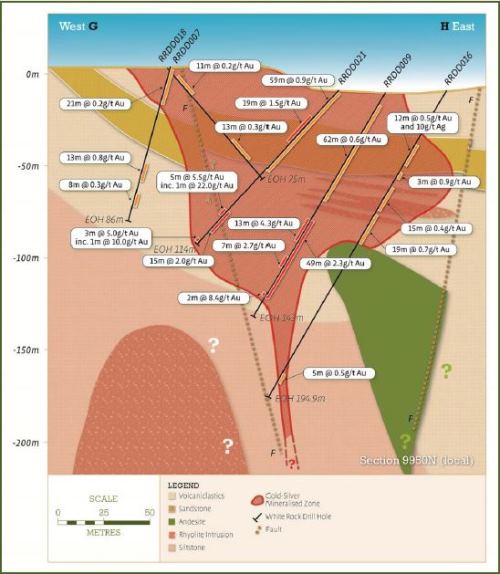
 

Cross section displaying drilling results. Source: Company announcement


Drilling at Mt Carrington is now focussed on the central and White Rock leases.

Drillholes have been completed to obtain metallurgical samples from the Strauss and Kylo gold deposits, which have Indicated and Inferred Resources of 208,000 ounces gold and 433,000 ounces.

The company is currently drilling with the intention to upgrade the White Rock silver Resource of 8.2 million ounces of silver from Inferred to Indicated status in preparation for pre-feasibility studies.
Monteray Mining hits gold mineralisation at Pepin North.

THE DRILL SERGEANT: Monteray Mining (ASX: MRY) has completed a maiden RC/AC drilling program at the company’s Pepin North prospect in Burkina Faso.

The company has so far received results that represent 59 per cent of the 9 holes for 1,116 metres of RC drilling and 57 holes for 2,981m of AC drilling.

Monteray indicated it was currently arranging for the re-assaying of 4m composites, with results expected to be received along with the remaining holes in the coming weeks.

“These are extremely encouraging first pass drill results,” Monteray Mining director John Hannaford said in the company’s announcement the Australian Securities Exchange.

“The grade, width and depth of mineralisation exceeded our expectations and it has provided exceptional follow up targets over focused areas.

“Considerable upside from further exploration is expected.”

Monteray said intersections it had received to date have confirmed widespread shallow mineralisation over two anomalies, the Granite prospect and Kosongo prospect with results from the Tanghin prospect due within a couple of weeks.

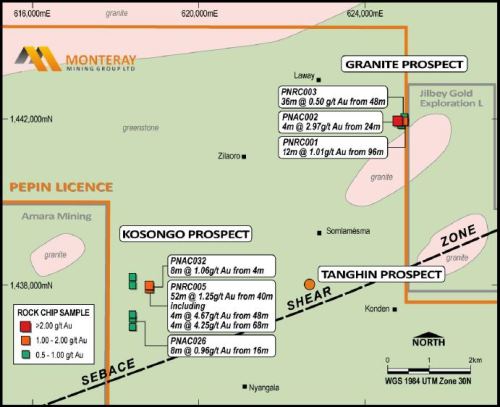
Hole PNRC005 at Kosongo prospect returned 96m of continuous mineralisation including:

–    4 metres at 4.67 grams per tonne gold from 48 metres;

–    4m at 4.25g/t gold from 68m; and

–    52m at 1.25g/t gold from40m.

Hole PNAC002 at The Granites prospect returned:

–    4m at 2.97g/t gold from 24m.


Pepin North drill assays with rock ship sample results. Source: Company announcement


Drilling at the Kosongo prospect located in the southwest sector of the Pepin North Auger grid consisted of 3 RC holes for 438m and 25 AC holes for 1,647m.

These holes are the first to be drilled in the prospect area with all assays returned apart from the final three holes numbered PNAC035-037.

Drilling at the Granite prospect located in the northeast sector of the Pepin North Auger grid consisted of 4 RC holes for 430m and 12 AC holes for 250m.

As at the Kosongo prospect, these holes are also the first holes drilled in the prospect area with all assay returned apart from hole PNRC009.

Drilling at the Tanghin prospect located in the centre of the Pepin North Auger grid consisted of 2 RC holes for 298m (PNRC007-008) and 20 AC holes for 1,084m, and were again the first holes drilled in the prospect area.

No assay results have been returned from the Laboratory for this drilling yet.

Tungsten Mining releases maiden Kilba project Resource

THE DRILL SERGEANT: Tungsten Mining (ASX: TGN) has announced a maiden JORC Mineral Resource estimate at the company’s 100 per cent-owned Mining Lease 08/314 within its Kilba project, located in the Gascoyne Region Western Australia.

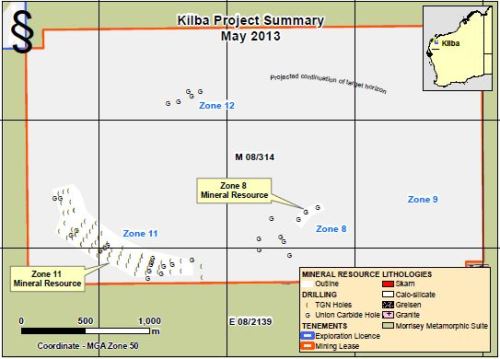
The new resource has been calculated at 1.3 million tonnes at 0.57 per cent tungsten trioxide (WO3), which the company said is located within a much larger resource of 5.0 million tonnes at 0.27 per cent WO3 from Zone 8 and Zone 11 of the Kilba project.


Location of Zone 8 and Zone 11 at the Kilba project. Source: Company announcement


Tungsten Mining kicked off drilling in November 2012, since when it has drilled 24 diamond holes and 42 reverse circulation (“RC”) holes over 1200 metres of mineralised strike at Zone 11.

“The release of a maiden JORC Mineral Resource represents a major step towards the company achieving its objective of the rapid evaluation and development of the Kilba project,” Tungsten Mining managing director Paul Berndt said in the company’s announcement to the Australian Securities Exchange.

“This milestone result provides us with confidence as we move to the feasibility study phase of the Kilba project.

“The higher-grade section of 1.3 million tonnes at 0.57 per cent tungsten trioxide identified in this initial estimate is a figure that meets our expectations, and importantly it is contained within a much larger resource of five million tonnes at 0.27 per cent tungsten trioxide, which provides us with significant upside potential.

“These results keep Tungsten Mining on target to fast-track Kilba into development in 2014.”

Tungsten Mining’s recent activities have focused on Zone 11 where previous drilling by Union Carbide Corporation intersected high-grade tungsten mineralisation in the 1970s/1980s.

The company explained that Union Carbide’s work also defined mineralisation at Zone 8 and results from this historic drilling had been used in the Mineral Resource estimate.

Union Carbide drilled diamond holes targeting high-grade tungsten mineralisation associated with skarns at Zone 8.

A number of these holes have been used to estimate an Inferred Resource of 230,000 tonnes at 0.56 per cent WO3.

Tungsten Mining has completed surface mapping, which it said has identified numerous skarn units at Zone 8 that have not been adequately drill tested.

Future exploration will focus on evaluating these targets.

Tungsten Mining releases Kilba project Resource

THE DRILL SERGEANT: Tungsten Mining (ASX: TGN) has announced a maiden JORC Mineral Resource estimate at the company’s 100 per cent-owned Mining Lease 08/314 within its Kilba project, located in the Gascoyne Region Western Australia.

The new resource has been calculated at 1.3 million tonnes at 0.57 per cent tungsten trioxide (WO3), which the company said is located within a much larger resource of 5.0 million tonnes at 0.27 per cent WO3 from Zone 8 and Zone 11 of the Kilba project.


Location of Zone 8 and Zone 11 at the Kilba project. Source: Company announcement


Tungsten Mining kicked off drilling in November 2012, since when it has drilled 24 diamond holes and 42 reverse circulation (“RC”) holes over 1200 metres of mineralised strike at Zone 11.

“The release of a maiden JORC Mineral Resource represents a major step towards the company achieving its objective of the rapid evaluation and development of the Kilba project,” Tungsten Mining managing director Paul Berndt said in the company’s announcement to the Australian Securities Exchange.

“This milestone result provides us with confidence as we move to the feasibility study phase of the Kilba project.

“The higher-grade section of 1.3 million tonnes at 0.57 per cent tungsten trioxide identified in this initial estimate is a figure that meets our expectations, and importantly it is contained within a much larger resource of five million tonnes at 0.27 per cent tungsten trioxide, which provides us with significant upside potential.

“These results keep Tungsten Mining on target to fast-track Kilba into development in 2014.”

Tungsten Mining’s recent activities have focused on Zone 11 where previous drilling by Union Carbide Corporation intersected high-grade tungsten mineralisation in the 1970s/1980s.

The company explained that Union Carbide’s work also defined mineralisation at Zone 8 and results from this historic drilling had been used in the Mineral Resource estimate.

Union Carbide drilled diamond holes targeting high-grade tungsten mineralisation associated with skarns at Zone 8.

A number of these holes have been used to estimate an Inferred Resource of 230,000 tonnes at 0.56 per cent WO3.

Tungsten Mining has completed surface mapping, which it said has identified numerous skarn units at Zone 8 that have not been adequately drill tested.

Future exploration will focus on evaluating these targets.

Horseshoe Metals hits 10 per cent copper at Horseshoe Lights

THE DRILL SERGEANT: Horseshoe Metals (ASX: HOR) has received results of recently-completed diamond drilling conducted at the company’s 100 per cent-owned Horseshoe Lights copper-gold project, located in the Peak Hill Mineral Field of Western Australia.

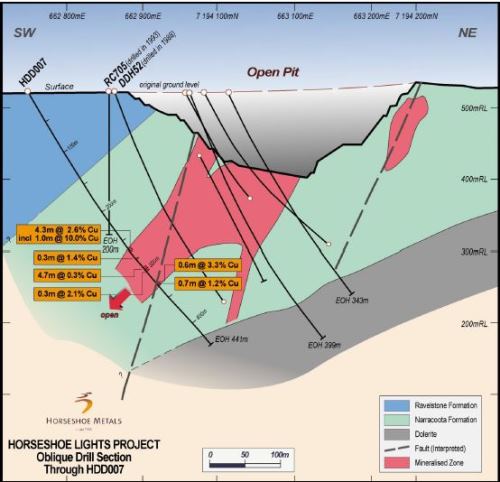
The drilling results have shown multiple intervals of copper mineralisation recorded in two diamond drill holes (HDD007 and HDD009).

Horseshoe Metals said drill holes HDD007 and HDD009 were successful in their intentions of testing for extensions of copper-gold mineralisation down dip of the Main Zone beneath the existing Horseshoe Lights open pit. The locations of the drill hole collars are shown in Figure 2.

Laboratory assays for 104 samples from the two diamond drill holes been received.

Best result recorded in HDD007 returned:

–    4.3 metres (from 264.7m to 269m) at 2.6 per cent copper, including 1 metre at 10 per cent copper and 0.1 grams per tonne gold.

Best result recorded in HDD009:

–    4.1m (308.9m to 313m) at 1.5 per cent copper, including 0.3m at 3.6 per cent copper and 0.2g/t gold.

“Numerous other intervals of chalcopyrite mineralisation intersected between 264 metres to 331 metres down hole depth in HDD007 confirm that a broad mineralised zone exists down dip of previous drilling and remains open at depth,” Horseshoe Metals said in its ASX announcement.


Drill Section HDD007. Source: Company announcement


The company explained the intersection in HDD009 was encountered about 80m south of the high grade intersection in HDD007, which it considers to confirm the continuity of the mineralised zone intersected in HDD007.

A second zone of copper mineralisation was identified from 457 metres depth down to the contact with the underlying Dolerite.

“Copper mineralisation identified in both HDD007 and HDD009 is consistent with the company’s geological modelling and confirms the potential for further down dip extensions to the west of the existing open pit as well as the southerly down plunge extension, which is yet to be tested,” Horseshoe Metals said.
 
The company is now incorporating these latest drilling results into its Mineral Resource estimation currently being finalised.

Horseshoe Metals is now planning to undertake an extensive deep Down Hole Electromagnetic (DHEM) survey utilising up to seven drill holes (including HDD007-HDD009) ahead of its next phase of drilling at Horseshoe Lights.

The DHEM survey will be searching for off-hole conductors which may represent massive sulphide copper/gold mineralisation.

Castle Minerals claims new gold discovery at Kpali

THE DRILL SERGEANT: Castle Minerals (ASX: CDT) capped off a good week by announcing RC drilling at the company’s Kpali prospect in north‐west Ghana has intersected gold mineralisation.

Three RC holes were completed to test oxide gold intercepts reported from previous RAB drilling.

All three RC holes intersected primary sediment hosted gold mineralisation.

Gold intercepts (5m composite samples) from the drilling at Kpali include:

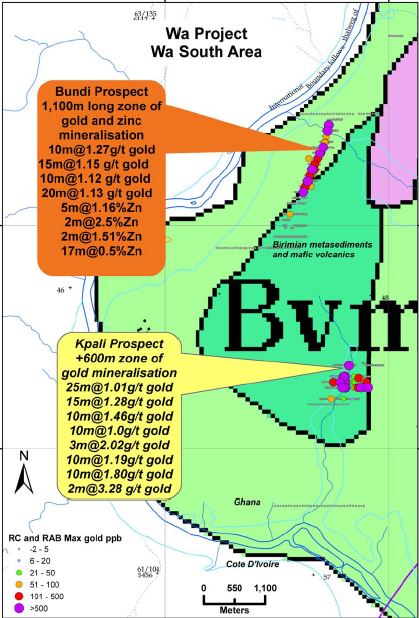
–    30 metres at 0.57 grams per tonne gold from 40 metres, including 5 metres at 1.42 grams per tonne gold from 40 metres;

–    15m at 1.28g/t gold from 60m; and

–    25m at 1.01g/t gold from 50m, including 10m at 1.52g/t gold from 60m.

Castle said the recent RC drilling had only tested the southern 200m of a 600m long RAB anomaly as new RAB drilling results were only received after the RC rig left site.

“Kpali is an exciting new gold discovery for the company with excellent potential to host a significant gold resource,” Castle Minerals managing director Mike Ivey said in the company’s announcement to the Australian Securities Exchange.

“We plan to recommence drilling in the area as soon as possible.”

Kpali is situated four kilometres south of Castle’s Bundi prospect and is considered by the company to be hosted within similar host rocks but does not display the high zinc and base metals association seen at Bundi.


Regional geology for the Wa South area showing location of Bundi and Kpali prospects. Source: Company announcement


Alteration at Kpali has been observed by Castle as predominantly pyrite‐silica‐sericite.

Kpali is a grassroots gold discovery in a previously unexplored area.

The company indicated its next steps at the prospect include individual metre analysis of gold samples, RAB and RC drilling and airborne geophysical surveys.

Golden Rim claims new zone of gold mineralisation at Balogo project

THE DRILL SERGEANT: Golden Rim Resources (ASX: GMR) has claimed discovery of a new zone of high-grade gold mineralisation in bedrock and a significant gold anomaly in auger drilling along strike from the Netiana Lodes at the company’s Balogo project in Burkina Faso.

“We are currently exploring for satellite, open pittable, gold resources to add to our existing gold resource on the Netiana Lodes with the objective of increasing the mine life and enhancing the economics of our planned mine development at Balogo,” Golden Rim Resources managing director Craig Mackay explained in the company’s announcement to the Australian Securities Exchange.

“This new near surface mineralisation is the first zone of ‘Netiana-style’ high grade gold mineralisation that has been located away from the Netiana Lodes and the new auger gold anomaly is very similar to the auger gold anomaly directly above the Netiana Lodes.

“Both areas are directly along strike from the Netiana Lodes and present exciting new exploration targets for satellite gold mineralisation.”


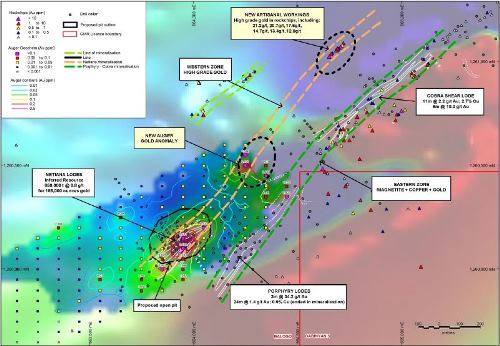
Location of the new zone of high-grade gold mineralisation and the
new auger gold anomaly at Balogo. Source: Company announcement


The new zone of mineralisation is situated one kilometre northeast along strike from the Netiana Lodes, where Golden Rim has outlined an Inferred Resource of 850,000 tonnes at 6.8 grams per tonne gold for 185,000 ounces.

The mineralisation is open in all directions and lies beneath two metres of transported soil cover.

Golden Rim said it had been identified in the last few weeks by local artisanal miners.

The company collected 14 rock chip samples of mineralisation exposed in the artisanal workings, which it submitted to BIGS Laboratory in Ouagadougou, Burkina Faso, for gold analysis.

All rock chip samples returned anomalous gold results with six returning assays greater than 10g/t gold.

These results included: 21.2g/t gold, 20.7g/t gold, 17.6g/t gold, 14.7g/t gold, 13.5g/t gold, and 12.8 g/t gold.

The new zone of gold mineralisation consists of multiple and strongly limonitic quartz – sulphide veins hosted in diorite, which are very similar in appearance to the high grade gold mineralisation in the oxide portion of the Netiana Lodes.

No auger drilling has been conducted in the area covering the new zone of mineralisation.

Golden Rim said it will commence an auger drilling program on a 100m by 25m grid over this area within the next few days.

Auger drilling around the new auger soil anomaly will be extended to the northeast.
 
A follow-up RC drilling program is then anticipated to be conducted.

Archer scores high-grade graphite at Campoona

THE DRILL SERGEANT: Recent RC drilling completed by Archer Exploration (ASX: AXE) at Campoona Central has confirmed the presence of graphite similar to the highly graphitic schist at Campoona Shaft and at widths amenable to mining.

The Campoona project is one of the company’s Eyre Peninsula graphite projects and has a current JORC Resource of 5.27 million tonnes at 7.6 per cent total graphitic carbon (TGC).

The other Eyre Peninsula graphite project is at Carappee Hill, which has an Exploration Target of 37 to 70 million tonnes at 10 to 12 per cent carbon.

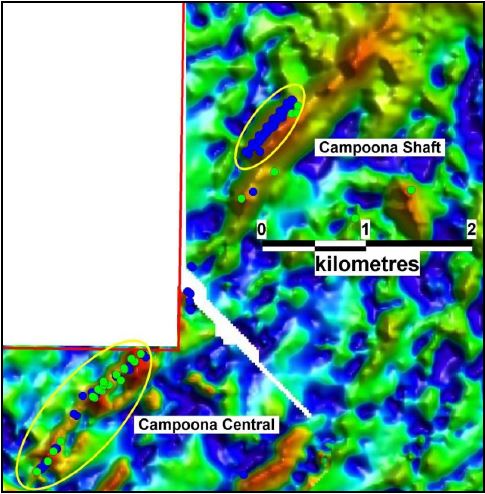
Campoona Central is located about 2.8 kilometres immediately to the southwest of the Campoona Shaft Resource.


Location of Campoona Central with respect to Campoona Shaft area. Source: Company announcement


The recent drilling at Campoona Central intersected graphite intervals including:

–    34 metres at 10.7 per cent TGC from 19 metres;

–    25m at 12.6 per cent TGC from 24m;

–    25m at 12.8 per cent TGC from 12m;

–    24m at 16.4 per cent TGC from 18m;

–    17m at 17.4 per cent TGC from 48m; and

–    16m at 15.2 per cent TGC from 27m.
 
Archer completed a total of 42 holes totalling 1.937m, with the average vertical depth below surface being approximately 45m.

Four of the holes drilled recorded graphite intervals of less than 5 per cent TGC, however Archer indicated these will be followed up to determine the potential for Campoona-style graphite mineralisation.

“Most of the significant intercepts are from the northern part of the area,” Archer Exploration said in its ASX announcement.

“Towards the south the graphite pinches and swells over shorter strike distances and is dislocated by a series of short scale fault offsets.”

Another 59 holes for 3,656m were completed to test regional EM signatures.

According to Archer this drilling identified three new graphitic schist horizons similar to the Campoona Shaft and Campoona Central deposits as well as intersecting high grade graphitic gneiss at Campoona Shaft.

Red Mountain Mining extends Uplong discovery

THE DRILL SERGEANT: Red Mountain Mining (ASX: RMX) has received high-grade gold surface sample results from the Ulupong gold discovery, located at the Lobo prospect within the company’s Batangas gold project, south of Manila in the Philippines.

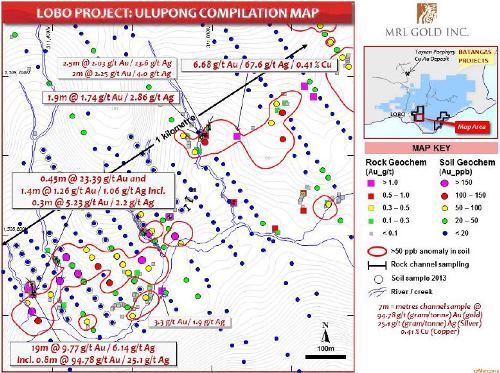
The results include 6.63 grams per tonne gold and 67.4 grams per tonne silver from sub-cropping quartz-sulphide boulders in the Bigaan-Ulupong area.


Plan of Ulupong soil anomalies and channel sampling results highlights. Source: Company announcement


The Bigaan-Ulupong area is located approximately 800 metres along strike to the northeast of trenching, which produced a result of 1.4m at 1.26g/t gold, including 0.3m at 5.3g/t gold across northern extensions of the ULOC 4 vein.

Previous sampling conducted by Red Mountain across the vein at ULOC 4 intersected 0.45m at 23.39g/t gold and sampling along the vein produced results of 19m at 9.77g/t gold including 7m at 23.58g/t gold.

“The Ulupong discovery is starting to look very significant,” Red Mountain Mining managing director Jon Dugdale said in the company’s announcement to the Australian Securities Exchange.

“High-grade gold, in outcropping veins, is supported by strong soil anomalies over a one kilometre strike length.

“We are excited at the prospect of drilling this new discovery, along with the other high grade, near surface targets at Pica and Japanese Tunnels.”

Red Mountain said t latest channel sampling results, combined with new soil sampling geochemistry, have enabled it to define a greater than one kilometre long corridor of mineralisation at the south-western end of the greater than two kilometres long Ulupong structure.

The company indicated it now has drilling planned to test the high-grade veins and soil anomalies at Ulupong as part of its next phase of drilling.

This is expected to be funded by a Rights Issue the company announced last week.

Castle Minerals confirms gold and zinc at Bundi prospect

THE DRILL SERGEANT: Recently-conducted RC drilling by Castle Minerals (ASX: CDT) at the company’s Bundi prospect in north‐west Ghana has intersected a coherent zone of gold mineralisation over at least 1100 metres strike.

Gold intercepts (5m RC composite samples) from the RC drilling at Bundi include:

–     10 metres at 1.27 grams per tonne gold from 25 metres;

–    15m at 1.15g/t gold from 30m, including 10m at 1.61g/t gold from 35m;

–    10m at 1.12g/t gold from 40m; and

–    20m at 1.13g/t gold from 50m, including 10m at 1.92g/t gold from 60m.

Castle said the gold mineralisation occurs within a zone of sulphide alteration that has a strong correlation with elevated zinc levels with up to four per cent zinc reported from portable XRF analysis.

The company said it had also observed coarse sphalerite (zinc sulphide) in drill chips.

“We have now confirmed Bundi as a new gold discovery for the company with the associated zinc mineralisation an unexpected bonus,” Castle Minerals managing director Mike Ivey said in the company’s announcement to the Australian Securities Exchange.

“Zinc mineralisation is rare in West Africa however Blackthorn Resources are developing their high-grade Perkoa zinc deposit in Burkina Faso that has a Probable Ore Reserve of 6.3 million tonnes at 13.9 per cent zinc.

“Bundi will now be explored for base metal mineralisation as part of our ongoing gold exploration program.”


Castle’s Wa Project in north‐west Ghana. Source: Company announcement


Castle describes Bundi to be a grassroots gold discovery in a previously unexplored area.

The company indicated upcoming work programs for Bundi include individual metre analysis of gold samples, laboratory analysis of zinc zones reported from the portable XRF analysis, RAB and RC drilling and airborne geophysical surveys.