Red Mountain gears up for Batangas drill program

THE DRILL SERGEANT: Red Mountain Mining (ASX: RMX) has planned its next stage of diamond drilling to test the Pica and Japanese Tunnel high-grade gold discoveries at the Lobo prospect, situated within the company’s Batangas project in the Philippines.

“We are looking forward to completing the current Rights Issue then commencing drilling to test these exciting, near surface, high-grade gold targets,” Red Mountain Mining managing director Jon Dugdale said in the company’s announcement to the Australian Securities Exchange.

Red Mountain is planning two drillholes to test multiple east-dipping high-grade veins at Pica.


Cross section through Pica veining with drilling results and new drilling planned. Source: Company announcement


Further drilling will then be planned along strike with the objective of defining a new gold resource at Pica.

Previous drilling results from Pica included strong gold and silver grades associated with multiple stacked veins including:

–    5 metres at 4.28 grams per tonne gold, 15.75 grams per tonne silver from 22.4 metres, including 1.3m at 9.49g/t gold, 21.5g/t silver; and

–    1.7m at 4.4g/t gold, 34.8g/t silver, 2.5 per cent lead from 58.1m.

Drilling has also been planned to test the Japanese Tunnel prospect, located 150m southwest of the Southwest Breccia Indicated and Inferred resource of 194,000 tonnes at 7.2g/t gold.

Three holes are planned to test the Japanese Tunnel prospect to follow up previous surface trenching results of:

–    5m at 10.43g/t gold, including 1m at 25.14g/t gold and 2m at 18.12g/t gold, including 1m at 28.69g/t gold.

Further drilling will then be planned along strike with the objective of defining a new mineral resource at Japanese Tunnel.
Equus Mining confirms copper mineralisation at Yerba

THE DRILL SERGEANT: Equus Mining (ASX: EQE) has received assay results it claims have confirmed the east-dip of copper mineralisation that was intersected in the first three drill holes completed at the company’s Yerba project in Chile, South America.

In its announcement to the ASX, Equus explained the holes are part of an initial 5,000m diamond drilling program at Yerba, which the company commenced in April to target the northern end of the 1,200 metre-long Yerba Trend.


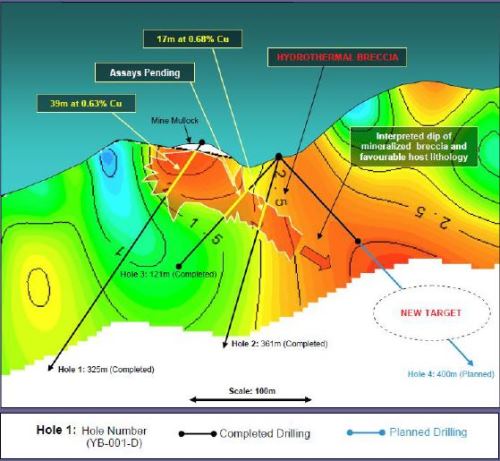
Yerba project drill section. Source: Company announcement


The latest hole to be completed (Hole 2) intersected 17m (true width) at 0.68 per cent copper from 23m down-hole, including 6m at 1.21per cent copper from 34m.

“The copper mineralisation is contained within a stratabound sheet comprising a mixture of both hydrothermally brecciated and massive vesicular andesite,” Equus said.

The company is in the process of drilling Hole 4 (currently at 115m), which is being drilled as the first direct test of an IP chargeability anomaly that lies to the east and down-dip of the outcropping copper mineralisation.

The target zone is interpreted to be intersected at approximately 150m down-hole.

Equus outlined its upcoming work program at Yerba will:

Complete drilling Hole 4 on the current section (6260775N) and test the down-dip extensions of the copper mineralisation; and

Commence drilling on the next drill section located approximately 70m north of 6260775N where the company has identified further outcropping copper mineralisation.

Horseshoe Metals increases Horseshoe Lights Resource by 40 per cent

THE DRILL SERGEANT: Horseshoe Metals (ASX: HOR) has announced a major increase in the Mineral Resource estimate at the company’s Horseshoe Lights copper-gold project, located 75 kilometres from Sandfire Resources’ (ASX: SFR) DeGrussa copper-gold mine in Western Australia.

The project’s new total Measured, Indicated and Inferred Mineral Resource Estimation is:

–    12.85 million tonnes at 1 per cent copper and 0.1 grams per tonne gold for 128,600 tonnes of copper and 36,000 ounces of gold (using a cut-off grade of 0.5 per cent copper).

This represents a 40 per cent increase in the copper metal content over the 2011 Mineral Resource Estimation.

More than 30 per cent of the new Resource estimate is in the Measured and Indicated categories.

Horseshoe commissioned the calculation of the Mineral Resource estimation following the completion of drilling at Horseshoe Lights in May 2013.

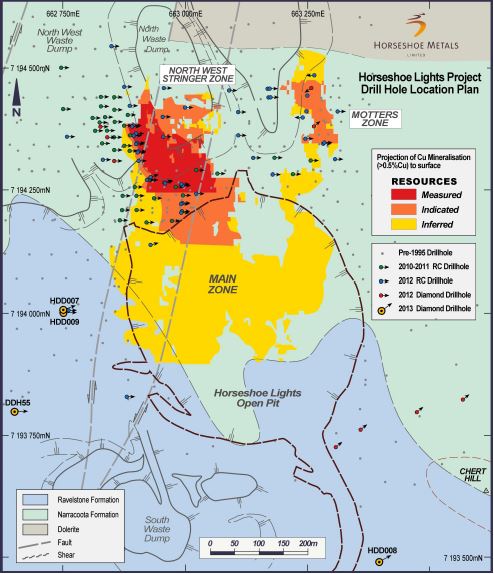
For all areas subjected to recent drilling the Mineral Resource has been classified into three categories (Measured, Indicated or Inferred) based on the geological confidence and data quality.

Horseshoe Metals indicated that there has been no twinning of historic drill holes within the Main Zone beneath the existing pit, which resulted in the entire resource south of 7194150mN beeing classified into the Inferred category.


Drill hole location plan. Source: Company announcement


The company said the combined total of the new Horseshoe Lights Resource and the recently-announced Mineral Resource Estimate for the Kumarina project gives it an overall copper metal inventory of 148,000 tonnes copper.

“The company’s understanding of the geology of the Horseshoe Lights deposit has increased substantially as a result of the drilling and modelling completed during the past 15 months,” Horseshoe Metals said in its ASX announcement.

“Recently reported diamond drilling on the western side of the open pit has confirmed the down dip/plunge potential below the Main Zone.

“In addition the eastern side of the open pit remains a very prospective location for discovering additional copper/gold mineralisation based on the limited number of historical holes drilled in this area.

“In the North West Stringer Zone several holes drilled by the company in 2012 recorded significant high-grade intercepts that require further drill testing.”

Horseshoe Metals said it remained confident of the existence for potential to substantially grow the copper inventory at the Horseshoe Lights project with targeted drilling.

The company is planning to undertake a Down Hole Electromagnetic (DHEM) survey ahead of the next phase of drilling at Horseshoe Lights.

The DHEM survey will be testing for off-hole conductors, which the company considers may represent massive sulphide copper/gold mineralisation.

Lodestar hits more gold at Contessa prospect

THE DRILL SERGEANT: Lodestar Minerals (ASX: LSR) has encountered further gold intercepts in aircore drilling recently completed at the Contessa prospect on the company’s Neds Creek tenements, located 170 kilometres north of Meekatharra in Western Australia.

Recent drilling targeted extensions to gold intercepts previously reported by the company and include:

–    5 metres at 6.6 grams per tonne gold from 55 metres;

–    10m at 5.6g/t gold from 55m;

–    10m at 1.2g/t gold from 50m; and

–    15m at 3.1g/t gold from 40m.

The results were in 5 metre composite samples from first pass drilling at Contessa.


Location plan showing gold prospects (red dots) on E52/2456. Source: Company announcement


“The gold mineralisation intersected at Contessa represents a significant new gold discovery,” Lodestar Minerals managing director Bill Clayton said in the company’s announcement to the Australian Securities Exchange.

“We are very encouraged by the tenor and extent of these early drill results and we are optimistic that further exploration may lead to additional success.”

Lodestar explained that three holes undertaken on Section 69700N intersected mineralisation covering 75m.

The company said this area represents an excellent target, as it considers it to have potential for a significant bedrock discovery beneath oxide mineralisation.

It is also adjacent to a section where mineralisation may project closer to the surface.

The Contessa gold system extends beyond the central sections, and based on geochemical anomalism in end‐of‐hole samples, continues outside of the drilled area.

Previous scout drilling by Lodestar encountered gold anomalism 1.6 kilometres to the grid south.

Lodestar believes it is likely this mineralisation is an extension of the Contessa system that has not been tested methodically by drilling.

The Brumby mineralisation 4.5 kilometres to the west of Contessa, where the granite contact position remains open, is also interpreted as being part of the Contessa gold mineralising system.

Ten kilometres of greenstone stratigraphy on Lodestar’s ground has had practically no historic exploration for gold, which the company considers represents a previously unrecognised extension of the Baumgarten Greenstone Belt, which hosts historic gold occurrences to the east of Lodestar’s tenements.

Lodestar’s recent exploration has doubled the extent of this greenstone belt.

Lodestar claims the drilling at Contessa has confirmed its gold potential.

Poseidon claims new nickel discovery at Mt Windarra project

THE DRILL SERGEANT: Poseidon Nickel (ASX: POS) received results from drilling currently underway at the company’s Mt Windarra nickel project in Western Australia.

The company is confident the latest intercepts should lead to further high-grade nickel zones being added to the current Mt Windarra resource.

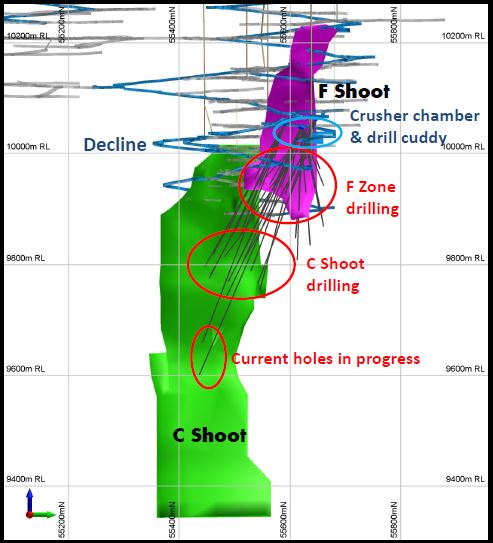
The latest results were achieved by drilling at the expanded C Shoot and newly discovered area, which is adjacent to F Shoot.


C Shoot and F Zone geological setting. Source: Company announcement


Poseidon said the results provide additional high-grade mineralised zones to the Mt Windarra ore body.

Drilling results at C Shoot include:

–    10.44 metres at 2.22 per cent nickel from 413.31 metres, within 15.75 metres at 1.67 per cent nickel;

–    5.58m at 2.76 per cent nickel from 465.42m, within 10.86m at 2.05 per cent nickel;

–    9m at 2.88 per cent nickel from 393m, within 16.7m at 2.24 per cent nickel; and

–    10m at 2.66 per cent nickel from 393m, within 19.25m at 1.84 per cent nickel.

Further drilling is underway to determine the extent of the vertical depth of the new zones.

Poseidon is of the opinion the results demonstrate the Mt. Windarra mine upside with deposits of nickel near to existing infrastructure, which it said can be cheaply revealed with modern technology.

“Our discovery cost, prior to this campaign, has been circa 10 cents for every pound of nickel in resources and these drilling results should continue that cost trend,” Poseidon Nickel managing director David Singleton said in the company’s announcement to the Australian Securities Exchange.

“I’m particularly pleased with the uncovering of the new, apparently mineable mineralised zone adjacent to F Shoot.

“It demonstrates that the detailed insights that our geologists have acquired over the last five years of painstaking work is creating breakthroughs in nickel discovery.

“With these additional high grade zones, we will now move to upgrade both the mineral resources and ore reserves at Mt Windarra, and incorporate these upgrades into our finance model.”

Total Mineral Resources at Mt Windarra currently stand at 3.95 million tonnes at 1.73 per cent, for 68,300 tonnes of contained nickel.

The company anticipates upgrades incorporating these extensions into both the Resource and Reserve calculations are expected to be released in the near future.

Trafford Resources’ Wilcherry Hill project reveals manganese potential

THE DRILL SERGEANT: Trafford Resources (ASX: TRF) has reported recent drilling conducted at the Hercules prospect at the company’s 100 per cent-owned Wilcherry Hill project in South Australia by IronClad Mining (ASX: IFE).

The drilling was aimed at near surface Direct Shipping hematite iron, yet intersected 23 metres at 22 per cent manganese from 55 metres.

This intersection also includes 7m at 28 per cent manganese and 4m at 29 per cent manganese.

A second hole intersected 7m at 20 per cent manganese from 55 metres.

Manganese is no stranger to Wilcherry Hill with drilling carried out at Hercules in 2008 resulting in an estimated JORC-compliant manganese inferred resource of 8.75 million tonnes at 10.01 per cent manganese (with 35 per cent iron).

Drilling carried out in 2013 has completed a total of 29 holes for 2198m with most holes being completed around 80m depth.

“The recent drilling, combined with the 2008 results from the southern portion of Hercules, shows the potential for continuity of manganese mineralisation along the entire six kilometre strike length of Hercules along with the new discovery of mineralisation in the three kilometre long eastern flank,” Trafford Resources said in its ASX announcement.

“The current 8.75 million tonnes inferred resource is derived from drilling a 1.5 kilometre strike length.

“The total strike length of Hercules is six kilometres with the Eastern Limb at three kilometres, giving a total of nine kilometres strike.”

Trafford pointed to the work of OM Holdings (ASX: OMH), which has demonstrated at its Bootu Creek project in the Northern Territory a 22 per cent resource grade can be beneficiated to a saleable 36 to 37 per cent manganese product.

“Metallurgical test work will be needed to determine ore characteristics for beneficiation options,” Trafford said.

“Beneficiation can be done with Heavy Medium Separation or via a Gravity Circuit, such as the one IronClad may utilise to recover Hematite Iron at Hercules.”

Trafford indicated it had identified further manganese potential at the Pier prospect, which is contained within the company’s 100 per cent-owned Eurilla Dam tenement, also located on the Eyre Peninsula of South Australia.

The company said recent field work has revealed potential for the Pier prospects to add to the Hercules manganese inferred resource.

A total of five rock samples returned high-grade manganese values ranging from 15.5 per cent to 31.4 per cent manganese with associated elevated iron values ranging from 13.8 per cent to 35.6 per cent iron.

The manganese rich rock samples were taken along an east-west striking low outcropping ridge over an approximate distance of four kilometres.

“Regional aeromagnetics indicate this east-west striking trend may extend further into the contiguous Lincoln Minerals (ASX: LML) Uno manganese prospect, where they have reported results of up to 66 per cent manganese oxide and associated 61 per cent iron hematite from outcropping gossans,” Trafford said.

“Monax Mining (ASX: MOX) has also recently discovered manganese projects on the Eyre Peninsula.”

Investigator Resources updates drilling at Paris

THE DRILL SERGEANT: Investigator Resources (ASX: IVR) has received further drilling results from the company’s Paris silver project.

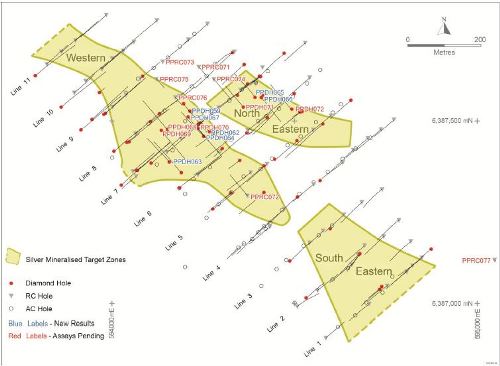
Investigator said the latest drilling had continued to improve its confidence in understanding the structural controls and geometries of the higher grade silver mineralisation in the central area (Lines 5, 6, 7, 8 & 9) of the deposit.

The company has a maiden mineral resource estimate expected in the September quarter of 2013.

The best intersections from the drilling include:

Hole PPDH063:

–     3.75m at 100 grams per tonne silver, 2.66 per cent lead and 0.42 per cent zinc from 66 metres;

–     1m at 329g/t silver, 1.77 per cent lead and 0.13 per cent zinc from 81m; and

–     3m at 184g/t silver, 0.16 per cent lead and 0.07 per cent zinc from 83m.

Hole PPDH064:

–     18.2m at 68g/t silver, 0.05 per cent lead and 0 per cent zinc from 7.8m;

–    6m at 112g/t silver, 0.77 per cent lead and 0.02 per cent zinc from 37m;

–     4.2m at 181g/t silver, 0.08 per cent lead and 0.11 per cent zinc from 72.8m; and

–    2m at 496g/t silver, 0.37 per cent lead and 0.12 per cent zinc from 78m.

Hole PPDH065:

–    10.7m at 1.88 per cent lead and 0.79 per cent zinc from 77m; and
 
–    7m at 1,570g/t silver from 79m.

Hole PPDH066 (There was no significant lead or zinc associated with the silver intersections):

–     4.4m at 252g/t silver from 35m; and

–    2m at 566g/t silver from 113m.


Drilling update plan, Paris Silver project. Source: Company announcement


“We now have three diamond drill rigs operating on double shift to conduct the in-fill drilling program,” Investigator Resources managing director John Anderson said in the company’s announcement to the Australian Securities Exchange.

“Two diamond drill rigs replaced the reverse-circulation percussion drill rig to improve drill sample recovery and to achieve our timetable for a maiden Inferred Mineral Resource in the September quarter of 2013.

“Investigator is also planning to undertake initial drill testing of three large satellite targets around Paris during the September quarter.

“These have strong silver and copper potential that will be evaluated in parallel with Paris to assess priorities for the wider Peterlumbo field.”

Stonehenge Metals confirms vanadium mineralisation in first drill hole

THE DRILL SERGEANT: Stonehenge Metals (ASX: SHE) has released assay results from the first hole of a 12 hole diamond drilling program currently underway at the company’s Daejon project in South Korea.

Stonehenge said the results have already confirmed a much greater mineralised zone than it has previously encountered with significant vanadium grades.

The first drill hole CHUDD0001, achieved a total depth of 341.5 metres.


Source: Company announcement


According to Stonehenge the mineralised zone contains strongly anomalous uranium mineralisation for both uranium and vanadium and extends from 263m to 338m, a total of 75m.

The previous estimate of width from a vertical hole was 56m.

“With the chemical assay results now available, we are reporting vanadium grades that are significant in their own right and should lead to a maiden vanadium resource estimate,” Stonehenge Metals managing director Richard Henning said in the company’s announcement to the Australian Securities Exchange.

“This is just the first hole in a 12 hole drilling program, and I am pleased that we have had such solid results over a much larger than anticipated mineralised interval.

“The uranium and/or vanadium credits that will apply to our final processing costs continue to be encouraging, and the wider mineralised zone could well impact on the bulk tonnage as we progress.”

Stonehenge has subsequently completed a second hole CHUDD0002 to a total depth of 407m and a mineralised zone extending to an estimated 95m.

Assays are pending, however, the company indicated mineralisation remains open down dip and along strike with additional drilling expected to increase the known dimensions of this zone.

Rox Resources hits deep massive nickel sulphides at Camelwood

THE DRILL SERGEANT: Rox Resources (ASX: RXL) has drilled a deeper diamond hole into the Main Zone of its Camelwood nickel sulphide prospect at Fisher East, located 450km north of Kalgoorlie in Western Australia.

According to Rox the hole has intersected a significant width of massive nickel sulphides at over 420m vertical depth.

Additional assays received from further reverse circulation (RC) holes at Camelwood have extended the strike extent of the mineralisation by over 500 metres to the south from previous drilling, extending the total strike length to 1.2 kilometres.

Rox said the assay results also indicate potential for a higher grade Southern Zone.


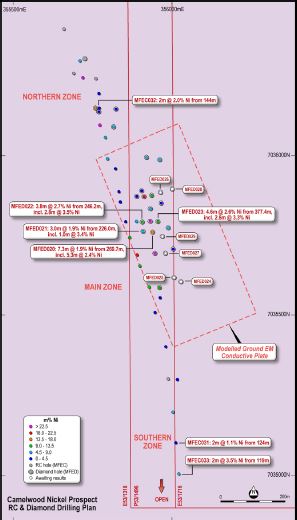
Camelwood prospect drill hole plan. Source: Company announcement


“Intersecting 2.2 metres of massive sulphides in hole MFED026 completely opens up the lower half of the Camelwood deposit and demonstrates to us that the mineralisation is continuing strongly at depth,” Rox Resources managing director Ian Mulholland said in the company’s announcement to the Australian Securities Exchange.

“In addition to the Main Zone, we now have higher grade mineralisation to follow-up at the Southern Zone, which we believe could be the top of another mineralised shoot.

“Our Camelwood deposit is turning out to be a very significant body of nickel sulphide mineralisation, still open at depth and along strike to the south and full of surprises

“Extensive further drilling is required to fully evaluate the deposit since the EM conductor has been modelled to extend to at least 700 metres vertical depth.”

Hole MFED026 at the Main Zone is the deepest mineralised hole Rox has drilled to date at Camelwood.

The hole was drilled to follow up a down hole EM anomaly indicated from hole MFED019.

RC holes MFEC031 and 033 conducted on the Southern Zone were drilled at the southernmost end of the defined strike of Camelwood.

Hole MFEC033 intersected 2m at 3.5 per cent nickel, including 1m at 5.7 per cent nickel from 119m.

This strong result leaves the Southern Zone open along strike to the south and open at depth.

Rox considers this latest intercept, together with the previously reported 4m at 1.9 per cent nickel from 140m (MFEC030), may indicate the top of a possible new shoot of thicker, higher grade mineralisation now termed the Southern Zone.

Follow-up diamond drilling beneath RC hole MFEC033 will commence shortly.

Atlas Iron encouraged by Corunna Downs drilling results

THE DRILL SERGEANT: Atlas Iron (ASX: AGO) has released additional drilling results from the recently-named Split Rock discovery, located at the company’s 100 per cent-owned Corunna Downs project in the Pilbara region of Western Australia.

Atlas has completed 39 RC holes at Split Rock to date, from which it has previously received some results.

It has now received the assay results for an additional 17 of those holes, which the company said has extended the potential of this discovery.

Additional assays received from Split Rock include:

–     136 metres at 56.74 per cent iron from surface;

–     90m at 58.74 per cent iron from 4m;

–     98m at 57.77 per cent iron from 72m; and

–    120m at 56.86 per cent iron from 6m.

“These new drilling results from Corunna Downs are fantastic and we await the remaining assays from our first Corunna Downs drill program with great anticipation,” Atlas Iron managing director Ken Brinsden said in the company’s announcement to the Australian Securities Exchange.

“Importantly, as our geologists spend more time on the ground at the project, they are turning up additional drill targets to test with continued exploration.

“We look forward to realising the full potential of what is going to be an exciting project for the company.”


Atlas Iron North Pilbara resource and exploration project locations. Source: Company announcement


Atlas indicated it will be targeting the development of its first Resource for the Split Rock prospect during the September Quarter 2013, following additional drilling to define the Western boundary to the body of mineralisation.

Atlas said the latest results have continued to support its expectation that this new direct shipping ore discovery has the potential to complement its existing North Pilbara mining model and further expand the company’s blending options.

As a result of further project scale geological mapping, additional drilling targets are also being identified along strike to the north and south of the first discovery holes.

Atlas is now working on the relevant approvals to enable drill testing of these prospects with a view to extending the potential of the entire project area.