White Rock continues to define shallow gold at Red Rock

THE DRILL SERGEANT: White Rock Minerals (ASX: WRM) has been encouraged by recent assay results from the Red Rock prospect, located 15 kilometres from the company’s 750,000 ounce gold equivalent Resource base at Mt Carrington in northern New South Wales.

The company has received assays from the first hole of a seven-hole infill drilling program, which have returned a 90 metre intersection of gold and silver from surface.

Results include:

–    8 metres at 3.4 grams per tonne gold and 14 grams per tonne silver from surface within 90 metres at 0.8g/t gold and 5g/t silver from surface.

White Rock said the results had confirmed previous drilling at the new gold-silver ‘Deadman’s Zone’, it discovered in late 2012.
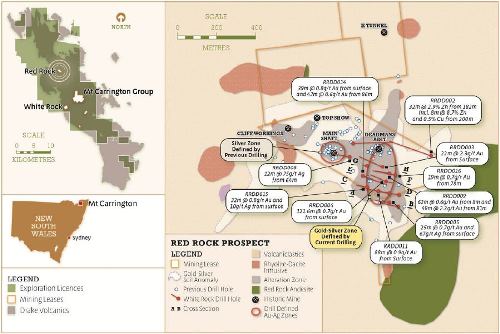
 

Red Rock surface plan showing location of White Rock drillholes
RRDD001 – 016 (red collars) with recent assay results, general geology,
historical drilling and mine workings. Source: Company announcement


The company indicated assays for the remaining six holes are pending and will form part of a resource estimate due mid-year.

“The drilling at Red Rock is returning results in line with our expectations as we work towards a new Resource estimation here,” White Rock Minerals managing director Geoffrey Lowe said in the company’s announcement to the Australian Securities Exchange.

“We have now turned our focus to continuing the pre-feasibility work required to confirm optimum metallurgical processes, upgrade our Inferred Resources and move the EIS studies to the next level in preparation for feasibility studies later in 2013.”

White Rock explained it has completed the remaining drillholes for the program to infill the drilling gaps within the known mineralised zone to firm up the mineralisation model, as well as testing for northern extensions to mineralisation.

It said all drillholes have intersected quantities of quartz veining and associated base metal sulphides and that it is now waiting on the results.

A program of electrical geophysics and infill geochemical sampling has also been completed at Red Rock, from which additional targets have been defined for drill testing in the second half of 2013.

Toro Energy commences Wiluna infill drilling

THE DRILL SERGEANT: Toro Energy (ASX: TOE) has commenced its 2013 extensive infill drilling program at the company’s wholly-owned Wiluna uranium project, based near Wiluna in Western Australia.

Toro said the program has been designed to focus on three of the five deposits situated within the Wiluna project regional resource: Lake Way, Millipede and Dawson Hinkler.


Source: Company announcement


The company will be utilising both sonic core drilling and air core drilling techniques to drill 370 holes over a 7,000 metre drilling program.

Toro explained the intention behind the current campaign is to further advance the Wiluna project towards mine development decision beginning at the Centipede and Lake Way deposits.

The company has already received Western Australian and Federal Government environmental approvals for these deposits.

“With the recent completion of government environmental approvals for mining at Centipede and Lake Way, Toro is continuing to advance the project and position it a step closer to being Western Australia’s first uranium mine.” Toro Energy managing director Vanessa Guthrie said in the company’s announcement to the Australian Securities Exchange.

This is the largest single drilling program Toro Energy has undertaken on the Wiluna Uranium project.

Octagonal hooks high-grade gold at Frenchman’s Reef

THE DRILL SERGEANT: Octagonal Resources (ASX: ORS) has received results of Reverse Circulation (RC) drilling recently completed at Frenchman’s Reef, Wehla, in Central Victoria.

Frenchman’s Reef is located within the Wehla Goldfield, 60 kilometres northwest of the company’s Porcupine Flat gold processing plant at Maldon, and just over one kilometre to the north of its Black Reef open pit.

The Wehla Goldfield historically produced around 100,000 ounces of high-grade gold from a two kilometre long line of reef, however, as Octagonal explained, the company has yet to gain a full understanding of the structural controls and nugget effect on the distribution of gold.


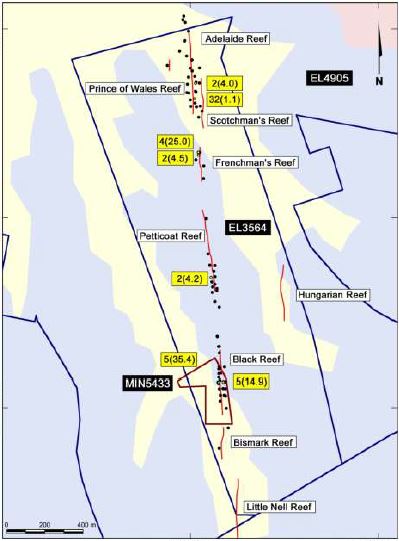
Main Wehla reefs and historic drilling results. Source: Company announcement


Octagonal is currently working to resolve these issues by mining a trial open pit at Black Reef, which it anticipates will supply information to assist in interpreting drilling results and justify a larger open pit operation in the Wehla Goldfield.

Assay results of recent drilling include:

–    6 metres at 24.3 grams per tonne gold from 18 metres, including 1 metre at 138.8 grams per tonne gold from 20 metres;

–    1m at 20g/t gold from 44m; and

–    2m at 4.1g/t gold from 33m.

“The results from this drilling program confirm that there is high-grade and nuggetty gold in the Wehla Goldfield,” Octagonal Resources managing director Anthony Gray said in the company’s announcement to the Australian Securities Exchange.

“With fantastic results like 6 metres at 24 grams gold surrounded by lower grades it is essential that we understand the nugget effect and distribution of gold in this goldfield.

“This is exactly why we are currently mining a trial open pit at Black Reef, because if the high-grade gold is more widespread than indicated in drilling, there is the potential for substantial near-surface gold in this goldfield.”

Doray kicks off underground activities at Andy Well

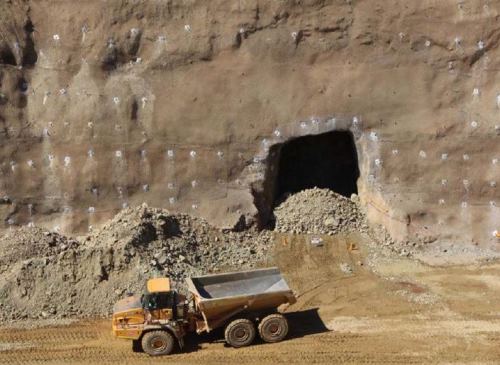
THE DRILL SERGEANT: Doray Minerals (ASX: DRM) has commenced underground development and mining at the company’s 100 per cent-owned Andy Well gold project in the northern Murchison region of Western Australia.

The company blasted the first portal trim on 26 April and has since advanced the decline approximately 16 metres underground.


Portal and underground development. Source: Company announcement


“The completion of the open pit and transition to underground mining is another significant milestone for Doray, again met on schedule, and is the beginning of a new phase for the company,” Doray Minerals managing director Allan Kelly said in the company’s announcement to the Australian Securities Exchange.

“While the open pit mining has been exciting in itself, within the next month or so, we will commence mining the high-grade Wilber Lode from underground and this makes up the bulk of the deposit

“Importantly, we are still well on track for the first gold production from Andy Well to occur in the September Quarter.”

Doray explained it would initially develop the decline down to the ‘1415 level’, which is approximately 65metres below surface and 25m below the bottom of the open pit.

From here the first cross cut will be developed to access the high-grade Wilber Lode from underground.

As it did with the Stage 1 open pit, Doary will stockpile ore from underground for future treatment once the processing plant is commissioned, which is anticipated to occur in the September Quarter.

Doray said construction of the processing plant and other site infrastructure is progressing on schedule, with first gold production forecast to follow commissioning of the processing plant in the September Quarter.

The company indicate it has been advised its ball mill has arrived in Fremantle and will be transferred to site within the next week.

Chesser Resources step out drilling hits standout gold

THE DRILL SERGEANT: Chesser Resources (ASX: CHZ) has received assay results for 25 holes from drilling currently underway at the company’s 100 per cent-owned Kestanelik gold project in Turkey.

The company is conducting a program of step-out drilling to identify extensions to gold bearing vein systems to the southwest of the projects’ initial JORC-compliant resource (5.9 million tonnes at 2.4g/t gold for a total of 462,000 ounces at a 0.5 g/t gold cut-off).

 Latest results include:
 
–    22 metres at 2.9 grams per tonne gold and 8.2 grams per tonne silver from 45 metres, including 5m at 8.7g/t gold and 24.4g/t silver;

–    18m at 2.9g/t gold and 1.3g/t silver from 41m, including 5m at 9g/t gold and 4.1g/t silver; and

–    4m at 5.3g/t gold and 3.6g/t silver from surface, including 2m at 9.4g/t gold and 5.9g/t silver as well as a deeper interval in the same hole of 3m at 7.1g/t gold and 9.5g/t silver from 24m.

“Drilling is continuing to deliver very encouraging results and will lead to an increase in the JORC Mineral Resource at Kestanelik following the completion of the campaign,” Chesser Resources managing director Dr Rick Valenta said in the company’s announcement to the Australian Securities Exchange.

“The multiple high-grade results in the K2-KS-K1 intersection zone will undoubtedly add to the upcoming resource as they lie well outside the limits of the initial resource and remain open to the southwest.


Locations of new drillholes within main drilling area. Source: Company announcement


“We have also continued to deliver good results on the A3C vein, increasing the likelihood that we will have sufficient drill coverage to bring it into the resource.

“We have also had a number of very encouraging scout drilling results to the west and south of the main area of drilling.

“Perhaps most exciting are the gold results in holes KED-238 and KED-253, which both returned good gold grades on a previously untested NW-trending structure that runs for over 2 kilometres on the property.”

Chesser said it expects to soon commence work on a Prefeasibility Study at Kestanelik, which it aims to complete and move onto EIA permitting process by the end of calendar 2013.

Atlas Iron claims new Direct Shipping Ore discovery

THE DRILL SERGEANT: Atlas Iron (ASX: AGO) has reported encouraging drill results from its maiden exploration drill program being carried out at the company’s 100 per cent-owned Corunna Downs project in Western Australia.

The program is drill testing one of several zones of surface iron enrichment Atlas previously identified at the Corunna Downs project.

To date 31 RC holes have been completed, 11 of which Atlas has so far received assay results.

The company said the assay results it has received to date indicate low alumina and moderate phosphorous and appear complimentary to its existing shipped product specification.

Best results include:

–    234 metres at 59.2 per cent iron from surface;

–    194m at 59.5 per cent iron from 6m;

–    180m at 58.8 per cent iron from 8m; and

–    62m at 59 per cent iron from surface.

“The first round of drilling results at Corunna Downs are spectacular and we look forward to seeing the remaining outstanding assays from this first pass drilling,” Atlas Iron managing director Ken Brinsden said in the company’s announcement to the Australian Securities Exchange.

“They also demonstrate the additional potential still to be realised from our North Pilbara portfolio.”


North Pilbara resource locations. Source: Company announcement


Atlas explained that although it was yet to identify an Exploration Target for the Corunna Downs project to date, its current drilling program is continuing to test a number of Banded Iron Formation (BIF) units.

Further work to define additional drill targets over the 20km-plus strike length of prospective ground Atlas holds in the region is underway.

Atlas recently exercised its option to complete the purchase of the entire underlying mineral rights to the Corunna Downs project area.

The company currently has two separate Exploration teams in the field; one drilling at Corunna Downs and the other adjacent to its Pardoo Operation.

Additional priority drilling at Abydos and Miralga Creek is expected to be completed in the coming months, in addition to continued drilling at Corunna Downs.


Disclaimer: The Roadhouse holds shares in Atlas Iron

Beadell Resources drills big results at Duckhead

THE DRILL SERGEANT: Beadell Resources (ASX: BDR) has announced high-grade infill RC drill results from the company’s Duckhead deposit in Brazil.

The results include intersections of:

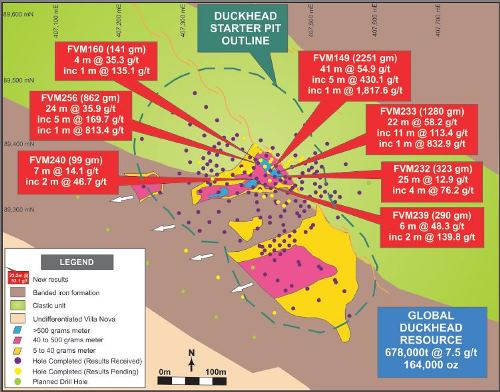
–    41 metres at 54.9 grams per tonne gold from surface, including 5 metres at 430.1g/t gold from 15 metres, including 1 metre at 1,817.6g/t gold from 16 metres;

–     22m at 58.2g/t gold, including 11m at 113.4g/t gold from 8m, including 1m at 832.9g/t gold from 16m; and

–    24m at 35.9g/t gold from surface, including 5m at 169.7g/t gold from 16m, including 1m at 813.4g/t gold from 17m.

Beadell said it considers the new high-grade drill results have enhanced the Duckhead deposit by locating previously unidentified extremely high-grade (greater than 500g/t gold) gold mineralisation in the upper 20m of the deposit.

Infill grade control RC drilling of the Main Lode has been completed down to approximately 50m below surface, which the company said has confirmed and enhanced the continuity of the high-grade Main Lode by extending the zone of extreme gold grades up plunge.

Beadell is confident the Duckhead gold deposit remains open at depth below the shallow level of drilling between 100 and 150 metres below surface and is prospective for extensions and repetitions of the high-grade gold mineralisation.

The company is continuing to conduct diamond drilling target the depth extensions of the Main and Hangingwall Lodes, with additional results expected shortly.


Duckhead plan showing location of new grade control results and starter pit. Source: Company announcement


“Approvals and preparations for commencement of open pit mining at Duckhead are progressing very well with both Government regulators and Anglo Ferrous and, subject to these approvals, Beadell is targeting a June 2013 start up,” Beadell Resources said in its ASX announcement.

“The current mining schedule indicates that 90 per cent of the total material moved from the combined Duckhead starter pit, currently at 98,000 ounces gold with no allowance for these extreme infill grade results, can be mined over a five month period, with the remaining 10 per cent completed within the 6th month.

“This 400,000 tonnes of gold ore will be blended into the company’s planned 2.3 million tonnes of gold ore to be processed in the last 7 months (Jun – Dec) of 2013.

“The inclusion of Duckhead in the 2013 plan will ensure the company’s total cost of production will sit firmly within the lowest quartile globally.”

Mutiny Gold receives US$2 million funding

THE DRILL SERGEANT: Mutiny Gold (ASX: MYG) has completed a second loan from Canadian gold-streaming company Sandstorm Gold.

The company completed the first loan from Sandstorm in November 2012, which it converted to shares in January 2013.

The second deal will result in Mutiny Gold receiving US$2 million from Sandstorm to fund ongoing activities in the lead-up to the completion of financing for the company’s Deflector copper-gold project in Western Australia.

The loan is interest free, with a due date for repayment of 30 September 2013 unless converted into shares before that date.

In the company’s announcement to the Australian Securities Exchange, Mutiny Gold managing director John Greeve said the completion of the second loan had demonstrated Sandstorm’s continued support of the Deflector project despite a market where the gold price recently retreated to the lows of 2011.

“The company plans to apply the proceeds of the loan to progress the Deflector exploration and implementation plans,” Greeve said.

“Meanwhile, Mutiny is continuing negotiations with the banks and remains confident it will be able to raise the required debt finance to put Deflector into production.”

Mutiny Gold completed a Definitive Feasibility Study at Deflector in 2012, which determined the project to be a low cost (C1 cash cost of $618 per ounce of gold equivalent), high-grade robust project.

Mutiny announced in April that it intended expanding the scope of its 2013 Deflector drilling program to allow it to increase ounces to support a potential increase of gold production from 70,000 ounces per annum to over 105,000 ounces per annum by year three at the proposed mine.

Supported by structural interpretation studies and a Sub Audio Magnetic (SAM) survey exploration program, Mutiny will aim the proposed drilling at targeting an increase to the current Deflector deposit resource of 2.86 million tonnes at 6.4 grams per tonne gold, 6.8 grams per tonne silver and 0.9 per cent copper for 591,000 ounces gold, 629,000 ounces silver and 27,000 tonnes of copper.

The resource has, to date, been defined over 900 metre of strike length, and has been interpreted by Mutiny to be open at depth and along strike.

The company indicated its expanded 2013 drilling program will include 4,000m of diamond and reverse-circulation drilling, up from a proposed 3,000m it announced in February 2013, to target high-grade grade extensions of Deflector.

Mutiny Gold said it believes the potential exists for it to provide significant increases to the current resource base.

AusAmerican hits wide high-grade massive sulphides at Blue Bell

THE DRILL SERGEANT: Australian-American Mining Corporation (ASX: AIW) has been heartened by further encouraging results from the maiden drilling program at the company’s Blue Bell project in Arizona.

Recent results from the drilling campaign at Blue Bell have returned multiple high-grade copper-gold-silver intersections, including:

–    17 metres at 4.6 per cent copper equivalent (CuEq) (3.3 per cent copper, 1.3 grams per tonne gold and 31.2 grams per tonne silver) from 216 metres;
 
–    17m at 1.3 per cent CuEq (1 per cent copper, 0.2g/t gold and 9.9g/t silver) from 192m;

–    15m at 2.2 per cent CuEq (1.9 per cent copper, 0.2g/t gold and 11.0g/t silver) from 213m; and

–    10m at 0.9 per cent CuEq (0.6 per cent copper, 0.2g/t gold and 11.9g/t silver) from 252m.

The drilling returned a number of broad high-grade intersections including:

–    9m at 6 per cent CuEq (4.5 per cent copper, 1.1g/t gold and 43.6g/t silver) from 216m; and
 
–    3m at 5.1 per cent CuEq (4.5 per cent copper, 0.4g/t gold and 22.6g/t silver) from 218m.

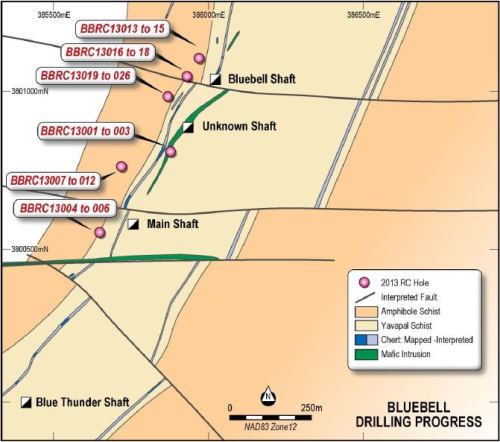
AusAmerican explained the latest drill holes were conducted to test an area which has not previously undergone any significant mining activity.


Q1 2013 Blue Bell drill hole plan. Source: Company announcement

The drilling has demonstrated mineralisation remains open at depth and along strike with results from 15 of 17 holes received so far intersecting mineralisation.

“These positive Phase 1 drill results validate our brownfield exploration strategy, provide further evidence that there is significant and relatively shallow high grade mineralisation remaining at Blue Bell, and confirms that previous mining activity in the 1920’s did not identify all of the high-grade lenses,” AusAmerican managing director Richard Holmes said in the company’s announcement to the Australian Securities Exchange.

The initial drilling program, which finished earlier this month, consisted of 26 holes for approximately 5,000 metres of RC drilling.

The company said it expects to receive the remaining results in May.

Blackham Resources confirms Iceberg Zone at Matilda gold project

THE DRILL SERGEANT: Blackham Resources Ltd (ASX: BLK) has received encouraging results from ongoing drilling at the company’s Matilda gold project in Western Australia.

Blackham is conducting a RC drilling program at the Matilda Mining Centre focussing on the M1, M2, M3 and M4 deposits.

The company said the latest results had complemented earlier results it had released earlier this month.

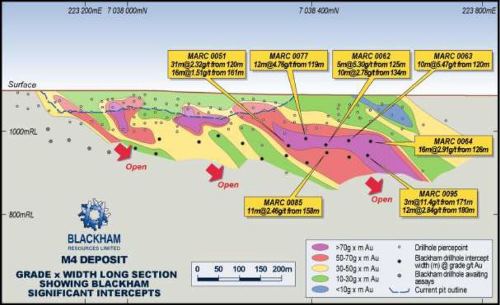
The latest drilling in the area north of the M4 pit has encountered further thick zones of mineralisation that now extend over 250m of strike.

The company has named this zone the Iceberg Zone due to the fact it has limited appearance near surface but grows at depth.


M4 Grade-width long section, highlighting the Iceberg Zone. Source: Company announcement


Latest results here include a high-grade zone of 3 metres at 11.4 grams per tonne gold from 171 metres and 12 metres at 2.84g/t gold from 180m, including 2 metres at 9.15g/t gold from 180 metres.

To date this is the deepest drill intercept Blackham has recorded at the Iceberg Zone.

The intercept is supported by the re-entry and extension of an earlier hole, which returned 23m at 2.66 g/t gold from 119m.

A continuous zone of mineralisation has also been identified in the hanging wall of the main lode with intercepts including 1m at 12.5g/t gold from 132m and 9m at 2.48g/t gold from 165m.

“Extensions of mineralisation have also been found in an area between the M1 and M3 pits,” Blackham said in its ASX announcement.

“These lodes may provide additional sources of near-surface ore to be exploited while targeting the main lodes of M1 and M3 at depth.”

Better results include:

2m at 2.99g/t gold from 34m; and

3m at 5.07g/t gold.

“The M4 deposit has been identified as a priority area to recommence mining operations at the Matilda Mining Centre,” Blackham said.

“The company will be updating the resource model and reviewing the mining economics of this deposit in the near future.”

Blackham’s resource inventory at the Matilda gold project is currently 25 million tonnes at 1.9g/t gold for 1.5 million ounces of gold, which includes 14 million tonnes at 1.8g/t gold for 784,000 ounces of gold at the Matilda Mining Centre.

Blackham indicated drilling is continuing at the Matilda project with the focus now turning to the M1 Pit, which historically has been the highest grade and largest producer (1.5 million tonnes at 2.54g/t gold for 121,000 ounces) of the seven pits at the Matilda Mining Centre.