Gryphon Minerals confirms mineralisation at Nogbele gold deposit

THE DRILL SERGEANT: Gryphon Minerals (ASX: GRY) has released infill Reverse Circulation (RC) drilling results from the northern portion of the Nogbele gold deposit, part of the company’s Banfora gold project in Burkina Faso, West Africa.

“These latest drill results confirm the high grade zones and grade continuity at Nogbele North and once again demonstrate the world class nature of the Banfora gold project,” Gryphon Minerals managing director Stephen Parsons said in the company’s announcement to the Australian Securities Exchange.

“These high grade shallow oxide zones will be targeted in the early years of mine production for enhanced economics.

“There is significant potential for the structural controls on these high grade zones to be pursued at depth to increase open pit reserves and potentially support underground studies.”

Gryphon’s latest drilling results are from ongoing Reverse Circulation (RC) drilling programs the company is conducting at the northern end of the Nogbele gold deposit.

Drilling is infill, targeting shallow mineralisation down to 30m vertical depth.

Gryphon explained that mineralisation at the Nogbele gold deposit outcrops from surface and remains open along strike and down dip and that the current drill pattern was conducted on a close spaced mining grid pattern.

The company considers the drilling has successfully confirmed grade and lode continuity, geological and resource models and has allowed it to evaluate the parameters required for future grade control drilling as part of its mine planning process.
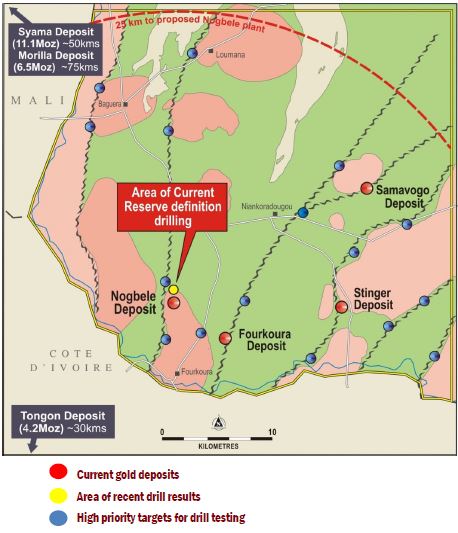
 

Location of drill results at Nogbele gold deposit. Source: Company announcement


Greater than 50 gram per metre intersects from infill drilling at the Nogbele gold deposit includes:

–    4 metres at 34.34g/t gold from 30 metres;
 
–    4m at 33.04g/t gold from 26m;

–    4m at 32.73g/t gold from 14m;

–    2m at 61.05g/t gold from 32m;

–    5m at 19.23g/t gold from 7m;

–    7m at 12.33g/t gold from 24m;

–    5m at 15.77g/t gold from 31m;

–    4m at 13.08g/t gold from 32m; and

–    4m at 12.92g/t gold from 2m.

Gryphon said the results it has received to date have confirmed the validity of the company’s current geological model at Nogbele North and have reinforced its geological expectations in both continuity and grade at the deposit.

The results are being incorporated into a local estimation for validation of the existing resource model.

The results will also be used to evaluate and optimize of the current grid spacing and composite length for eventual grade control drilling.
Pegasus Metals records new copper-zinc hits at Mt Mulchay

THE DRILL SERGEANT: Pegasus Metals (ASX: PUN) has intersected more high-grade mineralisation at the company’s Mt Mulcahy copper-zinc-silver-gold VMS discovery, in Western Australia.

Pegasus said it will use the latest results in calculating a maiden resource estimate, as well as determining whether the South Limb Pod hosts copper and zinc VMS-style mineralisation less than 200 metres from surface.

Intercepts received from the latest drilling include:

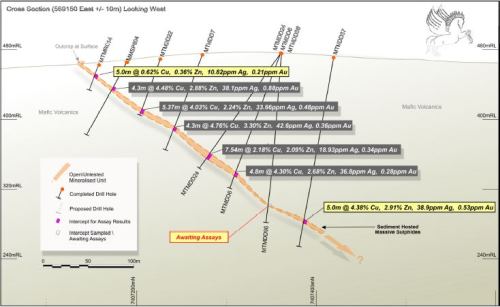
–    5 metres at 4.38 per cent copper, 2.91 per cent zinc, 38.9 grams per tonne silver and 0.53 grams per tonne gold, including 3 metres at 5.78 per cent copper, 3.84 per cent zinc, 49.6g/t silver and 0.54g/t gold;

–     4.44m at 2.51 per cent copper, 4.98 per cent zinc, 29.4g/t silver and 0.26g/t gold, including 3.44m at 3.04 per cent copper, 6.40 per cent zinc, 36.6g/t silver and 0.33g/t gold;

–     6.64m at 1.86 per cent copper, 1.44 per cent zinc, 15.2g/t silver and 0.07g/t gold, including 2.19m at 3.4 per cent copper, 3.02 per cent zinc, 27.2g/t silver and 0.10g/t gold); and

–    2m at 3.24 per cent copper, 1.06 per cent zinc, 25g/t silver and 0.10g/t gold.


Mt Mulcahy – South Limb pod. Source: Company announcement


“These results further confirm that South Limb Pod is an outstanding discovery characterised by extremely high-grade mineralisation with excellent ongoing exploration potential and the prospect of being very economical to mine,” Pegasus Metals managing director Michael Fotios said in the company’s announcement to the Australian Securities Exchange.

Cassini Resources defines potential large-scale nickel-copper target

THE DRILL SERGEANT: Cassini Resources (ASX: CZI) has completed a ground electromagnetic (ground EM) survey on the Pandora target at the company’s 100 per cent-owned West Musgrave project in Western Australia.

The company said the survey has further defined a potential large‐scale nickel‐copper sulphide exploration target.

Key outcomes of the ground EM survey include:

–    Confirmation of airborne EM (VTEM) findings and defining a large conductor coincident with a magnetic high, interpreted to be a mafic intrusion (Pandora target);

–    Large scale conductor with dimensions 600m long by 200m wide;

–    Depth of cover and/or weathering to top of conductor is only 70m; and

–    Detailed geometry of the ground EM conductor reinforces the conceptual geological model of massive and/or stringer nickel‐copper (Ni‐Cu) sulphides hosted within a mafic intrusion.

The survey confirmed a large‐scale conductor with a strike length of 600m and a width of 200m.

The top of the conductor is only 70m below the surface.

Cassini had a moving loop transient electromagnetic (MLTEM) survey conducted by Vortex Geophysics, which covered the VTEM anomaly within the West Musgrave project the company announced in April.

“The MLTEM survey covered the full extent of the VTEM anomaly with the main goal of the survey being to improve the definition of the conductor, in order to facilitate an effective drill program to test for mineralisation,” Cassini Resources said in its ASX announcement.

“The ground EM survey successfully achieved this objective.”

The company explained the MLTEM response indicated an intricate geological structure, consistent with the geological model proposed being a massive and stringer sulphide‐bearing mafic intrusion.

The MLTEM survey was carried out within the boundaries of the original VTEM anomaly.

The areas of highest conductance lie at the southern end of the aerial survey area so further ground
EM surveys outside these boundaries may be warranted if drilling results are positive.

The company intends to drill test the Pandora Target as a matter of priority. The heritage and environmental approval processes are currently underway.

Azure Minerals updates Promontorio Resource

THE DRILL SERGEANT: Azure Minerals (ASX: AZS) has announced an updated Mineral Resource for the company’s Promontorio copper-gold-silver deposit in northern Mexico.
 

The total Mineral Resource now stands at 840,000 tonnes at 4.1 per cent copper equivalent (CuEq) (at 0.5 per cent CuEq grade cut-off).


Promontorio Mineral Resource estimate based upon a 0.5 per cent CuEq lower cut-off grade. Source: Company announcement


“We’re pleased to finalise and present the updated JORC Mineral Resource, as this is another important step towards production from Promontorio,” Azure Minerals managing director Tony Rovira said in the company’s announcement to the Australian Securities Exchange.

“With approximately 75 per cent of the Promontorio Resource upgraded to the Indicated Mineral Resource category, we can now move to the Feasibility Study stage, including completing a definitive underground mine design, production schedule and a JORC-compliant Probable Ore Reserve.

“Previously we were unable to produce an Ore Reserve as a significant component of the first resource was in the Inferred category.

“This is a significant step towards the fulfilment of our vision to become a copper miner in Mexico, and I look forward to the extra value we can create for Azure at Promontorio.

“This has already started with drilling about to commence at the newly discovered, high grade copper zone at Cascada.

“If we’re successful in defining a large mineralised zone here, there will be a major benefit to the overall Promontorio project.”

Azure said the Mineral Resource estimate will be used to form the basis of a full mining evaluation, which will be part of the Feasibility Study.

The mining study will include an estimate of Probable Ore Reserves and updated mine design, mining method, production schedule, and mine capital and operating costs.

The company expects to undertake the mining study in the second half of 2013.

Trafford Resources encounters tin at Wilcherry Hill

THE DRILL SERGEANT: Trafford Resources (ASX: TRF) has announced that recent drilling conducted by its Joint Venture partner IronClad Mining (ASX: IFE) at the company’s Wilcherry Hill project in South Australia has intersected high-grade near-surface tin.

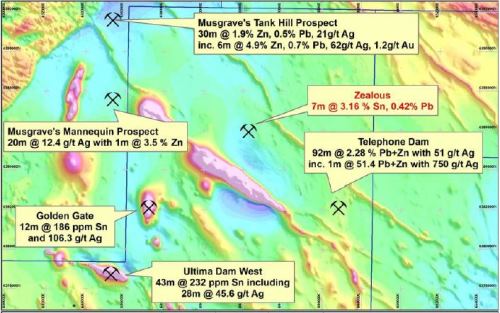
Results from the first of 10 holes drilled at the Zealous prospect include:

–    7 metres at 3.16 per cent tin with 0.42 per cent lead from 52 metres including, 1m at 5.49 per cent tin with 0.45 per cent lead and 1m at 5.15 per cent tin with 0.44 per cent lead.

Assays from the remaining nine holes are expected soon.


Wilcherry Hill regional map showing Zealous and tin/silver over magnetics. Source: Company announcement


Trafford owns 100 per cent of the rights to all minerals on the Wilcherry Hill tenements with the exception of iron – where it has a 20 per cent / 80 per cent JV with IronClad.
 
“Trafford’s Wilcherry Hill tenements are underlain by Hiltaba Granites and it has been noted in numerous references that the mineralising source of tin prospects in South Australia are the Hiltaba Suite Granites,” Trafford Resources explained inits ASX announcement.

“The findings strengthen the Southern Gawler Craton Hotspot in which Trafford is well placed with tenement holdings, multi commodity prospects and experience.”

The company explained its excitement in regards to the discovery by indicating tin to be the commodity which has the highest price amongst the mainstream London Metal Exchange (LME)-traded metals at a current price of around $20,000 per tonne.

Trafford said concentrate off-take terms for tin are amongst the best of the LME metals, which it claimed adds weight to the importance of the high-grade nature of the tin discovery at the Zealous prospect.

Blackham Resources upgrades Williamson Resource

THE DRILL SERGEANT: Blackham Resources (ASX: BLK) has upgraded the Resources at the Williamson Mining Centre, which is part of the company’s Matilda gold project in Western Australia.

Blackham explained it had conducted the resource upgrade was conducted in order to improve the company’s confidence in the geological model and to allow scoping studies to be completed.

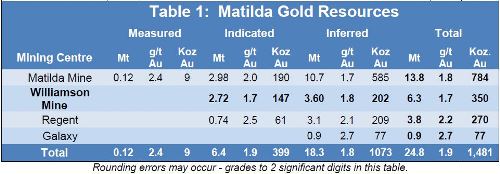
The new Williamson Resource – including the Williamson South deposit – is 6.3 million tonnes at 1.7 grams per tonne gold for 350,000 ounces, of which 2.7 million tonnes at 1.7g/t gold for 147,000 ounces has been promoted to the Indicated category.

The company said its increased confidence in the block model was the result of adding the grade control data and 15 additional RC & Diamond holes since the previous block model was calculated.

The new data has taken the Matilda gold project resource to 25 million tonnes at 1.9g/t gold for 1.5 million ounces with 408,000 ounces in Measured and Indicated categories.


Source: Company announcement


This represents an increase of 57 per cent over the previous estimate the company released in January 2013.

“Management believe there is significant potential to make additional improvements in the confidence of the Williamson Resource Model as well as increase the resources which are open both along strike and at depth,” Blackham Resources said in its ASX announcement.

“Exploration programs are currently being planned to test these targets.

“A review of targets within the Williamson region is also underway.”

Mindax encouraged by copper results from Mortlock drilling

THE DRILL SERGEANT: An aircore drilling program completed by Mindax Limited throughout February/March at the company’s Mortlock project in Western Australia has defined two new areas of supergene copper mineralisation.

The drilling was designed as infill around a previous copper and gold anomalism.
 
Mindax completed a total of 58 drillholes for 2,748 metres and has received initial assay results from four-metre composite samples.

The best result intersected:

–    12 metres at 0.65 per cent copper from 32 metres downhole, including 4 metres at 1.01 per cent copper from 32 metres down the hole.

An adjacent drillhole, located 50m along strike to the south, intersected:

–    8m at 0.5 per cent copper from 24m downhole.

Mindax is now awaiting results from selected one-metre samples, which were submitted for assay earlier this month.


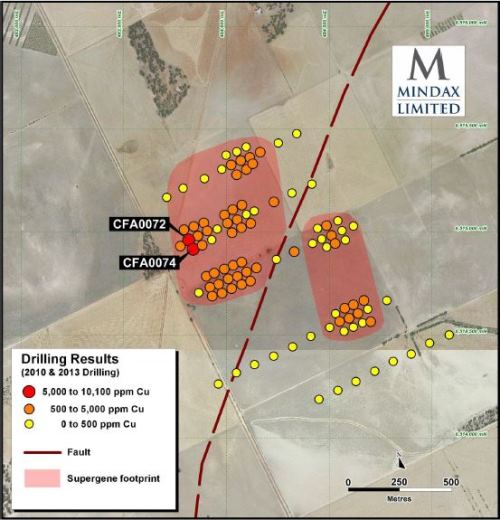
Geological interpretation showing two supergene anomalous zones. Source: Company announcement


Mindax has interpreted the assay results it has received so far to demonstrate two zones of copper enrichment offset approximately 500m by a large fault.

The footprint of these two zones covers approximately 700m by 500m and 600m by 300m respectively, which the company considers could indicate the existence of a larger mineralising system at depth.

Once it has received the outstanding results from the one-metre samples, the company said it anticipates being able to finalise its interpretation of the recent drill program and plan future exploration work programs.

“The initial results from Mortlock are certainly encouraging,” Mindax Limited managing director and chief executive officer Dr Steve Ward said in the company’s announcement to the Australian Securities Exchange.

“We now look forward to completing the interpretation from this year’s drill program and then determining the optimal future work plan.”

Centaurus Metals hits high-grade near-surface iron ore at Candonga

THE DRILL SERGEANT: Centaurus Metals (ASX: CTM) has claimed to be on track to complete a maiden JORC resource for a second potential satellite project to the company’s Jambreiro iron ore project in south-east Brazil by June.

The company’s confidence has been buoyed having received further positive drilling results from its 100 per cent-owned Candonga iron ore project, located 33 kilometres from Jambreiro.

The latest news follows recently reported positive results for the Canavial project, located 10km from Jambreiro, where a maiden JORC resource estimate is scheduled for May 2013.

Centaurus said the combination of these two satellite projects give it opportunities to grow or extend the life of the Jambreiro project.


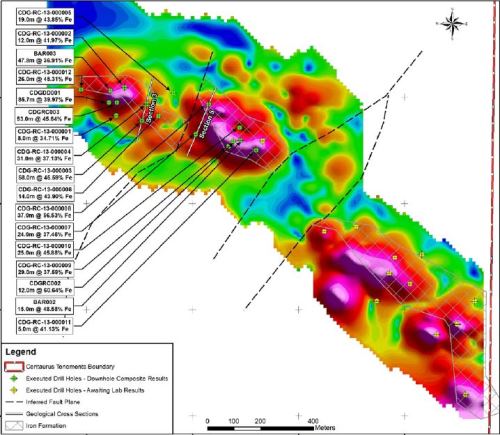
Candonga iron ore project map – Analytical signal mag image and drill results – May 2013. Source: Company announcement

According to the company Candonga has the potential to provide coarse grained friable itabirite to Jambreiro.

Highlights of the recent RC drilling results from Candonga, which support the results obtained from drilling and trenching conducted in 2010 and 2011, include the following continuous intersections of friable itabirite:
 
58 metres at 45.6 per cent iron, 2.6 per cent aluminium oxide and 0.11 per cent phosphorous from surface;

37m at 56.5 per cent iron, 2 per cent aluminium oxide and 0.06 per cent phosphorous from surface, including 20m at 63.4 per cent iron, 0.6 per cent aluminium oxide and 0.03 per cent phosphorous from 13m;

26m at 45.3 per cent iron, 8.6 per cent aluminium oxide and 0.03 per cent phosphorous from 1m;

25m at 45.9 per cent iron, 7.7 per cent aluminium oxide and 0.10 per cent phosphorous from surface;

24m at 37.5 per cent iron, 1.7 per cent aluminium oxide and 0.10 per cent phosphorous from 30m;

22m at 39.4 per cent iron, 3.5 per cent aluminium oxide and 0.10 per cent phosphorous from 34m; and

19m at 43.9 per cent iron, 4.1 per cent aluminium oxide and 0.13 per cent phosphorous from 26m.

“The Candonga results demonstrate the benefits of undertaking well-directed exploration at prospective regional projects with the potential to add substantial value to the Jambreiro project,” Centaurus Metals managing director Darren Gordon said in the company’s announcement to the Australian Securities Exchange.

“The results show that the Candonga area hosts relatively high-grade friable itabirite mineralisation.

“Given the coarse nature of the mineralisation close to surface, Candonga has the potential to develop as an ideal feeder project for the Jambreiro plant once it is in production.”

Cleveland Mining makes encouraging start to Brazil drill program

THE DRILL SERGEANT: Cleveland Mining Company (ASX: CDG) has drilled the first hole of a diamond drilling program at the company’s Premier North target in Brazil.

The drilling subsequently intersected approximately 60 metres of carbonaceous graphitic schist material, which its claims bears strong similarity to the gold‐bearing ore zones at both Cleveland’s Premier mine and AngloGold Ashanti’s (ASX: AGG) five‐million‐ounce Serra Grande mine, which is located less than one kilometre from Premier.

Cleveland is now waiting on assays that are being carried out in Santiago.

The first diamond hole at Premier North – Hole PGPDH 00166 – was designed to test the down‐dip potential of the Premier orebody by projecting its extension 3.5 kilometres to the north at approximately 700 metres depth, guided by historical drill logs.

Cleveland explained the hole intersected the same rock type, structures and sulphides associated with the orebodies at both Premier and Serra Grande.


Cross‐Section of interpreted mine sequence based on first drill hole
at Premier North, previous drilling by Cleveland and historical drill
records. Source: Company announcement


“The intersection is exciting because it provides greater clarity on the potential scale of the Premier project,” Cleveland Mining managing director David Mendelawitz said in the company’s announcement to the Australian Securities Exchange.

“The intersection is far thicker than outcropping Premier ore and appears to have very similar characteristics to Serra Grande ore, strengthening the view that there is potential for a significant resource at Premier.”

The company is planning infill drill holes to be conducted between the Premier orebody and hole PGPDH 00166 at Premier North to follow up the latest intersection.

Whilst the first hole was drilled in the Northern program, 19 additional holes were drilled around the existing ore‐body as part of the company’s initial program to expand the ore‐body.

Cleveland said results so far appear to be encouraging and more information will be released when it becomes available.

IMX Resources reports Inferred Mineral Resource at Zeppelin deposit

THE DRILL SERGEANT: IMX Resources (ASX: IXR) has completed an Inferred Mineral Resource estimate for the Zeppelin deposit.

The Zeppelin deposit forms part of the company’s Ntaka Hill nickel sulphide project, located in south-east Tanzania.

The Inferred Mineral Resource at the Zeppelin deposit has been calculated at 6 million tonnes at 0.52 per cent nickel for 31,000 tonnes of contained nickel (0.3 per cent nickel cut-off).

The Zeppelin Mineral Resource includes 1.6 million tonnes at 0.96 per nickel.

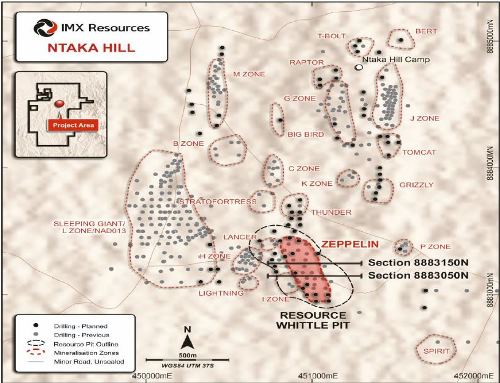
IMX said the Zeppelin deposit has now been defined over 465 metres and remains open up-plunge to the north, down plunge to the south and down dip to the west.

The company said work it had conducted at Zeppelin to date indicates that it forms part of a larger system of stacked mineralized zones which may be connected.

These areas are the Sleeping Giant deposit and the Zeppelin, H, NAD013 and L deposits, which IMX considers have the potential to comprise a single mineralised system, conducive to open-pit mining.


“This is an important step forward in advancing the Ntaka Hill project,” IMX Resources managing director Neil Meadows said in the company’s announcement to the Australian Securities Exchange.

“The mineral resources have the potential for lower cost open pit mining and the similarity with nearby mineralisation that demonstrated encouraging metallurgical test work results, indicates that material from Zeppelin will also show good metallurgical performance.”

IMX said the assays from the Zeppelin mineralisation also demonstrate consistently high nickel tenor, similar to the mineralisation in the Sleeping Giant, NAD013, H and L deposits.

Potential for Zeppelin, Sleeping Giant and H Zone to be connected. Source: Company announcement