Aguia Resources hits promising Brazilian phosphate

THE DRILL SERGEANT: Aguia Resources (ASX: AGR) has received results from a program of mapping, rock, soil and auger sampling the company recently completed at its Joca Tavares project located in the state of Rio Grande do Sul in southern Brazil.

Aguia said the recent work was conducted in order to delineate the dimensions of the Joca Tavares carbonatite for follow up programs of drill testing.

The company has completed 41 shallow auger drill holes so far and has received assays for the first 26 holes, 15 of which returned intersections of phosphate mineralisation from surface at similar grades to the company’s recent discovery at Três Estradas.
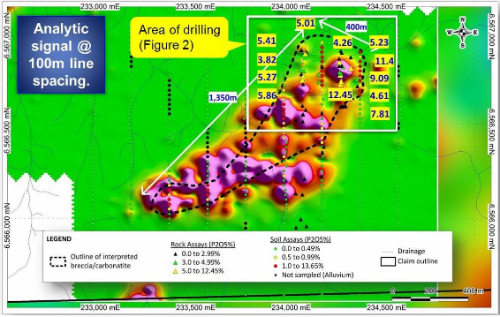
 

Mooca Tavares – Ground magnetic image, interpreted outline of
carbonatite, soil and rock chip assay results and area of drilling.
Source: Company announcement


Aguia said its previously reported auger assay results of up to 14.7 metres grading 10.8 per cent phosphate are now supported by further auger hole results that include:

9 metres at 11.5 per cent phosphate from surface (hole ended in mineralisation);

3.8m at 13.7 per cent phosphate from surface (hole ended in mineralisation);

3.5m at 12.1per cent phosphate from surface (hole ended in mineralisation); and

2m at 12.8 per cent phosphate from surface (hole ended in mineralisation).

Aguia explained Joca Tavares is yet to be drill tested and said these early results indicate phosphate bearing carbonatite host rock is present over an extensive area.

“We are extremely pleased with the ongoing shallow auger results from Joca Tavares that have now delineated an extensive zone of phosphate mineralisation from surface over a wide area,” Aguia Resources managing director Simon Taylor said in the company’s announcement to the Australian Securities Exchange.

“The results are very similar to the initial test work completed at Três Estradas where follow up drilling confirmed a JORC-compliant phosphate resource.

“With this second discovery we believe the projects located in Rio Grande do Sul have the potential to form a solid basis for future project development opportunities including a potential early start up and cash flow from the easily accessible shallow oxide material that extends from surface.”
Adelaide Resources receives boost from Alford West drilling

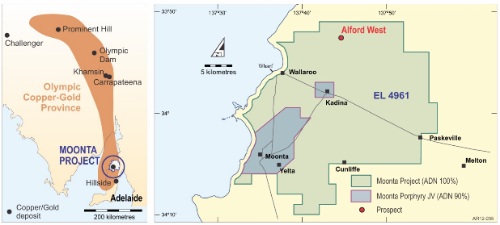
THE DRILL SERGEANT: Adelaide Resources (ASX: ADN) has received further encouragement from the latest round of drilling results from the company’s 100 per cent-owned Alford West prospect, located on the Yorke Peninsula of South Australia.

The Alford West prospect is situated within Adelaide Resources’ Moonta copper gold project.


Moonta copper gold project location. Source: Company announcement


The latest results are from holes completed during the company’s second round of aircore drilling.

Adelaide Resources said the latest assays from Alford West confirm copper and gold mineralisation over the central 1100 metres of a 3200 metre long auger copper anomaly that defines the prospect.

New drill intersections from Alford West include:

–    18 metres at 2.22 per cent copper and 0.17 grams per tonne gold from 46 metres, including 12 metres at 3.21 per cent copper and 0.19g/t gold from 47 metres;

–    9m at 1.21 per cent copper and 0.17g/t gold from 70m;

–    16m at 2.38 per cent copper and 0.18g/t gold from 60m, including 9m at 3.97 per cent copper and 0.14g/t gold from 66m;

–    12m at 0.41 per cent copper and 1.44g/t gold from 15m; and

–    11m at 1.11 per cent copper and 0.03g/t gold from 42m.

“The latest results have significantly expanded the known dimensions of the Alford West mineralisation,” Adelaide Resources managing director Chris Drown said in the company’s announcement to the Australian Securities Exchange.

“The deposit extends over the entire 1100 metres of strike length tested so far, remains open along strike and at depth, and shows excellent potential to increase further in size.

“Included in the latest results are further copper intersections of very attractive grade, and we can see coherent high-grade zones emerging within the large mineralised system.

“While speculation about the resource grade at Alford West is premature, we are satisfied that the results to date do not preclude achieving a grade comparable to those at operating mines.

“The latest assays also reveal the presence of significant molybdenum mineralisation in one area of the prospect, and molybdenum now presents a third target metal at Alford West.

“We are very satisfied with these new results, and with the positive way this prospect continues to develop for the company’s shareholders.”

Highfield Resources encouraged by Spanish drilling results

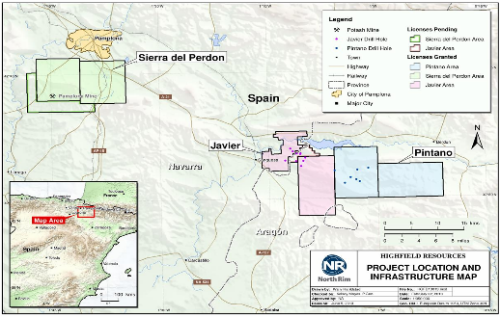
THE DRILL SERGEANT: Highfield Resources (ASX: HFR) has received the initial results from a recently-completed confirmatory drilling campaign on the company’s 100 per cent-owned Sierra del Perdón potash project in northern Spain.

The company has also commenced drilling on its Javier potash project.


Location of Highfield’s Javier, Pintano and Sierra del Perdón projects in northern Spain. Source: Company announcement


Highfield’s Sierra del Perdón project covers an area of about 80 square kilometres and contains two former operating mines that produced close to 10 million tonnes of potash product between 1972 and 1997.

The company said the initial drill hole of the four hole confirmatory program intersected a thick layer of salt, including what appears to be potassium mineralisation of about 14 metres at depths of 396.05 to 410.05 metres below surface.

Highfield carried out a visual inspection, it said demonstrated the drill core to be consistent with historical mine records and historical drill hole data.

The company said there appears to be a carnallite intersect running from 396.05m to 405.30m with some interbedding of halite, marls and sylvinite in transition.

There is also evidence of a sylvinite intersect running from 405.30m to 410.05m with some interbedding of halite.

“Beneath the sylvinite seam appears to be a halite layer of around 20 metres,” Highfield Resources said in its ASX announcement.

“The recovery of the cores has also been very good with limited dissolution.

“Importantly these results appear to confirm historic reports on the extent of the evaporite and the mining records detailing the extraction of some 37 million tonnes of sylvinite ore and 5.5 million tonnes of carnallite ore from the project area.

“The former operating mines extended to some 35 kilometres of the 60 kilometre project area of the Highfield permits over the evaporite.

“The core is subject to assaying and additional analysis to confirm chemical composition of the salt mineralisation.”

Northern Star Resources claims new Paulsens discovery

THE DRILL SERGEANT: Northern Star Resources (ASX: NST) has claimed a new high-grade discovery at the company’s Paulsens gold mine in Western Australia.

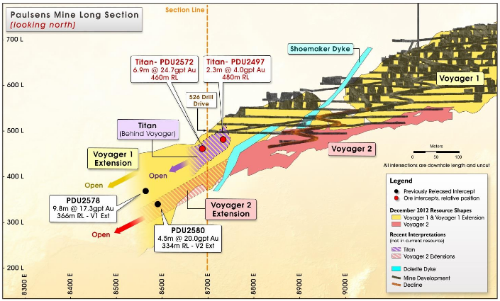
The Titan discovery hole returned 6.9 metres at 24.7 grams per tonne gold from a vertical depth of 700 metres with a second hole returning 2.3m at 4.3g/t gold.


Paulsens long section showing Titan discovery. Source: Company announcement


Northern Star explained the Titan mineralisation runs parallel and immediately adjacent to the currently-producing Voyager 1 and Voyager 2 lodes.

It is also located just 100m from the existing mine development, meaning the ore would be processed at the Paulsens plant.

Northern Star has drilled ten exploration holes, eight of which have intersected visible mineralised quartz with sulphides and stylolites, and up to 14m in true thickness.

Assays have been received from four holes with two of the remaining six holes containing visible gold.

In the meantime, drilling is continuing.

Northern Star believes the results support its belief there is still a substantial amount of gold to be found both at and immediately around the Paulsens mine as well as within a 10 kilometres radius.

The company considers the latest results demonstrates Titan may have potential to contribute to the inventory and mine life at Paulsens.

“The strength of these results, their close proximity to the Paulsens plant and their relatively shallow depth make Titan an extremely promising discovery,” Northern Star Managing Director Bill Beament said in the company’s announcement to the Australian securities Exchange.

“We have long believed there are substantial discoveries to be made in and around Paulsens, and the Titan find supports that view.

“Discoveries on our Paulsens ground are also one of the most cost – effective ways to create shareholder value and therefore we will continue to focus our exploration resources on this area.”

Sirius Resources encounters supergene Polar Bear

THE DRILL SERGEANT: Sirius Resources (ASX: SIR) has completed reconnaissance drilling it claims to have identified two new zones of gold anomalism at the first gold targets tested on the company’s 100 per cent-owned Polar Bear project.

Sirius said reconnaissance aircore drilling has defined two broad supergene gold anomalies in addition to those it reported to the ASX in February.

The first anomaly extends over 400 metres and has individual 4 metre samples grading up to 7.2 grams per tonne within a supergene blanket.


Plan projection of Polar Bear tenements, aircore drillhole locations and current targets. Source: Company announcement


The second anomaly is more extensive with a strike extent of approximately 1000m and a width of approx. 500m.

Individual 4m samples grade up to 3.64 g/t.

Intersections from this broad spaced reconnaissance drilling include:

–    8 metres at 3.96g/t gold from 36 metres, including 4 metres at 7.62g/t gold from 40 metres;

–    19m at 0.87g/t gold from 44m, including 4m at 3.64g/t gold from 44m;

–    15m at 0.99g/t gold from 40m, including 4m at 2.66g/t gold from 44m;

–    16m at 1g/t gold from 44m, including 8m at 1.73g/t gold from 48m; and

–    16m at 0.97g/t gold from 44m, including 8m at 2.07g/t gold from 48m.

“This is only the second of several stages of reconnaissance drilling planned to test a number of targets within the Polar Bear project area, which is surrounded by the Norseman, St Ives and Higginsville gold camps that collectively host approximately 25 million ounces of gold,” Sirius Resources said in its ASX announcement.

“These targets are located in a very under-explored area beneath the salt lake of Lake Cowan.”

Sirius said it was encouraged to identify further mineralised zones with high concentrations of gold over such broad areas at this early stage of the program.

Infill drilling, together with first pass drilling of the other untested targets is scheduled to commence in late August.

Sovereign Gold claims new gold system at Mount Adrah

THE DRILL SERGEANT: Sovereign Gold (ASX: SOC) is making a lot of noise concerning the possibility it has encountered, what he company describe to be, “a giant new gold system” at its Mount Adrah gold project, near Wagga Wagga.

The claim comes after the company received final drill results from the first drill hole.

Latest assays from the Hobbs Pipe 1 deposit show a continuous gold intercept from surface to a depth of 886 metres, which supports Sovereign’s conceptual exploration target for Pipe 1 of between 2.25 to 4 million ounces of contained gold.

Final assays results from the first hole at Pipe 1 are:

–    886m at 1.2 grams per tonne gold from surface, including 400m at 1.4g/t gold from surface, including 720m at 1.3g/t gold from surface.

Sovereign Gold said the drill results have provided it with further indication Pipe 1 is part of a broader substantial new gold system, which the company has estimated to contain an overall gold resource of up to 40 million ounces of gold as part of a broader conceptual exploration target.

“The final drill results further validates our belief that Mount Adrah can be a world class deposit,” Sovereign Gold managing director Michael Leu said in the company’s announcement to the Australian Securities Exchange.

“Diamond drilling of the second hole – designed to test the width of Pipe 1 – is underway and early results indicate it has contacted mineralisation at approximately 335 metres from surface as predicted.”

The company reported metallurgical testing by ALS Metallurgy has shown overall gold recovery rates are approximately 90 per cent, validating historical metallurgical work carried out in 1996 that showed gold recoveries of up to 94 per cent.

Centaurus Metals Resource update to extend Jambreiro mine life

THE DRILL SERGEANT: Centaurus Metals (ASX: CTM) is confident of extending the mine life of its Jambreiro iron ore project in south-east Brazil after reporting an updated JORC Mineral Resource featuring an increase in the Measured and Indicated Friable Itabirite Resource component.

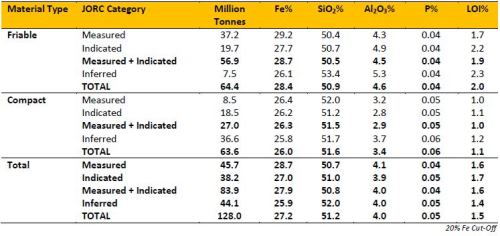
The overall JORC Mineral Resource for Jambreiro (combined Measured, Indicated and Inferred) has increased to 128 million tonnes at 27.2 per cent iron.


Jambreiro iron ore project – July 2013 JORC Resource Estimate, by mineralisation type. Source: Company announcement


Centaurus indicated the important change to the Resources was a six per cent increase in the Measured and Indicated Friable Itabirite component to 56.9 million tonnes at 28.7 per cent iron.
 
The company explained the Friable Itabirite resource underpins the project’s current Proven and Probable Ore Reserve of 48.5 million tonnes at an average grade of 28.1 per cent iron it announced in October 2012 with the completion of the Jambreiro Bankable Feasibility Study (BFS).

“We are pleased to have tightened up the Jambreiro resource base with enhanced data ahead of the finalisation of a revised mine plan and new Ore Reserve estimate,” Centaurus Metals managing director Darren Gordon said in the company’s announcement to the Australian Securities Exchange.

“We have been successfully implementing a number of important enhancements to the Jambreiro project while we complete negotiations for long-term product off-take, and this new Mineral Resource will provide the basis for a new mining sequence to tie in with other mine optimisation work.

“We expect to achieve a high conversion of the Measured and Indicated Friable Itabirite resource to Ore Reserves once this work is completed in October 2013, as was demonstrated at the time of the BFS late last year.”

Centaurus said the increase in the Measured and Indicated Friable Mineral Resource provided it with confidence in the robustness and quality of the Jambreiro project.

This confidence was heightened by taking into consideration the recently announced Mineral Resource at the Canavial project, which the company believes highlights the strong potential to extend the mine life at Jambreiro.

“This upgrade to our Mineral Resource inventory is therefore of strategic importance to the project, and should lay the foundations for an extended mine life along with the other improvements and enhancements that we are currently making,” Gordon said.

St George Mining encouraged by latest Cambridge drilling results

THE DRILL SERGEANT: St George Mining (ASX: SGQ) is convinced it has achieved an important breakthrough in exploration at the company’s 100 per cent-owned Cambridge nickel project, located at its East Laverton Property in the North Eastern Goldfields region of Western Australia.

The first phase of St George’s 2013 drilling campaign has provided new information the company believes suggests Cambridge is a large structurally modified extrusive ultramafic body.

This assertion stems from assay results, which demonstrate the magnesium content within ultramafic areas of Cambridge to be high at greater than 35 per cent magnesium oxide.

St George said this implies ultramafic areas at Cambridge are geologically consistent with the remainder of the Stella Range komatiites and that all ultramafic rocks along the Stella Range Belt – including Cambridge areas – are similarly prospective for nickel sulphides.

“Our investment in the extensive drilling at Cambridge has provided an exploration breakthrough for St George, resulting in a substantial enhancement to the exploration model for Cambridge,” St George Mining technical director Tim Hronsky said in the company’s announcement to the Australian Securities Exchange.

“This will allow us to narrow the search for nickel sulphides at the main Cambridge body, and to develop priority drill targets for the untested areas of the ultramafic belt to the north and south.

“The best nickel intersection was at the bottom of CAMRC-11 and in 40 per cent magnesium oxide ultramafics, and seems to be the top of something really interesting.

“We are very excited about taking this project to the next step.”


2013 drill hole locations across the Cambridge ultramafic body.
CAMRC001 and 002 were drilled by the company in 2012. DRAC32, 33 and 34
were completed in 2012 as part of project Dragon. Source: Company
announcement


St George said its exploration model for Cambridge had been substantially improved with the additional data from the seven new drill holes it has completed over the core Cambridge area.

The seven holes traversed the entire two kilometre width of the ultramafic body encountering metasediments at both the eastern and western edges.

The company has interpreted the new data to suggest the large ovoid shape of the Cambridge body may be the result of initial subvertical folding followed by shearing-out in a westward direction, associated with moderate east-dipping reverse and/or thrust faulting.

St George considers its refined geological model for Cambridge highlights the prospectivity of the central part of the body rather than the margins, which in turn strengthens the likelihood of high-grade nickel sulphides below the currently explored levels.


Disclaimer: The Roadhouse holds shares in St George Mining

Alacer Gold increases Turkish Mineral Resource

THE DRILL SERGEANT: Alacer Gold. (ASX: AQG) has announced an updated Mineral Resource estimate for the company’s Çöpler gold-silver-copper deposit in Turkey.

The updated Çöpler resource estimate has resulted in Measured and Indicated Resources increasing to 194.2 million tonnes at 1.4 grams per tonne gold, for 8.5 million ounces (inclusive of reserves).

“I am pleased to report that the Measured and Indicated Resource at Çöpler has increased for both oxide and sulphide mineralization since our last resource statement in December 2012, more than replacing mine production during the period,” Alacer Gold president and CEO David Quinlivan said in the company’s announcement to the Australian Securities Exchange.

“It is also significant that the new resource model has under-estimated the ounces in the area mined to June 30, 2013 by 11 per cent identifying potential upside to this new resource estimate.

“This resource update will form the basis of ongoing Çöpler oxide and sulphide mine studies.

“We have recently increased our regional exploration activities in the Çöpler District and are encouraged by the quality of targets being generated“.

Alacer Gold considers the Çöpler mine is likely to be the first of several significant gold deposits to be discovered and mined in the Çöpler District.

The copany indicated the Çöpler District to be its highest priority area for gold exploration and discovery.

Alacer Gold has recently increased its license holding in the Çöpler District, increased regional geological, geochemical and geophysical survey activities, and commenced the drilling of high-priority oxide-gold targets within a twenty kilometre radius of the Çöpler deposit.

Impact Minerals confirms PGE and cobalt at Mulga Tank

THE DRILL SERGEANT: Impact Minerals’ (ASX: IPT) claims its on-going review of the company’s Mulga Tank Joint Venture project in the Minigwal Greenstone Belt of Western Australia has confirmed the presence of widespread nickel sulphide mineralisation with the potential for credits of platinum group metals (PGE) and cobalt.

Impact said the review has revealed previously unknown PGE and cobalt assay results that include:

–    11 metres at 0.37 per cent nickel, 0.07 grams per tonne PGE (platinum and palladium) and 116 parts per million (ppm) cobalt from 202 metres, including 1 metre at 1.12 per cent nickel, 0.5g/t PGE (platinum and palladium) and 271ppm cobalt.

“The occurrence of magmatic nickel sulphides, coupled with the anomalous PGE and cobalt assays, have further confirmed Impact’s view that the Mulga Tank Dunite has the potential to host a major nickel deposit,” Impact Minerals managing director Dr Mike Jones said in the company’s announcement to the Australian Securities Exchange.

“The dunite covers a large area of at least 12 square kilometres and the fact that all four previous diamond drill holes contain extensive nickel sulphide is remarkable.

“We are awaiting the results of the recently-completed ground EM survey that we hope will identify specific drill targets.

“The project’s recent award of $134,000 under the State Government’s Industry Drilling Program will enable us to significantly increase the size of planned drill programs.”

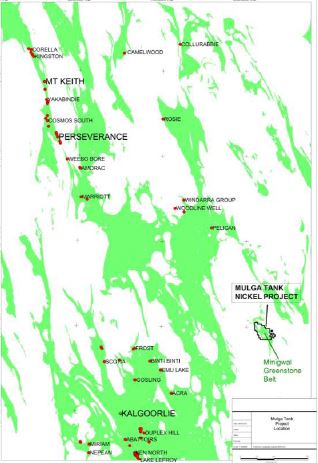
Impact has also completed a review of previous diamond drill core, which it said has confirmed much of the nickel sulphide mineralisation discovered at the Mulga Tank project is primary magmatic sulphide hosted in ultramafic rocks similar to those hosting the nickel deposits found at the Perseverance (45 million tonnes at 2 per cent nickel) and Mount Keith mines near Agnew in Western Australia.


Location of the Mulga Tank project and surrounding nickel sulphide
deposits (red dots) including the Mount Keith and Perseverance deposits.
Source: Company announcement


The company indicated that in places, the sulphide occurs as narrow massive layers up to several centimetres thick.

Impact recently acquired the rights to earn a 50 per cent interest in the joint venture from Golden Cross Resources (ASX: GCR) by spending $2.5 million by November 2nd 2017.

The Mulga Tank project is located 200km northeast of Kalgoorlie and covers 425 square kilometres.

It is located about 120km north west of the Nova nickel deposit of Sirius Resources (ASX: SIR) and 50km south west of the recent discovery of disseminated nickel sulphide at the BHP Billiton (ASX: BHP) and St George Mining (ASX: SGQ) Dragon project JV.