IMX updates Sleeping Giant Resource at Ntaka Hill

THE DRILL SERGEANT: IMX Resources (ASX: IXR, TSX: IXR) has updated the Mineral Resource estimate for the part of the company’s Ntaka Hill nickel sulphide project now referred to as the Sleeping Giant deposit.

The Ntaka Hill project is part of the company’s Nachingwea exploration project, located in south-eastern Tanzania.

IMX said the Resource estimate update provides further confirmation of the prospectivity of the area and the opportunity for future project development.

IMX said drilling completed in 2012 has confirmed the Sleeping Giant, L Zone, H Zone and NAD-013 deposit form one large mineralised system, which the company now refers collectively to as the Sleeping Giant deposit.


Plan view zoomed into the Sleeping Giant deposit, showing drill hole
collars and surface projection outline of resource estimate of
mineralisation. Source: Company announcement


The updated Mineral Resource for the Sleeping Giant deposit is comprised of:

–     An Indicated Mineral Resource of 17,200,000 tonnes at 0.49 per cent nickel for 84,280 tonnes of contained nickel; and

–    An Inferred Mineral Resource of 29,000,000 tonnes at 0.70 per cent nickel for 203,000 tonnes of contained nickel.

“We are pleased to release this updated Mineral Resource estimate for the Sleeping Giant deposit at our Ntaka Hill project,” IMX Resources managing director Neil Meadows said in the company’s announcement to the Australian Securities Exchange.

“The improved grade of the inferred portion of the resource is significant as is the demonstration of the linkage between the various zones referred to previously as being separate.

“In addition, current, near surface drilling has continued to expand the open pit potential at Ntaka Hill, while future planned drilling is aimed at investigating the area down plunge of the high-grade shoots within the Sleeping Giant deposit shown in the model output.”

Following a review in 2013 of the geological setting and structural controls of the project, IMX said it had applied a more conservative approach to applying material to the Measured and Indicated categories.

As a consequence, contained nickel in these categories has been reduced by 36,920 tonnes, however, contained nickel in the Inferred Resource category has increased by 99,500 tonnes at substantially improved grades.

The company has also applied a cut-off grade of 0.3 per cent nickel for the 2013 Mineral Resource models, as it considered this was more likely to represent an economic cut-off for open pit mining in either the current or forecast nickel price environments.

Gold Road survey identifies new targets

THE DRILL SERGEANT: Gold Road Resources (ASX: GOR) has identified 13 new high-priority gold targets from an Airborne Sub-Audio Magnetic (SAM) survey recently conducted within the Pacific Dunes – Corkwood Gold Camp, located approximately 65 kilometres north of the company’s Central Bore gold deposit of the Yamarna Greenstone Belt in Western Australia.

The Pacific Dunes – Corkwood Gold Camp is one of the targets Gold Road labelled as high-priority following a Regional Targeting exercise the company completed throughout 2012 and 2013.


Gold Road 100 per cent tenements and Gold Road-Sumitomo South
Yamarna Joint Venture tenements showing location of Gold Camps and Redox
targets. Source: Company announcement


The SAM survey covered an area of approximately 60 square kilometres (12km x 5km) covering a distance of approximately 582 line-kilometres with line spacing of 100 metres.

Gold Road described the The Pacific Dunes – Corkwood area as being characterised by the presence of sand and Permian sandstone cover up to 40 metres thick.

The depth of this overburden mas meant the majority of historical surface geochemistry is not effective.

“The identification of these 13 high-priority targets at Pacific Dunes – Corkwood enhances the results from the Regional Targeting exercises undertaken through 2012 – 2013 and the potential for future exploration of the other Gold Camp Targets,” Gold Road Resources chairman Ian Murray said in the company’s announcement to the Australian Securities Exchange.

“SAM is an excellent, quick and cost effective geophysical tool for gathering high-resolution subsurface information over a prospect scale area.”

Gold Road said it had also completed a SAM survey over its Breelya – Minnie Hill Gold Camp, which is within the Gold Road – Sumitomo Joint Venture Southern Tenements.

The interpretation of this survey is now in progress.

Gold Road indicated a drilling program in this area will be undertaken in Q4 2013.

Metals of Africa claims massive sulphide find

THE DRILL SERGEANT: Metals of Africa (ASX: MTA) has claimed discovery of a new high-grade lead base metal prospect, situated within the company’s 100 per cent-owned Rio Mazoe project, located in the Tete Province of Mozambique.

Metals of Africa (MoA) said it had identified a surficial occurrence (rock outcrop) of high grade lead mineralisation at Rio Mazoe in an area which is yet to be explored, but which the company considers to be prospective for Broken Hill Type-style mineralisation.


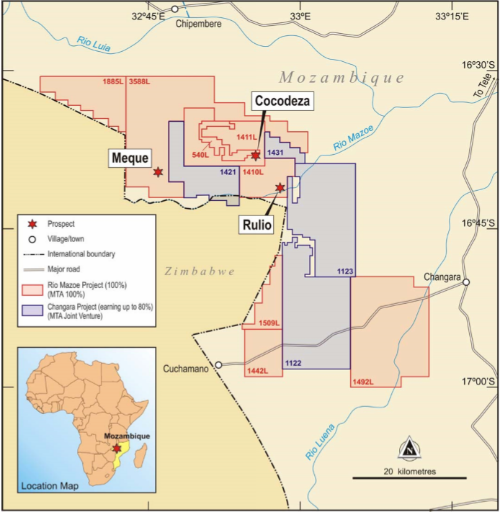
Location map of the Rio Mazoe and Changara projects showing the
recently discovered Rulio prospect together with the existing Meque and
Cocodeza prospects. Source: Company announcement


The company has recorded elevated lead grades ranging from 6.45 per cent to 79.9 per cent, with an average 44.2 of per cent lead from analysis of rock chip samples, utilising a portable XRF machine.

These rock chip samples have been sent for independent laboratory analysis.

The mineralised outcrop was discovered by the company’s geologists during a soil sampling program over an area it had identified due to its geological and structural setting.

MoA explained the mineralisation appears to be hosted on the contact of a medium grained quatzite unit and biotite-garnet-sillimanite schist, which at surface appears to be up to 1.5 metres wide.

This is largely covered by soil and MoA said detailed geological mapping followed by drilling will be required to determine the depth extent and dimensions of the mineralised occurrence.

“The discovery of outcropping high-grade lead within Proterozoic aged rocks displaying high-grade metamorphism and a complex deformation history is extremely encouraging because it ticks all of the right boxes for our search of a Broken Hill Type deposit,” Metals of Africa executive director Cherie Leeden said in the company’s announcement to the Australian Securities Exchange.

“We are continuing on with a regional soil sampling program, which to date has identified some impressive new surficial base-metal anomalism such as this lead discovery and the high grade copper outcrop announced last week.

“This work is a lead up to drilling and we’re expecting to have a number of exciting targets”.

MoA currently has a team of 12 people in the field at the Rio Mazoe project and at its neighbouring Changara Joint Venture project, conducting soil sampling and geological mapping of high-priority geochemically anomalies in areas that displayed elevated lead, zinc, silver, and/or copper during previous soil sampling programs.

The aim of the soil sampling is to discover mineralisation and define drill targets.

Rox Resources identifies Camelwood nickel targets

THE DRILL SERGEANT: Rox Resources (ASX: RXL) has completed a detailed analysis of regional data sets on the company’s recently-discovered Camelwood nickel sulphide deposit at Fisher East, located 500 kilometres north of Kalgoorlie in Western Australia.

According to Rox the latest work has enabled it to identify a number of additional high-priority nickel sulphide drill targets at Camelwood.

“Our first exploration program at Fisher East discovered the Camelwood nickel sulphide deposit, and with the number of high-quality targets identified by our team the chances of further discoveries are high as some of these targets show very similar features to our initial work at Camelwood,” Rox Resources managing director Ian Mulholland said in the company’s announcement to the Australian Securities Exchange.

“With very limited regional work done to date, it is likely that Fisher East is a nickel sulphide field, not just one isolated deposit, which is an intriguing and very exciting possibility.”

The work was carried out using a combination of recently-flown airborne magnetic survey data, a compilation of historic geochemical sampling (auger soils) undertaken in the 1970’s, and field prospecting and re-analysis of old RAB holes.

The result from all this is a number of excellent nickel sulphide drill targets have been developed, which display strong nickel-in-soil anomalism and/or anomalous values in historic RAB holes.

Rox explained these targets had not been previously analysed for nickel, and align with the prospective ultramafic horizon the company has identified from magnetics and a reinterpretation of earlier VTEM.

In some places the historic RAB chips are gossanous in nature and also record nickel analyses at a similar level to those initially found at the Camelwood discovery.

The company indicated its first stage of exploration will consist of RAB drilling over the targets followed up by either reverse circulation or diamond drilling.

At Diggers & Dealers last week Rox Resources announced encouraging drilling results from the first hole from the Teena prospect located on the company’s Reward zinc project in the Northern Territory.

Millennium Minerals confirms Au81 mineralisation and extends Golden Eagle

THE DRILL SERGEANT: Millennium Minerals (ASX: MOY) has received results from reverse circulation (RC) drilling carried out at the company’s Nullagine gold project, located in the East Pilbara district of Western Australia.

Millennium completed a combined total of 51 RC holes at the Au81 prospect and Golden Eagle deposit.

The company said the drilling had confirmed high-grades at the Au81 prospect, which it considers to demonstrate potential to form the next deposit at the Nullagine project.

The Au81 prospect is situated within two kilometres of the Golden Eagle processing facility.


Nullagine project location plan. Source: Company announcement


Highlights from the recent gold intercepts include:

–    22 metres at 12 grams per tonne gold from 14 metres, including 5 metres at 32 grams per tonne gold from 21 metres;

–    37m at 6.15g/t gold from 17m, including 7m at 12g/t gold from 18m; and

–    16m at 4.91g/t gold from 22m, including 2m at 17g/t gold from 31m.

Millennium indicated the results achieved at Au81 confirm the Main Zone high-grade shoot, with core gold grades of half to one ounce per tonne, saying the results validate historical intersections, confirm dips and highlight grades while demonstrating potential to form an economic deposit with further drilling.

The company also took delivery of results from drilling conducted at Golden Eagle.

This drilling encountered new intersections Millennium said had proven continuity of the Golden Eagle deposit footwall and main zone mineralisation at depth as well as demonstrating upside potential to expanded Resources and Reserves.

Gold intercepts from Golden Eagle include:

–    10m at 2.4g/t gold from 116m and 8m at 2.53g/t gold from 129m;

–    9m at 2.48g/t gold from 93m;

–    9m at 2.38g/t gold from 121m; and

–    7m at 2.98g/t gold from 106m, including 3m at 5.07g/t gold from 108m.

“The results demonstrate down dip continuity on both the Main Zone and Footwall zone of mineralisation,” Millennium Minerals said in its ASX announcement.

“They show potential to expand the Golden Eagle Resources and Reserves in two locations.

“Both of these areas also have good potential to deepen the adjacent pit designs with further drilling, with the effect of increasing the Resource and Reserve ounces and tonnes.

“Accordingly, a 500 metre follow-up program is being designed to further test these two areas.”

Robust Resources encounters further good drilling news

THE DRILL SERGEANT: Robust Resources (ASX: ROL) has received assay results for two further diamond drill holes recently carried out on the company’s Purple Heart prospect situated within the Lakuwahi Caldera on Romang Island in Indonesia.

The latest results have followed on from earlier work at Purple Heart, with both holes intersecting gold, silver and base metal mineralisation.

Robust has now completed 16 holes at Batu Perak including 10 at Purple Heart that have all intersected gold-silver mineralisation, some also with base metal values.


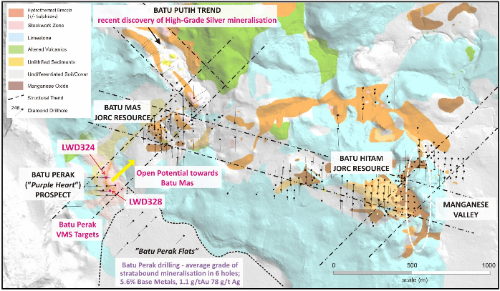
Geology Map of the central Lakuwahi Caldera showing drilling and
location of LWD 324 and LWD 328 in relation to mineral resources and
targets. Source: Company announcement


The recent drilling followed a recognised pattern with the upper sections of drill hole LWD 324 demonstrating enhanced assays for gold and silver, whereas the lower section is pervasively mineralised in base metals, in particular lead, zinc and copper, but also demonstrating gold and silver.

Results from LWD 324 include:

51 metres at 1.49 grams per tonne gold equivalent (AuEq) and 1.94 per cent base metals (BM) from 0 metres (0.73g/t gold, 36g/t silver, 0.29 per cent copper, 0.84 per cent lead, and 0.80 per cent zinc.

Including:

14m at 1.76g/t AuEq and 1.14 per cent BM from 2m (1.01g/t gold, 35g/t silver, 0.34 per cent copper, 0.62 per cent lead, 0.18 per cent zinc);
 
13m at 1.82g/t AuEq and 4.24 per cent BM from 36m (0.65g/t gold, 55g/t silver, 0.53 per cent copper, 1.72 per cent lead, 1.99 per cent zinc).

Robust highlighted the intersection in LWD 324 saying it demonstrates the Purple Heart zone remains strongly mineralised at the northern-most limit of the current drilling pattern.

This, the company said, combined with the orientation of the mineralised outcrops and geophysical evidence, suggests there may be a continuous zone of mineralisation beneath thin limestone cover, between Purple Heart and Batu Mas.

The second of the most-recent holes, LWD 328 intersected an even thicker, 108m mineralised zone but at a lower average grade of 0.53g/t AuEq.

“Assay results continue to demonstrate that Romang Island has multiple structures with high mineralisation,” Robust Resources managing director Gary Lewis said in the company’s announcement to the Australian Securities Exchange.

“Hole LWD 324 is another example of this, and the thick zones of gold and silver-rich polymetallic mineralisation are now the focus of current metallurgical test work.

“This test work is aimed at a new concept of processing both oxide and sulphide ores through a sizeable flotation plant, conceivably achieving enhanced metal recoveries overall and a more economic outcome.

“Currently seven diamond drill rigs are operating within the Lakuwahi Caldera, drilling for high-grade base metals, precious metals and manganese.

“An eighth rig is to commence drilling shortly.”

Core Exploration identifies 1km copper target

THE DRILL SERGEANT: Core Exploration (ASX: CXO) has claimed to have identified an undrilled, one kilometre-long copper target, which has previously returned assays up to 34 per cent copper at surface.

The target is a wholly-owned exploration licence (EL) application, situated within the company’s Albarta project, north east of Alice Springs in the Northern Territory.


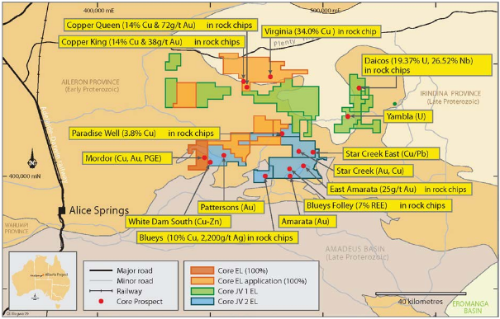
Core’s Albarta project tenements overlain on regional geology in the Northern Territory. Source: Company announcement


Core explained that rock chip sampling of malachite-stained rocks on the EL by previous explorers returned values typically in the 1 to 5 per cent copper range, with one hitting up to 34 per cent copper, within a stratiform copper horizon identified over one kilometre strike at Core’s Virginia prospect.

The Virginia copper prospect occurs in a distinctive garnet gneiss band within mafic gneiss.

Core said the previous soil sampling program was carried out on five lines on 600 metre by 50 metre spacing, coincident with a zone of alteration interpreted from Landsat images.

“A strong copper in soil anomaly was returned along strike from the main Virginia outcrop in both directions,” Core Exploration said in its ASX announcement.

“Despite the exceptional results, no drilling or geophysical surveys have been undertaken on the zone.

“Core’s planned soil sampling should identify any additional outcropping zones of mineralisation.

“The company also intends to undertake detailed geophysics over known areas of mineralisation to identify potentially larger mineral bodies at depth and determine drill targets.”

Core said it anticipated being in a position to commence field exploration on Virginia and in the previously announced Copper King area once the tenement has been granted, which it expects to occur later this month.

Centaurus Metals increases Brazilian iron Resources

THE DRILL SERGEANT: Centaurus Metals (ASX: CTM) has strengthened its position in south‐eastern Brazil with the release of a maiden JORC Mineral Resource estimate of 11.9 million tonnes at 43 per cent iron for the company’s 100 per cent‐owned Candonga project.

The Candonga project is a satellite deposit to Centaurus’ main Jambreiro iron ore project.

Centaurus said the new resource comprises 9.1 million tonnes of friable itabirite mineralisation at 43.8 per cent iron, which the company explained is similar to the material underpinning the Jambreiro project.

The Candonga resource also includes 0.88 million tonnes of high‐grade itabirite mineralisation at 58.6 per cent iron.

Centaurus anticipates this could be a potential source of coarse grained high‐grade direct ship material that would blend well with the Jambreiro sinter concentrate.

The maiden resource follows six months of RC drilling at Candonga and boosts Centaurus’ resource inventory in the Guanhães Region to over 167 million tonnes and takes the company‐wide resources in south‐eastern Brazil to over 216 million tonnes.

The new Candonga Resource follows the recently updated JORC Mineral Resource update for the Jambreiro project of 128 million tonnes at grading 27.2 per cent iron and the maiden JORC Mineral Resource estimate of 27.6 million tonnes at 30.5 per cent iron for the Canavial project, Centaurus announced in May.

The addition of the Candonga friable itabirite Resource to Jambreiro and Canavial projects, lifts the friable component of the company’s Guanhães Regional footprint to 89.2 million tonnes at 30.8 per cent iron (including the high ‐ grade itabirite resource), with 75 per cent of this resource base in the Measured and Indicated categories.

The new resource estimates for Candonga and Canavial have resulted in a 22 per cent increase Centaurus’ resource inventory in south‐eastern Brazil to over 216 million tonnes, with the friable component of its regional resource now standing at over 89 million tonnes.

“This represents a tremendous return on the funds invested in exploration drilling at these two prospects over the past six months and demonstrates the significant exploration upside of the region,” Centaurus Metals managing director Darren Gordon said in the company’s announcement to the Australian Securities Exchange.

“With Jambreiro moving rapidly towards development, we have now clearly demonstrated that we can add significantly to either the mine life or potentially the future production profile of Jambreiro from these satellite production areas.

“While there is a lot more work to do including metallurgical testwork and feasibility studies, we are confident based on what we already know that Candonga and Canavial will become part of our future growth plans at Jambreiro, further strengthening our footprint in the Guanhães region.”

Phoenix Gold confirms multiple mineralisation styles at Castle Hill

THE DRILL SERGEANT: Phoenix Gold (ASX: PXG) has received further results from drilling being conducted immediately north east of Stage 1 at the company’s Castle Hill gold project located on the Kunanalling shear zone in the Western Australian Goldfields.

According to Phoenix the drilling has extended gold mineralisation through the tonalite-basalt contact at depth and along strike of the Castle Hill resource, which currently stands at 23.54 million tonnes at 1.6 grams per tonne gold for 1,178,000 ounces.

“The more we drill at Castle Hill the greater our understanding of its potential,” Phoenix Gold managing director Jon Price said in the company’s announcement to the Australian Securities Exchange.

“The latest drilling within the adjoining basalt confirms continuous mineralisation within the tonalite is complemented with higher grade shear hosted mineralisation on the contact and within this basalt.

“With multiple mineralisation styles, orientations, and rocks types in this gold camp starting at surface, the endowment of this area is very robust and clearly justifies our large investment into this emerging new development centre.”


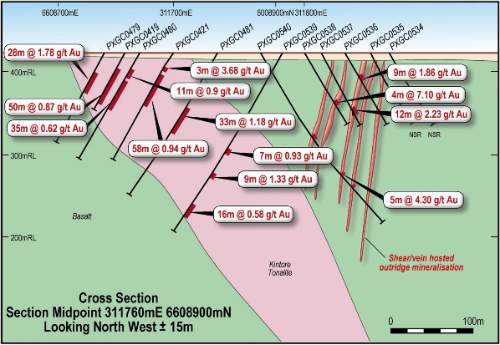
Castle Hill Stage 1 cross section 5. Source: Company announcement


During the recently-completed June Quarter Phoenix drilled a total of 53 Reverse Circulation drill holes totalling 7,444m immediately north east of Castle Hill Stage 1.

The company’s aim for the program was to test the mineralisation in the basalt contact and the basalt itself to the east of the Kintore Tonalite.

Highlighted mineralisation intercepts include:

–    70 metres at 1.7g/t gold from 113 metres;

–    10m at 6.6g/t gold from 67m;

–    31m at 2.7g/t gold from 16m;

–     79m at 1.2g/t gold from 48m;

–    47m at 1.8g/t gold from 107m;

–    2m at 24.7g/t gold from 126m;

–    33m at 1.8g/t gold from 178m; and

–    3m at 11.3g/t gold from 49m.

Phoenix said the drilling has also shown the supergene mineralisation in this area to be more extensive and higher grade than previously identified and provided confidence in the continuity of the high grade quartz veins within the sheared basalt.

The company considers the results to demonstrate mineralisation extends well beyond the Kintore Tonalite showing continuous grade and widths along strike and at depth as well as providing potential for the Stage 1 resource to grow both laterally and at depth with mineralisation remaining open in all directions.

Caravel Minerals claims Cloncurry-style discovery

THE DRILL SERGEANT: Caravel Minerals (ASX: CVV) has claimed discovery of broad zones of primary Cloncurry-style copper-gold mineralisation and alteration at the company’s Wynberg project, located 30 kilometres east of Cloncurry in North Queensland.

The new discovery follows on from drilling undertaken by Caravel in June this year targeting extensions to an existing JORC-compliant Inferred Resource of 3.1 million tonnes grading 1.4 grams per tonne gold for 140,109 contained ounces at Wynberg A.

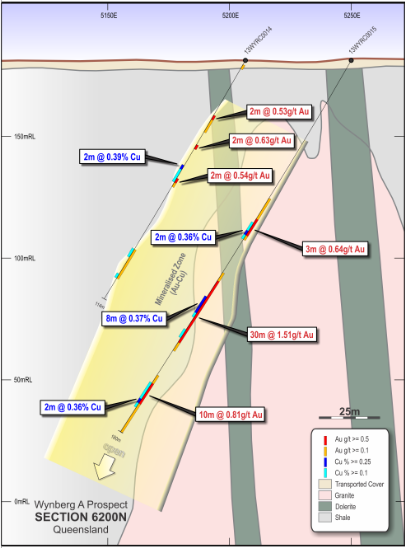
The drilling conducted to target extensions to the existing 140,000 ounce JORC gold resource at Wynberg A prospect where it intersected the broad zones of Cloncurry-style mineralisation and alteration.

Results include:

–    30m at 1.51g/t gold and 0.14 per cent copper from 106m;

–    18m at 0.75g/t gold and 0.01 per cent copper from 28m; and

–    10m at 0.81g/t gold and 0.18 per cent copper from 156m.

Caravel considers the latest results to have upgraded the potential and prospectivity of the Wynberg project.


Wynberg A prospect section 6200 north. Source: Company announcement


Caravel indicated the drilling had also identified a new semi-continuous zone of outcropping high-grade copper-gold mineralisation over a strike length of 3 kilometres, in the southern part of the Wynberg project at the Wynberg B.

Drilling at Wynberg B returned results including:

–    25 per cent copper and 1.6 grams per tonne gold;

–     15.6 per cent copper and 0.5g/t gold;

–    13 per cent copper and 7.7g/t gold; and

–     12.4 per cent copper and 1.3g/t gold.

Caravel said the intersection of the broad zones of primary copper-gold at Wynberg A, together with the zone of surface copper-gold at Wynberg B, could prove to be a game-changing development for the project.

“The entire area between these prospects has never been evaluated by systematic soil geochemistry–an approach which is now an immediate priority,” Caravel Minerals chief executive officer Marcel Hilmer said in the company’s announcement to the Australian Securities Exchange.

“This area is also traversed by the major NW-SE trending Fisher Creek Fault Zone, which has the potential to be an important control on mineralisation.

“While still early days, these are very encouraging developments and certainly upgrade the potential of the Wynberg project within our portfolio.

“The Cloncurry District is one of the most significant mineral provinces in the world, and having results like this on the doorstep of some of the great copper-gold finds of modern times, like Ernest Henry, is very encouraging.

“We intend to progress cost-effective and focused exploration activities at Wynberg to advance this project to the next stage, without compromising our ongoing focus on our prime asset, the Calingiri copper-molybdenum project in Western Australia.”