Monax Mining releases Wilclo South maiden Resource

THE DRILL SERGEANT: Monax Mining (ASX: MOX) has released a maiden JORC Inferred Mineral Resource for the Wilclo South graphite deposit on South Australia’s Eyre Peninsula.

The Wilclo South deposit forms part of the company’s 100 per cent-owned Waddikee project.


Location of the Waddikee project, central Eyre Peninsula. Source: Company announcement


The total combined Inferred resource Wilclo South deposit comprises 6.4 million tonnes grading 8.8 per cent total graphitic carbon (TGC) for the 550,000 tonnes of contained graphite using a 5 per cent cut-off.

The resource includes a high-grade component of 1.75 million tonnes grading 12.5 per cent TGC using a 10 per cent TGC cut-off.

The company stated the results confirm Wilclo South to now be comparable to other graphite deposits on Eyre Peninsula, which is emerging as a premier graphite province in Australia.

Monax will now undertake metallurgy studies and commence additional resource definition drilling at Waddikee’s nearby Francis prospect.

“Now that Monax has established a robust graphite resource at Wilclo South and further identified graphite potential at the Francis prospect, Waddikee will become a major focus for the company over the next 12 months,” Monax Mining managing director Gary Ferris said in the company’s announcement to the Australian Securities Exchange.

Monax explained the Wilclo South resource represents only a minor part of the potential graphitic horizon it has interpreted from airborne electromagnetic (AEM) data.

The company believes the interpretation is supported by limited drilling at the Francis prospect, which also reported high-grade graphite with up to 15 metres at 20.7 per cent TGC and 12m at 21.9 per cent TGC.

Both the Wilclo South deposit and Francis prospect are virgin discoveries with both targets based on interpretation of regional AEM data and a review of historical drill holes targeting base metals.

Initial exploration conducted by Monax at each target included ground electromagnetic (EM) surveys, which provided good quality data to assist with defining the dip of the prospective horizons.

“Monax is pleased with the results with Wilclo South now able to be compared to other known graphite deposits on the Eyre Peninsula,” Ferris said.

“We are excited about the inferred resource definition, as it provides further confidence in our strong belief that this is the first milestone in recognising, developing and upgrading our Waddikee graphite inventory.”

Monax identified a number of graphite prospects, Lacroma, Argent and Balumbah, during previous reconnaissance drilling and surface sampling in early 2012.

The company also encountered high grade intersections discovered during preliminary drill testing at the Francis prospect.

Francis is situated approximately six kilometres southwest of Wilclo South, on what the company interprets as a stratigraphic replication of Wilclo South due to a large geological fold structure in the area.

“This represents significant project upside on top of our Wilclo South inferred resource,” Ferris said.

“We are dealing with more than one graphite prospect within the Waddikee project.

“There are significant anomalous AEM targets right across the project area, many of which we already know contain graphite, and many that still remain untested under shallow sand cover.”

Monax will now undertake further work on the metallurgy of the deposit as well as undertaking further drilling at the Francis prospect to define a resource.
General Mining increases Chesterfield confidence

THE DRILL SERGEANT: General Mining Corporation (ASX: GMM) has been encouraged by recently-completed drilling at the company’s 100 per cent-owned Chesterfield gold project, located 50 kilometres north-west of Meekatharra in Western Australia.

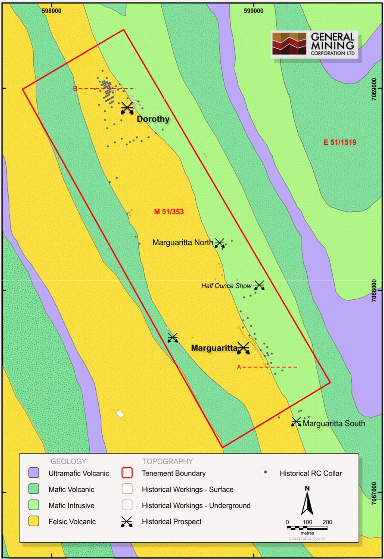
The latest results come from the Dorothy prospect at Chesterfield, where drilling targeted mineralisation associated with the main workings.

The drilling returned visible gold, which was observed in shear zone hosted quartz vein mineralisation, with notable intercepts including:
 
–    1 metre at 123.3 grams per tonne gold from 73.3 metres; and

–    1.75m at 13.83 g/t gold from 52.35m.

The company explained these results follow earlier RC drilling, which returned:

–    4m at 28.8g/t gold from 21m, including 2m at 53.9g/t gold;

–    5m at 5.4g/t gold from 38m, including 1m at 21.6g/t gold; and

–    4m at 33.81g/ t gold, including 2m at 61.3g/t gold.

“The latest results provided more firm evidence that Chesterfield has strong potential to host substantial high-grade resources,” General Mining Corporation chairman Michael Wright said in the company’s announcement to the Australian Securities Exchange.

“There is clearly the potential for a larger high-grade deposit between Dorothy and Marguaritta.

“Ongoing drilling will be aimed at testing for extensions to underpin a significant resource and therefore make Chesterfield a valuable source of high-grade ore in an area which already hosts several processing plants.”


Source: Company announcement


Dorothy sits about 2km along strike from the Marguaritta prospect, where earlier drilling returned high-grade results including:

–    5m at 2.73g/t gold from 13m; and

–    5m at 5.9g/t gold from 38m, including 2m at 12.2g/t gold.

General Mining has identified numerous targets it has tested by RC drilling and soil sampling over the 2km strike length between Marguaritta and Dorothy.

The Marguaritta deposit has been intersected over 950m from Marguaritta North to Marguaritta South and remains open to the north and south.

General Mining has additional diamond drilling planned at Dorothy to further test the mineralisation beneath the weathered zone and provide valuable information with respect to the geometry, grade and nature of the primary mineralisation.

Kidman Resources intersects thick copper zones at Home of Bullion

THE DRILL SERGEANT: Kidman Resources (ASX: KDR) has received assays results from a recently-completed RC drill program, which intersected thick zones of high-grade copper mineralisation on the Southern Lode at the company’s Home of Bullion project in the Northern Territory.

Results include:

–    10 metres at 3.56 per cent copper, 0.31 per cent lead, 2.46 per cent zinc, 13.17 grams per tonne silver from 49 metres, including 3 metres at 6.56 per cent copper, 0.3 per cent lead, 1.71 per cent zinc, 11.2g/t silver;

–    6m at 2.1 per cent copper, 0.43 per cent lead, 1.52 per cent zinc, and 17.2g/t silver from 154m, including 3m at 3.56 per cent copper, 0.43 per cent lead, 2.28 per cent zinc, 23.3g/t silver; and

–    15m at 1 per cent copper, 1.2 per cent lead, 2.11 per cent zinc, 34.6g/t silver from 133m, including 3m at 2.1 per cent copper, 0.23 per cent lead, 3.28 per cent zinc, 12.8g/t silver.


Southern Lode long-section showing recent copper intercepts. Source: Company announcement


“These RC drill holes have intersected some of the thickest massive sulphide zones on the Southern Lode and extended the strike length to the west by approximately 40 metres,” Kidman Resources managing director Shane Mele said in the company’s announcement to the Australian Securities Exchange.
 
“Importantly, these high-grade results are interpreted as close to true width.

“Down-hole electromagnetic (DHEM) surveys have identified these copper zones and further surveys are in progress to define diamond drill targets down plunge on both lodes.”

DHEM surveys on all peripheral drillholes and the broader zones of mineralisation are in progress to define new conductors down-dip and along strike to assist targeting drillholes for an upcoming diamond drilling program.

Kidman explained the upcoming diamond drilling program will commence shortly and has been designed to test the Main and Southern Lodes to approximately 600m below surface.

There will be two drill rigs onsite and the drill design will consist of two deep parent holes with multiple short daughter holes to reduce time and cost of discovery.

Ongoing DHEM surveys will be utilized in each drillhole to provide vectors towards stronger zones of copper mineralisation.

The company said it anticipates this program will have potential to add significant tonnage to the Home of Bullion deposit and fast-track the project’s development.

Sovereign Gold increases Mount Adrah resource potential

THE DRILL SERGEANT: Sovereign Gold (ASX: SOC) has boosted the JORC resource estimate at Pipe 1, located within the company’s Mount Adrah Hobbs gold deposit southeast of Wagga Wagga in New south Wales.

The increase is the result of an independent review based on exploration work completed so far and updated geological computer modelling by Melbourne-based Geosun Pty Ltd.

Sovereign Gold has reported the JORC-compliant resource estimate of Pipe 1 has increased to 650,027 ounces of contained gold at a grade of 1.23 grams per tonne.

Previously, the resource estimate was 239,000 ounces of contained gold at a grade of 1.13g/t.

The resource boost has also enabled the company to increase the conceptual exploration target at Pipe 1 to between 3.2 to 4.6 million ounces of gold from the previous target of 2.25 to 4 million ounces.
   
“Our confidence in the JORC resource uplift at Pipe 1 has been strengthened with the inclusion of the estimate in the Measured and Indicated categories,” Sovereign Gold chief executive Michael Leu said in the company’s announcement to the Australian Securities Exchange.

“It is exciting the company is able to announce a significant JORC resource uplift two months after drilling at Pipe 1 started.

“The consistency and presence of gold mineralisation throughout both drill holes enabled Geosun to quickly revise the JORC resource estimate.

“The next two drill holes will determine the strike length of Pipe 1, with estimations increased to between 250 to 300 metres.”

Sovereign Gold indicated it is fully-funded for the next two drill holes, plus further exploration work, after raising a total of $1.6 million through a share placement last week.

The Hobbs deposit sits on the same geo-structural system as Newcrest Mining’s Cadia Ridgeway gold mine – which hosts 60 million ounces of gold equivalent – and Rio Tinto’s eight million ounce gold equivalent Northparkes gold mine.

Rimfire Pacific further encouraged by latest Sopresa drill results

THE DRILL SERGEANT: Rimfire Pacific Mining (ASX: RIM) has received further encouragement from the first ever diamond drilling program being conducted at the company’s Sorpresa project, located near Fifield in New South Wales.

Four out of the five holes drilled have now returned gold and silver intersections with all holes intersecting the target ‘black silica’ stratigraphy, and by doing so expanding the company’s exploration target area.

Diamond Drilling Significant Intersections:

Newly Reported Intersection

Fi 325DDH

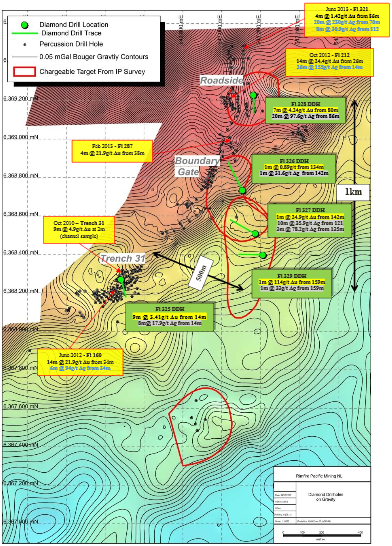
–    9 metres at 3.41grams per tonne gold from 14 metres, including 2 metres at 12.7 grams per tonne gold and 8 metres at 17.9g/t silver from 14 metres and 10 metres at 0.50g/t gold from 30 metres.

Previously reported intersections include:

Fi327 DDH

–    1m at 24.9g/t gold from 143m, 10m at 35.9g/t silver from 121m and 3m at 78.2g/t silver from 135m;

Fi 328 DDH

–    7m at 4.24g/t gold from 87m, including 1m at 22.7g/t gold, 20m at 97.6g/t silver from 80m, including 1m at 631g/t silver;

FI 329 DDH

–    1m at 114g/t gold from 159m, 1m at 33g/t silver.


Plan view diamond drill holes with main assay – Sorpresa project (with gravity and IP backdrop). Source: Company announcement


Rimfire explained diamond Hole Fi 325 DDH was drilled with the intention of providing the company with an understanding of the orientation and controls on high-grade gold mineralisation, whilst also examining the gold position in the oxide zone.

Rimfire considers this to have been achieved with mineralisation identified in the black silica horizon associated with localised brecciation, silicification and carbonate alteration.

The company said the diamond drilling program, as a whole, had delivered advances in the knowledge of the geology, alteration, mineralization, setting and style at Sorpresa.

Rimfire believes the combination of the intersections it has encountered in four out of five of the diamond holes undertaken at Sorpresa has elevated the project’s status to being an important component within a much larger area at Fifield.

The company intends carrying out further work at Sopresa, including constructing 3D models in preparation for systematic exploration and step out drilling, which it anticipates will commence in the next few weeks.

“The project’s first ever diamond drilling campaign has been incredibly successful,” Rimfire Pacific executive chairman John Kaminsky said in the company’s announcement to the Australian Securities Exchange.

“Intersecting bonanza grade at 1 metre at 114 grams per tonne gold, and significant width and grade mineralisation such as 7 metres at 4.24 grams per tonne gold, as previously reported, was very well complemented with 9 metres at 3.41 grams per tonne gold in hole Fi325 DDH.

“This is extremely pleasing to see.

“The current funding rounds, including the placement and the Share Purchase Plan (SPP) will enable the company to further develop the Sorpresa area.

“This will include systematic exploration east of the currently identified mineralisation towards the successful reconnaissance diamond drill results and beyond.

“The scale of the receptive geology and orientation of mineralisation especially in the Boundary Gate area has revealed significant scope for step out drill investigation and commencement of a drill program is anticipated in the coming weeks.”

Caravel Minerals identifies new Calingiri prospects

THE DRILL SERGEANT: Caravel Minerals (ASX: CVV) is excited about the identification of two new prospects at the company’s 100 per cent-owned Calingiri copper-molybdenum project, located 120 kilometres northeast of Perth in Western Australia.
 

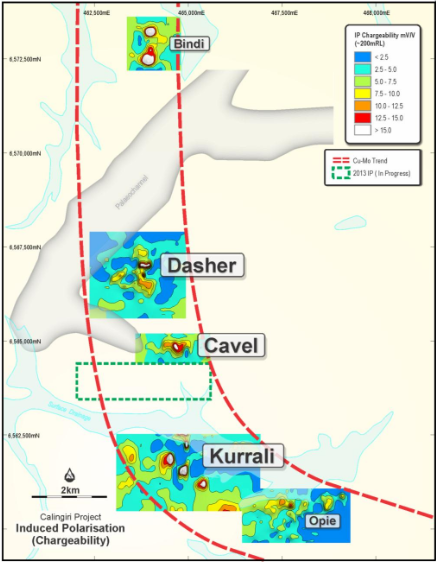
The new prospects, Cavel and Kurrali, are located 2.5 kilometres and 5 kilometres south of Calingiri’s main Dasher prospect respectively.


Calingiri Induced Polarisation (chargeability) targets and prospects. Source: Company announcement


The company considers the latest finds further highlight the exploration potential of a previously identified 30km-long regional copper-molybdenum trend.

Caravel recently announced an Exploration Target for Dasher of 60 to 100 million tonnes at 0.33 to 0.38 per cent copper with associated molybdenum, gold and silver.
 
A recently-completed Induced Polarisation (IP) survey at Cavel and Kurrali identified four strong chargeable anomalies the company has interpreted to reflect potential primary bedrock copper mineralisation.

Caravel considers these anomalies to be priority RC drill targets.
 
A recent report completed by consultants SGS Lakefield Oretest on the results of metallurgical testwork from Dasher RC drill samples indicate very encouraging first-stage rougher flotation recoveries of copper (up to 96.4 per cent), molybdenum (up to 98.2 per cent) and silver (up to 76.1 per cent).
 
Caravel said the new targets highlighted the potential for more ‘Dasherstyle’ systems to exist on the company’s freehold land at Calingiri.
 
“Importantly, both these new prospects have chargeable responses of similar magnitude and scale to those seen at Dasher, significantly increasing our confidence that these targets could host economic mineralisation,” Caravel Minerals chief executive Marcel Hilmer said in the company’s announcement to the Australian Securities Exchange.
 
“These strong results, in conjunction with the excellent initial metallurgical results at Dasher, further support the company’s belief that Calingiri could become a major new mining district on the doorstep of Perth.”

BrazIron updates Urubu Resource

THE DRILL SERGEANT: BrazIron (ASX: BZL) has reported an Inferred Resource for the company’s 100 per cent-owned Urubu iron ore prospect, which is part of its Xique Xique project, located in Bahia Province, Brazil.

The total JORC code-compliant Inferred Mineral Resource for the Urubu ore body now stands at 447.4 million tonnes at 25.3 per cent iron, comprising of:

–    A JORC code-compliant Inferred Mineral Resource of 317.7 million tonnes at 25.8 per cent iron estimated for the northern section of the Urubu ore body; and

–    A previous JORC code-compliant Inferred Mineral Resource of 129.7 million tonnes at 24.1 per cent iron for the southern section of Urubu.

“To finally complete our JORC reportable Mineral Resource is a great milestone,” BrazIron chief executive officer Brad George said in the company’s announcement to the Australian Securities Exchange.

“To now be able to quantitatively demonstrate significant tonnage of clean ore at Urubu, in conjunction with positive mining characteristics, positive metallurgy, encouraging transport options and developing local power and water infrastructure gives us confidence that we have the basis for an attractive mining operation at Urubu.

“We feel there is more ore to be found, but we now have the basis from which to advance the project as most of the components are now either in place or being put in place by third parties.”


Urubu prospect location. Source: Company announcement


BrazIron has almost completed a preliminary transport study to examine various options for movement of concentrate from Urubu to coastal ports.

A draft is being assessed now that has examined 10 potential transport routes utilising low cost barging and other existing or under-construction infrastructure.

The company has previously announced metallurgical results, which it said demonstrated the amenability of the Urubu ore to be beneficiated into a clean, high-grade concentrate of greater than 62 per cent iron.

It anticipates future studies will refine processing options in light of cheap power and water being available on or near site.

The company has also previously announced mapping results on leases to the north, which it considers leave open the potential for further exploration success.

BrazIron said the new resource, combined with the project’s positive metallurgy and promising transport options, allow the company to assess all commercial options, which may include moving the project into the feasibility stage.

King River Copper claims new Speewah Dome discovery

THE DRILL SERGEANT: King River Copper (ASX: KRC) has claimed discovery of visible surface copper occurrences on the company’s projects located in the north eastern corner of in the Speewah Dome in Western Australia.

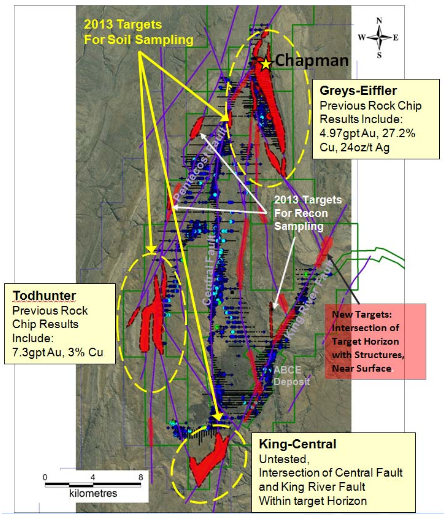
The new prospect area, which the company has named Chapman, was discovered by its geologists while they were conducting follow-up work on the source of a broad arsenic-in-soil anomaly and spot gold-in-soil anomaly.


Location of the new Chapman occurrence and the three high-priority
targets with anomalous copper and gold. Source: Company announcement


The company said numerous copper occurrences appear at Chapman, which are located in a one kilometre-long, north-west trending zone at the foot of a high escarpment, five kilometres north of the Greys-Hayden prospects.

Preliminary field analysis by Niton XRF has indicated these Chapman occurrences host a similar suite of mineral elements to that of the Greys-Hayden area, including copper, silver, lead, arsenic, antimony, bismuth, scandium, mercury and tin.

King River explained the need for the Niton field analyser results to be validated by laboratory assay, and to that end rock samples have been dispatched from the field.

The company anticipates those results will be available in two to three weeks.

King River said it has observed copper mineralisation has been observed in two different settings at Chapman: the first being sub-horizontal quartz veins and breccia along the sediment-granophyre contact; with the second being a hematite and quartz breccia in structure dipping 40 to 50 degrees northwest in granophyre and siltstone.

The company has lodged a program of works with the Department of Mines and Petroleum for drilling the soil covered areas at Greys-Hayden, Todhunter and Kings targets.

It will also submit a programme of works for drilling the new Chapman target once assays are received from a recent field survey and after further mapping and sampling is undertaken to define drill targets.

“The Directors are very excited by the discovery of this new copper prospect,” King River Copper said in its ASX announcement.

“Its location on the edge of the Speewah Dome associated with the targeted granophyre-sediment contact, with iron oxide rich breccia structures in the granophyre that have not been previously observed at Speewah, has opened up the potential for further discoveries of copper / gold mineralisation around the 30 kilometre-long Speewah Dome where this stratigraphic-structural configuration is found.”

Impact Minerals identifies ground EM anomaly at Broken Hill JV

THE DRILL SERGEANT: An ongoing review being conducted by Impact Minerals (ASX: IPT) of the recently-acquired Broken Hill Joint Venture project in New South Wales (IPT earning 80 per cent) has identified an electro-magnetic (EM) anomaly adjacent to the dormant Red Hill Mine.

Impact announced the confirmation of widespread high-grade copper, nickel and platinum group mineralisation in July this year.

Impact has reprocessed ground EM data acquired in 2005 at a broad line spacing of 200 metres, from which it says it has identified a previously unrecognised mid to late time conductor on two lines it considers may potentially be related to massive sulphide mineralisation.

The survey covered a part of the Red Hill prospect, recently highlighted by Impact, and which contains the dormant Red Hill Mine.

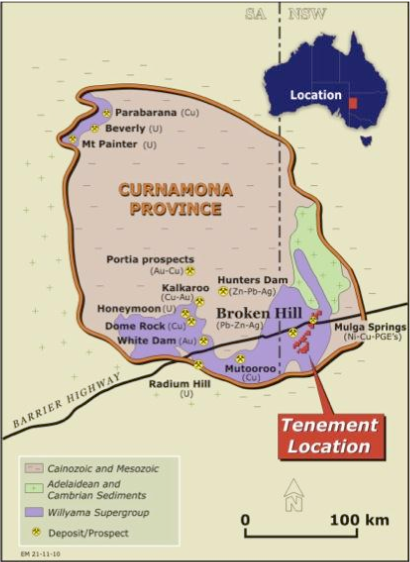
Impact explained the mine occurs close to the western contact of an ultramafic dyke that outcrops over an area of 500 metres by 250 metres and cross-cuts younger rocks of the Broken Hill Group in the Curnamona Province.


Location of the Broken Hill nickel-copper-PGE JV project. Source: Company announcement


“Again, these new findings at the Red Hill prospect, which we were unaware of when we purchased the joint venture rights to the project, have confirmed our view that the Broken Hill project is highly-prospective for high-grade copper-nickel-PGE mineralisation,” Impact minerals managing director Dr Mike Jones said in the company’s announcement to the Australian Securities Exchange.

“The EM anomaly is adjacent to the dormant mine and extends the prospect area to at least 500 metres of strike.

“Further work will undoubtedly identify some excellent drill targets.”

Impact said it has sourced mining records, which it claims suggest about 500 tonnes of ore was mined at Red Hill between 1906 and 1937, with face samples returning a grade range of 2 to 4 per cent copper, 2 to 3 per cent nickel, 5 to 41 grams per tonne PGE and 22 to 70 grams per tonne silver.

The company has interpreted the old data to indicate four parallel ‘lodes’, each 1m to 2.5m thick were mined. The lodes are open along strike and at depth.

In addition, previous rock chip assays taken over a 130m by 30m northeast trending area centred on the Red Hill Mine and close to the contact between the host ultramafic dyke and the surrounding rocks, returned a grade range of 1 to 36g/t PGE and 0.2 to 6.1 per cent copper and 0.2 to 1.9 per cent nickel.

The company explained these to be, in part, coincident with the EM anomaly. Follow up soil sampling using a hand held XRF machine is in progress.

The Red Hill prospect has not been drill tested.

Impact has a field program in progress at the Broken Hill project comprising field checking, soil and rock chip sampling and re-logging of previous diamond drill core.

Reprocessing of other EM surveys in the project area is also in progress.

Hannans Reward resplits assays and resizes gold intersection

THE DRILL SERGEANT: Hannans Reward (ASX: HNR) has revisited drilling results from the company’s 100 per cent-owned Pahtohavare project, located in northern Sweden.

In July the company reported initial one metre split assay results from samples where oxide copper mineralisation was observed.

Since then it has collected four metre composite samples throughout parts of the host unit which did not show visible copper mineralisation.

Where four metre composites returned values greater than 0.1 per cent copper, corresponding one metre splits were subsequently submitted for assay.

Hannans has now received assay results for re-split one metre assay results.

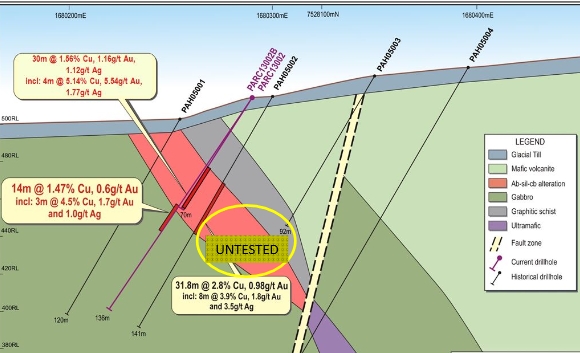
The company said the latest results confirm a 44m zone of copper-gold mineralisation was intercepted across holes PARC13002 and 13002B.

The initial reported intercept was 10m at 3.6 per cent copper, 2.7 grams per tonne gold and 1.8 grams per tonne silver from 60m in PARC13002.

The results included:

–    30m at 1.56 per cent copper, 1.16g/t gold, 1.12g/t silver from 40m (PARC13002); plus

–    14m at 1.47 per cent copper, 0.6g/t gold, 0.9g/t silver from 70m (PARC13002B).

This includes high-grade intercepts of:

–    4m at 5.14 per cent copper, 5.54g/t gold, 1.77g/t silver from 65m (PARC 13002); and

–    3m at 4.52 per cent copper, 1.69g/t gold, 1g/t silver from 73m (PARC13002B).

“It is important to note that drill holes PARC13002 and PARC13002B were started from the same point on the surface,” Hannans Reward said in its ASX announcement.


Drill Profile C showing assay results for PARC13002/PARC13002B. Source: Company announcement


“The first hole (PARC13002) was terminated at 70 metres due to difficult drilling conditions.

“The second hole (PAR C13002B) was cut below the casing at 24 metres before ending at 136 metres.

“The first hole was sampled from 0 to 70 metres and the second hole was sampled from 71 to 136 metres.

“Down hole surveying showed the dip of the second hole to be the same as the first; the second hole has deviated laterally to the north by a few metres only.”

Hannans is now waiting on assay results for the balance of drill holes completed at the Central Orebody in July 2013; a total of eight RC holes have been completed to date.