Golden Rim Resources hits new gold intersections at Balogo

THE DRILL SERGEANT: An ongoing auger drilling program being conducted by Golden Rim Resources (ASX: GMR) in the vicinity of the Netiana Lodes at the company’s Balogo project in Burkina Faso has outlined a number of new gold anomalies in weathered bedrock.

“The discovery of multiple gold anomalies in auger drilling, directly along strike/adjacent to the Netiana Lodes, is exciting news for the company,” Golden Rim resources managing director Craig Mackay said in the company’s announcement to the Australian Securities Exchange.
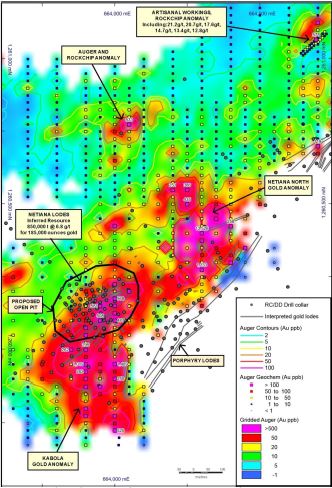
 

Location of the new auger gold anomalies at Balogo. Source: Company announcement


“We are currently exploring for satellite, open pittable, gold resources to add to our existing gold resource on the Netiana Lodes with the objective of increasing the mine life and enhancing the economics of our planned mine development at Balogo.

“The new auger gold anomalies present exciting new exploration targets for satellite gold mineralisation.”

According to Golden rim the recent drilling has outlined a new auger gold anomaly (Netiana North) in weathered bedrock, 300m northeast of the Netiana Lodes.

It has a very high peak value of 13,526 parts per billion (13.5g/t) gold, which Golden Rim said was its highest auger result ever obtained in West Africa.

The drilling has also identified another new auger gold anomaly (Kabola), with a peak value of 1,489ppb (1.5g/t) gold, again, in weathered bedrock, 100m south of the Netiana Lodes.

Golden Rim explained both of the new auger gold anomalies are larger in size and higher in tenor than the auger gold anomaly previously obtained over the high-grade Netiana Lodes, which covers an area of 300m by 150m and has a peak value of 581ppb gold.

The company expects to receive results from trenching across the Netiana North anomaly soon and follow-up RC drilling is planned at both Netiana North and Kabola.
Robust Resources confirms Romang Island silver discovery

THE DRILL SERGEANT: Robust Resources (ASX: ROL) has announced results from diamond drilling conducted on the Batu Putih trend on Romang Island, Indonesia.

The company said the drilling had confirmed the discovery of large-scale silver mineralisation resulting from a third significant intersection at Batu Putih from near surface.

The zone remains open along strike to the northwest and laterally.

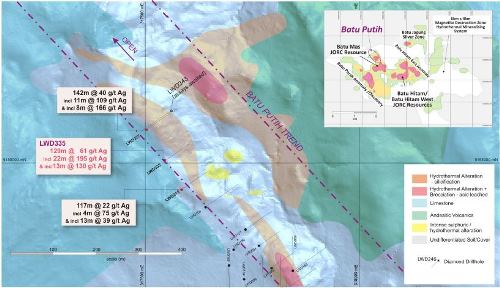
Diamond drillhole LWD 335 intersected:

129 metres at 61 grams per tonne silver from 7 metres, including sub intervals as follows:

–    58.9m at 122g/t silver from 8m;

–    22.2m at 194g/t silver from 9m; and

–    13m at 130g/t silver from 49.4m

The drilling also intersected a gold zone at 106m depth, including 6m at 1.69g/t gold.

The company explained the latest drilling was carried out 80m along strike, to the southeast of another recently-achieved intersection of silver mineralisation of 142m at 40g/t silver, including 11m at 109g/t silver and 8m at 166g/t gold.


Batu Putih geology, drill hole location and results. Source: Company announcement


Robust currently has seven diamond drill rigs operating on Romang Island across a number of prospective targets.

Due to the recent results from Batu Putih, the company is recommissioning an eighth diamond rig in order to fast-track exploration at its Batu Putih silver target.

“It is evident from the 35,000 metres of diamond drilling undertaken to date, and these recent assay results, that the Lakuwahi prospect hosts a sizeable silver-goldpolymetallic system,” Robust Resources managing director Gary Lewis said in the company’s announcement to the Australian Securities Exchange.

“With seven rigs drilling and an eighth to commence shortly, it is clear that the mineralised system and resource base on Romang is expected to keep growing.

“Commencing with a larger scale mining and processing operation from the outset, with potential to recover more of the precious and base metals, provides the Company with a real opportunity to maximise value from the Romang Island project.”

The silver mineralisation results it has achieved so far at Batu Putih has encouraged the company to commence a new conceptual study, introducing flotation at an earlier stage, and mining and processing the Lakuwahi deposits at a higher throughput than previously anticipated.

Robust is also assessing a lower-capex start-up mining operation targeting high-grade manganese ore, which it hopes may generate an early stage cash flow.

“With the support of our project partner the Salim Group, we are confident in our ability to fund a larger project,” Lewis said.

“As well as this new study, we remain committed to assessing the development of a low-capex, high-grade manganese mining operation, which we hope, will generate early cash and improve the overall project returns.

“We are very encouraged with the way Romang Island is shaping up, to the point where we have submitted an application for a mining license, and this marks an important step in the next phase of our growth.”

Gascoyne Resources extends Glenburgh deposits

THE DRILL SERGEANT: Gascoyne Resources (ASX: GCY) has encountered new gold intersections while conducting a recently-completed program of aircoe and RC drilling at the company’s 100 per cent-owned Glenburgh gold project in Western Australia.

Gascoyne said the drilling was carried out to target extensions to previously identified high-grades west of the Shelby deposit conceptual pit, which included up to 17 metres at 4.2 grams per tonne gold.

“Additional drilling was also conducted in the Tuxedo, Apollo and South West deposit areas,” Gascoyne Resources said in its ASX announcement.

“These positive drill results should extend the conceptual open pits at Tuxedo, Shelby and the South West deposits once included into an updated resource which is expected to be completed in the second half of 2013.

“Of particular note is that all of the intersections are shallow with many starting within 10 metres of the surface.”

Gascoyne said it had hit a number of intersections at the Tuxedo deposit, including 9m at 2.5g/t gold from 25m on the north western side of the conceptual Tuxedo pit.

The company indicated it expects this result to allow the expansion of the conceptual pit.

Infill holes intersected:

–    3m at 11.2g/t gold from 19m; and

–    6m at 1.2g/t gold from 12m.

Gascoyne said these hits had confirmed its resource interpretations.

It also claimed a further intersection of 13m at 1g/t gold from 37m to EOH on the south eastern edge of the conceptual pit had confirmed its interpreted eastern and depth extensions to the mineralisation.

Gascoyne said results from the Shelby deposit supported the company’s earlier wide-spaced RC drilling results and have confirmed western extensions to the Shelby conceptual open pit.

Other results from Shelby include:

–    6m at 1.4g/t gold from 10m;

–    9m at 0.9g/t gold from 2m; and

–    4m at 1.4g/t gold from 26m.


Glenburgh project aircore drilling results – Central Area. Source: Company announcement


“These new results and the rest of the previously reported 2013 drilling results will be incorporated into a resource update for the Glenburgh project, which is expected to be undertaken in late 2013,” Gascoyne Resources said.

The Glenburgh Feasibility Study is ongoing, for which the company said an update will be provided in the Quarterly Activities Report for the period ending 30 June 2013.

Further results and updates on the exploration activities at Glenburgh and Dalgaranga as well as the Glenburgh Feasibility Study will be provided as they become available.

Talga Resources doubles Swedish iron Resources

THE DRILL SERGEANT: Talga Resources (ASX: TLG) has received results from iron ore resource estimates across the company’s Vittangi project magnetite deposits in northern Sweden.

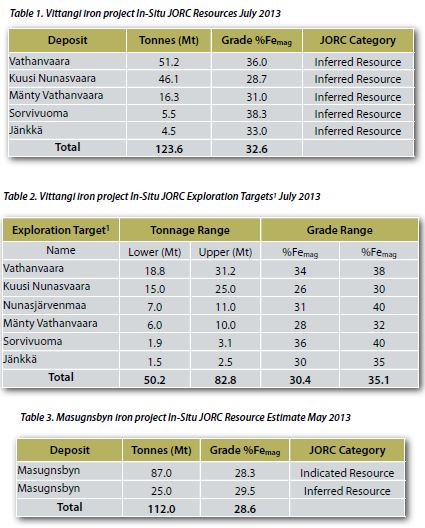
The latest work has provided a maiden JORC Inferred resource estimate of 124 million tonnes grading 33 per cent iron across Talga’s Vittangi project magnetite iron deposits in northern Sweden.

Combining the latest estimate with the company’s existing JORC resource at the Masugnsbyn iron project, 50km southeast of Vittangi, brings Talga’s total Swedish iron resources to 235.6 million tonnes at 30.7 per cent iron.

The historic exploration data has also defined additional JORC code-compliant exploration targets of 50 to 83 million tonnes grading 30 to 35 per cent iron present within the Vittangi project.

“The new Vittangi resources are higher grade than Talga’s Masugnsbyn iron ore project and lie 40 kilometres closer to rail infrastructure,” Talga Resources managing director Mark Thompson said in the company’s announcement to the Australian Securities Exchange.

“The new combined resource across both projects delivers an attractive opportunity for development, joint venturing or sale.

“Both iron projects are contained within the Kiruna mineral district, a mining province hosting the largest iron mines in Europe and are supported by established bulk commodity infrastructure including magnetite concentrators, iron pellet plants, grid power, public access rail and port infrastructure.

“Talga’s priority in Sweden remains development of our high grade graphite deposits, but these new iron results deliver another development or asset realisation opportunity.”


Source: Company announcement


Talga explained the new JORC compliant maiden Inferred Resource estimate stemmed from a recent review of historic drilling, geophysics and other data compiled by the Swedish Geological Survey.

The independently-completed resource estimation reviewed a total of 37 diamond drill holes for 6,055 metres.

The Vittangi iron project falls within the Kiruna mineral district which includes the Kiruna underground iron mine with an annual production capacity of over 26 million tonnes of ore.

Talga said iron deposits in the district typically utilise 25 to 45 per cent iron magnetite ore which is then milled and concentrated to 68 to 70 per cent for domestic steel mills or export markets.

Horseshoe Metals commences DHEM survey

THE DRILL SERGEANT: Horseshoe Metals (ASX: HOR) has begun a Down Hole Electromagnetic Survey (DHEM) at the company’s Horseshoe Lights copper-gold project, located 75 kilometres from Sandfire Resources’ (ASX: SFR) DeGrussa copper-gold mine, in Western Australia.
 
The company explained the aim of the DHEM survey is to test for off-hole conductors that may represent massive sulphide copper-gold mineralisation within the Narracoota Formation, where it lies largely untested beneath the overlying Ravelstone Formation.

The Narracoota Formation is the host of both the Horseshoe Lights and the DeGrussa deposits.

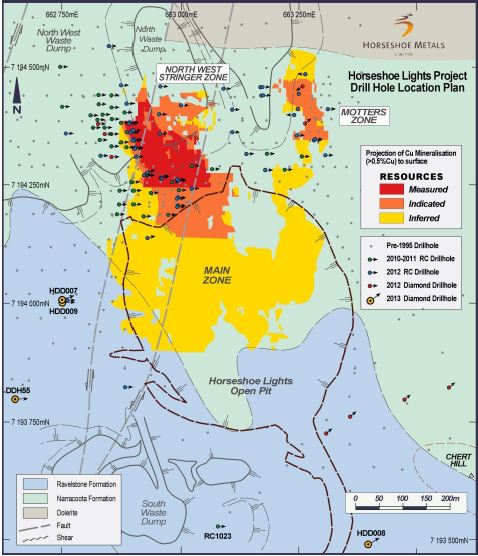
Five holes (RC1023, DDH55 and HDD007-009) have been earmarked for the DHEM survey the deepest of which being hole DDH55 at 706.6m deep.


Drill hole location plan. Source: Company announcement


In June this year Horseshoe Metals announced a 40 per cent increase in the in-situ Mineral Resource Estimation for the Horseshoe Lights project to 12.85 million tonnes at 1 per cent copper and 0.1 grams per tonne gold for 128,600 tonnes copper and 36,000 ounces of gold (using a cut-off grade of 0.5 per cent copper).

The company has also established a Mineral Resource Estimation for surface stockpiles and tailings at the Horseshoe Lights project, which stands at 1.7 million tonnes at  0.52 per cent copper for a further 8,800 tonnes copper.

“Combining the Mineral Resources detailed above with the earlier announced Mineral Resource Estimate for the company’s Kumarina project gives the company an overall copper metal inventory of 148,000 tonnes copper,” Horshoe Metals said in its ASX announcement.

“An interpretation of the DHEM survey results is expected to be available in August.”

Corazon Mining intersects massive sulphides at Top Up Rise

THE DRILL SERGEANT: Drilling being conducted by Corazon Mining (ASX: CZN) at the company’s Top Up Rise project (TUR) in the Gibson Desert region of Western Australia has encountered an intersection of a broad zone of sulphide mineralisation, including massive sulphide.
 
The company undertaking its inaugural drilling program at TUR with the primary target being an unexplored gravity anomaly, which Corazon claims to represent one of the largest amplitude residual gravity anomalies in Australia.

The core of the anomaly measures 10 kilometres by 6 kilometres and is located in an area considered favourable for Iron-Oxide Copper Gold (IOCG) mineralisation.

The third hole of the program has intersected a broad zone of sulphide mineralisation of 193 metres, including predominantly disseminated pyrrhotite, pyrite and chalcopyrite (copper-sulphide).

“The sulphides are hosted in altered amphibolites and quartz-biotite schists, between 288 metres and 481 metres down-hole,” Corazon Mining said in its ASX announcement.

“Within this zone, two intervals (between 326.6 to 329.05 metres and 367.3 to 369.3 metres) exhibit particularly strong sulphide mineralisation, including massive pyrrhotite, pyrite and chalcopyrite.”

Corazon said the drilling it has completed so far at TUR has identified a spatial and timing association between sulphide (particularly chalcopyrite) and magnetite mineralisation.

The company explained this was a positive result as the relationship is typical of distal mineralisation assemblages within many IOCG deposits.


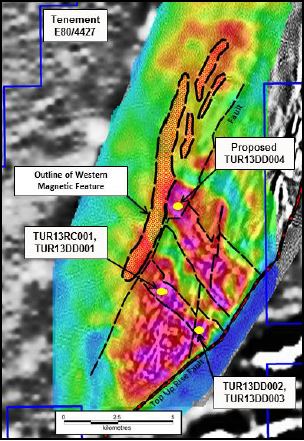
Drill hole location plan – Residual gravity image (colour) over
aeromagnetic image (grey-scale shadow). Source: Company announcement


In June the company announced it had intersected copper mineralisation with its first hole.

The latest hole has intersected greater sulphide mineralisation, including chalcopyrite, than previous holes of the program.

The second hole of the program was abandoned prior to reaching its target depth due to equipment failure down-hole.

However, Corazon said logging of this hole suggests mineralisation was improving down-hole, displaying similarities to the mineralisation intersected within the recently-completed hole.

“Samples from all drilling to date have been submitted for analysis,” Corazon said.

“Results are expected in August.

“Assays have been returned from the initial RC drill hole (TUR13RC001) into the basement.

“Sampled material includes predominantly quartz-biotite schist with minor disseminated pyrite.

“Analysis has indicated there is a robust base metal signature including an association between copper-lead-zinc-cadmium-silver, although, as anticipated, the tenor of metals within these rocks was low.”


Disclaimer: The Resources Roadhouse holds shares in Corazon Mining.

Sheffield Resources confirms potash at Oxley project

THE DRILL SERGEANT: Sheffield Resources (ASX: SFX) has completed its first RC drilling program at the company’s Oxley project near Three Springs in the Mid-west region Western Australia.

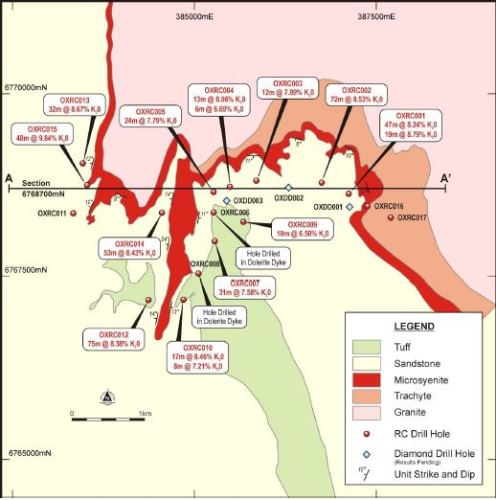
The company has reported the maiden 17-hole 1,704 metre program has returned thick, high-grade potash intervals including:

–    75 metres at 8.38 per cent potassium oxide from 7 metres to 82 metres, including 17 metres at 10.1 per cent potassium oxide from 50 metres;

–    72m at 8.53 per cent potassium oxide from 35m to 107m, including 11m at 10.1 per cent potassium oxide from 40m; and
 
–    48m at 9.84 per cent potassium oxide from 3m to 51m, including 39m at 10.4 per cent potassium oxide from 6m.

The drilling tested a target measuring eight kilometres strike length, returning mineralised widths up to 75m (average 36m) and potassium oxide grades up to 9.8 per cent (average 8.4 per cent) at a six per cent potassium oxide cut-off.


Oxley project drill hole plan with surface geology. Source: Company announcement


Sheffield said coherent higher grade zones occurs within these intervals with widths up to 39m (average 15m) and potassium oxide grades up to 10.4 per cent (average 9.9 per cent) at a nine per cent potassium oxide cut-off.

Sheffield also completed three diamond drill holes at Oxley, the drill core from which is currently being processed with results expected during Q3, 2013.

The drilling program was co-funded by the State Government under its Exploration Incentive Scheme (EIS).

“The results exceeded our expectations, particularly in terms of the thickness and continuity of the mineralised horizon,” Sheffield Resources managing director Bruce McQuitty said in the company’s announcement to the Australian Securities Exchange.

“Our Oxley potash project appears to have all the hallmarks of Sheffield’s target strategy; large-scale bulk mineral deposits within areas of established infrastructure.

“Additionally, the project is well located with respect to the high growth Australian and Asian fertiliser markets.

“The low-cost, staged approach to evaluating Oxley has proven successful to date and we will now progress to preliminary metallurgical testwork.

“Our work thus far has concentrated on only one quarter of the total strike length of the host unit and we hope to fully realise the ultimate potential at Oxley as further results become available.”

Hannans Reward encounters high-grade Swedish gold

THE DRILL SERGEANT: Hannans Reward (ASX: HNR) has received assay results for the first two Reverse Circulation (RC) drill holes to be completed at the company’s 100 per cent-owned Pahtohavare project, located in northern Sweden.

Hannans considers the results from drilling at the Central Orebody confirm the high-grade nature of the copper-gold mineralisation close to surface.

Additional samples have been sent to the laboratory for assay and results are pending.

The two holes intercepted a 46 metre zone of copper-gold mineralisation; within which samples were collected as both individual one metre samples and four metre composite samples (i.e. a sample collected from four individual metres and sent for assay as a composite).

The assay results received for the 1m samples include:

–    10 metres at 3.62 per cent copper, 2.7 grams per tonne gold, 1.79 grams per tonne silver from 60 metres, including 4m at 5.14 per cent copper, 5.54g/t gold, 1.77g/t silver from 65m; and

–    14m at 1.47 per cent copper, 0.6g/t gold, 0.9g/t silver from 70m, including 3m at 4.52 per cent copper, 1.69g/t gold, 1g/t silver from 73m.

“The assays for the four metre composites have been received and they also contain copper-gold mineralisation,” Hannans Reward said inits ASX announcement.

“Individual one metre splits of each four metre composite sample have been collected and submitted for analysis.

“When assay results are received for these one metre samples – estimated to be in early August – the full 46 metre zone of copper-gold mineralisation will be reported.”

Sheffield Resources completes first diamond drilling at Red Bull

THE DRILL SERGEANT: Sheffield Resources (ASX: SFX) has completed a round of diamond drilling at the company’s Red Bull nickel-copper project.

The Red Bull project is situated within 20 kilometres of Sirius Resources’ (ASX: SIR) Nova/Bollinger nickel-copper deposit, in the Fraser Range nickel province in Western Australia.

This was the first diamond drilling program to be carried out at Red Bull and was designed to test the source of three high-order bedrock conductors RB VA1 to VA3, which Sheffield identified from Fixed Loop EM surveys conducted earlier this year.

Three holes were completed, one at each conductor, with a total of 1,062 metres drilled.

At RB VA1, drilling intersected a 104.5m thick interval of moderately graphitic metasediment from 31.3m depth, containing four 0.8m to 4.7m thick zones of intense graphite mineralisation. This mineralisation will be further evaluated as a potential graphite deposit.

At RB VA2, drilling intersected 1m to 17m thick bands of weakly graphitic and sulphidic metasediment from 237.5m to 383.6m.

At RB VA3, drilling intersected a 3.8m thick zone of semi-massive and massive sulphide (pyrrhotite dominant) from 298.1m to 301.9m, followed by a 4.3m thick zone of disseminated sulphide and graphite in narrow bands from 301.9m to 306.2m.

The company said that although the diamond drilling results are not indicative of nickel sulphide mineralisation, further work will be undertaken to properly evaluate their significance.

“These are the first targets in our Fraser Range package that we have tested with diamond drilling,” Sheffield Resources managing director Bruce McQuitty said in the company’s announcement to the Australian Securities Exchange.

“With any large prospective land package in the Fraser Range, continuing systematic exploration is important for success.

“Two of the three diamond drill holes intersected anomalous mineralisation; one hit a wide zone of graphite, and the other massive and semi-massive sulphide.

“In addition to undertaking down-hole EM surveys, we will process and analyse the drill core for elements of economic significance.

“As part of our systematic exploration approach we are currently undertaking a regional aircore drilling program, which aims to generate new targets for subsequent RC/diamond drilling.

“This drilling is presently focusing on our Northern Drill Targets where nickel-copper prospective rock types have been intersected, consistent with a layered mafic-ultramafic intrusive complex, in an area where previous explorers report nickel-copper geochemical anomalism.

“Importantly, we remain well funded to continue our Fraser Range exploration program.”

MOD Resources hits gold via deep drilling

THE DRILL SERGEANT: MOD Resources (ASX: MOD) has encountered intersections of gold mineralisation while conducting deeper drilling of the Main Zone gold deposit at the company’s Sams Creek gold project in New Zealand.

The company said most of the drill holes it has completed in the Stage 2 program have intersected wide zones of moderate (2-3 grams per tonne) and locally-high (greater than 4g/t) grade gold mineralisation.

MOD explained this has supported its view that drilling it has carried out so far may have tested only part of what it considers to be a potentially large porphyry gold system.

MOD has now completed the Stage 2 drilling program it had designed to infill the current resource and upgrade 550,000 ounces of gold into the Indicated Mineral Resource category.

The resource upgrade is the main prerequisite for the company to increase its interest in Sams Creek to 60 per cent under the agreement it has with OceanaGold Corporation.

The agreement enables MOD to earn up to 80 per cent in the joint venture.

Latest results received by the company include:

–    63 metres at 2.4 grams per tonne gold from 197 metres including, 11 metres at 4 grams per tonne from 249 metres;

–    1.1m at 3.6g/t gold from 128.9m, including 6m at 11.5g/t from 147m; and

–    14.5m at 2g/t gold from 257m down hole depth.

“The Stage 2 drilling program at Sams Creek has been a great success,” MOD Resources managing director Julian Hanna said in the company’s announcement to the Australian Securities Exchange.

“Drilling was completed on budget and conducted to high safety and environmental standards, which is a credit to the project manager Paul Angus and his technical team on site.

“Drilling has produced very encouraging results, exceeded our expectations in terms of width and grade and has resulted in a far better understanding of the geometry of the Main Zone deposit.”