Impact Minerals review confirms copper nickel and PGE mineralisation

THE DRILL SERGEANT: Impact Minerals (ASX:IPT) has completed a review of its recently acquired Broken Hill Joint Venture project located within the Curnamona Province in New South Wales.

Impact is earning 80 per cent of the project.

Impact claims the review has confirmed widespread high-grade copper, nickel and platinum group mineralisation at the project’s Red Hill prospect.

The company said its on-going review of previous exploration results at the Broken Hill project has shown:

That around 500 tonnes of ore was mined from the dormant Red Hill Mine between 1906 and 1937, with face samples returning a grade range of:

2 to 4 per cent copper, 2 to 3 per cent nickel, 5 to 41 grams per tonne platinum group elements (PGE) and 22 to 70g/t silver;

Rock chip assays over a 130 m by 30 m area trending northeast from the Red Hill Mine, close to the contact between the host ultramafic intrusion and the surrounding rocks returned a grade range of:
     
1 to 36g/t PGE and 0.2 to 6.1 per cent copper; and

Previous exploration drilling has not tested the mineralised areas.

“These new findings at the Red Hill prospect, which we were unaware of when we purchased the joint venture rights to the project, have confirmed our view that the Broken Hill project is highly prospective for high-grade copper-nickel-PGE mineralisation and further complement the high-grade platinum and palladium results returned from the nearby Mulga Springs prospect,” Impact Minerals managing director Dr Mike Jones said in the company’s announcement to teh Australian Securities Exchange.

“Given that there are a few tens of kilometres of untested strike of the ultramafic intrusions elsewhere within the Broken Hill project area, I am confident that the on-going review will only lead to further exciting results for shareholders.”

Impact explained that the Red Hill Mine was mined for copper between 1906 and 1937 both at surface and underground, from a vertical shaft to a depth of 36m.

The company said mine records it has accessed indicate about 500 tonnes of ore was mined from four parallel ‘lodes’, each 1m to 2.5m wide.

Face samples from the underground mine returned a grade range of 2 to 4 per cent copper, 2 to 3 per cent nickel, 5 to 41g/t PGE and 22 to 70g/t silver.

The lodes are open along strike and at depth.

About 70 rock chip samples taken from the Red Hill Mine returned assays with a grade range of 1 to 36g/t PGE and 0.2 to 6.1 per cent copper near the western contact of the ultramafic rocks. These results have not been followed up.

Impact cautioned these assays may have been upgraded by near surface weathering.

It also said, however, that drilling at the Mulga Springs prospect beneath samples with similar surface grades has identified massive sulphide mineralisation in fresh rock at about 45m below surface with intercepts of:

4m at 17.9g/t platinum+palladium+gold, 2.3 per cent nickel and 3.2 per cent copper from 43 m; and

2.1m at 8.3g/t platinum+palladium+gold, 3 per cent nickel and 3.5 per cent copper from 45m.

Impact has commenced a field program at the Red Hill prospect comprising field checking and soil and rock chip sampling.

Re-processing of a previous ground EM survey over the area has also started.

The analysis and review of other exploration data is continuing. This will include the re-logging of previous diamond drill core that is stored at Broken Hill.
Stonehenge Metals records best Daejon drill result so far

THE DRILL SERGEANT: Stonehenge Metals (ASX: SHE) has announced chemical assay results from hole 5 of a 12 hole diamond drilling program currently underway at the company’s Daejon uranium and vanadium project in South Korea.

Stonehenge claims the results confirm a new mineralised zone of vanadium, as well as confirming previously reported uranium.

Highlights from the latest results include:

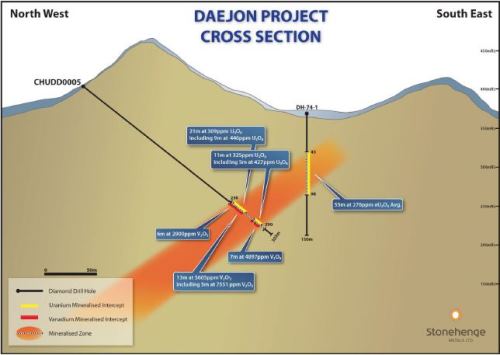
–    Intercepts of 52 metres true width respectively of mineralised zone of uranium and vanadium using 200 parts per million and 2,000ppm cut-off grade;

–    Chemical assay results continue to be consistent and comparable to stand-alone uranium and vanadium projects;

–    The Daejon mineralised system now is defined over six kilometres with consistent high-grade mineralisation throughout the Black Shales; and

–    High-grade mineralised zones may allow for selective mining subject to the continuity and distribution of these zones. This will be determined by further drilling.


Daejon project cross section CHUDD0005. Source: Company announcement


The results from the latest hole are similar to previous reports from Stonehenge in that the mineralisation remains open down dip and along strike.

The company anticipates additional drilling will increase the known dimensions of this zone.

“This hole has probably given us the best results to date with two distinct high-grade zones that contain both uranium and vanadium,” Stonehenge Metals managing director Richard Henning said in the company’s announcement to the Australian Securities Exchange.

“This will be of enormous benefit when it comes to modelling the operation and should have a strong impact on the economics of the project.
 
“I am really pleased that this short drilling campaign has shown vanadium grades comparable to stand alone vanadium operations, and as we work towards our maiden vanadium resource alongside uranium grades of plus-400 parts per million, as we have seen in this hole, together with proven co-extraction of both commodities – the future could be very rewarding.”

Southern Hemisphere Mining increases Llahuin Resources

THE DRILL SERGEANT: Dual-listed Southern Hemisphere Mining (ASX: SUH, TSXV: SH) has reported an increase in the Measured category of the Mineral Resource for the company’s Llahuin copper-gold project in central Chile.

The company said the increase provides it with further confidence in the robustness and quality of the deposit ahead of additional resource extension drilling planned for later this year.

The June 2013 Mineral Resource update includes the most recent drilling Southern Hemisphere has completed up to 31 March, 2013 under the Llahuin Joint Venture arrangements with global base metals miner Lundin Mining Corporation.

Southern Hemisphere explained that Lundin recently committed to proceed with the next phase of sole-funded exploration expenditure at Llahuin, comprising US$10 million to increase its interest from the current 20 per cent to 51 per cent.

Lundin can earn up to 75 per cent of the Llahuin project in three phases by spending a total of up to US$35 million.

Most of the recent drilling has been in-fill drilling, resulting in a substantial amount of material within the Indicated Resource category being upgraded to the Measured Resource category.

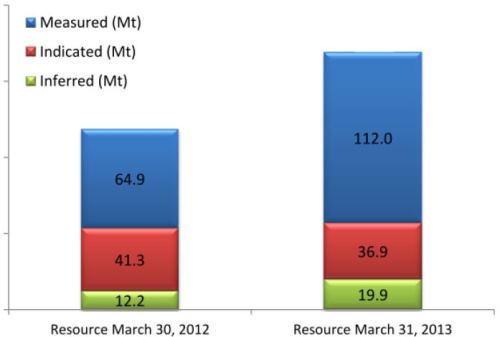
The Measured Resource for the Llahuin project now stands at 112 million tonnes at 0.42 per cent copper equivalent and equates to 344,000 tonnes of copper and 433,000 ounces of gold.

This represents a 26 per cent increase in Measured Resource tonnage, compared with the JORC and NI 43-101 Mineral Resource estimate Southern Hemisphere completed in September 2012, using the same 0.28 per cent copper equivalent cut off.

Additional drilling within the higher grade core in the Central Porphyry Zone has increased the Measured Resource in this section to 60 million tonnes, an 18 per cent tonnage increase, when compared with the September 2012 resource estimate.

The Inferred Resource of 20 million tonnes grading 0.36 per cent copper equivalent has increased by 20 per cent compared with the September 2012 Mineral Resource.

The overall Measured and Indicated Resource has increased compared with the September 2012 Mineral Resource (Measured and Indicated) of 145 million tonnes to currently sit at 149 million tonnes at 0.42 per cent copper equivalent.


Chart showing growth of the Llahuin project Mineral Resource during last 12 months of drilling. Source: Company announcement


The company indicated the increase reflects its focus on infill drilling within the Central Porphyry Zone.

“The increase in the Measured resource category gives the company greater confidence in the quality and potential of the Llahuin project as the foundation for future mine development,” Southern Hemisphere Mining managing director Trevor Tennant said in the company’s announcement to the Australian Securities Exchange.

“The next steps for this project will be to further expand the resource in the Cerro de Oro Zone and Ferrocarril Zones with ongoing drilling as these zones remain open.

“Comments contained within the independent resource estimate note that there are two higher grade drill hole intercepts at depth within the Ferrocarril Zone which require further drilling in the surrounding area.

“We believe we have a very significant copper-gold project on our hands at Llahuin and we are looking forward to progressing it to the next level.”

Ventnor Resources scores high assay results from visual intersections

THE DRILL SERGEANT: Ventnor Resources (ASX: VRX) has received further high-grade sulphide assays returned from previously announced visual intersections achieved during a deep drilling campaign at the company’s Thaduna/Green Dragon project in Western Australia.

High-grade assays from previous visual intersections include:

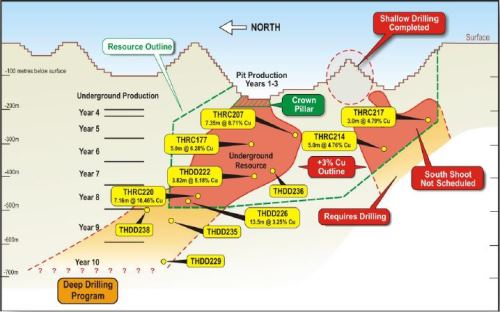
–    9.58 metres at 5 per cent copper from 612 metres down hole (THDD235);

–    23m at 3.66 per cent copper from 388m down hole (THDD236); and

–    6.15m at 9.94 per cent copper from 572m down hole (THDD238).

Ventnor indicated the assay results are to be included in a new Resource estimate.

The company reported holes THDD235 and THDD238 have extended the high-grade underground mineralisation while hole THDD236 was part of an infill drilling program conducted on the existing 142,200 tonne copper JORC code-compliant resource.


Completed drilling so far. Source: Company announcement


Ventnor has confirmed all of the visually identified intersections with high grade assays, which the company said confirms higher grades are coincident with bornite as the dominant sulphide mineralisation.

“We are pleased that the field observations of expected high grade zones have been confirmed by high grade assays,” Ventnor Resources managing director Bruce Maluish said in the company’s announcement to the Australian Securities Exchange.

“These intersections are some of the highest grade copper intersections reported in the last year in Australia and support the potential for underground production at Thaduna.

“We intend to follow up these intersections with further drilling as part of the Bankable Feasibility Study expenditure, which will better determine the extent of the high-grade mineralisation and lift the confidence in the Resource.

“Drilling to date has confirmed the continuity of the orebody to depth and also the high grade core.”

Enterprise Uranium granted drilling co-funding

THE DRILL SERGEANT: Enterprise Uranium (ASX: ENU) has been granted two applications for co-funded drilling by the Western Australia Department of Mines and Resources under Round 7 of the co-funded Government Exploration Incentive Scheme (EIS).

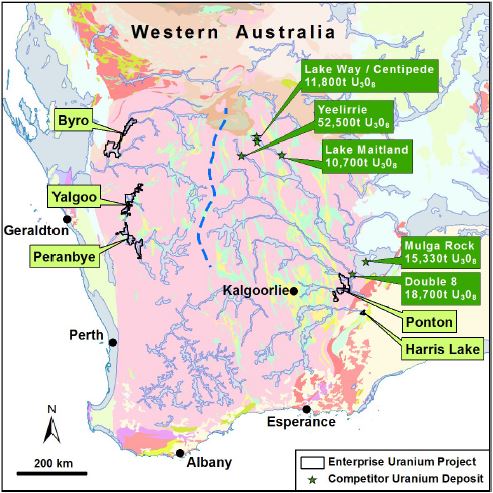
Enterprise is to receive a WA Government co-funded drilling grant of up to $75,000 for RC drill testing of palaoechannel uranium targets in the Byro project area, located within the valley of the Murchison River near Wooleen Station.

The company was also granted WA Government co-funding of up to $90,000 for RC drill testing of palaeochannel hosted uranium targets in the vicinity of Lake Yindana at the Ponton project in the Yilgarn Craton.


Project location plan. Source: Company announcement


“These awards, under independent peer reviewed competitive conditions, are a strong endorsement of the quality of the company’s targets and Enterprise’s technical capability,” Enterprise Uranium said in the company’s ASX announcement.

“The company expects to begin its drilling program at Byro in early July 2013.

“Enterprise also wishes to thank the WA State Government for its strong support of the mineral exploration industry through the Exploration Incentive Scheme.”
Under the terms of the Agreement with the Government, 50 per cent of company funds spent on the approved drilling programs at the Byro and Ponton projects will be refunded, up to the value of each grant.

The Round 7 funds are available for drilling up until 30 June 2014.

Metal Bank fieldwork returns high-grade gold and copper

THE DRILL SERGEANT: Metal Bank (ASX: MBK) has completed further fieldwork at the company’s Spinifex Ridge East project.

The Spinifex Ridge East project (80 per cent MBK) consists of two granted exploration licences over an area of 60.5 square kilometres, located approximately 50 kilometres northeast of Marble Bar in northwest Western Australia.

The project is situated 10km west of Haoma Mining’s (ASX: HAO) Bamboo Creek gold mine and one kilometre east of Moly Mines’ (ASX: MOL) Spinifex Ridge molybdenum-copper resource and iron ore mining operations.


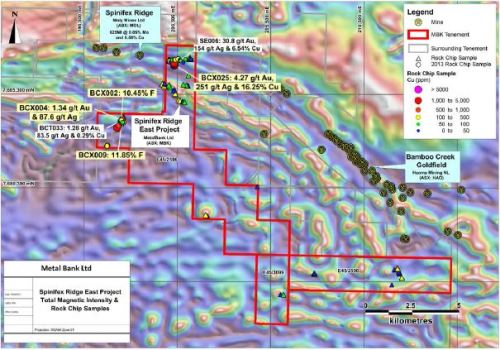
Sample results within Metal Bank’s Bamboo Creek tenements. Source: Company announcement


The latest fieldwork carried out by Metal Bank was carried out to follow-up results it had generated during rock chip sampling in 2012, which returned multi-commodity assays, including 30.8 grams per tonne gold, 154 grams per tonne silver and 6.54 per cent copper.

“Results from the recently completed program have confirmed the extent and tenor of the previously identified gold, copper and silver mineralisation, and have additionally identified anomalous fluorite mineralisation for the first time,” Metal Bank said in its ASX announcement.

During April 2013, Metal Bank carried out work over a number of known prospects at Spinifex Ridge East, including BC07, BC01, BC02 and Norms Find.

Previous exploration had identified mineralisation of 0.31g/t gold and 0.12 per cent copper at BC07; 30.8g/t gold at BC01; 154g/t silver at BC02; and 6.54 per cent copper at Norms Find.

Norm’s Find prospect

Five samples from this prospect returned anomalous results, including one sample which returned grades of 16.5 per cent copper, 4.27g/t gold, and 251g/t silver.

BC07 prospect

Metal Bank is of the opinion widespread anomalous gold and silver mineralisation exists at the BC07 prospect.

One sample from the latest work returned grades of 1.34g/t gold, and 88g/t silver, while anomalous fluorite grades of up to 11.5 per cent were returned from other samples.

“Fluorite at the reported grades is considered to be anomalous and further investigation of these areas to find economic zones will be considered in future programs,” Metal Bank explained.

“Fluorite is considered an industrial mineral and roughly half the world’s production of fluorite is used in the manufacture of hydrofluoric acid, which has a variety of uses, the most important of which are in the aluminum and chemical industries.

“Other uses include using fluorite as a flux in the production of steel and magnesium.”

Metal Bank considers both the Norm’s Find and BC07 prospects to warrant follow up work to assist in targeting for possible drilling in the future.

Ventnor Resources continues run of sulphide intersections at Thaduna-Green Dragon

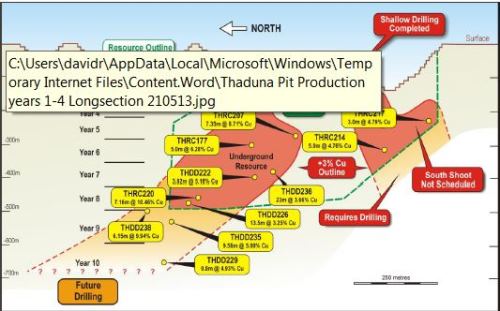
THE DRILL SERGEANT: Ventnor Resources (ASX: VRX) has achieved further sulphide intersections during a recently completed deep drilling campaign at the company’s Thaduna/Green Dragon project, located north of Meekatharra in Western Australia.

Ventnor said all the holes from the latest deep drilling campaign intersected visible copper sulphide mineralisation.

The company highlighted the significance of the continued presence of high-grade bornite and primary chalcocite within the mineralised zones.


The positions of the holes plotted on a long-section. Source: Company announcement


“We are further encouraged by these recent holes as they have similar mineralogy to previous high grade intersections and extend the known zone,” Ventnor Resources managing director Bruce Maluish said in the company’s announcement to the Australian Securities Exchange.

“Bornite has become the high-grade indicator in the deeper drilling and the dominant mineralisation encountered.”

Ventnor explained that Bornite contains highignificant levels of copper and is potentially high-grade ore when encountered.

“We continue to intersect widths of sulphide that potentially are suitable for economic underground mining,” Maluish said.

The company is now waiting on assays it expects will be delivered shortly from an additional four shallow diamond holes, which were drilled below the Thaduna pit to provide geotechnical and metallurgical samples and indicate significant widths of mineralisation.

The additional assay results would be included in an update of the current 142,200 copper tonnes JORC Resource for Thaduna/Green Dragon.

“We will incorporate these new hits into our updated Resource model to be used in the Bankable Feasibility Study,” Maluish said.

West African Resources releases Sartenga maiden Resource

THE DRILL SERGEANT: West African Resources (ASX: WAF) has reported a maiden Inferred Mineral Resource estimate for the company’s 100 per cent-owned Sartenga copper-gold-molybdenum-silver deposit, which is part of the Boulsa project in Burkina Faso.

The maiden Inferred Mineral Resource estimate contains 174,000 tonnes of copper, 651,000 ounces of gold, 11,000 tonnes of molybdenum and 2.5 million ounces of silver.

West African is currently drilling at Sartenga with two company-owned diamond rigs targeting a major Mineral Resource upgrade in both tonnes and JORC category by year end.

The independently-calculated maiden Inferred Mineral Resource comprises 70 million tonnes at 0.2 per cent copper, 0.3 grams per tonne gold, 166 grams per tonne molybdenum and 1.1 grams per tonne silver.

West African indicated the Inferred Mineral Resource also includes 57million tonnes of transitional and primary material at 0.6 per cent copper equivalent for some 316,000 tonnes of copper equivalent metal.


Sartenga June 2013 Mineral Resource outline. Source: Company announcement


“Our initial resource estimate for Sartenga is a significant achievement coming 12 months after discovery,” West African Resources managing director Richard Hyde said in the company’s announcement to the Australian Securities Exchange.

“In the past two months we have already shown that the Sartenga primary material is amenable to low-energy, coarse grinding and conventional flotation recovery methods, and is located close to existing rail infrastructure.

“We are one of the few companies in West Africa that will be drilling throughout the wet season and we intend to deliver a significant resource upgrade in both contained tonnes and Mineral Resource category in December this year.

“Drilling is ongoing and is focussed on the higher grade mineralisation in the core of the deposit and targeting extensions at depth.

“We have also reported an initial Exploration Target of 170 million tonnes to 250 million tonnes at 0.5 per cent to 0.9 per cent copper equivalent for Sartenga, which reflects the potential size of the mineralisation system at Sartenga.”

Azure Minerals hits 129m copper intercept

THE DRILL SERGEANT: Azure Minerals (ASX: AZS) has received results from the first three drill holes from the company’s Cascada copper-gold-silver project, located in the state of Chihuahua, Mexico.

Azure has received assays from the first three holes of the program, which include an exceptional drill intercept of 129 metres at 2.9 per cent copper equivalent (CuEq), including a high-grade zone of 10m at 14 per cent CuEq.

Two of the holes (APR-DD-089 and 090) returned long widths of copper, gold and silver mineralisation, including some high-grade intervals while the third hole (APR-DD-088) intersected minor copper mineralisation within a gold-rich zone.


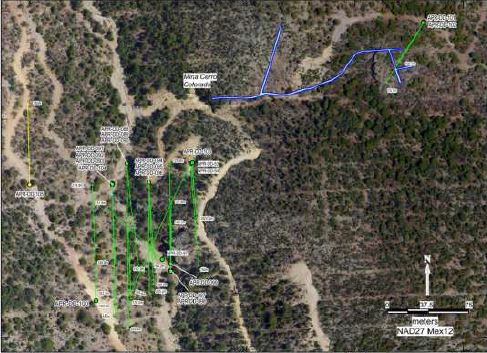
Cascada drill location plan with completed holes in green and planned holes in yellow. Source: Company announcement


“Not only have we hit a remarkable 129 metre long mineralised intercept in hole 089 grading 2.85 per cent CuEq, but hole 090 returned 70 metres at 1.9 per cent CuEq and hole 088 hit a gold-rich zone of 13 metres grading 2.1 g/t gold and 23 g/t silver,” Azure Minerals managing director Tony Rovira said in the company’s announcement tote Australian Securities Exchange.

“These are tremendous results for the first three holes drilled in this campaign.”

Individual samples returned assays up to 30.4 per cent copper, 9.2 grams per tonne gold and 658 grams per tonne silver.

Drill intercepts include:

APR-DD-088

–    12.7m at 1.95 per cent CuEq (0.38 per cent copper, 2.14g/t gold and 23g/t silver) from 79.3m, contained within a gold-rich zone of 23.7m at 1.49g/t gold and 16g/t silver from 72.30m.

APR-DD-089

–    128.95m at 2.85 per cent CuEq (1.95 per cent copper, 0.72g/t gold and 42g/t silver) from 41.2m, including an upper high-grade zone of 18.7m at 9.46 per cent CuEq (6.83 per cent copper, 1.02g/t gold and 180g/t silver) from 73.35m.

Includes an internal higher grade zone of:

–    10.03m at 14.3 per cent CuEq (10.2 per cent copper, 1.31g/t gold and 299g/t silver) from 76.07m

And a deeper high grade zone of:

–    30.95 at 3.05 per cent CuEq (2.16 per cent copper, 0.82g/t gold and 36g/t silver) from 123.35m

APR-DD-090

–    70.48m at 1.91 per cent CuEq (1.01 per cent copper, 1.09g/t gold and 22g/t silver) from 31.00m, including a higher grade zone of 10.16m at 3.97 per cent CuEq (3.26 per cent copper, 0.44g/t gold and 43g/t silver) from 85.55m.

“These exceptional drill results have delivered good widths of high grade copper, gold and silver mineralisation, with hole 089 returning a longer intercept at higher grades than the discovery hole 087.

“I believe these results confirm Cascada’s potential to host a significant body of copper mineralisation.

“Highlights are not only the widths of mineralisation intersected so far, but also the presence of high-grade copper in three of the four holes for which we have received assays.

“Combining this with the additional benefits of high grades of silver (up to 658g/t) and gold (up to 9.2g/t) makes Cascada a very exciting project indeed.

“We believe that, in addition to the already financially robust deposit we have defined at Promontorio, these Cascada results will lead to an increase in the project’s overall resource base and significantly enhance the economics of the project.

Phoenix Gold extends mineralisation at Castle Hill Stage 1

THE DRILL SERGEANT: Phoenix Gold (ASX: PXG) has received further results from drilling being conducted immediately north of Stage 1 at the company’s Castle Hill gold project, located on the Kunanalling shear zone in the Western Australian Goldfields, less than 50 kilometres from Kalgoorlie.

Phoenix Gold said the latest results have extended gold mineralisation at depth and along strike of the resource at Castle Hill, which currently stands at 23.54 million tonnes at 1.6 grams per tonne gold for 1,178,000 ounces.


Phoenix tenements, project location and Resource summary. Source: Company announcement


The latest drilling results include:

39 metres at 4.8 grams per tonne gold from 59 metres;

67m at 2.1g/t gold from 76m;

85m at 1.2g/t gold from 57m;

22m at 3.2g/t gold from 108m;

63m at 1.12g/t gold from 17m;

47m at 1.5g/t gold from 47m; and

14m at 3.9g/t gold from 127m.

“The excitement around the large intercept reported at the end of last year has certainly been justified with these latest results from the extensional program,” Phoenix Gold managing director Jon Price said in the company’s announcement to the Australian Securities Exchange.

“Given these results will potentially increase the resource envelope up to 300 metres north and at depth demonstrates the potential of our first large scale mine development.

“The drill out of Castle Hill Stage 1 is now complete and I look forward to releasing the results aimed at converting our Inferred resource to Indicated category, as well as a resource update for Stage 1 over the coming weeks.”

During the March and June Quarters 2013, Phoenix Gold completed a total of 44 Reverse Circulation (RC) for 6,461m north of Castle Hill Stage 1.

The aim of the program was to follow up extensional drilling from November last year, from which an intercept of 94m at 2.6g/t gold was reported 100m to the north of the current resource envelope.

The program also tested depth extensions below the current resource depth of 85m from surface.

Phoenix said the results demonstrate mineralisation extends while demonstrating continuous grade and widths along strike and at depth.

The company considers the results provide potential for the Stage 1 resource to grow both laterally and at depth with mineralisation remaining open in all directions.

A program of infill drilling has been conducted at Castle Hill Stage 1 to enable conversion of the Resource to the Indicated category for inclusion in an open pit Reserve study as part of a Definitive Feasibility Study due for completion in December 2013.

The infill drilling results are expected for release early in the September Quarter while an extensional RC and diamond drilling program has commenced.

The company is focussed on growing the resource position at Castle Hill and Red Dam and achieving its interim target of four million ounces by December 2013.