


Aguia Resources hits promising Brazilian phosphate
THE DRILL SERGEANT: Aguia Resources (ASX: AGR) has received results from a program of mapping, rock, soil and auger sampling the company recently completed at its Joca Tavares project located in the state of Rio Grande do Sul in southern Brazil.
Aguia said the recent work was conducted in order to delineate the dimensions of the Joca Tavares carbonatite for follow up programs of drill testing.
The company has completed 41 shallow auger drill holes so far and has received assays for the first 26 holes, 15 of which returned intersections of phosphate mineralisation from surface at similar grades to the company’s recent discovery at Três Estradas.
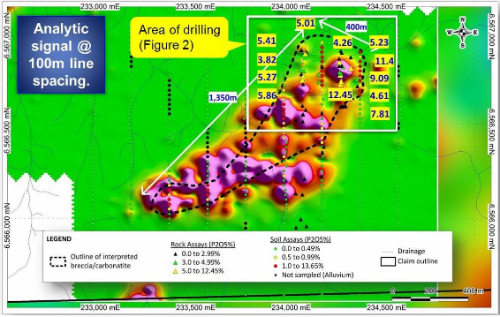
Mooca Tavares – Ground magnetic image, interpreted outline of
carbonatite, soil and rock chip assay results and area of drilling.
Source: Company announcement
Aguia said its previously reported auger assay results of up to 14.7 metres grading 10.8 per cent phosphate are now supported by further auger hole results that include:
9 metres at 11.5 per cent phosphate from surface (hole ended in mineralisation);
3.8m at 13.7 per cent phosphate from surface (hole ended in mineralisation);
3.5m at 12.1per cent phosphate from surface (hole ended in mineralisation); and
2m at 12.8 per cent phosphate from surface (hole ended in mineralisation).
Aguia explained Joca Tavares is yet to be drill tested and said these early results indicate phosphate bearing carbonatite host rock is present over an extensive area.
“We are extremely pleased with the ongoing shallow auger results from Joca Tavares that have now delineated an extensive zone of phosphate mineralisation from surface over a wide area,” Aguia Resources managing director Simon Taylor said in the company’s announcement to the Australian Securities Exchange.
“The results are very similar to the initial test work completed at Três Estradas where follow up drilling confirmed a JORC-compliant phosphate resource.
“With this second discovery we believe the projects located in Rio Grande do Sul have the potential to form a solid basis for future project development opportunities including a potential early start up and cash flow from the easily accessible shallow oxide material that extends from surface.”