Echo Resources hits impressive gold at Julius discovery

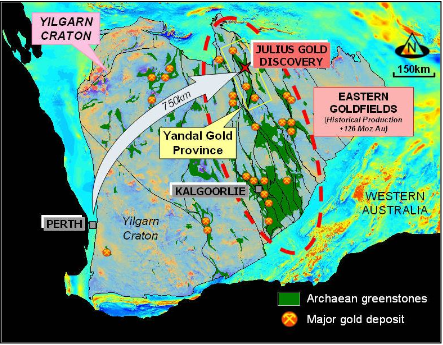
THE DRILL SERGEANT: Echo Resources (ASX: EAR) has announced high-grade gold fire assay results from Reverse Circulation and Diamond Core drill holes completed at the company’s Julius discovery, located in the Yandal Gold Province, approximately 750 kilometres northeast of Perth, Western Australia.


Location of the Julius discovery within the Yandal Gold Province. Source: Company announcement


In its announcement to the ASX, Echo indicated the gold lodes at Julius are hosted by weathered and fresh ultramafic, mafic and granodioritic rocks within and adjacent to the west-dipping Julius Shear Zone.

The company said the fire assays it has conducted have confirmed the presence of high gold grades in step-out drill hole ERC186, which was collared 300m west of the main drilling area at Julius.

Assays from ERC186 included:

5 metres at 21.6 grams per tonne gold from 235 metres, including 3m at 35g/t gold from 235m – with a peak assay of 1m at 90g/t gold from 236m.

Echo explained the high-grade gold zone in ERC186 is hosted by altered mafic rocks above the Julius Shear Zone.

The drilling of ERC186 also struck a second zone of gold mineralisation lower down, hosted by mafic-ultramafic and granodioritic rocks within the Julius Shear Zone.

The lower mineralised zone returned an intercept of:

7m at 1.8g/t gold from 270m, including 1m at 4.4g/t gold from 270m.

Echo Resources has interpreted ERC186 to have intersected potential down-plunge extensions of the Julius gold system.
 
Other notable fire assay results included:

ERCD208:
19.1m at 8.1g/t gold from 49m, including 5m at 21.7g/t gold from 54m, including 0.8m at 8.1g/t gold from 58.2m;

ERC206:
9m at 1.3g/t gold from 134m; and

2m at 13g/t gold from 187m to end-of-hole, including 1m at 21.6g/t gold from 187m.

ERC194:
10m at 1.7g/t gold from 43m; and

14m at 3.5g/t gold from 76m, including 5m at 6.9g/t gold from 76m.

ERC198:
3m at 2.7g/t gold from 12m; and

2m at 6.1g/t gold from 51m, including 1m at 10.9g/t gold from 52m;

ERC200:
6m at 3.1g/t gold from 12m; and

4m at 3.9g/t gold from 12m.

ERC192:
2m at 6.7g/t gold from 76m, including 1m at 11.4g/t gold from 76m.

ERC201:
7m at 2.4g/t gold from 13m, including 2m at 4.1g/t gold from 15m; and

4m at 2.1g/t gold from 25m.

ERC197:
12m at 1.7g/t gold from 41m.

ERC196:
6m at 1.7g/t gold from 31m.

Website:
www.echoresources.com.au

How are Australian Resources fairing since the Election?

Tony Abbott promised on winning the election that he would ‘reboot’ the mining boom.

Understandably there are concerns within the government about future projects being planned by some of Australia’s largest mining companies and their inability to raise the necessary finances for their projects to go ahead at this time.

The Australian government is concerned about the prospect of a drop in mining investments and its effect on budget revenues, already tracking below levels forecast before the election.

Decisions in the past year by miners to shelve major projects such as BHP Billiton’s expansion of the Olympic Dam mine in outback South Australia, Caterpillar cutting a further 200 jobs from its Tasmanian Burnie mine, further BHP Billiton withdrawal as the preferred developer of terminal 2 at the Port of Abbot Point plus they’ll not go ahead with the rail line linking the port with Bowen Basin mines, representing a loss of $5 billion.

Add to this about $150 billion worth of resource projects that have already been shelved, while at the moment some of the country’s biggest future resource projects are coming up to the stage where a decision will have to be made regarding their viability.

This news has prompted the former Labor government to argue the ‘investment stage’ of the mining boom was over.

The Treasurer Joe Hockey recently argued that the Liberals benchmark policies to dump the mining and carbon taxes were crucial to growth.

“Getting rid of things like the mining tax and the carbon tax will help to grow the Australian economy, there is no argument about that,” Hockey said.

“You have got to get rid of the speed humps.

“Speed humps are excessive regulation, excessive taxation and ultimately poor, inconsistent government. We are addressing all of those things.”


Already industry leaders are fearful that the high dollar plus the threats by the Labor and fringe parties to block the purposed reforms when they reach the Senate, with the appreciating dollar meaning that ‘returns are dropping’ for investors and this makes it important to directly address the underlying issues of economic reform.

The parliament needs to allow the government to carry through on its elect rial promise of reform irrespective of the agenda of defeated or fringe parties!

While this Australian internal struggle is taking place we are losing ground to the increasingly completive pressure from South/North America plus Africa.

So is it all gloom and doom?

Well not really, because there keeps coming snippets of good news from different sectors of the resources industry, for example Iron ore exports from Port Hedland were almost unchanged in October, with in fact a jump in shipments to China but this was balanced by lower deliveries to Japan and South Korea.

Port Hedland being one of the world’s largest iron-ore export terminals announced the encouraging news that October’s exports to China rose 10 per cent to 25.2 million tons.

While BHP-Billitton, raised its outlook for full year iron ore production following a reported record output from the expanding Pilbara mining hub in Northwest Australia.

With continued media reporting of China’s economy slowing down being at the moment proving wide of the mark, in fact the September iron ore exports hit a record 74.6 million tons, which is up 15 per cent on the year.

Compared with year earlier volumes, exports via Port Hedlands in October are 33 per cent up, with shipments to China being 43 per cent higher.

According to one of China’s top corporate officials, Xiong Weiping, head of Chinalco, China is still in the midst of the urbanisation process with several decades to run while still demanding the continued strong demand for minerals.

Chinalco is China’s largest nonferrous metals enterprise principally engaged in mineral resources development, nonferrous metals smelting and processing, related trading as well as engineering and technical services.

Chinalco is the world’s second largest alumina producer among many other strings to its bow, so Xiong Weiping knows what he’s talking about.
 
In words that will be of comfort to Australian iron ore exporters, he said that 52 per cent of the Chinese people now live in urban areas and that rate has been growing by about 1 per cent each year.

Based on the current speed, urbanisation will continue to boost China’s domestic demand for at least the next 30 years before it reaches the rate of 80 per cent, was his conclusion.

Confidence has picked up a little with the end of what seemed a never ending election period and as concern over the ‘end of the mining boom’ has receded.

For a while, the focus was on the damage to the economy.

But those fears have receded with the recognition that the impact of falling resources investment will be offset by growth in minerals production and exports.

We seem to be reconciled to be operating in an environment of continued slow growth.

And, with the prospect of tight expenditure and falling public investment adding to the negative impact of falling private resources investment, that’s what we’ll have to look forward to until the next economic spike comes along.

Clearly the residential market has picked up in the last few months since the election, but only in certain regions.

That’s not enough by itself, to boost national growth.

While there seems little prospects of any easing of the determination with which cost cutting is being pursued in either the private or public sectors.

The extent of spare capacity suggests continued deferral of any upturn in non-mining business investments which will need to be underwritten for stronger growth.

On the surface there looks to be at least two years before things start to move again.

The dollar has slightly fallen, but still remains too high, this delays the structural changes that will be an essential ingredient to rebalance the Australian economy back towards domestic trade exposed industries.

The fall has helped to take the pressure off Australian Exporters, but not enough to stimulate growth.

Renewed investor confidence is tending to strengthen the dollar. That’s not good.

So how is Australia going since the Election?

Australian consumer sentiment lifted 1.9 per cent this month to a three-year high.

This month’s report comes after two massive lifts in August and September, with consumer sentiment rising a whopping 4.7 per cent after the Federal Election.

Westpac Melbourne Institute Index of Consumer Sentiment lifted to 110.3, suggesting that consumer confidence is on its way back to July-December 2010 highs.

Similarly, business confidence – measured by NAB’s monthly business survey – rocketed immediately after the election but fell back down in October according to data released last week, suggesting that business and consumer confidence hadn’t yet translated to better trading conditions.

Westpac’s November survey interviews were conducted during the Melbourne Cup week, when the Reserve Bank kept rates on hold and the unemployment rate held at 5.7 per cent.

Westpac chief economist Bill Evans noted that while the official unemployment rate held, the October labour force report actually depicted a ‘very weak labour market’, reflecting in an unemployment expectations sub-index rising 0.9 per cent to 144.7.

Interestingly, while this month’s unemployment expectations are 11 per cent above the November 2011 level, the broader consumer sentiment index is up 6.7 per cent compared to November 2011.

“In effect, despite the Reserve Bank reducing interest rates by 225 basis points since November 2011 and Consumer Sentiment increasing, respondents are more concerned about the outlook for unemployment, and by implication job security, than was the case two years ago,” Evans wrote.

Reports of surging house prices also boosted confidence among homeowners, with confidence among outright homeowners up 6.1 per cent, although renter confidence fell 2.8 per cent.

Home buying intentions rose 4.2 per cent in the month, while still down 3.1 per cent year-on-year.


So how does Tony Abbott’s government rate for its first report?

The answer of course is that it’s too early to tell, there are some strong indications that things are improving, business is feeling a little more secure but until the world feels more confident our resource sector will have a hard struggle to regain consumer confidence, irrespective of which government is in power!

But the thing to remember is that there will always be another Sirius Resources just over the Horizon.

This article first appeared in The Digger newsletter


What the Brokers Say

WHAT THE BROKERS SAY: Interesting news and views from across the Resource Analyst universe.

Sirius Resources NL (ASX: SIR)

Exploration Appeal on Multiple Fronts

Sirius Resources NL, while continuing with its Nova-Bollinger development studies, is looking to replicate its exploration success with the discovery of more base and precious metal mines.

The company continues to report significant exploration results from the Fraser Range JV project (SIR 70 per cent), and from the Polar Bear gold project (SIR 100 per cent), south of Kalgoorlie.

Fraser Range – New nickel-copper mineralisation outside the Eye

Recently completed drilling at Fraser Range has identified a new intrusive complex approx. 3km to the west of Nova, with nickel and copper mineralisation intersected in Nova-style host rocks.

This new prospect (Western Trend) forms one of three new targets outside the Eye Intrusion (but within the mining lease application) which could provide the next discovery.

The intersection of nickel and copper mineralisation to the west of Nova is the first time nickel and copper mineralisation has been found outside the ‘Eye’ intrusive structure.

The ‘Western Trend’ was originally outlined by elevated nickel and copper bedrock geochemistry with the first diamond hole (436) into this feature intersecting shallow nickel-copper sulphides.

Follow-up exploration including DHEM and more detailed bedrock drilling is underway with the next diamond hole to be drilled.

In addition to the Western Trend, Sirius has another two near-Nova targets outside the Eye.

All three of these targets are planned to be drill-tested in the coming months.

Polar Bear – New gold bearing palaeochannel and ridge

At Polar Bear, three new supergene gold anomalies have been confirmed over the Lake Cowan salt lake.

Recently completed geochemical drilling at the Nanook prospect has returned some of the highest grade gold intercepts yet with 13m at 23.9g/t gold from 44m (incl. 4m at 74.7g/t gold) reported from quartz gravels within a palaeochannel.

Just to the west of this channel, drilling has also defined a buried ridge which contains quartz-veined altered bedrock, which could potentially be the primary source of the gold.

Further drilling is planned, with another five gold targets to test.

We have a nominal value for Polar Bear of approx. $20 million, included within our exploration value; this will be revisited as results come to hand.

Exploration remains a key value driver

We currently assign an exploration value of approx. $100 million in our Sirius NAV which we see as conservative given the proven prospectivity of the Fraser Range ground and potential now being demonstrated at Polar Bear.

A recently completed equity raise, positions Sirius in a very strong cash position (around $110 million) to accelerate exploration and/or fund some project development costs.

The cash could also be used as a component to partly fund the Nova-Bollinger project acquisition (should JV partner Creasy be a seller).

Sirius already has a proven track record of exploration success and with further encouragement in 100 per cent-owned ground increases the likelihood that more scrip could potentially be used when negotiating the purchase of the remaining 30 per cent project interest.

White Rock Minerals Limited (ASX: WRM)

Key Points

–    100 per cent owned tenements over the prospective Mount Carrington area in northern New South Wales;

–    Current JORC compliant resources of 23.5 million ounces of silver and 338,000 ounces of gold;

–    Excellent exploration potential for additional gold and silver resources within a large alteration system;

–    Additional untested porphyry copper potential;

–    Exploration model invokes a volcanic caldera model – worldwide these host major precious and base metal mineralisation; and

–    Ongoing drilling encountering broad intervals of shallow gold and silver mineralisation.

White Rock Minerals is a northern New South Wales precious and base-metals emerging developer/producer, with 100 per cent ownership of the highly prospective Mt Carrington area.

The tenements cover the Permian Drake Volcanics, including the interpreted Drake Volcanic Caldera, a 20km diameter feature that hosts the majority of the mineralisation and contains appreciable alteration.

White Rock Minerals continues to intersect precious metal mineralisation in drilling at the Mt Carrington Project in northern NSW.

The company has already established a resource base of 700,000 ounce (at 1.4g/t gold equivalent) and the strategy is to increase this through further exploration on a large number of targets within the volcanic complex.

In parallel the current resources are proposed to be developed, with an operation helping fund further exploration.

To date most drilling has been relatively shallow and there is good potential for additional discoveries at depth.

The mineralisation intersected to date is largely low-sulphidation epithermal gold and silver; our view is that there is significant potential to expand this, as well as for the discovery of porphyry copper mineralisation deeper in the system.

The copper potential is reinforced by the presence of a number of zones of supergene copper enrichment – very little work has been done to identify the primary source.

We believe that White Rock represents excellent value as a junior explorer. It has solid cash backing, highly prospective tenements that could be one drill hole away from a ‘company making’ discovery and a high quality team with a track record of discovery.

Disclaimer: The above is intended as a guide only. The Roadhouse accepts no responsibility for investments made from this advice, successful or otherwise.

Raising funds and Tax Refunds

THE FUND RAISER: Bit of a mix this week with some companies raising funds, while others receive R&D rebates or government milestone payments.

$1.2 million in Government grant milestone payments

Carnegie Wave Energy (ASX: CWE) received $748,849 from the Australian Government for progress on the desalination plant, foundations, onshore power plant and pipelines of the Perth wave energy project; with an additional $451,480 received from the Western Australian State Government.

Carnegie received $470,159 for completion of three milestones from the Australian Government under its grant from the Australian Renewable Energy Agency (ARENA) Emerging Renewables Program.

The milestone payments were awarded for Carnegie’s progress on the project’s foundation system, onshore plant and pipeline.

Carnegie also received a quarterly grant payment of $278,690 as part of a $1.27 million AusIndustry grant that supports the design, construction and operation of a CETO wave powered desalination pilot plant which will desalinate seawater to produce freshwater.

Raising $7 Million to accelerate ramp-up of ferrotungsten production

Hazelwood Resources (ASX: HAZ) announced it has resolved to raise up to $7 million through a placement of fully paid ordinary shares and a Share Purchase Plan to accelerate the continued ramp-up of Ferrotungsten production at the company’s ATC Plant in Vietnam.

Hazelwood said it has received strong support for the placement from existing shareholders as well as new domestic and international institutional investors to raise up to approximately $5 million at 3.8 cents per share.

In addition, the company will provide all eligible shareholders with the opportunity to apply for Shares at the same price as investors under the Placement, to raise up to an additional $2 million.

The funds raised under the Placement and the Share Purchase Plan will be applied primarily towards payment for the acquisition of tungsten feedstock used during the ramp-up of production at the ATC Ferrotungsten project in Vietnam, and for working capital.

R&D tax refund

Royal Resources (ASX: ROY) has received tax rebates of $2.6 million, including interest, and just under $1.3 million in relation to activities it has undertaken that are deemed Research and Development during the 2011/2012 and 2012/2013 financial years.

Royal explained it had undertaken a good deal of work in assessing the metallurgical properties of the company’s proposed Razorback premium iron project concentrate product which, because of it being sourced from an emerging iron ore district, is deemed to be innovative.

The company said the R&D refund, totalling $3.88 million before costs, will strengthen its cash position, enabling it to progress work on the Razorback project.

Share placements and Rights Issues

THE FUND RAISER: The end of year fund raising activity continue to gather pace.


Share Purchase Plan closes heavily oversubscribed

A Share Purchase Plan for AusQuest Limited (ASX: AQD), closed heavily oversubscribed.

The company said it would undertake a process to scale-back applications to ensure the terms of the SPP are met.

The SPP was designed to allow shareholders to participate in the current round of fundraising on the same terms as an earlier placement to sophisticated investors.

In total, AusQuest anticipates it will complete a capital raising of $2.75 million (subject to shareholder approval its AGM to be held on the 26 November) to fund ongoing exploration and drilling programs at the company’s Fraser Range nickel-copper and Peru copper-gold projects and to provide additional working capital.

Preparations for drilling are currently underway at the Fraser Range nickel-copper project, which is designed to test four high-priority EM targets.

Drilling is expected to commence in early December.

Capital raising funds Cascada drilling

Azure Minerals (ASX: AZS) has received commitments for a share placement of 83.15 million fully paid ordinary shares at 26 cents each to raise $2.16 million.

The primary purpose of the capital raising is to support further drilling at the company’s Cascada and Promontorio projects in Mexico.
 
The placement will be made to institutions and professional and sophisticated investors, including prominent New York-based investment fund Drake Private Investments, which is already a substantial shareholder of Azure.
 
“The capital raising was very successful with the strong demand exceeding our expectations,” Azure Minerals managing director Tony Rovira said.

“I am particularly pleased with Drake’s ongoing commitment and I thank them for their strong and continued support.

“Capital raised fully funds Azure for planned drilling at Cascada and the Promontorio porphyry copper target.”

Closure of Non-Renounceable Rights Issue

Metals of Africa (ASX: MTA) closed its fully underwritten non‐renounceable rights issue with applications for just over 2.6 million ordinary shares raising gross proceeds of $261,285.80.

The company indicated a shortfall of the Rights Issue of 9.2 million ordinary shares, has been over‐subscribed and anticipates these shares will be allocated shortly by the company’s underwriter CPS Capital Group, raising a further $922,714.20.

The Rights Issue and subsequent Shortfall Placement will complete Stage 2 of the company’s three part capital raising.

This consists of a Placement of 7.5 million shares at 10 cents per share to raise $750,000, a non‐renounceable Rights Issue to offer 11.84 million at 10 cents to raise $1.184 million (in progress) and a Loyalty Option Issue to offer 53.3 million Loyalty Options at 1 cent per option to raise $532,800.

The net proceeds of these three capital raisings will be used to fund Metals of Africa’s ongoing exploration activities at its projects in Mozambique as well as providing on‐going working capital for the company.

Private placement raises $0.8 million

Northern Mining Limited (ASX: NMI) has raised $785,688 via a private placement of approx. 65.5 million shares at an issue price of 1.2 cents each with professional and sophisticated investors from Singapore.

One investor, Mr Chia Soon Loi took up 40 million shares (total $480,000), while Mr Gerald Woon Tai Hwee claimed just on 25.5 million shares (total $305,688).

“This follows the just concluded one for one pro-rata non-renounceable entitlement issue raising $5.24 million which has received strong support from the shareholders and investment community,” Northern Mining said.

“It shows the confidence investors have in the company’s assets, Board and Management.

“The company is now well placed financially to progress its activities.”

Placement funds Colpayoc metallurgical work
 
Wild Acre Metals (AASX: WAC) has received commitments to raise $320,000 by way of a placement of securities.

The placement will involve the issue of 6.4 million fully paid ordinary shares at an issue price of 5 cents each together with 6.4 million free Attaching Options exercisable at 15 cents each and expiring on 31 January 2017.

Directors will contribute $110,000 towards the placement with the issue of those securities and the Attaching Options being subject to shareholder approval at a general meeting to be held in late December 2013.

Funds raised from the placement will be applied primarily towards progressing the Colpayoc gold project, particularly metallurgical test work of composite materials from the Daylight Zone and establishment of community agreements to facilitate future exploration work.

Three stage funding package

Convergent Minerals (ASX: CVG) has signed a non-binding Memorandum of Understanding (MOU) with a domestic financing group to provide capital to develop the Blue Vein gold project at the company’s Mt Holland Goldfield in Western Australia.

The MOU proposes a debt-focused finance package to provide sufficient capital to finalise planning, plant and infrastructure construction and mine development to first ore.

In conjunction with this funding, Convergent has commitments for a placement of shares at 1.5 cents per share and is inviting all shareholders to participate in a Share Purchase Plan (SPP) also at
1.5 cents per share.

The placement and SPP will provide funding to continue development of the project.

Convergent expects that upon completion of all funding initiatives, first gold from Mt Holland should be poured within eighteen months, unlocking the forecast $38 million cash flow outlined in a recently completed scoping study.

The placement of 66.7 million shares at 1.5 cents per share to raise gross proceeds of $1 million has been made to sophisticated investors.

In addition to the placement, a SPP is being offered to existing shareholders 1.5 cents per share and will be capped at $1.2 million.

The company will scale back applications under the SPP if the total number of new shares applied for exceeds 80 million.

What the Brokers Say

WHAT THE BROKERS SAY: Interesting news and views from across the Resource Analyst universe.

Bathurst Resources New Zealand Ltd. (ASX: BRL)

No more appeals – Path almost cleared to move into construction

Our view:
In a positive update, Bathurst has announced that the appeals period against the Environmental Court decision to award the resource consent for the Escarpment mine has lapsed.

This moves Bathurst one step closer to production.

Key points:
Following the decision of the Environmental Court to grant the resource consent for the Escarpment mine on the 24th of October, there was a window available for lodging appeals.

That window closed on Monday with no appeals.
This announcement follows the news last week that an agreement had been reached with the Royal Forest and Bird Protection Society such that it would not appeal.

This agreement significantly reduced the likelihood of any appeal as it was the most frequent appellant; nevertheless the news that no other party has appealed is positive.

We have reviewed our numbers, bringing forward production and lowering capex in line with more recent targets.

One step closer to construction:
Bathurst still requires approval of 25 management plans from local council, iwi, and the Department of Conservation.

These will allow for site access and for Bathurst to operate on the site.

Bathurst expects these plans to be signed off by mid-January 2014, allowing for first coal from Q1 as part of development. First steady state sales are expected in June.

While we acknowledge this final step should be much more straightforward than the court processes Bathurst has been embroiled in (there is significant local support and the resource consent has been granted), given the project’s history, we do not discount the possibility for delays.

Bringing production forward:
With appeals no longer possible we have adjusted our modelling to incorporate first sales from the June quarter vs. our prior assumption of the December quarter 2014.

We have also revised our capex to reflect the lower cost options now identified by Bathurst.

Funding:
With NZ$19 million cash on hand and very little capex prior to first coal (less than $10 million), Bathurst is funded into production.

However, we do not expect Bathurst to be free cash positive until 2016. In order to fund the remaining development capex to lift Escarpment to 0.9 million tonnes per annum we assume $100 million debt financing.

We estimate Bathurst can fund Wharatea West from cash flow.

With a major roadblock now passed, the path to production is becoming clearer for Bathurst. We see strong valuation support for the stock, and expect the transition into construction to see it supported.

Sandfire Resources (ASX: SFR)

DeGrussa de-risking, SFR still exploring

Bell Potter analysts recently attended a site trip to Sandfire’s DeGrussa mine and came home with the following update.

The key value drivers for Sandfire are the successful ramp-up of DeGrussa, and exploration success which can either extend the project’s life (currently around 7 years) or increase its scale.

We have returned more confident on the ramp-up, with copper recoveries improving, the mine operating at design 1.5 million tonnes per annum rates and issues with the paste fill plant being resolved.

However, there is yet to be any major success on the exploration front.

Recoveries improving to design 92 per cent rates

We are now more confident that Sandfire can achieve design recovery rates of 92 per cent at DeGrussa.

Sandfire only begun optimising the plant since late September 2013, when the plant switched to full underground ore feed.

Since then, there has been a marked improvement in recoveries, averaging 88 per cent in October, and 91 per cent in November to date.

We are confident that through optimising plant processes, ore grind size and the suite of reagents, Sandfire will be able to at least achieve design recovery rates.

Underground mining at 1.5Mtpa rates achieved

We are also more confident that SFR can sustainably mine at design underground rates of 1.5 million tonnes per annum, as achieved in October 2013.

There are risks around this target, with underground stoping, the paste fill plant and the mill all required to work in concert.

However, underground development is well ahead of mining, removing potential bottlenecks.

The paste plant has recently undergone upgrades and is operating well.

Investment thesis
 
The DeGrussa project is yet to reach sustainable steady-state production and ramp-up risks do remain.

However, the project is being progressively de-risked as underground mining rates improve and ore/mill performances are better understood.

We expect the high grade (low cost) DeGrussa project to deliver strong free cash flow in FY14-15, despite relatively high underground development capital costs over that period.

Disclaimer: The above is intended as a guide only. The Roadhouse accepts no responsibility for investments made from this advice, successful or otherwise.

Plymouth accelerating Morille tungsten-tin development

Plymouth Minerals managing director Adrian Byass is a man in a hurry.

Byass’ haste stems from his enthusiasm for the company’s recently-acquired Morille tungsten-tin project in Spain.

Morille is one of those projects that don’t come along often enough for junior companies such as Plymouth Minerals (ASX: PLH), but to fully understand why the company considers it to be such a significant opportunity involves a short history lesson.

The global tungsten price took a hammering in 1985 when the Chinese flooded the market, resulting in a number of tungsten projects around the world immediately ceasing production or development.

A steady rise in the price of tungsten since 2004 when China suddenly became a net importer of the metal has seen it enjoy a solid run, particularly in the past three years.

At the time of the China-induced tungsten coma, Morille was a patchwork of small-scale alluvial mines and two separate gravity separation processing plants.

The market collapse stopped these projects and nobody came back to them, a scenario Byass is familiar with having recently left ASX/AIM-listed Wolf Minerals after seven years on the Board.

“Wolf’s Hemerdon project was a case in point of development stopping on a dime, then being kick started,” Byass told The Roadhouse.

“Wolf is now a plus-$70 million company with funding in place and construction underway with mining scheduled to start 2014.

“I learned many valuable lessons at Wolf, which I will apply to Plymouth.”

In 2009, proving global financial upheavals provide opportunities, Antonio Areas Alonso, one of the original artisanal miners, consolidated Morille and sold it to AIM-listed company Aurum Mining, which was more focused on Joint Venture gold projects in the Province.


“Aurum spent several million pounds drilling gold ore bodies in Spain while ignoring Morille; eventually, like many juniors in 2013, they ran out of money,” Byass said.

“Plymouth on the other hand, had cash to purchase and commit to the necessary exploration to drive the project to the next level in 2014.

“We opened negotiations in July and whilst they took a few months to complete and arrive at a deal, that was it.”

Plymouth announced an agreement to acquire an 80% beneficial interest in the Morille project in October.

The deal involved Plymouth acquiring a 100% holding in Spanish company, Castilla Mining S.L., which owns the 80%interest in the project, from Aurum Mining for €300,000 in cash and shares to be paid over 12 months, of which all cash has been paid and the final payment of €50,000 in shares is due in October 2014. This payment will be based on VWAP in October 2014.  

The remaining 20% interest will be held by Aurum Mining as a free carry until decision to mine stage, at which time Aurum can elect to contribute pro rata in the funding and development, or if not, its interest is diluted to zero and a 0.5% NSR is granted.

Plymouth has the right to buy Aurum’s 20% interest for £2.5 million in cash at any time prior to the Decision to Mine point.

Morille is a brownfields exploration and development project with previous production results indicating its ability to produce high-quality tungsten concentrate until it closed in 1985.

Previously mined mineralisation at the project is characterised by two styles:

Mainly as “calcsilicate”, astratiform host unit, located between transported sedimentary material, with mineralisation predominantly in the form of coarse grained scheelite which form the bulk of mineralisation mined historically; and

As late-stage, quartz veins cross-cutting sediments and sedimentary hosted mineralisation typified by calcsilicate units. Quartz vein hosted mineralisation is typically as cassiterrite and lesser scheelite and wolframite.  Some of these veins have been continuously mined over 400m strike, down 75m (Anarbellas) and have little surface expression.

The project is located in the Salamanca Province, a renowned tungsten producing area within the Castilla y León Region, in central Spain, which has historically produced a large portion of western tungsten supply.

Mines are currently in operation in the region. The closest is the Los Santos tungsten mine operated by Almonty Industries approximately 30km south.

Plymouth has been encouraged by the fact Los Santos has been permitted and brought into production in the recent economic environment.

“The Morille project remains, after all this time, an unexplored, highly-prospective brownfields tungsten prospect with much potential,” Byass said.

“Historically, it has yielded the best part of one million tonnes of ore grading 0.1 to 1.0 per cent tungsten, which we have records for.”

“This ore consistently generated excellent, high-quality concentrates, recovering around plus-70 per cent for 70 to 76 per cent tungsten concentrates.

“Such quality from rudimentary process plants is very impressive.

“We feel this is a starting point from which we hope to improve on with a modern plant, the benefits of potentially low capex and commensurate low opex as a result of the coarse mineralogy of scheelite at Morille.”

Testing of ROM stockpiles averaging 0.41% tungsten that were left when processing became cost prohibitive in 1986 returned excellent recovery and good quality concentrate in line with historical records.

The Morille tungsten-tin project comprises five Investigation Permits covering over 57 square kilometres, which historically hosted multiple underground and open pit tungsten and tin mines.

The larger historical mines are the; Alegria, Claudina, Mundaca and Anarbellas tungsten mines.


Alegria was mined using both underground and open pit methods to 30m depth; Anarbells was underground over 400m strike and 75m depth

The Morille project was subjected to limited drilling in the 1980s by the Spanish Geological Survey.

Plymouth will be conducting exploration activities at Morille by the end of the year with a first phase of drilling to commence in 2014 on targets identified amongst the old workings .

“Our 2,500 metres of drilling will be the first on the tenements since they were consolidated and since the drilling of 12 holes by the Spanish Geological Survey,” Byass said.

“We are well-funded with $2 million dollars in the bank, which will drive this project well into next year.”

Plymouth’s aim is to establish a standalone operation at Morille and the 2014 drilling is aimed at defining a Resource as early as it possibly can.

“There is a mine 30 kilometres down the road, which has already processed several hundred tonnes from the old stockpiles, so we know it performs well in their processing, and we know their recovery is very good, so there is possibility to truck ore there if we can’t get standalone operation,” Byass said.

“I believe there is much value to be earned from this project as we go forward,” he said.

“We have acquired a project which has the right balance – we have mitigated through historical work any technical risk, the same for process risk, and we don’t have any legislative concerns.

“Mining stopped prior to depletion and no exploration was ever conducted to see more than what was in front of their faces at the time. “

“Our biggest risk is if, as a junior company, we don’t drive this project fast enough.”

Plymouth Minerals Limited (ASX: PLH)
…The Short Story

HEAD OFFICE
Level 1, 350 Hay St
Subiaco WA 6008

Ph: +61 8 64616350
Fax: +61 8 62101872

Email: admin@plymouthminerals.com
Web: www.plymouthminerals.com

DIRECTORS
Adrian Byass, Charles Schaus, Nicholas McMahon, Stephen Brockhurst

MAJOR SHAREHOLDERS
Board 16.3%
Kiandra Nominees 6.3%
A22 Pty Ltd 6.0%
Newton 6 Pty Ltd 5.3%
UBS Wealth management 3.3%

SHARES ON ISSUE
32.15 million

MARKET CAPITALISATION
$3.57 million (at 21/11/13)

MacPhersons hits deep zinc at Nimbus

THE DRILL SERGEANT: MacPhersons Resources (ASX: MRP) has intersected new zinc stringer zone mineralisation while conducting deep diamond drilling at the company’s 100 per cent-owned Nimbus silver-gold-zinc project, located east of Kalgoorlie’s superpit gold mine.


Nimbus-Boorara silver-gold-zinc projects located 10km east of Kalgoorlie’s superpit gold mine. Source: Company announcement


The company said handheld XRF analyses have confirmed the zinc sulphides as being silver rich with initial test spot measurements up to 1500 grams per tonne silver.

Current drilling of drillhole NBDH010 represents a deeper cross-section of the geological units found at the nearby Nimbus silver mine and provides a potential new deeper prospective zone for exploration across the Eastern Goldfields district.

MacPhersons indicated this drillhole has intersected some highly sheared zones containing quartz veining, sulphides and fuchsitic spotting, which will be reviewed in due course.

The current drilling program is expected to be completed in December with results expected in 2014.

“The zinc sulphide stringer zones represent new deeper mineralisation with significant indications of silver enrichments,” MacPhersons Resources managing director Morrie Goodz said in the company’s announcement to the Australian Securities Exchange.

“The relative thickness of the stringer zone and intense hydrothermal alteration indicate this area has been the focus of large volumes of mineral rich fluid flow.

“This drilling is deeper and further southeast than any drilling in the Nimbus stratigraphic domain.”

Email:
info@mrpresources.com.au
 

Website:
www.mrpresources.com.au

Convertible Notes: The Good, the Bad, and the Ugly

Convertible notes have become an increasingly popular source of finance for ASX companies over the past few years.

Versions of these products have appealed in particular to small and micro cap resources companies in need of fast cash to keep fledgling development projects alive.

The notes do, however, have their critics, particularly where companies which have issued them experience sharp share price declines.

Is this criticism fair or are the benefits of the notes being too readily ignored in favour of the negative views?

And do companies have alternatives to entering into the positions in the first place?

Below we attempt to explain how standard Australian convertible note positions work and explore alternatives available to capital hungry companies.

Convertible Notes Explained

Convertible notes are debt like agreements under which a company receives money from an investor upfront in return for making future principal and/or interest payments.

Unlike standard debt finance, convertible notes contain an option for settlement in shares in lieu of cash.

Typical Deal Terms

Convertible note terms are very much bespoke and often hugely complex.

Deals done in Australia have, however, tended towards a standardised form and typically include the following features:

Note facility: a company issues a series of notes to an investor under a facility agreement. The facility size is usually around five times the size of the first note issued and is rarely used to its full capacity.

Face value: each note has a specified face value, which is the principal amount that needs to be repaid by the company to the investor. A ‘face value discount’ results in the upfront cash payment received by the company for the note being less than the face value, allowing the investor to earn a profit.

Repayment option: while companies have the right to settle convertible notes in cash, in virtually all cases they opt to instead settle by issuing shares to the investor. The number of shares the company is required to issue is determined by the share conversion price.

Share conversion price: the share conversion price is determined by applying a discount to the company share price. The discount is typically 10 per cent to 20 per cent of the average of the lowest five daily share prices over the 20 trading days preceding note repayment. This approach yields a share conversion price which is typically 15 per cent to 30 per cent below the average share price over the period.

Early termination: early termination allows the investor or the company to exit the facility before its maturity under certain conditions. The company is ordinarily able to exit only after paying an exit fee to the investor in addition to repaying all outstanding note amounts.

Option issuance: investors often receive three year options to buy shares in the company as part of the note facility agreement. These options are issued at strikes of around 125 per cent of the original company share price.

The Good

The most clear and important benefit offered by convertible notes is the immediate injection of cash into company accounts.

This benefit cannot be underestimated, particularly for companies which have critically low cash balances and are in the pre production phase or for companies looking to quickly embark on exploration and development projects.

Convertible notes also have the benefit of tailorable terms.

This gives companies the flexibility to negotiate terms which better suit them, by for example issuing more options in exchange for a smaller share conversion price discount.

This is sometimes easier said than done given that negotiating power often rests with the investor.

Finally, convertible notes allow a listed company to take advantage of one of its great untapped assets: its listed status.

The costs of compliance and reporting for a listed company are very high. For early stage companies, these costs are arguably justifiable only where the company is consistently issuing shares into the market to raise capital.

A convertible note is a fantastic tool for doing exactly this.

Furthermore, the note does it in a way which minimises management effort by avoiding prospectus documents and road shows, allowing management to better focus on company operations.

The Bad

Convertible notes represent an expensive form of capital.

Costs are incurred by the company through upfront fees, exit fees, option issuance, the face value discount and the share conversion price discount.

To put these costs in perspective, if we assume a company establishes a $5 million facility which it uses to one third capacity before terminating (a typical scenario in the Australian market), the company will issue notes to the investor of total face value $1.67 million.

Applying a standard face value discount of 10 per cent to this amount, the company will receive a cash payment of $1.5 million for the notes.

The table below illustrates the overall cost picture assuming share settlement with an average share conversion price discount of 20 per cent.


In addition to high cost, convertible notes can offer limited flexibility should company circumstances change.

Note terms typically require that a minimum portion of the facility size be issued prior to the company having the right to close the facility out.

This means that the company may be forced to raise more capital than it truly requires and limits the ability to opt for an alternative form of capital should one become available.

In the atypical scenario where the company pays cash to settle the note rather than issues shares, the cash payment is typically due between three and six months from the issuance date.

The 10 per cent note issuance discount therefore translates into an effective annual rate of interest of between 21 per cent and 46 per cent before upfront fees and option cost are taken into account.

The Ugly

The biggest concern faced by companies issuing convertible notes is the potential for a large and sustained drop in share price.

Shares are often issued in large parcels to cover the obligations under the note.

These are typically sold into the market, putting downward pressure on the share price.

Under the terms of the note, obligations are fixed in dollar terms rather than in share terms.

As the share price drops, a greater number of shares are needed to cover a given dollar repayment.

These additional shares cause increased shareholder dilution and further and accelerated downward price pressure.

This process has the potential to turn into a vicious ‘death spiral’ and drive the share price well below its initial level.

Alternatives

In addition to traditional placements, right issues and prospectus based raises, alternatives to convertible notes for listed companies do exist but have yet to be taken up in the Australian market.

Acuity Capital’s Controlled Placement Agreement (CPA) provides listed companies with control over the capital raising process.

The CPA allows companies to decide the frequency, timing, maximum size and minimum issue price of anycapital raised.

In this way, companies can be flexible in their approach to raising capital and quickly take advantage of short term changes in market or stock specific conditions.

A convertible note is potentially well suited to companies requiring immediate injections of cash.

Although the CPA can raise large amounts of capital in short periods of time, it is more suited to a proactive forward looking capital management plan and critically does not require a company to issue any shares should a change in circumstances remove the need for such action.

The Bottom Line

Convertible notes are complex products which take real work to properly understand.

While they do have their pitfalls, they also have the potential to rescue fledgling companies from impending insolvency, providing executives with the time and money they need to create long term shareholder value.

The key for company executives is to have their eyes open when using convertible notes and to understand the alternatives available to them to ensure the right capital solutions are employed.

Stephen Earl and Mark Hergott are directors at Acuity Capital, an Australian based, owned and operated provider of capital raising solutions for ASX-listed companies.

For more information:

Email
info@acuitycapital.com.au

Website
www.acuitycapital.com.au.


What the Brokers Say

WHAT THE BROKERS SAY: Interesting news and views from across the Resource Analyst universe.

Mutiny Gold (ASX: MYG)

Paterson Securities considers Mutiny Gold’s (MYG) Deflector deposit to be a quality gold-copper asset with the potential to generate significant cash flow.

With an updated Definitive Feasibility Study (DFS) demonstrating a considerable reduction to start-up capital, the key challenge for MYG is obtaining project financing.

Robust project economics should underpin a funding outcome in the near term and we highlight mid-2015 as a potential start date for production.

With upside to both resource size and production profile we see MYG as a valid investment proposition, well leveraged to any improvement in commodity prices.

Numbers stand up on all fronts.

A revised DFS released in September 2013 allowed for a 32 per cent reduction in start-up capital costs to $62 million while maintaining average production of approx. 80,000 ounces per annum gold equivalent.

Cash costs are forecast to be around $638 per ounce and all-in sustaining costs around $800 per ounce, on a gold equivalent basis.

Funding solution the key catalyst.

We have modelled funding for the Deflector project on a 70:30 debt-equity basis.

Despite tight debt markets, we see financing the portion of the $62 million capital requirement as achievable given the robust economics of the project.

Rocksteady iron ore project a strategic asset.

MYG is also developing the small scale Rocksteady iron ore project with current drilling aiming to increase the 650,000 tonne DSO resource to between 1.5 to 4.5 million tonnes.

The asset is strategically located near rail and port infrastructure and as the scale grows, it may attract corporate interest from regional producers.

Lamboo Resources Limited (ASX: LMB)

Lamboo Resources (ASX: LMB) continues to make steady progress at the McIntosh flake graphite project (located in northern WA) and at its three South Korean flake graphite projects (called Geumam, Taewha & Samcheok).

At the McIntosh project, Lamboo released a maiden JORC Resource of 5.3 million tonnes at 4.9 per cent TGC (Total Graphitic Carbon) covering the north-eastern end of ‘Target 1’.

Encouragingly, only 10 per cent of the interpreted strike length of the graphitic schist horizon has been tested, paving the way for meaningful resource upgrades as drilling continues along strike and at depth.

Lamboo has also identified an additional four high priority targets at McIntosh, increasing the prospective strike length by an additional approx. 10 kilometres.

A further 15km of geophysical anomalies (proven to have a high correlation to graphitic schist horizons) have also been identified at the neighbouring ‘Black Rock’ project, which is currently under application.

The South Korean projects cover three different project areas, each of which were historically mined by open cut operations.

The three deposits have a combined JORC Resource estimate of 0.57 million tonnes at 7.5 per cent TGC and offer significant exploration potential.

Processing of the flake graphite ore is relatively straight forward as demonstrated by the historical operators who employed a simple flotation processing route to produce a large flake carbon-graphite concentrate on site.

A ‘Mining Right’ was recently granted over the Samcheock project paving the way for further exploration and potential early start-up of mining operations.

The initial 5.3 million tonnes at 4.9 per cent TGC, JORC Resource at the McIntosh project was broadly in line with the company’s stated exploration target and provides Breakaway with confidence that Lamboo will reach its next stated objective, which is to double the resource in the near term.

Breakaway is also encouraged by the large flake size of the graphite mineralisation from the McIntosh area.

Flake graphite of a size >425µm (0.425mm) as appears the case for around 15 per cent of the mineralisation at Target 1, commands a significant premium trading in a price range of $3,000-$35,000 per tonne.

On the path to production

A recently completed capital raising of A$1 million (at 6 cents per share) will support Lamboo as it embarks on engineering and baseline environmental studies as well as associated metallurgical test work.

An application for a Mining Licence at McIntosh has already been submitted although parameters around the potential size and cost of the operation are yet to be fully assessed.


Disclaimer: The above is intended as a guide only. The Roadhouse accepts no responsibility for investments made from this advice, successful or otherwise.